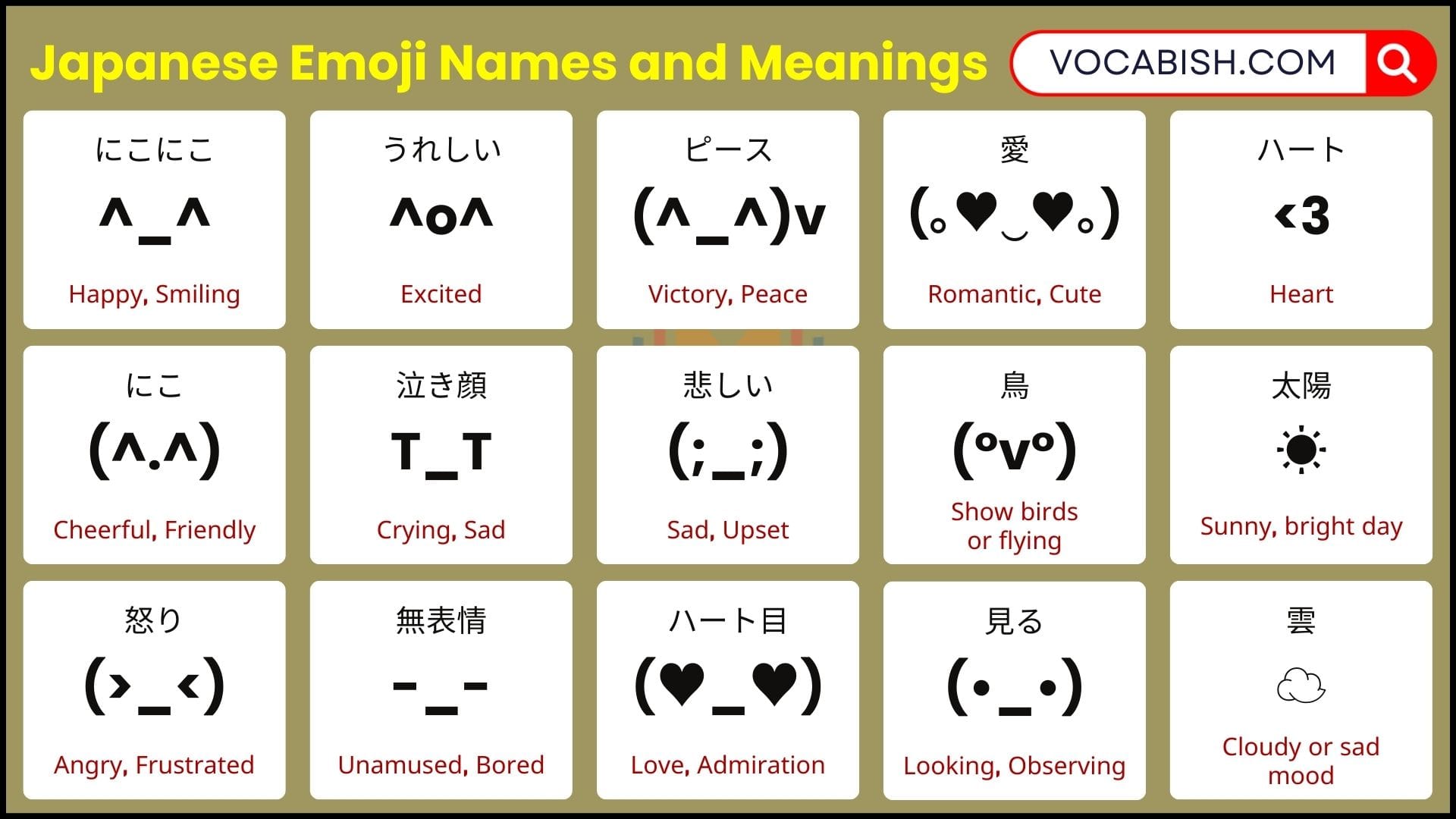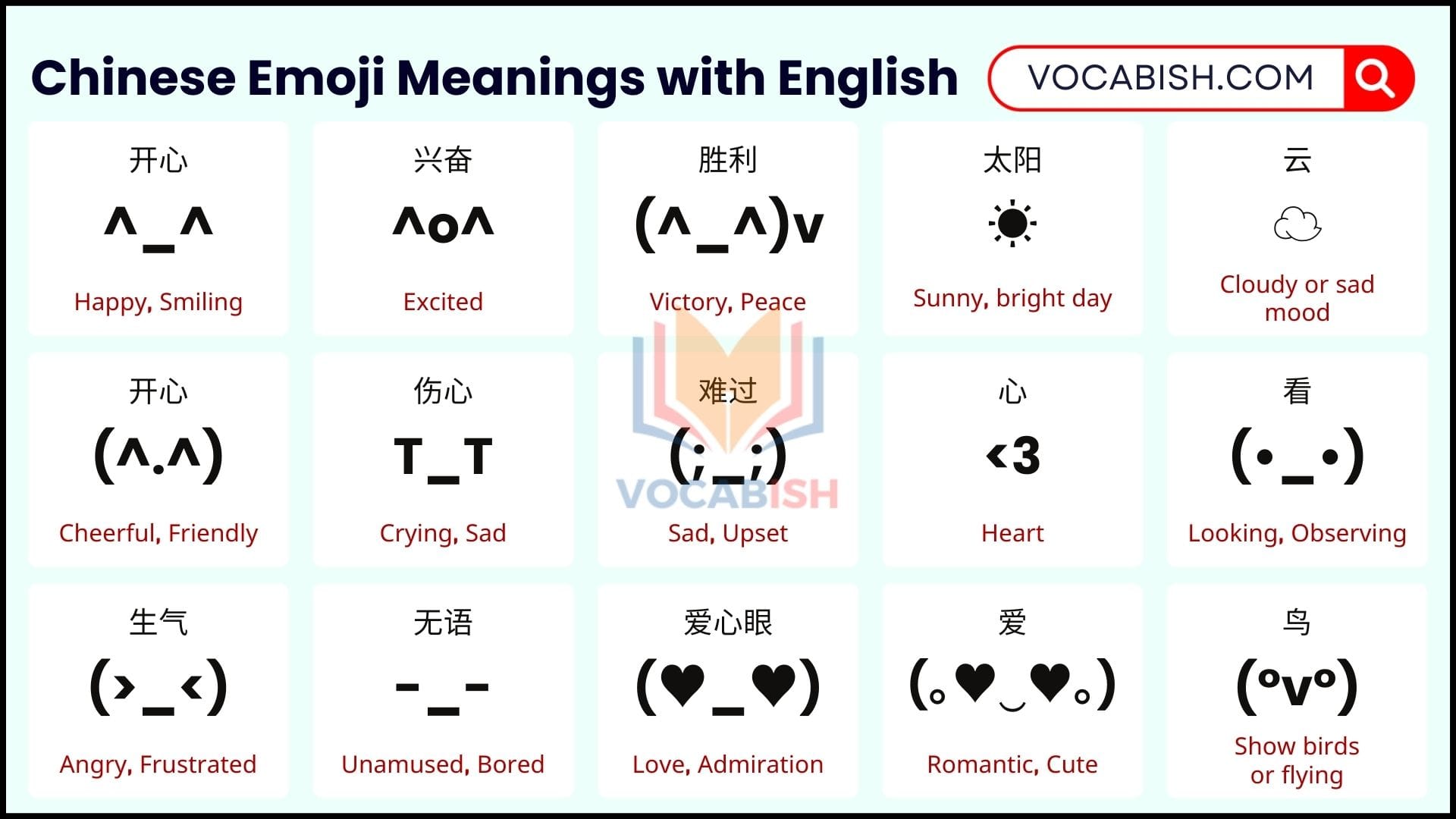
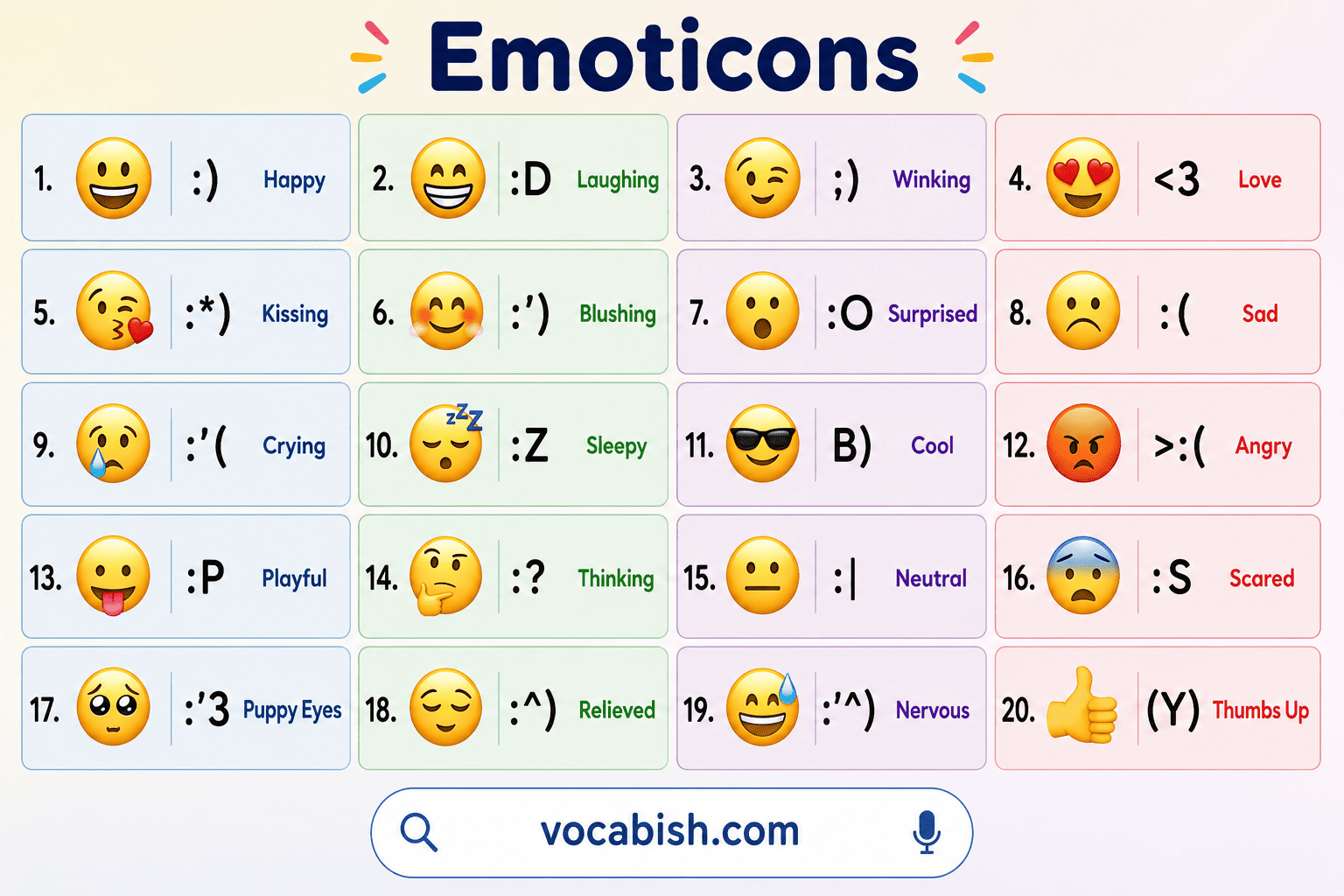

Emoticon Emojis are text-based symbols that help express emotions, reactions, and personality in online conversations. From classic faces like :) and :D to creative designs such as ^_^ and <3, they make messages more engaging and easier to understand. This collection features 100 popular emoticon emojis with clear meanings and ready-to-use copy-paste options, so you can quickly find the perfect one for chats, social media, emails, or everyday communication.
Explore our Emoji Meanings category to learn 1000+ emojis and symbols in English.
What Are Emoticon Emojis?
Emoticon emojis are text-based symbols created with keyboard characters to represent emotions, facial expressions, and reactions in digital conversations. Unlike graphic emojis, they use combinations of letters, numbers, and punctuation marks to create expressive faces or gestures. Popular examples include :) for happiness, :( for sadness, :D for laughter, and <3 for love.
People use emoticon emojis in chats, emails, forums, social media posts, and text messages to make communication feel more personal and engaging. They are easy to type, work on almost any device, and remain a popular way to express feelings even in the age of modern emojis.
The word “emoticon” comes from:
- Emotion
- Icon
Before emojis existed, people used punctuation marks, letters, and symbols to create emotional expressions in messages.
Quick Answer:
Emoticons are text-based symbols made with keyboard characters to express emotions, reactions, and facial expressions in messages. Common examples include:)for happiness,:(for sadness,:Dfor laughter, and<3for love. This collection of 100 popular emoticons explains what each one means, when to use it, and how it helps make online conversations more expressive and engaging.
Common Examples of Emoticons
Emoticon | Meaning |
|---|---|
:) | Happy |
:( | Sad |
:D | Laughing |
;) | Winking |
:P | Playful or teasing |
¯\_(ツ)_/¯ | Shrug/confusion |
Emoticons vs Emojis
Emoticons | Emojis |
|---|---|
Made with keyboard symbols | Graphic icons |
Example: :) | Example: 😊 |
Older internet style | Modern smartphone style |
Even though emojis became more popular, emoticons still remain part of internet culture, gaming chats, forums, and texting language.
List of Most Popular Emoticon Emojis
Heart Emoticon
Heart emoticons represent love, affection, friendship, and emotional connection.
<3
Shows love, care, or affection.
Example: Thank you for always helping me <3
Shrug Emoticon
The shrug emoticon usually means confusion, indifference, or “I don’t know.”
¯\_(ツ)_/¯
Means “I don’t know” or uncertainty.
Example: I do not know why the website is not working ¯_(ツ)_/¯
Star Emoticon
Star symbols often represent excitement, sparkle, fame, or aesthetic text decoration.
☆
Represents stars, excitement, or admiration.
Example: Your presentation was excellent ☆
Arrow Emoticon
Arrow emoticons are used for directions, reactions, emphasis, or aesthetic texting.
-->
Shows direction or movement toward something.
Example: Please go –> to the next page.
Crying With Laughter Emoticon
These emoticons show intense laughter or funny reactions.
xD
Shows very strong laughter or amusement.
Example: That joke made everyone laugh xD
Cat Emoticon
Cat emoticons are playful text faces inspired by anime and internet culture.
=^.^=
A cute cat face used to show happiness or playfulness.
Example: Your kitten is so adorable =^.^=
Kawaii Emoticons
Kawaii emoticons come from Japanese internet culture and focus on cute expressions.
(^▽^)
Japanese-style cute emoticon showing happiness.
Example: I finally passed my English exam (^▽^)
Crying Emoticon
Crying emoticons express sadness, heartbreak, or emotional reactions.
:'(
Shows sadness or crying.
Example: I was very upset after losing my notebook :'(
Hand Emoticon
Hand emoticons represent gestures, greetings, or reactions.
o/
Represents a waving hand or greeting.
Example: Hello everyone o/
Happy Emoticon
Happy emoticons show joy, friendliness, or positivity.
:)
Shows happiness or friendliness.
Example: I enjoyed the school trip today 🙂
IDK Emoticons
These emoticons represent confusion, awkwardness, or uncertainty.
¯\_(ツ)_/¯
Means “I don’t know” or no clear answer.
Example: Why did he leave early ¯_(ツ)_/¯
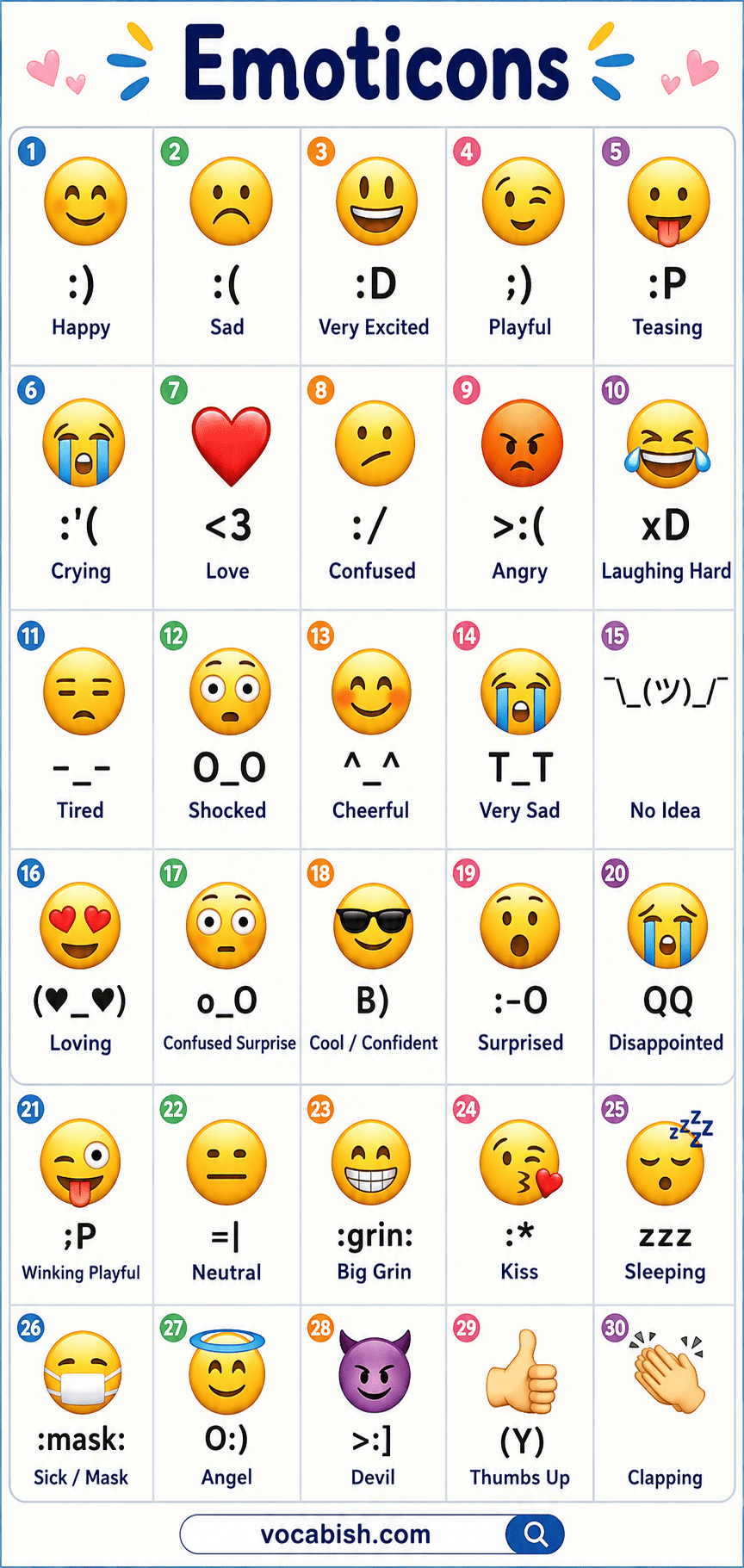
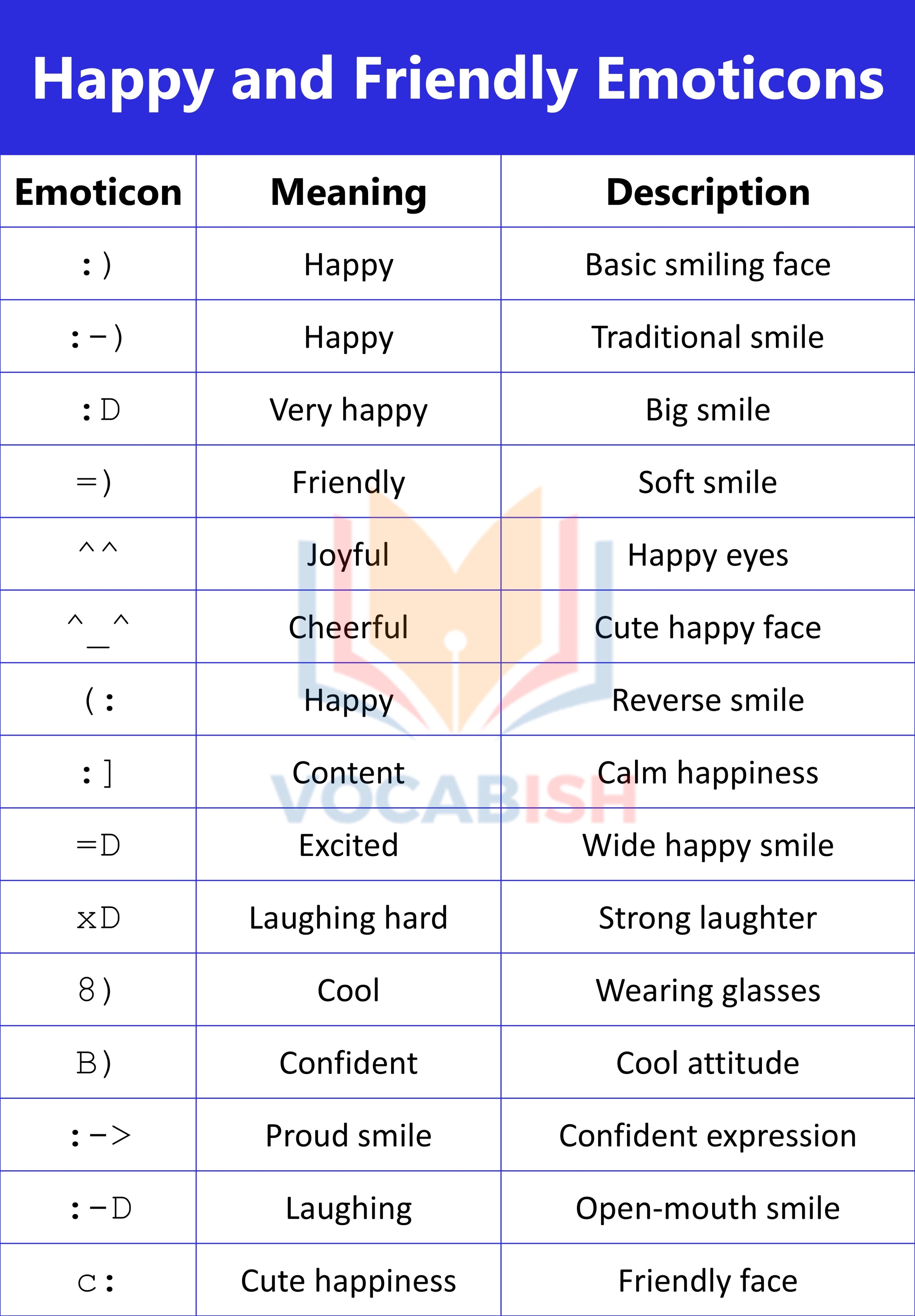
Happy and Friendly Emoticon Emojis
These emoticons create positive and welcoming conversations.
Emoticon | Meaning | Simple Description |
|---|---|---|
:) | Happy | Basic smiling face |
:-) | Happy | Traditional smile |
:D | Very happy | Big smile |
=) | Friendly | Soft smile |
^^ | Joyful | Happy eyes |
^_^ | Cheerful | Cute happy face |
(: | Happy | Reverse smile |
:] | Content | Calm happiness |
=D | Excited | Wide happy smile |
xD | Laughing hard | Strong laughter |
8) | Cool | Wearing glasses |
B) | Confident | Cool attitude |
:-> | Proud smile | Confident expression |
:-D | Laughing | Open-mouth smile |
c: | Cute happiness | Friendly face |
These are commonly used in:
- Text messages
- Gaming chats
- Instagram captions
- Friendly emails
Examples in Everyday Conversation:
- That’s amazing! Congratulations! 🙂
- Thanks for helping me today. 🙂
- See you tomorrow! 😉
- Your presentation was excellent. ^_^
- We finally finished the project! =D
Sad and Emotional Emoticon Emojis
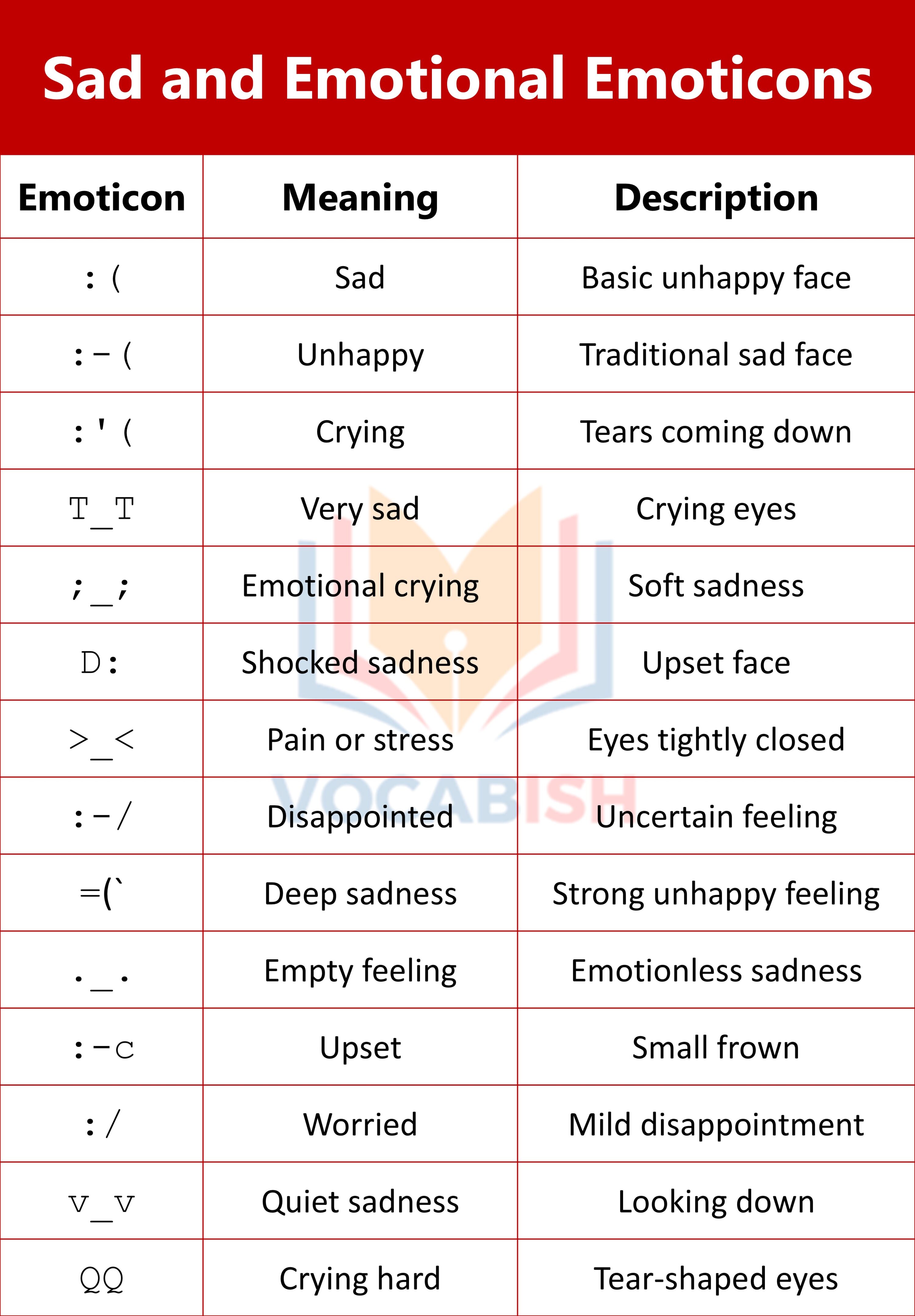
Sad emoticons help express disappointment, heartbreak, loneliness, or emotional pain.
Emoticon | Meaning | Simple Description |
|---|---|---|
:( | Sad | Basic unhappy face |
:-( | Unhappy | Traditional sad face |
:'( | Crying | Tears coming down |
T_T | Very sad | Crying eyes |
;_; | Emotional crying | Soft sadness |
D: | Shocked sadness | Upset face |
>_< | Pain or stress | Eyes tightly closed |
:-/ | Disappointed | Uncertain feeling |
=(` | Deep sadness | Strong unhappy feeling |
._. | Empty feeling | Emotionless sadness |
:-c | Upset | Small frown |
:/ | Worried | Mild disappointment |
v_v | Quiet sadness | Looking down |
QQ | Crying hard | Tear-shaped eyes |
Examples in Everyday Conversations:
- Emma: I missed my flight. 🙁
Lily: I’m so sorry to hear that. - David: My favorite show ended today. T_T
Chris: I know, I’ll miss it too. - Sophia: My phone broke this morning. ;_;
Mia: Hopefully you can get it fixed soon. - Mark: I lost my wallet :'(
John: That’s terrible. Let’s look for it.
Love and Affection Emoticon Emojis
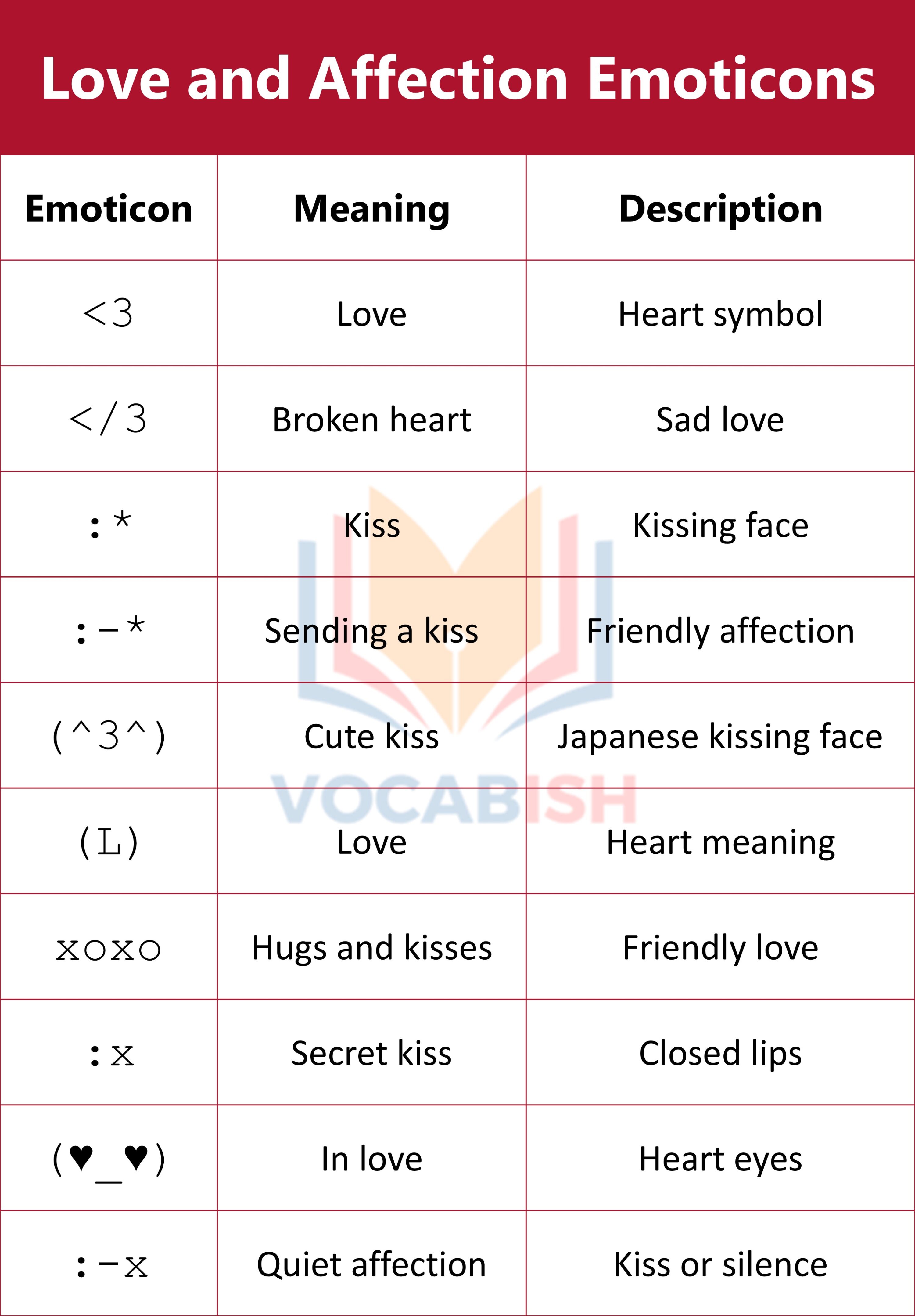
These emoticons show romance, care, support, and affection.
Emoticon | Meaning | Simple Description |
|---|---|---|
<3 | Love | Heart symbol |
3 | Broken heart | Sad love |
:* | Kiss | Kissing face |
:-* | Sending a kiss | Friendly affection |
(^3^) | Cute kiss | Japanese kissing face |
(L) | Love | Heart meaning |
xoxo | Hugs and kisses | Friendly love |
:x | Secret kiss | Closed lips |
(♥_♥) | In love | Heart eyes |
:-x | Quiet affection | Kiss or silence |
Everyday Conversation Examples:
- Noah: Good morning! <3
Emma: Good morning to you too! - Liam: Happy anniversary! :*
Olivia: Thank you, sweetheart! - Jake: Sending you a big hug (づ。◕‿‿◕。)づ
Lucy: I needed that today. - Mason: You’re the best! ♥‿♥
Chloe: Aww, that’s kind of you.
Funny and Playful Emoticon Emojis
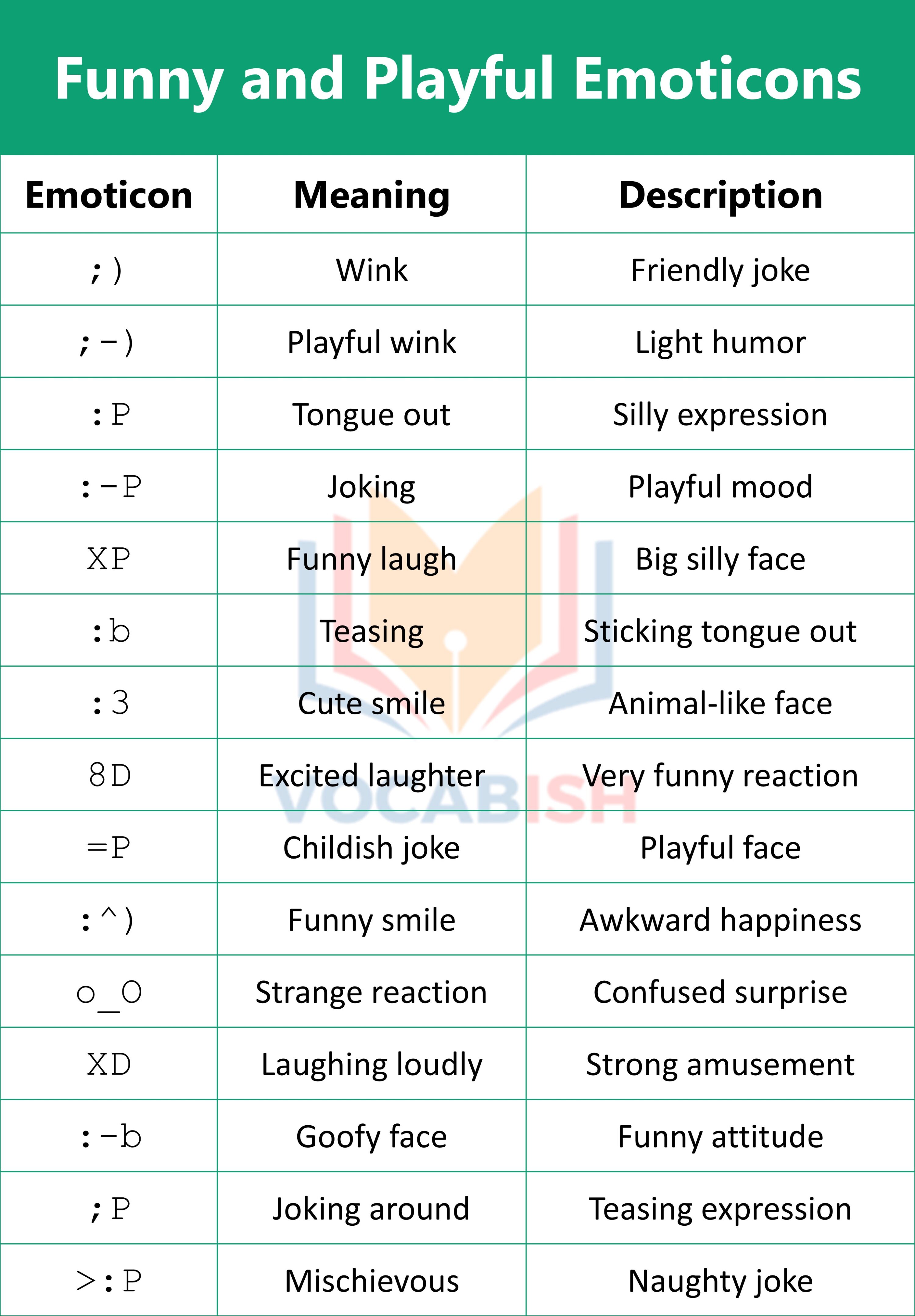
Funny emoticons make conversations feel lighthearted and entertaining.
Emoticon | Meaning | Simple Description |
|---|---|---|
;) | Wink | Friendly joke |
;-) | Playful wink | Light humor |
:P | Tongue out | Silly expression |
:-P | Joking | Playful mood |
XP | Funny laugh | Big silly face |
:b | Teasing | Sticking tongue out |
:3 | Cute smile | Animal-like face |
8D | Excited laughter | Very funny reaction |
=P | Childish joke | Playful face |
:^) | Funny smile | Awkward happiness |
o_O | Strange reaction | Confused surprise |
XD | Laughing loudly | Strong amusement |
:-b | Goofy face | Funny attitude |
;P | Joking around | Teasing expression |
>:P | Mischievous | Naughty joke |
These emoticons became especially popular in:
- Meme culture
- Old Facebook chats
- Online forums
- Gaming communities
Daily Used Examples in Sentences:
- Olivia: I almost believed your story XD
Sophia: Got you! - Jake: Just kidding! ;P
Emma: You scared me for a second. - Chris: I won by pure luck xD
Tom: I’ll let you have this one. - Mia: Don’t steal my fries :3
Anna: No promises!
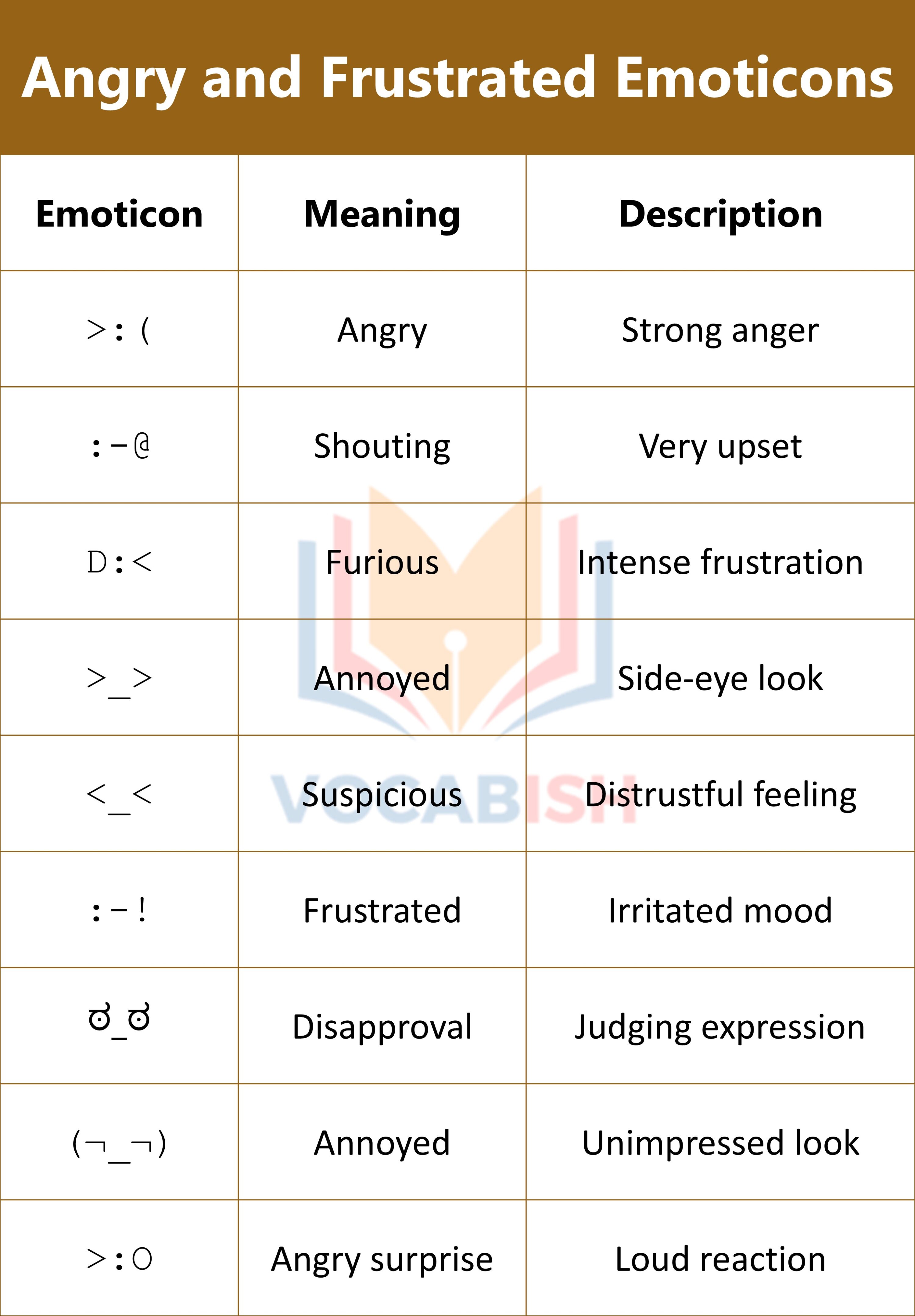
Angry and Frustrated Emoticon Emojis
Angry emoticons express irritation, annoyance, or frustration.
Emoticon | Meaning | Simple Description |
|---|---|---|
>:( | Angry | Strong anger |
:-@ | Shouting | Very upset |
D:< | Furious | Intense frustration |
>_> | Annoyed | Side-eye look |
<_< | Suspicious | Distrustful feeling |
:-! | Frustrated | Irritated mood |
ಠ_ಠ | Disapproval | Judging expression |
(¬_¬) | Annoyed | Unimpressed look |
>:O | Angry surprise | Loud reaction |
Examples in Sentences:
- Jack: Someone scratched my car >:(
Mike: That’s really frustrating. - Emma: My laptop crashed again :@
Lucy: I’d be upset too. - Tom: The internet stopped during my meeting DX
Ben: Bad timing! - Sarah: I waited two hours! >:(
Kate: You deserve an apology.
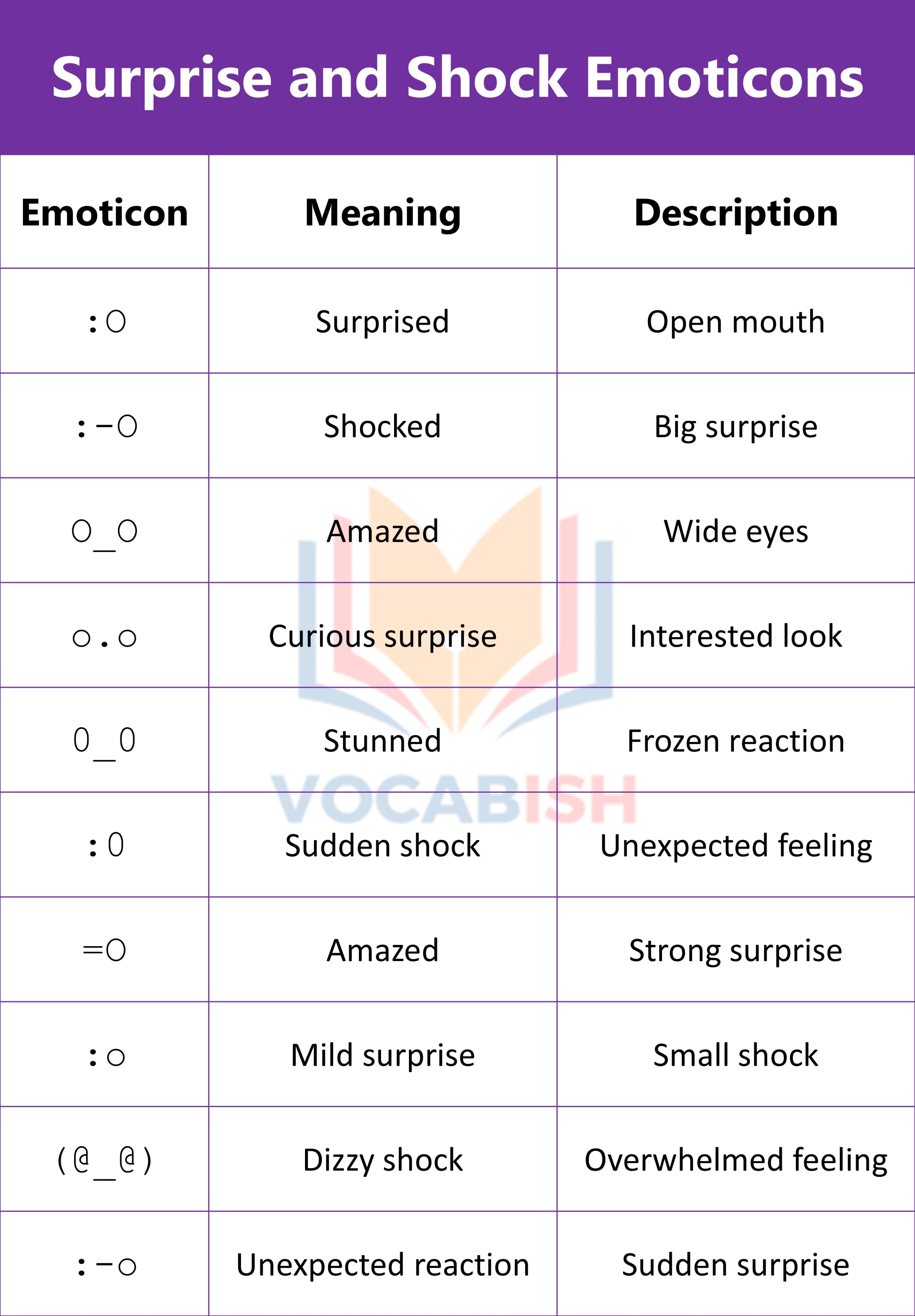
Surprise and Shock Emoticon Emojis
These emoticons represent disbelief, surprise, or sudden reactions.
Emoticon | Meaning | Simple Description |
|---|---|---|
:O | Surprised | Open mouth |
:-O | Shocked | Big surprise |
O_O | Amazed | Wide eyes |
o.o | Curious surprise | Interested look |
0_0 | Stunned | Frozen reaction |
:0 | Sudden shock | Unexpected feeling |
=O | Amazed | Strong surprise |
:o | Mild surprise | Small shock |
(@_@) | Dizzy shock | Overwhelmed feeling |
:-o | Unexpected reaction | Sudden surprise |
Emoticons in Everyday Conversation:
- Emily: I won the competition!
Lisa: Seriously? Congratulations.:O - David: They’re giving everyone a bonus O_O
John: That’s unexpected. - Chris: The tickets sold out in one minute D:
Ben: Wow, that’s fast.
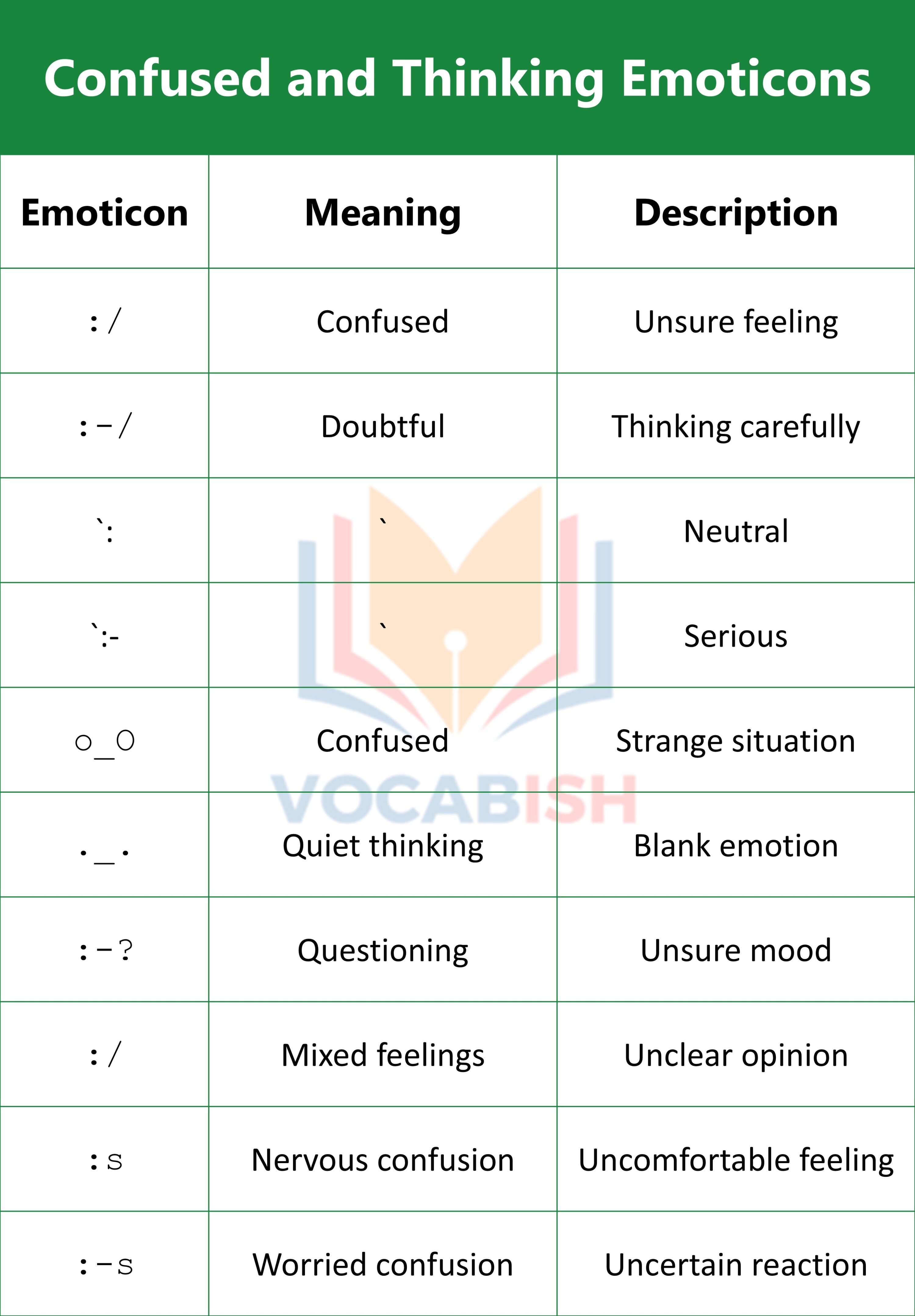
Confused and Thinking Emoticon Emojis
These emoticons show confusion, deep thought, or awkward reactions.
Emoticon | Meaning | Simple Description |
|---|---|---|
:/ | Confused | Unsure feeling |
:-/ | Doubtful | Thinking carefully |
`: | ` | Neutral |
`:- | ` | Serious |
o_O | Confused | Strange situation |
._. | Quiet thinking | Blank emotion |
:-? | Questioning | Unsure mood |
:/ | Mixed feelings | Unclear opinion |
:s | Nervous confusion | Uncomfortable feeling |
:-s | Worried confusion | Uncertain reaction |
Examples:
- Liam: Which train should we take? :/
Emma: Let me check the schedule. - Olivia: I don’t understand this question :-\
Mia: I’ll explain it. - Kate: Something feels strange -_-
Lucy: I noticed it too.
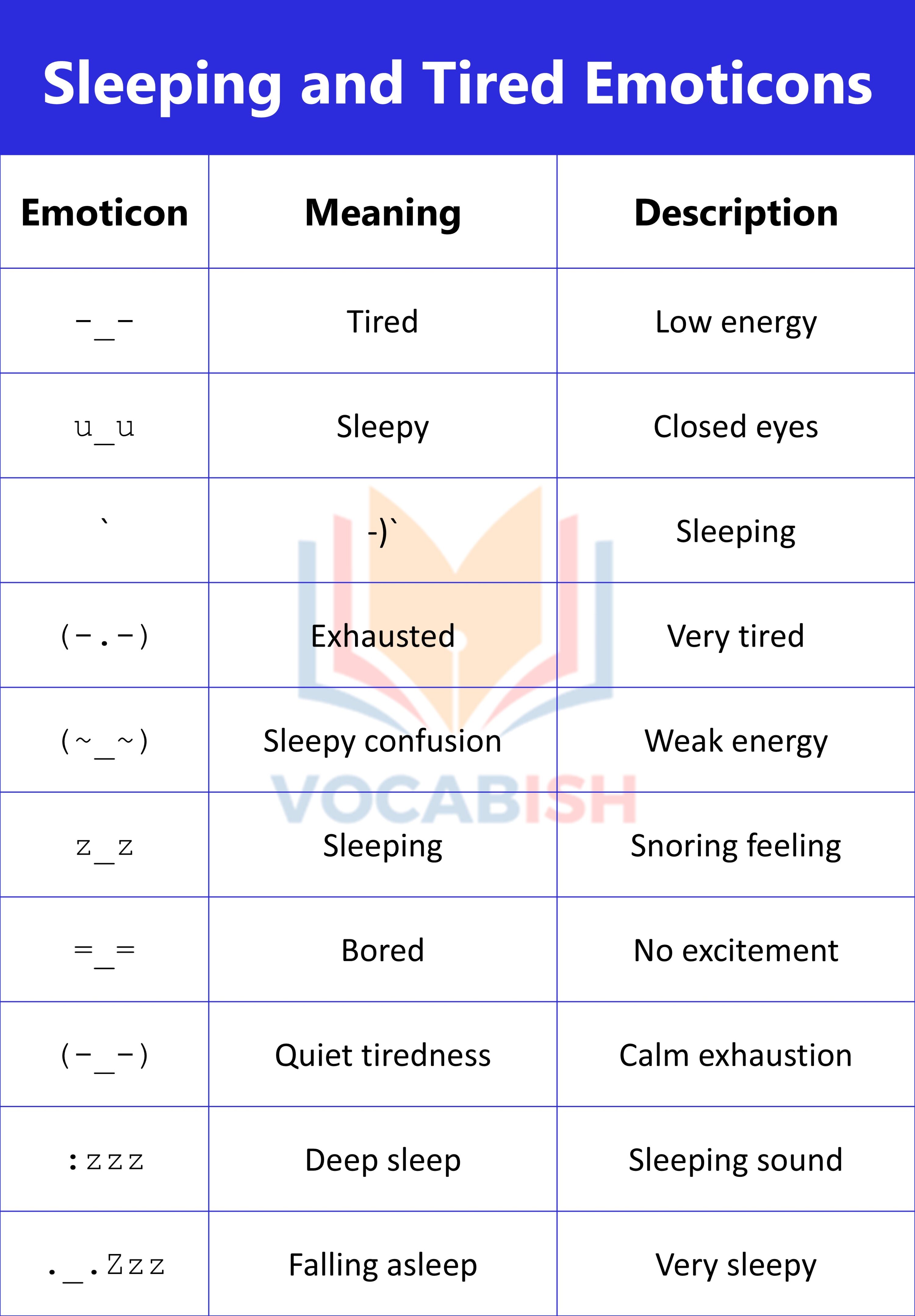
Sleeping and Tired Emoticons
Sleeping emoticons express exhaustion, boredom, or sleepiness.
Emoticon | Meaning | Simple Description |
|---|---|---|
-_- | Tired | Low energy |
u_u | Sleepy | Closed eyes |
` | -)` | Sleeping |
(-.-) | Exhausted | Very tired |
(~_~) | Sleepy confusion | Weak energy |
z_z | Sleeping | Snoring feeling |
=_= | Bored | No excitement |
(-_-) | Quiet tiredness | Calm exhaustion |
:zzz | Deep sleep | Sleeping sound |
._.Zzz | Falling asleep | Very sleepy |
Examples:
- Emma: I only slept three hours
-_-
Lily: You should rest tonight. - Tom: Long day at work x_x
Jake: Get some sleep. - Ben: I can’t keep my eyes open Zzz
Chris: Coffee might help. - Amy: Finals are over… x_x
Lisa: Time for a vacation!
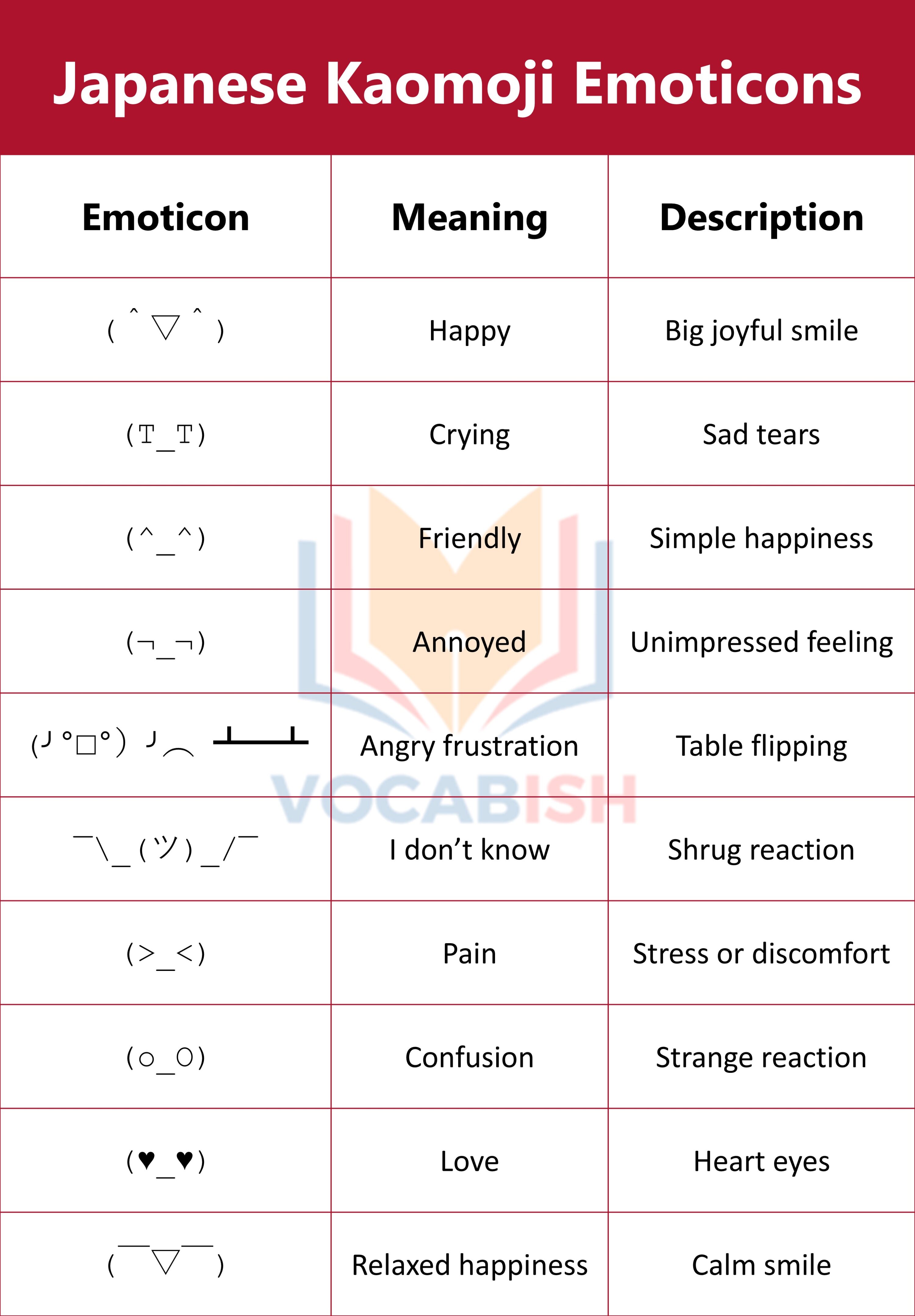
Japanese Kaomoji Emoticons
Kaomoji are Japanese-style emoticons that focus on expressive eyes instead of mouth shapes.
Unlike Western emoticons, kaomoji don’t require tilting your head.
Emoticon | Meaning | Simple Description |
|---|---|---|
(^▽^) | Happy | Big joyful smile |
(T_T) | Crying | Sad tears |
(^_^) | Friendly | Simple happiness |
(¬_¬) | Annoyed | Unimpressed feeling |
(╯°□°)╯︵ ┻━┻ | Angry frustration | Table flipping |
¯\_(ツ)_/¯ | I don’t know | Shrug reaction |
(>_<) | Pain | Stress or discomfort |
(o_O) | Confusion | Strange reaction |
(♥_♥) | Love | Heart eyes |
( ̄▽ ̄) | Relaxed happiness | Calm smile |
Kaomoji spread worldwide through:
- Anime fandoms
- Discord servers
- TikTok culture
- Gaming communities
They feel expressive, cute, and visually creative.
Examples in Sentences:
- Mia: I finally got the job! (≧▽≦)
Emma: That’s wonderful news! - Ryan: Here’s a hug (づ。◕‿‿◕。)づ
Anna: Thank you! - Tom: Everything worked out (⌒‿⌒)
Jake: I’m happy for you. - Ben: That movie was amazing (•‿•)
Chris: I loved it too.
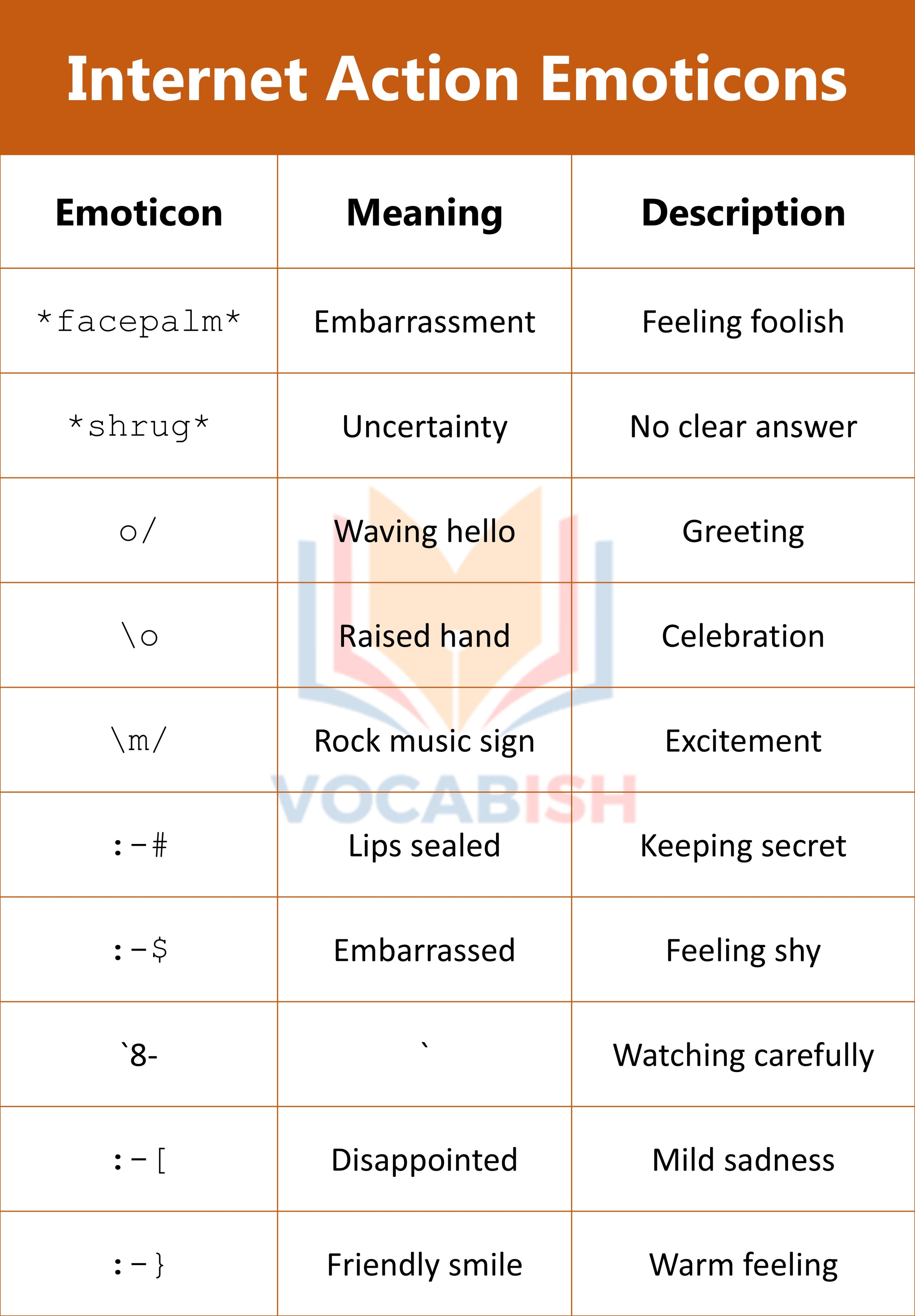
Internet Action Emoticons
These emoticons represent actions rather than emotions.
Emoticon | Meaning | Simple Description |
|---|---|---|
*facepalm* | Embarrassment | Feeling foolish |
*shrug* | Uncertainty | No clear answer |
o/ | Waving hello | Greeting |
\o | Raised hand | Celebration |
\m/ | Rock music sign | Excitement |
:-# | Lips sealed | Keeping secret |
:-$ | Embarrassed | Feeling shy |
`8- | ` | Watching carefully |
:-[ | Disappointed | Mild sadness |
:-} | Friendly smile | Warm feeling |
These action-style emoticons became very common in forums and roleplay chats.
Examples:
- Alex: I give up ¯_(ツ)_/¯
Ryan: We’ll try again tomorrow. - Ben: My computer froze (╯°□°)╯︵ ┻━┻
Tom: Stay calm! - Jake: Easy now ┬─┬ ノ( ゜-゜ノ)
Chris: You’re right. - Mia: That’s the restaurant ☞゚ヮ゚☞
Olivia: I see it now!
Emoticons to Copy Paste
Tips for Using Emoticons Correctly
- Use emoticons mainly in informal writing.
- Avoid too many emoticons in professional emails.
- Learn the emotional meaning before using one.
- Different cultures may use emoticons differently.
- Simple emoticons are easiest for beginners.
Download PDF
Frequently Asked Questions
Emoticons are keyboard-made symbols used to express emotions, reactions, or facial expressions in text messages and online conversations.
No. Emoticons use keyboard characters like : ) while emojis are graphic icons like 😊.
Many people use emoticons because they feel nostalgic, simple, expressive, and compatible across all devices.
XD represents intense laughter. The “X” shows closed laughing eyes, while “D” represents a wide open laughing mouth.
The shrug emoticon ¯_(ツ)_/¯ means confusion, uncertainty, or indifference.
Kaomoji are Japanese-style emoticons such as (^▽^) or (╥﹏╥) that use detailed text characters to show emotions.
Yes. Even with emojis dominating social media, emoticons remain popular in texting, gaming, anime communities, forums, and meme culture.
Related Articles: