
Prepositions are small words like in, on, and at that connect different parts of a sentence and show relationships between them. In this blog post, you will learn Prepositions in English: Definition, Types, Uses, and Examples so you can understand how these words are used in real sentences. Many English learners feel confused because prepositions do not always match their native language patterns, but once you understand the basics, your sentences start to sound more natural and correct.
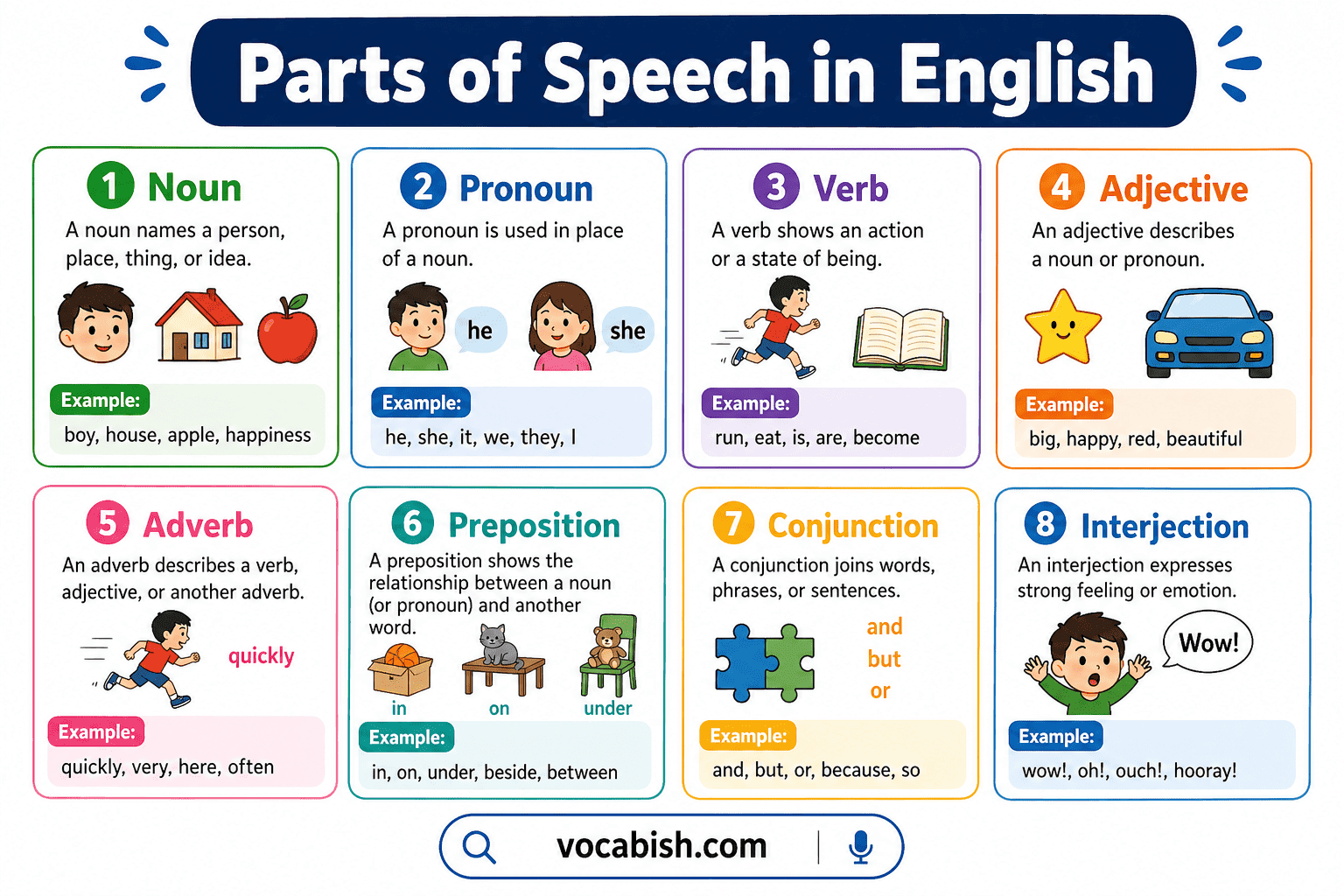
If you want to understand how nouns, verbs, and adjectives connect, go through our complete English grammar structure guide.
Introduction to Prepositions
Prepositions are small words, but they carry a lot of meaning. They connect ideas and show relationships such as time, place, direction, cause, and manner.
You might not notice them when reading or listening, but removing them usually makes a sentence unclear or incomplete.
Think about this:
- The book is the table. (confusing)
- The book is on the table. (clear)
That small word “on” completely changes the meaning.
What is a Preposition? (Definition and Meaning)
A preposition is a word that shows the relationship between a noun or pronoun and another word in the sentence.
Most commonly, it connects:
- a noun/pronoun → to a verb, adjective, or another noun
Why does this matter? Because English depends heavily on word order, and prepositions help “explain” that order.
Examples:
- The cat is under the bed.
- She arrived at the airport.
- We walked through the park.
In each case, the preposition shows where, when, or how something happens.
Why Prepositions are Important in English
Without prepositions, English becomes vague or completely incorrect.
They help you:
- Show time relationships (when something happens)
- Show location (where something is)
- Show direction (movement)
- Show reason or cause
- Link ideas naturally in speech and writing
If you remove prepositions, meaning breaks down quickly.
Examples:
- I’ll meet you Monday. (sounds incomplete)
- I’ll meet you on Monday. (correct and natural)
Most learners struggle because prepositions don’t always follow strict logic. Instead, they depend on usage and patterns.
Functions of Prepositions in Sentences
Prepositions perform several key functions:
- Showing time: at 5 PM, in July
- Showing place: on the table, in the room
- Showing direction: to school, into the car
- Showing reason: because of rain
- Linking ideas: with confidence
They always introduce a prepositional phrase, which adds extra information to a sentence.
Example:
- She sat on the chair.
Here, “on the chair” gives location information.
Types of Prepositions with Definition and Examples
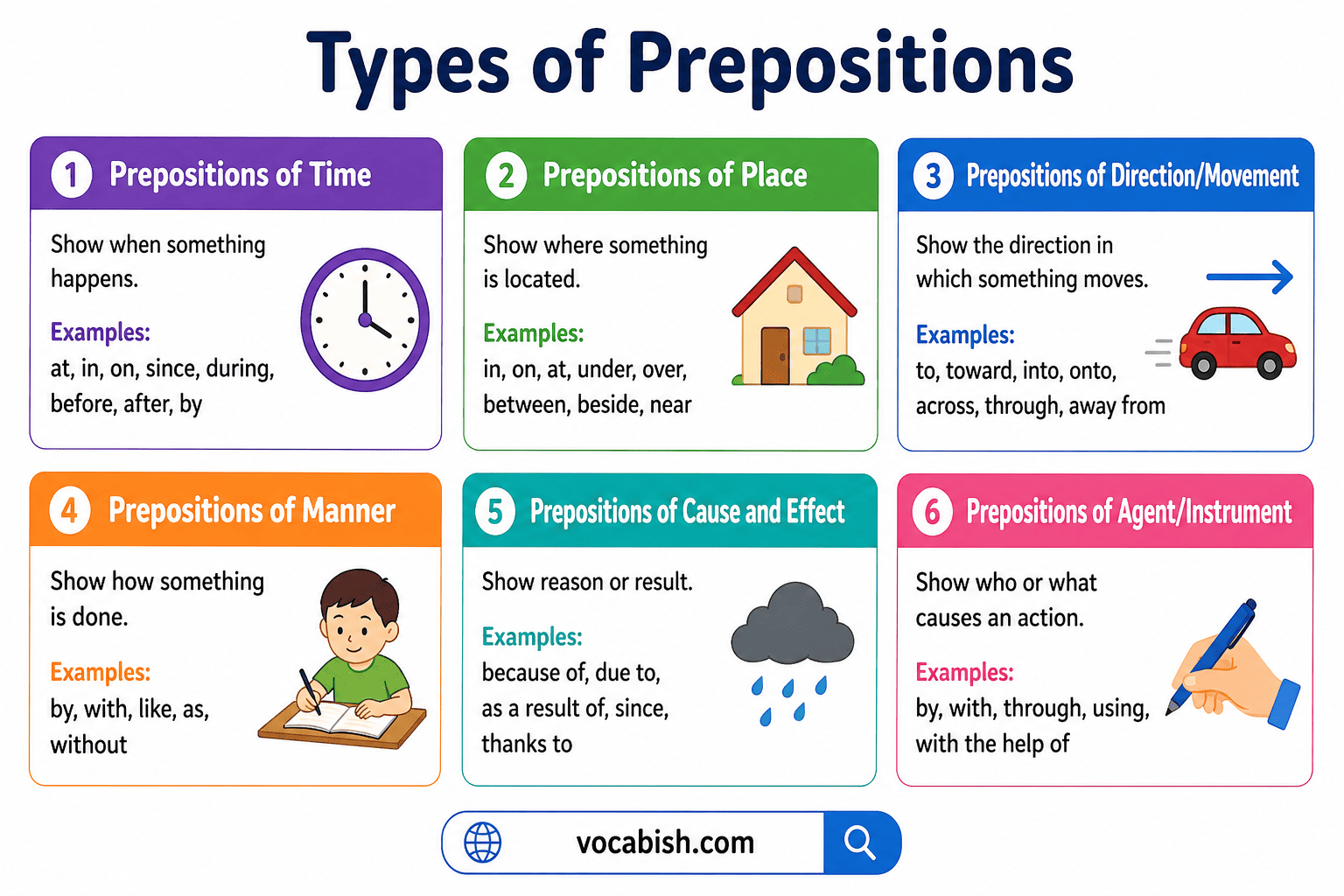
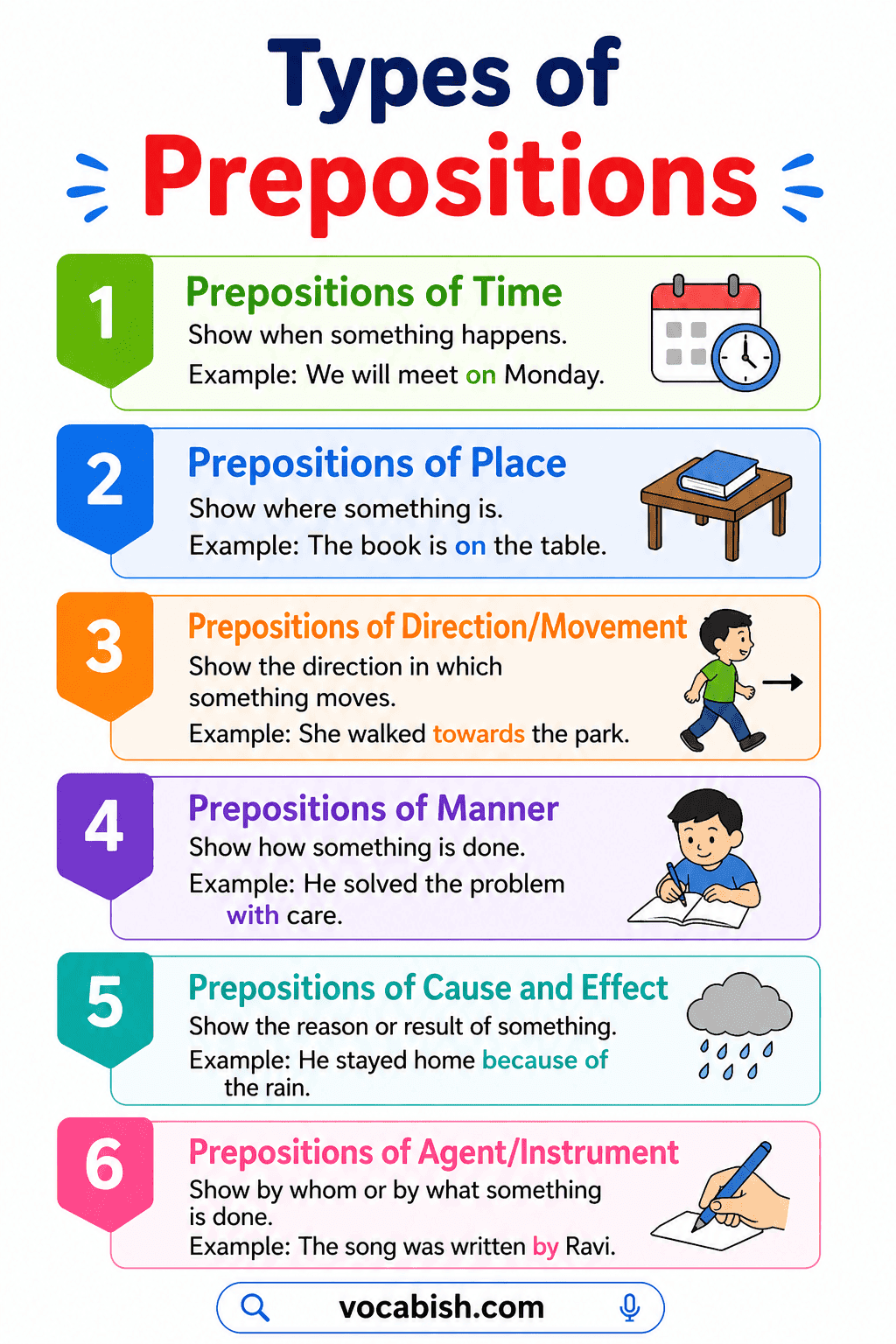
English prepositions can be grouped by function. Let’s break them down clearly.
1. Prepositions of Time
These show when something happens.
Common ones: at, on, in, before, after
Why this works: time is structured in layers (seconds → days → years), and each preposition matches a level.
Examples:
- I’ll see you at 6 PM.
- She was born in 2001.
- We met on Monday.
- He left after dinner.
2. Prepositions of Place
These show where something is located.
Common ones: in, on, at, under, between
Examples:
- The keys are on the table.
- She is in the room.
- He stood at the door.
- The ball is under the chair.
3. Prepositions of Direction/Movement
These show movement from one place to another.
Common ones: to, into, onto, through, across
Examples:
- She went to school.
- He walked into the room.
- The car drove through the tunnel.
- They ran across the street.
4. Prepositions of Manner
These show how something is done.
Common ones: by, with, like
Examples:
- She spoke with confidence.
- He traveled by train.
- She sings like a professional.
5. Prepositions of Cause and Effect
These explain why something happens.
Common ones: because of, due to, from
Examples:
- The match was canceled because of rain.
- He was tired due to lack of sleep.
- She screamed from fear.
6. Prepositions of Agent/Instrument
These show who or what performs an action.
Common ones: by, with
Examples:
- The book was written by J.K. Rowling.
- The door was opened with a key.
7. Phrase Prepositions
These are multi-word prepositions.
Common ones: in front of, on behalf of, in spite of
Examples:
- She stood in front of the mirror.
- He spoke on behalf of the team.
- In spite of the rain, we went out.
Common Prepositions List
Here are some frequently used prepositions:
Time | Place | Direction | Other |
|---|---|---|---|
at, on, in | in, on, under | to, into, onto | by, with, about |
before, after | between, near | through, across | of, for, from |
This is not a complete list, but it covers the most essential ones you’ll use daily.
Preposition Rules and Usage
Prepositions follow patterns rather than strict grammar rules.
Key guidelines:
- A preposition is always followed by a noun or pronoun
- Prepositions never stand alone in standard grammar
- They form prepositional phrases
- Meaning often depends on context, not translation
Examples:
- She is good at English.
- They talked about the problem.
- We arrived in time.
Most learners try to translate directly from their native language. That’s where mistakes start.
Prepositional Phrases
What is a Prepositional Phrase?
A prepositional phrase is a group of words that begins with a preposition and ends with a noun or pronoun.
Structure:
Preposition + noun/pronoun (+ modifiers)
It acts like an adjective or adverb in a sentence.
Examples of Prepositional Phrases
- in the morning
- on the table
- with a smile
- at the station
Examples in sentences:
- She arrived in the morning.
- The book on the table is mine.
- He answered with a smile.
Common mistake: forgetting the object of the preposition.
Position of Prepositions in Sentences
Prepositions usually come before a noun or pronoun.
However, in questions and relative clauses, they may appear at the end.
Examples:
- Who are you talking to?
- This is the house I lived in.
Formal writing sometimes moves the preposition forward:
- To whom are you talking?
Both are correct, but informal English prefers end placement.
How to Identify a Preposition in a Sentence
To find a preposition, ask:
- Is it showing location, time, direction, or relationship?
- Is it followed by a noun or pronoun?
- Does it connect two ideas?
Example:
- She sat beside her friend.
“beside” shows relationship → preposition.
Common Mistakes with Prepositions
1: Wrong time preposition
- Wrong: I was born on 2000.
- Correct: I was born in 2000.
- Why: years take “in,” not “on.”
2: Using “in” instead of “at”
- Wrong: She is in the bus stop.
- Correct: She is at the bus stop.
- Why: “at” refers to a point/location.
3: Confusing “to” and “for”
- Wrong: This gift is to you.
- Correct: This gift is for you.
- Why: “for” shows purpose or benefit.
4: Leaving out the preposition
- Wrong: She arrived the airport.
- Correct: She arrived at the airport.
- Why: verbs like “arrive” need prepositions.
Prepositions Exercise
Identify the Preposition:
Find the preposition in each sentence:
- She is in the kitchen.
- They walked through the park.
- He arrived at noon.
- The pen is on the desk.
Answers:
- in
- through
- at
- on
Fill in the Blanks:
- She is good ___ English.
- I will meet you ___ Monday.
- The keys are ___ the table.
- He traveled ___ train.
Answers:
- at
- on
- on
- by
Multiple Choice Questions:
- She arrived ___ the airport.
a) in
b) at
c) on - The book is ___ the bag.
a) in
b) at
c) on - He walked ___ the room.
a) into
b) on
c) at
Answers:
- b) at
- a) in
- a) into
FAQs about Prepositions
Prepositions are words like in, on, at, by, and with that show relationships between nouns or pronouns and other words, such as time, place, direction, or manner in a sentence.
The most common prepositions include in, on, at, by, for, with, about, under, over, and between. These are used daily to show time, place, and relationships.
Use at for exact time (at 5 PM), on for days and dates (on Monday), and in for longer periods like months, years, or centuries (in 2020).
A prepositional phrase is a group of words starting with a preposition and ending with a noun or pronoun, like “in the room” or “on the table,” adding extra sentence detail.
Yes, in modern English, ending a sentence with a preposition is common and natural in speaking and informal writing, such as “Who are you talking to?”
Main types include prepositions of time, place, direction, manner, cause, and agent. Each type shows a different relationship between words in a sentence.
Common mistakes include using wrong time prepositions like “on 2020” instead of “in 2020,” or omitting needed prepositions after verbs like “arrive at.”
Conclusion
Prepositions are small but powerful words that shape meaning in English sentences. Once you understand how they connect time, place, direction, and relationships, your English becomes clearer and more natural.
The key is not memorizing endless lists, but learning patterns and practicing real examples. The more you see them in context, the more intuitive they become.
You May Also Like: