
This article explains the important parts of the present perfect continuous tense, also called the present perfect progressive tense. You will learn what this tense means, how to form it correctly, and how to use it for ongoing actions, duration, and situations with since and for. You’ll also see examples, simple structure charts, and practice exercises with answers to help you build correct and natural English sentences.
If you want to read about the structures of verb tenses, then you may visit this link: Tense Structure
Present Perfect Continuous Tense
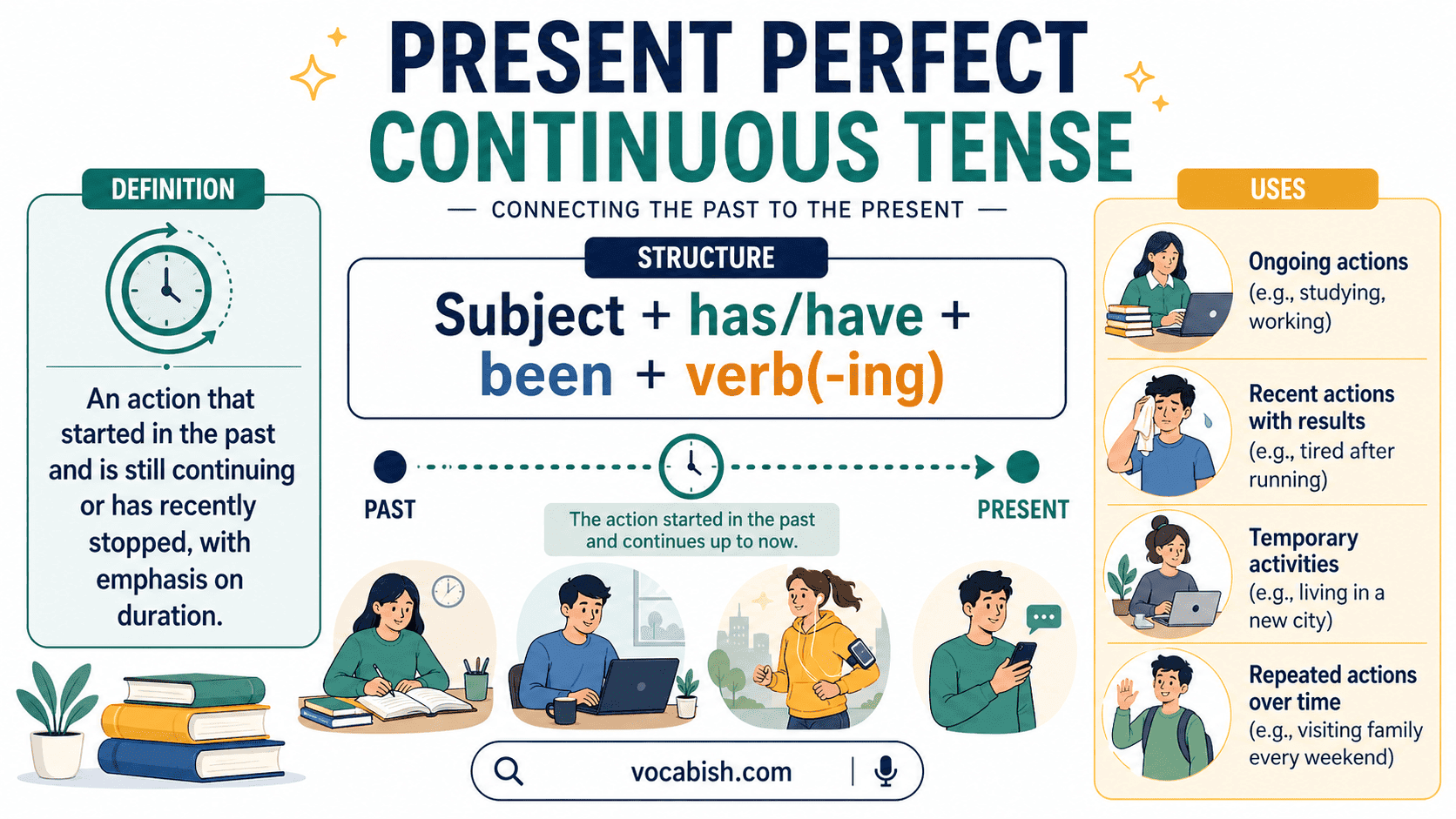
The present perfect continuous tense, also called the present perfect progressive, is used to talk about actions that began in the past and are still continuing now, or actions that recently stopped but still have visible results.
It connects the past with the present, which is why learners often use it when discussing duration, ongoing situations, or recent activity.
Look at this timeline idea:
Past → → → Now
The action started earlier and continues up to the present moment.
For example:
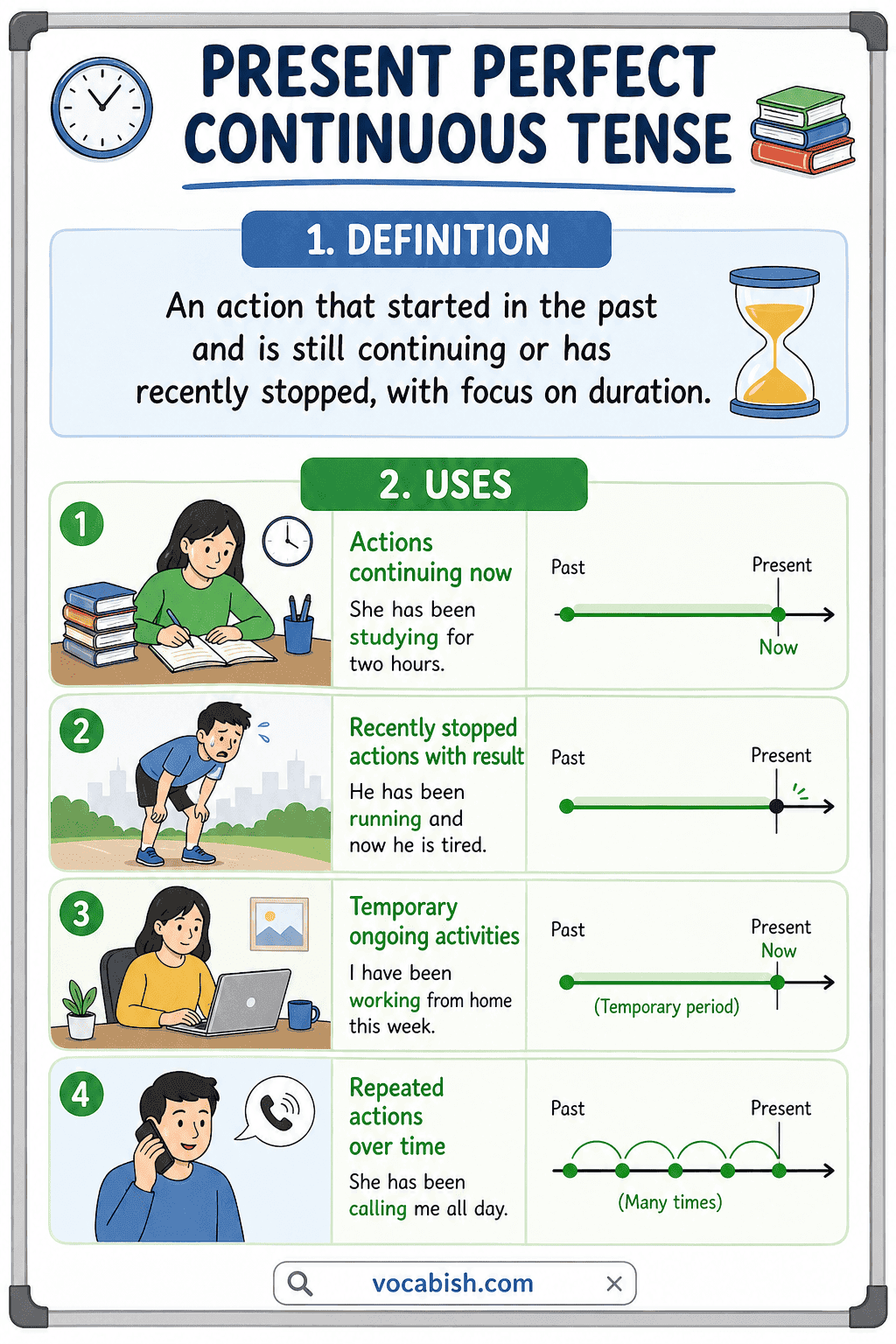
- She has been studying for three hours.
- They have been living in London since 2022.
In both examples, the activity began in the past and continues now.
This tense is also useful when a recent action leaves evidence in the present:
- Your clothes are wet. Have you been walking in the rain?
- He looks tired because he has been working all day.
Here, the activity may have stopped, but its effect is still noticeable.
The present perfect continuous usually works best with dynamic verbs because they describe actions or changing activities.
Common verb types include:
Verb Type | Examples |
|---|---|
Activities | learn, read, listen |
Processes | grow, change, improve |
Bodily sensations | ache, hurt, feel |
Transitional events | arrive, leave |
Short repeated actions | kick, hit, jump |
Stative verbs are not commonly used in this tense because they describe states, not ongoing actions.
Examples of stative verbs:
- know
- believe
- understand
- own
- love
Incorrect:
- I have been knowing her for years.
Correct:
- I have known her for years.
Present Perfect Continuous Tense Structure
The structure is simple once you remember the helping verbs.
Basic Structure:
Subject + has/have + been + verb (-ing)
Examples:
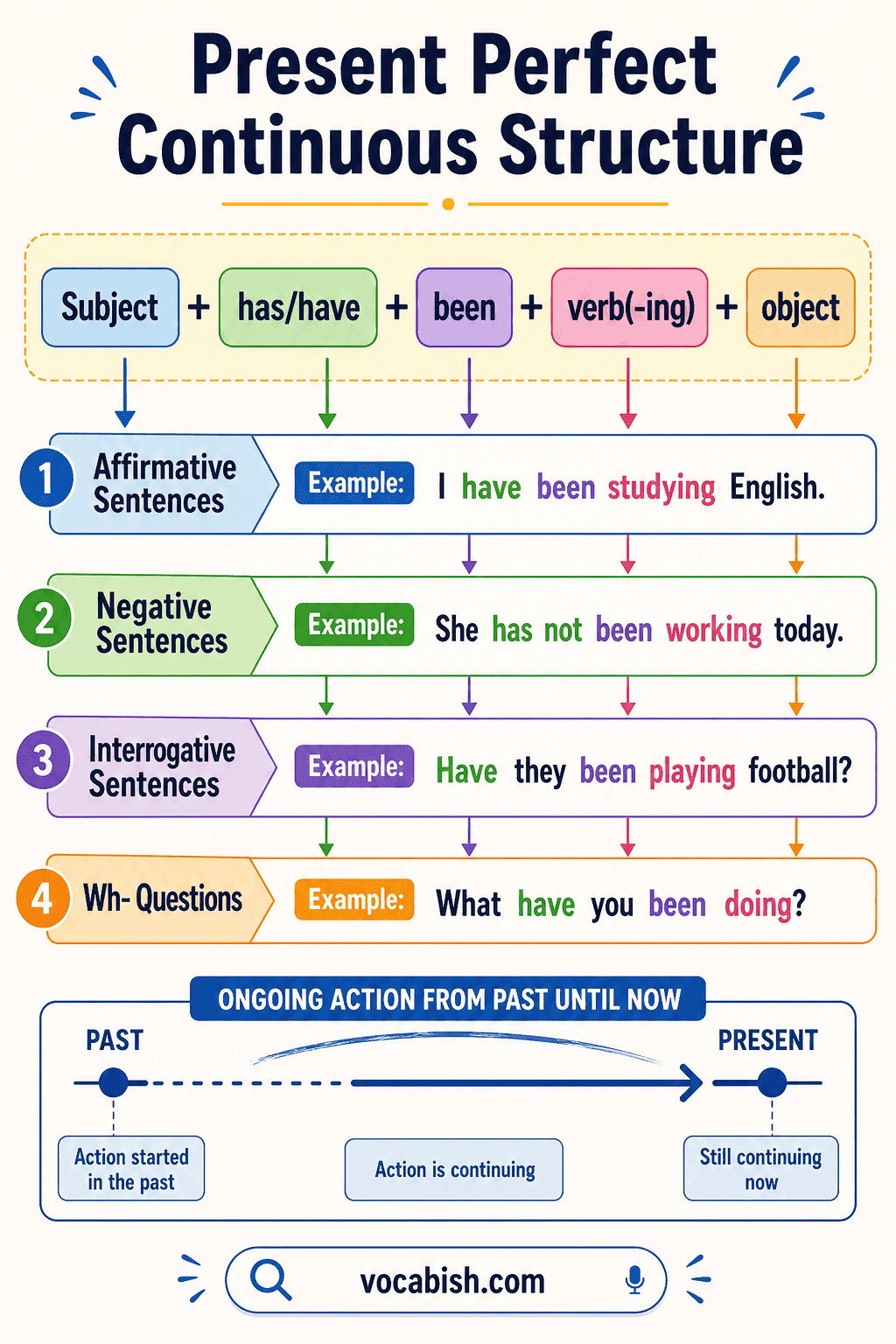
- I have been reading this book.
- She has been learning English.
- We have been waiting for the bus.
Use:
- has → he, she, it, singular nouns
- have → I, you, we, they, plural nouns
The main verb always takes -ing form.
Present Perfect Progressive Contractions
In everyday English, contractions are very common.
Full Form | Contraction |
|---|---|
I have | I’ve |
You have | You’ve |
He has | He’s |
She has | She’s |
We have | We’ve |
They have | They’ve |
Negative contractions:
Full Form | Contraction |
|---|---|
have not | haven’t |
has not | hasn’t |
Examples:
- I’ve been practicing all morning.
- She’s been talking on the phone for hours.
- They haven’t been sleeping well lately.
Formation and Examples of Perfect Continuous Tense Structure
Positive Sentences
Positive sentences describe ongoing actions or activities.
Formula: Subject + has/have + been + verb(-ing) + object
Examples:
- I have been writing notes since morning.
- He has been exercising for two months.
- They have been watching television all evening.
- We have been preparing for the exam.
- The baby has been crying for an hour.
Notice the use of since and for:
- since → starting point
(since Monday, since 9 AM, since 2020) - for → duration
(for two hours, for a week, for months)
Negative Sentences
Negative sentences show that an action has not been continuing.
Structure: Subject + has/have + not + been + verb (-ing)
Examples:
- She has not been feeling well lately.
- I have not been sleeping enough.
- They haven’t been attending classes regularly.
- He hasn’t been working this week.
- We have not been using the old computer.
Questions
Questions are formed by placing has or have at the beginning.
Formula: Has/Have + subject + been + verb (-ing)?
Examples:
- Have you been studying for the test?
- Has she been working here long?
- Have they been waiting outside?
- Has it been raining since morning?
- Have we been talking too loudly?
Question words can also be added:
- How long have you been learning English?
- Why has he been shouting?
How to Use the Present Perfect Progressive Tense
The present perfect progressive is mainly used in three situations.
1. Express Long Actions That Started in the Past and Continue Until Now
This is the most common use.
The action began earlier and is still happening.
Examples:
- I have been learning English for three years.
- She has been teaching since 2018.
- They have been building the house for months.
Time expressions often appear with this use:
- for two days
- since morning
- for a long time
- since last week
Since vs For
Word | Use |
|---|---|
Since | Starting point |
For | Period of time |
Examples:
- He has been living here since 2021.
- He has been living here for three years.
2. Express Recent Actions With Visible Results
Sometimes the activity recently stopped, but we can still see the result now.
Examples:
- The ground is wet because it has been raining.
- She looks exhausted because she has been running.
- Your hands are dirty. Have you been gardening?
The focus is often on the evidence or effect.
3. Describe Temporary or Short-Term Situations
This tense often sounds more temporary than the present perfect simple.
Examples:
- I have been staying with my cousin this week.
- He has been using my laptop recently.
- We have been eating out a lot these days.
These situations may change soon.
Compare:
- She has worked here for ten years.
(focus on fact or completion) - She has been working here for ten years.
(focus on the ongoing activity)
Exercises of Present Perfect Continuous Tense with Answers
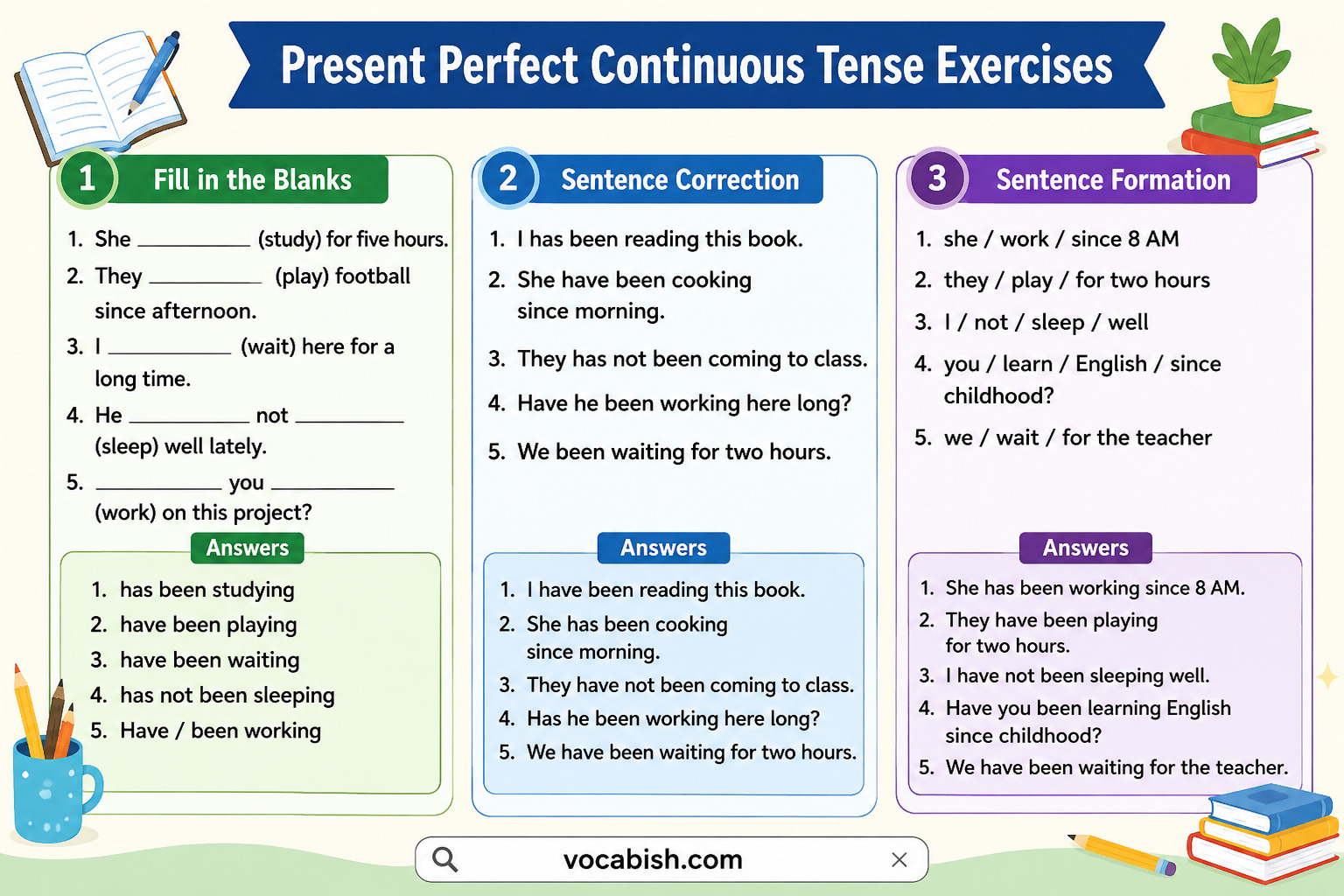
Fill in the Blanks
Complete the sentences using the correct form of the verb.
- She __________ (study) for five hours.
- They __________ (play) football since afternoon.
- I __________ (wait) here for a long time.
- He __________ not __________ (sleep) well lately.
- __________ you __________ (work) on this project?
Answer Key:
- has been studying
- have been playing
- have been waiting
- has not been sleeping
- Have / been working
Sentence Correction
Correct the mistakes in these sentences.
- I has been reading this book.
- She have been cooking since morning.
- They has not been coming to class.
- Have he been working here long?
- We been waiting for two hours.
Answer Key:
- I have been reading this book.
- She has been cooking since morning.
- They have not been coming to class.
- Has he been working here long?
- We have been waiting for two hours.
Sentence Formation
Make complete sentences using the given words.
- she / work / since 8 AM
- they / play / for two hours
- I / not / sleep / well
- you / learn / English / since childhood?
- we / wait / for the teacher
Answer Key:
- She has been working since 8 AM.
- They have been playing for two hours.
- I have not been sleeping well.
- Have you been learning English since childhood?
- We have been waiting for the teacher.
You may also like:
- Past Perfect Continuous Tense Uses and Examples
- Future Perfect Continuous Tense Made Easy
- 12 Tense Structures and Examples with Chart
FAQs about Present Perfect Continuous
The present perfect continuous tense describes an action that started in the past and is still continuing now or recently stopped with a visible result.
Example:
She has been studying for three hours.
The structure is:
Subject + has/have + been + verb(-ing)
Examples:
I have been reading.
He has been working.
We use the present perfect progressive to talk about:
— actions continuing until now
— ongoing temporary situations
— recent activities with visible effects
Example:
They have been playing football since morning.
Since shows the starting point of an action.
For shows the duration of time.
Examples:
She has been living here since 2020.
She has been living here for four years.
Usually, stative verbs are not used in this tense because they describe states instead of actions.
Incorrect:
I have been knowing him.
Correct:
I have known him for years.
Use:
Subject + has/have + not + been + verb(-ing)
Examples:
She has not been sleeping well.
They haven’t been studying lately.
The present perfect simple focuses on completion or results, while the present perfect continuous focuses on duration or ongoing activity.
Examples:
I have written five emails.
(focus on completed result)
I have been writing emails all morning.
(focus on ongoing activity)