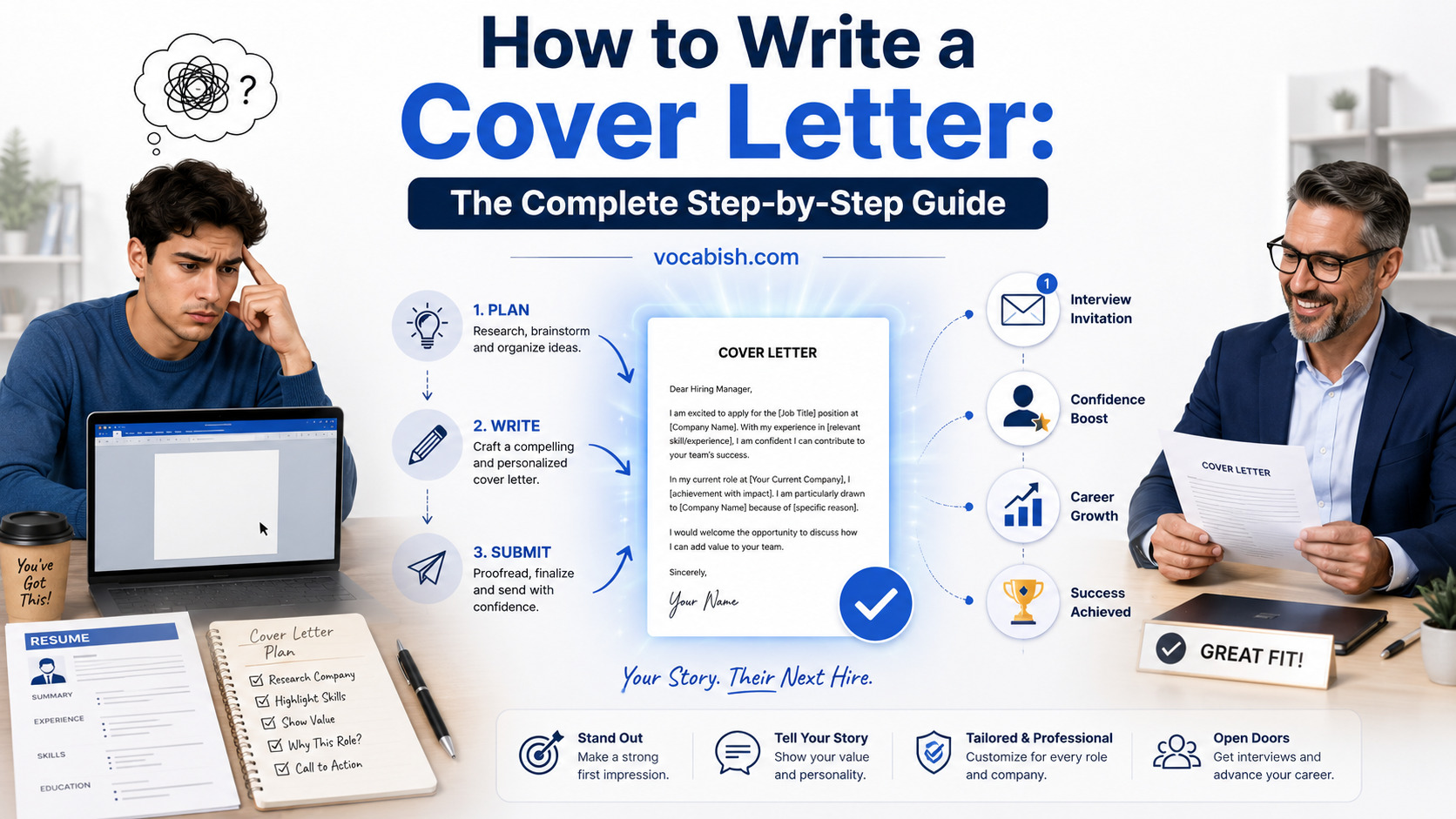

Staring at a blank screen while trying to figure out how to write a cover letter can feel incredibly frustrating. You already polished your resume, and now you have to summarize your entire professional life into just a few paragraphs. However, a well-crafted letter is your best opportunity to show the hiring manager the human being behind the bullet points. It allows you to tell a story about your skills, your passion, and exactly why you belong at their company. Let us walk through the exact steps to build a confident, professional application that makes employers want to call you for an interview.
Why You Still Need a Cover Letter
Many job seekers wonder if hiring managers actually read these documents anymore. While some recruiters rely heavily on resumes, a strong letter acts as a tie-breaker between two equally qualified candidates.
It gives you a space to explain things that a resume cannot. Here is what a well-written letter accomplishes for you:
- Explains career gaps: It gives you a chance to address time taken off for personal reasons or travel.
- Shows cultural fit: You can align your personal values with the mission of the company.
- Highlights soft skills: You can demonstrate your communication skills directly through your writing style.
- Proves genuine interest: It shows you took the time to research the specific role instead of clicking “Quick Apply.”
The Standard Cover Letter Structure
Writing becomes much easier when you follow a proven formula. A professional letter should always look clean, organized, and easy to read.
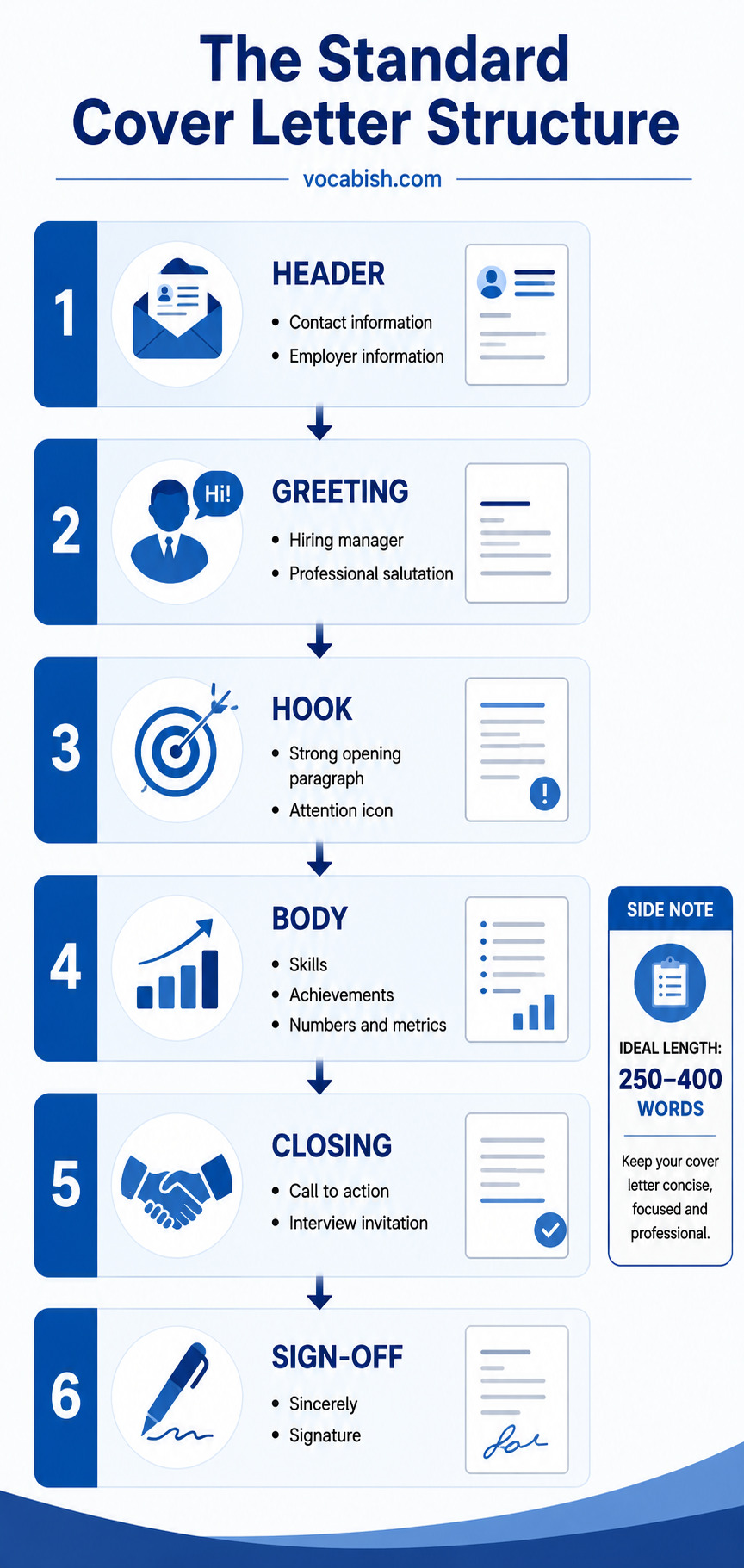
Here is the exact breakdown of how to structure your page:
Section | Purpose | Ideal Length |
Header | Provides your contact details and the employer’s information. | 4–5 lines |
Greeting | Addresses the specific hiring manager professionally. | 1 line |
The Hook | Grabs attention and states the role you want. | 1 short paragraph |
The Body | Proves your value with specific achievements and skills. | 1–2 paragraphs |
The Close | Reverses the focus to what you can do for them. | 1 short paragraph |
Sign-off | Includes a professional closing and your name. | 2 lines |
How to Write a Cover Letter Step-by-Step
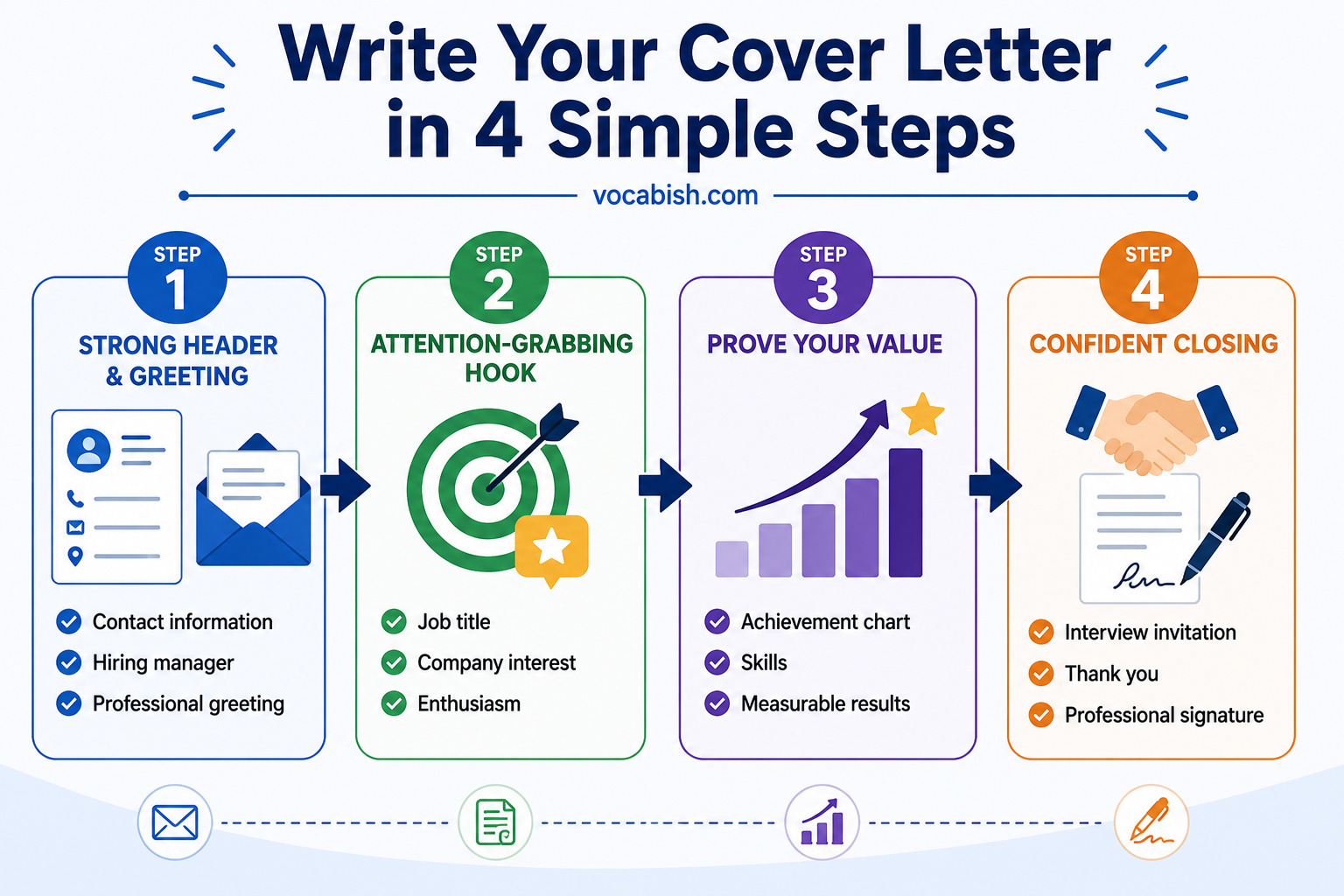
Breaking the writing process into small, manageable steps removes the anxiety from the task. Follow these instructions to build your letter one section at a time.
Start With a Strong Header and Greeting
Your header should sit at the top of the page. Include your full name, phone number, email address, and your LinkedIn profile link. Below that, write the date, followed by the hiring manager’s name, title, and company address. Always try to find the actual name of the person reading your application. Avoid using “To Whom It May Concern,” as it looks outdated and lazy. If you cannot find a name, use “Dear Hiring Manager” or “Dear [Department] Team.”
Write an Attention-Grabbing Hook
Your opening paragraph needs to make an immediate impact. State clearly which position you are applying for, but do not stop there. Mention a mutual connection if you have one, or state exactly why you admire the company. Show enthusiasm right away so the reader actually wants to continue to the second paragraph.
Prove Your Value in the Body Paragraphs
This is the core of your document. Do not just repeat your resume. Pick one or two of your biggest professional achievements and tell a brief story about them. Use numbers to back up your claims. If you increased sales, say you “grew sales by 20% in six months.” Connect your past success directly to the problems the company is trying to solve right now.
End With a Confident Call to Action
Your final paragraph should wrap up your thoughts and invite the next step. Do not sound desperate. Confidently state that you would love to discuss how your skills match their needs in an interview. Thank them for their time, and sign off with a professional closing like “Sincerely” or “Best regards.”
Proven Cover Letter Examples
Seeing a complete document makes the writing process much clearer. Here are two distinct examples you can adapt for your own job search.
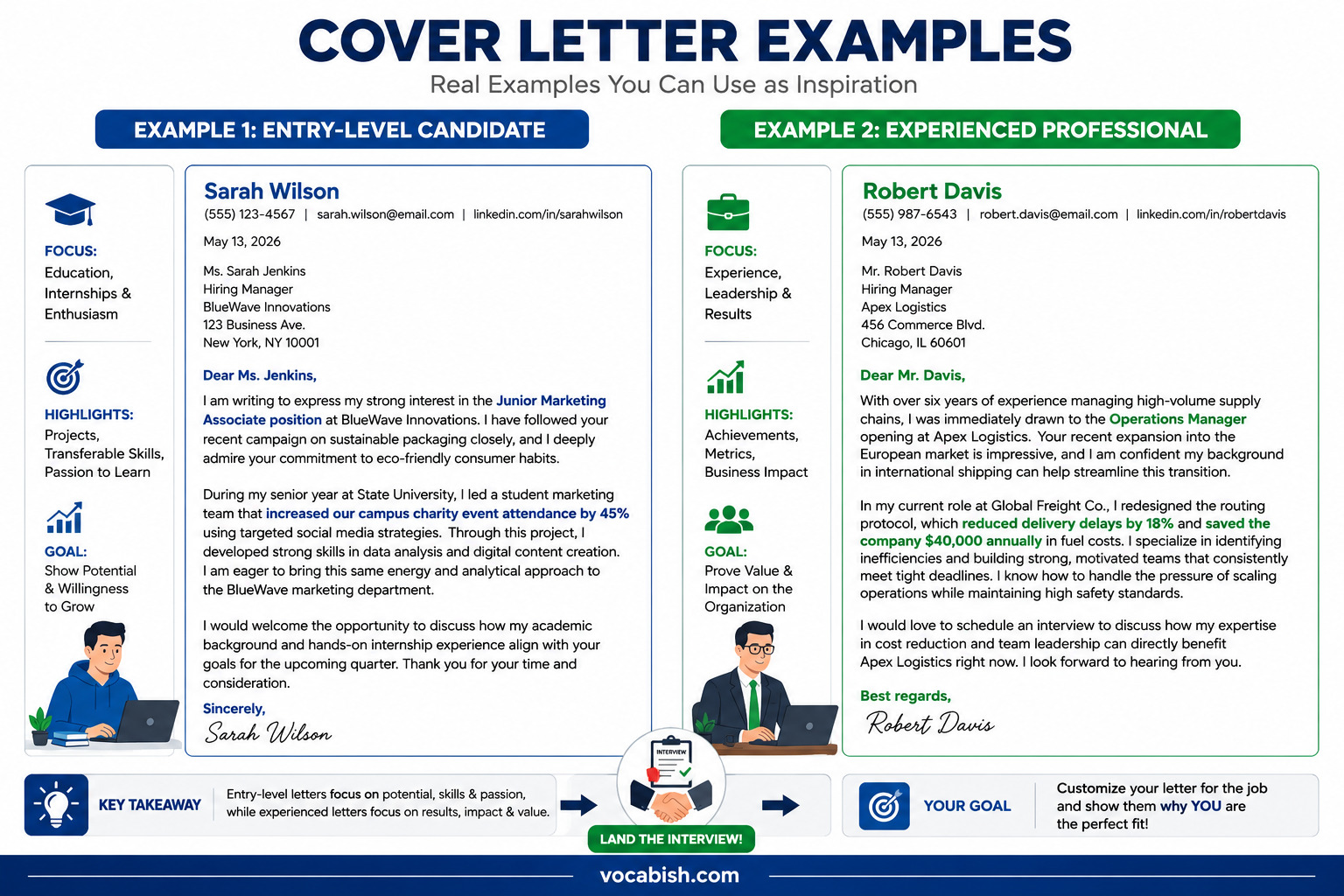
Example 1: The Entry-Level Candidate
When you lack decades of experience, focus on your education, internships, and deep enthusiasm for the industry.
Dear Sarah Jenkins,
I am writing to express my strong interest in the Junior Marketing Associate position at BlueWave Innovations. I have followed your recent campaign on sustainable packaging closely, and I deeply admire your commitment to eco-friendly consumer habits.
During my senior year at State University, I led a student marketing team that increased our campus charity event attendance by 45% using targeted social media strategies. Through this project, I developed strong skills in data analysis and digital content creation. I am eager to bring this same energy and analytical approach to the BlueWave marketing department.
I would welcome the opportunity to discuss how my academic background and hands-on internship experience align with your goals for the upcoming quarter. Thank you for your time and consideration.
Sincerely,
[Your Name]
Example 2: The Experienced Professional
When you have a solid career history, focus heavily on measurable metrics and leadership qualities.
Dear Mr. Robert Davis,
With over six years of experience managing high-volume supply chains, I was immediately drawn to the Operations Manager opening at Apex Logistics. Your recent expansion into the European market is impressive, and I am confident my background in international shipping can help streamline this transition.
In my current role at Global Freight Co., I redesigned the routing protocol, which reduced delivery delays by 18% and saved the company $40,000 annually in fuel costs. I specialize in identifying inefficiencies and building strong, motivated teams that consistently meet tight deadlines. I know how to handle the pressure of scaling operations while maintaining high safety standards.
I would love to schedule an interview to discuss how my expertise in cost reduction and team leadership can directly benefit Apex Logistics right now. I look forward to hearing from you.
Best regards,
[Your Name]
Common Mistakes to Avoid
Even highly qualified candidates sometimes miss out on interviews because of small, avoidable errors in their application materials.
- Writing too much: Hiring managers are busy. Keep your text under one page, ideally between 250 and 400 words.
- Focusing only on yourself: Do not just talk about what the job will do for your career. Focus on what your skills will do for the employer.
- Typos and grammar errors: A single spelling mistake signals carelessness. Always read your document out loud before sending it to catch awkward phrasing.
- Using a generic template: Sending the exact same document to fifty different companies never works. Always customize the text for the specific role.
Frequently Asked Questions (FAQs)
Keep it concise and focused. A professional letter should never exceed one single page, ideally staying between 250 and 400 words.
Yes, you always should. An optional submission is a perfect opportunity to stand out and show extra dedication to the hiring manager.
Search LinkedIn or the company website to find the specific hiring manager’s name. If unavailable, use “Dear [Department Name] Hiring Team.”
Focus on transferable skills from your education, volunteer work, or personal projects. Highlight your enthusiasm, adaptability, and willingness to learn quickly.
Yes, bullet points work very well in the body paragraph. They make your biggest achievements easy to scan and highly readable for recruiters.
No, you must customize it. Hiring managers quickly spot generic templates. Always change the company name and mention specific job requirements.