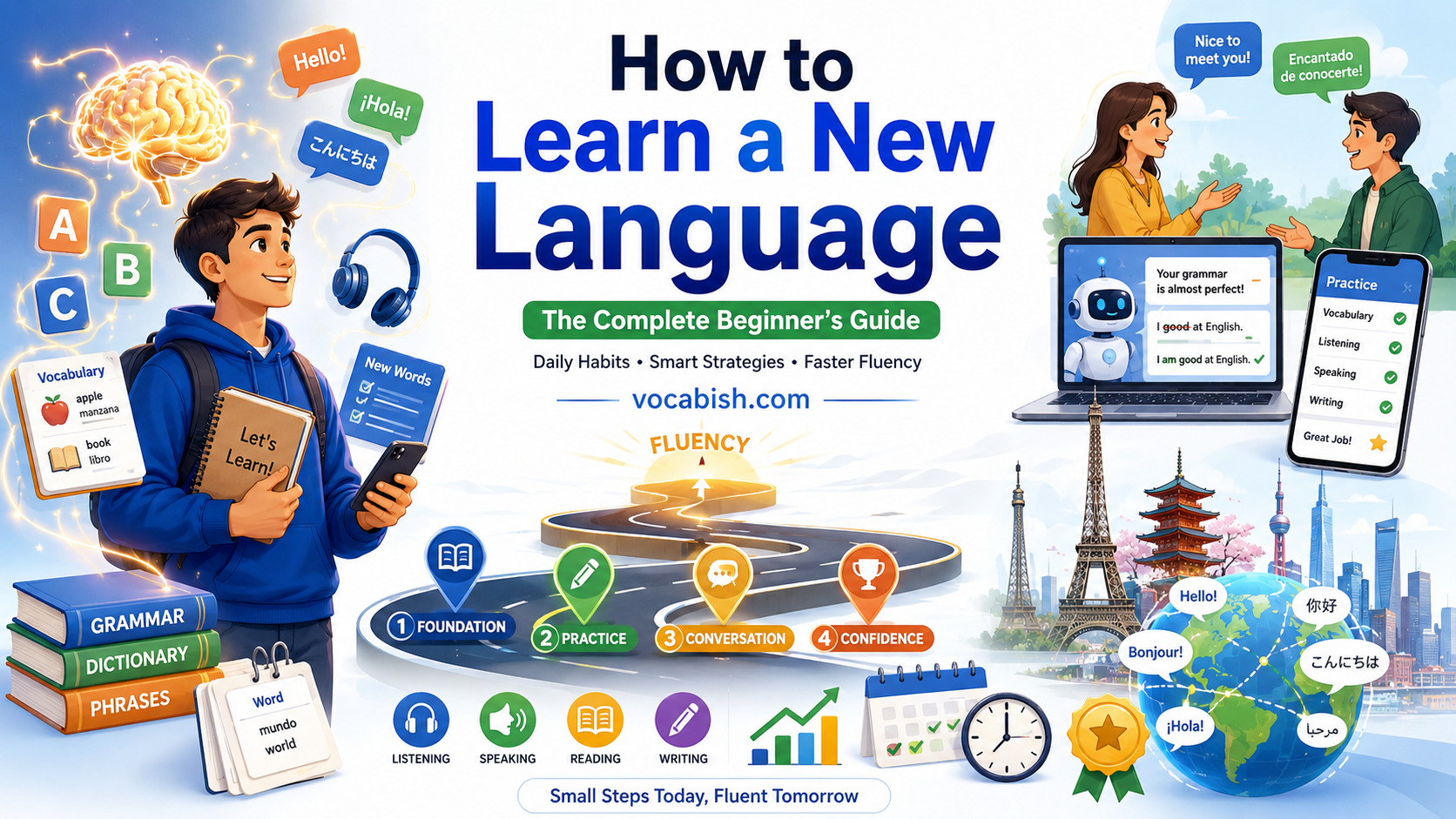

Have you ever imagined confidently ordering a meal in a Parisian cafe or navigating the bustling streets of Tokyo without a dictionary? Figuring out how to learn a new language often feels like standing at the bottom of a massive mountain. You might doubt your memory or worry about your busy schedule. The reality is quite different. Learning to speak, read, and understand foreign words does not require special talent. By building the right daily habits, anyone can achieve fluency. Let us walk through the exact steps, timeframes, and psychological tools you need to start communicating today.
Steps to Learn a New Language Effectively
- Set a Clear Purpose: Identify why you want to learn the language (e.g., travel, career, personal growth). A strong purpose will keep you motivated.
- Start with Basic Vocabulary and Phrases: Focus on the 100 most common words and essential phrases for everyday conversations. Gradually expand to 1,000 words to understand 70% of most texts.
- Immerse Yourself in the Language: Watch movies, listen to podcasts, or read books in the target language. Change your device settings to the new language to familiarize yourself with common terms.
- Practice Speaking Daily: Engage in conversations with native speakers or language exchange partners. Use apps like Italki or HelloTalk to connect with speakers online.
- Use Language Learning Apps: Download apps like Duolingo, Babbel, or Memrise for structured lessons and gamified learning experiences.
- Focus on Pronunciation: Practice saying words aloud and mimic native speakers. Use apps with pronunciation feedback or ask native speakers to correct you.
- Learn Grammar Gradually: Prioritize communication over perfect grammar. Focus on basic sentence structures and verb conjugations as you progress.
- Write and Read Regularly: Write simple sentences, shopping lists, or journal entries in the new language. Start with children’s books and progress to newspapers or novels.
- Practice Listening Skills: Watch shows without subtitles or listen to music in the language. Revisit familiar content to focus on understanding words and sentence rhythms.
- Be Consistent: Dedicate time daily to study and practice. Even 15–30 minutes a day can lead to significant progress over time.
- Embrace Mistakes: Accept errors as part of the learning process. Learn from feedback and keep practicing without fear.
- Engage in Real-Life Practice: Travel to a country where the language is spoken or participate in local language meetups. Immersion accelerates learning.
How Hard Is It to Learn a New Language?
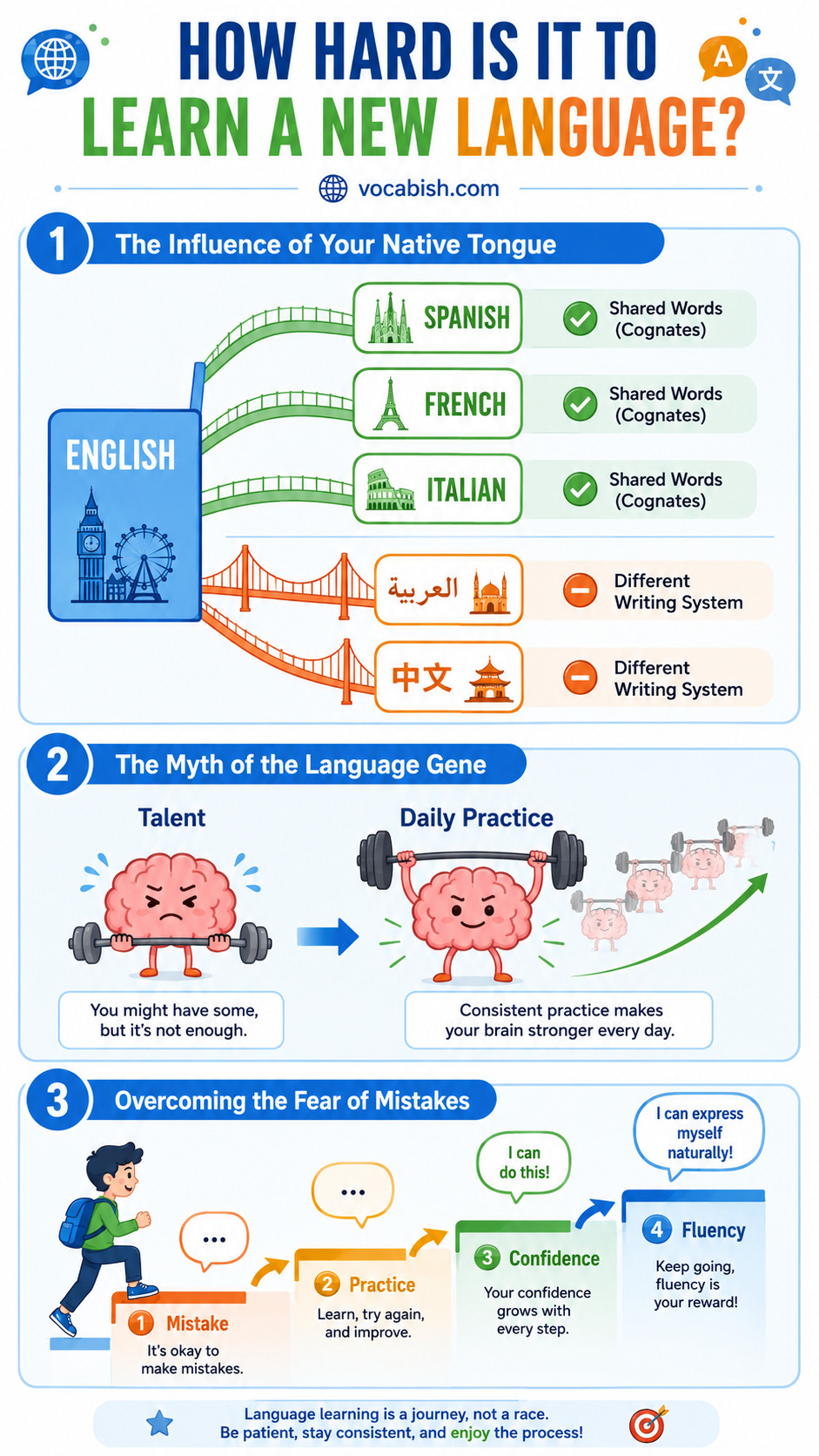
Many beginners ask how hard is it to learn a new language before they even memorize their first word. The difficulty relies heavily on your native tongue, your attitude, and the consistency of your daily routine.
The Influence of Your Native Tongue
If your native language is English, picking up languages with shared roots feels much lighter. Languages like Spanish, French, and Italian share a massive amount of vocabulary with English. We call these cognates. For example, the English word “problem” is “problema” in Spanish. Because of this, your brain does not have to work as hard to store the new information. On the other hand, tackling languages with entirely different writing systems, such as Arabic or Mandarin, demands more mental energy. However, different does not mean impossible; it just requires a different strategy.
The Myth of the Language Gene
A common excuse is the belief that some people are just born with a “language gene.” This is scientifically inaccurate. While some individuals might have a slightly better ear for mimicry, consistent practice always beats natural talent. Your brain is a muscle that adapts to whatever you feed it. When you expose your brain to foreign sounds daily, it automatically starts building new neural pathways. You do not need to be a genius; you just need to be stubborn enough to keep practicing.
Overcoming the Fear of Mistakes
The biggest barrier to fluency is not grammar; it is the fear of looking foolish. Adults hate making mistakes. We are used to sounding intelligent in our native tongues. When you start speaking a new language, you temporarily go back to sounding like a toddler. You must embrace this phase. Every mistake you make is a stepping stone to accuracy. Native speakers rarely judge you for incorrect verb conjugations. They are usually just thrilled that you are making an effort to speak their language.
How Long Does It Take to Learn a New Language?
You want to know how long does it take to learn a new language so you can set realistic expectations. The timeline changes based on the linguistic distance from English and your study intensity.
The Standard Timelines for English Speakers
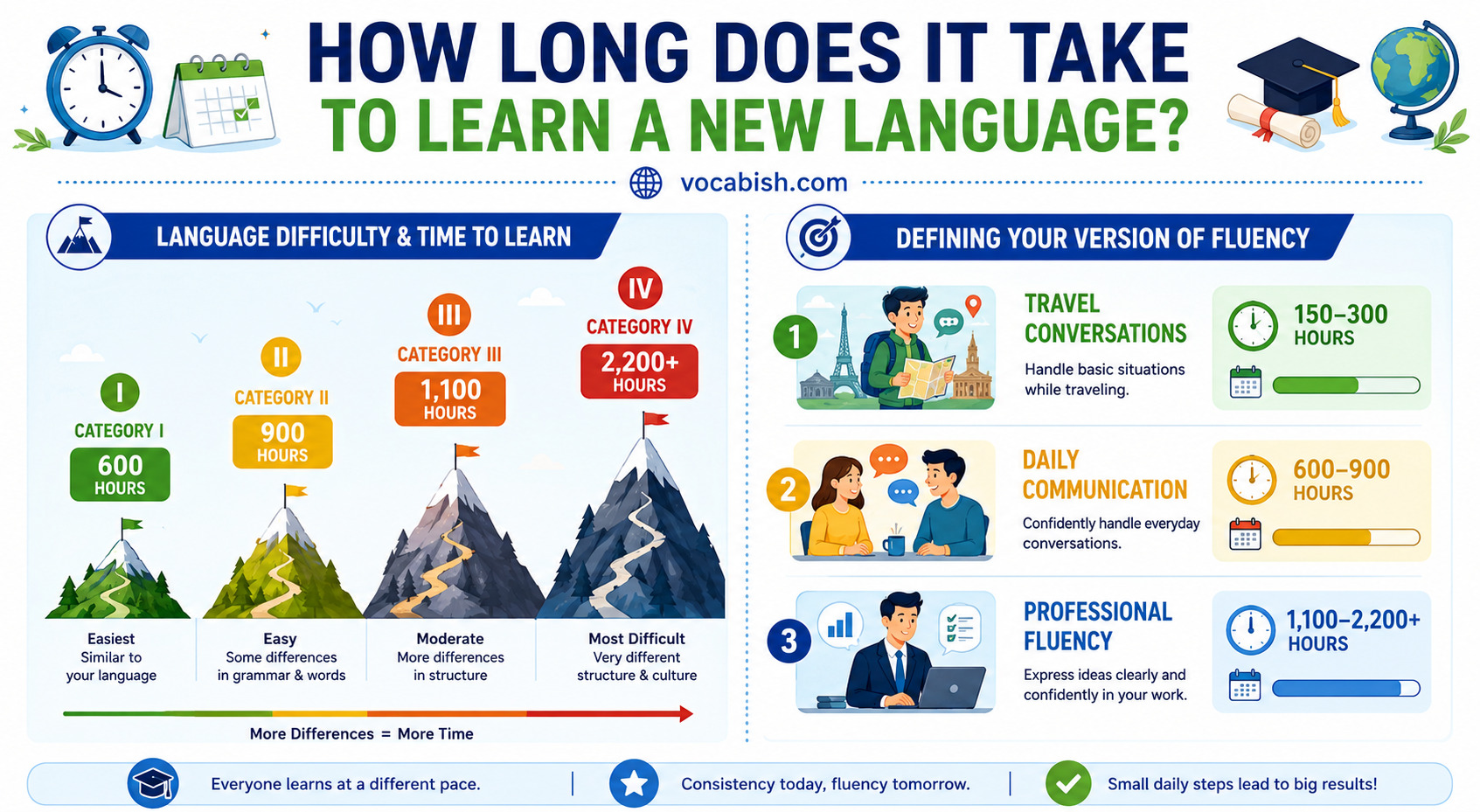
The Foreign Service Institute (FSI) has mapped out the approximate time it takes for a native English speaker to reach general professional proficiency. Remember, these numbers assume you are studying consistently.
Language Category | Difficulty Level | Examples | Estimated Study Hours |
Category I | Closely related to English | Spanish, French, Italian, Portuguese | 600 hours (24 weeks) |
Category II | Similar to English but with differences | German, Indonesian, Malay | 900 hours (36 weeks) |
Category III | Significant linguistic differences | Russian, Hindi, Thai, Greek | 1,100 hours (44 weeks) |
Category IV | Exceptionally difficult for English speakers | Arabic, Japanese, Korean, Mandarin | 2,200+ hours (88 weeks) |
Defining Your Version of Fluency
“Fluency” is a highly subjective word. If your goal is to travel and chat with locals, you only need about 150 to 200 hours of focused study. This gets you to a conversational survival level. If your goal is to read academic papers or negotiate business deals, you will need to push toward the 1,000-hour mark. Decide what your personal finish line looks like before you start stressing over the clock.
How to Learn a New Language by Yourself
Knowing how to learn a new language by yourself gives you the ultimate freedom to design your own curriculum. You become both the student and the teacher, allowing you to focus purely on what interests you.
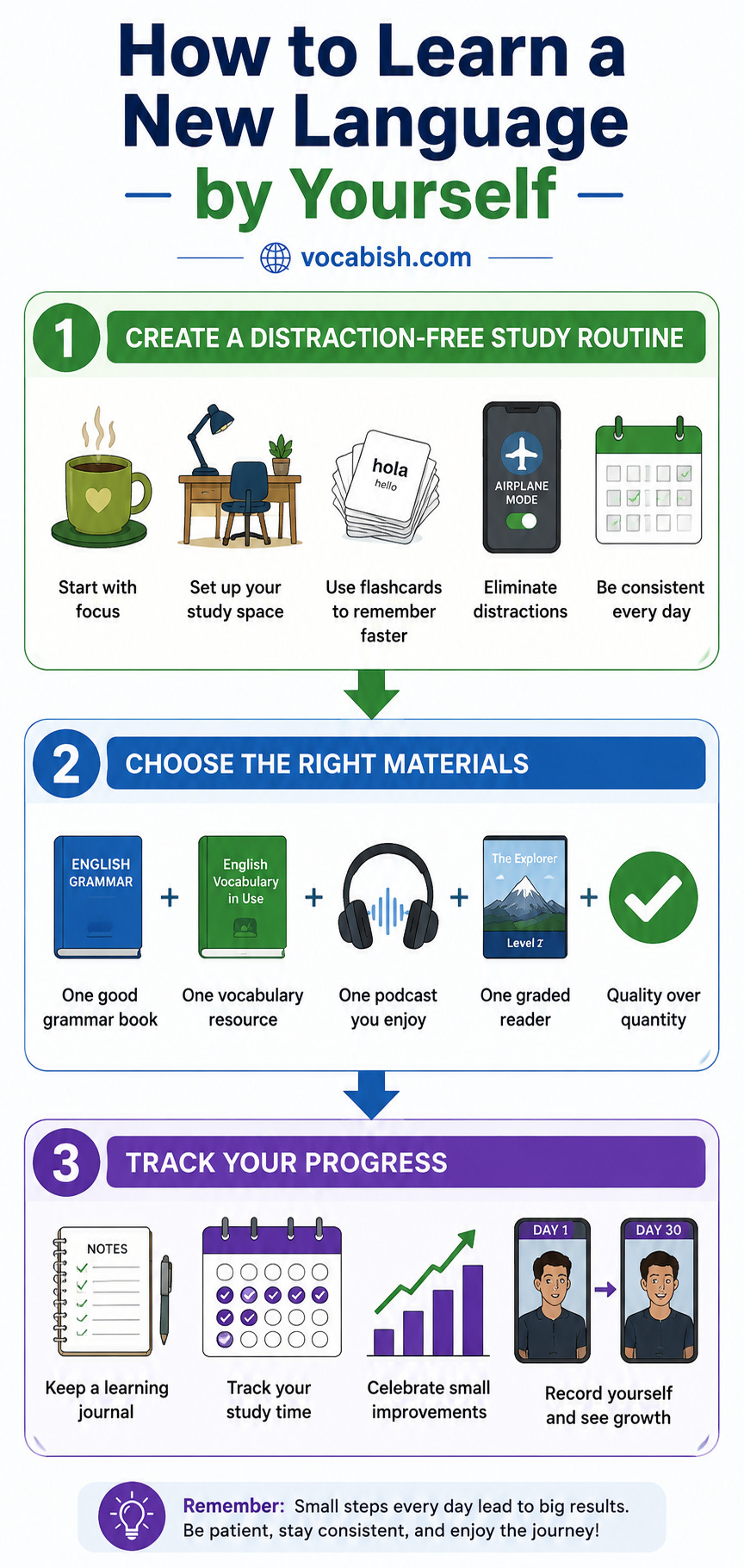
Creating a Distraction-Free Study Routine
Motivation fades, but habits remain. You cannot rely on feeling excited every day. Instead, you need to tie your study time to an existing daily habit. We call this “habit stacking.” For example, tell yourself you will review flashcards for ten minutes while drinking your morning coffee. By connecting the new task to an established routine, you remove the friction of starting. Find a quiet corner, put your phone on airplane mode, and commit to short, focused sessions.
Choosing the Right Materials for Your Level
When studying solo, the temptation is to buy every textbook and download every app available. This leads to decision fatigue. Pick one primary resource for grammar, one for vocabulary, and one for listening. Stick to them until you finish them. As a beginner, avoid materials made for native speakers, like news broadcasts or complex novels. You will only get frustrated. Seek out “graded readers” and slow podcasts specifically designed for language learners.
Tracking Your Progress at Home
Without a teacher to give you grades, it is easy to feel like you are not making progress. You need to create your own milestones. Record a video of yourself speaking for one minute on day one. After thirty days, record another video. When you compare the two, the progress will shock you. Keep a notebook where you write down the date and the new concepts you mastered that week. Visualizing your growth keeps you moving forward during difficult weeks.
Proven Ways on How to Learn a New Language Fast
If you are facing a tight deadline, discovering how to learn a new language fast requires strategic thinking. You must optimize your brain’s ability to retain information quickly.
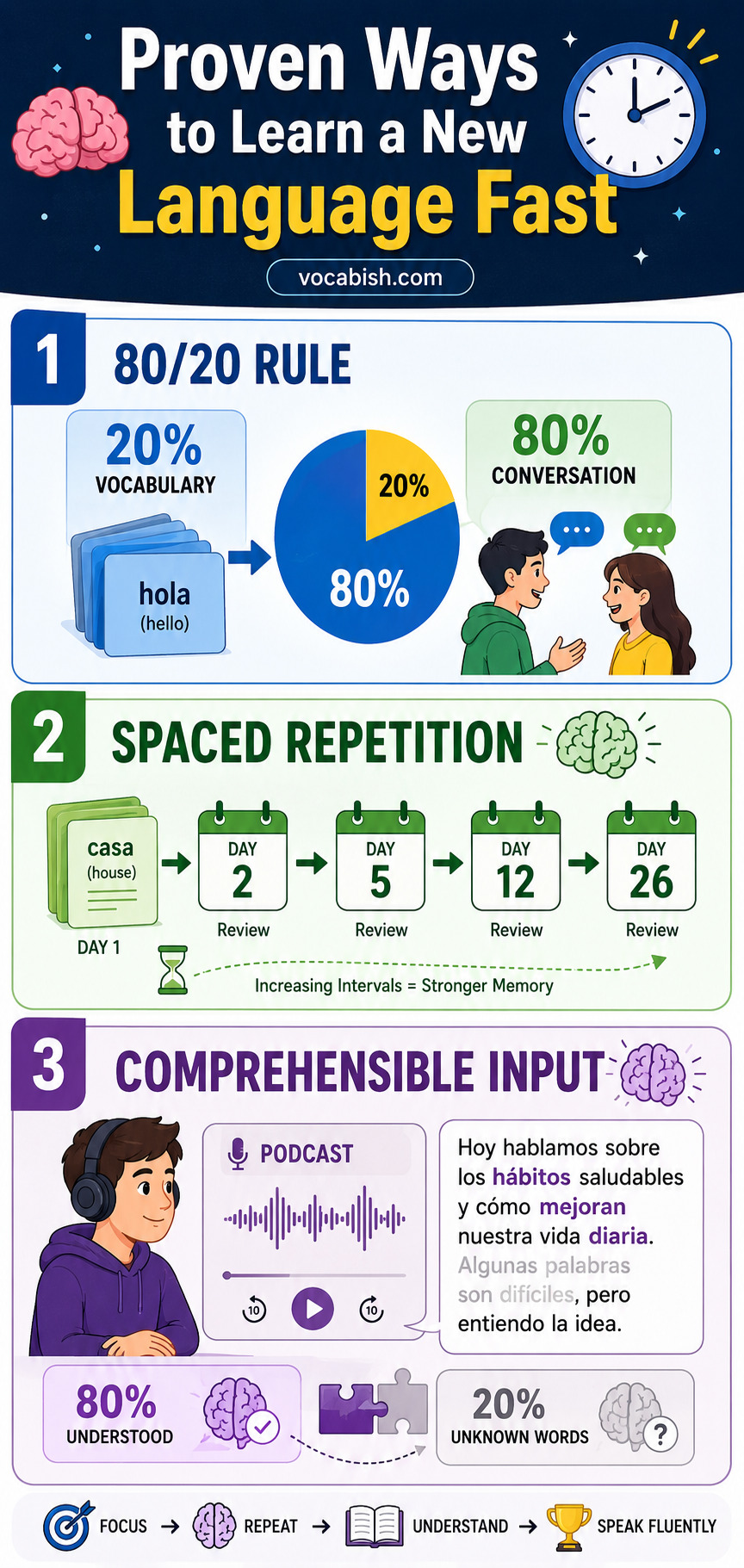
The 80/20 Rule in Vocabulary (Pareto Principle)
You do not need to read a dictionary to hold a conversation. Roughly 20% of the words in any language are used in 80% of daily interactions. Focus intensely on the top 1,000 most frequently spoken words. Learn the verbs “to be,” “to have,” “to go,” and “to want” immediately. Learn how to connect sentences using words like “because,” “but,” and “however.” Mastering this core vocabulary gives you the foundation to express almost any thought, even if you have to talk your way around words you do not know yet.
Implementing Spaced Repetition Systems (SRS)
The human brain is designed to forget information it does not use. Spaced repetition hacks this natural process. Digital flashcard systems show you a word right at the exact moment you are about to forget it. If you remember the word easily, the system waits a longer time before showing it to you again. If you struggle, the word appears more frequently. This method forces vocabulary into your long-term memory faster than reading a textbook for hours.
The Comprehensible Input Hypothesis
You acquire language best when you understand the message, even if you do not know every single word. This is known as comprehensible input. You should read and listen to materials that are just slightly above your current level. If you understand about 70% to 80% of what you hear, your brain naturally figures out the remaining 20% through context. Do not stop to look up every single unknown word; let your brain do the heavy lifting of pattern recognition.
How to Learn a New Language Quickly Using Technology
Modern tools have completely transformed how to learn a new language quickly and efficiently. Your smartphone is a portable classroom if you use it correctly.
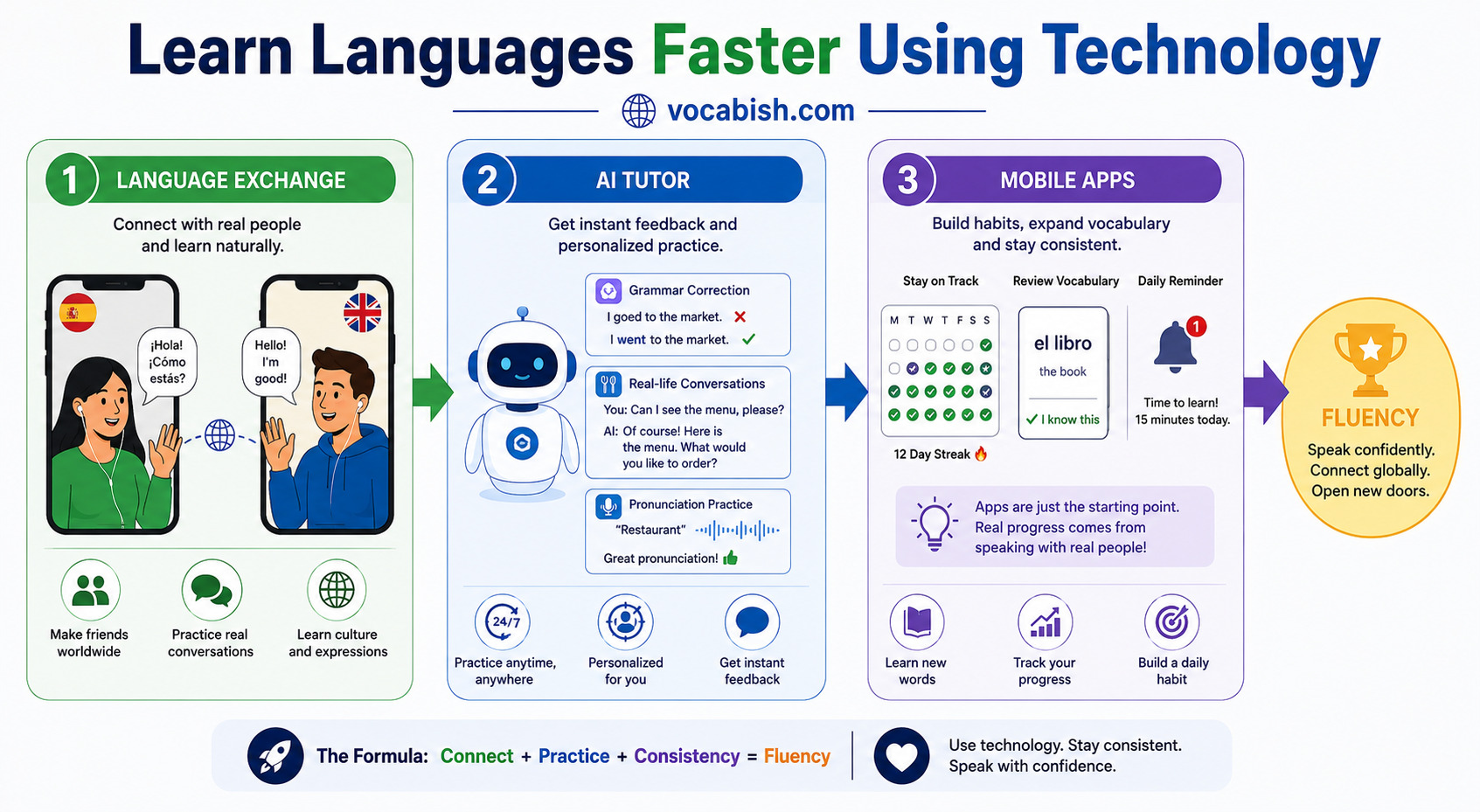
Language Exchange Platforms
You no longer need to buy a plane ticket to speak with foreigners. Platforms connect you with native speakers globally. You spend thirty minutes speaking English to help them, and they spend thirty minutes speaking their native tongue to help you. It is a free, highly effective way to build conversational speed. Talking to real people also teaches you the modern slang and natural phrasing that textbooks often ignore.
Artificial Intelligence as a Tutor
AI chatbots are incredibly powerful tools for solo learners. You can ask an AI to simulate a real-life scenario, like a job interview or a date at a restaurant. You can prompt the AI to correct your grammar mistakes gently. Unlike humans, AI never gets tired of answering your questions. You can ask it to explain a complex grammar rule five different ways until you finally understand it completely.
The Right Way to Use Mobile Apps
Gamified language apps are fantastic for building a daily habit and keeping you engaged. However, tapping buttons on a screen does not equal fluency. Use these apps as your warm-up routine. Spend ten minutes earning your digital points, and then move on to heavier lifting, like reading an article or speaking out loud. Never rely on a single app to carry you all the way to fluency.
The Four Core Skills of Language Mastery
To truly conquer a language, you must balance the four main pillars of communication. Neglecting one skill will eventually slow down your overall progress.
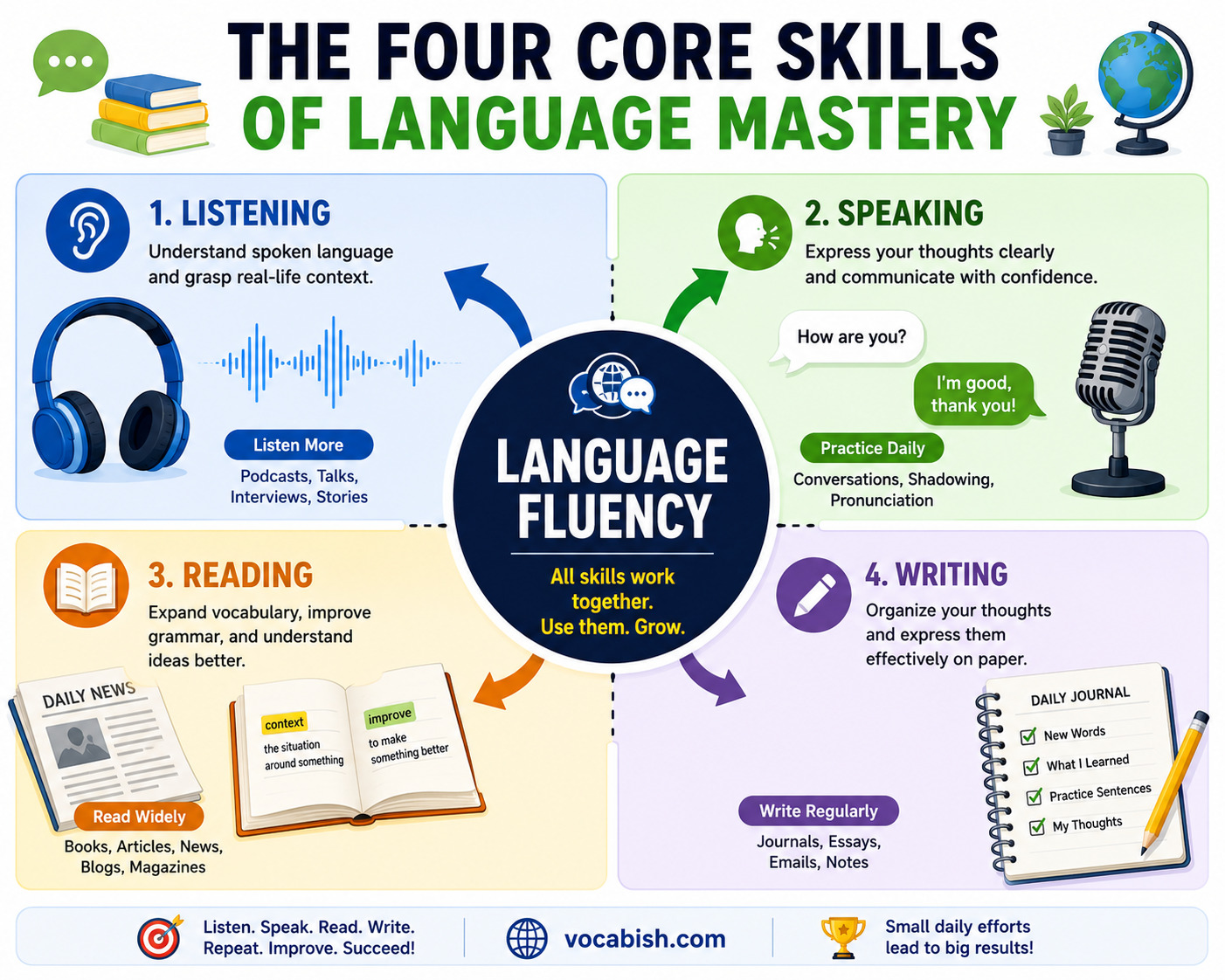
Listening: Training Your Brain to Hear New Sounds
Your ears are not used to the frequencies and rhythms of the new language. At first, everything sounds like one long, incredibly fast word. To fix this, practice active listening. Take a two-minute audio clip and listen to it five times. The first time, just try to catch the general topic. The second time, listen for verbs. By the fifth time, try to transcribe exactly what you hear. This intense focus trains your brain to separate individual words naturally.
- Listen to slow podcasts designed for learners.
- Watch familiar movies dubbed in your target language.
- Listen to foreign music and read the lyrics simultaneously.
Speaking: Opening Your Mouth from Day One
Most students wait until they feel “ready” to speak. This is a massive mistake. You will never feel fully ready. You must start talking immediately. Even if you only know how to say “Hello, my name is…”, say it out loud. Practice shadowing, a technique where you listen to a native speaker and repeat their exact words a fraction of a second later. This trains your tongue and facial muscles to produce foreign sounds correctly, heavily reducing your natural accent.
Reading: Absorbing Grammar Naturally
Reading is the cheat code for learning grammar without memorizing rules. When you read, you see sentences structured perfectly over and over again. Your brain absorbs these patterns silently. Start with children’s books or bilingual stories where one page is in English and the other in your target language. As you improve, move to news articles. Reading also exposes you to a much wider vocabulary than casual speaking ever will.
Writing: Organizing Your Thoughts
Speaking happens fast, giving you no time to think. Writing slows the process down. It gives you the space to carefully select your words and check your grammar. Keep a daily journal. Write three sentences about what you ate for lunch or what you plan to do tomorrow. If you do not know a word, look it up. This active recall solidifies the vocabulary in your mind, making it much easier to access the next time you need to speak.
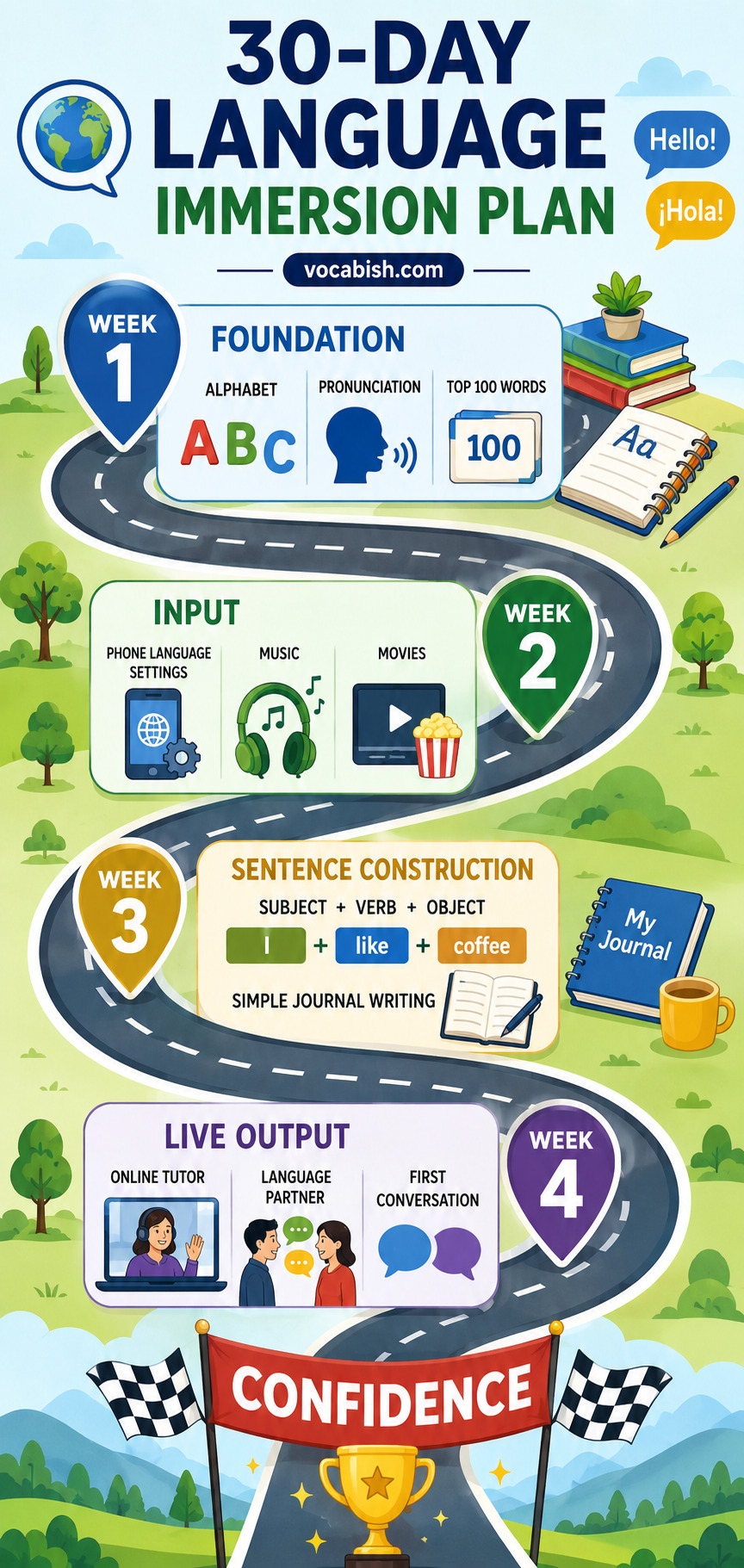
Building a 30-Day Immersion Plan
If you want to know how to learn a new language by yourself effectively, you need a structured plan. A one-month immersion challenge will shock your brain into rapid adaptation.
Here’s a PDF book of the 30 Days Spoken English Course.
Week 1: Foundation and Frequency
Dedicate your first seven days exclusively to the highest-frequency words and basic pronunciation. Learn the alphabet perfectly. Master the sounds that do not exist in English. Create a flashcard deck of the top 100 nouns and verbs. During this week, do not worry about grammar rules at all. Your only goal is to recognize the building blocks of the language and get your mouth comfortable producing new sounds.
Week 2: Input and Environment
Now, turn your world upside down. Change the language on your smartphone, social media accounts, and computer. You will instinctively know where the buttons are, so you will learn new vocabulary through context. Start listening to foreign music during your commute. Watch your favorite childhood movie dubbed in the new language. You already know the plot, so your brain can focus entirely on connecting the new words to the actions on screen.
Week 3: Basic Sentence Construction
It is time to start gluing your vocabulary together. Focus on basic sentence patterns: Subject + Verb + Object. Learn how to ask questions (Who, What, Where, When, Why). Learn how to talk about the past, the present, and the future in their simplest forms. Start writing your daily three-sentence journal. Do not use complex vocabulary; focus purely on making the sentence structurally correct.
Week 4: Live Output
In the final week of your challenge, you must speak to a human being. Find a language partner online or book a cheap 30-minute session with an online tutor. Warn them that you are a beginner. Your goal is not to have a deep philosophical debate. Your goal is simply to survive a basic introduction, ask how they are doing, and understand their response. Surviving this first conversation will give you an incredible confidence boost.
Common Mistakes When Studying
Many learners accidentally sabotage their own progress. Recognizing these traps will help you maintain your momentum and avoid unnecessary frustration.
Obsessing Over Grammar Too Early
Grammar is the skeleton of a language, but vocabulary is the meat. If you study a skeleton, you just have a pile of bones. You cannot speak using only grammar rules. Many beginners quit because they try to memorize complex verb conjugations before they even know twenty nouns. Learn words first. Once you have a healthy vocabulary, the grammar rules will actually make sense because you have real examples to apply them to.
Translating Literally in Your Head
Every language has its own unique logic and cultural flavor. You cannot translate word-for-word from English. For example, in English, you say “I am hungry.” In Spanish, you say “Tengo hambre,” which translates to “I have hunger.” If you try to force English logic onto another language, you will sound unnatural. Stop translating in your head. Try to link the foreign word directly to an image or a feeling, bypassing English entirely.
Relying on Passive Learning
Watching a movie with English subtitles feels like studying, but it is actually passive entertainment. Your brain is reading the English and ignoring the foreign audio. To make it active, you must turn on the subtitles in the target language. Pause the video. Write down unknown words. Repeat the dialogue out loud. Active learning feels tiring because your brain is actually working. If your study session feels effortless, you are probably not retaining much information.
Download PDF of This Complete Roadmap
Frequently Asked Questions (FAQs)
You can reach a solid conversational level in three months, but true fluency requires years of consistent, deep cultural immersion.
Change your phone settings, consume media entirely in the target language, use spaced repetition flashcards, and speak aloud daily.
Apps are wonderful for daily vocabulary habits, but you must eventually practice real conversations with native speakers to achieve fluency.
Adults actually grasp complex grammar faster than children do. It only feels harder due to busy schedules and less free time.
Morning sessions build strong routines, while reviewing vocabulary right before sleep helps your brain cement the information into long-term memory.
Focus strictly on survival vocabulary. Learn to order food, navigate transportation, handle emergencies, and manage money before studying heavy grammar.
Depending on the language’s difficulty and your daily effort, reaching conversational comfort generally takes between six months to two years.
It is highly recommended to focus on one language until you reach an intermediate level before adding a second to avoid confusion.
You May Also Like: