
The Blue Heart Emoji Meaning 💙 is commonly connected with trust, loyalty, calm support, and platonic affection. It often communicates a steady emotional bond without the intense romantic feeling usually associated with a red heart.
However, 💙 does not always represent personal affection. Brands, sports teams, awareness campaigns, fan groups, and online communities frequently use it because blue matches their identity, cause, uniform, flag, or visual theme. Its exact intent depends on the message, sender, topic, and surrounding emojis.
You can explore the Meaning of all Heart Emojis to understand what each colour heart emoji describes.
The Four Main Ways People Use 💙
The blue heart can communicate emotional support, friendship, loyalty, or simple colour-based identity.
Main use | What it communicates | Common context |
|---|---|---|
Loyalty and trust | Reliability, commitment, dependability | Friendships, teams, organisations |
Platonic affection | Caring without strong romance | Friends, classmates, colleagues |
Calm emotional support | Reassurance, peace, steady encouragement | Difficult moments, supportive messages |
Colour or community identity | Connection through a shared colour | Brands, sports, campaigns, fandoms |
Loyalty and Trust
💙 often represents dependable loyalty rather than passionate love. It can show that someone values a relationship, supports another person consistently, or feels part of a trusted group.
Common messages include:
- “I will always support you 💙”
- “You can count on me 💙”
- “Proud to be part of this team 💙”
- “Thank you for always being there 💙”
The emotion feels stable, respectful, and reassuring. It is especially suitable when someone wants to express commitment without sounding overly romantic.
Platonic Affection
Friends frequently use 💙 to express warmth without creating romantic confusion. It may communicate appreciation, closeness, or a strong friendship.
Examples include:
- “Miss you, bestie 💙”
- “You are such a good friend 💙”
- “Thanks for checking on me 💙”
- “Our friendship means a lot 💙”
In this context, the blue heart can feel affectionate while remaining emotionally safer and less intense than ❤️.
Calm Emotional Support
Blue is often associated with calmness, stability, and emotional peace. Because of this, 💙 works naturally in supportive messages.
Someone may send it when they want to say:
- “I am thinking about you.”
- “You are not alone.”
- “Take care of yourself.”
- “I hope things improve soon.”
For example:
“No pressure to reply. Just wanted you to know I am here 💙”
The heart adds warmth while keeping the message gentle and emotionally balanced.
Colour, Team or Community Identity
Sometimes 💙 has little connection with personal affection. People may use it because blue represents a team, brand, school, country, fandom, or campaign.
Typical examples include:
- Supporting a sports team with blue uniforms
- Celebrating school or university colours
- Matching a company’s blue branding
- Participating in a colour-themed campaign
- Decorating an ocean, winter, or sky-related post
In these situations, the colour itself matters more than the heart’s emotional symbolism.
What Does the Blue Heart Mean From Someone?
To understand 💙 correctly, focus on what the sender appears to be communicating rather than relying only on your relationship with them.
“I Support You”
A blue heart can show emotional encouragement, especially during a difficult situation.
“You handled that situation really well 💙”
The sender may be offering reassurance without making the conversation overly emotional.
“You Can Trust Me”
💙 can represent honesty, reliability, and emotional safety.
“Anything you tell me stays between us 💙”
Here, the heart strengthens the promise of trust.
“We Are Close Friends”
Friends may use the blue heart to show a meaningful but non-romantic connection.
“Another unforgettable day with my favourite person 💙”
The wording and normal communication pattern determine whether the message is purely friendly.
“I Identify With This Team or Community”
The sender may use 💙 to show loyalty to a sports club, fan group, school, company, or online community.
“Blue forever! What a win 💙🏆”
The heart represents shared identity rather than private affection.
“Blue Matches This Post”
Sometimes the choice is completely visual.
A person may add 💙 to posts about:
- Blue clothing
- Ocean views
- Winter scenes
- Blue flowers
- Sky photography
- Interior design
- Colour-themed outfits
In such posts, the emoji may simply improve the aesthetic.
Is 💙 Romantic?
The blue heart can be romantic, but it does not automatically confirm attraction. Its emotional meaning depends on the accompanying words, relationship history, and sender’s usual style.
It may be romantic when | It is likely platonic when |
|---|---|
It appears with flirting or compliments | It appears in ordinary friendly conversations |
The sender regularly expresses attraction | The sender uses it with many friends |
It follows affectionate or intimate words | It accompanies encouragement or gratitude |
It is part of a couple’s shared colour theme | It represents a team, brand, or community |
It appears in private emotional conversations | It appears in public comments or group posts |
When It May Be Romantic
💙 can represent romantic affection when the rest of the message clearly contains intimacy or attraction.
Examples:
- “I cannot stop thinking about you 💙”
- “You looked beautiful tonight 💙”
- “Goodnight, my love 💙”
- “You make me feel safe 💙”
Some couples also choose blue hearts because blue is a favourite colour or part of their shared aesthetic.
When It Is Clearly Platonic
The heart is usually platonic when it appears with friendship-based language.
Examples:
- “You are the best friend anyone could ask for 💙”
- “Thanks for helping with the assignment 💙”
- “So proud of our whole team 💙”
- “Hope you feel better soon 💙”
The emotional warmth is real, but it does not necessarily indicate attraction.
How Accompanying Words Remove Ambiguity
Words reveal more than colour alone.
Compare:
- “Thanks for your help 💙” — appreciation
- “Miss you, best friend 💙” — friendship
- “I am falling for you 💙” — romantic interest
- “Come on, Blues! 💙” — team support
- “This dress is perfect 💙” — colour matching
The message surrounding the emoji usually provides the clearest interpretation.
Why Colour Alone Does Not Confirm Attraction
A blue heart is not a secret universal code for romance. People choose it for personal, emotional, cultural, visual, and community-based reasons.
Do not assume attraction simply because someone sends 💙. Look for consistent flirting, personal attention, affectionate wording, and other signs of romantic interest.
Blue Heart Conversation Case Studies
A Friend Checking In
Message:
“You seemed quiet today. Is everything okay? 💙”
Likely meaning: The friend is showing concern and emotional availability. The heart softens the question without making it romantic.
Someone Offering Support
Message:
“Take all the time you need. We are here for you 💙”
Likely meaning: The sender is offering calm, dependable support during a stressful or emotional situation.
A Sports Fan Celebrating
Message:
“Final secured! What a performance 💙🏆”
Likely meaning: The heart represents the team’s colour, fan loyalty, and shared celebration.
A Brand Replying to a Customer
Message:
“Thank you for choosing us. We are happy to help 💙”
Likely meaning: The company is using a friendly response that matches its blue brand identity. It is not expressing personal love.
A Partner Using Their Favourite Colour
Message:
“Another amazing year with you 💙”
Likely meaning: The message is romantic because of the relationship and wording. The blue heart may simply be the partner’s preferred heart colour.
Blue Heart in Communities, Campaigns and Public Posts
The blue heart is widely used in public communication because blue can represent identity, unity, calmness, professionalism, or group loyalty.
Common uses include:
- Sports teams: Fans use 💙 when supporting teams whose uniforms or logos feature blue.
- Schools and universities: Students and alumni use it to celebrate institutional colours.
- Brand identity: Companies add blue hearts to customer replies, announcements, and promotional posts.
- Awareness content: Campaign organisers may use blue as a symbolic campaign colour.
- Fan communities: Music, gaming, film, and celebrity fandoms may adopt blue hearts.
- National or regional themes: Users may choose 💙 when blue appears prominently in a flag or cultural symbol.
There is no single campaign meaning that applies everywhere. Always confirm the organisation, hashtag, event, or surrounding post before connecting 💙 with a specific cause.
Platform-by-Platform Blue Heart Usage
Facebook Groups and Community Posts
On Facebook, 💙 commonly appears in:
- Local community groups
- Sports fan pages
- School and university communities
- Supportive comments
- Fundraising posts
- Brand communities
A comment such as “We are all behind you 💙” normally expresses group support and solidarity.
Instagram Brand and Lifestyle Content
Instagram users frequently choose 💙 for visual consistency. It may appear with blue outfits, ocean photography, winter content, travel posts, or branded graphics.
Brands also use it to make captions and customer replies feel warm while maintaining a recognisable colour identity.
TikTok Fan Communities
On TikTok, the blue heart may act as a fandom marker. Users can include it in usernames, comments, edits, hashtags, and live-chat reactions.
Its meaning may be understood mainly by members of that particular fan community.
X Campaigns and Live Events
On X, 💙 often appears during:
- Live sports events
- Political or public campaigns
- Television broadcasts
- Product launches
- Community hashtags
- Breaking announcements
Because public conversations move quickly, the relevant hashtag and event topic are essential for understanding the heart.
WhatsApp Friendships
On WhatsApp, 💙 commonly feels personal but platonic. Friends may use it for reassurance, gratitude, check-ins, and everyday affection.
Examples:
- “Reached home safely 💙”
- “Thanks for listening 💙”
- “Good luck tomorrow 💙”
A romantic meaning is more likely when affectionate words or established couple behaviour accompany it.
LinkedIn Brand-Coloured Reactions
LinkedIn users may add 💙 to company announcements, employee appreciation posts, partnership updates, and professional achievements.
It often communicates:
- Brand pride
- Team loyalty
- Professional appreciation
- Calm encouragement
- Community belonging
Its meaning is usually supportive rather than intimate.
When 💙 Can Feel Emotionally Distant
Although 💙 is generally positive, it can occasionally feel cooler or less intimate than expected.
- After previously using ❤️: A sudden switch from red to blue may appear less romantic, especially without explanation.
- During a romantic disagreement: The recipient may interpret it as emotionally controlled or intentionally distant.
- As a short reply to an emotional message: Responding only with “💙” can feel insufficient when someone has shared something deeply personal.
- When the sender normally communicates warmly: A brief blue heart may seem unusual if the person normally uses affectionate words and red hearts.
However, one emoji change is not proof of emotional withdrawal. The sender may have chosen it casually, visually, or without considering the colour difference.
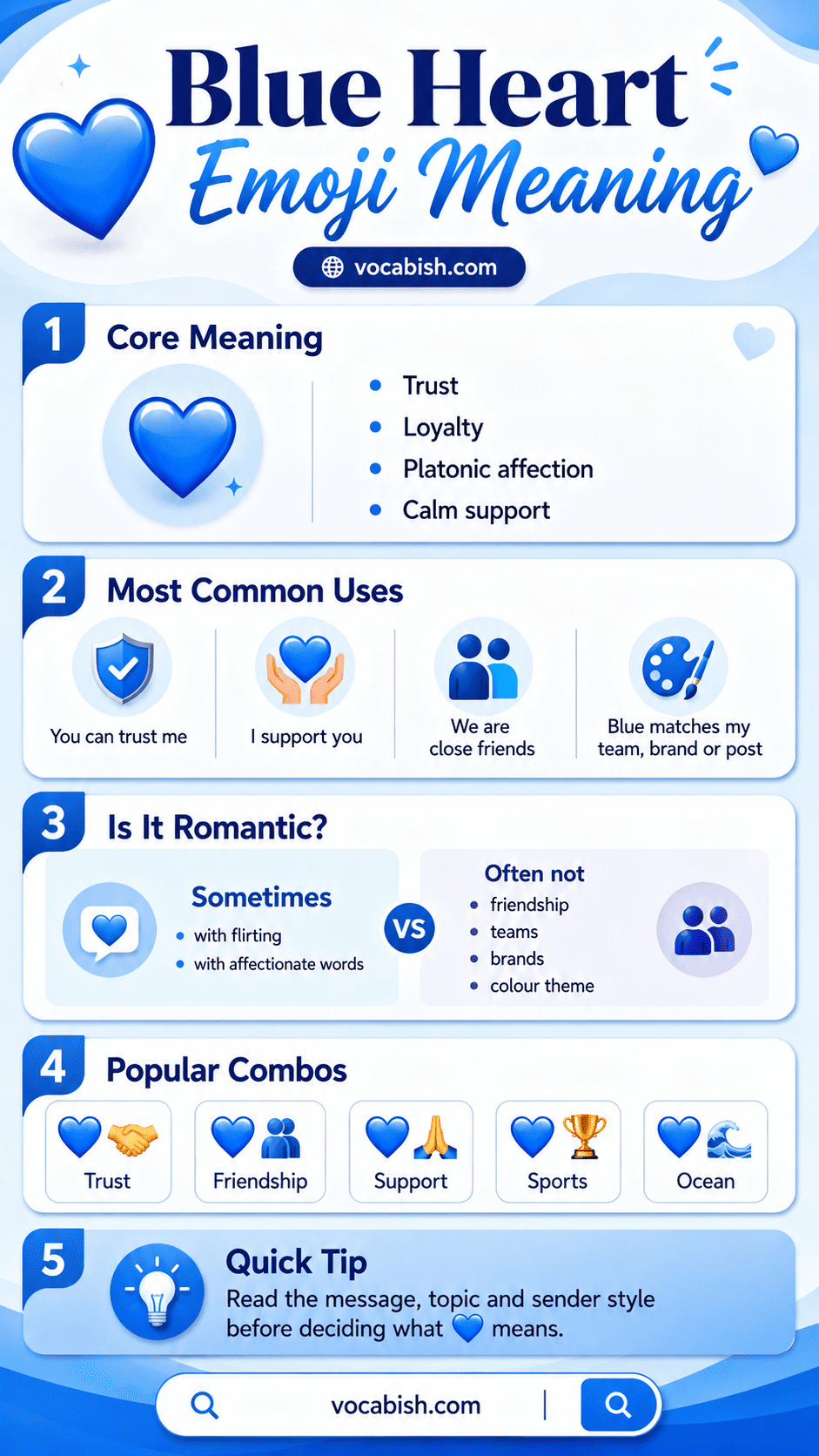
Blue Heart Emoji Combinations by Intent
Combination | Common intent | Example |
|---|---|---|
💙🤝 | Trust and cooperation | “Glad we can work together 💙🤝” |
💙🫂 | Close friendship and comfort | “Sending you a big hug 💙🫂” |
💙🙏 | Calm support or gratitude | “Hoping everything improves soon 💙🙏” |
💙🏆 | Sports loyalty and victory | “Champions again 💙🏆” |
💙🌊 | Ocean, travel, or peaceful energy | “Nothing beats this view 💙🌊” |
💙❄️ | Winter, cold weather, or blue aesthetic | “First snow of the year 💙❄️” |
💙🎉 | Friendly celebration | “Congratulations on your achievement 💙🎉” |
💙✨ | Hope, positivity, or admiration | “Better days are coming 💙✨” |
Emoji combinations usually reduce ambiguity because the second emoji reveals the topic or emotional direction.
How to Interpret 💙 Accurately
Use this four-step decoder before deciding what a blue heart means.
1. Read the Message
Start with the actual words.
- Supportive words suggest encouragement.
- Flirting suggests possible romance.
- Team language suggests loyalty.
- Colour references suggest visual matching.
The sentence carries more meaning than the heart alone.
2. Identify the Relationship
Consider whether the sender is a friend, partner, colleague, brand, family member, or stranger.
The same emoji can feel personal in a private chat and completely promotional in a brand comment.
3. Check the Post Topic
Ask what the conversation is about.
Is it related to:
- Friendship?
- Emotional support?
- A sports result?
- A blue outfit?
- A public campaign?
- A company announcement?
- A romantic conversation?
The topic usually reveals why blue was selected.
4. Observe the Sender’s Normal Emoji Style
Some people use 💙 as their default heart with everyone. Others reserve it for specific groups, teams, or relationships.
Compare the message with their normal communication before assigning a deeper meaning.
Related Emojis and Key Differences
Comparison | Main difference |
|---|---|
💙 vs ❤️ | 💙 feels calm, loyal, or platonic; ❤️ usually feels deeper, warmer, and more openly romantic. |
💙 vs 🩵 | 💙 suggests stronger loyalty and trust; 🩵 feels softer, lighter, and more gentle. |
💙 vs 🤍 | 💙 communicates dependable support; 🤍 often represents peace, purity, sympathy, or quiet affection. |
💙 vs 💜 | 💙 is linked with trust and calmness; 💜 may suggest admiration, creativity, glamour, or affectionate closeness. |
💙 vs 🤝 | 💙 adds emotional warmth; 🤝 directly represents agreement, partnership, cooperation, or mutual respect. |
💙 vs 🫂 | 💙 symbolises affection or loyalty; 🫂 more clearly expresses comfort, hugging, and emotional presence. |
Frequently Asked Questions
Yes. It commonly signals loyal, comfortable, and non-romantic affection, especially between close friends who regularly use supportive or colour-themed emojis.
Yes, especially when paired with affectionate words, flirting, or established couple behaviour, but the blue colour alone does not prove romantic attraction.
In comments, 💙 may show appreciation, support, team loyalty, brand alignment, or simple visual matching with the colours used in the post.
Brands use blue hearts to reinforce colour identity, communicate trust, soften customer replies, and make social interactions feel friendly without sounding overly personal.
Yes. The blue heart often represents steady loyalty, reliability, and dependable support, particularly in friendships, teams, communities, and long-term public affiliations.
It can feel cooler or more distant after frequent red hearts, but context, mood, and the sender’s usual style remain more reliable clues.
From a crush, 💙 may suggest gentle interest, emotional safety, or friendship; look for flirting, compliments, consistency, and private conversation before assuming romance.
Short Summary
The blue heart emoji 💙 commonly represents trust, loyalty, friendship, calm support, and emotional reliability. It can also identify sports teams, brands, schools, campaigns, fandoms, or colour-themed content.
It may carry romantic meaning when paired with flirting or affectionate language, but the colour alone does not confirm attraction. Read the message, consider the topic, identify the sender’s intent, and compare it with their normal emoji style.
Explore More Related Emojis