
Talking about the future is not always about what will happen. Sometimes we want to describe what will be in progress at a particular moment in the future. That is where the future continuous tense becomes useful.
Imagine these situations:
- At 8 PM tonight, Sarah will be studying for her exam.
- This time tomorrow, we will be flying to Dubai.
- Next week, the team will be working on a new project.
In each sentence, the action is not simply happening in the future. It is continuing at a specific future time. The future continuous tense helps us express this idea clearly and naturally.
This guide explains the structure, uses, rules, examples, common mistakes, and practice exercises so you can use the future continuous tense confidently in everyday English.
What Is the Future Continuous Tense?
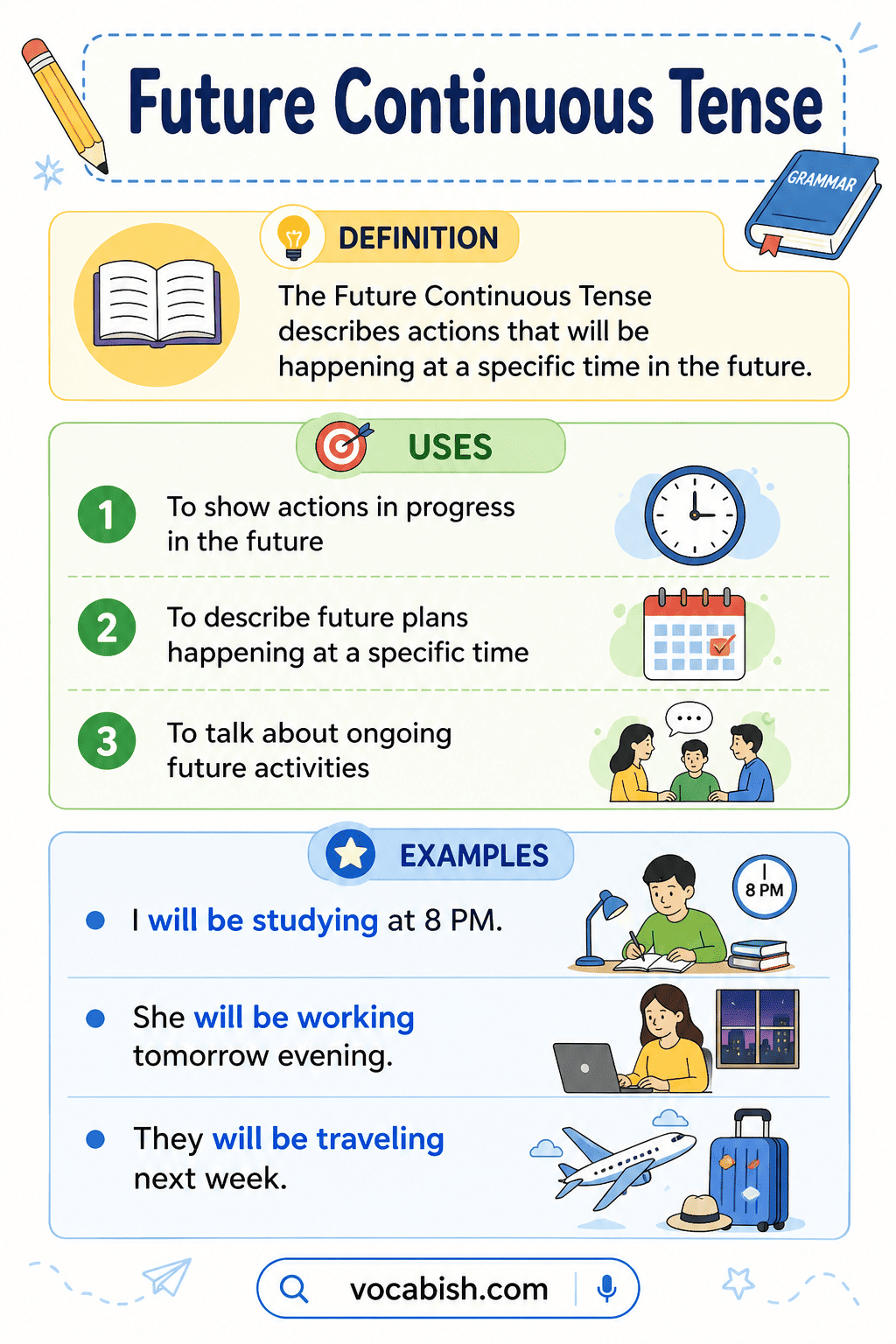
The future continuous tense describes an action that will be ongoing at a certain time in the future.
It shows that an activity will be in progress rather than completed.
Examples:
- I will be watching a movie at 9 PM.
- She will be sleeping when you call.
- They will be traveling next month.
Another name for this tense is the future progressive tense. Both terms refer to the same grammar structure.
Why Do We Use the Future Continuous Tense?
English speakers use this tense when they want to focus on the duration or progress of a future action.
Compare these sentences:
- I will study tonight.
- I will be studying tonight.
The first sentence simply states a future action.
The second sentence emphasizes that the studying will be happening over a period of time.
This difference makes communication more natural and precise.
Understanding Future Actions in Progress
Think of the future continuous tense as a snapshot of the future.
You imagine a future moment and describe what will be happening at that time.
For example:
Tomorrow at 10 AM, I will be sitting in a meeting.
You are not talking about when the meeting starts or ends. You are focusing on the activity in progress at 10 AM.
This is the key idea behind the future continuous tense.
Future Continuous Tense Structure
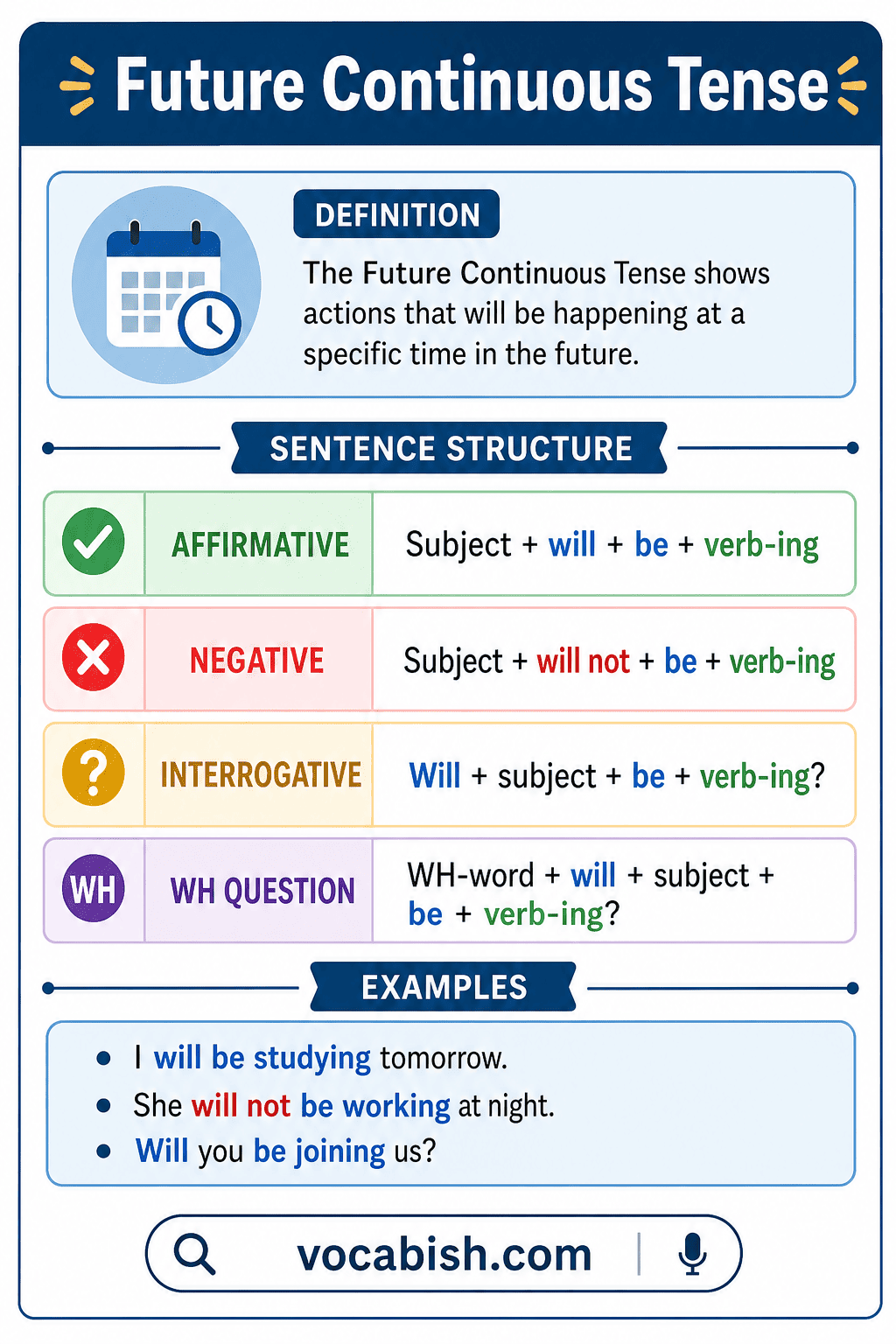
The future continuous tense is formed with will + be + verb (-ing) and is used to describe an action that will be in progress at a specific time in the future. In this tense, the main verb always takes the -ing form to show that the action will be continuing or happening over a period of time. For example, “She will be studying at 8 PM tonight.”
Positive Sentence Structure
Structure: Subject + will + be + verb-ing + object/complement
Examples:
- I will be working late tonight.
- She will be reading a novel tomorrow.
- We will be waiting for you.
- The children will be playing in the park.
- They will be discussing the project next week.
Negative Sentence Structure
Structure: Subject + will not + be + verb-ing
Won’t can be used in informal English.
Examples:
- I will not be attending the meeting.
- She won’t be staying at the hotel.
- We will not be traveling this weekend.
- They won’t be using the old system.
- He will not be working tomorrow.
Interrogative Sentence Structure
Structure: Will + subject + be + verb-ing?
Examples:
- Will you be joining us for dinner?
- Will she be working tomorrow?
- Will they be waiting outside?
- Will the students be taking the test?
- Will he be driving tonight?
Future Continuous Examples in Sentences
Here are different examples showing how this tense works in real situations.
- At 7 PM, I will be cooking dinner.
- We will be staying at a beach resort next month.
- She will be talking with clients all afternoon.
- This time tomorrow, they will be crossing the border.
- The company will be launching a new product next year.
- He will be waiting for the train when you arrive.
- My parents will be visiting relatives this weekend.
- The students will be preparing for their final exams.
- I will be working from home on Friday.
- They will be celebrating their anniversary tomorrow evening.
When to Use the Future Continuous Tense
The future continuous tense serves several purposes in daily communication.
Actions That Will Be Happening at a Specific Time
This is the most common use.
Examples:
- At 6 PM, I will be exercising.
- She will be teaching at 10 AM.
- They will be having lunch when we arrive.
- At midnight, many people will be celebrating.
The exact future time is important here.
Future Actions in Progress
Sometimes we simply want to show that an activity will continue during a future period.
Examples:
- The workers will be repairing the road next week.
- We will be improving the website throughout the month.
- The team will be developing new features.
The focus is on the ongoing process.
Planned Future Activities
The tense is often used when discussing scheduled or arranged activities.
Examples:
- We will be attending the conference next Thursday.
- She will be meeting the new manager tomorrow.
- I will be staying in London for a few days.
- They will be participating in the competition.
These events are already expected or planned.
Polite Questions About Future Plans
The future continuous tense can sound more polite and less direct than the future simple tense.
Compare:
- Will you use the car tomorrow?
- Will you be using the car tomorrow?
The second question sounds softer and more natural.
More Examples:
- Will you be joining us later?
- Will you be staying for lunch?
- Will you be working this weekend?
- Will you be attending the event?
Time Expressions Used in Future Continuous Tense
Certain time expressions frequently appear with this tense.
Time Expression | Example Use |
|---|---|
At this time tomorrow | At this time tomorrow I will be traveling |
Next week | I will be working next week |
Tomorrow evening | She will be cooking tomorrow evening |
In the future | People will be living differently in the future |
By this time | By this time tomorrow, I will be sleeping |
Rules for Using the Future Continuous Tense
Keep these rules in mind.
1. Use “will be” in every sentence
Correct:
- She will be studying.
Incorrect:
- She will studying.
2. Use the -ing form of the main verb
Correct:
- They will be working.
Incorrect:
- They will be work.
3. Do not use future time words unnecessarily if the context is already clear
Natural:
- This time tomorrow, I will be traveling.
Less natural:
- This time tomorrow, tomorrow, I will be traveling.
4. Use continuous action verbs
Most action verbs work well.
- running
- reading
- driving
- working
- studying
Future Simple vs Future Continuous
Although both tenses refer to the future, they serve different purposes.
Future Simple | Future Continuous |
|---|---|
Focuses on a future action | Focuses on a future action in progress |
will + verb | will be + verb-ing |
I will call you tonight. | I will be calling clients tonight. |
They will travel tomorrow. | They will be traveling tomorrow. |
The future continuous tense highlights the ongoing nature of the action.
Present Continuous vs Future Continuous
These tenses can sometimes seem similar because both use a verb ending in -ing.
Present Continuous | Future Continuous |
|---|---|
am/is/are + verb-ing | will be + verb-ing |
Action happening now | Action happening in the future |
She is studying now. | She will be studying tonight. |
We are having lunch. | We will be having lunch at noon tomorrow. |
The time reference changes the meaning.
Daily Conversation Examples
Real-life examples help you understand how native speakers use this tense.
- Ali: Can I call you at 8 PM?
- Sara: I will be attending a meeting then. Can you call later?
- Ahmed: Will you be driving to Lahore tomorrow?
- Bilal: Yes, I will be leaving early in the morning.
- Manager: Will you be working on the report this afternoon?
- Employee: Yes, I will be updating the final section.
- Friend: What will you be doing this weekend?
- You: I will be visiting my grandparents.
Common Mistakes in Future Continuous Tense
Many learners make similar errors.
- Wrong: I will be study tomorrow.
Correct: I will be studying tomorrow.
Why: You must use -ing form after “be.” - Wrong: She will be works at 9 PM.
Correct: She will be working at 9 PM.
Why: “works” is incorrect after auxiliary structure. - Wrong: Will she be go there?
Correct: Will she be going there?
Why: Always use -ing form in questions. - Wrong: I will being working late.
Correct: I will be working late.
Why: “being” is unnecessary and incorrect.
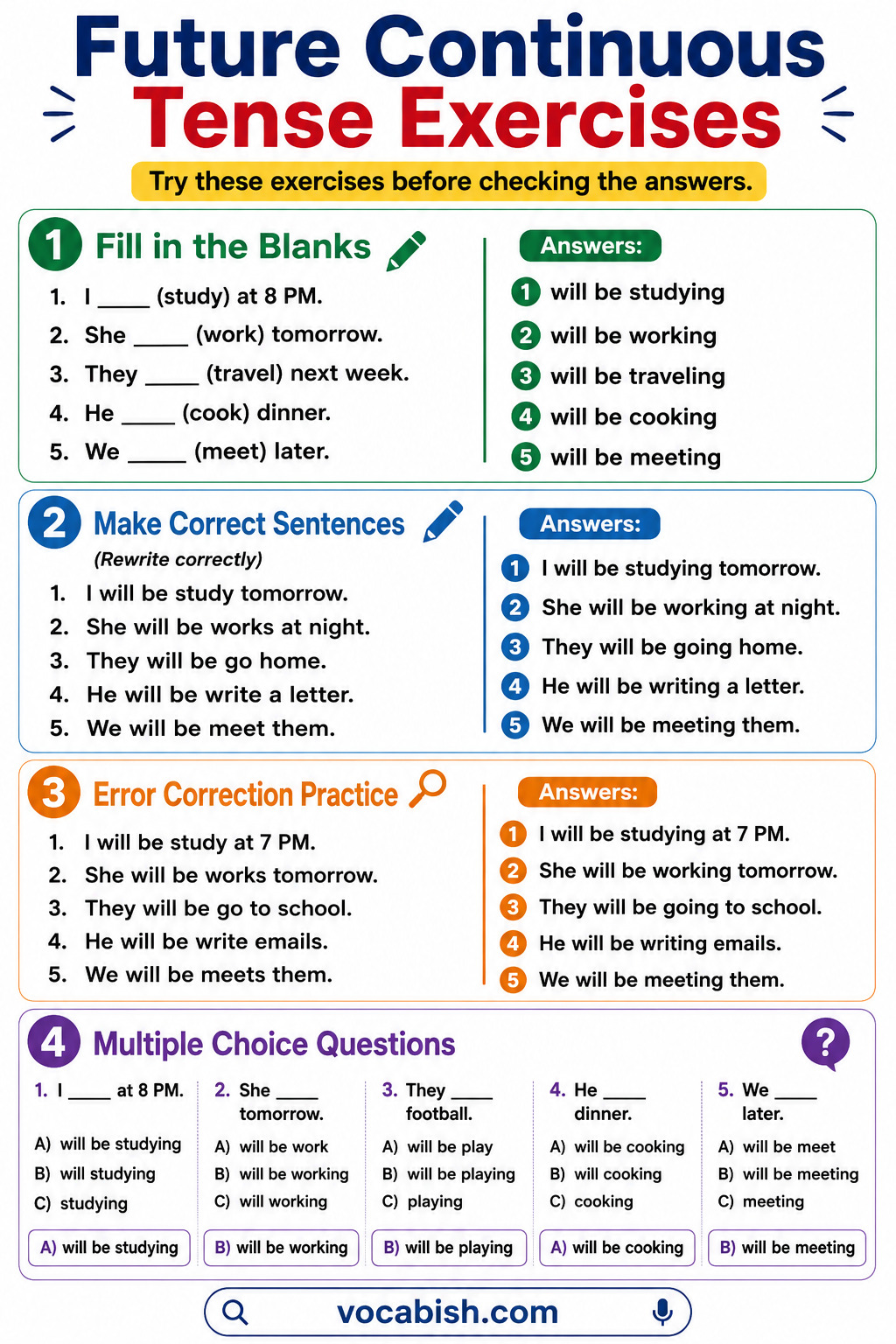
Future Continuous Tense Exercises
Try these exercises before checking the answers.
1. Fill in the Blanks
- I ____ (study) at 8 PM.
- She ____ (work) tomorrow.
- They ____ (travel) next week.
- He ____ (cook) dinner.
- We ____ (meet) later.
Answers:
- will be studying
- will be working
- will be traveling
- will be cooking
- will be meeting
2. Make Correct Sentences
(Rewrite correctly)
- I will be study tomorrow.
- She will be works at night.
- They will be go home.
- He will be write a letter.
- We will be meet them.
Answers:
- I will be studying tomorrow.
- She will be working at night.
- They will be going home.
- He will be writing a letter.
- We will be meeting them.
3. Error Correction Practice
- I will be study at 7 PM.
- She will be works tomorrow.
- They will be go to school.
- He will be write emails.
- We will be meets them.
Answers:
- I will be studying at 7 PM.
- She will be working tomorrow.
- They will be going to school.
- He will be writing emails.
- We will be meeting them.
4. Multiple Choice Questions
- I ____ at 8 PM.
A) will be studying
B) will studying
C) studying
A) will be studying - She ____ tomorrow.
A) will be work
B) will be working
C) will working
B) will be working - They ____ football.
A) will be play
B) will be playing
C) playing
B) will be playing - He ____ dinner.
A) will be cooking
B) will cooking
C) cooking
A) will be cooking - We ____ later.
A) will be meet
B) will be meeting
C) meeting
B) will be meeting
You May Also Like:
- 12 Tense Structures and Examples Chart
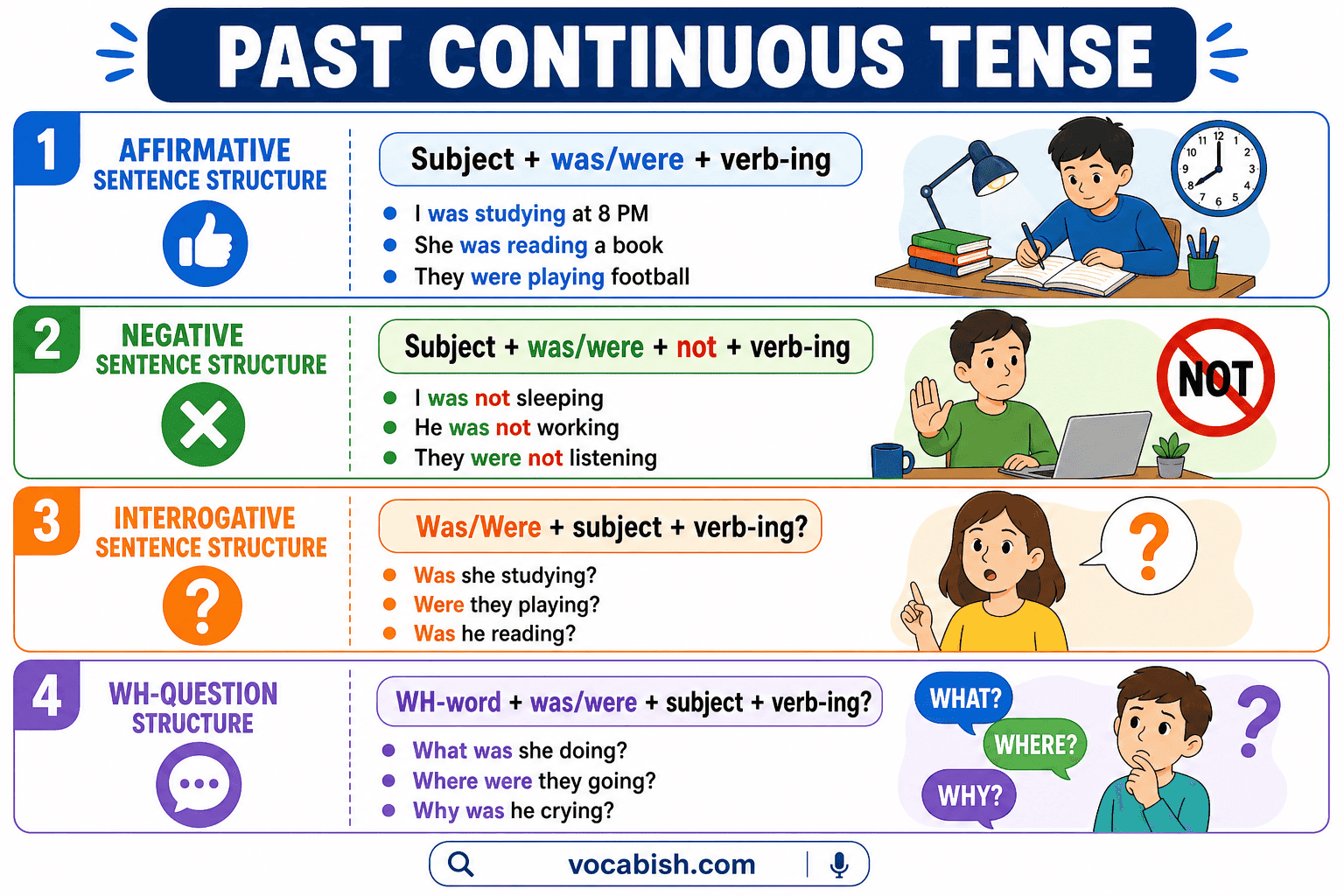
- Past Continuous Tense Uses and Examples
- Verb Tenses Chart with Formula and Examples
FAQs about Future Continuous Tense
The future continuous tense describes an action that will be in progress at a particular time in the future.
Example:
I will be studying at 8 PM.
It is also called the future progressive tense.
The basic structure is:
Subject + will + be + verb-ing
Example:
They will be working tomorrow.
Yes. Won’t is the short form of will not.
Example:
She won’t be attending the meeting.
It sounds less direct and more considerate when asking about someone’s plans.
Example:
Will you be using the printer later?
Yes. It is commonly used for planned events and expected future activities.
Example:
We will be staying in Paris next week.
Conclusion
The future continuous tense is used to describe actions that will be happening at a specific point in the future. Whether you are talking about travel plans, work schedules, family activities, or future events, this tense helps you show that an action will be in progress.
Remember the basic formula:
Subject + will + be + verb-ing
Once you understand this pattern, you can easily talk about future activities in a more natural and detailed way. Practice using the future continuous tense in everyday situations, and it will quickly become part of your active English vocabulary.