
Skip to content
  • Home
  • Privacy Policy
  • About Us
  • Contact Us
Logo of vocabish.com

Vocabish

Learn English as a Second Language

  • Home
  • Vocabulary
    • Adjectives
    • A to Z Colors Name
    • Antonyms
    • Confusing Words
    • Fruits Name by Color
    • Synonyms
    • Types of Fruits
  • Kids English Learning
    • Riddles for Kids
    • Tongue Twisters for Kids
  • Emoji Meanings
  • Worksheets
  • Privacy Policy
  • Contact Us
  • Toggle search form
Future Perfect Tense in English Grammar

Future Perfect Tense: Structure, Uses, and Examples

Posted on May 2, 2026May 2, 2026 By Muhammad Matloob No Comments on Future Perfect Tense: Structure, Uses, and Examples

The Future Perfect Tense shows actions that will be completed before a specific time in the future. Many learners feel confused about when to use it and how it is different from other future forms. In this blog post, you will understand how this tense works, why it matters, and how it helps you speak about future plans with accuracy. When you learn this tense, you can talk about deadlines, goals, and finished actions in a natural way. It also improves your writing by making your ideas more precise and organized. As you practice, your listening and reading skills will improve because you will recognize how native speakers talk about completed future actions.

Table of Contents

Toggle
  • Introduction to Future Perfect Tense
  • What is the Future Perfect Tense?
  • Formula and Structure of Future Perfect Tense
    • 1. Affirmative Sentence Structure
    • 2. Negative Sentence Structure
    • 3. Interrogative Sentence Structure
    • 4. WH-Question Structure
  • Helping Verbs Used in Future Perfect Tense
    • 1. Use of “Will Have”
    • 2. Use of Past Participle (3rd Form of Verb)
  • Main Uses of Future Perfect Tense
    • 1. Actions Completed Before a Future Time
    • 2. Predicting Completed Future Actions
    • 3. Deadlines and Future Goals
    • 4. Duration Before a Future Moment
  • Time Expressions Used in Future Perfect Tense
    • 1. By Tomorrow
    • 2. By Next Week
    • 3. Before
    • 4. By the Time
    • 5. Until Then
  • Future Perfect Tense Examples
    • Daily Life Examples
    • Academic Examples
    • Spoken English Examples
    • Question and Answer Examples
  • Rules for Using Future Perfect Tense
  • Difference Between Future Perfect and Future Simple
  • Difference Between Future Perfect and Future Continuous
  • Common Mistakes in Future Perfect Tense
  • Easy Tips to Learn Future Perfect Tense Quickly
  • Future Perfect Tense Exercises
    • 1. Fill in the Blanks
    • 2. Sentence Transformation
    • 3. Error Correction Practice
    • 4. Multiple Choice Questions
  • FAQs about Future Perfect Tense
  • Conclusion

Introduction to Future Perfect Tense

The future perfect tense often feels confusing at first because it mixes the idea of the future with something already completed. That sounds contradictory, right? But it’s actually very logical.

You use it when you imagine yourself at a future point and look back at something that will already be done.

Think of it like standing in the future and reviewing completed actions.

What is the Future Perfect Tense?

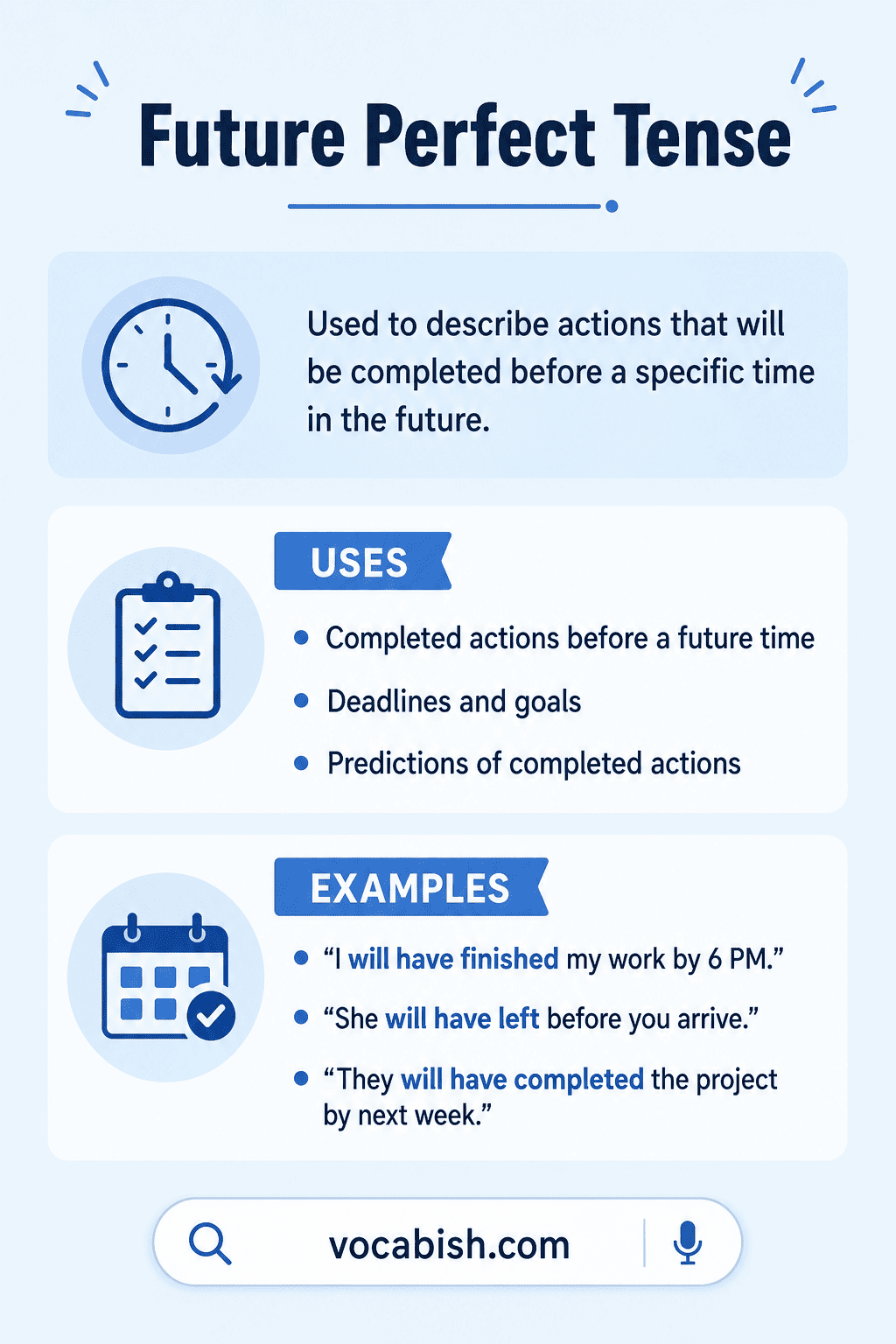
The future perfect tense describes an action that will be finished before a certain future time or event.

Why does English need this tense? Because sometimes “will” alone isn’t enough. You need to show not just that something will happen—but that it will already be done before something else.

Examples:

  • I will have finished my homework by 8 PM.
  • She will have left before you arrive.
  • They will have completed the project by next week.
  • We will have eaten dinner before the movie starts.

Formula and Structure of Future Perfect Tense

The structure is actually very consistent, which is good news.

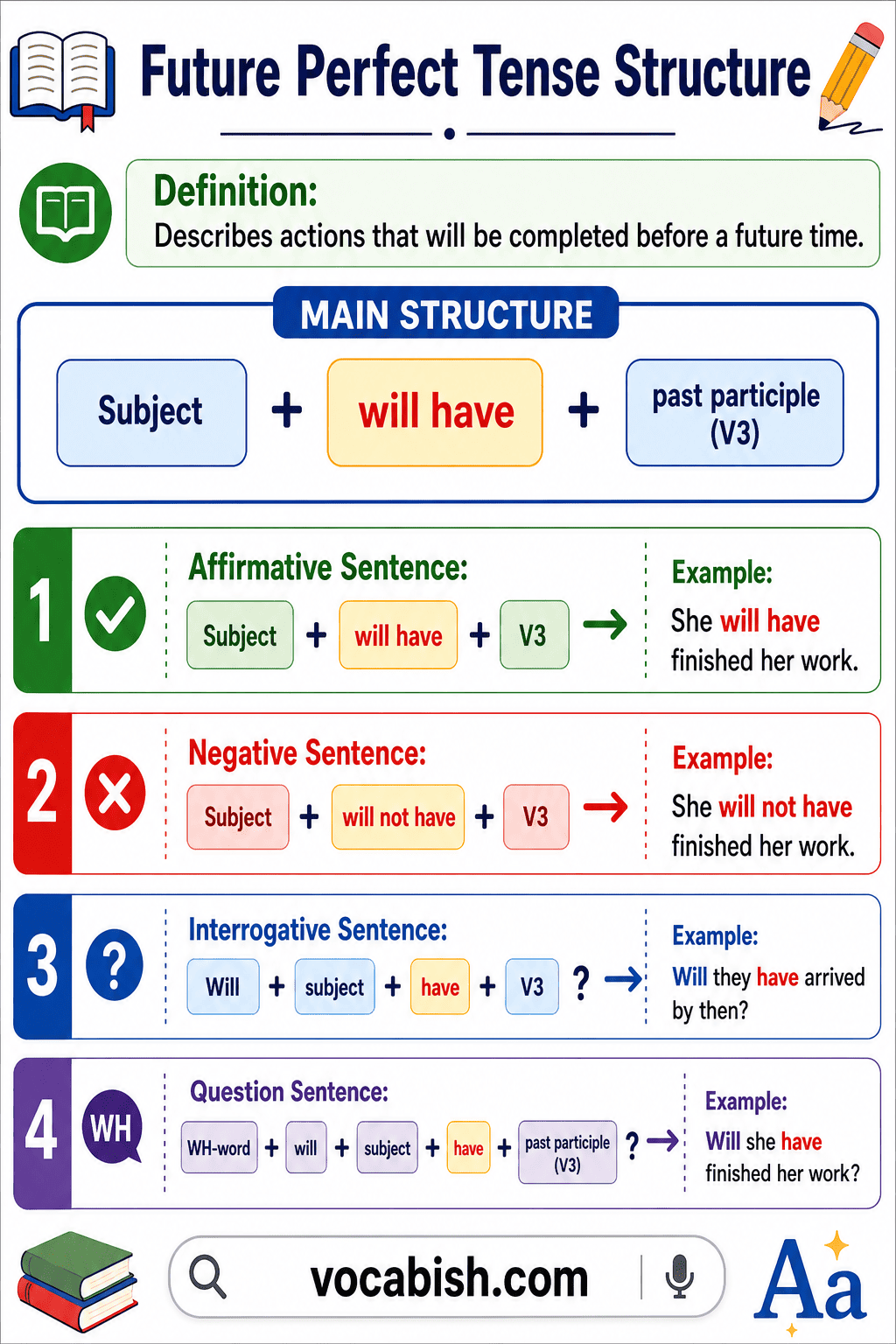
Sentence TypeStructureExample
AffirmativeSubject + will have + past participleShe will have finished
NegativeSubject + will not have + past participleShe will not have finished
QuestionWill + subject + have + past participleWill she have finished?

1. Affirmative Sentence Structure

Rule:
Use subject + will have + past participle (V3).

Why this works:
“Will” shows the future, “have” signals completion, and the past participle shows the finished action.

Examples:

  • I will have completed the task by noon.
  • She will have written the report by tomorrow.
  • They will have arrived before sunset.
  • We will have finished the meeting by 5 PM.

2. Negative Sentence Structure

Rule:
Add “not” after “will.”

Examples:

  • I will not have finished the work by evening.
  • She will not have completed the assignment on time.
  • They will not have reached the station by then.

3. Interrogative Sentence Structure

Rule:
Start with “Will.”

Examples:

  • Will you have finished the work by 6 PM?
  • Will she have completed the task before the deadline?
  • Will they have arrived by then?

4. WH-Question Structure

Rule:
WH-word + will + subject + have + past participle.

Examples:

  • When will you have finished the project?
  • Why will she have left early?
  • How will they have completed the work so fast?
Future Perfect Structure and Examples

Helping Verbs Used in Future Perfect Tense

1. Use of “Will Have”

“Will have” is the backbone of this tense. You can’t remove either word.

Examples:

  • I will have learned this lesson by tomorrow.
  • She will have finished her work by then.
  • We will have completed the course by next month.

2. Use of Past Participle (3rd Form of Verb)

The third form shows the action is complete.

Examples:

  • He will have eaten lunch before 2 PM.
  • They will have built the house by next year.
  • She will have gone home before dark.

Main Uses of Future Perfect Tense

1. Actions Completed Before a Future Time

This is the most common use.

Examples:

  • I will have finished this by 5 PM.
  • She will have left before you arrive.
  • They will have completed the work by tomorrow.

2. Predicting Completed Future Actions

Used for logical guesses.

Examples:

  • He will have reached home by now.
  • They will have finished the exam already.
  • She will have completed the task by evening.

3. Deadlines and Future Goals

Perfect for schedules and planning.

Examples:

  • I will have completed my degree by 2027.
  • She will have saved enough money by next year.
  • They will have finished construction by December.

4. Duration Before a Future Moment

Often used with “for.”

Examples:

  • By next month, I will have worked here for five years.
  • She will have lived here for a decade by then.
  • They will have studied English for two years.
Future Perfect Uses and Examples

Time Expressions Used in Future Perfect Tense

1. By Tomorrow

  • I will have finished it by tomorrow.

2. By Next Week

  • She will have completed the project by next week.

3. Before

  • They will have left before you arrive.

4. By the Time

  • By the time you come, I will have finished the work.

5. Until Then

  • I will have prepared everything until then.

Future Perfect Tense Examples

Daily Life Examples

  • I will have cooked dinner by 7 PM.
  • She will have cleaned the house before guests arrive.
  • We will have finished shopping by noon.
  • He will have repaired the car by tomorrow.
  • They will have packed their bags before leaving.
  • I will have completed my workout by evening.
  • She will have done her homework before dinner.
  • We will have watched the movie by then.
  • He will have paid the bill before the deadline.
  • They will have arrived home by night.

Academic Examples

  • I will have submitted my assignment by Friday.
  • She will have completed her research by next month.
  • They will have finished the syllabus before exams.
  • We will have studied all chapters by next week.
  • He will have written his thesis by then.
  • Students will have learned this topic by tomorrow.
  • She will have passed the test by then.
  • I will have completed my degree by 2026.
  • They will have solved all problems by evening.
  • We will have revised everything before the test.

Spoken English Examples

  • I will have called you before you reach.
  • She will have finished by the time you arrive.
  • We will have left before traffic starts.
  • He will have eaten already.
  • They will have gone by then.
  • I will have done it before you ask again.
  • She will have cleaned everything.
  • We will have completed it soon.
  • He will have arrived by now.
  • They will have finished the job.

Question and Answer Examples

  • Will you have finished the work?
  • Yes, I will have completed it.
  • Will she have arrived by then?
  • No, she will not have reached yet.
  • Will they have completed the project?
  • Yes, they will have finished it.
  • Will he have submitted the report?
  • No, he will not have done it.
  • Will we have learned this lesson?
  • Yes, we will have understood it.

Rules for Using Future Perfect Tense

  • Always use will have + past participle
  • Use it for actions completed before a future point
  • Often used with time expressions like “by,” “before”
  • Not used for actions happening at the same time

Difference Between Future Perfect and Future Simple

FeatureFuture SimpleFuture Perfect
FocusAction will happenAction will be completed
Structurewill + verbwill have + V3
ExampleI will finishI will have finished

Difference Between Future Perfect and Future Continuous

FeatureFuture ContinuousFuture Perfect
FocusOngoing actionCompleted action
ExampleI will be workingI will have finished

Common Mistakes in Future Perfect Tense

Wrong: I will finished the work.
Correct: I will have finished the work.
Why: Missing “have.”

Wrong: She will have finish it.
Correct: She will have finished it.
Why: Wrong verb form.

Wrong: I will have done it yesterday.
Correct: I did it yesterday.
Why: Future tense cannot refer to past time.

Easy Tips to Learn Future Perfect Tense Quickly

  • Think “completed before future time”
  • Look for words like “by” or “before”
  • Practice irregular verbs daily
  • Imagine a timeline—it helps a lot

Future Perfect Tense Exercises

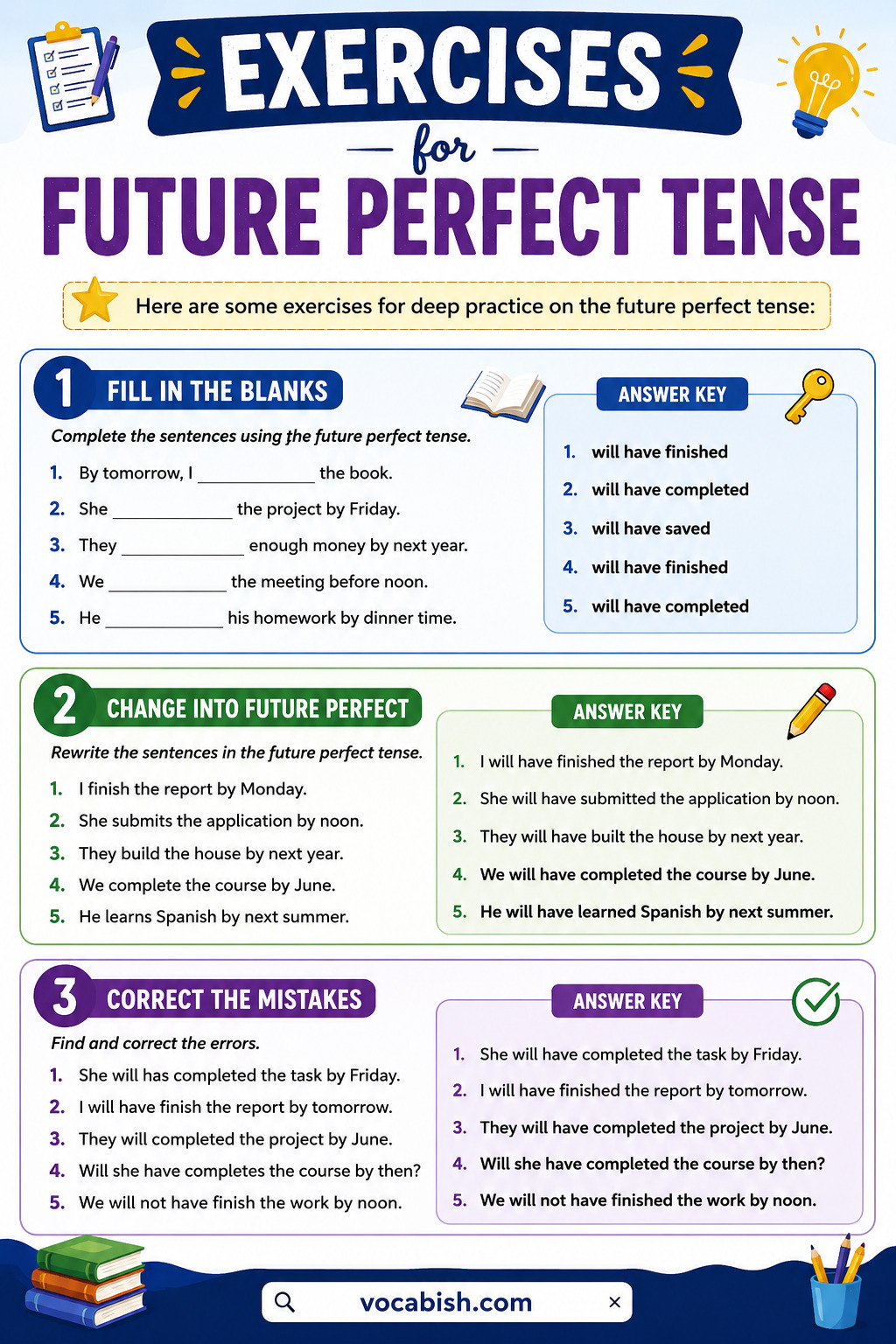
1. Fill in the Blanks

Fill in each blank using the correct form of the future perfect tense.

  1. I ______ (finish) my homework by 8 PM.
  2. She ______ (complete) the project before the deadline.
  3. They ______ (arrive) by the time we reach the station.
  4. We ______ (leave) before you get there.
  5. He ______ (write) the report by tomorrow morning.
  6. The team ______ (win) the match by then.
  7. She ______ (learn) all the lessons by next week.
  8. I ______ (cook) dinner before you come home.
  9. They ______ (build) the house by next year.
  10. We ______ (watch) the movie before midnight.

Answer Key:

  1. will have finished
  2. will have completed
  3. will have arrived
  4. will have left
  5. will have written
  6. will have won
  7. will have learned
  8. will have cooked
  9. will have built
  10. will have watched

2. Sentence Transformation

Rewrite each sentence using the future perfect tense.

  1. I will complete the task by 5 PM.
  2. She will finish the book by tomorrow.
  3. They will reach the airport before noon.
  4. We will clean the house before guests arrive.
  5. He will submit the report by Monday.
  6. I will learn this lesson by next week.
  7. She will prepare dinner before we come.
  8. They will solve the problem by then.
  9. We will finish the meeting by 3 PM.
  10. He will repair the car by evening.

Answer Key:

  1. I will have completed the task by 5 PM.
  2. She will have finished the book by tomorrow.
  3. They will have reached the airport before noon.
  4. We will have cleaned the house before guests arrive.
  5. He will have submitted the report by Monday.
  6. I will have learned this lesson by next week.
  7. She will have prepared dinner before we come.
  8. They will have solved the problem by then.
  9. We will have finished the meeting by 3 PM.
  10. He will have repaired the car by evening.

3. Error Correction Practice

Find and correct the mistake in each sentence.

  1. I will have finish the work by tomorrow.
  2. She will have completed the task yesterday.
  3. They will finished the project by next week.
  4. He will have ate dinner before you arrive.
  5. We will have complete the assignment soon.
  6. She will have write the letter by then.
  7. I will have did my homework by evening.
  8. They will have build the house by next year.
  9. He will have went home before night.
  10. We will have saw that movie by tomorrow.

Answer Key:

  1. I will have finished the work by tomorrow.
  2. She completed the task yesterday.
  3. They will have finished the project by next week.
  4. He will have eaten dinner before you arrive.
  5. We will have completed the assignment soon.
  6. She will have written the letter by then.
  7. I will have done my homework by evening.
  8. They will have built the house by next year.
  9. He will have gone home before night.
  10. We will have seen that movie by tomorrow.

4. Multiple Choice Questions

Choose the correct answer.

  1. I ______ the work by tomorrow.
    a) will finish
    b) will have finished
    c) finished
  2. She ______ the project before the deadline.
    a) will complete
    b) will have completed
    c) completes
  3. They ______ by the time we arrive.
    a) will leave
    b) will have left
    c) leaving
  4. We ______ dinner before you come.
    a) will cook
    b) will have cooked
    c) cooked
  5. He ______ the report by Monday.
    a) will submit
    b) will have submitted
    c) submitting
  6. I ______ this lesson by next week.
    a) learn
    b) will have learned
    c) learned
  7. She ______ home before dark.
    a) will go
    b) will have gone
    c) goes
  8. They ______ the work by evening.
    a) will finish
    b) will have finished
    c) finishing
  9. We ______ the meeting by 3 PM.
    a) will have finished
    b) finished
    c) will finishing
  10. He ______ the car by tomorrow.
    a) repair
    b) will repair
    c) will have repaired

Answer Key:

  1. b
  2. b
  3. b
  4. b
  5. b
  6. b
  7. b
  8. b
  9. a
  10. c

FAQs about Future Perfect Tense

What is the Future Perfect Tense?

The Future Perfect Tense describes an action that will be completed before a specific time in the future. It helps you show that something will already be finished at that future moment.

How do you form the Future Perfect Tense in English?

You form the Future Perfect Tense using “will have + past participle.” For example: “She will have finished her work.” This structure stays the same for all subjects.

When should I use the Future Perfect Tense?

Use the Future Perfect Tense when you want to show that an action will be completed before a future time or event, especially with time expressions like “by” or “before.”

What are common examples of Future Perfect Tense sentences?

Examples include: “I will have completed the task by 5 PM” and “They will have left before you arrive.” These show completed actions in the future.

What is the difference between Future Perfect and Future Simple?

Future Simple shows an action will happen, while Future Perfect shows it will be completed before a future time. Example: “I will finish” vs. “I will have finished.”

What time expressions are used with the Future Perfect Tense?

Common time expressions include “by tomorrow,” “by next week,” “before,” and “by the time.” These phrases help show when the action will be completed.

What mistakes should I avoid in the Future Perfect Tense?

Avoid missing “have” or using the wrong verb form. Always use “will have + past participle,” not “will finished” or “will have finish.”

Conclusion

The future perfect tense becomes much easier once you see it as “looking back from the future.” Focus on the structure—will have + past participle—and practice with real-life situations. The more you use it in speaking and writing, the more natural it will feel.

12 Tenses

Post navigation

Previous Post: Future Continuous Tense: Structure, Uses, and Examples
Next Post: Future Perfect Continuous Tense: Structure, Uses, and Examples

Leave a Reply Cancel reply

Your email address will not be published. Required fields are marked *

  • Facebook
  • Pinterest

Recent Comments

  • Israel BIZIMANA on 2000 Antonym Words in English with Pictures and PDF
  • Israel BIZIMANA on 2000 Antonym Words in English with Pictures and PDF
  • rachid nouacer on 100 Adverbs and Their Antonyms | Adverbs Opposite Words List
  • Adeel on How to Introduce Yourself in English for Beginners
  • OmarFaruk on 200+ Action Verbs List in English with Pictures

Recent Posts

  • Future Perfect Continuous Tense: Structure, Uses, and Examples
  • Future Perfect Tense: Structure, Uses, and Examples
  • Future Continuous Tense: Structure, Uses, and Examples
  • Future Simple Tense: Definition, Structure, Uses, and Examples
  • Past Perfect Continuous Tense: Structure, Uses, and Examples

Most Popular Articles

  • Heart Emoji Meanings : What Each Colour Heart Means (17,482)
  • Emoji Meanings: Complete List of Emojis and Their Meanings (10,355)
  • Face Emoji Meanings — The Hidden Meanings Behind Emojis (10,010)
  • Unique Irregular Verbs List in English with Examples (5,305)
  • 500 Daily Used Normal vs Advanced English Words (4,912)
  • Clothes and Fashion Vocabulary in English (3,805)
  • 50 Irregular Verbs | Present, Past, and Past Participle (3,237)
  • 50 Basic Adjectives to Describe People in English (2,751)
  • 200+ Action Verbs List in English with Pictures (2,610)

Our Topics

  • 12 Tenses (13)
  • Adjectives (44)
  • Antonyms (11)
  • Basic English Learning (5)
  • Confusing Words (35)
  • Emoji Meanings (11)
  • Examples (34)
  • Figure of Speech (8)
  • Kids English Learning (32)
    • Riddles for Kids (2)
    • Tongue Twisters for Kids (7)
  • List of Nouns (1)
  • Masculine and Feminine (7)
  • Other Ways to Say (11)
  • Parts of Speech (10)
  • Sentences (25)
  • Synonyms (37)
  • Vocabulary (187)
    • A to Z Colors Name (14)
    • Fruits Name by Color (6)
    • Types of Fruits (19)
  • Worksheets (7)
  • Writing (14)

Copyright © 2026 Vocabish.

Powered by PressBook WordPress theme