
The 12 Tenses Chart shows how English verbs change to express time, action, and duration in a structured way. In this blog post, you will learn how each tense works, how sentences are formed, and how to use them correctly in real situations.
Many learners feel confused because they try to memorize rules without seeing the full system. When you understand how the tenses, structure, and patterns connect, English starts to make more sense. You can see when an action happens and how long it continues.
Introduction to the 12 Tenses in English Grammar
The 12 tenses in English grammar are built from three main time frames: present, past, and future. Each time frame has four types, which show different aspects of an action.
Instead of memorizing all 12 randomly, it’s better to see them as a pattern. That’s how I teach my students in class, and it works much better than trying to remember rules one by one.
What are Tenses in English?
A tense tells you when an action happens and sometimes how long it continues or whether it is complete.
English uses tenses to give clear time meaning. Without them, your sentence can sound confusing or incomplete.
Examples:
- I eat breakfast at 8 AM.
- I am eating breakfast now.
- I have eaten breakfast.
- I will eat breakfast later.
Notice how the verb changes. That change gives you time information.
Why Tenses are Important in English Grammar
Tenses are essential because they make your meaning clear. Without correct tense, your listener or reader may misunderstand you.
When you use the right tense:
- Your speaking sounds more natural
- Your writing becomes more accurate
- You understand conversations better
I’ve seen many learners say things like:
- ❌ I go yesterday
- ✔ I went yesterday
The message becomes clear only when the tense is correct.
Classification of the 12 Tenses
English tenses are grouped into three main categories.
1. Present Tenses
These describe actions happening now or regularly.
Examples:
- I work every day.
- She is studying now.
2. Past Tenses
These describe actions that already happened.
Examples:
- I worked yesterday.
- She was studying last night.
3. Future Tenses
These describe actions that will happen later.
Examples:
- I will work tomorrow.
- She will be studying tonight.
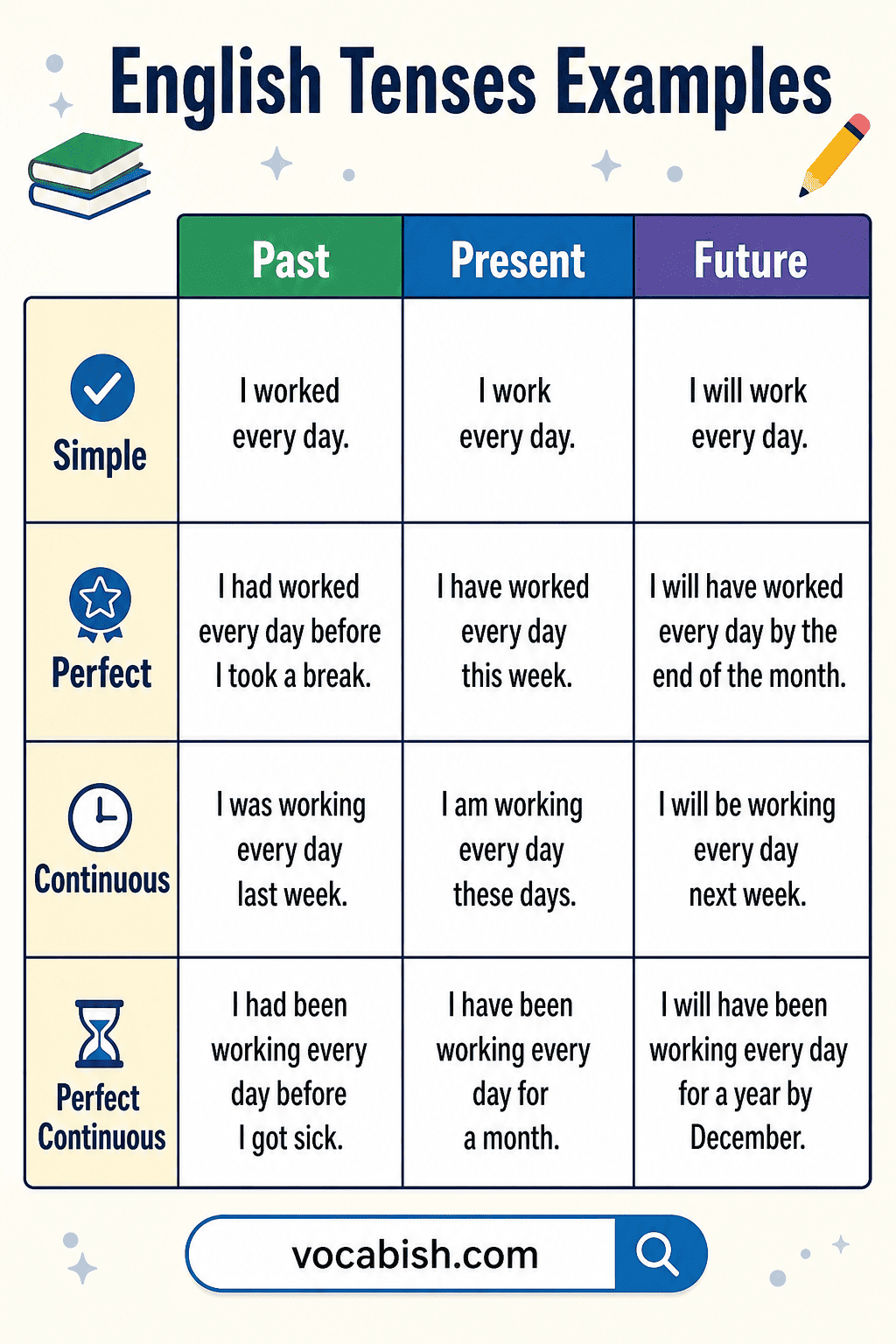
4. English Tenses Examples: Verb Tenses Chart
Tense Type | Past | Present | Future |
|---|---|---|---|
Simple | I worked every day. | I work every day. | I will work every day. |
Perfect | I had worked every day before I took a break. | I have worked every day this week. | I will have worked every day by the end of the month. |
Continuous | I was working every day last week. | I am working every day these days. | I will be working every day next week. |
Perfect Continuous | I had been working every day before I got sick. | I have been working every day for a month. | I will have been working every day for a year by December. |
Present Tenses
1. Simple Present Tense
Used for habits, routines, and general facts.
Examples:
- I play football every weekend.
- She teaches English.
- They live in London.
Common mistake: forgetting “s” with third person.
- ❌ She play
- ✔ She plays
2. Present Continuous Tense
Used for actions happening now.
Examples:
- I am studying now.
- She is working at the moment.
- They are playing outside.
3. Present Perfect Tense
Used for actions completed at an unknown time or connected to the present.
Examples:
- I have finished my homework.
- She has visited Paris.
- They have eaten lunch.
4. Present Perfect Continuous Tense
Used for actions that started in the past and are still continuing.
Examples:
- I have been studying for two hours.
- She has been working all day.
- They have been waiting since morning.
Past Tenses
1. Simple Past Tense
Used for completed actions in the past.
Examples:
- I visited my friend yesterday.
- She watched a movie.
- They played football.
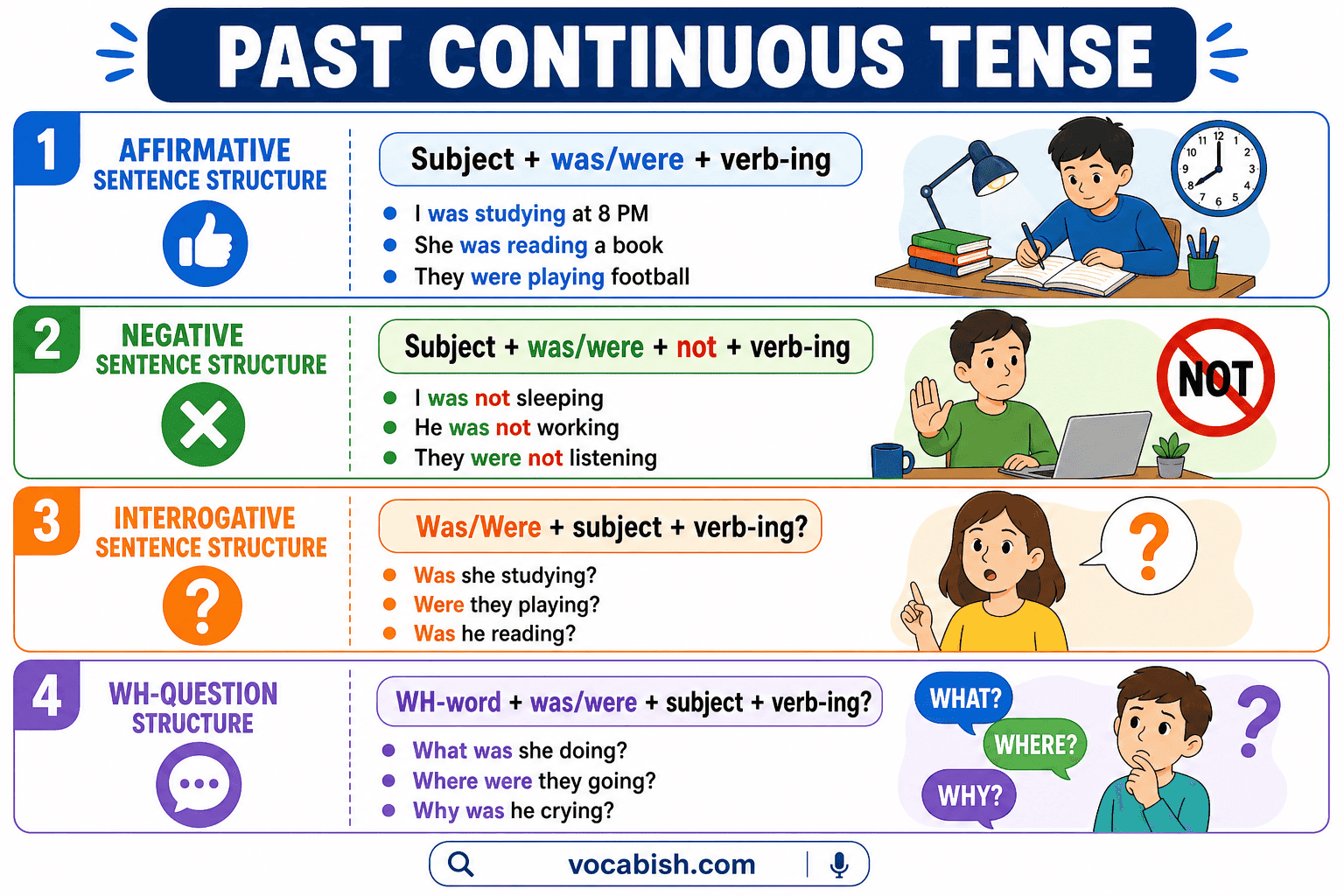
2. Past Continuous Tense
Used for actions in progress at a specific time in the past.
Examples:
- I was studying at 8 PM.
- She was cooking dinner.
- They were playing outside.
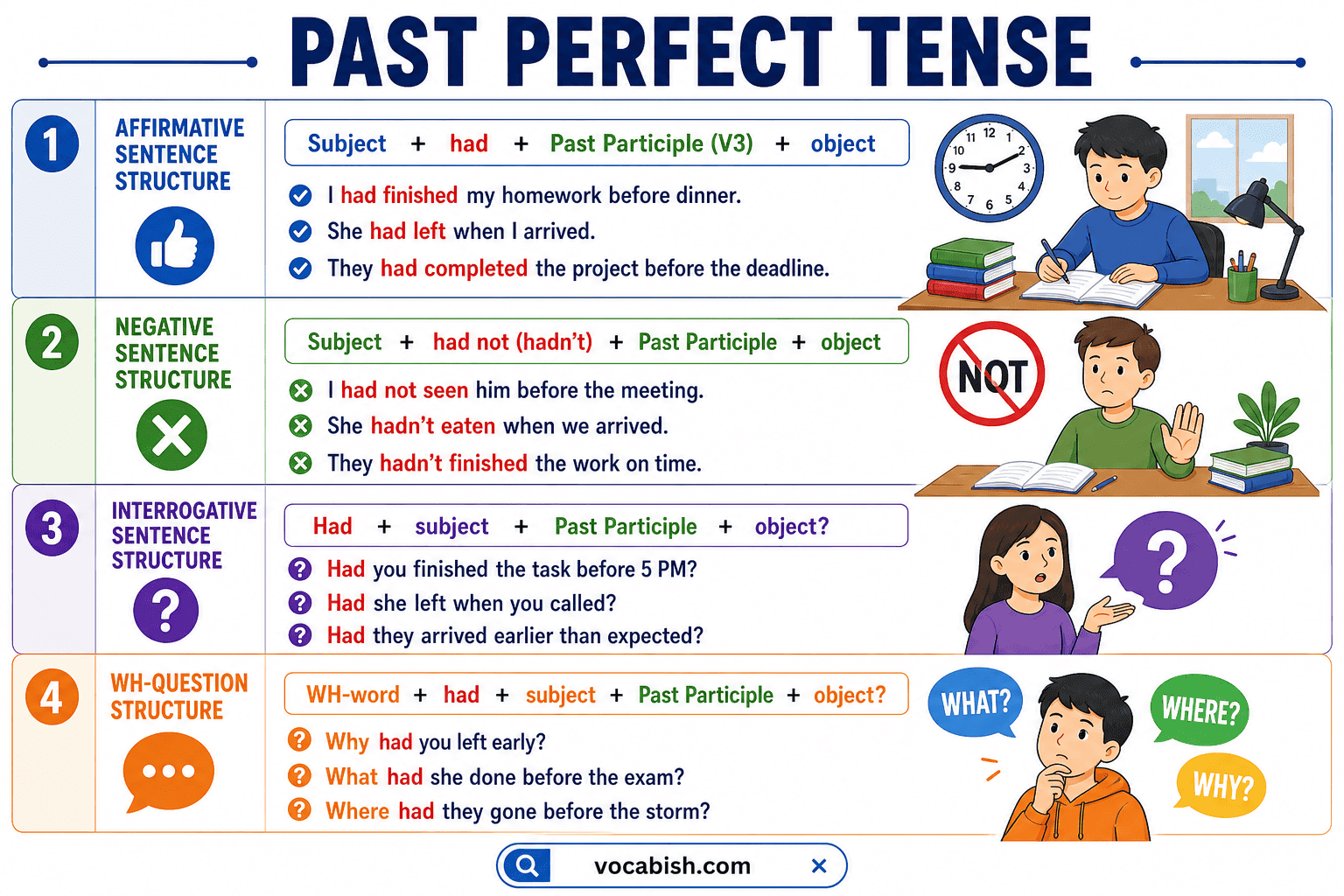
3. Past Perfect Tense
Used to show one action happened before another in the past.
Examples:
- I had finished my work before dinner.
- She had left before I arrived.
- They had completed the task.
4. Past Perfect Continuous Tense
Used for long actions that happened before another past action.
Examples:
- I had been studying for hours before the exam.
- She had been working all day.
- They had been traveling for weeks.
Future Tenses
1. Simple Future Tense
Used for decisions, promises, and predictions.
Examples:
- I will call you later.
- She will help you.
- They will arrive soon.
2. Future Continuous Tense
Used for actions that will be in progress at a specific time.
Examples:
- I will be studying at 9 PM.
- She will be working tomorrow.
- They will be traveling next week.
3. Future Perfect Tense
Used for actions that will be completed before a certain future time.
Examples:
- I will have finished my work by 6 PM.
- She will have completed the project.
- They will have left by then.
4. Future Perfect Continuous Tense
Used for actions continuing up to a future point.
Examples:
- I will have been studying for three hours.
- She will have been working all day.
- They will have been traveling for weeks.
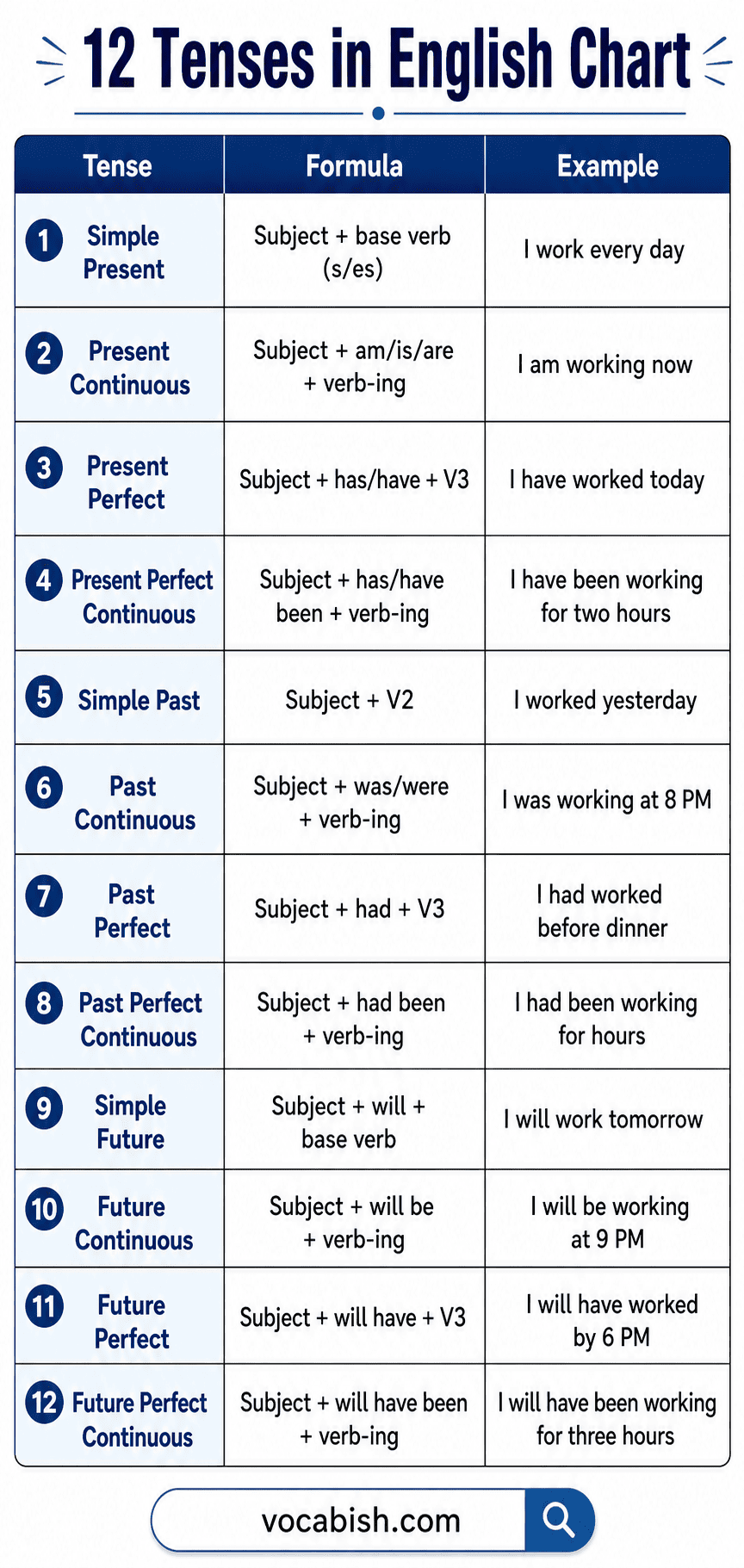
12 Tenses Chart in English Grammar
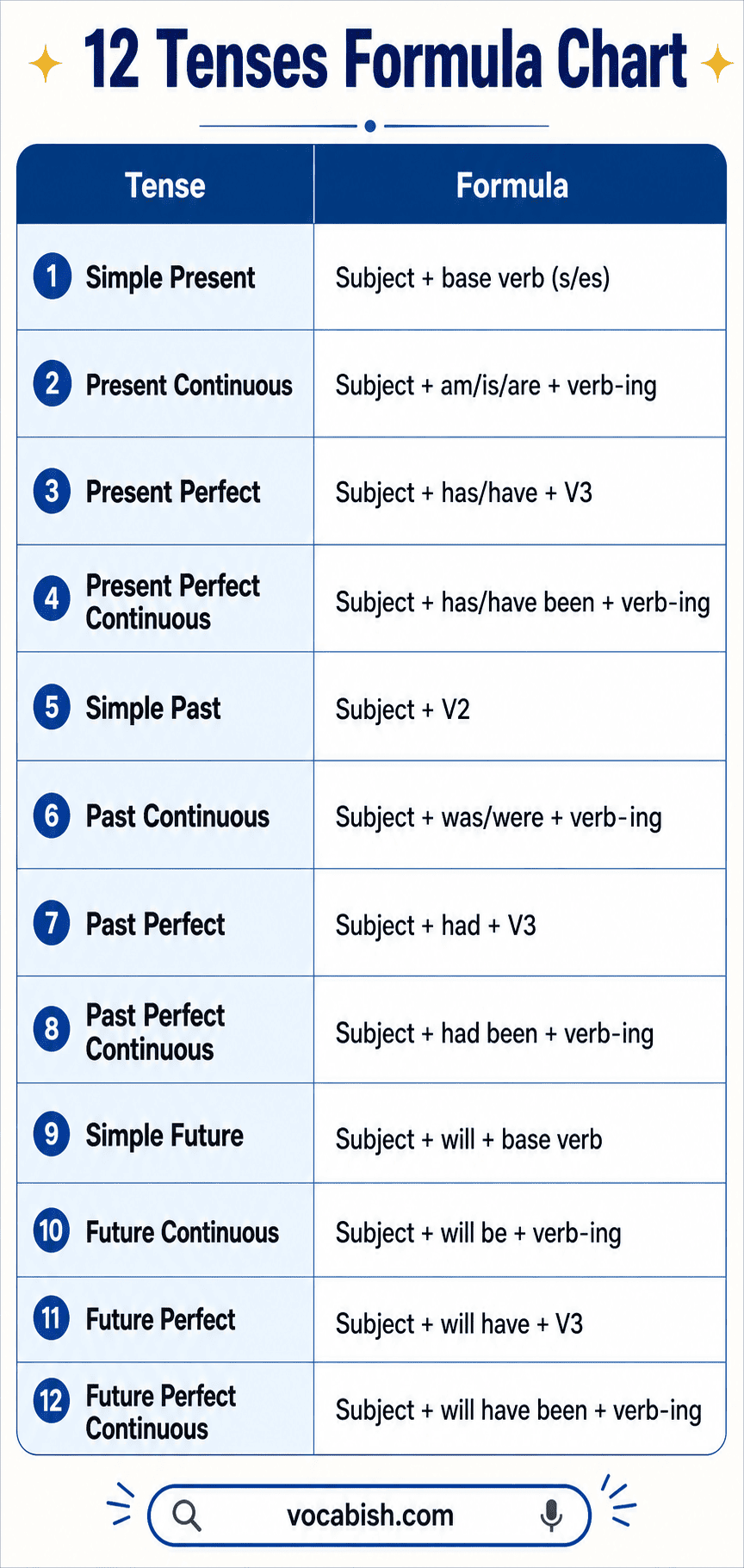
1. Formula Chart of All 12 Tenses
Tense | Formula |
|---|---|
Simple Present | Subject + base verb |
Present Continuous | Subject + am/is/are + ing |
Present Perfect | Subject + has/have + V3 |
Present Perfect Continuous | Subject + has/have been + ing |
Simple Past | Subject + V2 |
Past Continuous | Subject + was/were + ing |
Past Perfect | Subject + had + V3 |
Past Perfect Continuous | Subject + had been + ing |
Simple Future | Subject + will + base |
Future Continuous | Subject + will be + ing |
Future Perfect | Subject + will have + V3 |
Future Perfect Continuous | Subject + will have been + ing |
2. Positive Sentence Chart
Tense | Example |
|---|---|
Present | I work |
Past | I worked |
Future | I will work |
3. Negative Sentence Chart
Tense | Example |
|---|---|
Present | I do not work |
Past | I did not work |
Future | I will not work |
4. Question Sentence Chart
Tense | Example |
|---|---|
Present | Do you work? |
Past | Did you work? |
Future | Will you work? |
Examples of All 12 Tenses
1. Present Tense Examples
- I eat breakfast daily.
- She is studying now.
- They have finished the task.
- We have been waiting for hours.
2. Past Tense Examples
- I went home early.
- She was cooking dinner.
- They had left already.
- We had been working all day.
3. Future Tense Examples
- I will travel tomorrow.
- She will be studying tonight.
- They will have completed the work.
- We will have been waiting for hours.
Difference Between the Verb Tenses
The key difference lies in time and aspect.
Tense Type | Focus |
|---|---|
Simple | action only |
Continuous | action in progress |
Perfect | completed action |
Perfect Continuous | duration of action |
Learners often mix perfect and continuous forms. The difference becomes clearer when you focus on whether the action is finished or still continuing.
How to Identify Tenses in Sentences
Start by looking at the verb form. That’s your biggest clue.
- “is/am/are + ing” → continuous
- “has/have + V3” → perfect
- “will” → future
Ask yourself:
- When is the action happening?
- Is it complete or ongoing?
This method works much better than memorizing rules blindly.
FAQs about Tenses
The 12 tenses in English grammar are divided into present, past, and future, each with four forms: simple, continuous, perfect, and perfect continuous, showing time and action clearly.
Start by understanding the three time groups, then learn one tense at a time with examples. Practice daily sentences to build accuracy and confidence in real communication.
The 12 tenses help you express time, actions, and duration correctly. Using them properly improves speaking clarity, writing accuracy, and overall understanding of English conversations.
Each tense follows a pattern using helping verbs and main verbs, such as “will be + verb-ing” or “has + past participle,” depending on time and action type.
The difference lies in time and aspect. Simple shows facts, continuous shows ongoing actions, perfect shows completion, and perfect continuous shows duration over time.
Look at the verb form and helping verbs. Words like “is,” “was,” “has,” or “will” indicate tense type and help you understand when the action happens.
Simple present, present continuous, and simple past are used most often in daily conversation, but understanding all 12 tenses helps you speak more naturally and accurately.
Yes, correct use of the 12 tenses is essential in IELTS and other exams. It directly affects grammar scores in speaking and writing sections.
Conclusion
The 12 tenses in English grammar may look overwhelming at first, but they follow a clear pattern. Once you understand how time and structure work together, everything becomes easier to manage.
Focus on one tense at a time, practice with real sentences, and use them in daily conversation. That’s how you turn grammar knowledge into real communication skill.