
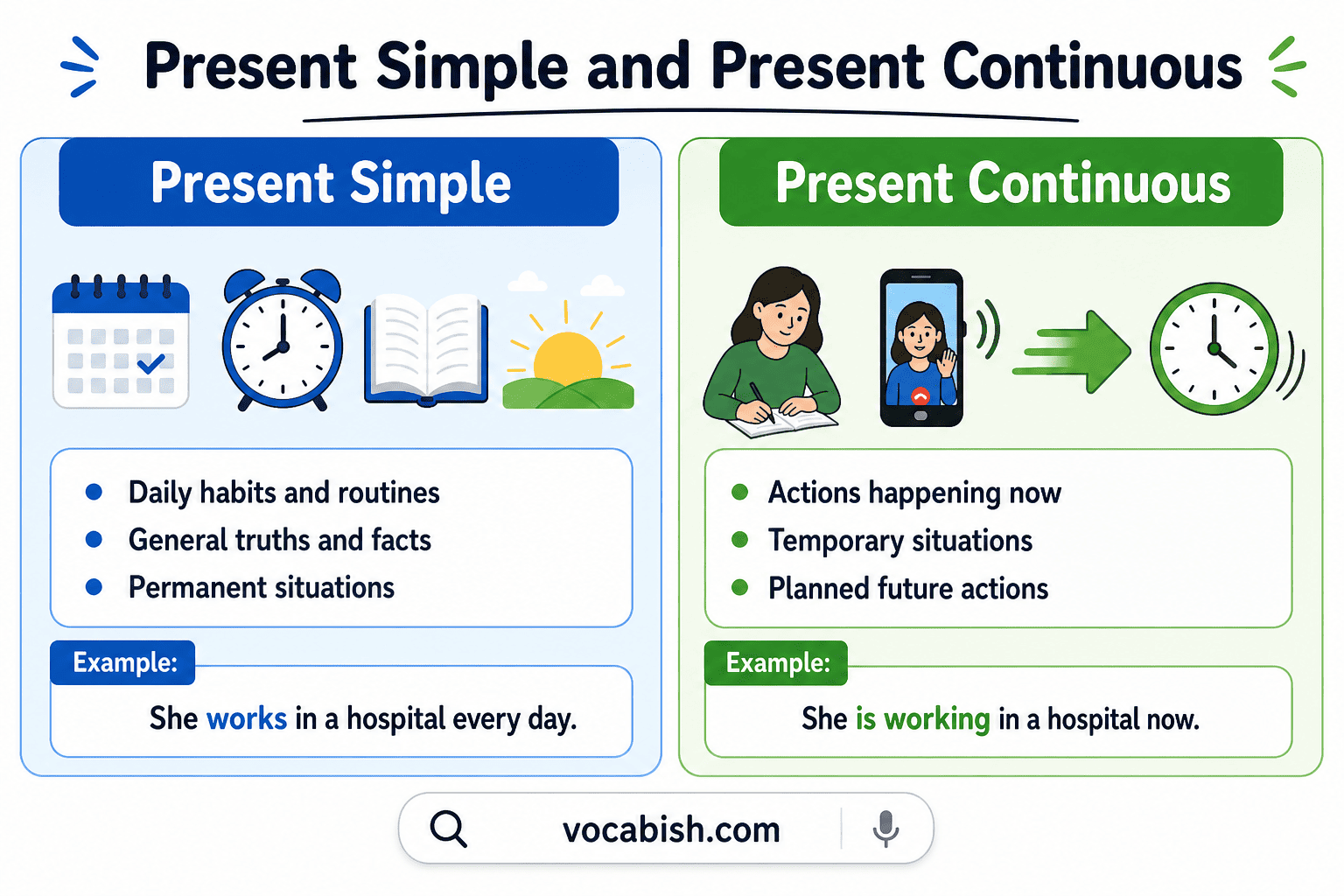
In this blog post, you will learn the difference between Present Simple and Present Continuous and how each tense is used in real English sentences. These two tenses help you talk about daily routines, habits, and actions happening right now, which are essential parts of everyday communication in English.
Understanding these tenses is important because they appear in almost every conversation, book, and article. When you know when to use Present Simple for routines and facts and when to use Present Continuous for actions happening at the moment, your speaking becomes more accurate.
Complete guide to all 12 English tenses with usage rules, structure charts, and examples to help you master grammar for speaking and writing confidently.
Introduction to Present Simple and Present Continuous
These two tenses often confuse learners because both refer to the present. But they don’t describe the present in the same way.
The Present Simple is about what is generally true or happens regularly. The Present Continuous is about what is happening at this exact moment or around this time.
Think of it this way:
- Present Simple = habits and facts
- Present Continuous = actions in progress
Once you see this difference clearly, most mistakes start to disappear.
What is Present Simple Tense?
The Present Simple tense is used to describe habits, routines, facts, and permanent situations. It shows what is regular or always true.
We use it because life has patterns. You wake up every day. The sun rises every morning. These things don’t change moment by moment.
Examples:
- I work every day.
- She lives in London.
- The Earth revolves around the Sun.
- They play football on weekends.
The most common mistake is adding “-ing” unnecessarily, like saying “I am go to school every day”. That’s incorrect because it describes a routine, not a current action.
What is Present Continuous Tense?
The Present Continuous tense describes actions happening right now or temporary situations around the present time.
We use it because not everything in life is permanent. Some actions are in progress and will stop soon.
Examples:
- I am studying for my exam now.
- She is talking on the phone.
- They are staying at a hotel this week.
- We are watching a movie.
The most common mistake is using Present Simple for actions happening right now, like “I study now”. That sounds unnatural in English.
Structure of Present Simple Tense
1. Affirmative Sentences
The structure is: Subject + base verb (+ s/es for he/she/it)
We use this structure because English marks third-person singular differently to show agreement.
Examples:
- I work in a bank.
- She likes coffee.
- He plays tennis.
- They study English.
2. Negative Sentences
Structure: Subject + do/does + not + base verb
We use “do/does” because English needs an auxiliary verb for negation.
Examples:
- I do not (don’t) like spicy food.
- She does not (doesn’t) go to school on Sundays.
- We don’t watch TV often.
3. Interrogative Sentences
Structure: Do/Does + subject + base verb?
This inversion helps form questions clearly in English.
Examples:
- Do you work here?
- Does she live nearby?
- Do they play football?
Structure of Present Continuous Tense
1. Affirmative Sentences
Structure: Subject + am/is/are + verb-ing
We use “be” verbs because the action is ongoing.
Examples:
- I am reading a book.
- She is cooking dinner.
- They are playing outside.
2. Negative Sentences
Structure: Subject + am/is/are + not + verb-ing
We simply add “not” after the auxiliary verb.
Examples:
- I am not working today.
- He is not watching TV.
- They are not listening.
3. Interrogative Sentences
Structure: Am/Is/Are + subject + verb-ing?
We switch the auxiliary verb to the beginning.
Examples:
- Are you studying now?
- Is she coming with us?
- Am I interrupting you?
Present Simple vs Present Continuous Chart
| Feature | Present Simple | Present Continuous |
|---|---|---|
| Structure | Subject + base verb (add s/es for he/she/it) Example: She works in a bank. | Subject + am/is/are + verb-ing Example: She is working in a bank today. |
| Negative Form | Subject + do/does + not + base verb Example: I do not (don’t) like coffee. | Subject + am/is/are + not + verb-ing Example: I am not liking coffee right now. |
| Question Form | Do/Does + subject + base verb? Example: Do you play football? | Am/Is/Are + subject + verb-ing? Example: Are you playing football now? |
Uses of Present Simple Tense
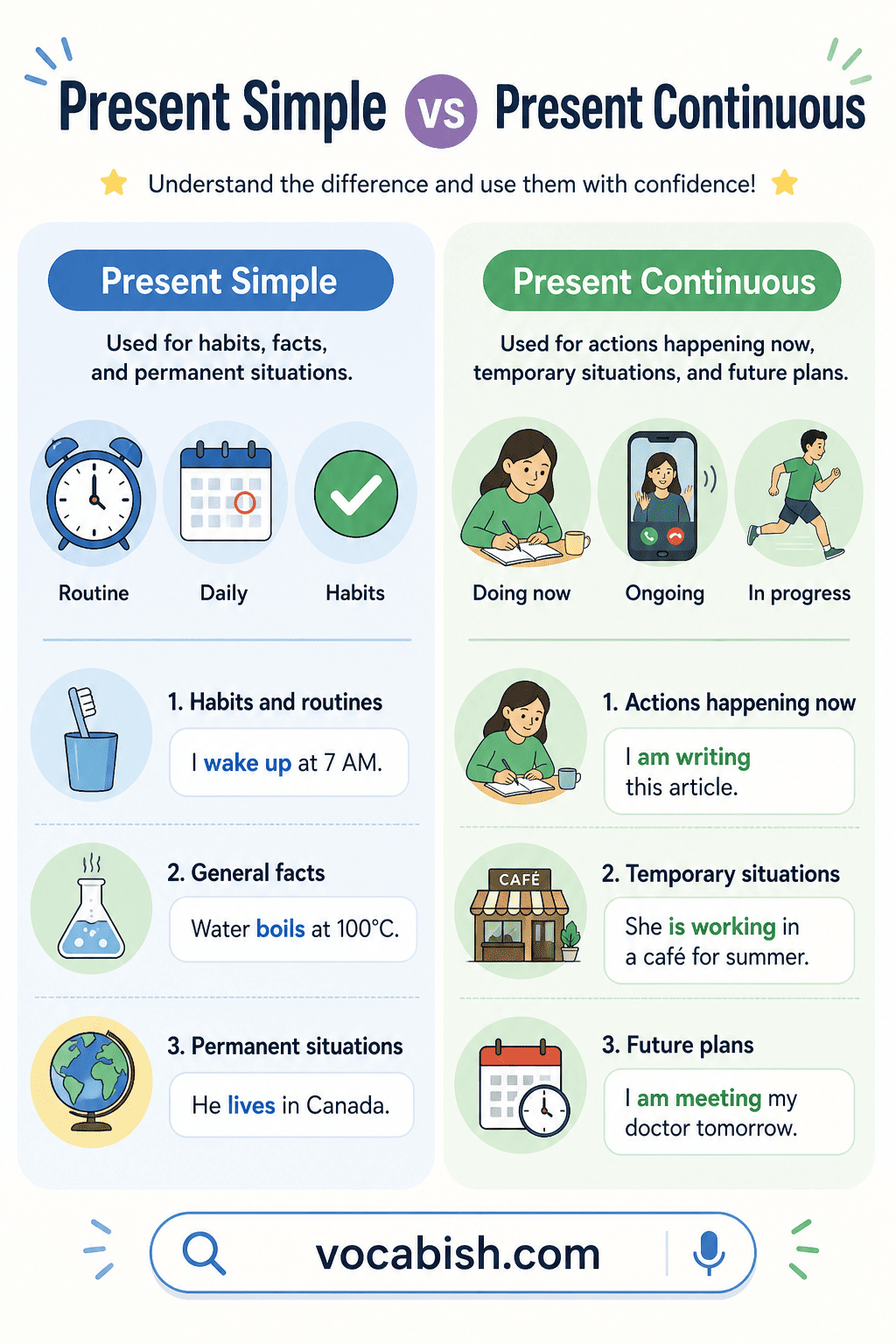
1. Daily Habits and Routines
We use Present Simple for repeated actions because they form patterns in our life.
Examples:
- I wake up at 7 AM.
- She goes to gym every day.
- They eat dinner at 8 PM.
2. General Facts and Truths
These are things that are always true, so they don’t need time markers.
Examples:
- Water boils at 100°C.
- The sun rises in the east.
- Dogs bark.
3. Permanent Situations
We use it for long-term states that don’t change frequently.
Examples:
- He lives in Canada.
- I work as a teacher.
- She owns a car.
Uses of Present Continuous Tense
1. Actions Happening Now
We use it when something is happening at the exact moment of speaking.
Examples:
- I am writing this article.
- She is talking on the phone.
- They are watching TV.
2. Temporary Situations
These are situations that are not permanent.
Examples:
- I am staying with my friend this week.
- She is working in a café for summer.
- They are living in a rented apartment.
3. Planned Future Arrangements
We can use Present Continuous for fixed future plans.
Examples:
- I am meeting my doctor tomorrow.
- She is flying to Paris next week.
- They are leaving at 6 PM.
Signal Words Used in Both Tenses
1. Present Simple Signal Words
These words show regularity or repetition.
| Signal Word | Meaning |
|---|---|
| always | every time |
| usually | most of the time |
| often | frequently |
| every day | daily routine |
| never | not at any time |
2. Present Continuous Signal Words
These words show actions happening now or temporary situations.
| Signal Word | Meaning |
|---|---|
| now | at this moment |
| right now | immediately |
| at the moment | currently |
| today | this period |
| currently | ongoing situation |
Main Differences Between Present Simple and Present Continuous
The biggest difference is time focus.
- Present Simple = repeated or permanent actions
- Present Continuous = ongoing or temporary actions
We use the Present Simple when life is predictable. We use Present Continuous when something is actively happening or changing.
Comparison Chart of Both Tenses
| Feature | Present Simple | Present Continuous |
|---|---|---|
| Time | Regular habits | Now or temporary |
| Structure | Base verb / s-es | am/is/are + ing |
| Usage | Facts, routines | Actions in progress |
| Example | I work daily | I am working now |
Side-by-Side Sentence Examples
- I work every day. / I am working now.
- She lives in Paris. / She is staying in Paris this month.
- They play football on Sundays. / They are playing football now.
Common Mistakes Students Make
- Wrong: I am go to school every day
Correct: I go to school every day
Why: Routine needs Present Simple, not Continuous - Wrong: She is works here
Correct: She works here
Why: “is” is unnecessary in Present Simple - Wrong: They play now
Correct: They are playing now
Why: “now” requires Present Continuous - Wrong: I am knowing him
Correct: I know him
Why: Some verbs (like know, like, love) are stative - Wrong: He does working
Correct: He is working
Why: Continuous needs “is/am/are + ing”
Tips to Understand the Difference Easily
- If it’s a habit → use Present Simple
- If it’s happening now → use Present Continuous
- If it’s permanent → Present Simple
- If it’s temporary → Present Continuous
A simple question helps: “Is this always true or happening right now?”
Present Simple vs Present Continuous Exercises
1. Fill in the Blanks
- She ______ (go) to school every day.
- I ______ (read) a book now.
- They ______ (play) football on Sundays.
- He ______ (cook) dinner at the moment.
Answers:
- goes
- am reading
- play
- is cooking
2. Choose the Correct Tense
- She (works / is working) in a hospital now.
- I (eat / am eating) breakfast every morning.
- They (are playing / play) outside at the moment.
- He (lives / is living) in New York.
Answers:
- is working
- eat
- are playing
- lives
3. Error Correction Practice
- I am go to school daily.
- She is knows the answer.
- They plays football now.
- He is work in a bank.
Answers:
- I go to school daily.
- She knows the answer.
- They are playing football now.
- He works in a bank.
4. Multiple Choice Questions
- She ___ every morning.
a) is running
b) runs - I ___ a movie right now.
a) watch
b) am watching - They ___ in London.
a) live
b) are living - He ___ dinner at the moment.
a) cooks
b) is cooking
Answers:
- b
- b
- a
- b
FAQs about Present Simple vs Present Continuous
Present Simple describes habits, routines, and facts, while Present Continuous describes actions happening now or temporary situations around the present time.
We use the present simple for daily routines, general truths, and permanent situations. It shows actions that happen regularly or facts that are always true.
We use the present continuous for actions happening right now, temporary situations, and planned future arrangements. It focuses on ongoing or incomplete actions.
Yes, both refer to the present, but in different ways. Present Simple is for regular actions, while Present Continuous is for actions happening at this moment.
I work every day is Present Simple, while I am working now is Present Continuous. One shows routine, the other shows action happening right now.
Present Simple uses words like always, usually, and every day. Present Continuous uses now, at the moment, and currently to show ongoing actions.
I am working now is correct because the action is happening at this moment. The present continuous is needed for ongoing actions, not the present simple.
Teach Present Simple first as it is easier and more common. Then introduce Present Continuous as “actions happening now.” Use real-life examples, timelines, and contrast sentences to show the clear difference in meaning and usage.
Conclusion
The difference between Present Simple and Present Continuous becomes clear once you focus on time and meaning. One describes what is regular or permanent, while the other shows what is happening right now or temporarily.
If you train yourself to ask “habit or happening now?”, you’ll avoid most mistakes. Keep practicing with real-life sentences, and these two tenses will start feeling natural in everyday English.
Related Articles: