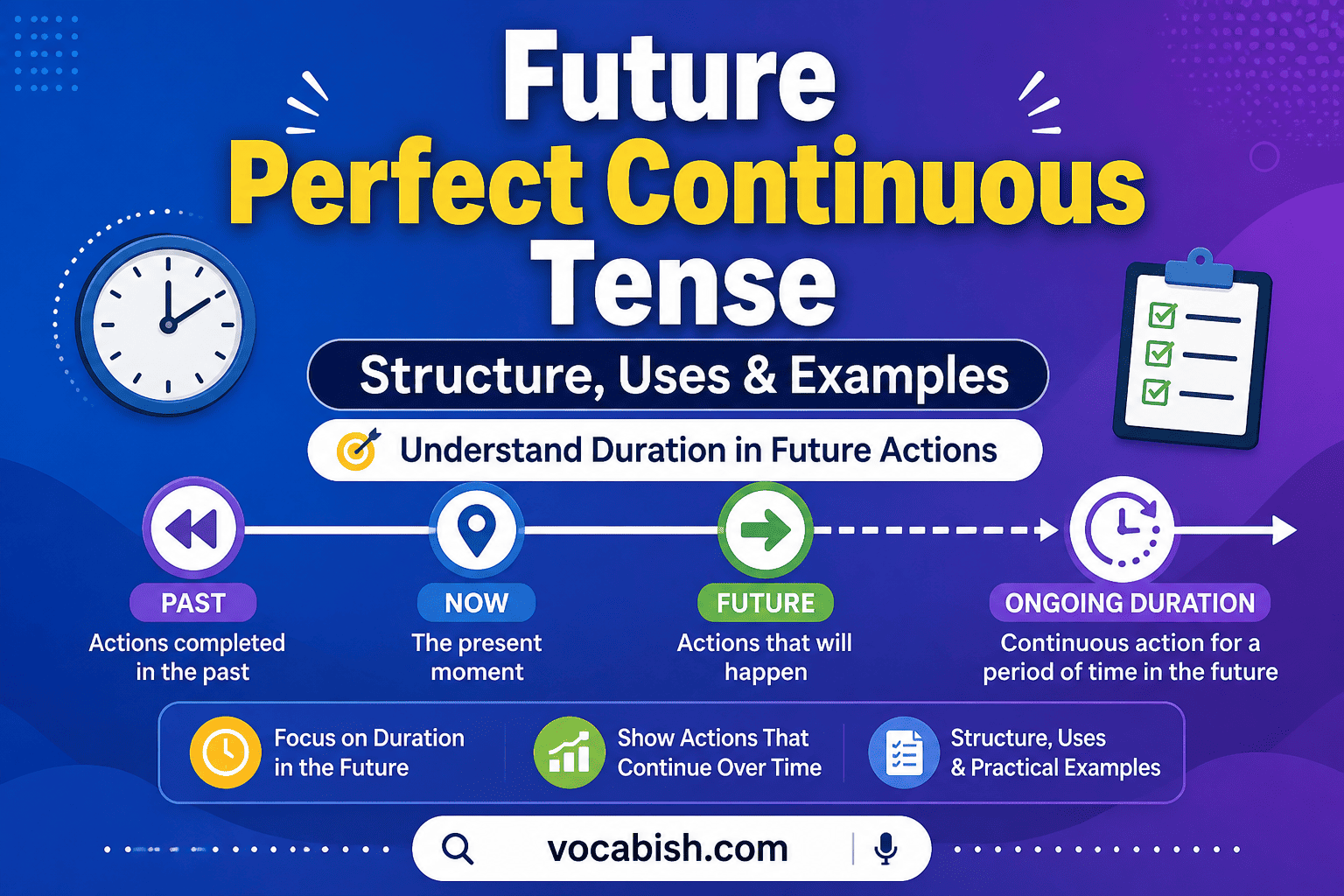

The lesson explains the future perfect continuous tense, including its meaning, structure, common uses, and important time expressions. It is designed to help you understand when and how to use this tense to talk about actions that continue up to a specific point in the future.
You will also find clear examples, practical exercises, and a quiz to help you strengthen your understanding. By the end of this lesson, you will be able to form accurate sentences and use the Future Perfect Continuous with greater confidence in both speaking and writing.
What is the Future Perfect Continuous Tense?
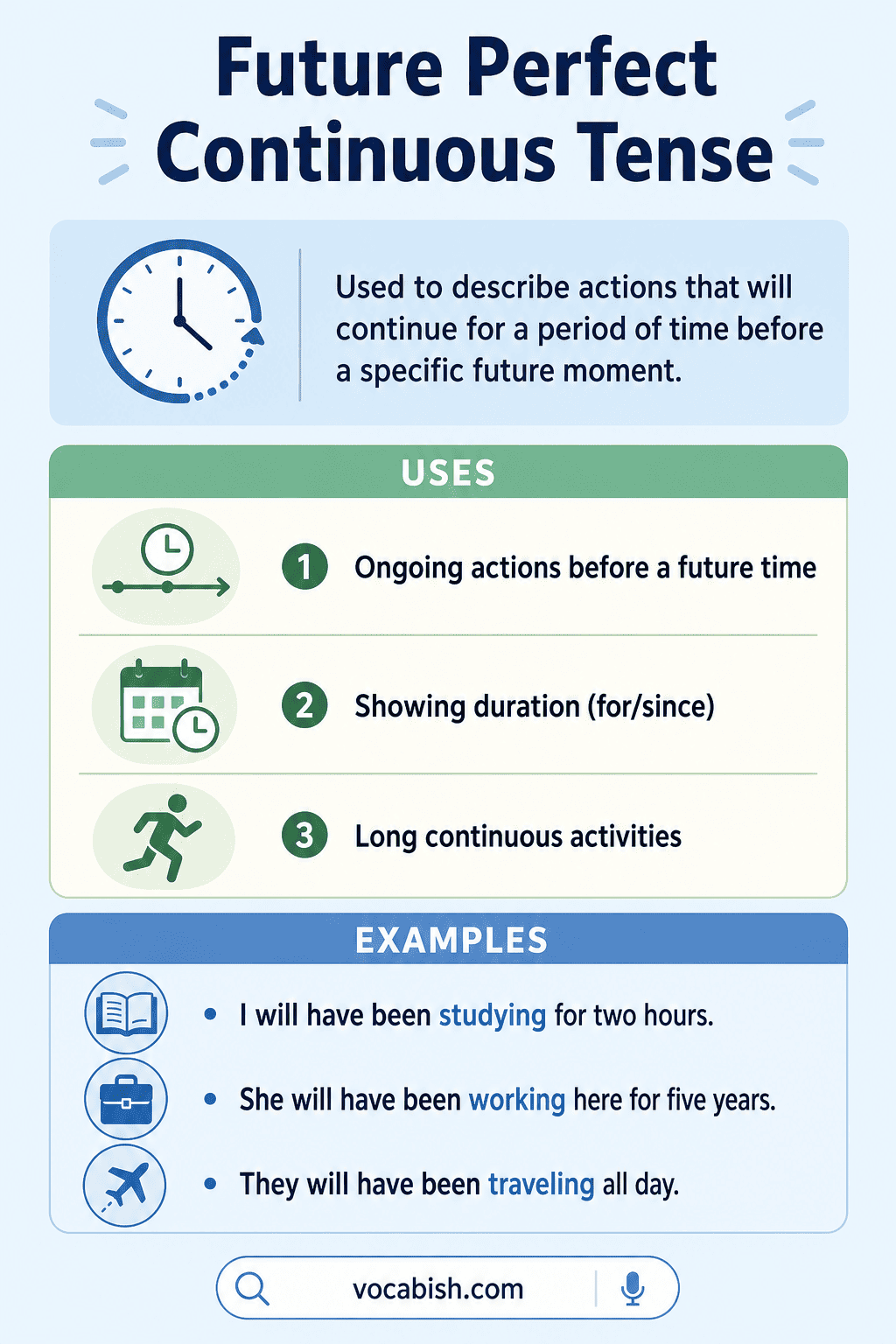
The future perfect continuous tense describes an action that will be in progress for a period of time before a specific moment in the future.
It focuses on:
- duration
- continuous activity
- how long something will have been happening
Definition:
The Future Perfect Continuous is used to show that an action will continue up to a certain time in the future and emphasizes the length of that activity.
Examples:
- By next month, I will have been living here for three years.
- She will have been studying English for five years by 2030.
- They will have been working on the project for six months by December.
- By noon, we will have been driving for four hours.
In all these examples, the action starts before the future point and continues until that future time.
How to Use the Future Perfect Continuous
The future perfect continuous is used to describe an action that will continue for a period of time before a specific point or event in the future. This tense focuses on the duration of an activity and shows how long it will have been in progress by a certain future time.
Examples:
- Sarah will have been studying medicine for more than three years by the time she graduates.
- I will be exhausted when the match ends because I will have been running for over two hours.
- By next summer, they will have been living in Australia for five years.
- We will have been driving for seven hours by the time we reach the mountains.
Formulas of Future Perfect Continuous
This section is going to help you understand how to form sentences using the future perfect continuous tense correctly and naturally in different situations.
If you would like to review how this tense fits into the bigger picture, you can also explore our guide to the 12 English Tenses and Their Structures for a complete overview of English tense formation.
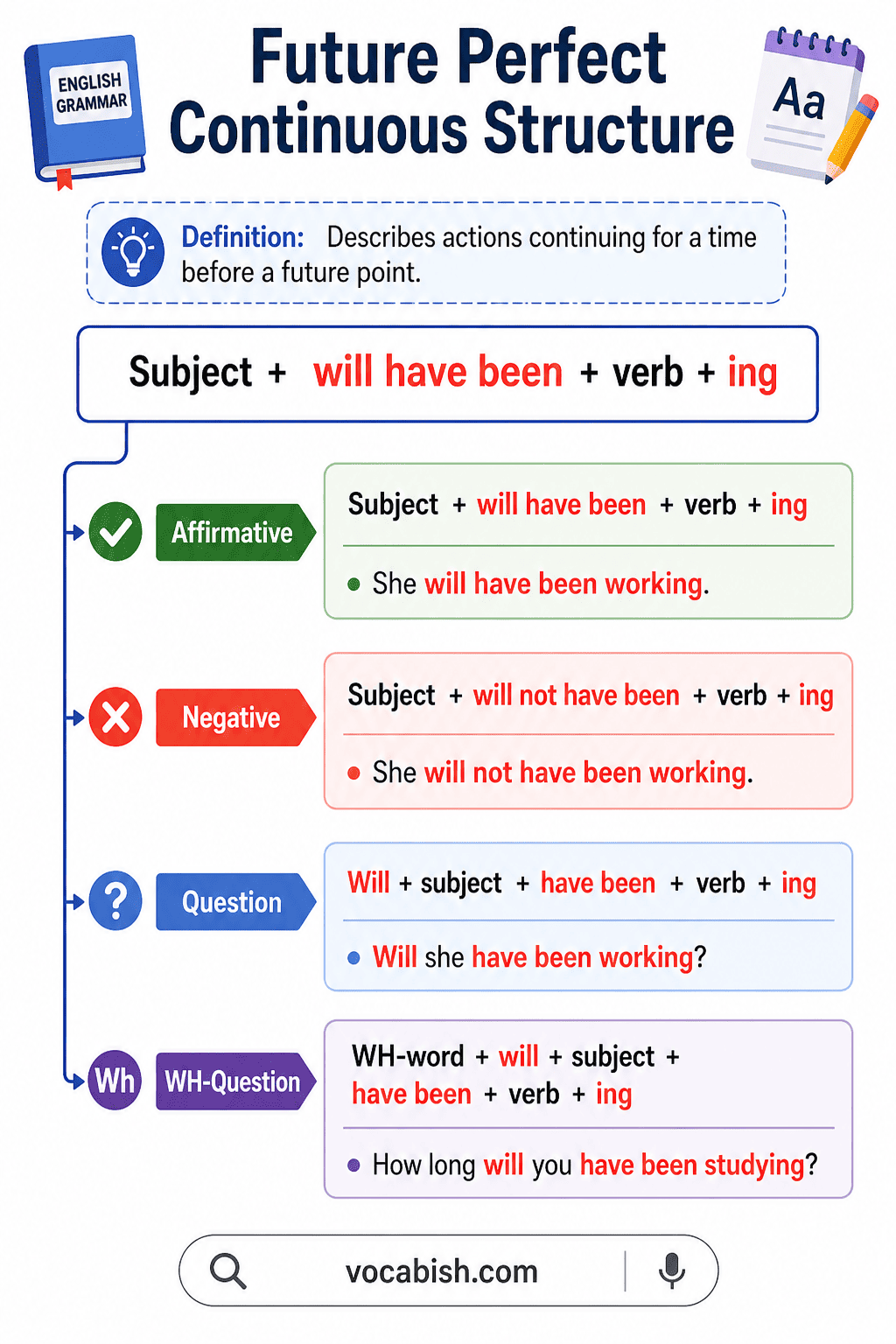
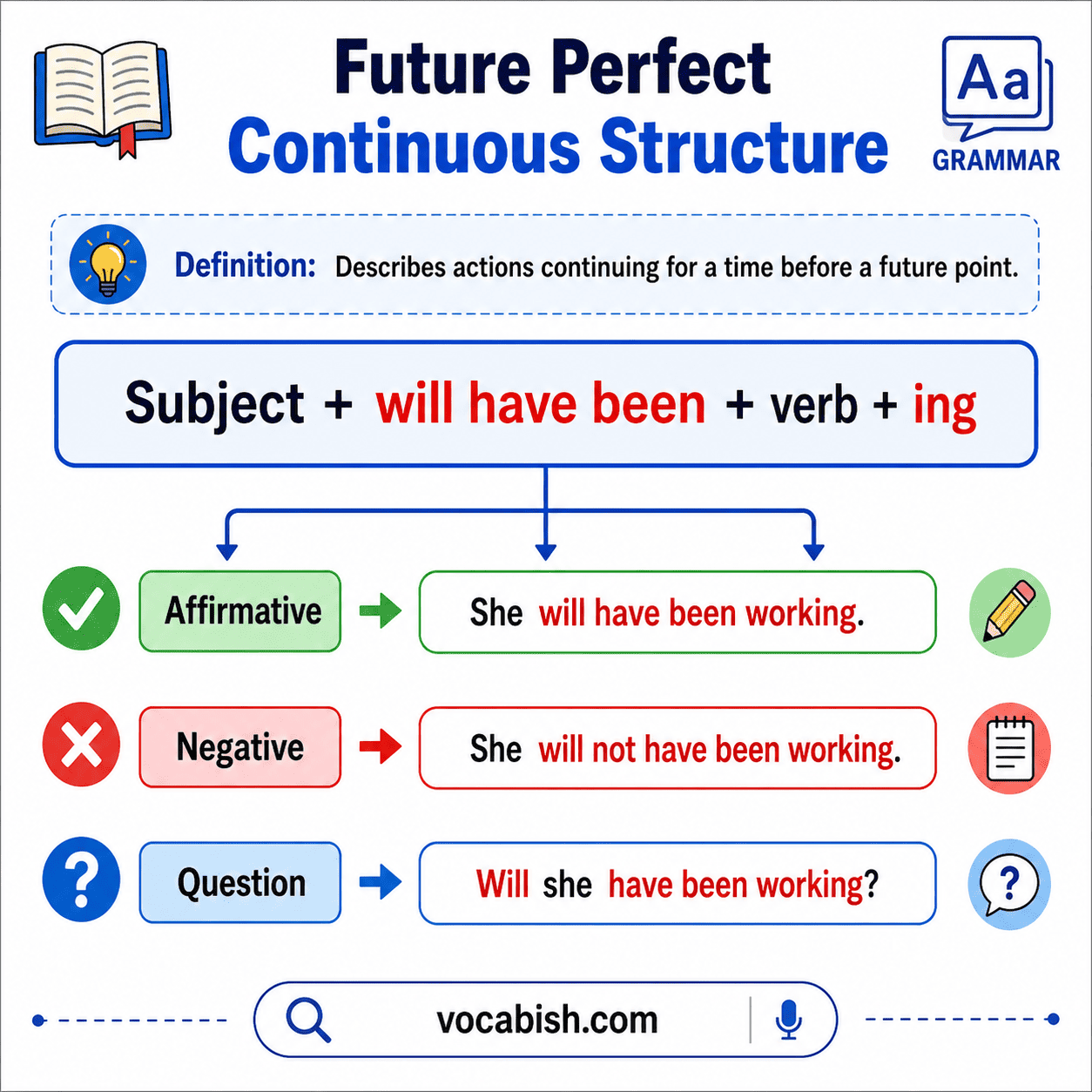
Affirmative Sentences
Subject + will have been + verb (-ing) + time expression
Examples:
- I will have been working here for ten years.
- She will have been teaching for five hours.
- They will have been traveling for two weeks.
Negative Sentences
Subject + will not have been + verb (-ing)
Examples:
- I will not have been waiting long.
- She will not have been studying for very long.
- They will not have been living there for a year.
Contraction:
- won’t have been
Examples:
- I won’t have been working here long.
- He won’t have been driving for many hours.
Interrogative Sentences
Will + subject + have been + verb (-ing)?
Examples:
- Will you have been studying for three hours?
- Will she have been working here for ten years?
- Will they have been traveling for a month?
Question with Wh-Words
Wh-word + will + subject + have been + verb (-ing)?
Examples:
- How long will you have been living here?
- Why will they have been waiting so long?
- Where will she have been working?
Usage of Future Perfect Continuous Tense
The Future Perfect Continuous has several important uses.
1. Showing Duration Before a Future Time
- By next Friday, I will have been working on this report for two weeks.
- By 2030, she will have been teaching for twenty years.
- They will have been living in Canada for five years by June.
2. Emphasizing Length of an Ongoing Activity
- By midnight, we will have been driving for eight hours.
- By the end of the day, he will have been practicing for six hours.
- By lunchtime, she will have been cooking for four hours.
3. Talking About Long Future Activities
- Next year, I will have been running my business for a decade.
- By 2040, scientists will have been researching the topic for many years.
- She will have been writing novels for twenty years by then.
4. Predicting the Duration of Future Situations
- By the time you arrive, I will have been waiting for an hour.
- By evening, the workers will have been repairing the road all day.
- By next month, the company will have been developing the software for a year.
Future Perfect vs Future Perfect Continuous
Future Perfect | Future Perfect Continuous |
|---|---|
Focuses on completion | Focuses on duration |
Action finished by future time | Action continues up to future time |
I will have written the report. | I will have been writing the report for three hours. |
She will have completed the course. | She will have been studying for six months. |
Adverb Placement
Adverbs can be used in the future perfect continuous tense to add extra meaning, such as frequency, certainty, or emphasis. They are most commonly placed after will and before have been to keep the sentence natural and easy to understand.
Examples:
- Always: She will always have been supporting local charities by then.
- Probably: They will probably have been discussing the proposal for several hours.
- Never: I will never have been working on a project for such a long time before.
- Regularly: By next year, he will regularly have been attending training sessions.
- Constantly: By the end of the week, we will constantly have been improving the design.
Signal Words Used with Future Perfect Continuous
Signal Word/Phrase | Use | Example |
|---|---|---|
for | Shows duration | for three hours |
since | Shows a starting point | since 2022 |
by | Refers to a future time | by next month |
by the time | Refers to another future event | by the time she arrives |
all day/week/month | Shows continuous duration | all day |
before | Indicates an earlier future point | before the meeting starts |
when | Refers to a future event | when I get home |
Examples in Sentences:
- By next year, I will have been working here for five years.
- By 2030, she will have been teaching since 2020.
- By the time they arrive, we will have been waiting for two hours.
- He will have been studying all day by evening.
- We will have been traveling for six hours when we reach the city.
You May Also Like:
- 12 Tenses in English Grammar with Charts
- Past Perfect Continuous Tense in English
- Definition and Examples of Present Perfect Continuous
Future Perfect Continuous Tense Practice Quiz
Test your understanding of the Future Perfect Continuous Tense.
1. By next June, I _____ here for five years.
2. By the time you arrive, she _____ for two hours.
3. Which sentence is correct?
4. By 2030, they _____ the project for ten years.
5. Future Perfect Continuous mainly focuses on:
Common Mistakes to Avoid
1. Forgetting “been”:
- Incorrect: I will have working here for five years.
- Correct: I will have been working here for five years.
2. Using the Base Verb Instead of -ing:
- Incorrect: She will have been study for three hours.
- Correct: She will have been studying for three hours.
3. Using Present Time Instead of Future Time:
- Incorrect: By yesterday, I will have been working for two years.
- Correct: By next year, I will have been working for two years.
4. Confusing It with Future Perfect:
- Incorrect: By June, I will have written the report for three hours.
- Correct: By June, I will have been writing the report for three hours.
5. Leaving Out Duration:
The tense often sounds more natural when duration is included.
Less clear:
- By noon, I will have been waiting.
Better:
- By noon, I will have been waiting for two hours.
Exercises for Future Perfect Continuous Tense
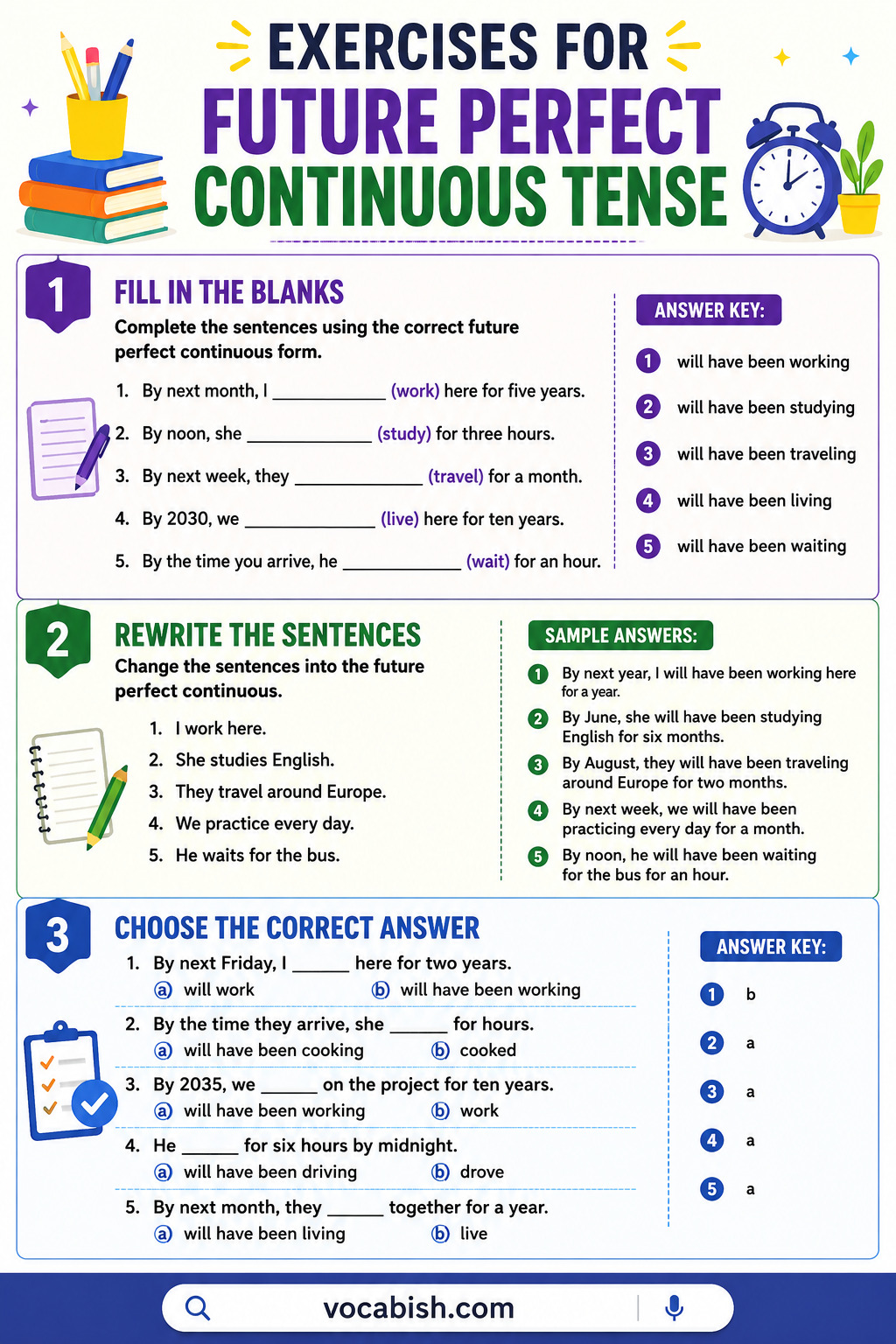
Fill in the Blanks
Complete the sentences using the correct future perfect continuous form.
- By next month, I __________ (work) here for five years.
- By noon, she __________ (study) for three hours.
- By next week, they __________ (travel) for a month.
- By 2030, we __________ (live) here for ten years.
- By the time you arrive, he __________ (wait) for an hour.
Answer Key:
- will have been working
- will have been studying
- will have been traveling
- will have been living
- will have been waiting
Rewrite the Sentences
Change the sentences into the future perfect continuous.
- I work here.
- She studies English.
- They travel around Europe.
- We practice every day.
- He waits for the bus.
Sample Answers:
- By next year, I will have been working here for a year.
- By June, she will have been studying English for six months.
- By August, they will have been traveling around Europe for two months.
- By next week, we will have been practicing every day for a month.
- By noon, he will have been waiting for the bus for an hour.
Choose the Correct Answer
- By next Friday, I _____ here for two years.
- a) will work
- b) will have been working
- By the time they arrive, she _____ for hours.
- a) will have been cooking
- b) cooked
- By 2035, we _____ on the project for ten years.
- a) will have been working
- b) work
- He _____ for six hours by midnight.
- a) will have been driving
- b) drove
- By next month, they _____ together for a year.
- a) will have been living
- b) live
Answer Key:
- b
- a
- a
- a
- a
FAQs about Future Perfect Continuous
The future perfect continuous tense is used to describe an action that will have been continuing for a specific period of time before a particular point or event in the future.
Use it when you want to show how long an action will have continued before a future time or event.
The structure is subject + will have been + verb-ing, followed by a duration or future time expression.
Future Perfect focuses on completion, while Future Perfect Continuous focuses on the length of an activity before a future point.
You can form the future perfect continuous tense with subject + will have been + verb (-ing). This structure is used to show how long an action will have continued before a specific time in the future.
Yes. “Since” introduces the starting point of an action that continues until a future reference time.
The Future Perfect Continuous Tense is generally not used in the passive voice because it creates awkward and unnatural sentence structures. In most cases, English speakers use an active sentence or choose another tense instead.
Conclusion
The Future Perfect Continuous Tense helps you talk about actions that will continue for a period of time before a specific point in the future. In this lesson, you learned its meaning, structure, common uses, signal words, and how it differs from the future perfect tense. You also practiced using it through examples, exercises, and a quiz.
Once you understand that this tense focuses on duration rather than completion, it becomes much easier to use in everyday conversations and writing. Keep practicing with future time expressions and duration phrases, and you’ll become more confident using the Future Perfect Continuous naturally and accurately.