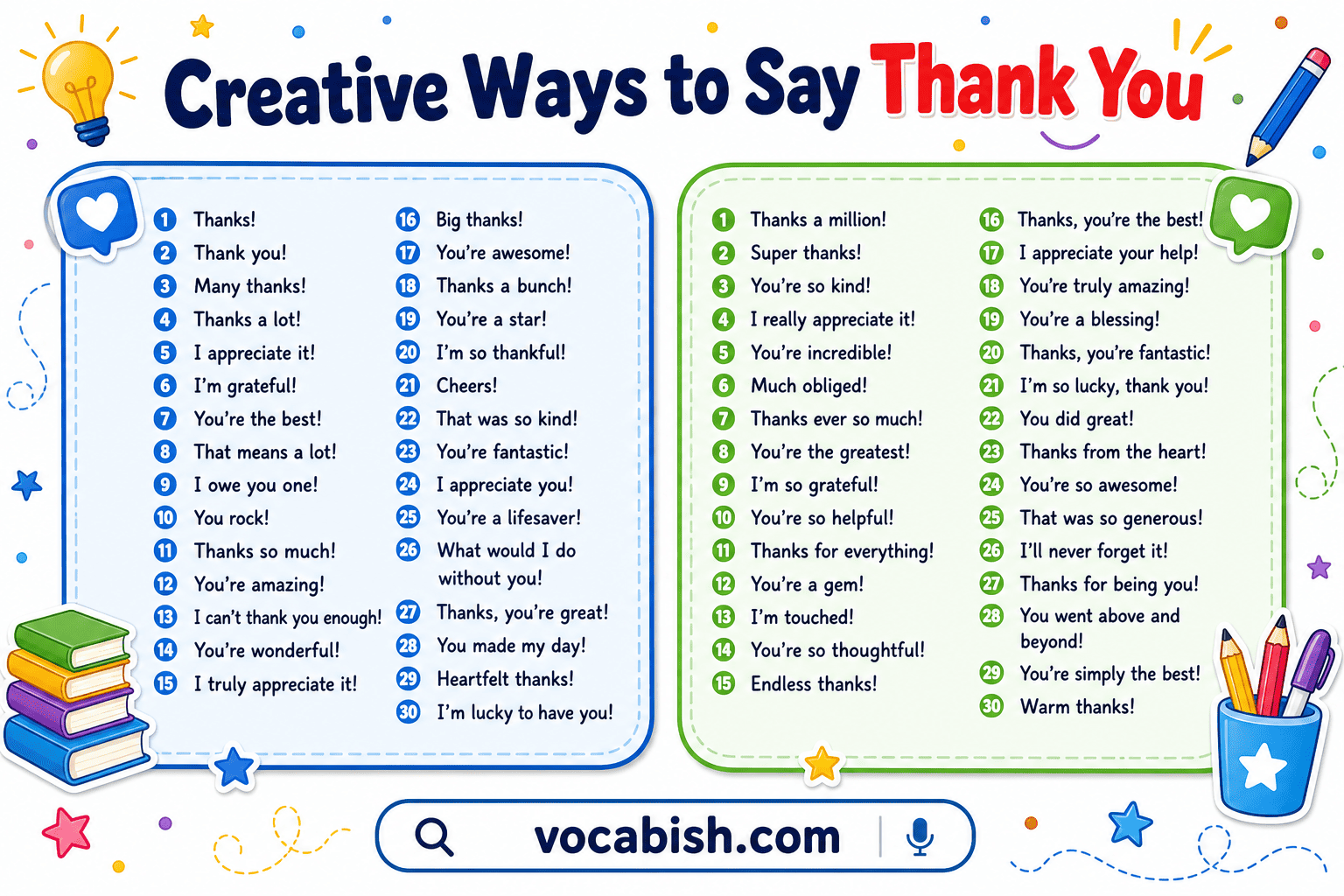

Saying thank you is one of the easiest ways to show kindness and appreciation. However, using the same phrase every time can feel repetitive. Learning other ways to say thank you helps you choose words that fit the situation, relationship, and level of formality.
A student may say, “Thanks for helping me with my homework,” while a professional may write, “I sincerely appreciate your assistance.” Both sentences show gratitude, but their tone is different. Parents and teachers can also use these phrases to help children build stronger everyday English skills.
Below, you will find more than 90 useful ways to express gratitude, along with scenarios, conversational examples, tones, and short explanations. You will also find formal, informal, polite, and professional expressions that you can use in speaking and writing.
What Are Other Ways to Say “Thank You”?
Other ways to say “thank you” are different phrases used to show appreciation, gratitude, or recognition for something someone has done.
For example:
- Thanks a lot! — A friendly way to show strong appreciation.
- I really appreciate it. — A natural phrase that shows sincere gratitude.
The best expression depends on the situation. Some phrases are casual, while others are better for emails, teachers, customers, colleagues, or formal occasions.
90+ Other Ways to Say “Thank You”
Here is a quick list of useful alternatives before we look at each phrase in context.
No. | Other Way to Say “Thank You” |
|---|---|
1 | Thanks |
2 | Thanks a lot |
3 | Thanks so much |
4 | Thank you so much |
5 | Many thanks |
6 | Thanks a million |
7 | Thanks a bunch |
8 | Thanks a ton |
9 | I appreciate it |
10 | I really appreciate it |
11 | I truly appreciate it |
12 | I appreciate your help |
13 | I appreciate your support |
14 | I’m grateful |
15 | I’m very grateful |
16 | I’m truly grateful |
17 | I’m so grateful |
18 | I’m deeply grateful |
19 | I’m thankful |
20 | I’m very thankful |
21 | I can’t thank you enough |
22 | I owe you one |
23 | You’re a lifesaver |
24 | You saved the day |
25 | You’re the best |
26 | You’re too kind |
27 | That means a lot |
28 | It means so much to me |
29 | I’m touched |
30 | I’m deeply touched |
31 | That was very kind of you |
32 | That’s very kind of you |
33 | How kind of you |
34 | I’m thankful for your help |
35 | I’m grateful for your support |
36 | I value your help |
37 | I value your support |
38 | Your help means a lot |
39 | Your support means a lot |
40 | I’m indebted to you |
41 | Please accept my thanks |
42 | Please accept my sincere thanks |
43 | My sincere thanks |
44 | My heartfelt thanks |
45 | With sincere thanks |
46 | With gratitude |
47 | With deepest gratitude |
48 | I sincerely appreciate it |
49 | I greatly appreciate it |
50 | I’m sincerely grateful |
51 | Thank you for your kindness |
52 | Thank you for your generosity |
53 | Thank you for your time |
54 | Thank you for your patience |
55 | Thank you for your understanding |
56 | Thank you for your support |
57 | Thank you for being there |
58 | Thank you for everything |
59 | Thank you for your help |
60 | Thank you for your advice |
61 | Thank you for your guidance |
62 | Thank you for your encouragement |
63 | Thank you for listening |
64 | Thank you for coming |
65 | Thank you for joining us |
66 | Thank you for thinking of me |
67 | Thank you for remembering |
68 | I’m thankful for you |
69 | I’m grateful to have you |
70 | I’m lucky to have your support |
71 | I couldn’t have done it without you |
72 | I couldn’t have managed without you |
73 | You have my thanks |
74 | My thanks to you |
75 | I want to express my gratitude |
76 | I’d like to express my appreciation |
77 | I’m especially grateful |
78 | I’m forever grateful |
79 | I’m incredibly grateful |
80 | I’m enormously grateful |
81 | You have my deepest thanks |
82 | Please know how grateful I am |
83 | I’m grateful for everything you’ve done |
84 | Your kindness is greatly appreciated |
85 | Your help is greatly appreciated |
86 | Your support is greatly appreciated |
87 | I cannot express how grateful I am |
88 | Words cannot express my thanks |
89 | I’m at a loss for words |
90 | I’m truly thankful for this |
91 | I’m grateful beyond words |
92 | Thank you from the bottom of my heart |
93 | You have my heartfelt thanks |
94 | I appreciate everything you’ve done |
95 | I’m so thankful for your kindness |

1. Casual and Everyday Ways to Say “Thank You”
These phrases work well with friends, classmates, family members, neighbours, and people you know well.
1. Thanks
Scenario: A friend gives you a pen.
Examples:
- “Thanks for the pen!”
- “Thanks for helping me.”
- “Thanks, I really needed that.”
Tone: Casual and friendly.
Short explanation: “Thanks” is the most common short form of “thank you.”
2. Thanks a Lot
Scenario: Someone helps you carry your books.
Examples:
- “Thanks a lot for helping me.”
- “You brought my books? Thanks a lot!”
- “Thanks a lot. I really appreciate it.”
Tone: Friendly and appreciative.
Short explanation: Use it when you want to show more appreciation than a simple “thanks.”
3. Thanks So Much
Scenario: Your friend gives you useful advice.
Examples:
- “Thanks so much for your advice.”
- “Thanks so much for coming today.”
- “Thanks so much. That really helped.”
Tone: Warm and friendly.
Short explanation: This phrase adds warmth and emphasis to “thanks.”
4. Thank You So Much
Scenario: Someone helps you solve a difficult problem.
Examples:
- “Thank you so much for helping me.”
- “Thank you so much. I was worried about this.”
- “Thank you so much for your kindness.”
Tone: Warm and sincere.
Short explanation: A natural way to express strong appreciation.
5. Many Thanks
Scenario: A colleague sends you an important document.
Examples:
- “Many thanks for sending the file.”
- “Many thanks for your help.”
- “Many thanks for your quick reply.”
Tone: Polite and slightly formal.
Short explanation: “Many thanks” is common in messages and emails.
6. Thanks a Million
Scenario: A friend helps you at the last minute.
Examples:
- “Thanks a million for helping me!”
- “You found my keys? Thanks a million!”
- “Thanks a million for being there.”
Tone: Casual and enthusiastic.
Short explanation: It does not mean a literal million thanks; it emphasizes strong appreciation.
7. Thanks a Bunch
Scenario: Someone brings you your favourite snack.
Examples:
- “Thanks a bunch for this.”
- “Thanks a bunch for helping.”
- “Thanks a bunch! That was really thoughtful.”
Tone: Very casual and friendly.
Short explanation: Use it mainly in relaxed conversations.
8. Thanks a Ton
Scenario: Your classmate helps you finish an assignment.
Examples:
- “Thanks a ton for your help.”
- “Thanks a ton for explaining that.”
- “Thanks a ton. You saved me some time.”
Tone: Casual and warm.
Short explanation: It means “thank you very much.”
9. I Appreciate It
Scenario: Someone holds the door for you.
Examples:
- “I appreciate it.”
- “Thanks for waiting. I appreciate it.”
- “You helped me out, and I appreciate it.”
Tone: Friendly and natural.
Short explanation: A very useful everyday expression of gratitude.
10. I Really Appreciate It
Scenario: A neighbour helps you during a busy day.
Examples:
- “I really appreciate it.”
- “Thanks for picking that up. I really appreciate it.”
- “You helped me when I needed it. I really appreciate it.”
Tone: Warm and sincere.
Short explanation: It shows stronger appreciation than “I appreciate it.”
2. Polite Ways to Say “Thank You”
11. I Truly Appreciate It
Scenario: Someone gives you valuable advice.
Examples:
- “I truly appreciate your advice.”
- “I truly appreciate everything you did.”
- “Thank you. I truly appreciate it.”
Tone: Sincere and polite.
Short explanation: “Truly” adds a stronger feeling of genuine appreciation.
12. I Appreciate Your Help
Scenario: A classmate helps you understand a lesson.
Examples:
- “I appreciate your help with this.”
- “I really appreciate your help today.”
- “Thank you. I appreciate your help.”
Tone: Polite and friendly.
Short explanation: A direct way to recognize someone’s assistance.
13. I Appreciate Your Support
Scenario: A friend supports you before an important test.
Examples:
- “I appreciate your support.”
- “I really appreciate your support during this time.”
- “Your support helped me a lot.”
Tone: Warm and sincere.
Short explanation: Use this when someone gives encouragement or emotional support.
14. I’m Grateful
Scenario: Someone helps you during a difficult situation.
Examples:
- “I’m grateful for your help.”
- “I’m grateful that you were there.”
- “I’m grateful for everything you did.”
Tone: Sincere and warm.
Short explanation: “Grateful” expresses a strong feeling of appreciation.
15. I’m Very Grateful
Scenario: A teacher gives you extra help.
Examples:
- “I’m very grateful for your guidance.”
- “I’m very grateful that you helped me.”
- “I’m very grateful for your time.”
Tone: Sincere and polite.
Short explanation: A stronger version of “I’m grateful.”
16. I’m Truly Grateful
Scenario: Someone gives you important support.
Examples:
- “I’m truly grateful for your support.”
- “I’m truly grateful for your kindness.”
- “I’m truly grateful that you came.”
Tone: Sincere and heartfelt.
Short explanation: Use it when you want your gratitude to sound especially genuine.
17. I’m So Grateful
Scenario: Your family helps you prepare for an event.
Examples:
- “I’m so grateful for your help.”
- “I’m so grateful you came.”
- “I’m so grateful for everything.”
Tone: Warm and personal.
Short explanation: A natural phrase for expressing strong personal gratitude.
18. I’m Deeply Grateful
Scenario: Someone gives you major support during an important event.
Examples:
- “I’m deeply grateful for your support.”
- “I’m deeply grateful for your kindness.”
- “I’m deeply grateful for everything you have done.”
Tone: Formal and heartfelt.
Short explanation: This phrase expresses very strong appreciation.
19. I’m Thankful
Scenario: Someone helps you with a personal problem.
Examples:
- “I’m thankful for your help.”
- “I’m thankful that you came.”
- “I’m thankful for your support.”
Tone: Warm and sincere.
Short explanation: “Thankful” is a common way to express appreciation.
20. I’m Very Thankful
Scenario: A teacher spends extra time helping you.
Examples:
- “I’m very thankful for your help.”
- “I’m very thankful for your patience.”
- “I’m very thankful that you stayed.”
Tone: Sincere and polite.
Short explanation: Use it to show stronger appreciation.
3. Warm and Conversational Ways to Say “Thank You”
21. I Can’t Thank You Enough
Scenario: Someone helps you during an emergency.
Examples:
- “I can’t thank you enough for helping me.”
- “I can’t thank you enough for being there.”
- “I really can’t thank you enough.”
Tone: Very grateful and emotional.
Short explanation: It means your gratitude feels too strong to express fully.
22. I Owe You One
Scenario: Your friend covers your lunch.
Examples:
- “Thanks for lunch. I owe you one.”
- “You helped me again. I owe you one.”
- “I owe you one for this!”
Tone: Casual and friendly.
Short explanation: Use it when you expect to return the favour later.
23. You’re a Lifesaver
Scenario: A friend brings you an important document you forgot.
Examples:
- “You’re a lifesaver!”
- “Thanks for bringing this. You’re a lifesaver.”
- “You fixed the problem. You’re a lifesaver!”
Tone: Casual and expressive.
Short explanation: It means someone helped you at an important moment.
24. You Saved the Day
Scenario: Someone fixes a problem before an event.
Examples:
- “You saved the day!”
- “Thanks for helping. You really saved the day.”
- “Your quick thinking saved the day.”
Tone: Friendly and enthusiastic.
Short explanation: Use it when someone’s help solves an urgent problem.
25. You’re the Best
Scenario: Your friend helps you prepare for a presentation.
Examples:
- “Thanks for helping. You’re the best!”
- “You brought my notes? You’re the best.”
- “Thanks so much. You’re honestly the best.”
Tone: Casual and affectionate.
Short explanation: A warm way to praise someone while showing gratitude.
26. You’re Too Kind
Scenario: Someone gives you a thoughtful gift.
Examples:
- “You’re too kind. Thank you!”
- “That’s lovely. You’re too kind.”
- “You really didn’t have to. You’re too kind.”
Tone: Warm and polite.
Short explanation: Use it when someone does something generous or thoughtful.
27. That Means a Lot
Scenario: A friend offers support when you need it.
Examples:
- “Thank you. That means a lot.”
- “Your support means a lot.”
- “You came all this way? That means a lot.”
Tone: Warm and sincere.
Short explanation: It shows that someone’s action has personal importance to you.
28. It Means So Much to Me
Scenario: Your family celebrates an important achievement.
Examples:
- “Thank you. It means so much to me.”
- “Your support means so much to me.”
- “You remembered my birthday. It means so much to me.”
Tone: Emotional and heartfelt.
Short explanation: A strong expression of personal gratitude.
29. I’m Touched
Scenario: Someone gives you a thoughtful card.
Examples:
- “I’m touched by your kindness.”
- “Thank you. I’m really touched.”
- “Your message touched me. Thank you.”
Tone: Warm and emotional.
Short explanation: Use it when someone’s kindness makes you feel deeply appreciated.
30. I’m Deeply Touched
Scenario: Many people support you during an important event.
Examples:
- “I’m deeply touched by your support.”
- “Your message deeply touched me.”
- “I’m deeply touched by your kindness.”
Tone: Heartfelt and formal.
Short explanation: A stronger expression of emotional appreciation.
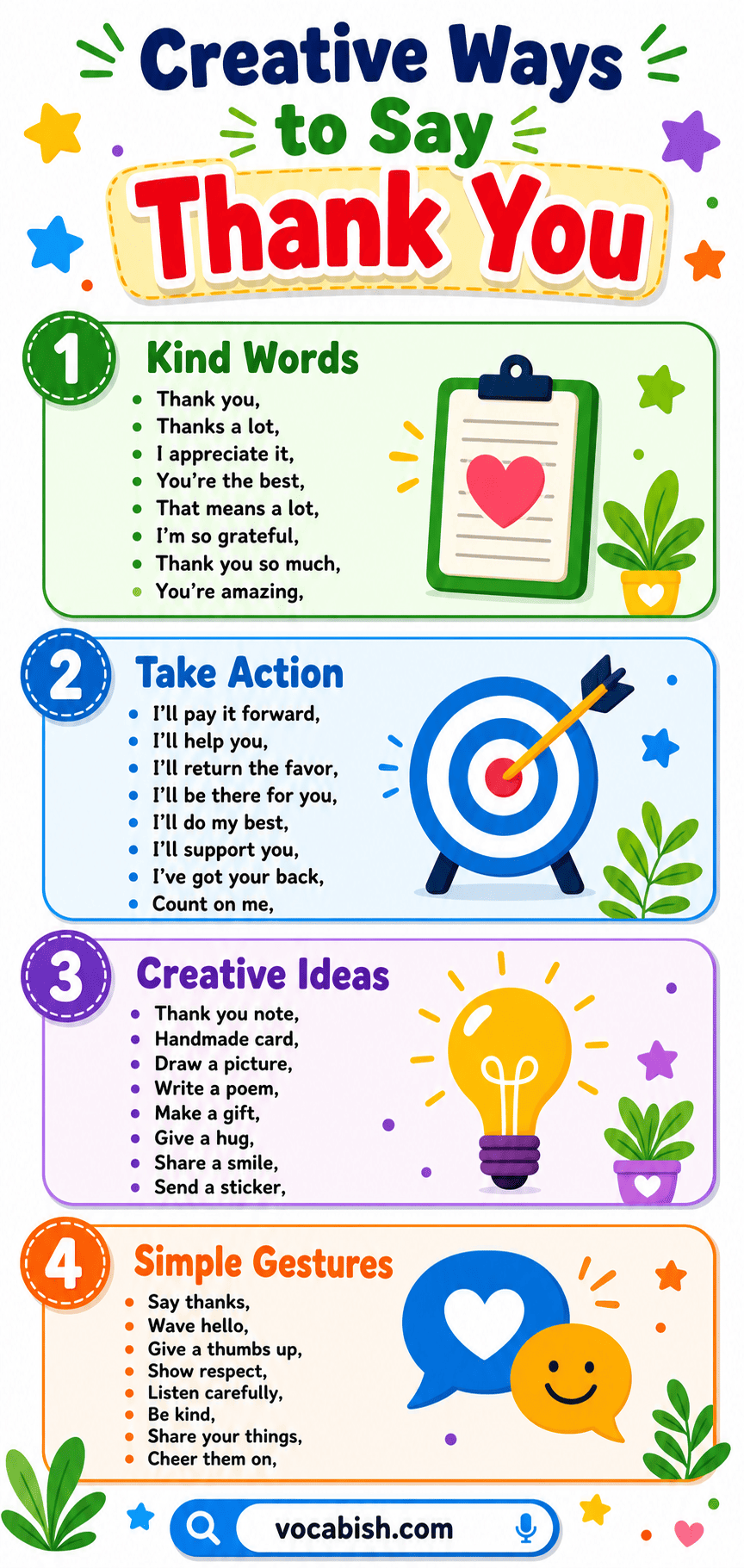
4. Formal and Professional Ways to Say “Thank You”
These expressions are useful for business emails, teachers, managers, customers, interviews, applications, and formal messages.
31. That Was Very Kind of You
Scenario: A colleague helps you with a task.
Examples:
- “That was very kind of you. Thank you.”
- “It was very kind of you to help.”
- “That was very kind of you to remember.”
Tone: Polite and warm.
Short explanation: Recognizes another person’s thoughtful action.
32. That’s Very Kind of You
Scenario: Someone offers you assistance.
Examples:
- “That’s very kind of you.”
- “That’s very kind of you to offer.”
- “Thank you. That’s very kind of you.”
Tone: Polite and professional.
Short explanation: A natural response to an offer or thoughtful gesture.
33. How Kind of You
Scenario: Someone brings you a small gift.
Examples:
- “How kind of you to bring this.”
- “How kind of you to think of me.”
- “How kind of you. Thank you.”
Tone: Polite and warm.
Short explanation: Shows appreciation for someone’s thoughtful behaviour.
34. I’m Thankful for Your Help
Scenario: A colleague helps you complete a project.
Examples:
- “I’m thankful for your help.”
- “I’m especially thankful for your help.”
- “I’m thankful for your help with this project.”
Tone: Polite and sincere.
Short explanation: Clearly identifies the reason for your gratitude.
35. I’m Grateful for Your Support
Scenario: A manager supports you during a difficult project.
Examples:
- “I’m grateful for your support.”
- “I’m very grateful for your continued support.”
- “I’m grateful for your support throughout the project.”
Tone: Professional and sincere.
Short explanation: Suitable for professional and formal communication.
36. I Value Your Help
Scenario: A colleague gives useful assistance.
Examples:
- “I value your help with this project.”
- “I really value your help.”
- “I value the time you gave me.”
Tone: Professional and respectful.
Short explanation: Shows that you consider someone’s assistance important.
37. I Value Your Support
Scenario: Your manager supports a new project.
Examples:
- “I value your support.”
- “I truly value your continued support.”
- “I value your support and encouragement.”
Tone: Professional.
Short explanation: A useful phrase for workplace communication.
38. Your Help Means a Lot
Scenario: A colleague helps you meet a deadline.
Examples:
- “Your help means a lot.”
- “Your help means a lot to me.”
- “Your help with this project means a lot.”
Tone: Warm and professional.
Short explanation: Shows that the person’s assistance has real value.
39. Your Support Means a Lot
Scenario: Someone encourages you during a challenging project.
Examples:
- “Your support means a lot.”
- “Your continued support means a lot.”
- “Thank you. Your support means a lot to me.”
Tone: Sincere and professional.
Short explanation: Useful when thanking someone for encouragement or backing.
40. I’m Indebted to You
Scenario: Someone provides major professional assistance.
Examples:
- “I’m indebted to you for your guidance.”
- “I’m deeply indebted to you for your help.”
- “I feel indebted to you for everything you did.”
Tone: Formal and serious.
Short explanation: A strong expression meaning you feel you owe someone a great deal.
5. Formal Expressions for Emails and Messages
41. Please Accept My Thanks
Scenario: You are writing a formal message after receiving assistance.
Examples:
- “Please accept my thanks for your assistance.”
- “Please accept my thanks for your time.”
- “Please accept my sincere thanks.”
Tone: Formal and respectful.
Short explanation: Suitable for formal written communication.
42. Please Accept My Sincere Thanks
Scenario: A professional organisation helps you.
Examples:
- “Please accept my sincere thanks for your assistance.”
- “Please accept my sincere thanks for your support.”
- “Please accept my sincere thanks for your time.”
Tone: Very formal and sincere.
Short explanation: A polished expression for formal letters and emails.
43. My Sincere Thanks
Scenario: You want a short formal closing.
Examples:
- “My sincere thanks for your help.”
- “My sincere thanks to everyone involved.”
- “Please accept my sincere thanks.”
Tone: Formal.
Short explanation: A concise way to express genuine appreciation.
44. My Heartfelt Thanks
Scenario: Someone provides meaningful personal support.
Examples:
- “My heartfelt thanks for your support.”
- “Please accept my heartfelt thanks.”
- “My heartfelt thanks go to everyone who helped.”
Tone: Deeply sincere.
Short explanation: “Heartfelt” shows strong and genuine emotion.
45. With Sincere Thanks
Scenario: You are ending a formal note.
Examples:
- “With sincere thanks, Maria.”
- “With sincere thanks for your support.”
- “With sincere thanks to everyone involved.”
Tone: Formal and warm.
Short explanation: Often works well as a written closing.
46. With Gratitude
Scenario: You are writing a thank-you note.
Examples:
- “With gratitude, Daniel.”
- “With gratitude for your continued support.”
- “I send this message with gratitude.”
Tone: Formal and heartfelt.
Short explanation: A concise expression of appreciation, especially in writing.
47. With Deepest Gratitude
Scenario: Someone gives significant support.
Examples:
- “With deepest gratitude for your kindness.”
- “I offer my deepest gratitude for your support.”
- “With deepest gratitude to everyone who helped.”
Tone: Very formal and heartfelt.
Short explanation: Used for strong or meaningful expressions of thanks.
48. I Sincerely Appreciate It
Scenario: A professional gives you valuable assistance.
Examples:
- “I sincerely appreciate your assistance.”
- “I sincerely appreciate your time.”
- “I sincerely appreciate your support.”
Tone: Professional and sincere.
Short explanation: A strong phrase for formal emails and workplace communication.
49. I Greatly Appreciate It
Scenario: A colleague completes an urgent task.
Examples:
- “I greatly appreciate your help.”
- “I greatly appreciate your time.”
- “I greatly appreciate your assistance.”
Tone: Formal and professional.
Short explanation: “Greatly” emphasizes the importance of the help received.
50. I’m Sincerely Grateful
Scenario: Someone gives you important professional advice.
Examples:
- “I’m sincerely grateful for your guidance.”
- “I’m sincerely grateful for your support.”
- “I’m sincerely grateful for your time.”
Tone: Formal and heartfelt.
Short explanation: Clearly communicates genuine appreciation.
6. “Thank You for…” Expressions
These phrases are especially useful because they explain what you appreciate.
51. Thank You for Your Kindness
Scenario: Someone treats you with care.
Examples:
- “Thank you for your kindness.”
- “Thank you for your kindness and support.”
- “I’m grateful for your kindness.”
Tone: Warm and sincere.
Short explanation: Use it when thanking someone for thoughtful or caring behaviour.
52. Thank You for Your Generosity
Scenario: Someone makes a generous donation.
Examples:
- “Thank you for your generosity.”
- “We appreciate your generosity.”
- “Your generosity means a lot. Thank you.”
Tone: Polite and sincere.
Short explanation: Specifically recognizes generous actions, gifts, money, or resources.
53. Thank You for Your Time
Scenario: Someone attends your meeting.
Examples:
- “Thank you for your time.”
- “Thank you for taking the time to meet with me.”
- “I really appreciate your time.”
Tone: Professional and polite.
Short explanation: Common in business emails, meetings, and interviews.
54. Thank You for Your Patience
Scenario: Someone waits while you solve a problem.
Examples:
- “Thank you for your patience.”
- “Thank you for your patience while we worked on this.”
- “We appreciate your patience.”
Tone: Polite and professional.
Short explanation: Use it when someone waits or remains calm during a delay.
55. Thank You for Your Understanding
Scenario: You need to explain a change in plans.
Examples:
- “Thank you for your understanding.”
- “Thank you for your understanding and support.”
- “We appreciate your understanding.”
Tone: Polite and professional.
Short explanation: Common when explaining delays, changes, or difficult situations.
56. Thank You for Your Support
Scenario: Someone helps you complete an important project.
Examples:
- “Thank you for your support.”
- “Thank you for your continued support.”
- “We truly appreciate your support.”
Tone: Professional and sincere.
Short explanation: A versatile expression for personal or professional support.
57. Thank You for Being There
Scenario: A friend supports you during a difficult time.
Examples:
- “Thank you for being there for me.”
- “Thank you for always being there.”
- “I’m grateful that you were there.”
Tone: Personal and heartfelt.
Short explanation: Shows appreciation for someone’s presence and support.
58. Thank You for Everything
Scenario: Someone has helped you in many ways.
Examples:
- “Thank you for everything.”
- “Thank you for everything you’ve done.”
- “I’m truly grateful. Thank you for everything.”
Tone: Warm and heartfelt.
Short explanation: Useful when there are many things to appreciate.
59. Thank You for Your Help
Scenario: A friend helps you move some furniture.
Examples:
- “Thank you for your help.”
- “Thank you so much for your help.”
- “I really appreciate your help.”
Tone: Polite and natural.
Short explanation: One of the most useful everyday thank-you expressions.
60. Thank You for Your Advice
Scenario: A teacher gives you useful advice.
Examples:
- “Thank you for your advice.”
- “Thank you for the helpful advice.”
- “I really appreciate your advice.”
Tone: Polite and sincere.
Short explanation: Use it when someone gives you guidance or suggestions.
7. More Specific Ways to Express Gratitude
61. Thank You for Your Guidance
Scenario: A teacher helps you improve your writing.
Examples:
- “Thank you for your guidance.”
- “Thank you for your guidance throughout the project.”
- “I really appreciate your guidance.”
Tone: Professional and respectful.
Short explanation: Best when thanking someone for direction or instruction.
62. Thank You for Your Encouragement
Scenario: A teacher encourages a student before an exam.
Examples:
- “Thank you for your encouragement.”
- “Your encouragement helped me a lot.”
- “Thank you for always encouraging me.”
Tone: Warm and appreciative.
Short explanation: Recognizes someone’s positive words and motivation.
63. Thank You for Listening
Scenario: A friend listens to your concerns.
Examples:
- “Thank you for listening.”
- “Thank you for listening to me.”
- “I really appreciate you listening.”
Tone: Personal and sincere.
Short explanation: Shows appreciation for someone’s attention and emotional support.
64. Thank You for Coming
Scenario: A friend attends your birthday party.
Examples:
- “Thank you for coming.”
- “Thank you so much for coming.”
- “Thanks for coming to the party.”
Tone: Friendly and polite.
Short explanation: Use it when someone attends an event or visit.
65. Thank You for Joining Us
Scenario: Guests attend a school event.
Examples:
- “Thank you for joining us today.”
- “Thank you for joining us for this event.”
- “We appreciate you joining us.”
Tone: Polite and professional.
Short explanation: Common for meetings, events, presentations, and gatherings.
66. Thank You for Thinking of Me
Scenario: Someone sends you a birthday card.
Examples:
- “Thank you for thinking of me.”
- “Thank you for thinking of me on my birthday.”
- “It was so kind of you to think of me.”
Tone: Warm and personal.
Short explanation: Shows appreciation for someone’s thoughtful gesture.
67. Thank You for Remembering
Scenario: A friend remembers your special day.
Examples:
- “Thank you for remembering.”
- “Thank you for remembering my birthday.”
- “It means a lot that you remembered.”
Tone: Warm and appreciative.
Short explanation: Use it when someone remembers something important to you.
68. I’m Thankful for You
Scenario: You are thanking a close friend.
Examples:
- “I’m thankful for you.”
- “I’m thankful to have you in my life.”
- “I just want you to know that I’m thankful for you.”
Tone: Personal and heartfelt.
Short explanation: Focuses gratitude on the person rather than a specific action.
69. I’m Grateful to Have You
Scenario: You are thanking someone close to you.
Examples:
- “I’m grateful to have you as a friend.”
- “I’m grateful to have you by my side.”
- “I’m grateful to have you in my life.”
Tone: Warm and personal.
Short explanation: Expresses appreciation for someone’s presence in your life.
70. I’m Lucky to Have Your Support
Scenario: Someone regularly encourages you.
Examples:
- “I’m lucky to have your support.”
- “I feel lucky to have your support.”
- “I’m lucky to have people like you supporting me.”
Tone: Warm and sincere.
Short explanation: Shows that you value someone’s continued support.
8. Strong and Heartfelt Ways to Say “Thank You”
71. I Couldn’t Have Done It Without You
Scenario: Someone helps you complete a major project.
Examples:
- “I couldn’t have done it without you.”
- “We couldn’t have finished without you.”
- “Thank you. I couldn’t have done it without your help.”
Tone: Sincere and appreciative.
Short explanation: Shows that someone’s help was very important to your success.
72. I Couldn’t Have Managed Without You
Scenario: Someone helps you during a difficult situation.
Examples:
- “I couldn’t have managed without you.”
- “I honestly couldn’t have managed without your help.”
- “Thank you. I couldn’t have managed without you.”
Tone: Personal and heartfelt.
Short explanation: Emphasizes how valuable someone’s support was.
73. You Have My Thanks
Scenario: You are thanking someone formally.
Examples:
- “You have my thanks for your assistance.”
- “You have my sincere thanks.”
- “For everything you have done, you have my thanks.”
Tone: Formal.
Short explanation: A concise and respectful expression of gratitude.
74. My Thanks to You
Scenario: You want to express appreciation in a formal message.
Examples:
- “My thanks to you for your support.”
- “My thanks to everyone who helped.”
- “My sincere thanks to you.”
Tone: Formal and respectful.
Short explanation: A traditional way to express appreciation.
75. I Want to Express My Gratitude
Scenario: You are giving a formal speech.
Examples:
- “I want to express my gratitude for your support.”
- “I want to express my gratitude to everyone involved.”
- “I want to express my sincere gratitude.”
Tone: Formal and professional.
Short explanation: Useful in speeches, presentations, letters, and formal statements.
76. I’d Like to Express My Appreciation
Scenario: You are speaking at a workplace event.
Examples:
- “I’d like to express my appreciation for your help.”
- “I’d like to express my appreciation to the entire team.”
- “I’d like to express my sincere appreciation.”
Tone: Formal and professional.
Short explanation: A polished phrase for formal speaking and writing.
77. I’m Especially Grateful
Scenario: Someone provides special support.
Examples:
- “I’m especially grateful for your guidance.”
- “I’m especially grateful for your patience.”
- “I’m especially grateful that you came.”
Tone: Warm and sincere.
Short explanation: Highlights one particular reason for your gratitude.
78. I’m Forever Grateful
Scenario: Someone makes a major difference in your life.
Examples:
- “I’m forever grateful for your kindness.”
- “I’ll be forever grateful for your help.”
- “I’m forever grateful that you were there.”
Tone: Deeply heartfelt.
Short explanation: Expresses lasting gratitude and is usually reserved for meaningful situations.
79. I’m Incredibly Grateful
Scenario: Someone gives you major support.
Examples:
- “I’m incredibly grateful for your help.”
- “I’m incredibly grateful for your support.”
- “I’m incredibly grateful that you came.”
Tone: Strong and sincere.
Short explanation: “Incredibly” adds emphasis to your gratitude.
80. I’m Enormously Grateful
Scenario: You receive important professional assistance.
Examples:
- “I’m enormously grateful for your help.”
- “I’m enormously grateful for your support.”
- “I’m enormously grateful for your kindness.”
Tone: Formal and strong.
Short explanation: A powerful expression of appreciation.
9. Very Sincere Ways to Express Gratitude
81. You Have My Deepest Thanks
Scenario: Someone gives you meaningful support.
Examples:
- “You have my deepest thanks for your support.”
- “You have my deepest thanks for your kindness.”
- “You have my deepest thanks for everything.”
Tone: Formal and heartfelt.
Short explanation: Expresses very deep appreciation.
82. Please Know How Grateful I Am
Scenario: You want to emphasize sincere appreciation.
Examples:
- “Please know how grateful I am for your help.”
- “Please know how grateful I am for your support.”
- “Please know how grateful I am that you came.”
Tone: Sincere and personal.
Short explanation: Highlights the strength of your feelings.
83. I’m Grateful for Everything You’ve Done
Scenario: Someone has supported you over a long period.
Examples:
- “I’m grateful for everything you’ve done.”
- “I’m truly grateful for everything you’ve done.”
- “I’ll always be grateful for everything you’ve done.”
Tone: Warm and heartfelt.
Short explanation: Useful when thanking someone for many actions rather than one specific favour.
84. Your Kindness Is Greatly Appreciated
Scenario: Someone helps a customer or visitor.
Examples:
- “Your kindness is greatly appreciated.”
- “Your kindness and patience are greatly appreciated.”
- “Please know that your kindness is greatly appreciated.”
Tone: Formal and polite.
Short explanation: Works especially well in professional and written communication.
85. Your Help Is Greatly Appreciated
Scenario: A colleague assists with an urgent task.
Examples:
- “Your help is greatly appreciated.”
- “Your help with this project is greatly appreciated.”
- “Your continued help is greatly appreciated.”
Tone: Professional.
Short explanation: A useful workplace expression for acknowledging assistance.
86. Your Support Is Greatly Appreciated
Scenario: An organisation thanks supporters.
Examples:
- “Your support is greatly appreciated.”
- “Your continued support is greatly appreciated.”
- “Your support during this project is greatly appreciated.”
Tone: Formal and professional.
Short explanation: Common in business, organisations, announcements, and formal messages.
87. I Cannot Express How Grateful I Am
Scenario: Someone provides extraordinary personal support.
Examples:
- “I cannot express how grateful I am.”
- “I cannot express how grateful I am for your help.”
- “I cannot express how grateful I am for everything you did.”
Tone: Deeply sincere.
Short explanation: Emphasizes that ordinary words do not seem enough.
88. Words Cannot Express My Thanks
Scenario: Someone does something deeply meaningful.
Examples:
- “Words cannot express my thanks.”
- “Words cannot express how grateful I am.”
- “Words cannot express my thanks for your support.”
Tone: Very heartfelt.
Short explanation: Used when gratitude feels too strong to describe fully.
89. I’m at a Loss for Words
Scenario: Someone surprises you with an especially thoughtful gesture.
Examples:
- “I’m at a loss for words. Thank you.”
- “Your kindness has left me at a loss for words.”
- “I’m honestly at a loss for words. Thank you so much.”
Tone: Emotional and sincere.
Short explanation: Means you cannot find enough words to describe your feelings.
90. I’m Truly Thankful for This
Scenario: Someone gives you an unexpected opportunity.
Examples:
- “I’m truly thankful for this opportunity.”
- “I’m truly thankful for this support.”
- “I’m truly thankful for everything you’ve done.”
Tone: Sincere and polite.
Short explanation: A natural way to express strong appreciation for a specific thing.
91. I’m Grateful Beyond Words
Scenario: Someone makes an important personal sacrifice to help you.
Examples:
- “I’m grateful beyond words.”
- “I’m grateful beyond words for your support.”
- “I’m grateful beyond words for everything you did.”
Tone: Very heartfelt.
Short explanation: Expresses gratitude that feels too great to describe normally.
92. Thank You from the Bottom of My Heart
Scenario: Someone gives you important emotional support.
Examples:
- “Thank you from the bottom of my heart.”
- “Thank you from the bottom of my heart for being there.”
- “From the bottom of my heart, thank you.”
Tone: Deeply emotional and sincere.
Short explanation: A strong personal expression of heartfelt gratitude.
93. You Have My Heartfelt Thanks
Scenario: You are writing a formal appreciation message.
Examples:
- “You have my heartfelt thanks for your support.”
- “You have my heartfelt thanks for everything.”
- “Please accept my heartfelt thanks.”
Tone: Formal and heartfelt.
Short explanation: Combines a formal expression with strong personal feeling.
94. I Appreciate Everything You’ve Done
Scenario: A teacher has supported you throughout a school year.
Examples:
- “I appreciate everything you’ve done.”
- “I truly appreciate everything you’ve done for me.”
- “Thank you. I appreciate everything you’ve done.”
Tone: Warm and sincere.
Short explanation: A useful phrase when someone’s support includes many different actions.
95. I’m So Thankful for Your Kindness
Scenario: Someone treats you with unusual care.
Examples:
- “I’m so thankful for your kindness.”
- “I’m so thankful for your kindness and support.”
- “I’m truly thankful for your kindness.”
Tone: Warm and heartfelt.
Short explanation: Clearly connects your gratitude with another person’s kindness.
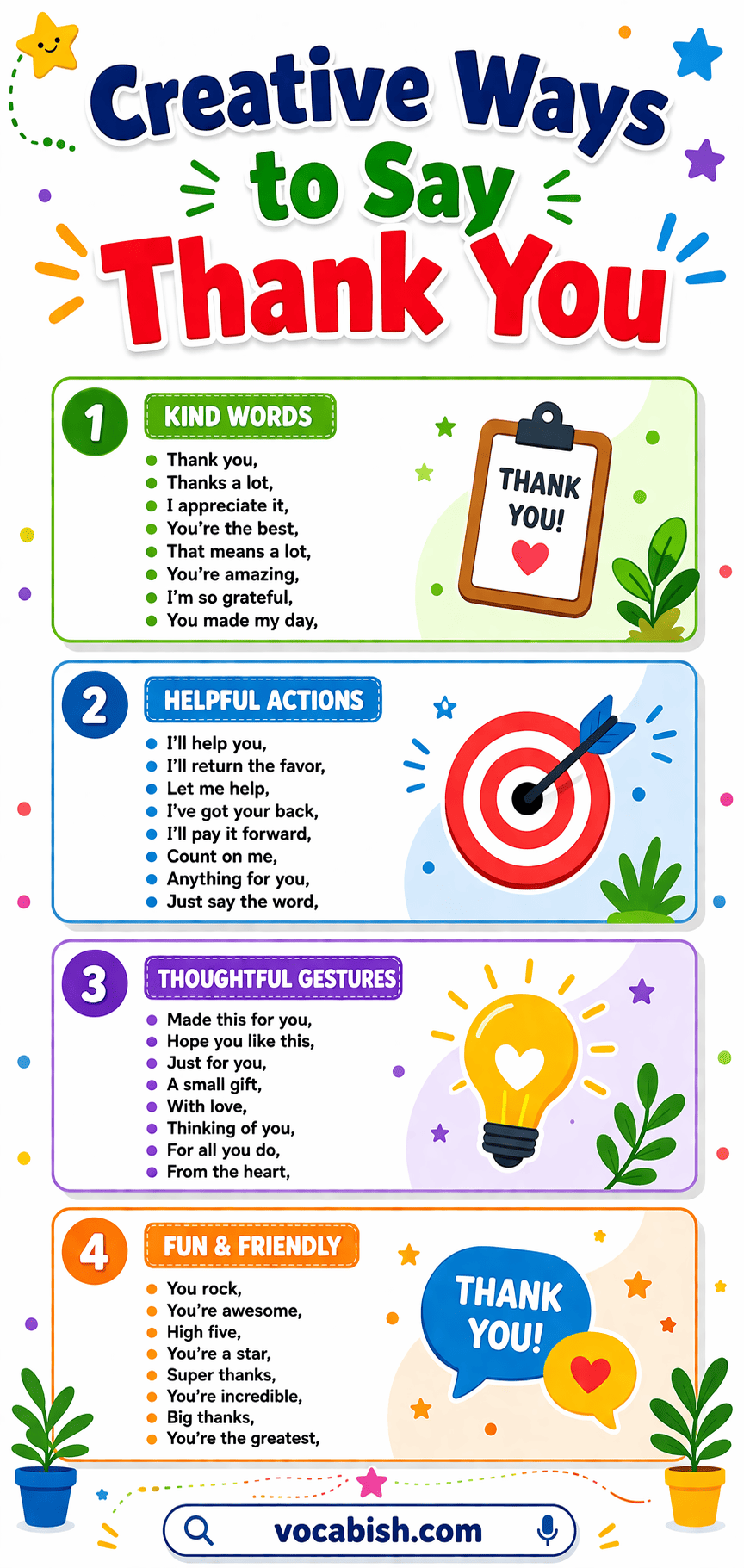
How to Choose the Right Way to Say “Thank You”
The best phrase depends on who you are speaking to and why you are thanking them.
Situation | Useful Expression |
|---|---|
Friend helps you | “Thanks a lot!” |
Friend does you a big favour | “I owe you one.” |
Teacher helps you | “I really appreciate your help.” |
Customer helps you | “Thank you for your patience.” |
Job interview | “Thank you for your time.” |
Business email | “I sincerely appreciate your assistance.” |
Someone gives advice | “Thank you for your guidance.” |
Someone supports you | “I’m grateful for your support.” |
Someone gives a gift | “You’re too kind.” |
Formal letter | “Please accept my sincere thanks.” |
Emotional support | “Thank you for being there.” |
Major personal favour | “I can’t thank you enough.” |
Formal vs. Informal Ways to Say Thank You
Informal
- Thanks!
- Thanks a lot!
- Thanks so much!
- Thanks a bunch!
- Thanks a ton!
- Thanks a million!
- I owe you one.
- You’re the best!
- You’re a lifesaver!
- You saved the day!
Neutral and Polite
- I appreciate it.
- I really appreciate it.
- That’s very kind of you.
- I’m grateful.
- I’m very thankful.
- Your help means a lot.
- Thank you for your help.
- Thank you for your time.
Formal
- I sincerely appreciate your assistance.
- Please accept my sincere thanks.
- My sincere thanks.
- With sincere thanks.
- With gratitude.
- I’d like to express my appreciation.
- I want to express my gratitude.
- Your support is greatly appreciated.
- You have my deepest thanks.
How to Teach Other Ways to Say “Thank You”
Parents and teachers can help children use different gratitude phrases through short, real-life activities.
1. Match the Situation
Give students situations such as:
- A friend gives you a pencil.
- A teacher helps with homework.
- Someone gives you a gift.
- A colleague helps with a project.
Ask students to choose the most suitable thank-you expression.
2. Create a Thank-You Chart
Make four columns:
Situation | Person | Thank-You Phrase | Tone |
|---|---|---|---|
Homework help | Teacher | I appreciate your help. | Polite |
Birthday gift | Friend | Thanks so much! | Friendly |
Business meeting | Client | Thank you for your time. | Formal |
3. Role-Play Conversations
Students can work in pairs. One student gives help, advice, a gift, or an invitation. The other student responds with an appropriate expression of gratitude.
4. Replace “Thank You”
Write several sentences containing thank you. Ask students to replace it with a suitable alternative.
Example:
Thank you for helping me.
Possible answer:
I really appreciate your help.
5. Write a Thank-You Note
Ask students to write a short note to a teacher, parent, friend, or classmate. Encourage them to explain why they are grateful.
Other Ways to Say “Thank You”
Test your English with real-life situations and choose the most natural expression.
Loading question…
Great Work!
You completed the practice.
FAQs
You can say “I appreciate it,” “I’m grateful,” “Thanks so much,” “Many thanks,” or “I sincerely appreciate your help.”
“I really appreciate it,” “That’s very kind of you,” and “I’m grateful for your help” are polite choices for everyday situations.
Formal options include “Please accept my sincere thanks,” “I sincerely appreciate your assistance,” and “I’d like to express my appreciation.”
Use phrases such as “Thank you for your time,” “I appreciate your assistance,” or “Your support is greatly appreciated” in professional communication.
Casual alternatives include “Thanks,” “Thanks a lot,” “Thanks so much,” “I owe you one,” and “You’re the best.”
You can say “Thank you for your help,” “I really appreciate your help,” or “I’m grateful for your assistance.”
Say “I can’t thank you enough,” “Thank you from the bottom of my heart,” or “I’m deeply grateful for your kindness and support.”
Conclusion
There are many other ways to say thank you, from simple expressions such as “Thanks a lot” to formal phrases such as “Please accept my sincere thanks.” The right expression depends on the person, situation, and tone you want to use. For everyday conversations, casual phrases work well, while professional situations often need more polite or formal language. Use these examples to make your English more natural and varied. Try a few new expressions today and choose the one that best fits your situation.