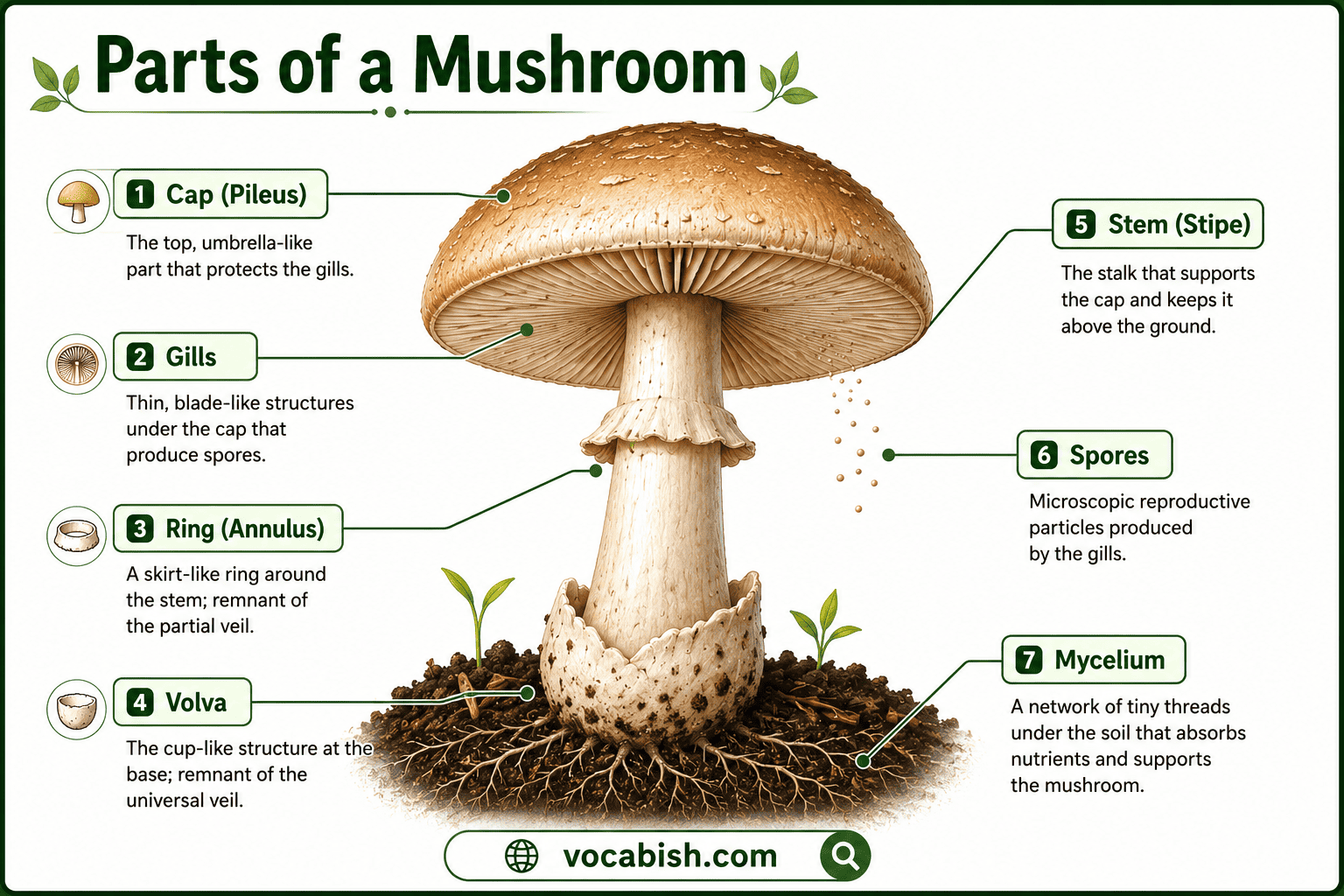

A mushroom is a type of fungus made up of different parts that help it grow, reproduce, and survive in nature. In this blog post, you will learn the parts of a mushroom, their functions, and a labeled diagram to understand the structure of a mushroom in detail. From the cap and gills to the stalk and spores, each part has a specific role in the mushroom’s growth and reproduction process. Learning the names of mushroom parts helps readers understand English vocabulary related to plants, fungi, biology, and natural science commonly used in classrooms, books, and educational studies.
What is a Mushroom?
A mushroom is a type of fungus. It grows above the ground and is not a plant. Mushrooms help nature by breaking down dead material. Some mushrooms are safe to eat, while others are poisonous.
Main Parts of a Mushroom
Cap
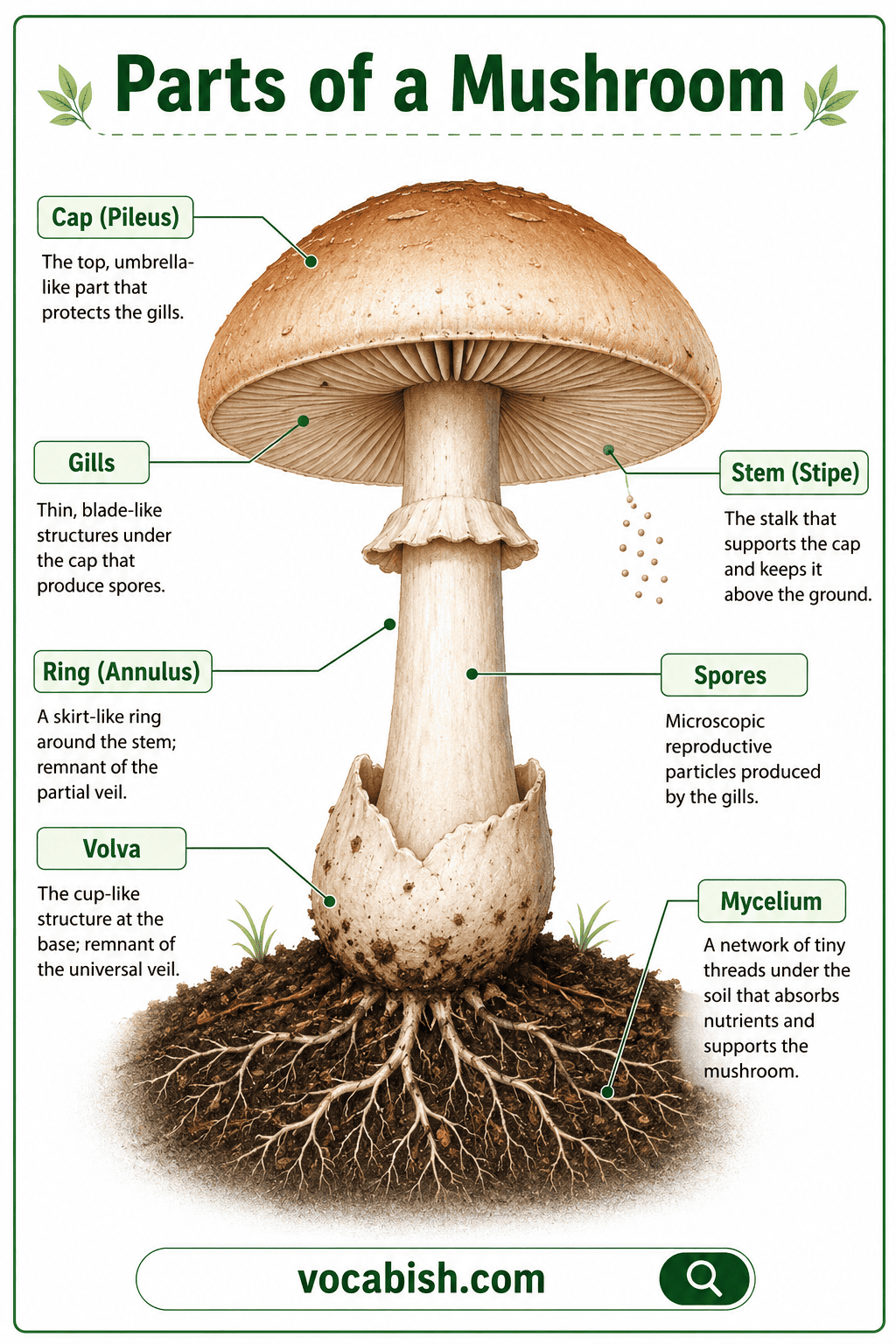
The top, umbrella-shaped part of a mushroom. It protects the gills and helps spread spores.
Example: “The cap of the mushroom was big and brown.”
Gills
Thin lines under the cap. They produce and release spores.
Example: “The gills under the cap were light pink.”
Stem
The long middle part. It holds the cap up and supports the mushroom.
Example: “The stem was tall and thin.”
Ring
A small circle around the stem. It is left from a protective cover when the mushroom grows.
Example: “You can see a white ring on the stem.”
Volva
A cup-like part at the base.
It protects the mushroom when it is young.
Example: “The volva is at the bottom of the mushroom.”
Hidden Parts of a Mushroom
Mycelium
A network of thin threads under the ground. It absorbs food and helps the mushroom grow.
Example: “The mycelium spreads under the soil.”
Spores
Tiny seed-like cells. They help mushrooms reproduce and spread.
Example: “Spores fall to the ground and grow into new mushrooms.”
Mushroom Parts by Function
Protective Parts
- Cap: Covers delicate parts
- Volva: Protects young mushroom
Support Parts
- Stem: Holds the mushroom upright
- Ring: Leftover support layer
Reproductive Parts
- Gills: Make spores
- Spores: Create new mushrooms
Feeding Part
- Mycelium: Takes nutrients from soil
Parts of a Mushroom Labeled Diagram
Why Learning Mushroom Parts Is Useful
- Helps in school science lessons
- Improves nature and food vocabulary
- Builds basic biology knowledge
- Useful for reading and exams
Summary on Parts of a Mushroom
The parts of a mushroom include the cap, gills, stem, ring, volva, mycelium, and spores. Each part has a clear role in protection, support, or growth. Learning these words builds strong vocabulary and helps learners understand nature in simple English.
Frequently Asked Questions
The main parts of a mushroom are the cap, gills, stem, ring, volva, mycelium, and spores. Each part helps the mushroom grow or reproduce.
The cap is the top part of a mushroom. It protects the gills and helps spread spores.
Gills are thin lines under the cap. They produce spores that help mushrooms reproduce.
The stem supports the cap and lifts it above the ground so spores can spread easily.
Spores are tiny cells that help mushrooms reproduce and grow in new places.
Mycelium is the root-like network under the ground. It absorbs nutrients and supports mushroom growth.
Related Articles: