
In English, seam and seem sound alike but have very different meanings. Knowing the difference is important for speaking, writing, reading, and listening accurately. In this blog post, you will learn when to use seam and seem correctly, with examples that make their meanings easy to understand. By mastering these words, you can express your ideas more clearly and communicate more effectively.
You can explore our 100 confusing words list to expand your vocabulary skills!
Meanings of Seam and Seem
Seam
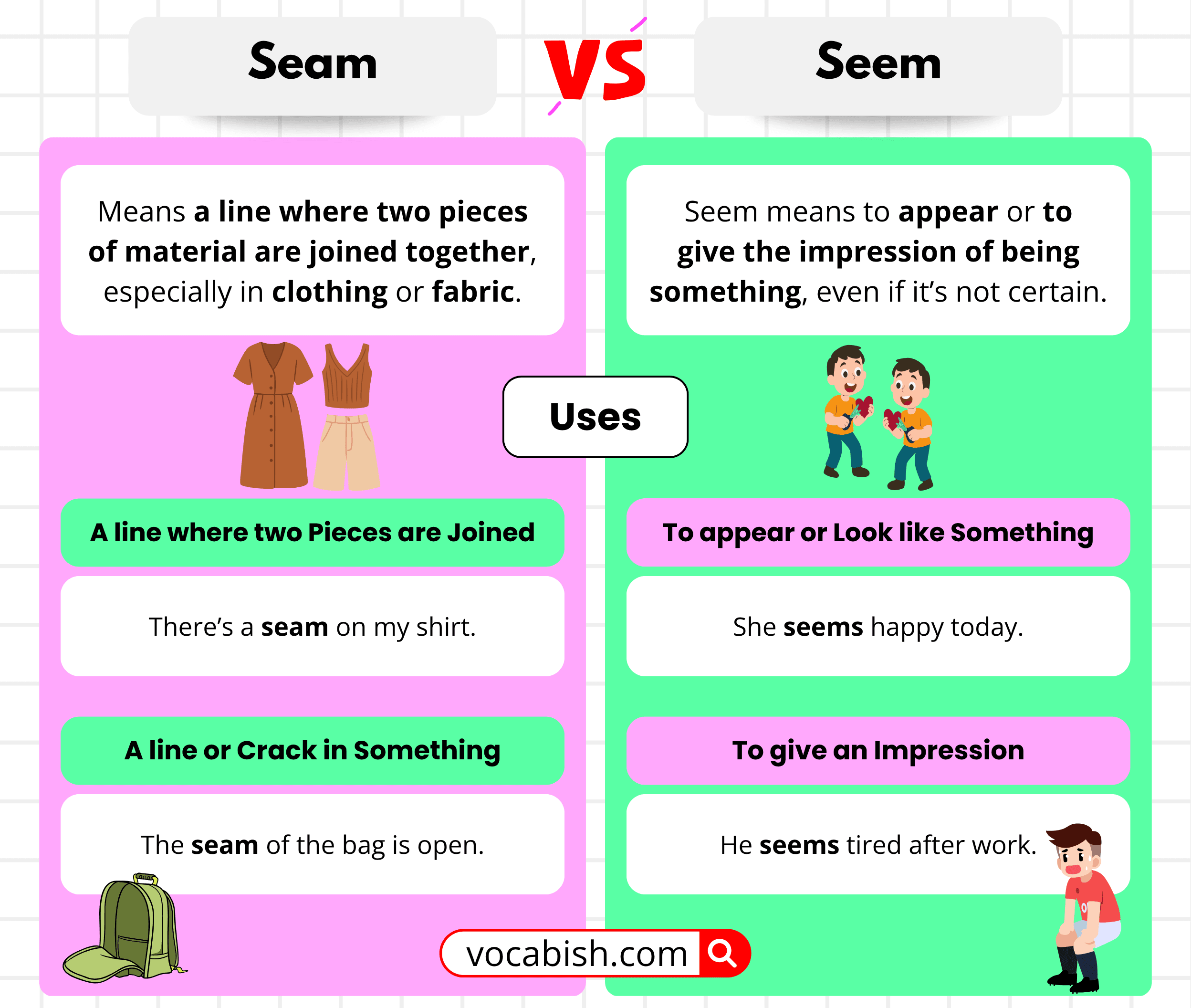
Seam means a line where two pieces of material are joined together, especially in clothing or fabric.
It can also mean a crack or joint between two surfaces.
Example: The seam on my shirt came undone.
Seem
Seem means to appear or to give the impression of being something, even if it’s not certain. It describes how things look or feel, not what they really are.
Example: You seem happy today.
Differences Between Seam and Seem
| Point | Seam | Seem |
|---|---|---|
| Part of Speech | Noun | Verb |
| Meaning | A line where things are stitched or joined | To appear or look like something |
| Usage | Used for physical joins (like in clothes or surfaces) | Used for appearance or impression |
| Example | The dress has a loose seam. | It seems like a good idea. |
Usage of Seam
Seam is commonly used in sewing, clothing, and construction to describe a line where materials meet or are stitched together.
Examples:
- There’s a seam on the side of my jeans.
- The tailor fixed the torn seam.
- The seam between the tiles is neat.
- She noticed a small tear near the seam.
- The dress has a beautiful lace seam.
Usage of Seem
Seem is used when something appears to be true or looks like something without confirmation. It helps express opinions, impressions, or assumptions.
Examples:
- You seem tired after work.
- It seems like it’s going to rain.
- He seems interested in learning English.
- That seems difficult, but it’s not.
- The story seems real but is fictional.
Formal and Informal Usage
Formal
- Seam: The seam between the panels was sealed perfectly.
- Seem: It seems that the meeting will begin soon.
Informal
- Seam: My shirt’s seam ripped again!
- Seem: You seem upset today.
Summary on Seam and Seem
- Seam → A line where two things are joined (noun).
- Seem → To appear or look like something (verb).
Use seam for physical things like clothes.
Use seem for ideas, feelings, or appearances.
FAQs on Seem and Seam
What is the main difference between Seam and Seem?
Seam is a noun meaning a line of joining, while Seem is a verb meaning to appear or look like something.
Can Seam be used as a verb?
Rarely. It’s mainly used as a noun, though “seamed” can describe something with visible joins (e.g., “a seamed face”).
Which one means ‘to appear’?
The word Seem means to appear or to look like.
Which one is related to clothing?
Seam refers to the stitched line on clothing or fabric.
How can I remember the difference?
Think — Seam has an “a” for apparel, and Seem has “ee” for eyes, as it relates to what you see.
Read More