
A fishing reel is an important fishing tool used to hold, release, and retrieve the fishing line while catching fish in rivers, lakes, and oceans. In this blog post, you will learn the parts of a fishing reel with their functions and a diagram to understand how each part of the reel works during fishing. From the spool and handle to the drag system and bail arm, every part has a specific role in controlling the fishing line and improving casting performance. Learning the names of fishing reel parts helps readers understand English vocabulary related to fishing equipment, outdoor activities, and angling tools commonly used in fishing and recreational learning.
What is a Fishing Reel?
A fishing reel is a mechanical device attached to a fishing rod. It helps in casting the line into the water and retrieving fish safely. It makes fishing faster and more enjoyable. Fishing reels can be used in freshwater or saltwater fishing depending on their type.
Types of Fishing Reels
Spinning Reel
- Description: Very popular and easy to use. The spool faces forward, making casting simple.
- Best for: Beginners and light to medium fishing.
Baitcasting Reel
- Description: Provides more control and distance. Requires more skill.
- Best for: Experienced anglers and heavier fishing.
Spincast Reel
- Description: Simple to use with a closed face design.
- Best for: Kids and beginners.
Main Parts of a Fishing Reel
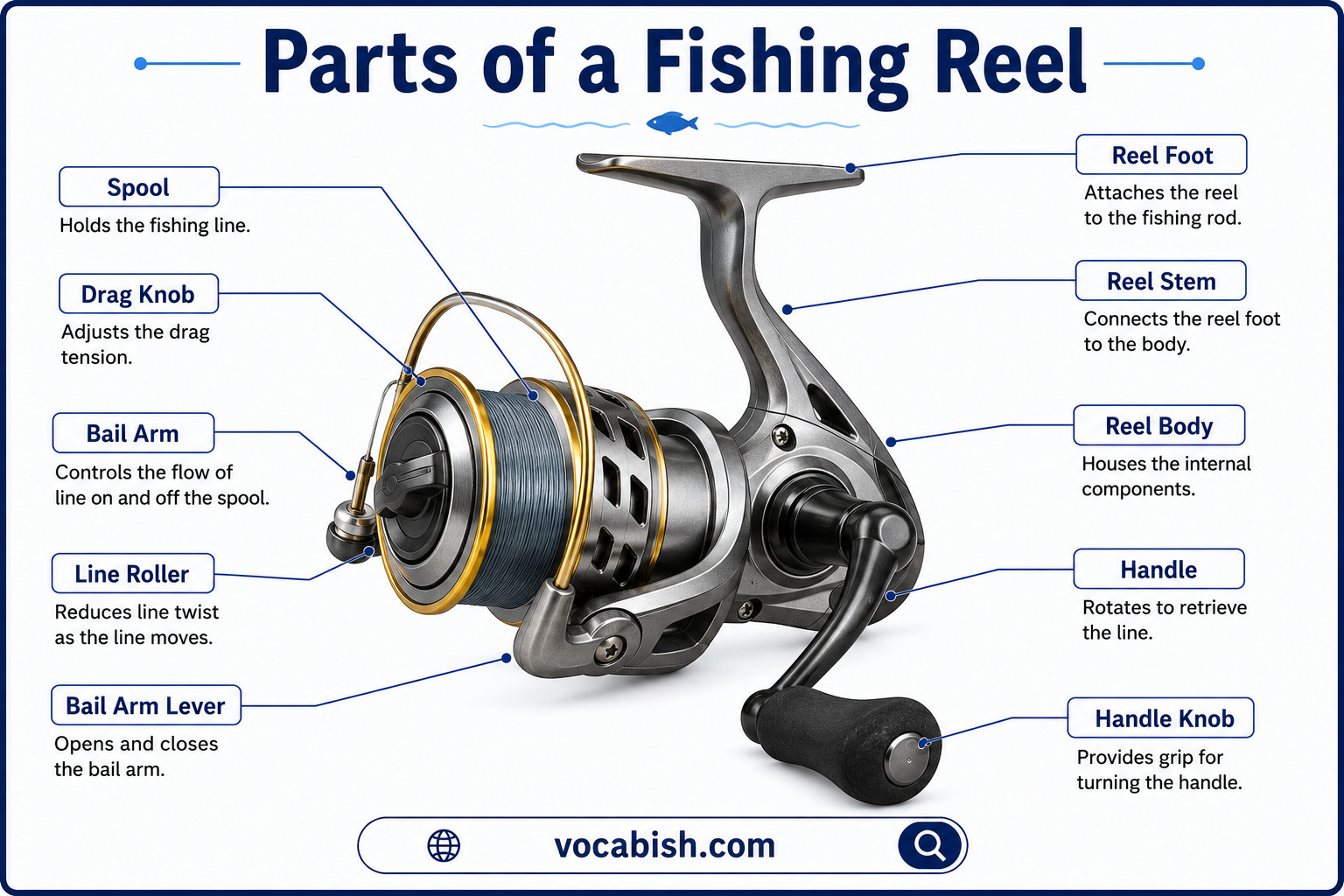
Handle
Function: Used to retrieve the fishing line by turning it.
Spool
Function: Holds the fishing line. Can be fixed or rotating.
Drag System
Function: Controls the line tension to avoid breaking the line when a fish pulls.
Bail
Function: Guides the line on the spool and helps in casting smoothly.
Reel Foot
Function: Attaches the reel firmly to the fishing rod.
Body
Function: Holds all internal parts and protects the mechanism.
Line Roller
Function: Reduces line twisting and helps the line move smoothly.
Anti-Reverse Switch
Function: Stops the handle from spinning backward, giving better control.
Gear System
Function: Transfers handle rotation to the spool. Controls the retrieving speed and power.
Fishing Reel Parts Labeled Diagram
Tips for Using a Fishing Reel
- Always check the drag system before fishing.
- Keep the reel clean and dry after use.
- Turn the handle smoothly to avoid line tangles.
- Practice casting and retrieving to get better control.
Understanding the parts of a fishing reel and their functions makes fishing easier and more fun. By learning each part, beginners can fish more confidently and maintain their equipment properly.
Frequently Asked Questions
The handle is used to retrieve the fishing line by turning it smoothly, helping to reel in fish.
The spool holds the fishing line and allows it to be cast out or retrieved efficiently.
The drag system controls the line tension, preventing the line from breaking when a fish pulls hard.
The bail guides the line onto the spool and ensures smooth casting without tangling.
The line roller helps reduce line twisting and allows the line to move smoothly onto the spool.
The anti-reverse switch stops the handle from spinning backward, giving better control when catching fish.
Related Articles: