
Sometimes a sentence gives information, asks a question, shows excitement, or gives a command. Learning the different types of sentences helps you understand how English communication changes in different situations. The same words can sound polite, serious, friendly, angry, or excited depending on the sentence type and punctuation.
In daily English, people constantly switch between sentence types while talking, texting, writing emails, or giving instructions. Understanding these patterns makes communication clearer and more natural.
What are Types of Sentences?
English sentences are not all common for the same purpose. Some sentences share information, while others ask something, express emotion, or tell someone what to do.
These are called types of sentences by purpose.
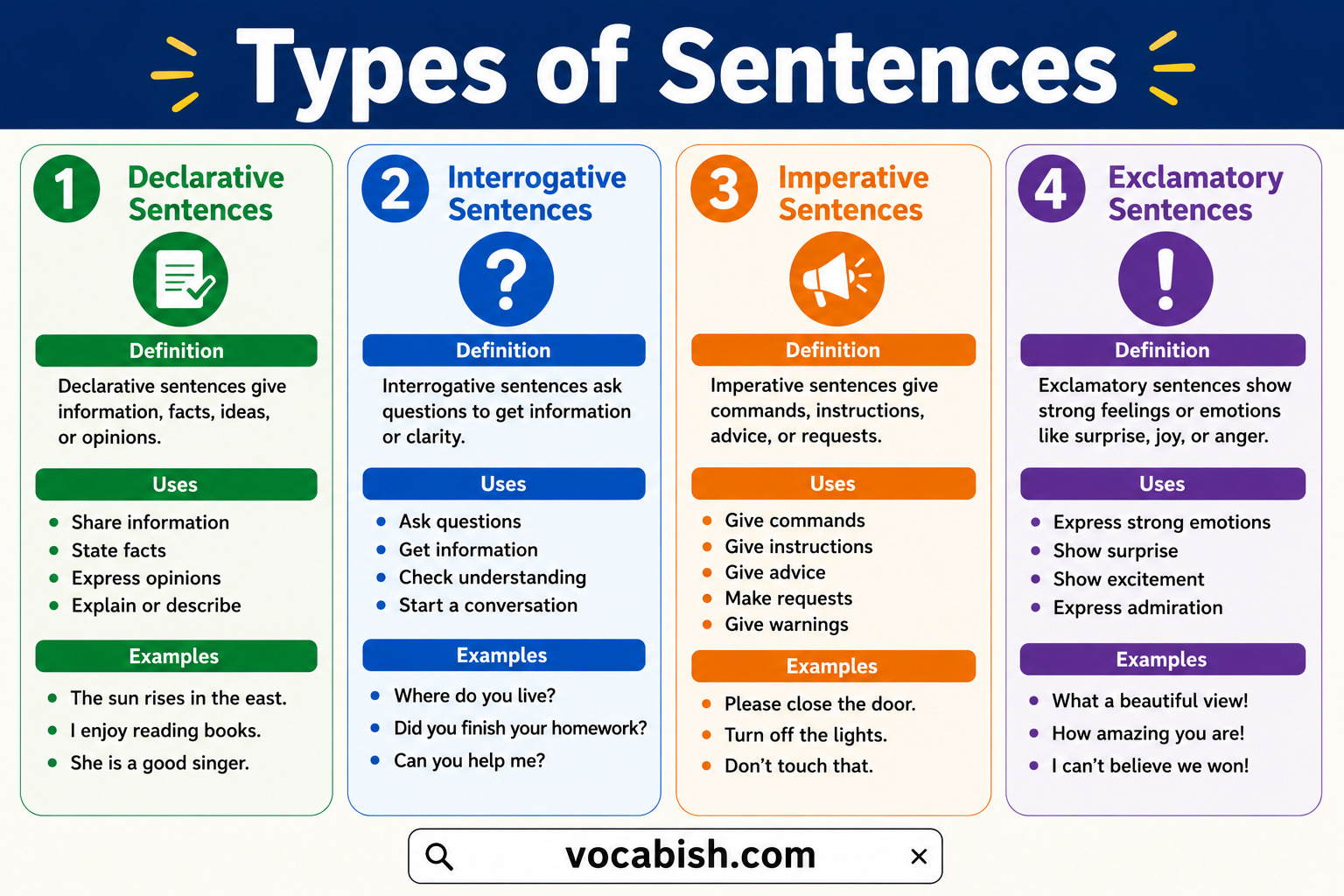
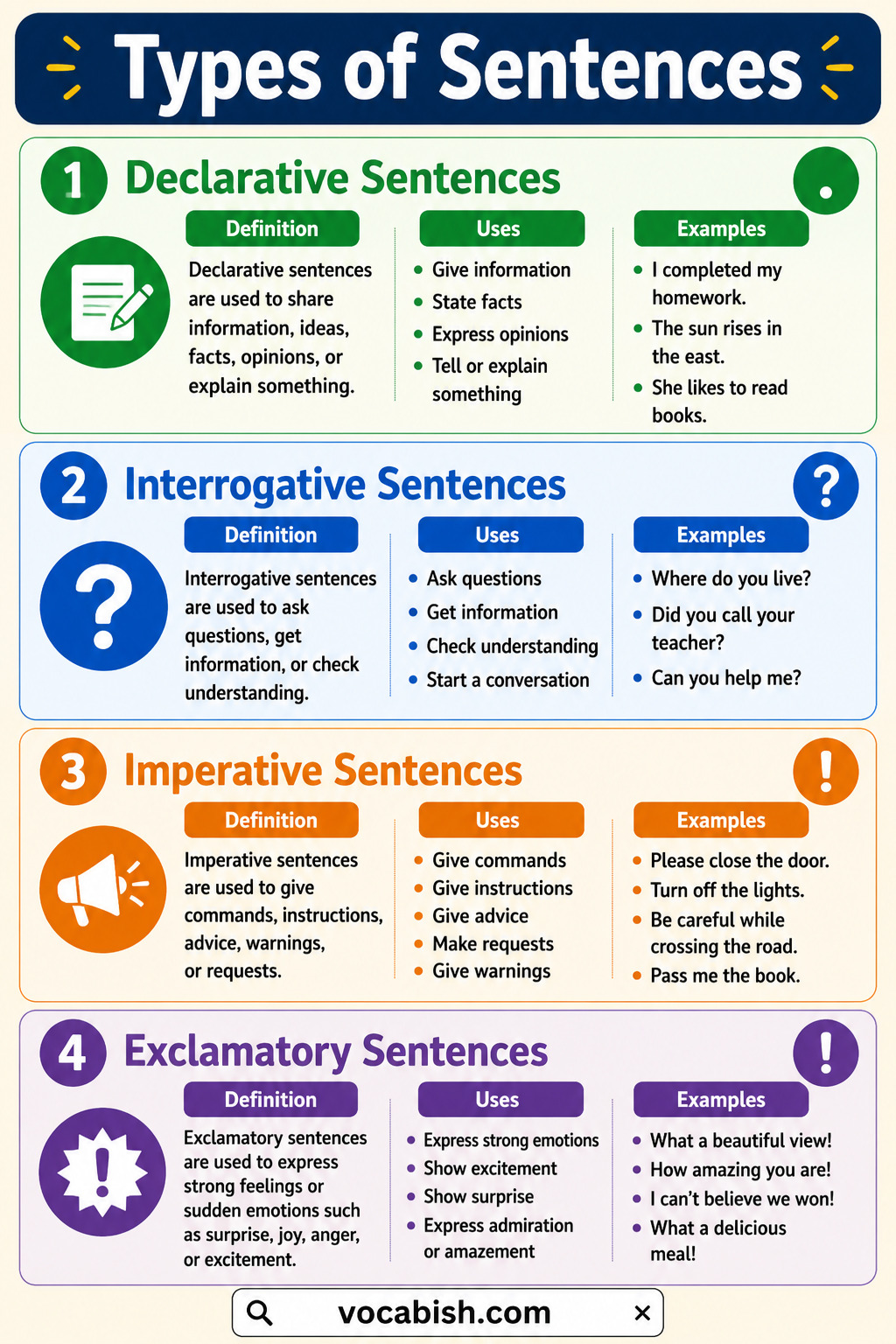
The four main sentence types are:
- Declarative Sentences
- Interrogative Sentences
- Imperative Sentences
- Exclamatory Sentences
Each type changes the meaning, tone, and purpose of communication.
For example:
- I finished my homework. → gives information
- Did you finish your homework? → asks a question
- Finish your homework now. → gives a command
- What a difficult homework assignment! → expresses emotion
Even though all these sentences talk about homework, their purpose is completely different.
Why We Use Different Sentence Types
Sentence types affect how people understand your message.
A wrong sentence type can create confusion or even sound rude.
Imagine these situations:
- In class, a teacher asks a question.
- At work, a manager gives instructions.
- Friends send excited text messages.
- A customer asks for help politely.
All of these situations need different sentence styles.
Using the correct types of sentences helps with:
- speaking naturally
- writing clearly
- understanding tone
- expressing emotions
- asking questions correctly
- giving polite instructions
It also improves reading comprehension because punctuation and sentence purpose guide the reader.
Types of Sentences in English
Different sentences are used for different purposes in communication. Some sentences give information, some ask questions, others give instructions, and some express strong emotions. These four main types are Declarative, Interrogative, Imperative, and Exclamatory sentences. In the sections below, we will explain each sentence type with its purpose, usage, and examples.
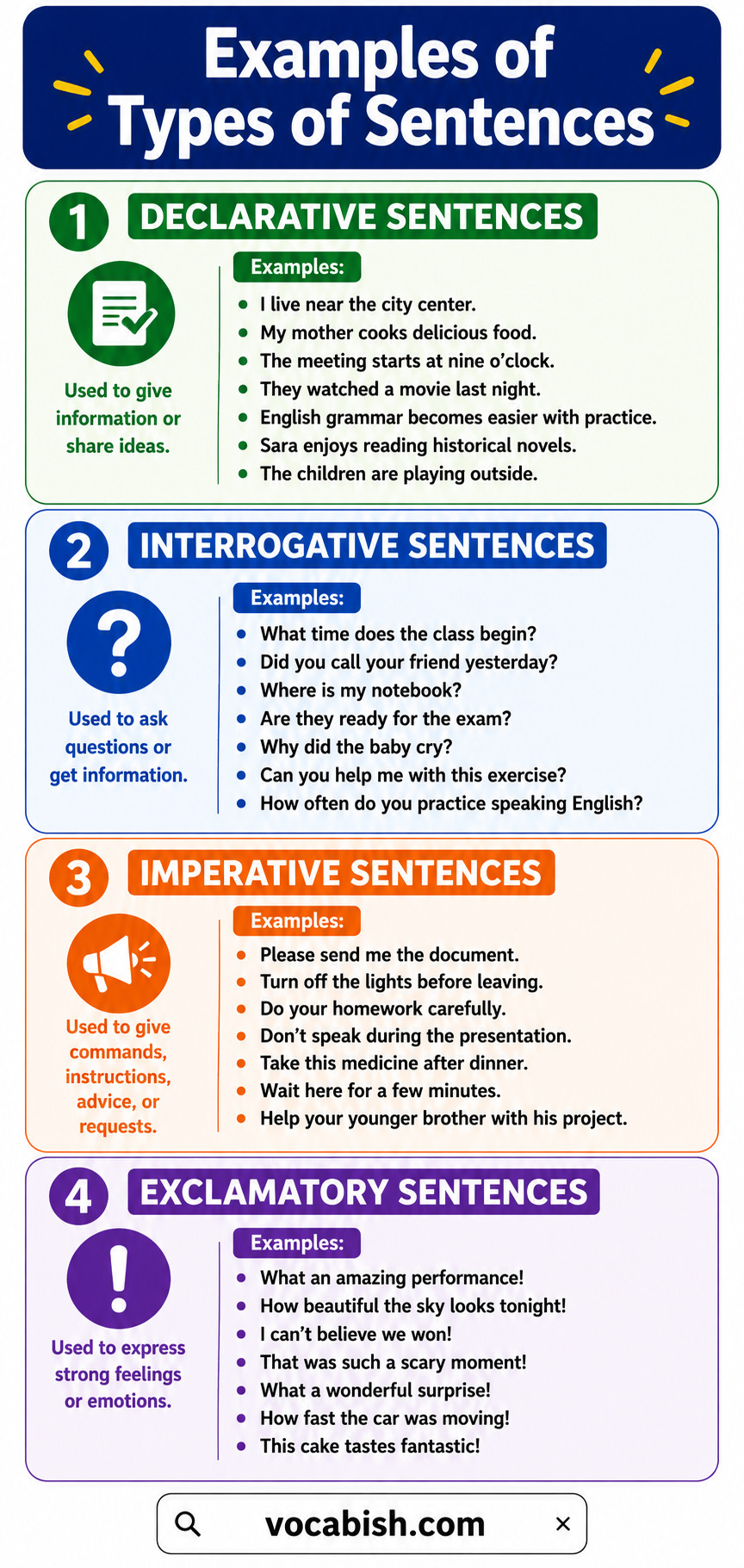
Declarative Sentences
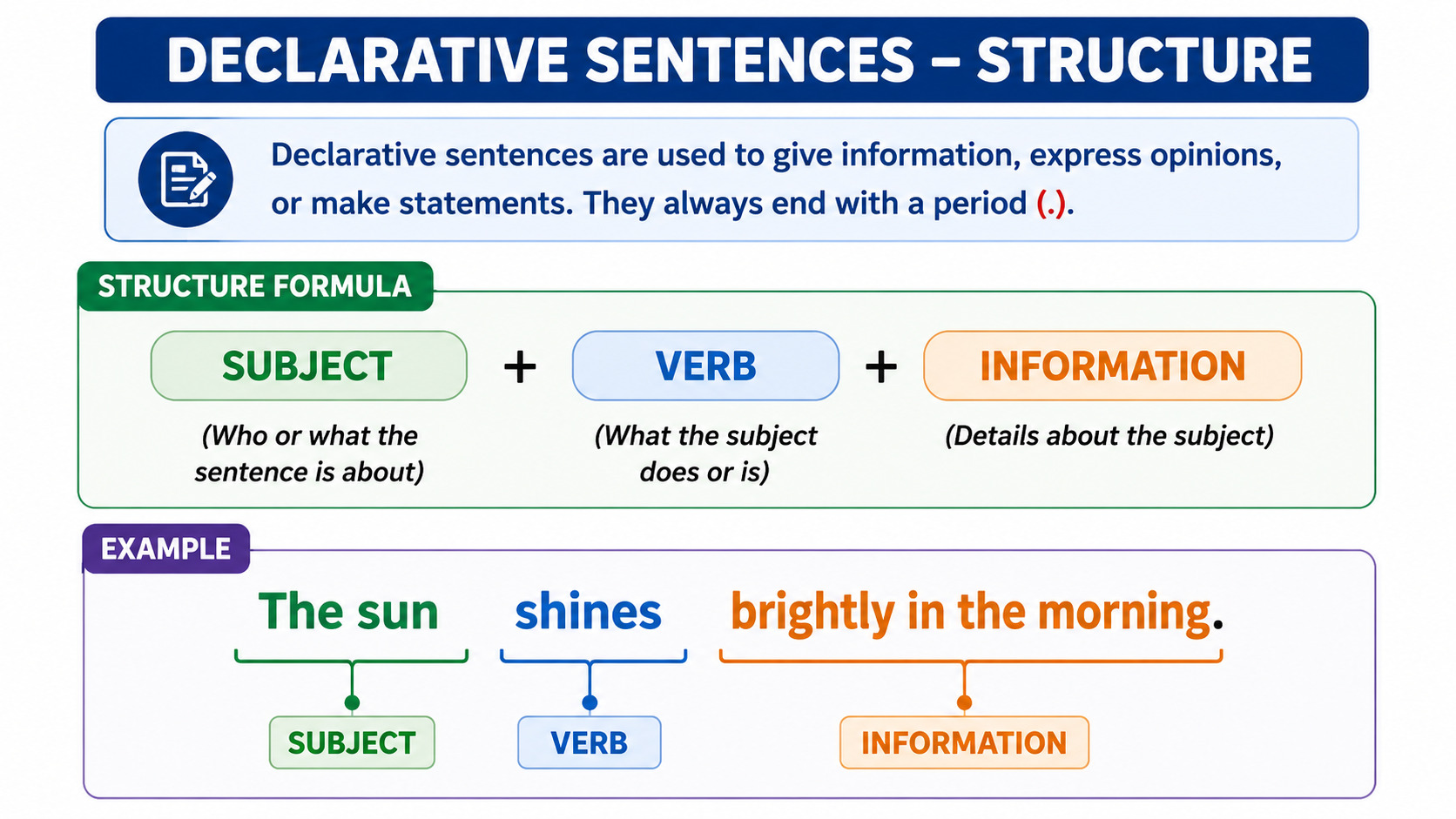
Declarative sentences are used when people want to share information, ideas, facts, opinions, or everyday details during communication. These sentences help you explain something clearly to another person.
These kind of sentences usually end with a period (.)
Real-life communication context:
- sharing news
- introducing yourself
- explaining ideas
- giving information
- telling stories
Structure:
Declarative sentences usually follow this pattern:
Subject + Verb + Information
Examples:
- The train arrived late.
- My brother plays football.
- We are studying English grammar.
Some declarative sentences are short:
- It is raining.
- She smiled.
Others can be longer:
- The students finished the project before the deadline yesterday.
Examples of Declarative Sentences
- I live near the city center.
- My mother cooks delicious food.
- The meeting starts at nine o’clock.
- They watched a movie last night.
- English grammar becomes easier with practice.
- Sara enjoys reading historical novels.
- The children are playing outside.
Interrogative Sentences
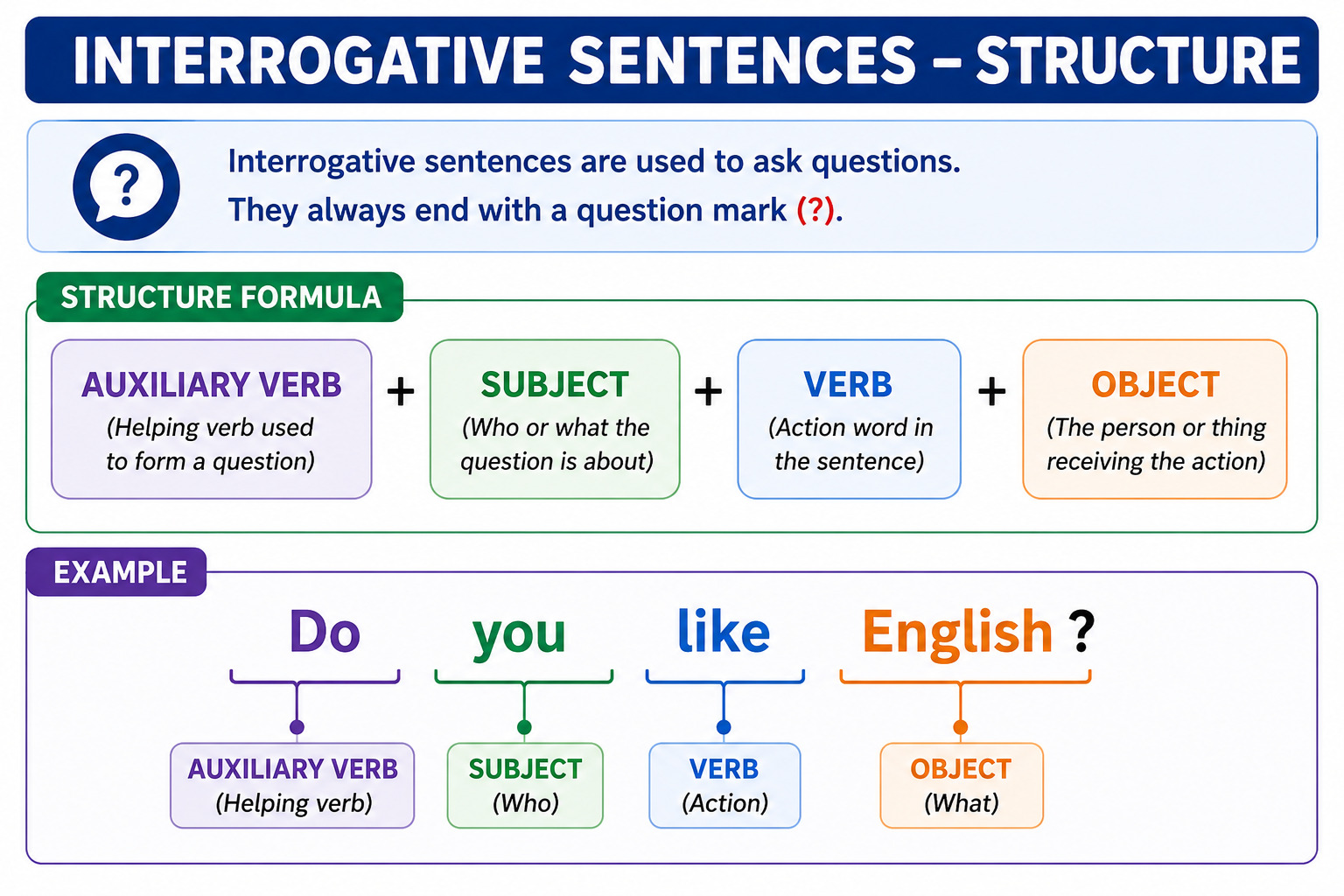
Interrogative sentences are common when someone wants to ask questions, get information, check understanding, or continue a conversation with another person.
The sentence that ends with a question mark (?) is known as an interrogative or question sentence.
Used in daily conversations:
People use interrogative sentences to:
- ask for information
- request clarification
- start conversations
- check understanding
- offer help
Structure:
- Auxiliary verb + Subject + Verb + Object
- Ends with a question mark (?)
Examples:
- Do you like coffee?
- Are they coming today?
- Can she drive?
Question words are also common:
- what
- where
- when
- why
- how
- who
Examples:
- Where do you work?
- Why are you laughing?
Examples of Interrogative Sentences
- What time does the class begin?
- Did you call your friend yesterday?
- Where is my notebook?
- Are they ready for the exam?
- Why did the baby cry?
- Can you help me with this exercise?
- How often do you practice speaking English?
Imperative Sentences
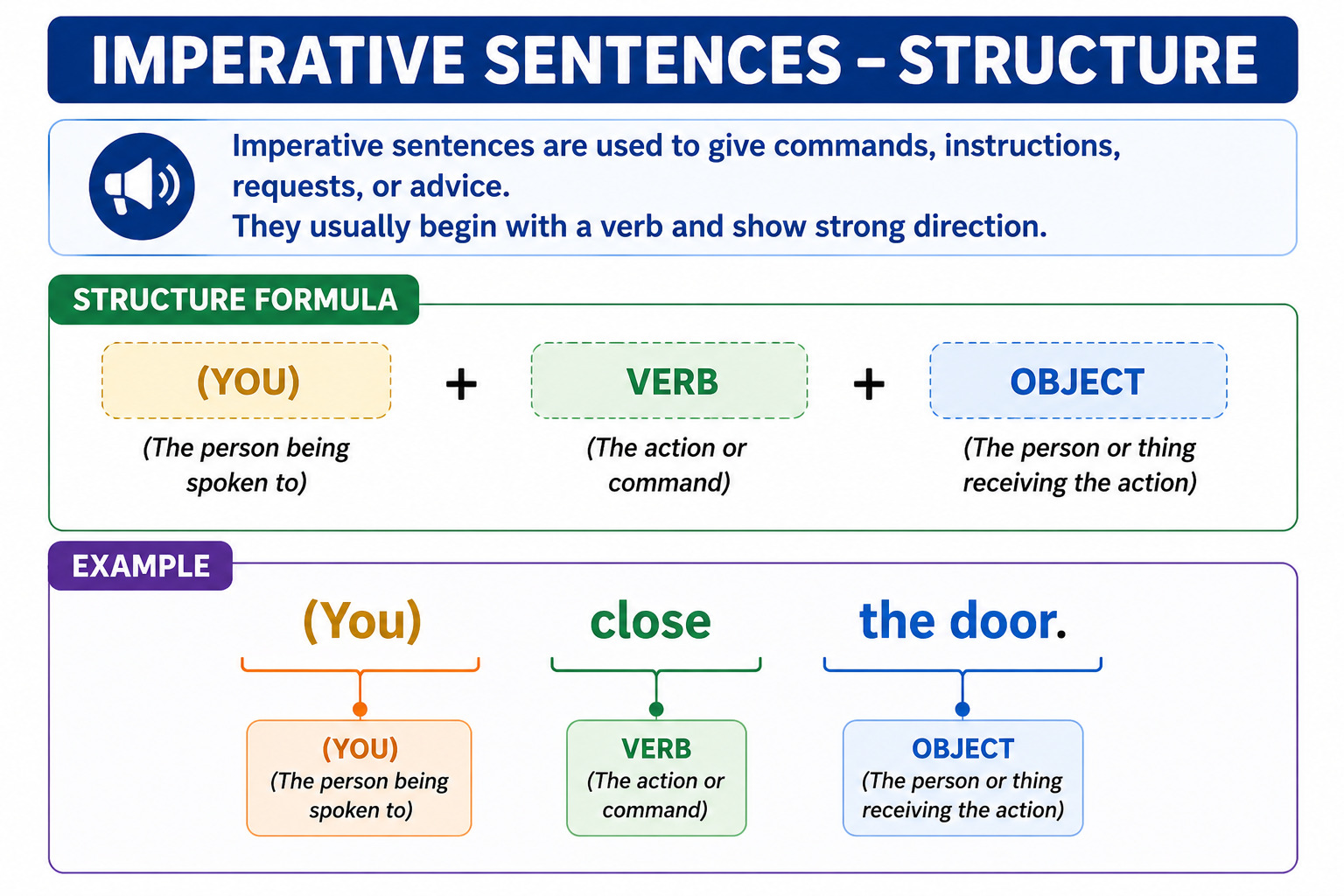
Imperative sentences are helpful when people give commands, instructions, advice, warnings, or polite requests. They usually tell someone to do or not do something.
The subject is usually understood rather than written directly. In most cases, the hidden subject is “you.”
Commands and instructions:
These sentences are common in:
- classrooms
- recipes
- workplaces
- road signs
- conversations
- manuals
Structure:
- (You) + Verb + Object
- Can end with a period (.) or an exclamation mark (!)
Examples:
- Open the window.
- Turn left at the corner.
- Please sit down.
Tone changes depending on word choice.
Compare:
- Close the door. → direct command
- Please close the door! → polite request
Negative imperatives use do not or don’t.
Examples:
- Don’t touch the stove.
- Do not run in the hallway.
Examples of Imperative Sentences
- Please send me the document.
- Turn off the lights before leaving.
- Do your homework carefully.
- Don’t speak during the presentation.
- Take this medicine after dinner.
- Wait here for a few minutes.
- Help your younger brother with his project.
Exclamatory Sentences
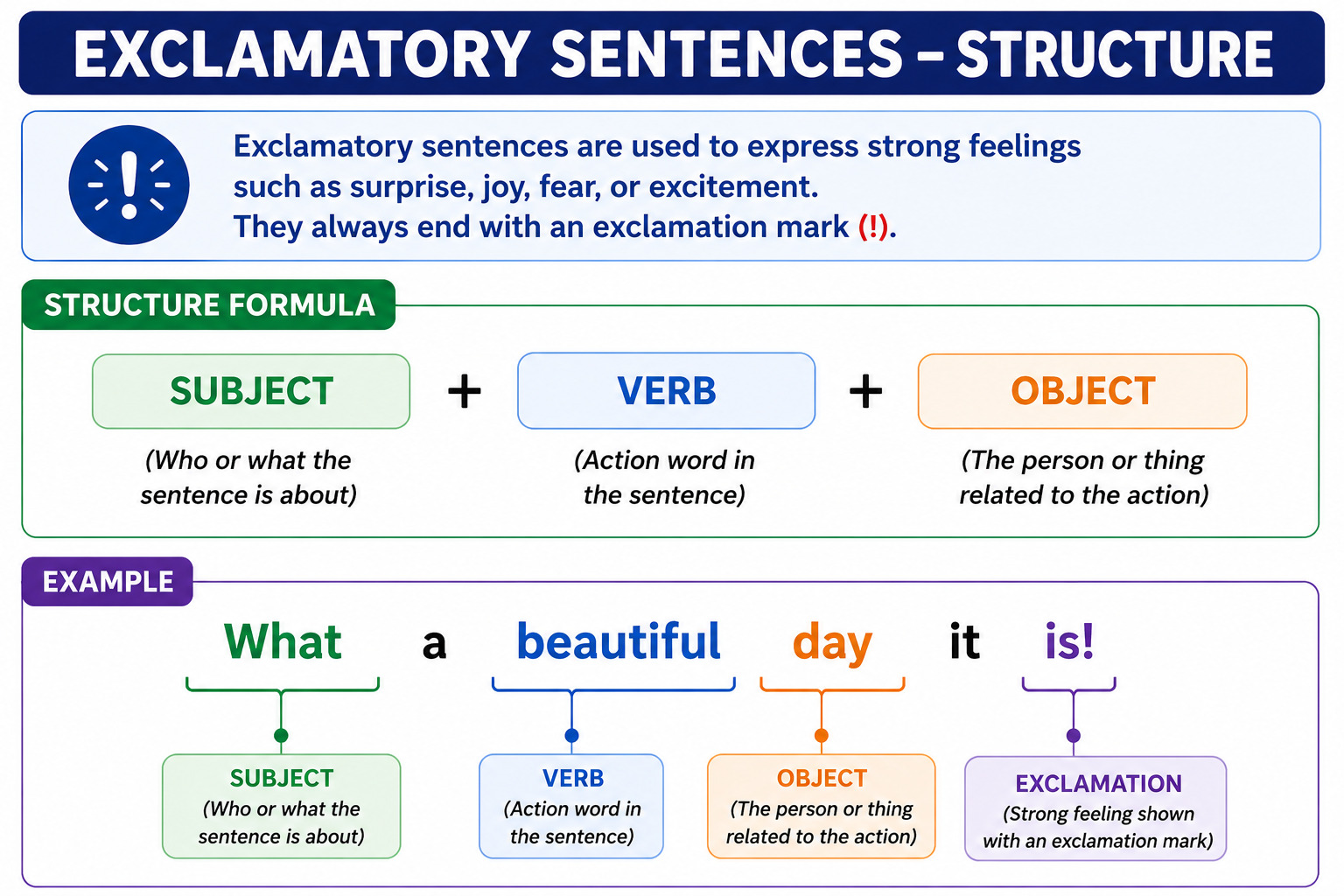
Exclamatory sentences help to express strong feelings, sudden reactions, excitement, surprise, happiness, anger, or other emotions during communication.
These sentences usually end with an exclamation mark (!).
Tone and emotion matter:
The same sentence can feel completely different with different punctuation.
Compare:
- You won the match. → simple information
- You won the match! → strong excitement
Structure:
- Subject + Verb + Object
- Ends with an exclamation mark (!)
Exclamatory sentences are common in conversations, storytelling, and informal writing.
Words like “what” and “how” often appear in these sentences.
Examples:
- What a beautiful painting!
- How quickly time passes!
Examples of Exclamatory Sentences
- What an amazing performance!
- How beautiful the sky looks tonight!
- I can’t believe we won!
- That was such a scary moment!
- What a wonderful surprise!
- How fast the car was moving!
- This cake tastes fantastic!
Sentence Types in Daily Conversation
People naturally switch between sentence types during communication.
Classroom
- Open your books. → imperative
- Do you understand the lesson? → interrogative
- Today’s lesson is about grammar. → declarative
- What an interesting topic! → exclamatory
Workplace
- Please email the report today.
- Did the client approve the design?
- The meeting has been postponed.
- What a productive week!
Text Messages
- Where are you?
- I’m outside your house.
- Come quickly.
- This place looks amazing!
Instructions
Recipes, traffic signs, and manuals mostly use imperative sentences because they focus on actions.
Examples:
- Mix the ingredients carefully.
- Do not park here.
- Press the green button.
Common Mistakes Using Types of Sentences
1. Using the wrong punctuation
Incorrect:
- Where do you live.
Correct:
- Where do you live?
2. Forgetting helping verbs in questions
Incorrect:
- You are coming today?
Correct:
- Are you coming today?
3. Confusing commands and polite requests
Direct command:
- Give me the file.
Polite request:
- Could you give me the file, please?
4. Overusing exclamation marks
Incorrect:
- I went to school today!!!
Better:
- I went to school today.
Use exclamation marks only when strong emotion is necessary.
5. Wrong word order in interrogative sentences
Incorrect:
- Where you are going?
Correct:
- Where are you going?
Comparison between Types of Sentences
Sentence Type | Purpose | Examples |
|---|---|---|
Declarative | Gives information | She works in a hospital. |
Interrogative | Asks a question | Where do you study? |
Imperative | Gives command/request | Please open the window. |
Exclamatory | Shows strong emotion | What a wonderful day! |
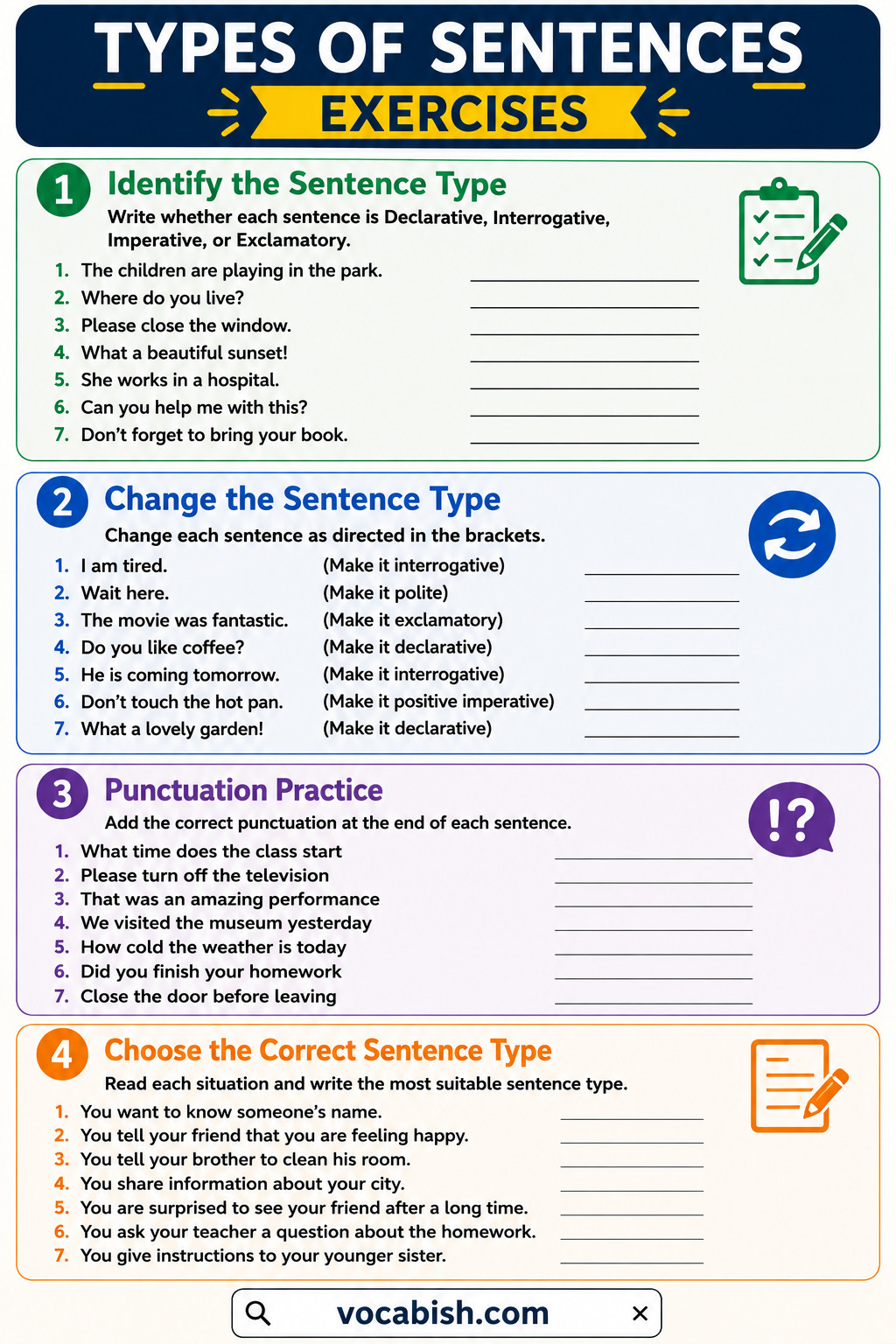
Practice Exercise: Types of Sentences
1: Identify the Sentence Type
Write whether each sentence is declarative, interrogative, imperative, or exclamatory.
- Please answer the phone.
- What a beautiful garden!
- The students completed the assignment.
- Are you ready for the test?
- Don’t forget your umbrella.
- How exciting this trip is!
- My father works in a bank.
Answer Key:
- Imperative
- Exclamatory
- Declarative
- Interrogative
- Imperative
- Exclamatory
- Declarative
2: Change the Sentence Type
Convert the sentence according to the instruction.
- You are tired. → Make it interrogative.
- Close the window. → Make it polite.
- The movie was amazing. → Make it exclamatory.
- Are they coming today? → Make it declarative.
- You finished the project. → Make it interrogative.
- Sit down. → Make it negative imperative.
- It is a beautiful place. → Make it exclamatory.
Answer Key:
- Are you tired?
- Please close the window.
- What an amazing movie!
- They are coming today.
- Did you finish the project?
- Do not sit down. / Don’t sit down.
- What a beautiful place!
3: Correct the Punctuation
Add the correct punctuation mark.
- What time is the meeting
- Please be quiet
- That was incredible
- We visited the museum yesterday
- How cold the weather feels
- Did you complete your homework
- Turn off the computer before leaving
Answer Key:
- What time is the meeting?
- Please be quiet.
- That was incredible!
- We visited the museum yesterday.
- How cold the weather feels!
- Did you complete your homework?
- Turn off the computer before leaving.
4: Choose the Correct Sentence Type
Read each situation and write the most suitable sentence type.
- You want to know someone’s name.
- You tell your friend that you are feeling happy.
- You tell your brother to clean his room.
- You share information about your city.
- You are surprised to see your friend after a long time.
- You ask your teacher a question about the homework.
- You give instructions to your younger sister.
Download PDF
You may also Like:
FAQs about Sentence Types
The four types are declarative, interrogative, imperative, and exclamatory sentences. Each type has a different communication purpose and punctuation style.
Sentence types help listeners and readers understand information, emotions, questions, commands, and tone clearly during speaking, writing, texting, and conversations.
Interrogative sentences always end with a question mark because they ask direct questions and expect information, clarification, or responses from listeners.
Yes. Adding words like “please,” “could,” or softer expressions makes imperative sentences sound more respectful and less direct in conversations.
Exclamatory sentences are less common in formal writing because strong emotional punctuation may sound informal or overly dramatic in professional contexts.
Sentence types describe purpose, while sentence structure describes grammatical form such as simple, compound, complex, and compound-complex sentence patterns.
Learners improve faster by reading dialogues, noticing punctuation, speaking aloud, rewriting sentences, and practicing real communication situations regularly every day.