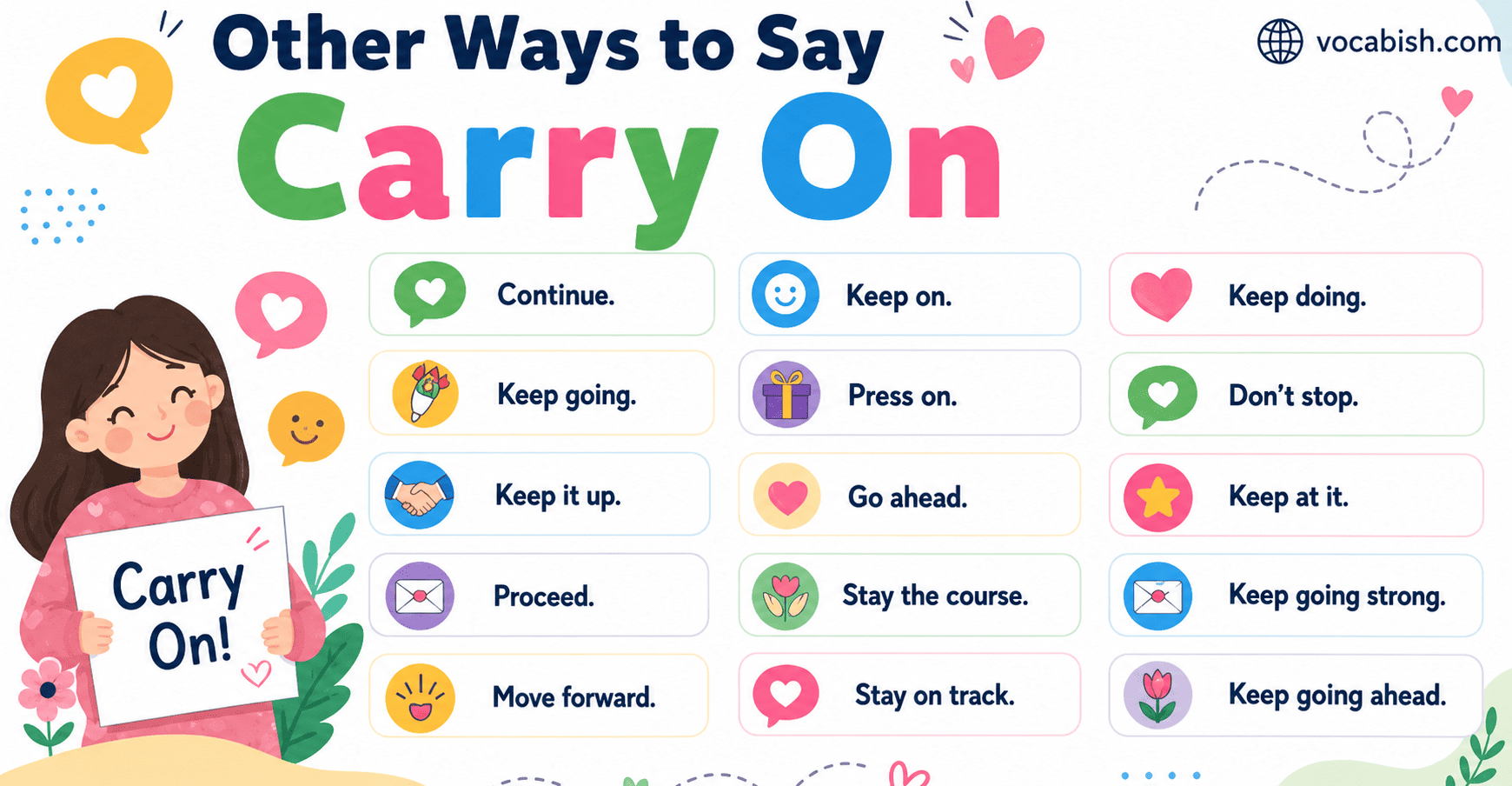

Carry on is a common English phrase used to mean continue or keep going in a situation. In this blog post, you will learn different ways to express this idea with clear meanings and real examples. These phrases are useful in both formal and informal communication. Knowing them helps you sound more natural when you speak or write. It also supports better reading and listening by helping you recognize similar expressions in context.
Carry On Meaning with Examples
The phrase carry on means to continue an action or behavior without stopping.
Example: Please carry on with your work.
It can also mean to behave in an excited or noisy way.
Example: The kids were carrying on during the party.
So, carry on can be used in two main contexts:
- To continue something
- To behave in an emotional or noisy way
Simple Ways to Say “Carry On”
Here are some simple alternatives you can use:
- Keep going
- Continue
- Move forward
- Go ahead
- Persist
- Stick with it
- Maintain
- Push on
- Endure
- Stay the course
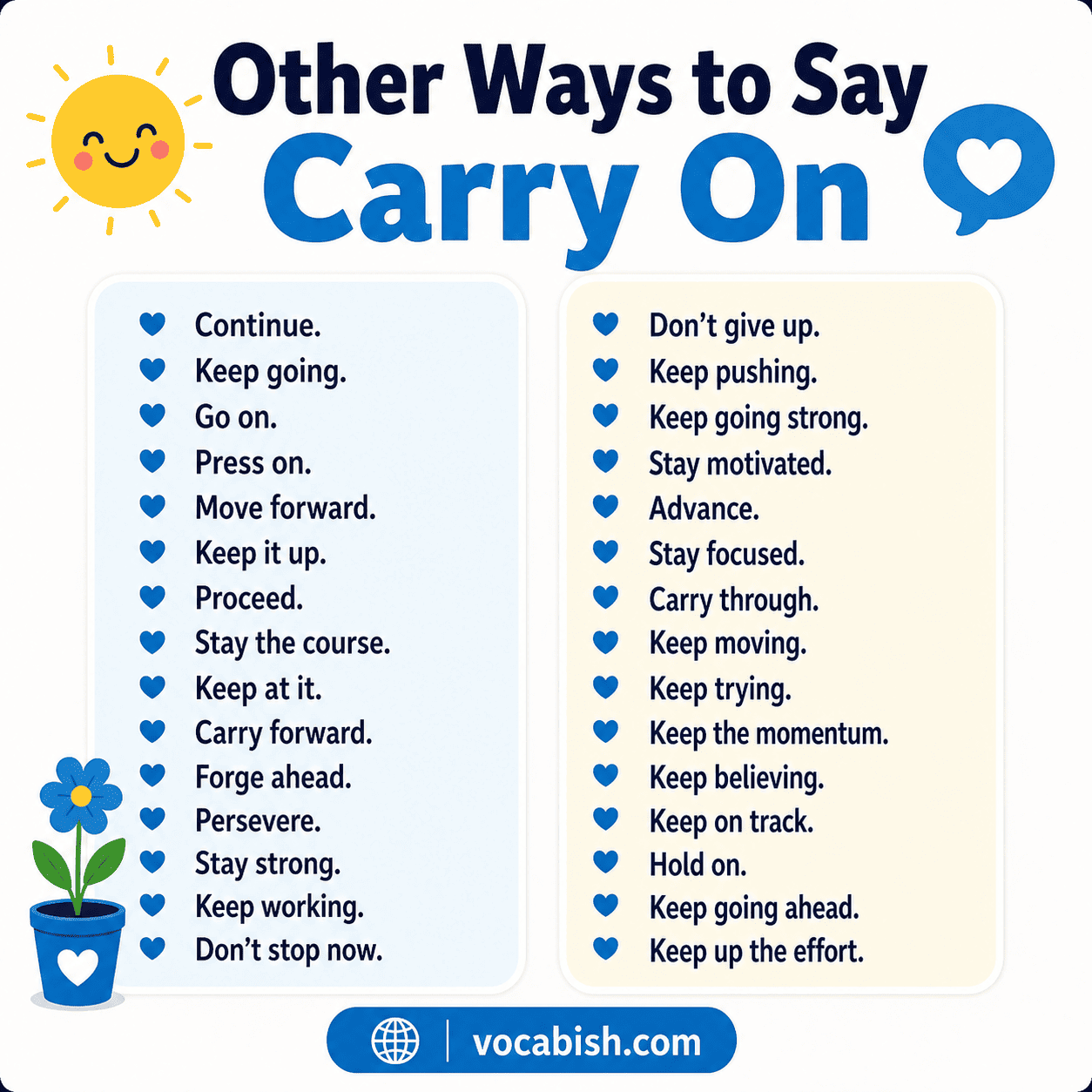
Formal Ways to Say Carry On
Alternative Word/Phrase | Meaning | Example Sentence |
|---|---|---|
Continue | Not stop doing something | You may continue your work. |
Proceed | Move forward with action | Please proceed with the meeting. |
Persist | Keep going despite problems | She persisted with her research. |
Maintain | Keep in the same way | He maintained his efforts until success. |
Informal Ways to Say Carry On
Alternative Word/Phrase | Meaning | Example Sentence |
|---|---|---|
Keep going | Carry on without stopping | Keep going, you are doing great! |
Go ahead | Start or continue freely | Go ahead with your idea. |
Stick with it | Keep trying | Stick with it and don’t give up. |
Push on | Move forward with energy | Let’s push on with the project. |
Academic Ways to Say Carry On
Alternative Word/Phrase | Meaning | Example Sentence |
|---|---|---|
Endure | Continue under stress | The experiment endured for 10 hours. |
Sustain | Keep something going | The study sustained progress over time. |
Advance | Move forward in progress | The research advanced steadily. |
Stay the course | Continue until the end | Students must stay the course of study. |
Contexts of Using Carry On with Examples
Continue an activity
- Carry on with your homework.
- He carried on running despite the rain.
Encourage someone
- Carry on, you’re doing well.
- Please carry on with your story.
Behavior or reaction
- The children carried on loudly during the show.
- She carried on crying after the news.
Frequently Asked Questions
It means to continue doing something.
It can be both. In formal situations, we often use “continue” or “proceed.”
Yes, in informal use it can mean making noise or showing strong emotion.
Words like “persist,” “endure,” or “sustain” are better in academic writing.
In British English, “carry on” is common for ‘continue.’ In American English, people more often use “continue” or “keep going.”
Related Articles: