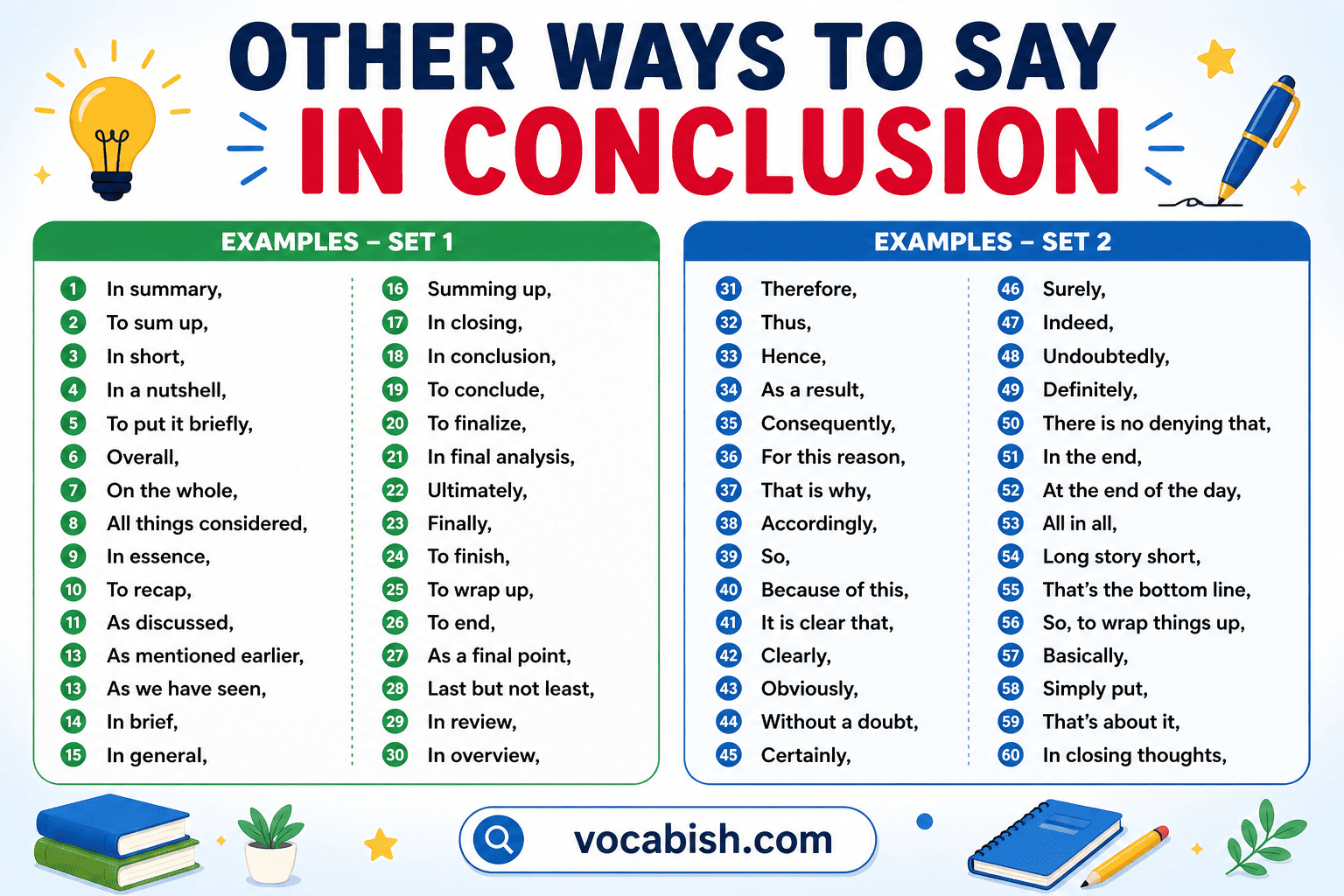

The phrase “In Conclusion” is often used in English to end a speech, essay, or discussion, but there are many ways to say it. Learning different expressions with examples helps you speak, write, and understand English more naturally. In this blog post, you will discover alternatives to “In Conclusion” that make your writing and presentations more professional and engaging. Mastering these phrases improves your communication skills and helps you summarize ideas clearly and effectively.
What Does In Conclusion Mean?
The phrase in conclusion is used when you want to:
- End a speech, essay, or presentation.
- Summarize the main points.
- Give a final thought or decision.
Example: In conclusion, hard work is the key to success.
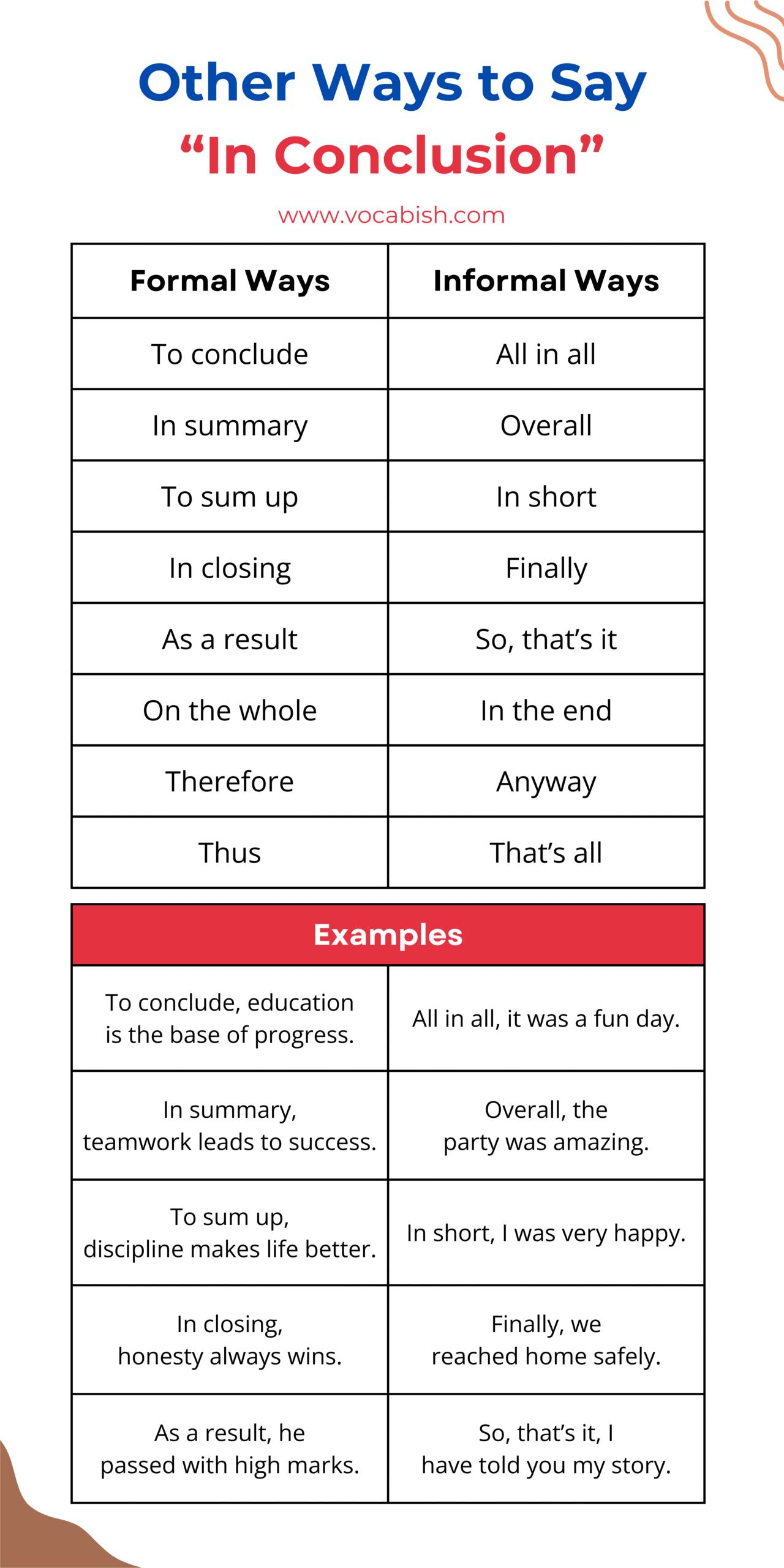
Other Ways to Say In Conclusion
Here are some simple and useful alternatives:
- To sum up
- In summary
- To conclude
- Overall
- Finally
- All in all
- As a result
- In closing
- On the whole
- In short
Formal Ways to Say In Conclusion
These are good for essays, reports, presentations, or academic writing:
- In conclusion
- To conclude
- In summary
- To summarize
- In closing
- In brief
- Overall
- On the whole
- Taking everything into account
- All things considered
Informal Ways to Say In Conclusion
These are better for daily conversation, friendly talks, or casual writing:
- So, yeah
- All in all
- At the end of the day
- Basically
- Long story short
- That’s about it
- In the end
- So, to wrap things up
- That’s the bottom line
- Simply put
Strong Opinion Conclusions
Use when you want to give a clear opinion.
- Clearly
- Obviously
- Without a doubt
- It is clear that
- There is no denying that
- Certainly
- Surely
- Indeed
- Undoubtedly
- Definitely
Summary Based Conclusions
These focus on restating main points.
- To sum up
- In short
- In a nutshell
- To put it briefly
- In brief
- Summing up
- To recap
- As discussed
- As mentioned earlier
- As we have seen
Result Based Conclusions
These show outcomes or results.
- Therefore
- Thus
- Hence
- As a result
- Consequently
- For this reason
- So
- That is why
- Accordingly
- Because of this
List of Ways to Say In Conclusion
- In conclusion
- To conclude
- In summary
- To summarize
- In closing
- Overall
- All in all
- In brief
- In short
- To sum up
- In a nutshell
- To put it briefly
- Summing up
- On the whole
- Taking everything into account
- All things considered
- As a result
- Therefore
- Thus
- Hence
- Consequently
- For this reason
- Accordingly
- Because of this
- So
- Clearly
- Obviously
- Without a doubt
- Certainly
- Surely
- Indeed
- Undoubtedly
- Definitely
- It is clear that
- There is no denying that
- In the end
- At the end of the day
- Long story short
- Basically
- Simply put
- That’s the bottom line
- To wrap things up
- So, yeah
- That’s about it
- To finalize
- As discussed
- As mentioned earlier
- As we have seen
- In essence
- In general
- Ultimately
- Finally
- To finish
- In final analysis
- To conclude briefly
- In closing remarks
- To end
- As a final point
- Last but not least
- In conclusion, therefore
- Briefly speaking
- In total
- In summation
- As a conclusion
- To bring it all together
- To draw to a close
- In wrapping up
- In final thoughts
- As a last remark
- To close
- Ending this discussion
- To end this
- In final words
- Bringing it together
- To conclude finally
- In review
- After everything
- Considering all
- Given these points
- Based on this
- In the final analysis
- To summarize briefly
- As shown above
- From this
- Looking back
- Reflecting on this
- In overview
- To conclude simply
- In simple terms
- To end briefly
- As a summary
- In closing thoughts
- To finalize thoughts
- Wrapping it up
- To conclude clearly
- To sum everything up
- In short conclusion
- Final thoughts
- In conclusion overall
- To conclude the discussion
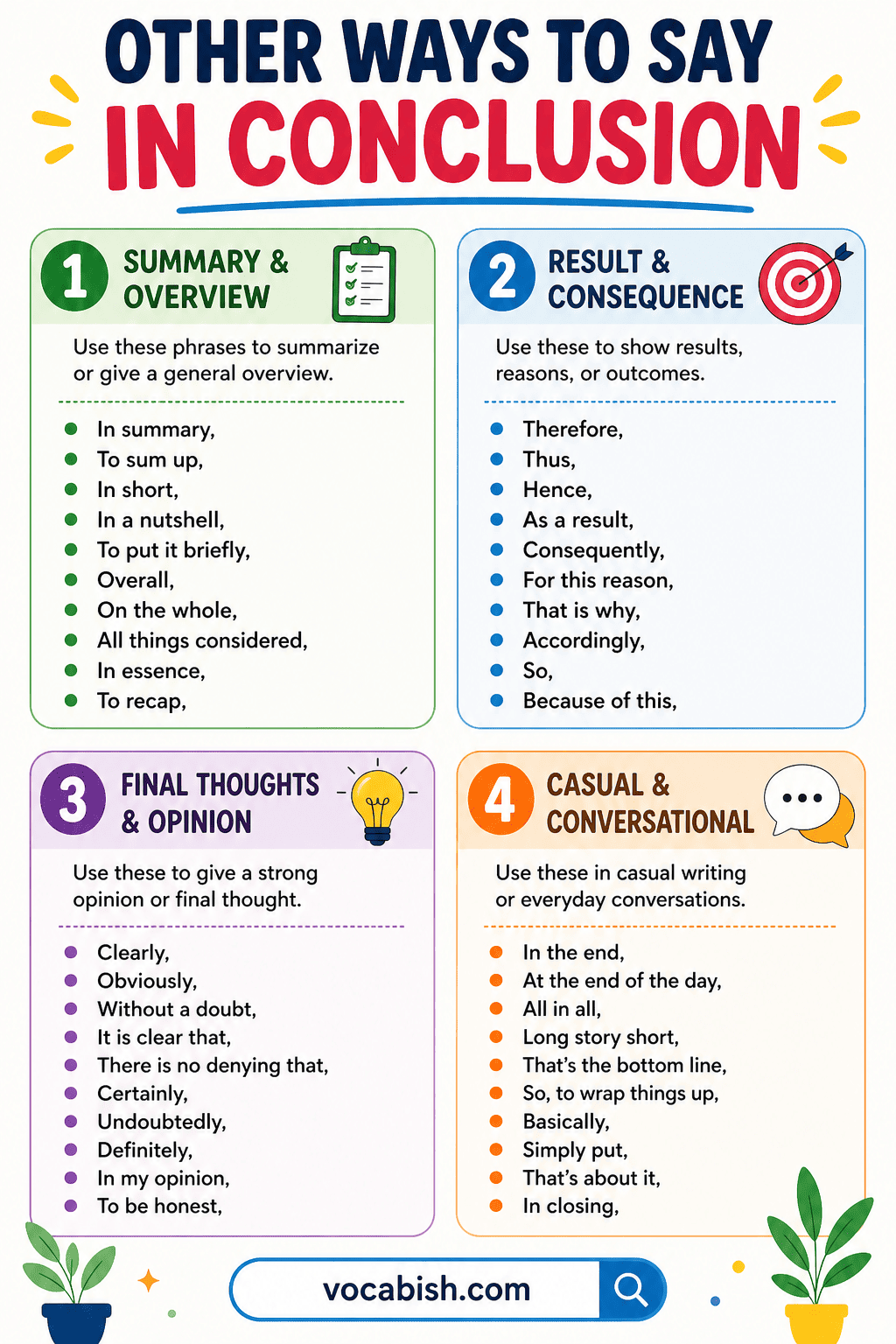
Contexts and Usage of In Conclusion
In Essays or Reports (Formal)
→ In conclusion, global warming is a serious issue.
In Presentations (Formal)
→ To sum up, we need more investment in education.
In Conversations (Informal)
→ All in all, it was the best trip ever.
In Storytelling (Informal)
→ Finally, the hero saved the village.
Example Sentences with Alternatives
- To conclude → To conclude, exercise improves health.
- In summary → In summary, reading builds knowledge.
- All in all → All in all, we enjoyed the picnic.
- Finally → Finally, he finished his project.
- In short → In short, honesty is the best policy.
FAQs about In Conclusion
In conclusion is used to end a discussion or summarize main points. Example: In conclusion, kindness makes the world better.
Formal alternatives include to conclude, in summary, to sum up, in closing, as a result, on the whole.
Informal alternatives include all in all, overall, in short, finally, so that’s it.
Yes, finally can be used in both writing and speaking. Example: Finally, we reached our goal.
The best academic alternatives are to conclude, in summary, to sum up.
Related Articles: