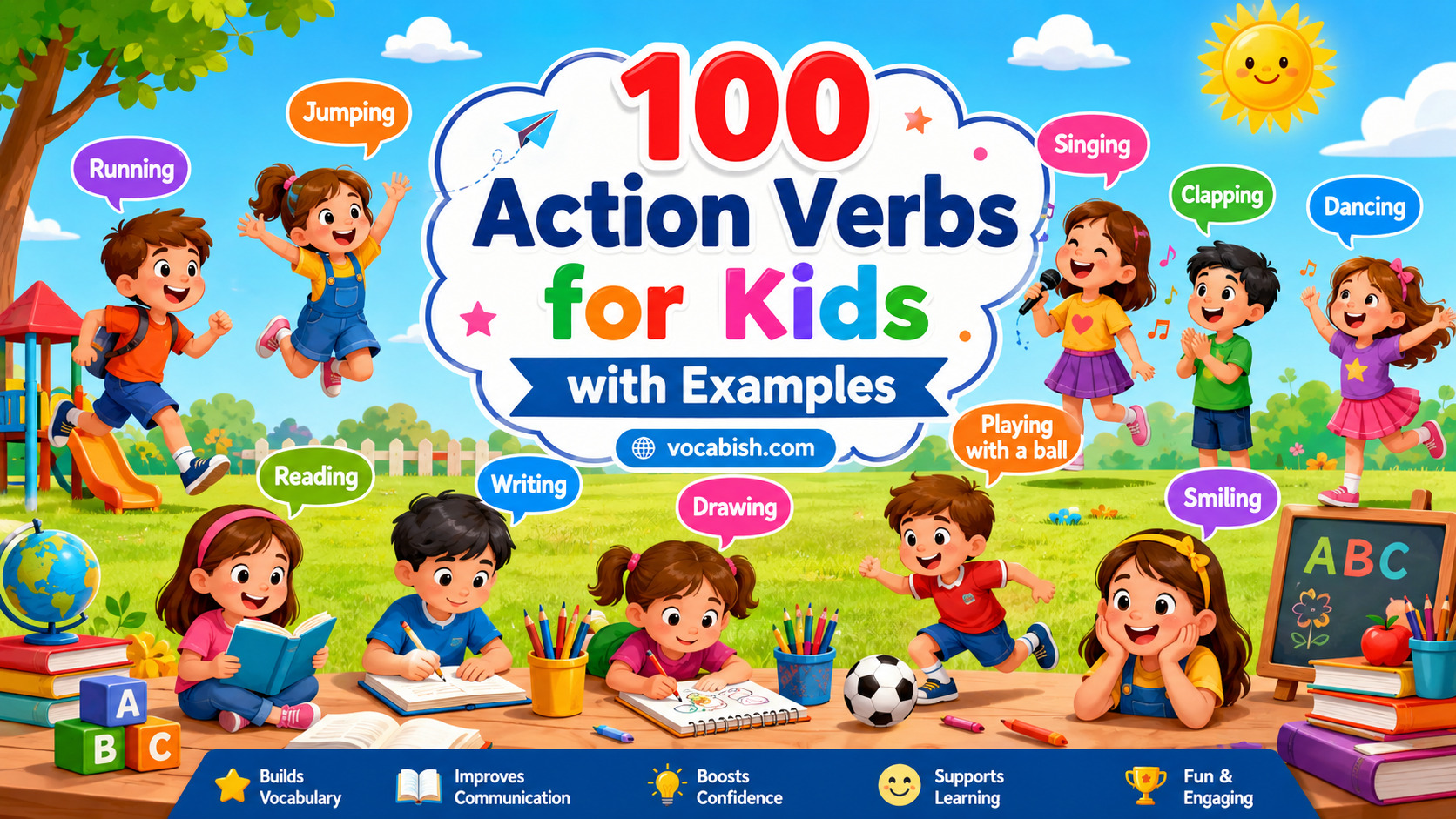

Learning action verbs for kids in English is one of the most exciting steps in building an early vocabulary. Action words bring sentences to life. They show movement, energy, and imagination. Whether a child is running on the playground, reading a book, or building a block tower, an action verb describes exactly what they are doing.
This guide gives parents and teachers a complete list of 100 action words in English, broken down by age and grade level. You can use this list to create flashcards, build an action verbs for kids wordwall, or even print it out as an action verbs for kids pdf for your classroom.
Let’s dive into these fun, energetic words!
What Are Action Verbs?
Simply put, action verbs are “doing words.” They describe physical activities (like jump or run) and mental activities (like think or guess).
If you can do it, it is an action verb. Teaching these words helps young learners form complete sentences, express their feelings, and tell amazing stories. Pairing these words with visual aids to create action verbs for kids with pictures is the best way to make them stick.
Here’s a comprehensive guide on: 200+ Action Verbs List in English
Action Verbs for Kids Class 1 & Early Learners (Preschool to KG)
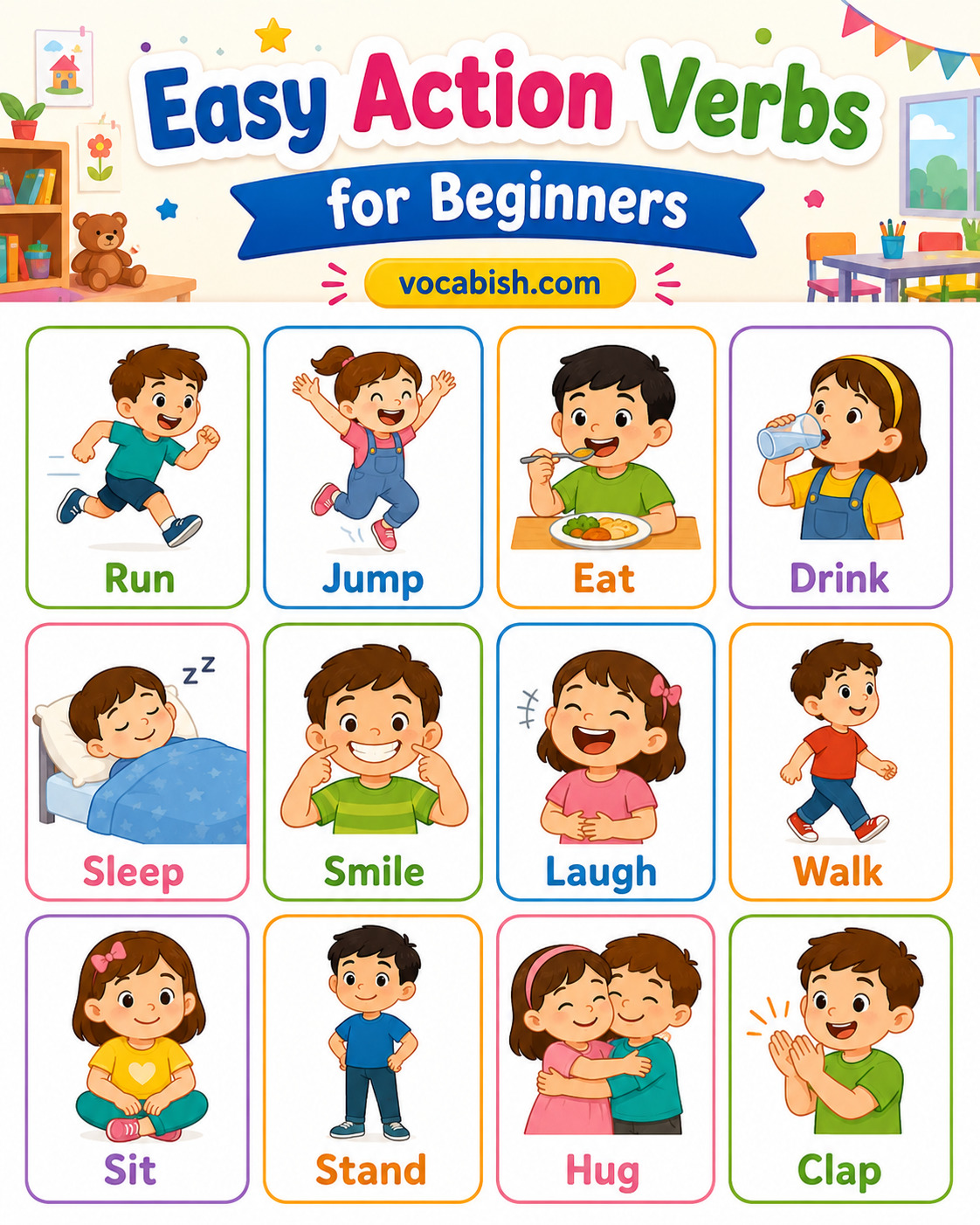
These are the foundation words. These everyday action verbs are perfect for toddlers, preschoolers, and kindergarteners who are just learning to express their daily movements.
- Run: To move very fast on your feet.
Example: I love to run in the park. - Jump: To push yourself up into the air using your legs.
Example: Can you jump over the puddle? - Play: To do things for fun.
Example: We play with blocks after lunch. - Eat: To chew and swallow food.
Example: I eat an apple for a snack. - Drink: To swallow water, milk, or juice.
Example: Please drink your water. - Sleep: To rest with your eyes closed.
Example: The baby will sleep in the crib. - Cry: To let tears fall when you are sad or hurt.
Example: I cry when I scrape my knee. - Smile: To turn up the corners of your mouth because you are happy.
Example: You always smile at funny jokes. - Laugh: To make a happy sound when something is funny.
Example: We laugh at the silly clown. - Walk: To move on your feet at a normal speed.
Example: I walk my dog every morning. - Sit: To rest your body on a chair or the floor.
Example: Please sit on the blue rug. - Stand: To be upright on your feet.
Example: Stand up tall like a tree. - Hug: To hold someone tightly to show love.
Example: I give my mom a big hug. - Kiss: To touch someone with your lips to show love.
Example: Dad gave me a kiss goodnight. - Catch: To grab something that is moving through the air.
Example: Try to catch the red ball! - Throw: To use your arm to send something flying.
Example: Throw the frisbee to me. - Wave: To move your hand back and forth to say hello or goodbye.
Example: Wave goodbye to your friends. - Clap: To hit your hands together to make a sound.
Example: Clap your hands to the music. - Dance: To move your body to music.
Example: We dance at the birthday party. - Sing: To make musical sounds with your voice.
Example: I sing my favorite song loudly.
Action Verbs for Kids Class 2 (School & Play Action Words)
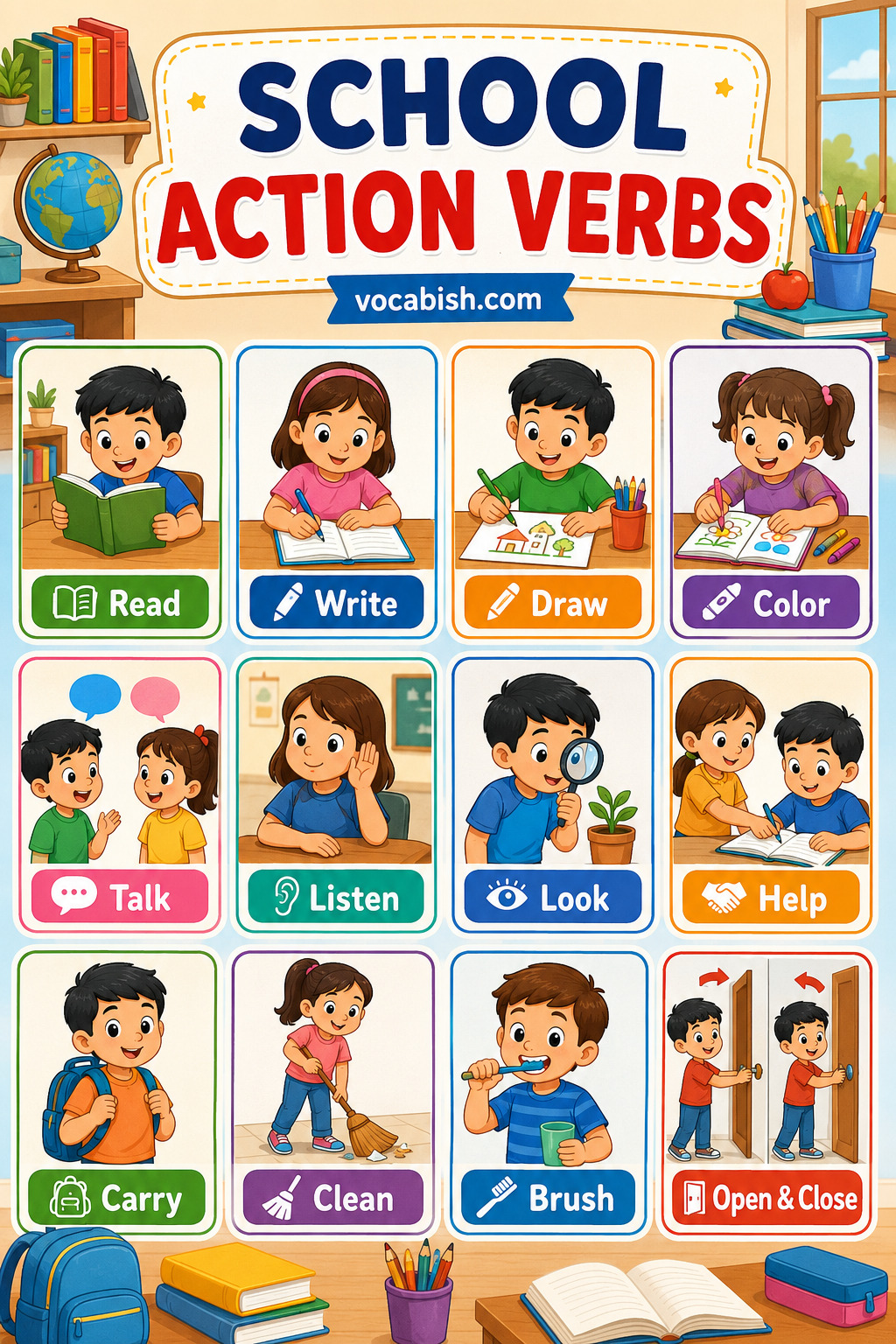
As kids enter first and second grade, their vocabulary expands. They need action words to describe school activities, chores, and playground games. This list is great for generating an action verbs for kids worksheet.
- Read: To look at words and understand what they mean.
Example: I read a book about dinosaurs. - Write: To make letters and words using a pencil or pen.
Example: I write my name on the paper. - Draw: To make a picture using crayons or pencils.
Example: I draw a picture of a house. - Color: To fill a picture with different shades and hues.
Example: Color the sun bright yellow. - Talk: To say words out loud to someone else.
Example: I talk to my best friend on the phone. - Listen: To pay attention to sounds or someone speaking.
Example: Listen to the teacher’s instructions. - Look: To direct your eyes toward something.
Example: Look at that beautiful butterfly! - See: To notice something with your eyes.
Example: Do you see the airplane in the sky? - Help: To make something easier for someone else.
Example: I help my dad wash the car. - Share: To let someone else use something you have.
Example: I share my toys with my sister. - Open: To move something so you can get inside.
Example: Open the door for the dog. - Close: To shut something.
Example: Close the window because it is cold. - Push: To use force to move something away from you.
Example: Push the swing higher! - Pull: To use force to bring something toward you.
Example: Pull the wagon up the hill. - Wash: To clean something using water and soap.
Example: Wash your hands before dinner. - Clean: To make something neat and tidy.
Example: It is time to clean your bedroom. - Brush: To smooth your hair or clean your teeth.
Example: I brush my teeth every night. - Comb: To untangle your hair using a plastic tool.
Example: Comb your hair before school. - Kick: To hit something using your foot.
Example: Kick the soccer ball into the net. - Hop: To jump lightly on one foot.
Example: A bunny can hop across the grass.
Action Verbs for Kids Class 3 (Exploration & Movement)
By the third grade, kids are becoming more independent. These verbs describe exploring the world, engaging in sports, and discovering new things.
- Build: To make something by putting pieces together.
Example: We build a giant sandcastle. - Climb: To go up something using your hands and feet.
Example: I want to climb the big oak tree. - Swim: To move through water using your arms and legs.
Example: I swim in the pool all summer. - Ride: To travel on a bike, horse, or in a car.
Example: I ride my bike to the park. - Drive: To control a car or truck.
Example: Mom will drive us to the grocery store. - Fly: To move through the air like a bird or plane.
Example: The bird will fly to its nest. - Hide: To put yourself somewhere so no one can see you.
Example: Hide behind the big couch. - Seek: To look for something or someone.
Example: We play hide and seek in the yard. - Find: To discover something you were looking for.
Example: I finally find my missing shoe. - Lose: To misplace something so you cannot find it.
Example: Try not to lose your jacket. - Drop: To let something fall to the ground.
Example: Be careful not to drop the glass. - Pick: To take hold of something and pull it up.
Example: Let’s pick fresh strawberries. - Hold: To carry something in your hands.
Example: Hold my hand when we cross the street. - Carry: To move something from one place to another.
Example: I carry my heavy backpack to school. - Bring: To take someone or something with you.
Example: Bring your umbrella just in case. - Take: To reach for something and make it yours.
Example: Take a cookie from the jar. - Give: To hand something to someone else.
Example: Give this letter to your teacher. - Show: To let someone see something.
Example: Show me your new drawing. - Tell: To speak information to someone.
Example: Tell me a bedtime story. - Ask: To request an answer to a question.
Example: Ask the teacher if you need help.
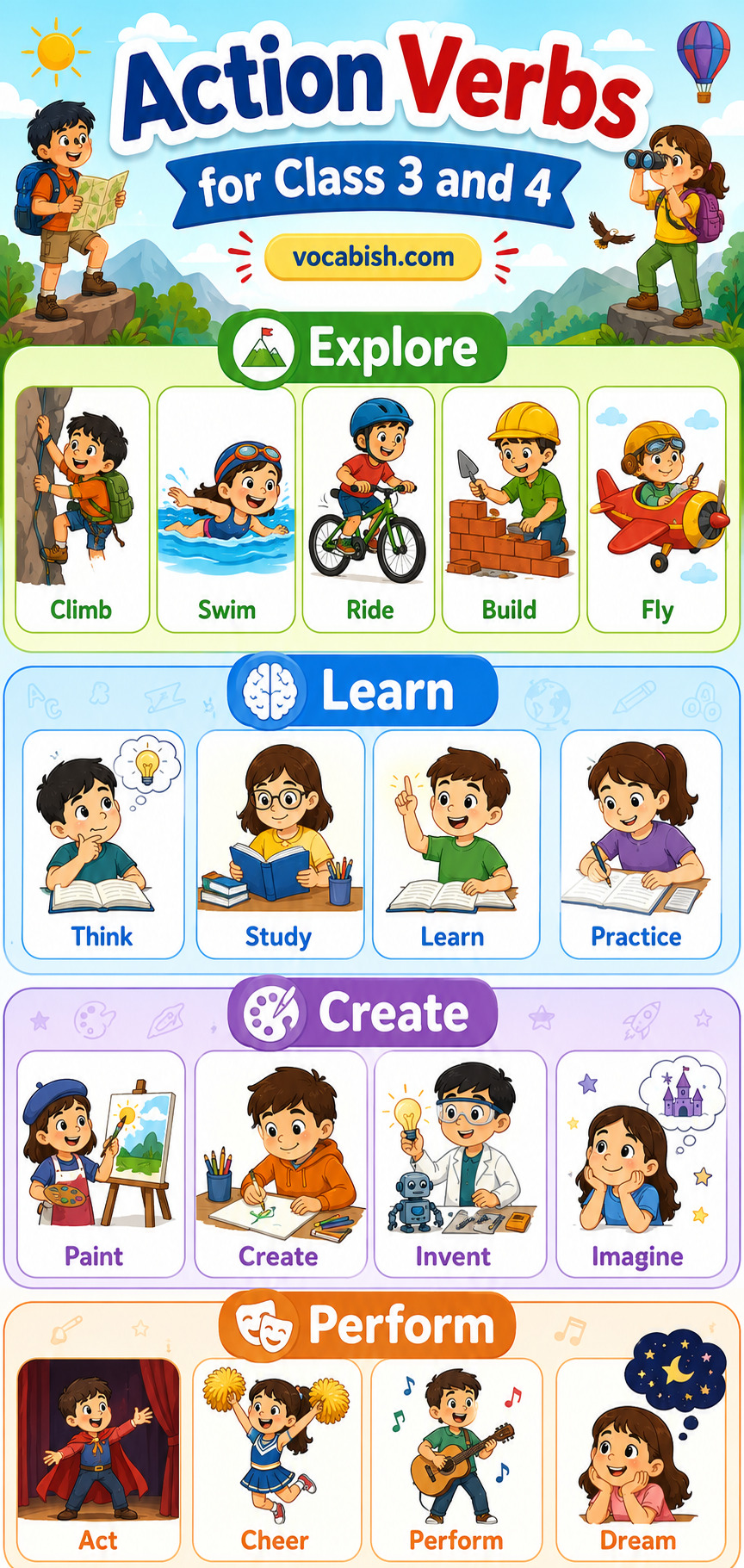
Action Verbs for Kids Class 4 (Expressive & Creative Words)
Older children need richer vocabulary to describe how they think, create, and feel. These words are fantastic for creative writing assignments.
- Answer: To reply to a question.
Example: Raise your hand to answer the math problem. - Guess: To try giving an answer when you are not completely sure.
Example: Can you guess how many jellybeans are in the jar? - Think: To use your brain to form ideas.
Example: I need a minute to think about the puzzle. - Know: To have information firmly in your mind.
Example: I know all the words to that song. - Learn: To gain new knowledge or a new skill.
Example: We learn about planets in science class. - Study: To spend time reading and practicing to learn.
Example: I study for my spelling test every Tuesday. - Practice: To do something over and over to get better.
Example: You must practice the piano every day. - Try: To make an effort to do something hard.
Example: Always try your best on the test. - Win: To come in first place in a game or race.
Example: Our team hopes to win the soccer championship. - Fail: To not succeed at something on the first try.
Example: It is okay to fail as long as you try again. - Score: To earn a point in a game.
Example: He kicked the ball to score the winning goal. - Cheer: To shout loudly to show support or happiness.
Example: The crowd will cheer when the parade starts. - Paint: To put color on paper or canvas using a brush.
Example: I paint a picture of a starry night. - Create: To make something brand new.
Example: Use the clay to create a little monster. - Invent: To design or build something that never existed before.
Example: She wants to invent a flying car. - Imagine: To form a picture or story in your mind.
Example: Imagine you are exploring deep space. - Dream: To see pictures and stories in your mind while sleeping.
Example: I dream about riding a dragon. - Pretend: To act like something is real when it is not.
Example: Let’s pretend we are brave pirates. - Act: To perform a role in a play or movie.
Example: I will act like a king in the school play. - Perform: To show a talent like singing or magic to an audience.
Example: The magician will perform a great trick.
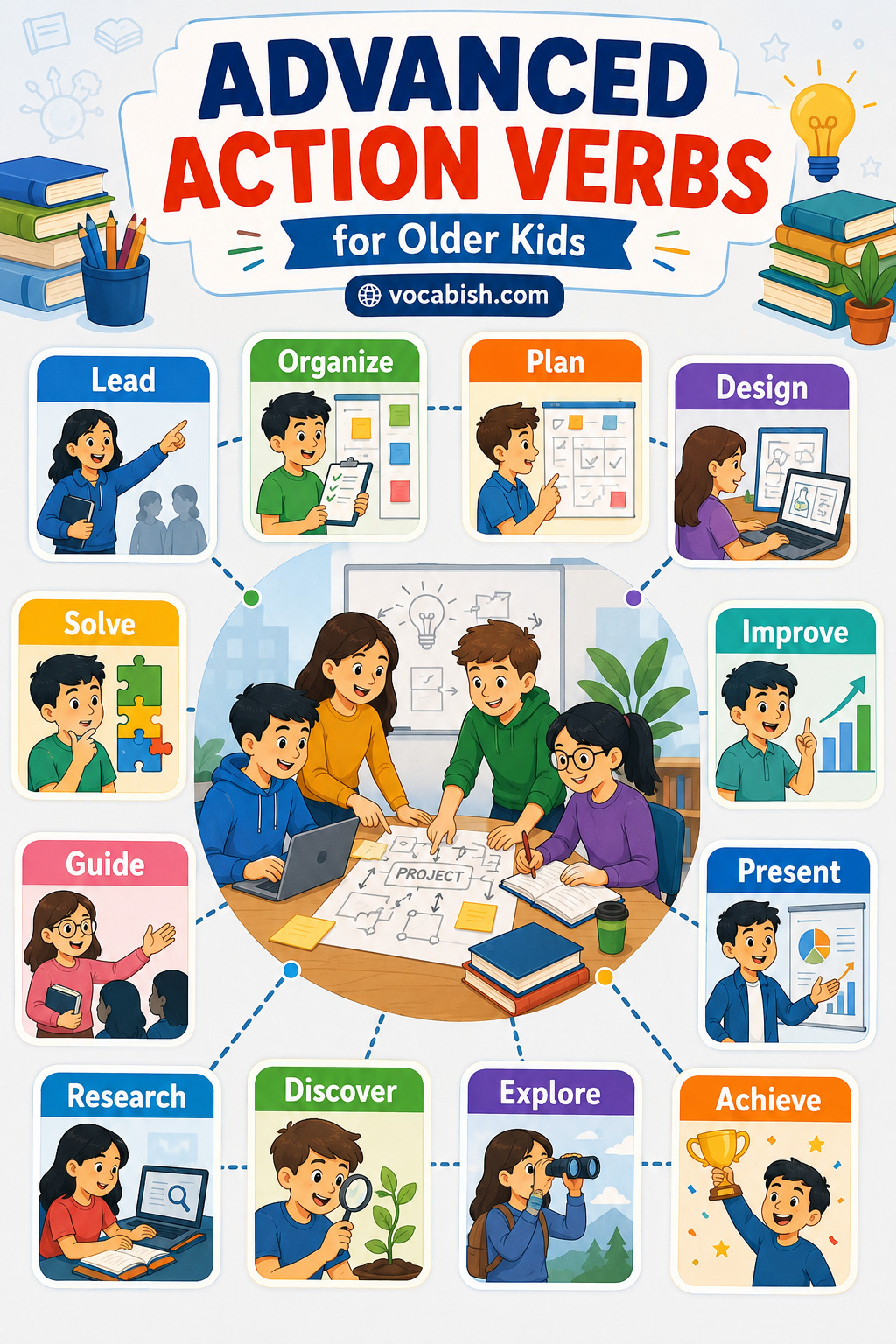
Advanced Action Words (For Older Kids & Future Resumes)
As kids transition into middle school and beyond, they begin developing leadership and project skills. These strong action verbs are not only great for school essays but are exactly the type of action words used for resumes when kids eventually apply for their first jobs or college programs.
- Lead: To guide a group of people.
Example: She will lead the group project for science class. - Organize: To put things in a neat and logical order.
Example: I organize my desk so I can find my pencils. - Plan: To decide how to do something before you actually do it.
Example: We plan the surprise party for Friday. - Design: To draw or plan how something will look and work.
Example: I design a new logo for our club. - Solve: To find the answer to a problem.
Example: We solve the tricky math puzzle together. - Fix: To repair something that is broken.
Example: Dad helped me fix my flat bicycle tire. - Improve: To make something better than it was before.
Example: Reading every day will improve your vocabulary. - Support: To help someone or hold something up.
Example: Good friends always support each other. - Guide: To show someone the right way to go or do something.
Example: The ranger will guide us through the forest. - Manage: To take care of and control a task or group.
Example: He can manage the school store during lunch. - Present: To show and explain something to an audience.
Example: I will present my science fair project tomorrow. - Research: To study a topic carefully to find facts.
Example: We research ocean animals in the library. - Discover: To find something new or hidden.
Example: The explorers discover a hidden cave. - Explore: To travel through a new place to learn about it.
Example: Let’s explore the woods behind the house. - Compare: To look at two things to see how they are alike or different.
Example: Compare the two apples to see which is bigger. - Decide: To make a final choice about something.
Example: I must decide which flavor of ice cream to get. - Focus: To put all your attention on one thing.
Example: You need to focus on your homework right now. - Achieve: To successfully reach a goal through hard work.
Example: If you practice, you will achieve your dreams. - Complete: To finish all parts of a task.
Example: Make sure you complete your chores before playing. - Construct: To build something large, like a building or model.
Example: We construct a tall bridge using wooden popsicle sticks.
Fun Action Verbs for Kids Games
You don’t have to just read this list—you can play with it! Here are a few action verbs for kids games to make learning these 100 verbs a blast:
- Simon Says: This classic game requires kids to listen for the action verb. “Simon says touch your nose!” or “Simon says hop on one foot!”
- Verb Charades: Write down words from the 100 action verbs for kids list on slips of paper. Have a child pick one and silently act it out while the others guess the verb.
- Action Freeze Dance: Play music and call out an action verb (like dance, swim, or crawl). The kids must do the action while the music plays, and completely freeze when the music stops.
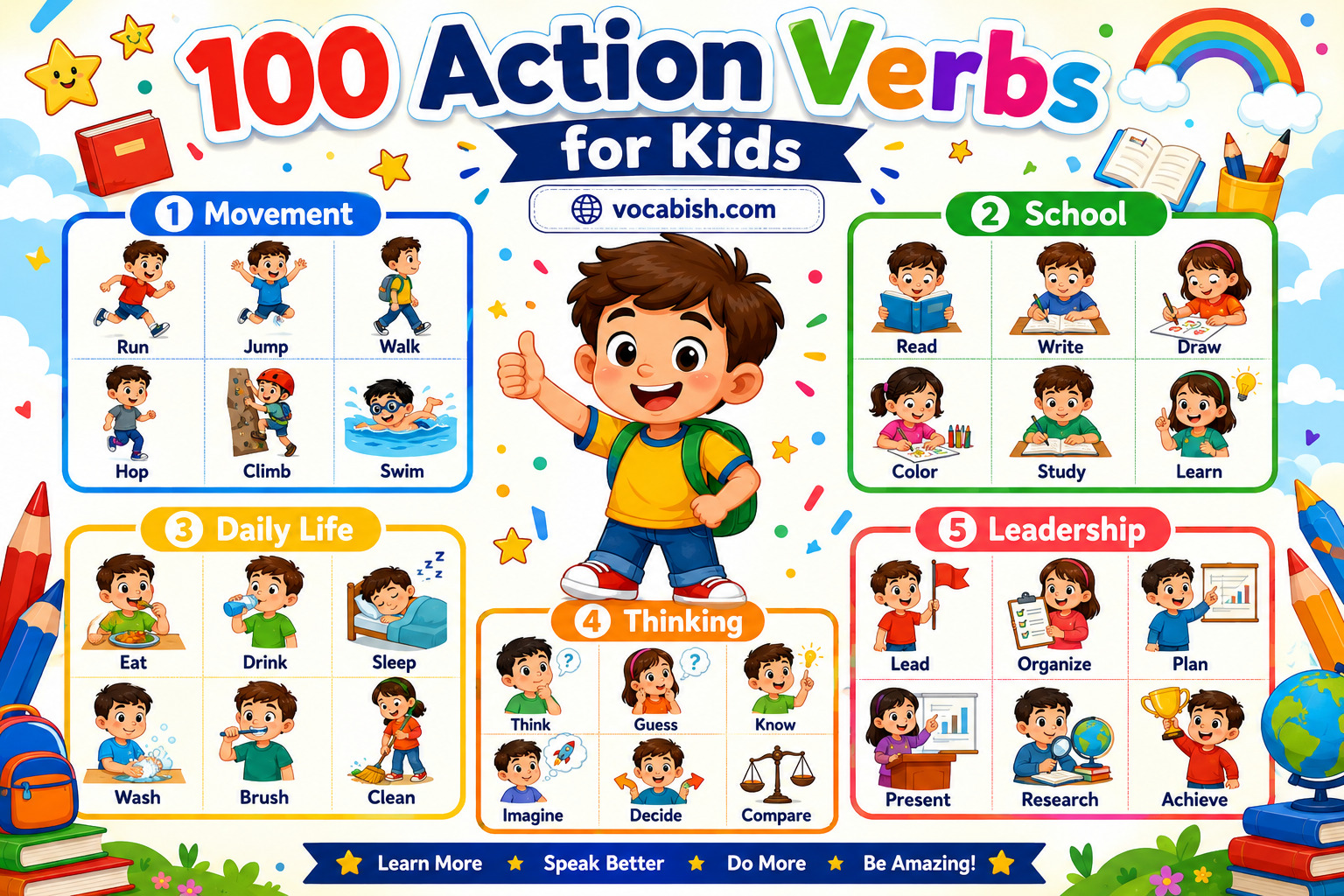
Using these 100 action words in English actively throughout the day ensures that kids truly understand the meaning behind the vocabulary. Encourage them to find action words in the books they read and use them in the stories they write!
Download PDF of Action Verbs for Kids
FAQs About Action Verbs for Kids
An action verb is a doing word that describes physical or mental movements, like running, jumping, thinking, or playing outside.
Tell your child that action words describe anything they can actively do, like jumping, clapping hands, singing songs, or eating food.
Ten very simple examples of action verbs include run, jump, play, eat, sleep, smile, talk, read, write, and catch a ball.
Learning these important words helps young children build complete sentences, express their big emotions clearly, and tell amazing, descriptive daily stories.
Parents can easily teach these energetic words by playing fun movement games like Simon Says, charades, or doing interactive freeze dances.
Kindergarten students should focus on basic physical movements like walk, sit, stand, hug, kiss, catch, throw, wave, laugh, and smile daily.
Yes, action words are simply a helpful term used to describe action verbs, which show physical movements or unseen mental activities.
Explore More Kids Learning Lessons
- 100 Basic English Words and Meanings for Kids
- Body Parts for Kids in English with Labelled Diagram
- Chores for Kids in English with Definitions and Chart
- Family Tree for Kids with Worksheet and PDF
- 150 Sentences for Kids in English for Daily Use with PDF
- Table Manners for Kids: Learn Good Eating Habits
- 100 Easy Riddles for Kids with Answers and PDF