
Learning English becomes much easier when children start with simple and commonly used words. These words are part of everyday life and are often heard at school, at home, during games, and in daily conversations with friends and family. When children learn easy words first, they feel more confident while speaking, reading, and understanding English.
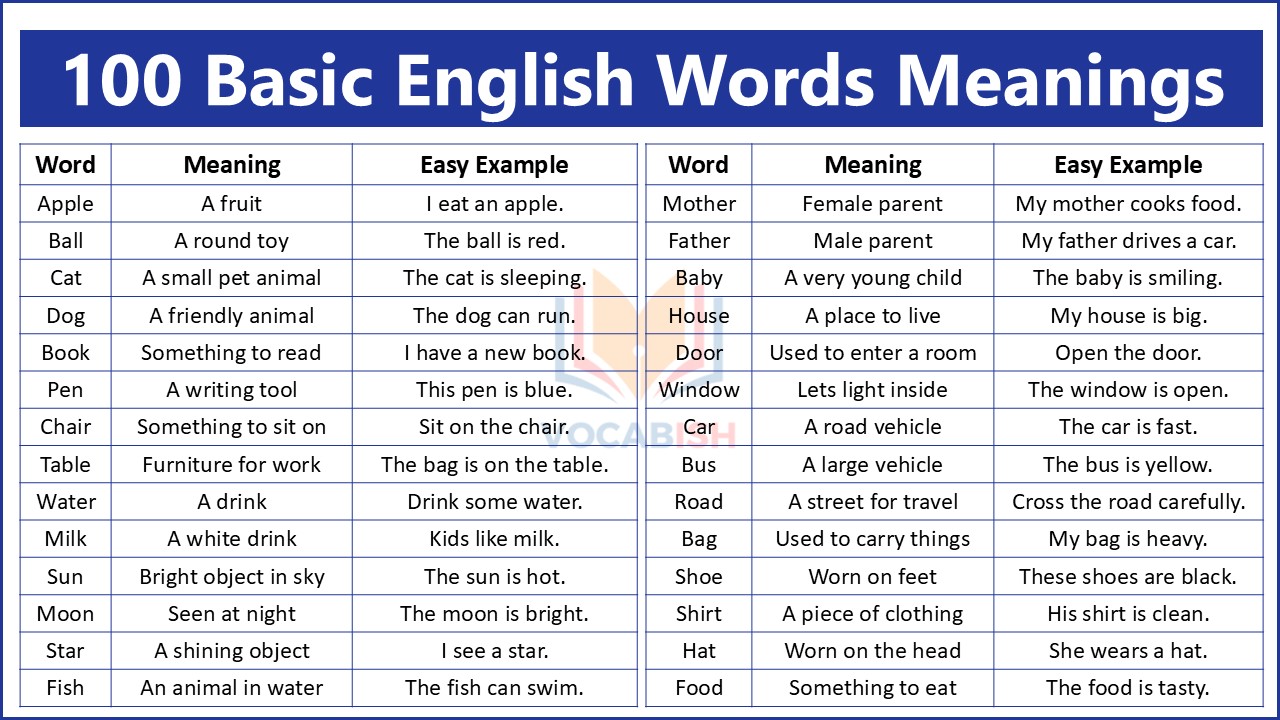
This blog post includes 100 basic English words with short meanings and simple examples to help young learners improve their vocabulary step by step. Each word is explained in an easy way so children can learn quickly and use the words in daily communication without difficulty.
What Are Basic English Words?
Basic English words are the common words people use in daily conversation. These words help kids:
- Speak clearly
- Read simple books
- Understand lessons
- Build strong vocabulary
These words are used in many places such as:
- School conversations
- Family talks
- Games and activities
- Simple writing tasks
Why Should Kids Learn Basic English Words?
Learning easy English words helps children become more confident.
- Better speaking skills
- Easy reading practice
- Strong vocabulary growth
- Clear communication with others
Kids can also understand stories, cartoons, songs, and classroom lessons more easily.
100 Basic English Words for Kids
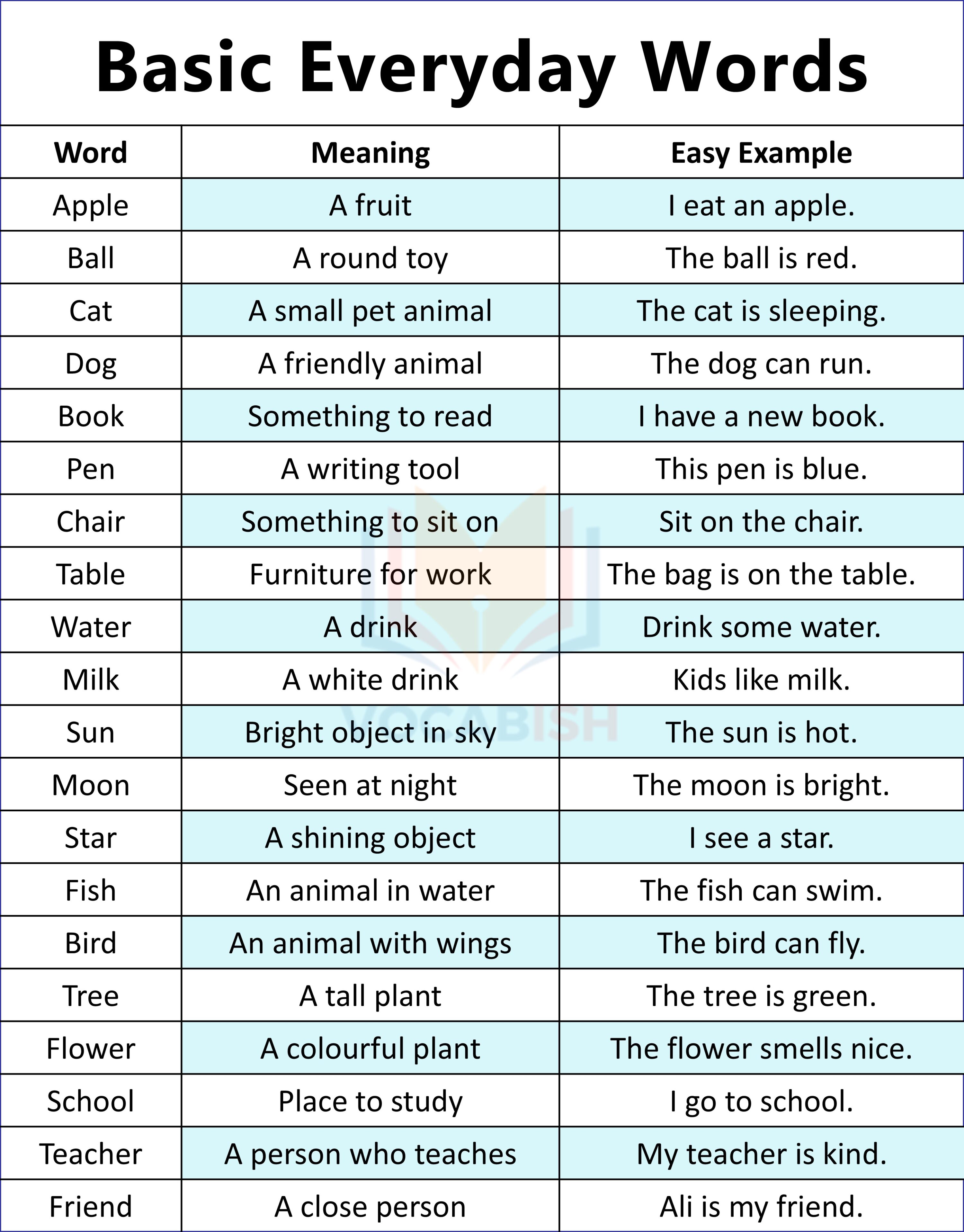
Basic Everyday Words for Kids
Word | Meaning | Easy Example |
|---|---|---|
Apple | A fruit | I eat an apple. |
Ball | A round toy | The ball is red. |
Cat | A small pet animal | The cat is sleeping. |
Dog | A friendly animal | The dog can run. |
Book | Something to read | I have a new book. |
Pen | A writing tool | This pen is blue. |
Chair | Something to sit on | Sit on the chair. |
Table | Furniture for work | The bag is on the table. |
Water | A drink | Drink some water. |
Milk | A white drink | Kids like milk. |
Sun | Bright object in sky | The sun is hot. |
Moon | Seen at night | The moon is bright. |
Star | A shining object | I see a star. |
Fish | An animal in water | The fish can swim. |
Bird | An animal with wings | The bird can fly. |
Tree | A tall plant | The tree is green. |
Flower | A colourful plant | The flower smells nice. |
School | Place to study | I go to school. |
Teacher | A person who teaches | My teacher is kind. |
Friend | A close person | Ali is my friend. |
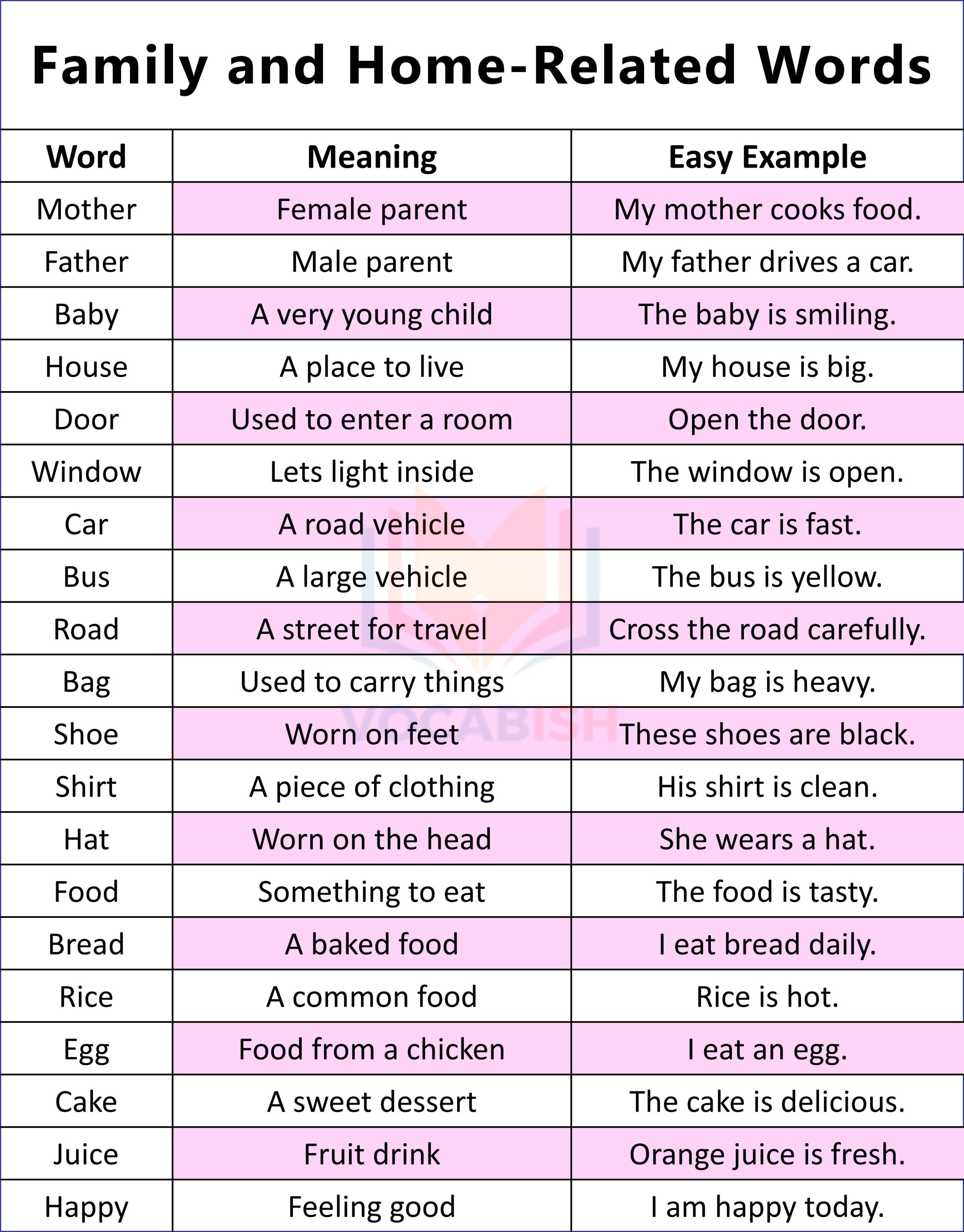
Family and Home-Related Words for Kids
Word | Meaning | Easy Example |
|---|---|---|
Mother | Female parent | My mother cooks food. |
Father | Male parent | My father drives a car. |
Baby | A very young child | The baby is smiling. |
House | A place to live | My house is big. |
Door | Used to enter a room | Open the door. |
Window | Lets light inside | The window is open. |
Car | A road vehicle | The car is fast. |
Bus | A large vehicle | The bus is yellow. |
Road | A street for travel | Cross the road carefully. |
Bag | Used to carry things | My bag is heavy. |
Shoe | Worn on feet | These shoes are black. |
Shirt | A piece of clothing | His shirt is clean. |
Hat | Worn on the head | She wears a hat. |
Food | Something to eat | The food is tasty. |
Bread | A baked food | I eat bread daily. |
Rice | A common food | Rice is hot. |
Egg | Food from a chicken | I eat an egg. |
Cake | A sweet dessert | The cake is delicious. |
Juice | Fruit drink | Orange juice is fresh. |
Happy | Feeling good | I am happy today. |
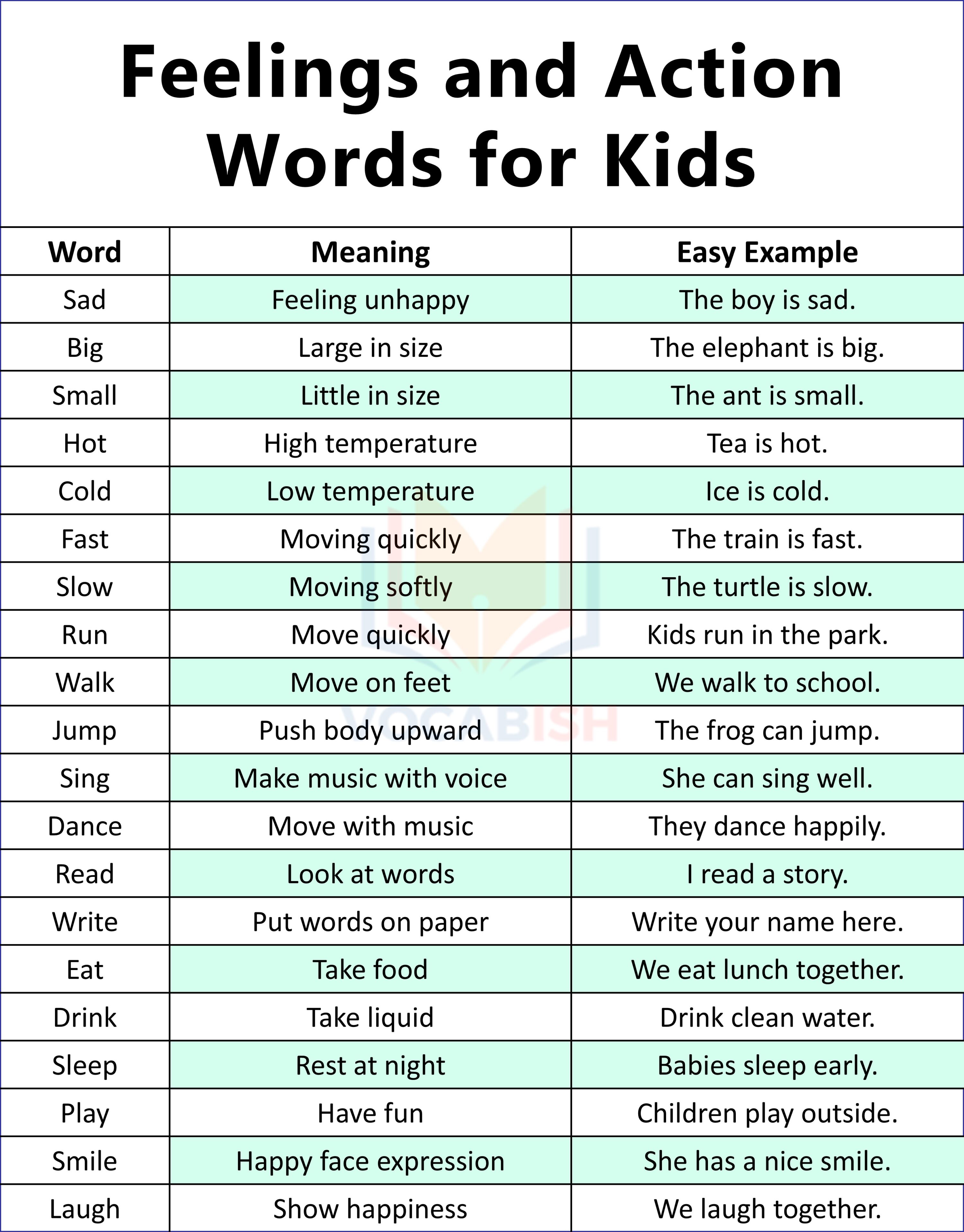
Feelings and Action Words for Kids
Word | Meaning | Easy Example |
|---|---|---|
Sad | Feeling unhappy | The boy is sad. |
Big | Large in size | The elephant is big. |
Small | Little in size | The ant is small. |
Hot | High temperature | Tea is hot. |
Cold | Low temperature | Ice is cold. |
Fast | Moving quickly | The train is fast. |
Slow | Moving softly | The turtle is slow. |
Run | Move quickly | Kids run in the park. |
Walk | Move on feet | We walk to school. |
Jump | Push body upward | The frog can jump. |
Sing | Make music with voice | She can sing well. |
Dance | Move with music | They dance happily. |
Read | Look at words | I read a story. |
Write | Put words on paper | Write your name here. |
Eat | Take food | We eat lunch together. |
Drink | Take liquid | Drink clean water. |
Sleep | Rest at night | Babies sleep early. |
Play | Have fun | Children play outside. |
Smile | Happy face expression | She has a nice smile. |
Laugh | Show happiness | We laugh together. |
Related Resources: 100 Action Verbs for Kids with PDF
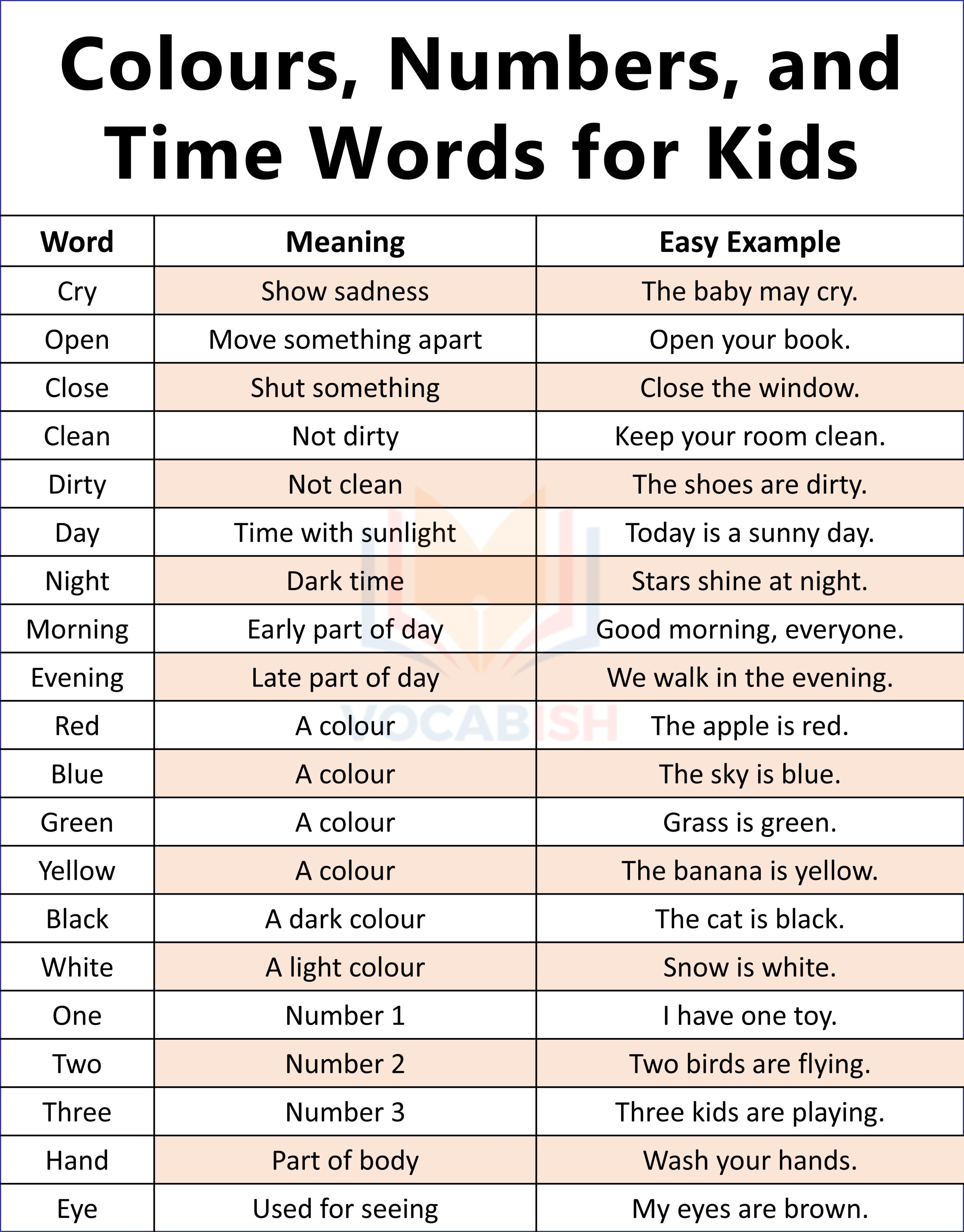
Colours, Numbers, and Time Words for Kids
Word | Meaning | Easy Example |
|---|---|---|
Cry | Show sadness | The baby may cry. |
Open | Move something apart | Open your book. |
Close | Shut something | Close the window. |
Clean | Not dirty | Keep your room clean. |
Dirty | Not clean | The shoes are dirty. |
Day | Time with sunlight | Today is a sunny day. |
Night | Dark time | Stars shine at night. |
Morning | Early part of day | Good morning, everyone. |
Evening | Late part of day | We walk in the evening. |
Red | A colour | The apple is red. |
Blue | A colour | The sky is blue. |
Green | A colour | Grass is green. |
Yellow | A colour | The banana is yellow. |
Black | A dark colour | The cat is black. |
White | A light colour | Snow is white. |
One | Number 1 | I have one toy. |
Two | Number 2 | Two birds are flying. |
Three | Number 3 | Three kids are playing. |
Hand | Part of body | Wash your hands. |
Eye | Used for seeing | My eyes are brown. |
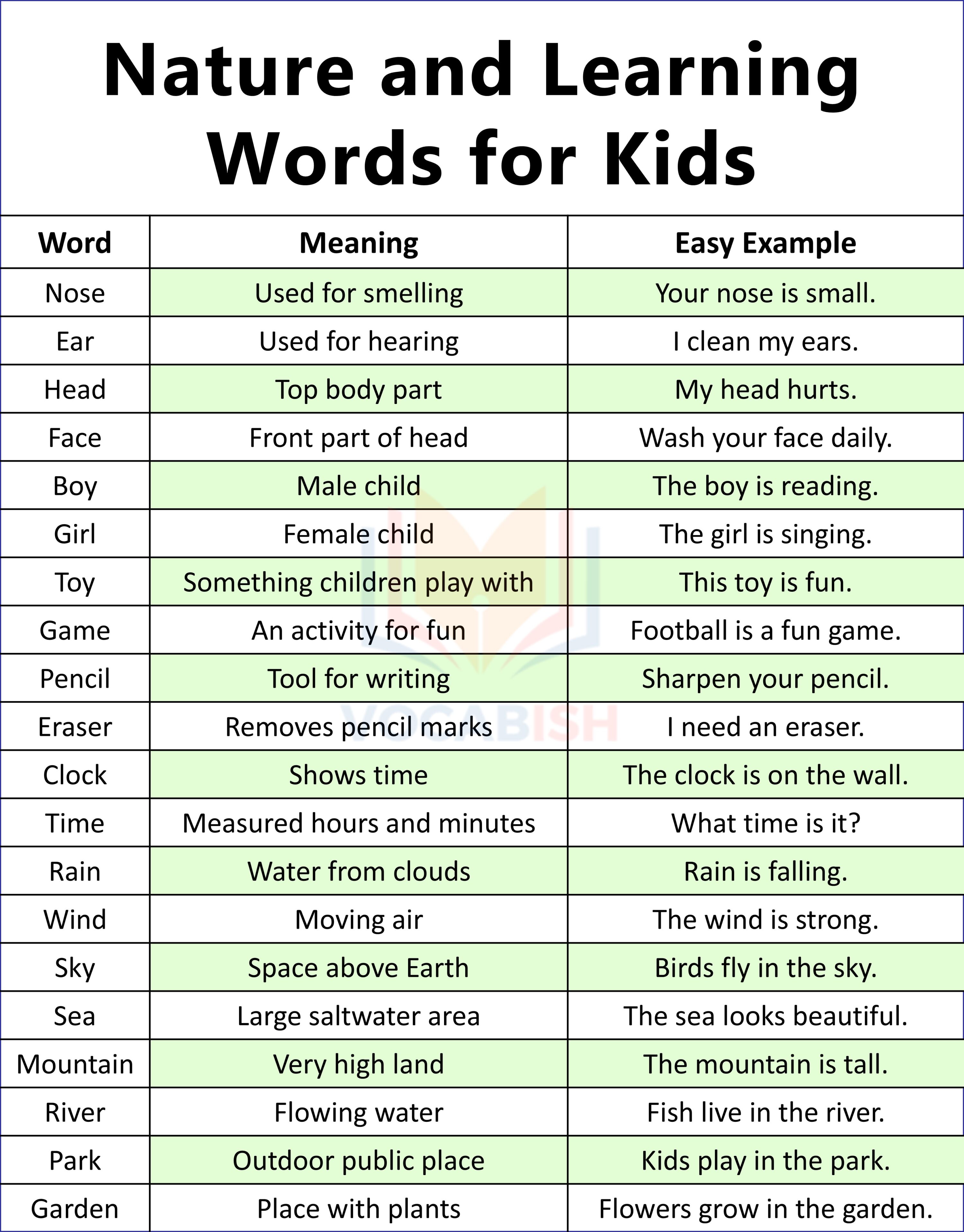
Nature and Learning Words for Kids
Word | Meaning | Easy Example |
|---|---|---|
Nose | Used for smelling | Your nose is small. |
Ear | Used for hearing | I clean my ears. |
Head | Top body part | My head hurts. |
Face | Front part of head | Wash your face daily. |
Boy | Male child | The boy is reading. |
Girl | Female child | The girl is singing. |
Toy | Something children play with | This toy is fun. |
Game | An activity for fun | Football is a fun game. |
Pencil | Tool for writing | Sharpen your pencil. |
Eraser | Removes pencil marks | I need an eraser. |
Clock | Shows time | The clock is on the wall. |
Time | Measured hours and minutes | What time is it? |
Rain | Water from clouds | Rain is falling. |
Wind | Moving air | The wind is strong. |
Sky | Space above Earth | Birds fly in the sky. |
Sea | Large saltwater area | The sea looks beautiful. |
Mountain | Very high land | The mountain is tall. |
River | Flowing water | Fish live in the river. |
Park | Outdoor public place | Kids play in the park. |
Garden | Place with plants | Flowers grow in the garden. |
Easy Ways to Remember English Words
- Read words every day
- Speak words loudly
- Write words in a notebook
- Watch English cartoons
- Use words in sentences
These activities make learning fast and fun.
Using Basic Words in Different Contexts
Some words can be used in different ways in English.
“Play” in different contexts:
- Play a game
- Play football
- Play music
“Run” in different contexts:
- Run fast
- Run a race
- Run to school
“Light” in different contexts:
- Turn on the light
- A light bag
- Light colours
Learning these simple contexts helps kids understand English better.
Download PDF
Basic English words are very important for children and beginners. These words improve daily speaking, easy reading, and simple writing skills. By learning a few words every day, kids can become more confident in English.
FAQs About English Words for Kids
Basic English words for kids are simple and commonly used words that help children speak, read, write, and understand English more easily in daily life.
Learning basic English vocabulary improves communication skills, helps children understand school lessons, and builds confidence in speaking and reading.
Kids can remember English words by reading daily, speaking simple sentences, writing words in notebooks, and using them in everyday conversations.
Easy English words for beginners include common daily words such as apple, book, cat, dog, water, school, friend, happy, play, and house.
Kids should first learn around 100 simple English words to improve vocabulary and understand basic conversations and classroom activities.
Yes, learning basic English words helps children make simple sentences, speak clearly, and communicate better with teachers, friends, and family members.
Related Articles: