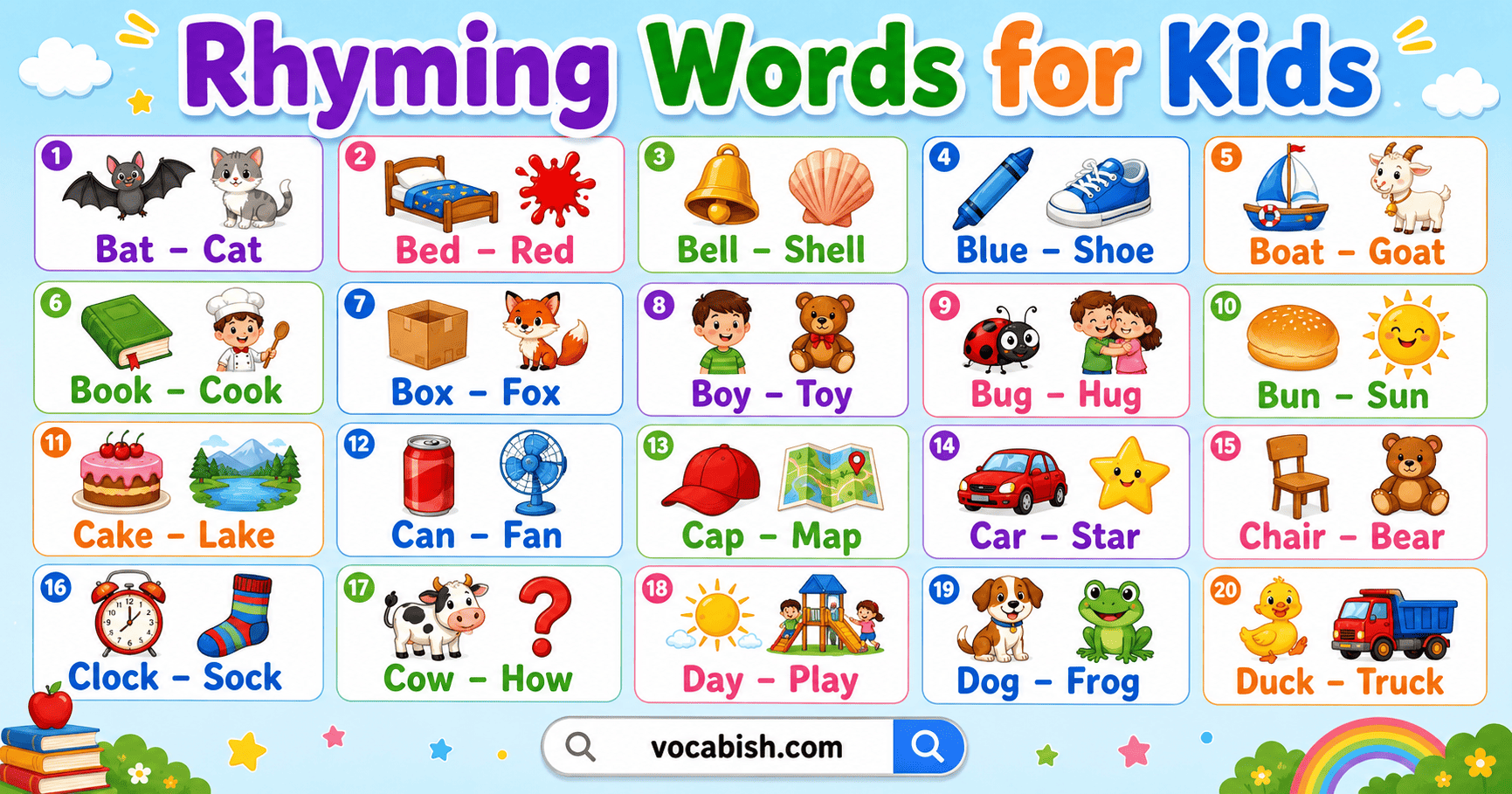

Rhyming words make language playful and memorable. They are words with the same or similar ending sounds, such as cat, hat, and bat. Children often hear rhymes in songs, poems, bedtime stories, and nursery rhymes before they begin reading independently.
Learning rhyming words helps children listen closely to sounds, recognize word patterns, improve pronunciation, and prepare for reading. This guide includes easy word families, rhyming pairs, sentences, short poems, classroom games, home activities, and worksheet ideas for preschool and kindergarten learners.
What Are Rhyming Words for Kids?
Rhyming words are words that have the same or similar sounds at the end. For example, sun and fun rhyme because both words end with the -un sound.
Rhyming depends mainly on pronunciation rather than spelling. Two words may look different but still rhyme when spoken aloud. Listening to the ending sound is therefore more important than looking only at the final letters.
Simple Rhyming Words Examples
Here are some easy groups of words that rhyme:
- Cat, bat, hat, mat
- Sun, fun, run, bun
- Cake, lake, make, snake
- Blue, shoe, glue, true
- Dog, frog, log, jog
- Bee, tree, see, free
- Ball, call, fall, tall
- Boat, goat, coat, float
Ask children to say each group slowly. Hearing the repeated ending sound helps them understand what makes the words rhyme.
Do Rhyming Words Always Have the Same Spelling?
No. Rhyming words do not always have the same spelling. They only need to have matching or similar ending sounds.
For example:
- Blue and shoe
- Bear and care
- Light and kite
- Sea and bee
- Rain and plane
- Night and write
- Flower and tower
- New and through
Some words have similar spellings but do not rhyme. For example, love and move both end in “-ove,” but they have different ending sounds.
Children should listen to the words instead of deciding by spelling alone.
Why Are Rhyming Words Important for Children?
Rhyming is more than a fun language activity. It supports several important early literacy skills.
- It builds phonological awareness. Children learn that spoken words are made of smaller sound parts.
- It improves sound recognition. Children begin noticing which words have matching endings.
- It supports reading readiness. Recognizing sound patterns makes it easier to decode unfamiliar words.
- It develops listening skills. Children must listen carefully to compare one word with another.
- It strengthens pronunciation. Repeating rhyming words helps children practise clear speech sounds.
- It introduces spelling patterns. Words such as cat, hat, and mat show how one ending can form several words.
- It expands vocabulary. A familiar word can help a child learn several related words.
- It improves memory. Rhythmic and rhyming language is often easier to remember.
- It makes stories enjoyable. Children can predict the next word in poems, songs, and rhyming books.
- It encourages creativity. Children can invent funny sentences, short poems, and playful word combinations.
Rhyming also creates a useful connection between spoken language and written language. A child may first hear that dog and log rhyme and later notice that both words share the written ending -og.
Easy Rhyming Words for Kids by Word Family
A word family is a group of words that share a common sound pattern. Teaching one word family at a time allows children to compare words without feeling overwhelmed.
“-at” Rhyming Words
- At
- Bat
- Brat
- Cat
- Chat
- Fat
- Flat
- Hat
- Mat
- Pat
- Rat
- Sat
- Splat
- That
Example: The fat cat sat on a mat.
“-an” Rhyming Words
- An
- Ban
- Can
- Fan
- Man
- Pan
- Plan
- Ran
- Scan
- Span
- Tan
- Van
Example: The man ran to the van.
“-op” Rhyming Words
- Bop
- Chop
- Cop
- Crop
- Drop
- Flop
- Hop
- Mop
- Pop
- Shop
- Stop
- Top
Example: Hop to the shop and stop at the top.
“-ug” Rhyming Words
- Bug
- Dug
- Hug
- Jug
- Mug
- Plug
- Pug
- Rug
- Shrug
- Slug
- Snug
- Tug
Example: The snug pug slept on the rug.
“-ake” Rhyming Words
- Ache
- Bake
- Brake
- Cake
- Fake
- Flake
- Lake
- Make
- Rake
- Shake
- Snake
- Stake
- Take
- Wake
Example: Jake will bake a cake by the lake.
“-ight” Rhyming Words
- Bright
- Flight
- Fright
- Height
- Kite
- Light
- Might
- Night
- Right
- Sight
- Tight
- White
- Write
Example: The white kite flew high in the bright light.
“-ee” Rhyming Words
- Bee
- Fee
- Flea
- Free
- Glee
- Knee
- Me
- See
- Tea
- Three
- Tree
- We
Example: I can see three bees near the tree.
“-oon” Rhyming Words
- Balloon
- Cartoon
- Moon
- Noon
- Spoon
- Soon
- Tune
Example: We will see the moon very soon.
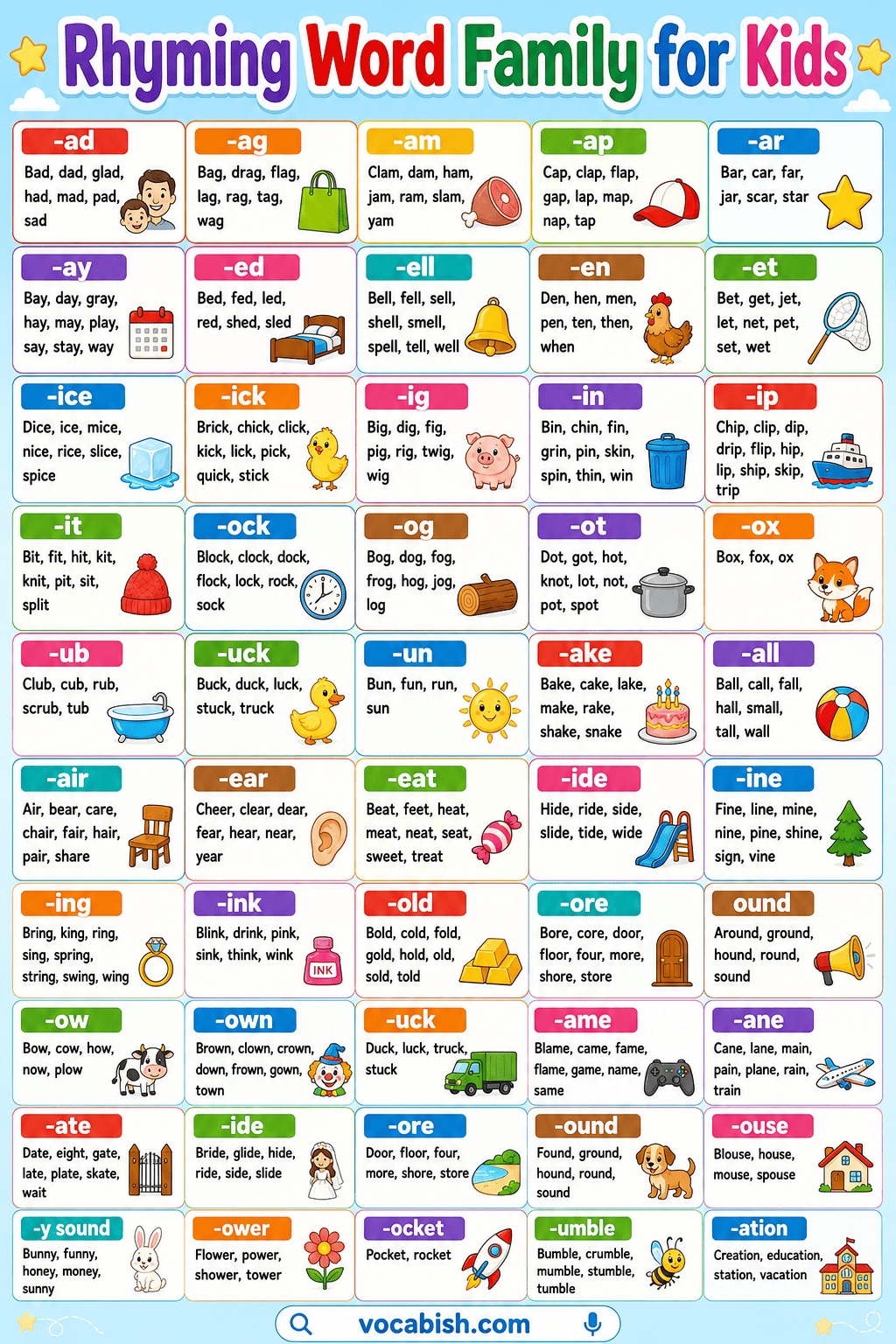
Here are more useful word families for children:
Word Family | Rhyming Words |
|---|---|
-ad | Bad, dad, glad, had, mad, pad, sad |
-ag | Bag, drag, flag, lag, rag, tag, wag |
-am | Clam, dam, ham, jam, ram, slam, yam |
-ap | Cap, clap, flap, gap, lap, map, nap, tap |
-ar | Bar, car, far, jar, scar, star |
-ay | Bay, day, gray, hay, may, play, say, stay, way |
-ed | Bed, fed, led, red, shed, sled |
-ell | Bell, fell, sell, shell, smell, spell, tell, well |
-en | Den, hen, men, pen, ten, then, when |
-et | Bet, get, jet, let, net, pet, set, wet |
-ice | Dice, ice, mice, nice, rice, slice, spice |
-ick | Brick, chick, click, kick, lick, pick, quick, stick |
-ig | Big, dig, fig, pig, rig, twig, wig |
-in | Bin, chin, fin, grin, pin, skin, spin, thin, win |
-ip | Chip, clip, dip, drip, flip, hip, lip, ship, skip, trip |
-it | Bit, fit, hit, kit, knit, pit, sit, split |
-ock | Block, clock, dock, flock, lock, rock, sock |
-og | Bog, dog, fog, frog, hog, jog, log |
-ot | Dot, got, hot, knot, lot, not, pot, spot |
-ox | Box, fox, ox |
-ub | Club, cub, rub, scrub, tub |
-uck | Buck, duck, luck, stuck, truck |
-un | Bun, fun, run, sun |
-ake | Bake, cake, lake, make, rake, shake, snake |
-all | Ball, call, fall, hall, small, tall, wall |
-air | Air, bear, care, chair, fair, hair, pair, share |
-ear | Cheer, clear, dear, fear, hear, near, year |
-eat | Beat, feet, heat, meat, neat, seat, sweet, treat |
-ide | Hide, ride, side, slide, tide, wide |
-ine | Fine, line, mine, nine, pine, shine, sign, vine |
-ing | Bring, king, ring, sing, spring, string, swing, wing |
-ink | Blink, drink, pink, sink, think, wink |
-old | Bold, cold, fold, gold, hold, old, sold, told |
-ore | Bore, core, door, floor, four, more, shore, store |
-ound | Around, ground, hound, round, sound |
-ow | Bow, cow, how, now, plow |
-own | Brown, clown, crown, down, frown, gown, town |
-uck | Duck, luck, truck, stuck |
-ame | Blame, came, fame, flame, game, name, same |
-ane | Cane, lane, main, pain, plane, rain, train |
-ate | Date, eight, gate, late, plate, skate, wait |
-ide | Bride, glide, hide, ride, side, slide |
-ore | Door, floor, four, more, shore, store |
-ound | Found, ground, hound, round, sound |
-ouse | Blouse, house, mouse, spouse |
-y sound | Bunny, funny, honey, money, sunny |
-ower | Flower, power, shower, tower |
-ocket | Pocket, rocket |
-umble | Bumble, crumble, mumble, stumble, tumble |
-ation | Creation, education, station, vacation |
Words within the same family are useful for sound-matching practice, but children do not need to memorize every word at once. Begin with three or four familiar examples and add new words gradually.
Rhyming Words for Kids from A to Z
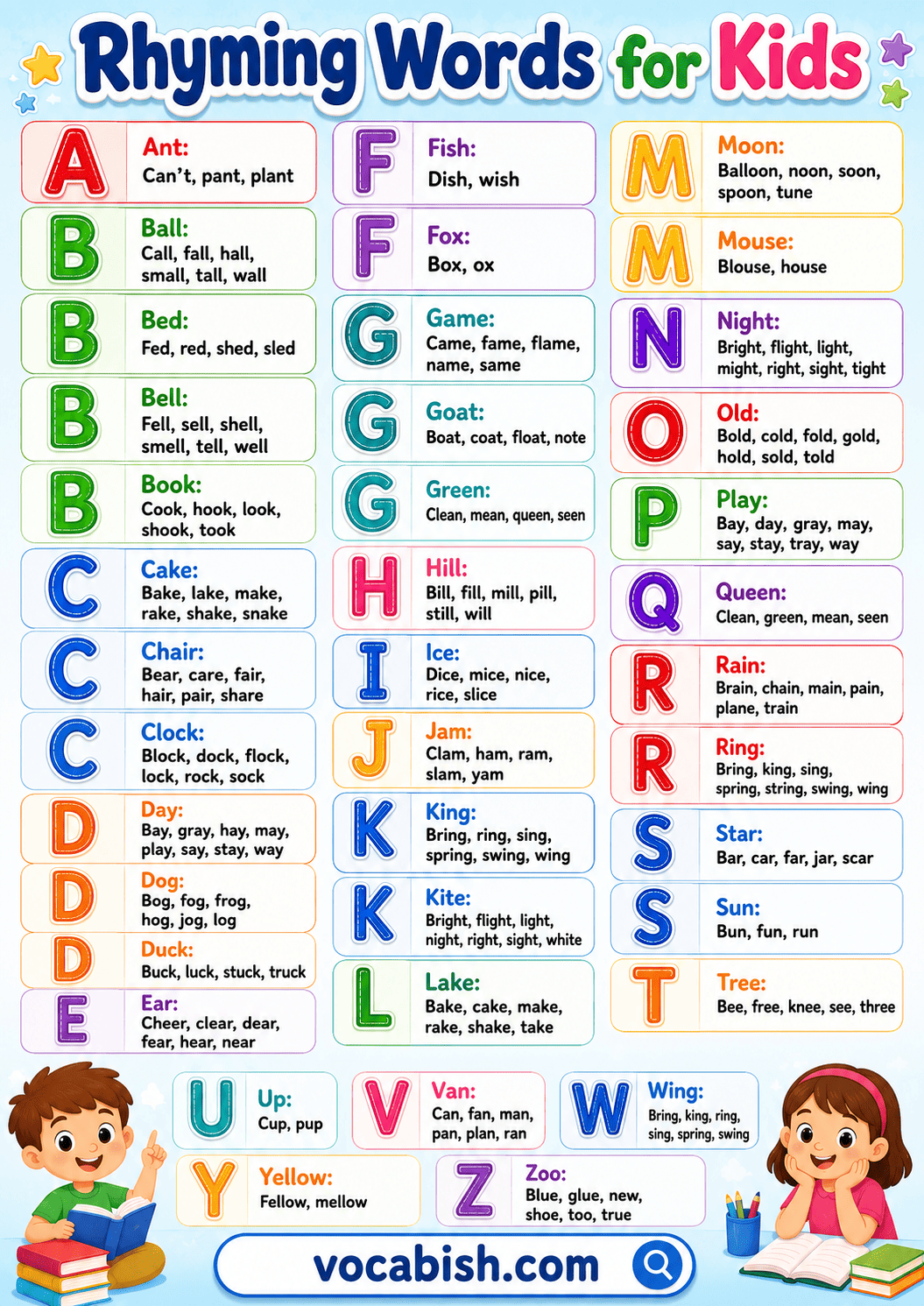
This alphabetical reference list gives children a starting word followed by several words that rhyme with it.
Word | Rhyming Words |
|---|---|
Ant | Can’t, pant, plant |
Ball | Call, fall, hall, small, tall, wall |
Bed | Fed, red, shed, sled |
Bell | Fell, sell, shell, smell, tell, well |
Book | Cook, hook, look, shook, took |
Cake | Bake, lake, make, rake, shake, snake |
Chair | Bear, care, fair, hair, pair, share |
Clock | Block, dock, flock, lock, rock, sock |
Day | Bay, gray, hay, may, play, say, stay, way |
Dog | Bog, fog, frog, hog, jog, log |
Duck | Buck, luck, stuck, truck |
Ear | Cheer, clear, dear, fear, hear, near |
Fish | Dish, wish |
Fox | Box, ox |
Game | Came, fame, flame, name, same |
Goat | Boat, coat, float, note |
Green | Clean, mean, queen, seen |
Hill | Bill, fill, mill, pill, still, will |
Ice | Dice, mice, nice, rice, slice |
Jam | Clam, ham, ram, slam, yam |
King | Bring, ring, sing, spring, swing, wing |
Kite | Bright, flight, light, night, right, sight, white |
Lake | Bake, cake, make, rake, shake, take |
Moon | Balloon, noon, soon, spoon, tune |
Mouse | Blouse, house |
Night | Bright, flight, light, might, right, sight, tight |
Old | Bold, cold, fold, gold, hold, sold, told |
Play | Bay, day, gray, may, say, stay, tray, way |
Queen | Clean, green, mean, seen |
Rain | Brain, chain, main, pain, plane, train |
Ring | Bring, king, sing, spring, string, swing, wing |
Star | Bar, car, far, jar, scar |
Sun | Bun, fun, run |
Tree | Bee, free, knee, see, three |
Up | Cup, pup |
Van | Can, fan, man, pan, plan, ran |
Wing | Bring, king, ring, sing, spring, swing |
Yellow | Fellow, mellow |
Zoo | Blue, glue, new, shoe, too, true |
Some rhymes may sound slightly different across English accents. Teachers should model the pronunciation used in their classroom while also explaining that English is spoken in many different ways around the world.
Short and Easy Rhyming Pairs
These simple rhyming pairs are useful for quick oral practice:
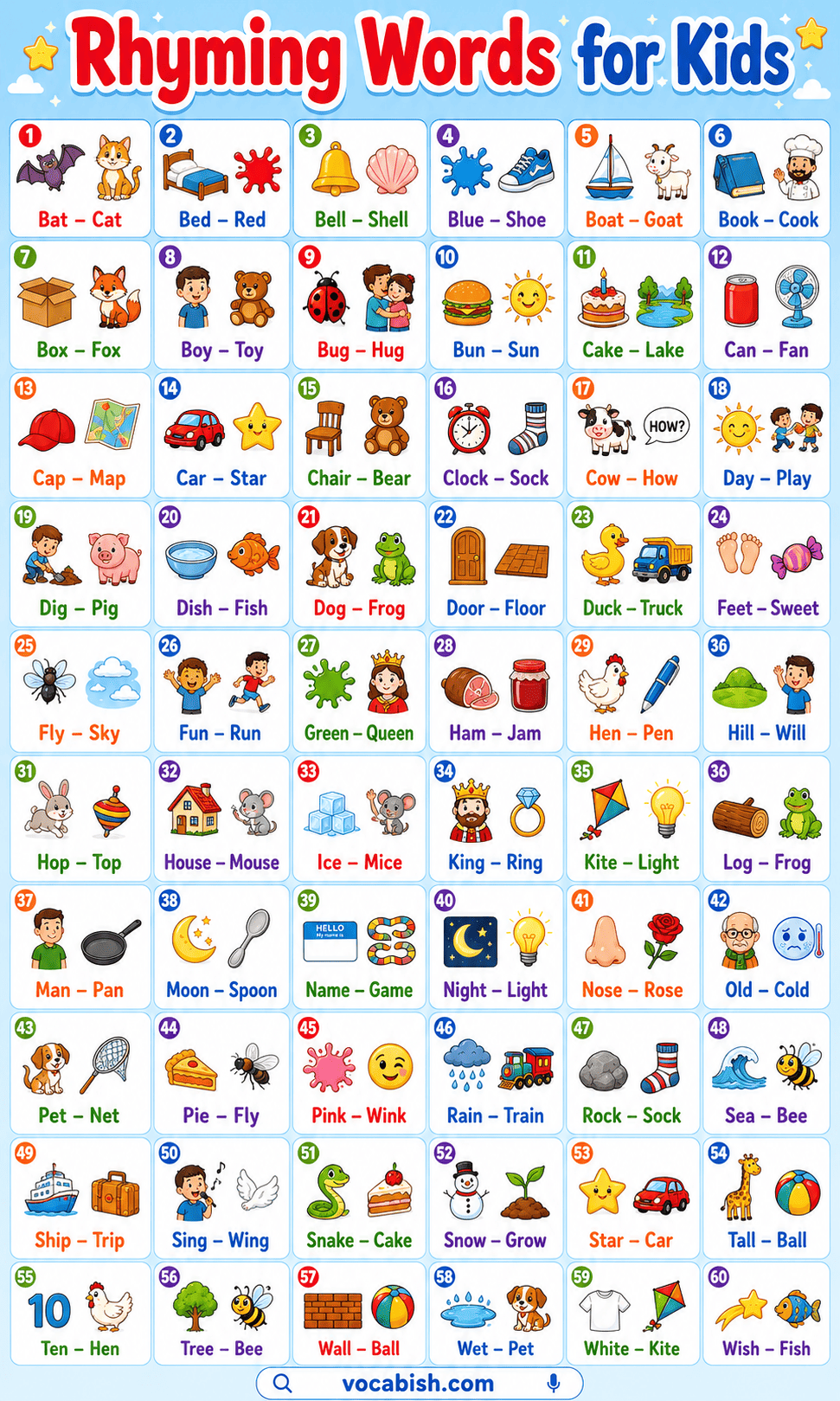
Rhyming Pair | Rhyming Pair | Rhyming Pair |
|---|---|---|
Bat – Cat | Bed – Red | Bell – Shell |
Blue – Shoe | Boat – Goat | Book – Cook |
Box – Fox | Boy – Toy | Bug – Hug |
Bun – Sun | Cake – Lake | Can – Fan |
Cap – Map | Car – Star | Chair – Bear |
Clock – Sock | Cow – How | Day – Play |
Dig – Pig | Dish – Fish | Dog – Frog |
Door – Floor | Duck – Truck | Feet – Sweet |
Fly – Sky | Fun – Run | Green – Queen |
Ham – Jam | Hen – Pen | Hill – Will |
Hop – Top | House – Mouse | Ice – Mice |
King – Ring | Kite – Light | Log – Frog |
Man – Pan | Moon – Spoon | Name – Game |
Night – Light | Nose – Rose | Old – Cold |
Pet – Net | Pie – Fly | Pink – Wink |
Rain – Train | Rock – Sock | Sea – Bee |
Ship – Trip | Sing – Wing | Snake – Cake |
Snow – Grow | Star – Car | Tall – Ball |
Ten – Hen | Tree – Bee | Wall – Ball |
Wet – Pet | White – Kite | Wish – Fish |
Parents can read the first word and ask the child to say its partner. Once that becomes easy, reverse the order or ask the child to produce a new rhyme without seeing an example.
Three-Letter Rhyming Words for Beginners
Three-letter words are helpful for early readers because many follow a simple consonant-vowel-consonant, or CVC, pattern.
Short “a” Words
- Bad, dad, had, mad, sad
- Bag, rag, tag, wag
- Ban, can, fan, man, pan, ran, van
- Bat, cat, fat, hat, mat, pat, rat, sat
- Cap, gap, lap, map, nap, tap
Short “e” Words
- Bed, fed, led, red
- Beg, leg, peg
- Den, hen, men, pen, ten
- Bet, get, jet, let, net, pet, set, wet
Short “i” Words
- Big, dig, fig, pig, rig, wig
- Bin, fin, pin, sin, tin, win
- Bit, fit, hit, kit, pit, sit
- Dip, hip, lip, rip, sip, tip, zip
Short “o” Words
- Bog, dog, fog, hog, jog, log
- Cop, hop, mop, pop, top
- Cot, dot, got, hot, lot, not, pot
- Box, fox
Short “u” Words
- Bug, dug, hug, jug, mug, pug, rug, tug
- Bun, fun, gun, run, sun
- Cub, rub, tub
- Cup, pup
Teacher tip: Say the ending first, such as -at, and ask children to repeat it. Then add different beginning sounds: c-at, h-at, m-at. Finally, read each complete word naturally.
Rhyming Words for Preschool and Kindergarten Kids
Children develop rhyming skills at different rates. Preschool learners usually benefit from listening, pictures, repetition, and movement. Kindergarten students can begin connecting spoken rhymes with letters and spelling patterns.
Rhyming Words for Preschoolers
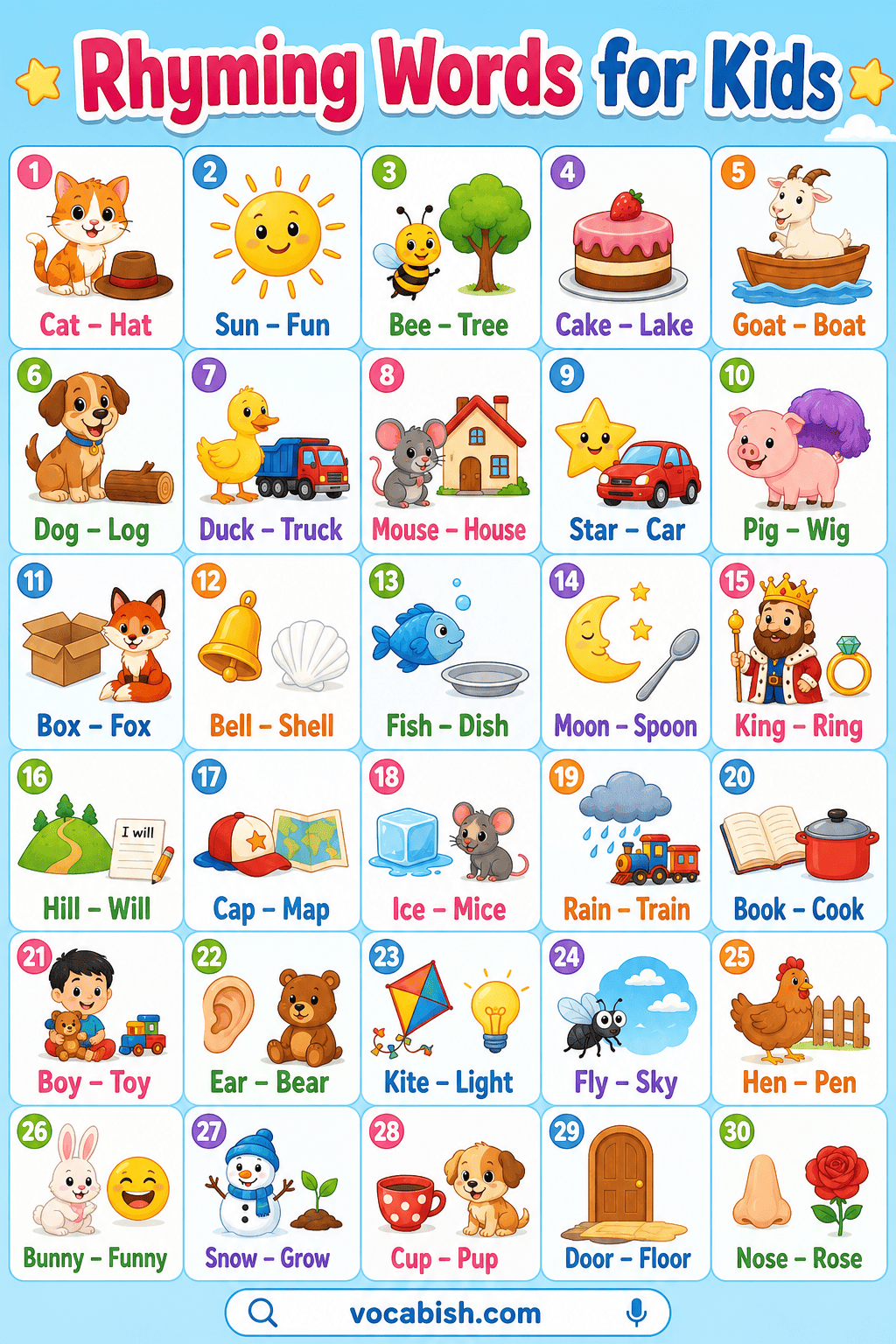
Use familiar objects, animals, actions, and picture cards:
- Ball – Tall
- Bat – Cat
- Bee – Tree
- Bell – Shell
- Blue – Shoe
- Boat – Goat
- Box – Fox
- Bug – Hug
- Bun – Sun
- Cake – Snake
- Can – Fan
- Cap – Map
- Car – Star
- Chair – Bear
- Clock – Sock
- Cow – How
- Day – Play
- Dog – Log
- Duck – Truck
- Fish – Dish
- Fly – Sky
- Fun – Run
- Hen – Pen
- Hop – Top
- House – Mouse
- King – Ring
- Moon – Spoon
- Night – Light
- Pig – Wig
- Rain – Train
- Tree – Bee
At preschool level, children do not need to spell every word. The main goal is to hear whether two words rhyme.
Try asking:
- “Do cat and hat sound the same at the end?”
- “Which word rhymes with sun: run or dog?”
- “Can you find the picture that rhymes with fox?”
Rhyming Words for Kindergarten Students
Kindergarten learners can work with longer words and less obvious spelling patterns:
- Baking – Making
- Bending – Sending
- Bunny – Funny
- Candle – Handle
- Chewing – Doing
- Clapping – Napping
- Dancing – Prancing
- Flower – Tower
- Funny – Sunny
- Hopping – Shopping
- Jelly – Smelly
- Kitty – Pretty
- Mellow – Yellow
- Money – Honey
- Pocket – Rocket
- Playing – Staying
- Reading – Feeding
- Singing – Ringing
- Snowing – Growing
- Tumble – Bumble
- Walking – Talking
- Winking – Thinking
Children at this stage can complete missing words, sort word families, write rhyming pairs, and identify the word that does not belong in a rhyme group.
Rhyming Sentences for Kids
Short sentences help children understand how rhyming words work in real language.
- The cat is wearing a hat.
- The fat cat slept on the mat.
- I see a bee beside the tree.
- The fox is sitting on a box.
- The goat is riding in a boat.
- The king wears a shiny ring.
- The frog jumped over a log.
- The mouse ran into the house.
- The duck stood beside the truck.
- The snail carried a tiny pail.
- The bear sat on a chair.
- The moon appeared very soon.
- The boy found a red toy.
- The hen slept inside the pen.
- The pig wore a funny wig.
- The fly flew high in the sky.
- The fish swam near the dish.
- The snake rested beside the lake.
- The queen wore a dress of green.
- The train moved through the rain.
- The sheep went to sleep.
- The white kite flew in the light.
- The small ball rolled toward the wall.
- The bug crawled under the rug.
- The pup drank from a cup.
- The clown walked through the town.
- The star shone over the car.
- The goose became loose.
- The rose touched my nose.
- The plane flew above the train.
After reading each sentence, ask the child to point to or repeat the two rhyming words.
Short Rhyming Poems for Kids
Short poems help children hear repeated sounds in a meaningful and enjoyable way.
A Funny Cat Rhyme
A little cat wore a purple hat,
Then curled up softly on the mat.
It saw a mouse run past the door,
Then dropped its hat upon the floor.
Which two words rhyme in this poem?
Possible answers: cat–hat–mat and door–floor.
A Sunny Day Rhyme
The golden sun says, “Let us run,”
The birds agree and join the fun.
We laugh and play throughout the day,
Then wave as clouds float far away.
Which two words rhyme in this poem?
Possible answers: sun–run–fun and play–day–away.
A Bedtime Rhyme
The moon shines softly through the night,
The little stars are warm and bright.
I close my eyes and hug my bear,
Then dream of floating through the air.
Which two words rhyme in this poem?
Possible answers: night–bright and bear–air.
Fun Rhyming Activities for Kids
Rhyming activities do not require expensive materials. Word cards, pictures, household objects, and a little imagination are often enough.
Find the Rhyming Match
Prepare picture or word cards such as cat, hat, dog, log, bee, and tree. Mix the cards and ask children to place each rhyming pair together.
Begin with obvious pairs. Later, add extra cards that do not have a match.
Complete the Rhyme
Read a sentence and let the child supply the missing rhyming word:
- I see a cat wearing a ___.
- The little fox sits on a ___.
- A bee is flying by the ___.
- The frog is resting on a ___.
- The goat is sailing in a ___.
- The king is wearing a ___.
- The pup is drinking from a ___.
- The mouse ran into the ___.
Possible answers: hat, box, tree, log, boat, ring, cup, house.
More than one answer may sometimes work. Accept any sensible word that completes the rhyme and fits the sentence.
Rhyming Word Hunt
Choose one word, such as chair, and ask children to look around the room for something that rhymes with it. They may find or think of hair, bear, or pair.
The matching word does not always need to be physically present. Children may draw it, say it, or find it in a picture book.
Odd Word Out
Say or display four words. Three should rhyme and one should not.
- Cat, hat, sun, bat
- Cake, lake, dog, snake
- Bee, tree, car, see
- Run, bun, fun, fish
- Bell, shell, wall, tell
- Pig, wig, dog, dig
- Light, kite, night, boat
- Rain, train, star, plane
Answers: sun, dog, car, fish, wall, dog, boat, star.
Ask the child to explain the answer by repeating the matching ending sounds.
Rhyming Basket Game
Place several picture cards in a basket. Say a target word such as log. The child searches for the card that shows a dog or frog and places it beside the target card.
For a group activity, give each child one card and ask them to find the classmate holding its rhyming partner.
Make a Silly Rhyme
Silly rhymes make language practice feel like play. Give children two rhyming words and ask them to create a funny phrase or sentence.
Examples:
- A frog on a log
- A mouse in a house
- A goat in a boat
- A bear on a chair
- A king with a ring
- A fox in a box
- A snail with a pail
- A cat in a hat
- A pup with a cup
- A bug on a rug
The sentence does not need to be realistic. Humorous combinations often help children remember the words.
Rhyming Games for Home and Classroom
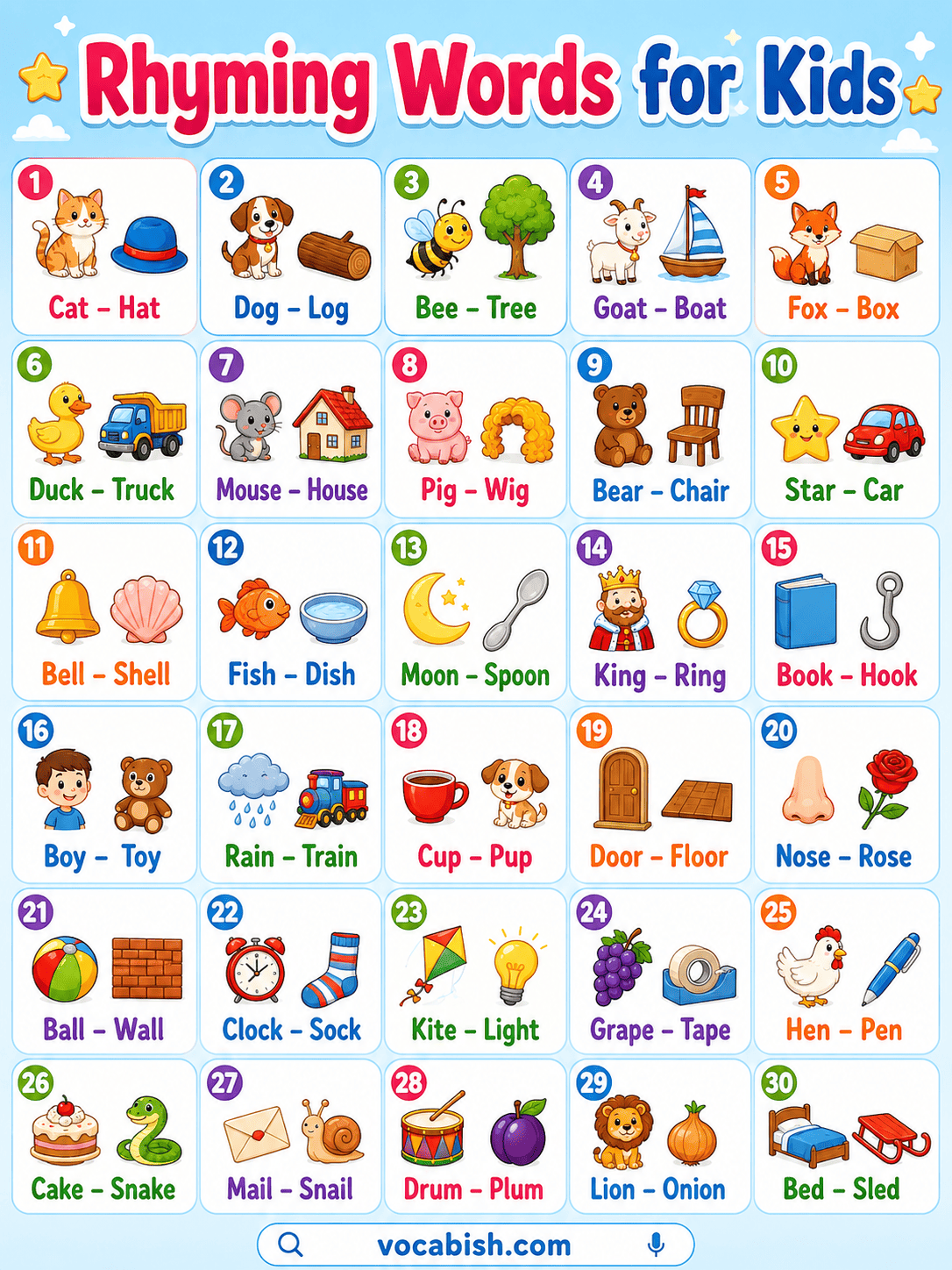
Interactive games give children repeated sound practice without turning the lesson into a memorization exercise.
Rhyme Bingo
Materials: Bingo cards containing simple pictures or words.
How to play: Call out a word that rhymes with an item on the card. If you say log, children cover the picture of a dog.
Learning goal: Listening for matching ending sounds.
Pass the Rhyme
Materials: A soft ball or beanbag.
How to play: Say a word and pass the ball to a child. The child says a rhyming word before passing it to someone else.
Learning goal: Producing rhymes quickly and confidently.
Rhyming Memory Cards
Materials: Pairs of picture cards showing rhyming objects.
How to play: Place the cards face down. Players turn over two cards and keep them if the pictures rhyme.
Learning goal: Connecting visual vocabulary with spoken sounds.
Rhyme Relay
Materials: Word or picture cards placed at the other side of the room.
How to play: Divide children into teams. Say a word, and one child from each team runs to collect a card that rhymes with it.
Learning goal: Sound recognition, movement, and teamwork.
Rhyme or Not?
Materials: No special materials are required.
How to play: Say two words. Children clap if they rhyme and keep their hands still if they do not.
Examples:
- Cat–hat: clap
- Dog–sun: no clap
- Bee–tree: clap
- Book–ball: no clap
Learning goal: Distinguishing rhyming and non-rhyming pairs.
Rhyming Charades
Materials: Picture or word cards.
How to play: A child acts out or points to a word without saying it. After the class guesses the word, everyone suggests words that rhyme with it.
Learning goal: Building vocabulary while producing rhyme families.
How to Teach Rhyming Words to Kids
A clear, gradual approach works better than giving children a long list to memorize.
- Begin with familiar words. Use common objects and animals such as cat, hat, dog, log, bee, and tree.
- Say the words slowly. Stretch the ending slightly so the matching sound becomes easier to hear: c-at, h-at.
- Repeat the ending sound. Ask the child to say -at before reading the complete words.
- Use pictures and objects. Young children often understand a picture pair before they can read the written words.
- Introduce one word family at a time. Practise cat, bat, hat, mat, and rat before moving to a new pattern.
- Compare rhymes and non-rhymes. Ask whether cat–hat and cat–dog sound alike at the end.
- Read rhyming stories aloud. Pause before a predictable word and let the child complete the rhyme.
- Use songs and nursery rhymes. Repeated rhythm and melody make sound patterns easier to remember.
- Add movement. Children can clap, jump, or tap whenever they hear two words that rhyme.
- Let children invent words. A made-up word can show that a child understands the sound pattern, even if it is not a real vocabulary word.
- Connect sound with spelling. Once children can hear the rhyme, show them the shared written ending.
- Review words in different contexts. Use the same words in pictures, sentences, games, and poems.
- Praise effort rather than speed. Some children need more listening practice before they can create rhymes independently.
- Keep lessons short. Five to ten minutes of regular practice is often more effective than one long and tiring session.
At-home tip: Choose one everyday word during breakfast, travel, or bedtime and take turns saying rhyming words.
Classroom tip: Create a “rhyme of the day” board. Add new words whenever students discover another member of the word family.
Common Rhyming Mistakes Children Make
Mistakes are a normal part of learning to hear and compare sounds.
- Confusing the first sound with the ending sound:
A child may think cat and car rhyme because both begin with /k/. Say the words slowly and draw attention to -at and -ar. - Choosing words with similar spelling:
Words that look alike do not always rhyme. For example, love and move have similar endings in writing but different pronunciations. - Focusing only on the last letter:
Cat and boat both end with the letter “t,” but they do not rhyme. Children need to compare the complete ending sound, not only the final letter. - Mixing exact rhymes and near rhymes:
Words such as cat and hat are exact rhymes. Words such as shape and keep may sound slightly connected in a poem, but they are not exact rhymes for beginner practice. - Thinking a word cannot rhyme because its spelling is different:
Words such as blue and shoe rhyme even though their endings look different. - Rejecting invented words:
A child may say zat as a rhyme for cat. Although zat is not a standard English word, it shows that the child has heard the -at pattern. Praise the sound match, then ask for a real word too. - Adding a word that belongs to the same topic:
A child might pair cat with dog because both are animals. Explain that categories tell us what words mean, while rhymes tell us how words sound. - Being affected by accent differences:
A pair may rhyme in one English accent but sound less exact in another. Model the local pronunciation without telling children that another natural accent is “wrong.”
Instead of saying, “That answer is wrong,” try saying:
- “Let’s listen to the endings again.”
- “Cat ends with -at. Does dog end with -at?”
- “Those words belong together, but do they sound the same at the end?”
- “That is a creative word. Can you think of a real word with the same sound?”
Rhyming Words Worksheet Ideas
Worksheets can reinforce a lesson after children have already practised the sounds aloud.
- Match the rhyming pictures: Draw lines between pictures such as a cat and hat.
- Circle the rhyming word: Give one target word and three possible answers.
- Fill in the missing rhyme: Complete a sentence or a two-line poem.
- Color the matching pairs: Use the same color for words that rhyme.
- Write three rhyming words: Give a word family ending such as -at or -ig.
- Cross out the odd word: Include three rhyming words and one non-rhyming word.
- Sort the word families: Place words under headings such as -an, -op, and -ug.
- Complete a rhyme chain: Start with cat, followed by blank spaces for hat, mat, and rat.
- Cut and paste the pairs: Children cut out pictures and place rhyming words together.
- Choose the correct picture: Read a word and select the picture that rhymes with it.
- Find rhymes in a poem: Underline or circle words with matching endings.
- Draw a rhyming object: Give the word star and ask the child to draw a car or jar.
- Finish the silly sentence: “A fox is sleeping in a ___.”
- Rhyme maze: Follow only the words that rhyme with the starting word.
- Rhyme word search: Find several words from one word family.
- Build a rhyme ladder: Change the first sound while keeping the ending, such as cat–bat–hat–mat.
- Write a two-line poem: Give children the final words and let them complete the lines.
- Listen and mark: Read pairs aloud while children tick “rhymes” or “does not rhyme.”
Keep worksheets visually clean. Young learners benefit from large print, familiar pictures, short instructions, and enough space to write or draw.
Download Rhyming Words for Kids PDF
FAQs About Rhyming Words for Kids
Five simple rhyming pairs are cat–hat, sun–fun, bee–tree, cake–lake, and goat–boat. Each pair has the same or a very similar ending sound. Reading the pairs aloud helps children hear the rhyme more clearly than looking at the spelling alone.
Tell the child that rhyming words sound the same at the end. Say an easy pair such as cat–hat, repeat the -at sound, and ask the child to listen carefully. Pictures, songs, clapping games, and familiar objects make the idea easier to understand.
Many children begin noticing rhyming sounds during the preschool years. They may recognize familiar rhymes before they can create their own. By kindergarten, many learners can match and produce simple rhyming words, although language development varies from one child to another.
Rhyming develops phonological awareness, which is the ability to hear and work with sounds in spoken language. It helps children notice word parts, compare sound patterns, predict words in stories, and connect spoken endings with written word families. These skills support early reading and spelling.
No. Rhyming words need matching sounds, not matching spellings. Blue–shoe, bear–care, and night–write rhyme even though they are spelled differently. In contrast, words can look similar without rhyming, as seen in love–move and cough–though.
Start with familiar picture pairs such as cat–hat and dog–log. Say the words slowly, repeat the ending sound, and ask children to match pictures or complete a spoken pair. Short daily games, songs, stories, and word-family practice usually work better than long lessons.
Practice Rhyming Words Every Day
Children learn rhyming words through regular listening, speaking, reading, and playful repetition. Begin with familiar pairs, practise one word family at a time, and gradually introduce longer or differently spelled rhymes.
Rhyming can become part of everyday routines. Find rhymes during story time, make silly sentences in the car, sing rhyming songs, or choose a “word of the day” and build a family around it.
Choose one word family each day and ask your child to find, say, write, or draw three words that rhyme. A few enjoyable minutes of practice can build stronger listening, vocabulary, pronunciation, reading, and spelling skills.
Explore More Kids Learning Resources