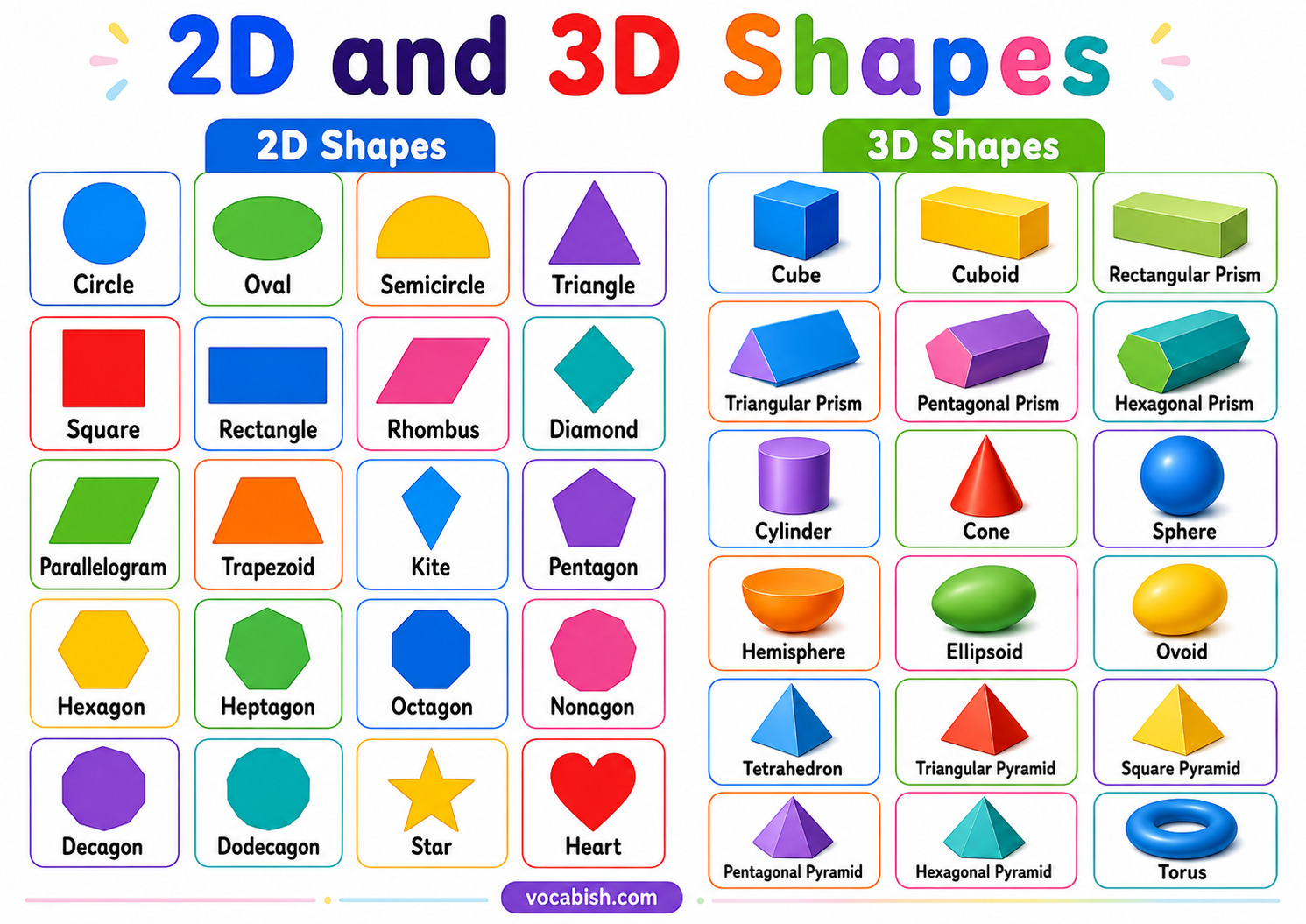

2D shapes and 3D shapes are important parts of geometry. Students learn them in early math because shapes help us understand objects, space, size, position, patterns, and measurement.
A 2D shape is flat, like a circle, square, or triangle. A 3D shape is solid, like a cube, cone, or sphere. Children see these shapes every day in books, toys, boxes, balls, clocks, doors, cans, signs, and buildings.
This complete guide explains the meaning of 2D and 3D shapes, their differences, properties, examples, formulas, real-life uses, and common mistakes. It also includes useful tables and a simple worksheet for students.
What Are 2D Shapes and 3D Shapes?
2D shapes and 3D shapes are two main types of geometric shapes.
- A 2D shape is a flat shape. It has only length and width. It does not have thickness, height, or depth.
- A 3D shape is a solid shape. It has length, width, and height or depth. It takes up space.
Simple examples:
- Circle is a 2D shape.
- Square is a 2D shape.
- Triangle is a 2D shape.
- Cube is a 3D shape.
- Cone is a 3D shape.
- Sphere is a 3D shape.
Here’s a comprehensive guide on All Shapes Name with Pictures.
Definition of 2D Shapes
A 2D shape is a flat geometric figure that has two dimensions: length and width.
The word 2D means two-dimensional.
A 2D shape may have:
- Sides
- Corners
- Angles
- Curved boundaries
- A flat surface
Examples of 2D shapes include circle, triangle, square, rectangle, oval, pentagon, hexagon, octagon, and decagon.
Definition of 3D Shapes
A 3D shape is a solid geometric figure that has three dimensions: length, width, and height or depth.
The word 3D means three-dimensional.
A 3D shape may have:
- Faces
- Edges
- Vertices
- Flat surfaces
- Curved surfaces
Examples of 3D shapes include cube, cuboid, rectangular prism, cylinder, cone, sphere, pyramid, prism, and hemisphere.
Main Difference Between 2D and 3D Shapes
The main difference between 2D and 3D shapes is that 2D shapes are flat, while 3D shapes are solid.
Feature | 2D Shapes | 3D Shapes |
|---|---|---|
Full Form | Two-dimensional shapes | Three-dimensional shapes |
Meaning | Flat shapes | Solid shapes |
Dimensions | Length and width | Length, width, and height/depth |
Space | Do not take up physical space as solids | Take up physical space |
Parts | Sides, corners, angles | Faces, edges, vertices |
Examples | Circle, square, triangle | Cube, cone, sphere |
Drawing Style | Flat drawing | Solid object drawing |
Real-Life View | Seen as a flat face or outline | Seen as an object |
Example:
A square drawn on paper is a 2D shape.
A dice is a 3D shape because it has length, width, and height.
Related Resources: Six Basic Types of Triangle with Pictures
Easy Way to Understand 2D and 3D Shapes
A simple way to understand the difference is this:
- If a shape is flat, it is 2D.
- If a shape can be held like an object, it is 3D.
For example:
- A circle on paper is 2D.
- A ball is 3D.
- A rectangle drawn in a notebook is 2D.
- A book is 3D.
- A triangle on a sign is 2D.
- A pyramid toy is 3D.
2D Shapes
2D shapes are flat shapes. They are often drawn on paper, boards, worksheets, charts, and screens.
Most 2D shapes are made with straight lines or curved lines.
There are two main types of 2D shapes:
- Straight-sided shapes
- Curved shapes
Straight-sided 2D shapes are called polygons. Curved 2D shapes are not polygons.
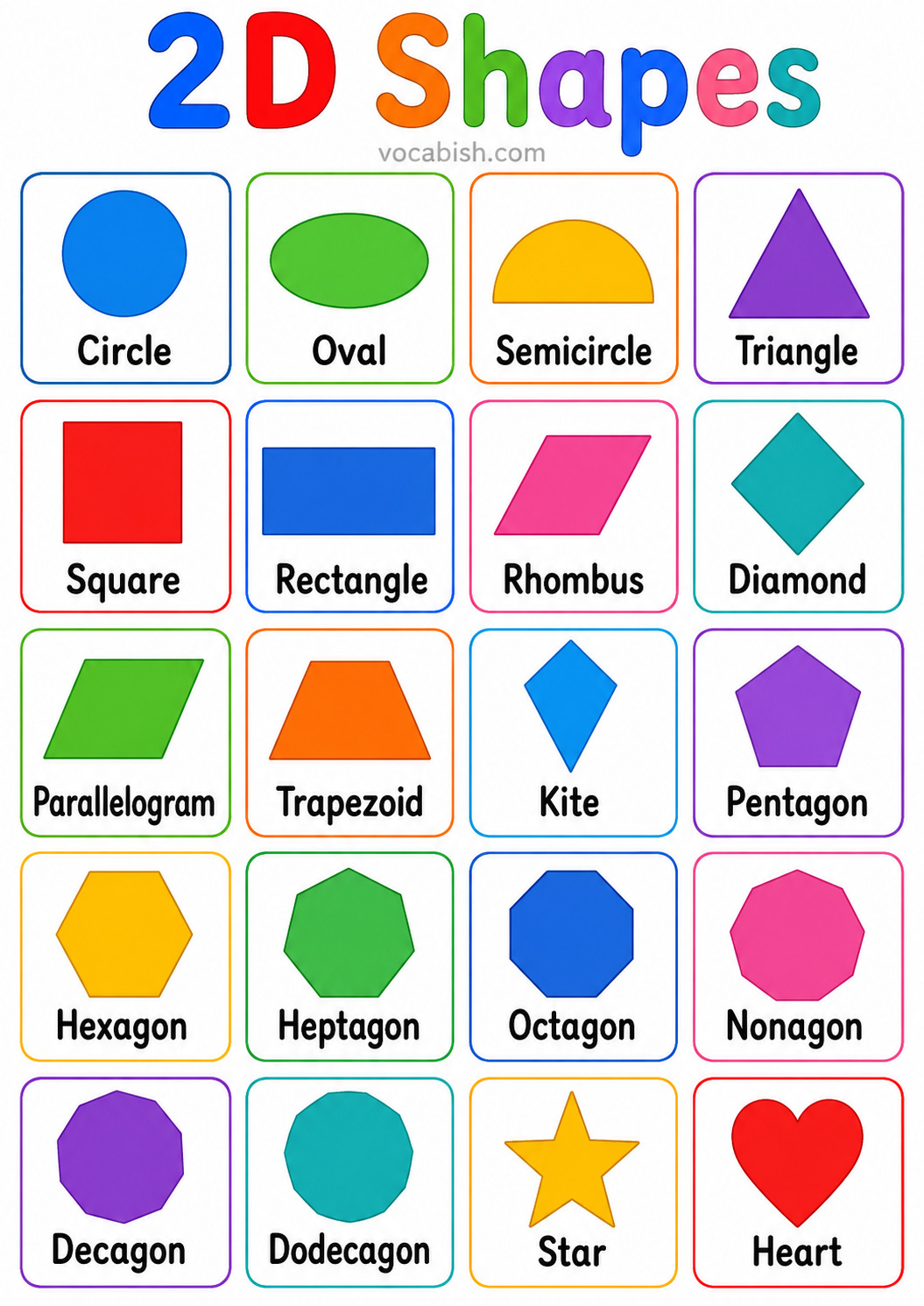
Types of 2D Shapes
2D shapes can be divided into different groups.
1. Curved 2D Shapes
Curved shapes have curved boundaries.
Examples:
- Circle
- Oval
- Semicircle
2. Polygons
A polygon is a closed 2D shape made only of straight sides.
Examples:
- Triangle
- Square
- Rectangle
- Pentagon
- Hexagon
- Octagon
3. Regular Shapes
A regular shape has equal sides and equal angles.
Examples:
- Regular triangle
- Regular square
- Regular pentagon
- Regular hexagon
4. Irregular Shapes
An irregular shape does not have all sides or all angles equal.
Examples:
- Irregular pentagon
- Irregular hexagon
- Irregular quadrilateral
Want to explore the Worksheets? Check it out: 2D and 3D Shapes Worksheets
List of 2D Shapes with Properties
2D Shape | Type | Sides | Vertices / Corners | Simple Description |
|---|---|---|---|---|
Circle | Curved shape | 0 straight sides | 0 | A round flat shape |
Oval | Curved shape | 0 straight sides | 0 | A stretched circle |
Semicircle | Curved shape | 1 straight side + 1 curved edge | 2 | Half of a circle |
Triangle | Polygon | 3 | 3 | A shape with 3 sides |
Square | Quadrilateral | 4 | 4 | 4 equal sides and 4 right angles |
Rectangle | Quadrilateral | 4 | 4 | Opposite sides equal and 4 right angles |
Rhombus | Quadrilateral | 4 | 4 | 4 equal sides |
Diamond | Quadrilateral | 4 | 4 | A tilted square-like shape |
Parallelogram | Quadrilateral | 4 | 4 | Opposite sides are parallel |
Trapezoid | Quadrilateral | 4 | 4 | Has at least one pair of parallel sides |
Kite | Quadrilateral | 4 | 4 | Two pairs of equal adjacent sides |
Pentagon | Polygon | 5 | 5 | A shape with 5 sides |
Hexagon | Polygon | 6 | 6 | A shape with 6 sides |
Heptagon | Polygon | 7 | 7 | A shape with 7 sides |
Octagon | Polygon | 8 | 8 | A shape with 8 sides |
Nonagon | Polygon | 9 | 9 | A shape with 9 sides |
Decagon | Polygon | 10 | 10 | A shape with 10 sides |
Dodecagon | Polygon | 12 | 12 | A shape with 12 sides |
Star | 2D figure | Usually 10 sides | Usually 10 | A pointed decorative shape |
Heart | Curved 2D figure | Curved boundary | Usually 1 point | A common symbol shape |
Common 2D Shapes Explained
Circle
A circle is a round 2D shape. It has no straight sides and no corners.
Examples:
- Clock
- Coin
- Wheel
- Plate
- Button
A circle is not a polygon because it does not have straight sides.
Oval
An oval is a stretched circle. It has a curved boundary and no corners.
Examples:
- Egg
- Balloon
- Mirror
- Watermelon shape
Triangle
A triangle is a polygon with 3 sides and 3 corners.
Examples:
- Pizza slice
- Road sign
- Roof shape
- Sandwich piece
Common types of triangles:
Triangle Type | Meaning |
|---|---|
Equilateral Triangle | All 3 sides are equal |
Isosceles Triangle | 2 sides are equal |
Scalene Triangle | No sides are equal |
Right Triangle | Has one right angle |
Acute Triangle | All angles are less than 90 degrees |
Obtuse Triangle | Has one angle greater than 90 degrees |
Related Resources: Six Basic Types of Triangle with Pictures
Square
A square has 4 equal sides and 4 corners. All angles are right angles.
Examples:
- Tile
- Chessboard box
- Sticky note
- Window shape
Rectangle
A rectangle has 4 sides and 4 corners. Opposite sides are equal.
Examples:
- Book
- Door
- Phone
- Table top
- Whiteboard
Rhombus
A rhombus has 4 equal sides. Its angles do not need to be right angles.
A diamond shape is often used as an easy example of a rhombus.
Parallelogram
A parallelogram has two pairs of opposite sides that are parallel.
Examples can be found in patterns, tiles, and slanted designs.
Trapezoid
A trapezoid is a quadrilateral with at least one pair of parallel sides.
Examples:
- Some bags
- Lampshades
- Bridge designs
- Table shapes
Pentagon
A pentagon has 5 sides and 5 corners.
Hexagon
A hexagon has 6 sides and 6 corners.
A honeycomb cell is a common real-life example of a hexagon.
Heptagon
A heptagon has 7 sides and 7 corners.
Octagon
An octagon has 8 sides and 8 corners.
A stop sign is a common example of an octagon.
Decagon
A decagon has 10 sides and 10 corners.
3D Shapes
3D shapes are solid shapes. They have length, width, and height or depth. We can hold many 3D shapes in real life.
A 3D shape may have flat faces, curved surfaces, edges, and vertices.
Examples of 3D shapes include:
- Cube
- Cuboid
- Rectangular prism
- Cylinder
- Cone
- Sphere
- Pyramid
- Prism
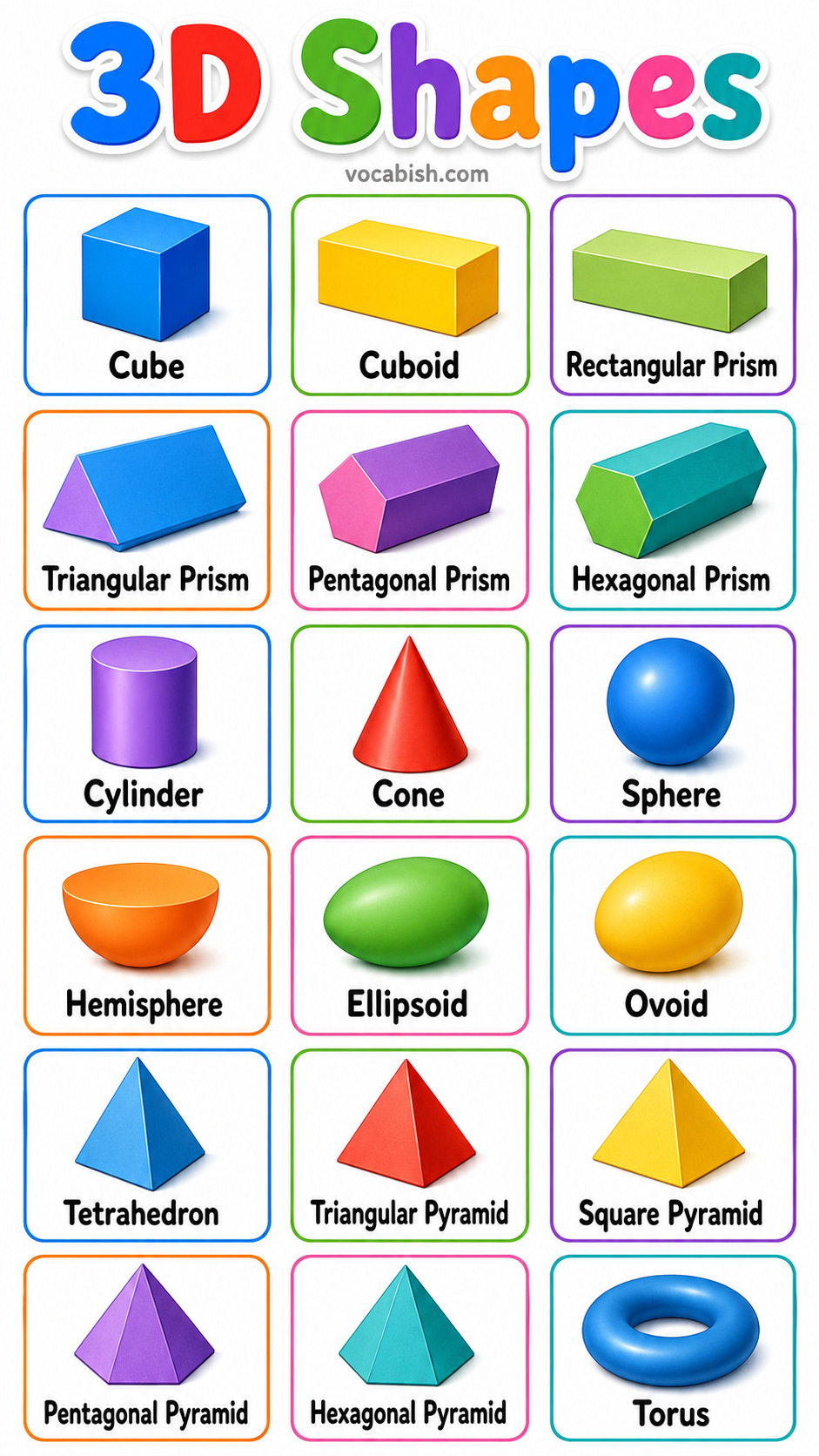
Important Parts of 3D Shapes
To understand 3D shapes, students should know these basic words.
Face
A face is a flat surface of a 3D shape.
Example:
A cube has 6 square faces.
Edge
An edge is where two faces meet.
Example:
A cube has 12 edges.
Vertex
A vertex is a corner where edges meet. The plural of vertex is vertices.
Example:
A cube has 8 vertices.
Curved Surface
Some 3D shapes have curved surfaces instead of only flat faces.
Examples:
- Sphere
- Cone
- Cylinder
List of 3D Shapes with Properties
3D Shape | Type | Faces / Surfaces | Edges | Vertices | Simple Description |
|---|---|---|---|---|---|
Cube | Solid shape | 6 flat faces | 12 | 8 | A box with 6 equal square faces |
Cuboid | Solid shape | 6 flat faces | 12 | 8 | A box with rectangular faces |
Rectangular Prism | Prism | 6 flat faces | 12 | 8 | A prism with rectangular faces |
Triangular Prism | Prism | 5 flat faces | 9 | 6 | A prism with 2 triangular faces |
Pentagonal Prism | Prism | 7 flat faces | 15 | 10 | A prism with pentagon bases |
Hexagonal Prism | Prism | 8 flat faces | 18 | 12 | A prism with hexagon bases |
Cylinder | Curved solid | 2 flat faces + 1 curved surface | 2 curved edges | 0 | A shape like a can |
Cone | Curved solid | 1 flat face + 1 curved surface | 1 curved edge | 1 | A shape with a circular base and point |
Sphere | Curved solid | 1 curved surface | 0 | 0 | A perfectly round solid shape |
Hemisphere | Curved solid | 1 flat face + 1 curved surface | 1 curved edge | 0 | Half of a sphere |
Ellipsoid | Curved solid | 1 curved surface | 0 | 0 | A stretched sphere |
Ovoid | Curved solid | 1 curved surface | 0 | 0 | An egg-shaped solid |
Tetrahedron | Pyramid | 4 flat faces | 6 | 4 | A pyramid with triangular faces |
Triangular Pyramid | Pyramid | 4 flat faces | 6 | 4 | A pyramid with a triangular base |
Square Pyramid | Pyramid | 5 flat faces | 8 | 5 | A pyramid with a square base |
Pentagonal Pyramid | Pyramid | 6 flat faces | 10 | 6 | A pyramid with a pentagon base |
Hexagonal Pyramid | Pyramid | 7 flat faces | 12 | 7 | A pyramid with a hexagon base |
Torus | Curved solid | 1 curved surface | 0 | 0 | A ring-shaped solid |
Common 3D Shapes Explained
Cube
A cube has 6 equal square faces, 12 edges, and 8 vertices.
Examples:
- Dice
- Ice cube
- Building block
- Cube box
Cuboid
A cuboid has 6 rectangular faces, 12 edges, and 8 vertices.
Examples:
- Brick
- Book
- Shoebox
- Cereal box
Rectangular Prism
A rectangular prism is a 3D shape with rectangular faces. It is very similar to a cuboid.
Examples:
- Tissue box
- Room
- Book
- Packaging box
Triangular Prism
A triangular prism has two triangular faces and three rectangular faces.
Examples:
- Tent
- Roof shape
- Some chocolate bars
Cylinder
A cylinder has two circular flat faces and one curved surface.
Examples:
- Can
- Drum
- Pipe
- Candle
- Jar
Cone
A cone has one circular base, one curved surface, and one vertex.
Examples:
- Ice cream cone
- Party hat
- Traffic cone
- Funnel
Sphere
A sphere is a perfectly round 3D shape. It has no edges and no vertices.
Examples:
- Ball
- Globe
- Marble
- Orange
- Planet
Hemisphere
A hemisphere is half of a sphere.
Examples:
- Bowl shape
- Dome
- Half ball
Pyramid
A pyramid has a base and triangular faces that meet at one top point.
Examples:
- Egyptian pyramids
- Tent-like structures
- Decorative objects
Prism
A prism has two matching bases and flat side faces.
Examples:
- Triangular prism
- Rectangular prism
- Pentagonal prism
- Hexagonal prism
2D Shapes vs 3D Shapes: Complete Comparison
Point of Difference | 2D Shapes | 3D Shapes |
|---|---|---|
Shape Type | Flat | Solid |
Dimensions | 2 dimensions | 3 dimensions |
Has Length | Yes | Yes |
Has Width | Yes | Yes |
Has Height / Depth | No | Yes |
Can Be Drawn on Paper | Yes | Yes, but as a 3D drawing |
Can Be Held as an Object | No | Yes |
Main Parts | Sides and corners | Faces, edges, and vertices |
Examples | Circle, square, triangle | Cube, cone, sphere |
Measurement | Area and perimeter | Surface area and volume |
Classroom Level | Early geometry | Early and advanced geometry |
2D and 3D Shapes Examples in Real Life
Shapes are not only found in books. They are everywhere around us.
Real-Life Object | Shape |
|---|---|
Clock | Circle |
Door | Rectangle |
Tile | Square |
Pizza slice | Triangle |
Egg | Oval |
Stop sign | Octagon |
Honeycomb | Hexagon |
Dice | Cube |
Book | Rectangular prism |
Can | Cylinder |
Ball | Sphere |
Ice cream cone | Cone |
Roof | Triangular prism |
Bowl | Hemisphere |
Pyramid model | Square pyramid |
How to Identify 2D and 3D Shapes
Students can identify shapes by asking simple questions.
Questions for 2D Shapes
Ask:
- Is it flat?
- Does it have sides?
- Does it have corners?
- Is it round?
- How many sides does it have?
- How many corners does it have?
Example:
A shape has 3 sides and 3 corners.
It is a triangle.
Questions for 3D Shapes
Ask:
- Is it solid?
- Can it be held?
- Does it have faces?
- Does it have curved surfaces?
- How many edges does it have?
- How many vertices does it have?
Example:
A shape has 6 square faces, 12 edges, and 8 vertices.
It is a cube.
Shape Family Tree
This simple family tree helps students understand how shapes are connected.
Geometric Shapes
Geometric shapes can be divided into:
- 2D Shapes
- 3D Shapes
2D Shapes
2D shapes can be divided into:
- Curved shapes
- Polygons
Curved shapes:
- Circle
- Oval
- Semicircle
Polygons:
- Triangle
- Quadrilateral
- Pentagon
- Hexagon
- Heptagon
- Octagon
- Decagon
3D Shapes
3D shapes can be divided into:
- Polyhedrons
- Curved solids
Polyhedrons have only flat faces.
Examples:
- Cube
- Prism
- Pyramid
Curved solids have curved surfaces.
Examples:
- Cylinder
- Cone
- Sphere
- Hemisphere
- Torus
Flat Faces vs Curved Surfaces
This is an important concept that many students confuse.
A flat face is a straight, flat surface.
A curved surface is rounded.
Examples:
Shape | Flat Face | Curved Surface |
|---|---|---|
Cube | Yes | No |
Rectangular Prism | Yes | No |
Cylinder | Yes | Yes |
Cone | Yes | Yes |
Sphere | No | Yes |
Hemisphere | Yes | Yes |
- A cube has only flat faces.
- A sphere has only a curved surface.
- A cylinder has both flat faces and a curved surface.
Sides, Edges, Corners, Faces, and Vertices
Students often mix these words. Here is a simple explanation.
Word | Used For | Meaning |
|---|---|---|
Side | Mostly 2D shapes | A straight line around a flat shape |
Corner | 2D shapes | A point where two sides meet |
Vertex | 2D and 3D shapes | A corner point |
Edge | Mostly 3D shapes | A line where two faces meet |
Face | 3D shapes | A flat surface of a solid shape |
Surface | 3D shapes | Any outside part of a solid shape |
For young learners, use corner first. For higher grades, introduce vertex and vertices.
Regular and Irregular Shapes
Regular Shape
A regular shape has all sides equal and all angles equal.
Examples:
- Regular triangle
- Square
- Regular pentagon
- Regular hexagon
Irregular Shape
An irregular shape does not have all sides or all angles equal.
Examples:
- Irregular pentagon
- Irregular hexagon
- Irregular quadrilateral
Important note:
A shape can still be a polygon even if it is irregular. It only needs to be closed and made of straight sides.
2D Shapes Formulas
Older students may also learn basic formulas for 2D shapes.
2D Shape | Area Formula | Perimeter / Circumference Formula |
|---|---|---|
Square | side × side | 4 × side |
Rectangle | length × width | 2 × (length + width) |
Triangle | 1/2 × base × height | side + side + side |
Circle | π × radius² | 2 × π × radius |
Parallelogram | base × height | 2 × (base + side) |
Trapezoid | 1/2 × (a + b) × height | sum of all sides |
For younger students, focus on names, sides, and corners first. Formulas should be introduced later.
3D Shapes Formulas
Older students may learn surface area and volume of 3D shapes.
3D Shape | Volume Formula | Surface Area Formula |
|---|---|---|
Cube | side³ | 6 × side² |
Rectangular Prism | length × width × height | 2(lw + lh + wh) |
Cylinder | πr²h | 2πr(r + h) |
Cone | 1/3 × πr²h | πr(r + l) |
Sphere | 4/3 × πr³ | 4πr² |
For early learners, it is better to focus on faces, edges, vertices, and real-life examples.
Why Students Learn 2D and 3D Shapes
Learning 2D and 3D shapes helps students build early math skills.
It also improves:
- Visual recognition
- Sorting skills
- Drawing skills
- Vocabulary
- Problem-solving
- Measurement skills
- Spatial awareness
- Real-world observation
Shapes also help students understand patterns, symmetry, maps, design, architecture, art, and science.
Common Mistakes Students Make
Students often make mistakes when learning 2D and 3D shapes.
1: Calling a Cube a Square
A square is flat. A cube is solid.
- Square = 2D
- Cube = 3D
2: Calling a Ball a Circle
A circle is flat. A ball is a sphere.
- Circle = 2D
- Sphere = 3D
3: Confusing Rectangle and Rectangular Prism
A rectangle is flat. A rectangular prism is solid.
- Rectangle = 2D
- Rectangular prism = 3D
4: Thinking All Shapes Have Straight Sides
Some shapes have curved boundaries or curved surfaces.
Examples:
- Circle
- Oval
- Sphere
- Cylinder
- Cone
5: Thinking a Circle Is a Polygon
A circle is not a polygon because it does not have straight sides.
Teaching Tips for 2D and 3D Shapes
Teachers and parents can make shape learning easier with simple activities.
Use Real Objects
Show students real objects.
Examples:
- Ball for sphere
- Can for cylinder
- Dice for cube
- Book for rectangular prism
- Clock for circle
Compare Flat and Solid Shapes
Show a square drawing and a cube object. Ask students what is different.
Use Shape Sorting
Ask students to sort shapes into two groups:
- 2D shapes
- 3D shapes
Use Drawing and Coloring
Let students draw and color shapes. This helps them remember names and features.
Ask Simple Questions
Examples:
- Is this shape flat or solid?
- How many sides does it have?
- How many corners does it have?
- Can you hold it?
- Does it roll?
Summary
2D shapes and 3D shapes are basic parts of geometry. A 2D shape is flat and has length and width. A 3D shape is solid and has length, width, and height or depth.
Examples of 2D shapes include circle, triangle, square, rectangle, pentagon, hexagon, and octagon. Examples of 3D shapes include cube, rectangular prism, cylinder, cone, sphere, prism, and pyramid.
Students should learn shape names, properties, sides, corners, faces, edges, vertices, and real-life examples. Understanding 2D and 3D shapes builds a strong foundation for geometry, measurement, drawing, problem-solving, and everyday observation.
2D and 3D Shapes PDF
FAQs on 2D Shapes and 3D Shapes
2D shapes are flat shapes that have length and width. They do not have height or depth. Examples include circle, square, triangle, rectangle, oval, pentagon, and hexagon.
3D shapes are solid shapes that have length, width, and height or depth. Examples include cube, cone, cylinder, sphere, pyramid, and rectangular prism.
The main difference is that 2D shapes are flat, while 3D shapes are solid. A square is 2D, but a cube is 3D.
A circle is a 2D shape because it is flat and has only length and width.
A sphere is a 3D shape because it is solid and has length, width, and height.
No. A square is a flat 2D shape. A cube is a solid 3D shape with 6 square faces.
Examples of 2D shapes in real life include a clock face as a circle, a tile as a square, a door outline as a rectangle, and a pizza slice as a triangle.
No. A rectangle is a flat 2D shape. A rectangular prism is a solid 3D shape, like a book or box.
Faces are flat surfaces of 3D shapes. Edges are lines where two faces meet. Vertices are corner points where edges meet.
You May Also Like: