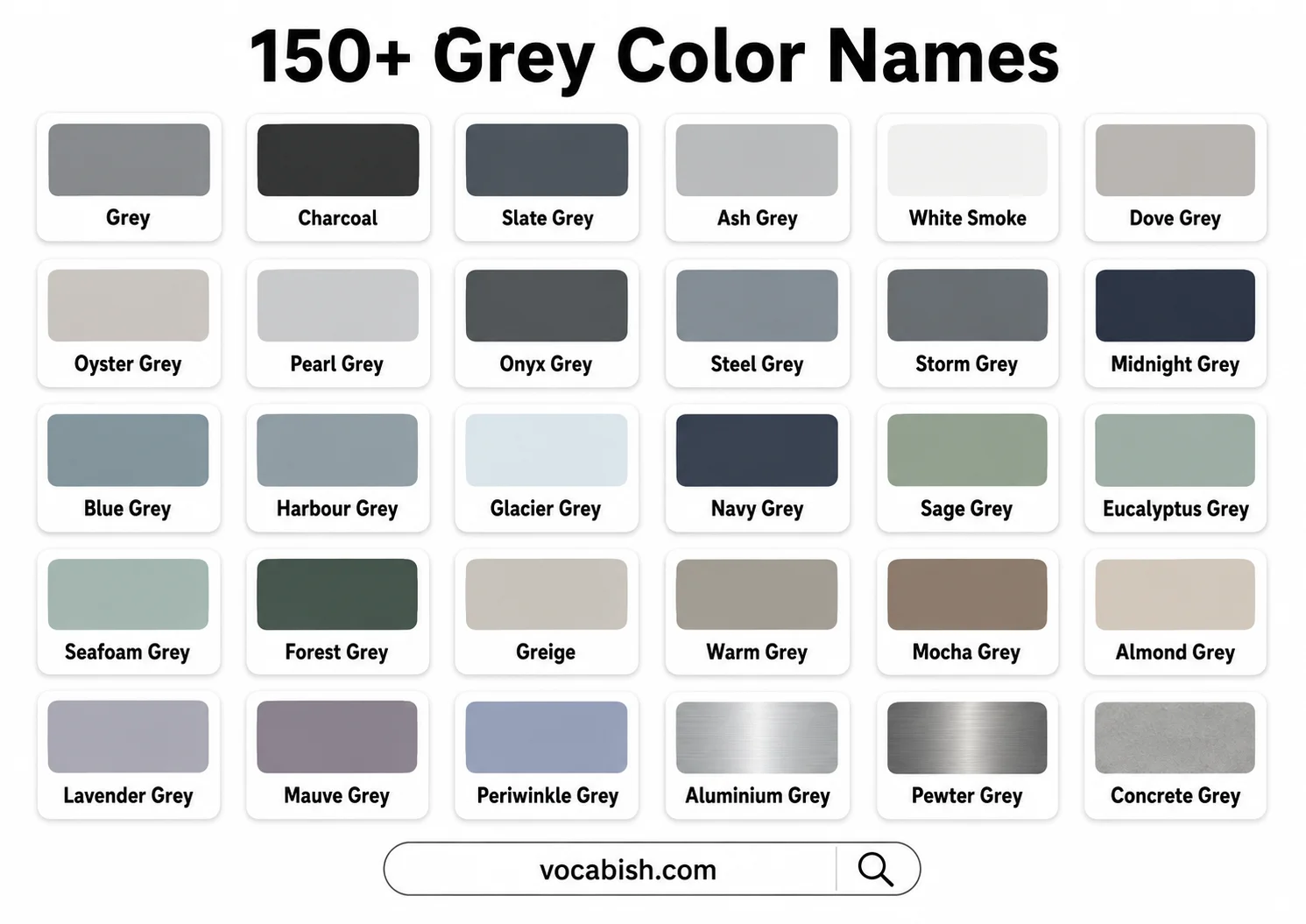

Grey color names include many more shades than light grey, dark grey, and silver. This colour family has warm, cool, pale, deep, metallic, blue-grey, green-grey, and purple-grey tones. Each shade has its own look and meaning. Names such as charcoal, slate grey, ash grey, dove grey, greige, and pewter describe these colours more clearly. They are useful in art, fashion, interior design, branding, and everyday English. This article includes 150+ grey shades with HEX codes, RGB values, meanings, and colour previews through pictures.
What Is the Colour Grey?
Grey is a neutral colour located between black and white. A perfectly neutral grey contains equal amounts of red, green, and blue light, but many everyday greys have visible undertones.
Grey can be pale, deep, warm, cool, metallic, dusty, smoky, earthy, or blue-toned. This range explains why designers, artists, clothing brands, and paint companies use so many different names of grey colors.
Quick definition: Grey is a neutral or low-saturation colour created by combining different amounts of black and white or balancing red, green, and blue light.
The pronunciation of grey is:
Grey: /ɡreɪ/
It rhymes with day, say, play, and way.
How to Read Grey Color Codes
Digital colors are commonly written as HEX or RGB values. These codes help websites, apps, graphic-design programs, and digital tools display a chosen colour more consistently.
CSS supports several ways of representing color, including HEX notation, RGB functions, and named color keywords.
What Is a HEX Code?
A HEX code contains a hash sign followed by six letters or numbers.
Example:
Grey: #808080
The six characters represent the amounts of red, green, and blue in the colour.
- First pair: red
- Second pair: green
- Third pair: blue
When all three values are equal, the result is a neutral grey.
What Is an RGB Code?
RGB means:
- R: Red
- G: Green
- B: Blue
Each RGB value normally ranges from 0 to 255.
For example:
Grey: RGB(128, 128, 128)
Because red, green, and blue have equal values, this colour is a balanced neutral grey.
Are All Grey Names Standardized?
No. Some names, such as grey, light grey, dark grey, dim grey, slate grey, and gainsboro, are standardized web color keywords.
Other names are used descriptively in art, fashion, interiors, products, branding, or paint collections. Their exact appearance may vary between manufacturers and color systems.
The codes in the following grey colors chart provide practical digital references for each named shade.
Grey Color Families at a Glance
Grey shades can be organized by brightness, undertone, material, or visual impression. Learning these groups makes a long grey colors list easier to understand.
Grey family | Main appearance | Common examples |
|---|---|---|
Neutral grey | Balanced without a strong undertone | Grey, neutral grey, dim grey |
Light grey | Pale and close to white | Dove grey, mist grey, paper grey |
Dark grey | Deep and close to black | Charcoal, graphite, coal grey |
Blue-grey | Grey with blue undertones | Slate grey, rain grey, steel grey |
Green-grey | Grey with green undertones | Sage grey, moss grey, patina grey |
Warm grey | Grey with beige, brown, or red undertones | Greige, mushroom grey, taupe |
Purple-grey | Grey with violet or mauve undertones | Lavender grey, plum grey |
Metallic grey | Grey associated with metal | Silver, pewter, titanium grey |
150+ Grey Color Names and Codes
The following grey color names chart contains 160 shades. Each entry includes a HEX code, an RGB value, and a short description of the shade’s appearance or common impression.
Color meanings are not fixed rules. Culture, lighting, surrounding colors, materials, and personal experience can change how a grey shade feels.
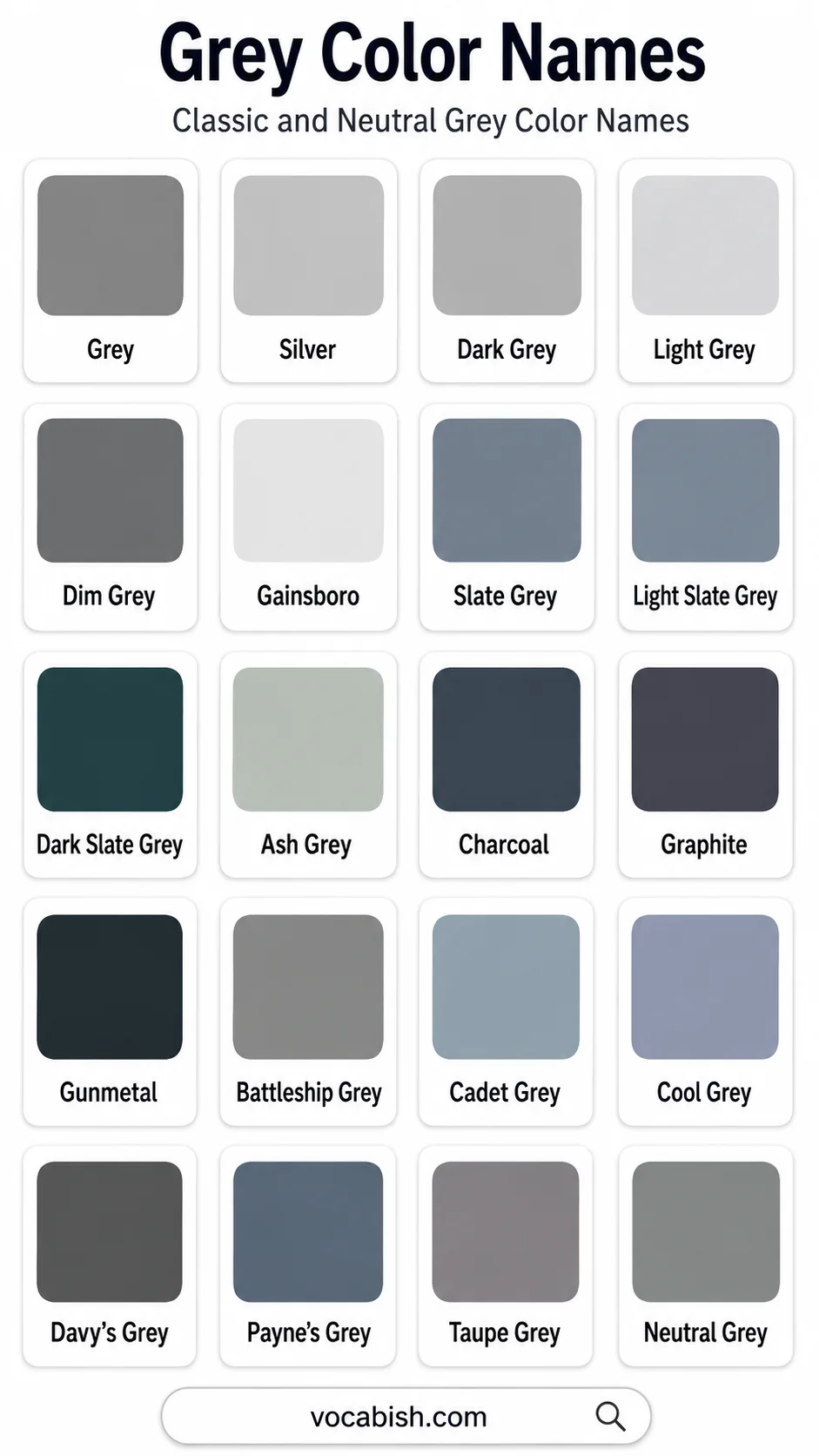
Classic and Neutral Grey Color Names
These are some of the most widely recognized greys. They include balanced neutrals, traditional artist colors, and familiar stone or mineral shades.
Grey colour name | HEX code | RGB code | Meaning or impression |
|---|---|---|---|
Grey | #808080 | 128, 128, 128 | A balanced and widely recognized mid-grey. |
Silver | #C0C0C0 | 192, 192, 192 | A light metallic-looking grey linked with polish and technology. |
Dark Grey | #A9A9A9 | 169, 169, 169 | A medium-light standard web grey despite its name. |
Light Grey | #D3D3D3 | 211, 211, 211 | A pale neutral often used for soft backgrounds. |
Dim Grey | #696969 | 105, 105, 105 | A muted dark grey with a quiet, low-light feel. |
Gainsboro | #DCDCDC | 220, 220, 220 | A very light grey used as a named web colour. |
Slate Grey | #708090 | 112, 128, 144 | A blue-grey inspired by natural slate stone. |
Light Slate Grey | #778899 | 119, 136, 153 | A softer and lighter form of slate grey. |
Dark Slate Grey | #2F4F4F | 47, 79, 79 | A deep blue-green grey with a serious mood. |
Ash Grey | #B2BEB5 | 178, 190, 181 | A pale greenish grey associated with cooled ash. |
Charcoal | #36454F | 54, 69, 79 | A deep grey that resembles burned wood. |
Graphite | #41424C | 65, 66, 76 | A dark mineral grey inspired by pencil graphite. |
Gunmetal | #2A3439 | 42, 52, 57 | A dark blue-grey associated with metal surfaces. |
Battleship Grey | #848482 | 132, 132, 130 | A practical medium grey linked with naval paint. |
Cadet Grey | #91A3B0 | 145, 163, 176 | A cool blue-grey with a calm, formal appearance. |
Cool Grey | #8C92AC | 140, 146, 172 | A grey with noticeable blue or violet undertones. |
Davy’s Grey | #555555 | 85, 85, 85 | A dark artist’s grey traditionally used in painting. |
Payne’s Grey | #536878 | 83, 104, 120 | A blue-toned dark grey popular in watercolor painting. |
Taupe Grey | #8B8589 | 139, 133, 137 | A grey balanced with soft brown and violet notes. |
Neutral Grey | #898E8C | 137, 142, 140 | A middle grey that feels neither strongly warm nor cool. |
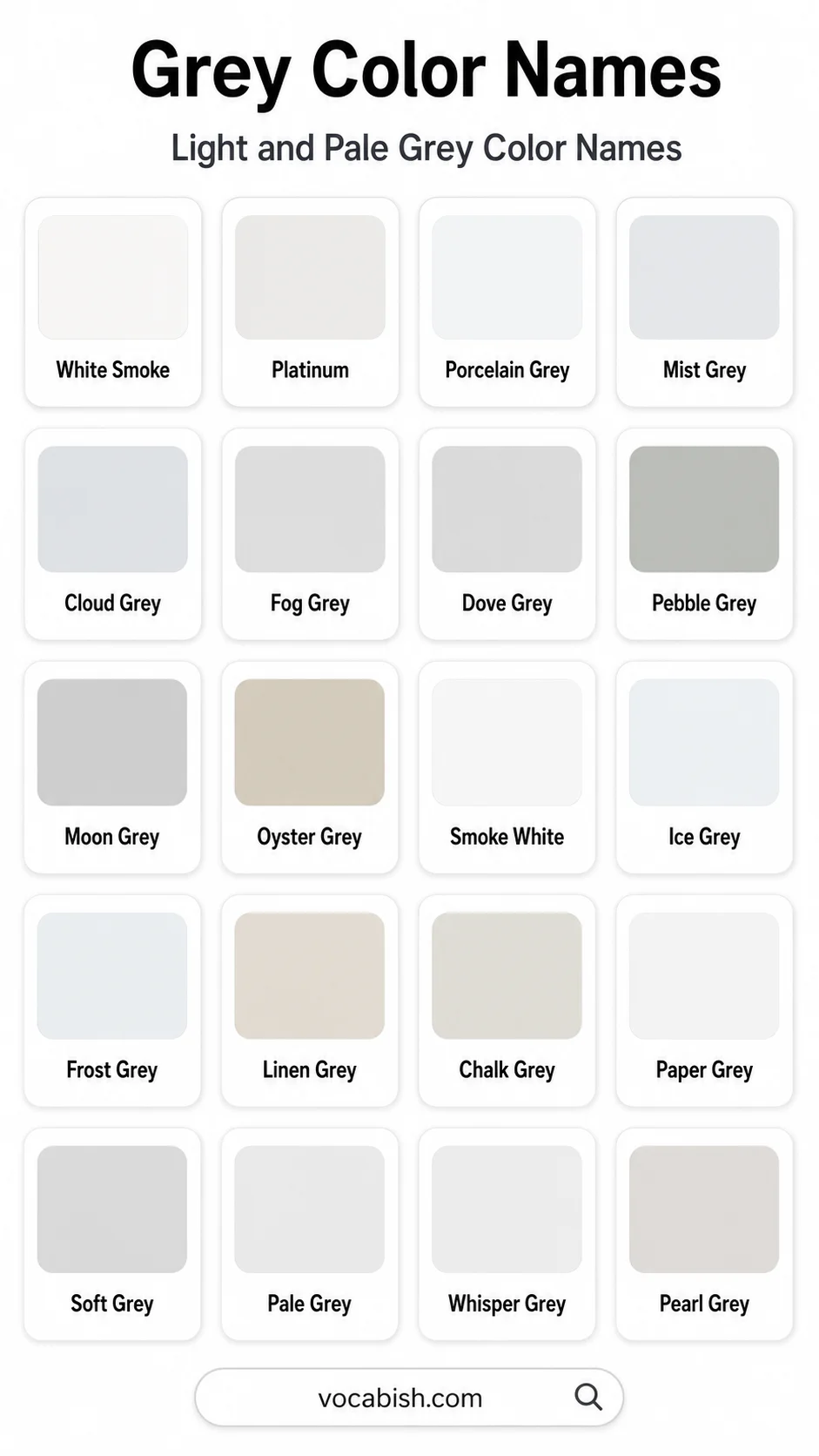
Light and Pale Grey Color Names
Light greys create a soft, open, and quiet appearance. They are often used for backgrounds, walls, clothing, stationery, and minimalist designs.
Grey colour name | HEX code | RGB code | Meaning or impression |
|---|---|---|---|
White Smoke | #F5F5F5 | 245, 245, 245 | An almost-white grey used for clean digital backgrounds. |
Platinum | #E5E4E2 | 229, 228, 226 | A pale silvery grey named after the precious metal. |
Porcelain Grey | #F2F3F4 | 242, 243, 244 | A delicate near-white grey with a clean ceramic feel. |
Mist Grey | #E5E7E9 | 229, 231, 233 | A soft grey that recalls thin morning mist. |
Cloud Grey | #D8DDE2 | 216, 221, 226 | A light cool grey inspired by overcast clouds. |
Fog Grey | #D7D8D6 | 215, 216, 214 | A muted pale grey with low visual contrast. |
Dove Grey | #D6D6D6 | 214, 214, 214 | A gentle light grey associated with dove feathers. |
Pebble Grey | #B4B8B0 | 180, 184, 176 | A natural grey with a faint earthy-green undertone. |
Moon Grey | #C7C7C7 | 199, 199, 199 | A quiet silver-grey inspired by moonlight. |
Oyster Grey | #CBC1AE | 203, 193, 174 | A warm pale grey with beige shell-like undertones. |
Smoke White | #F0F0F0 | 240, 240, 240 | A white-grey softened by a trace of smoke. |
Ice Grey | #E8ECEF | 232, 236, 239 | A very pale blue-grey with a crisp, cold feeling. |
Frost Grey | #E1E5E8 | 225, 229, 232 | A cool light grey resembling a frosted surface. |
Linen Grey | #D9D3C7 | 217, 211, 199 | A warm fabric-like grey with beige undertones. |
Chalk Grey | #D7D5CB | 215, 213, 203 | A dusty pale grey inspired by chalk. |
Paper Grey | #EDEDED | 237, 237, 237 | A near-white neutral suited to page backgrounds. |
Soft Grey | #D1D1D1 | 209, 209, 209 | A gentle grey with low visual intensity. |
Pale Grey | #E4E4E4 | 228, 228, 228 | A light neutral grey with little contrast. |
Whisper Grey | #E6E6E6 | 230, 230, 230 | An extremely quiet and barely noticeable grey. |
Pearl Grey | #D9D5D2 | 217, 213, 210 | A luminous warm-grey inspired by pale pearls. |
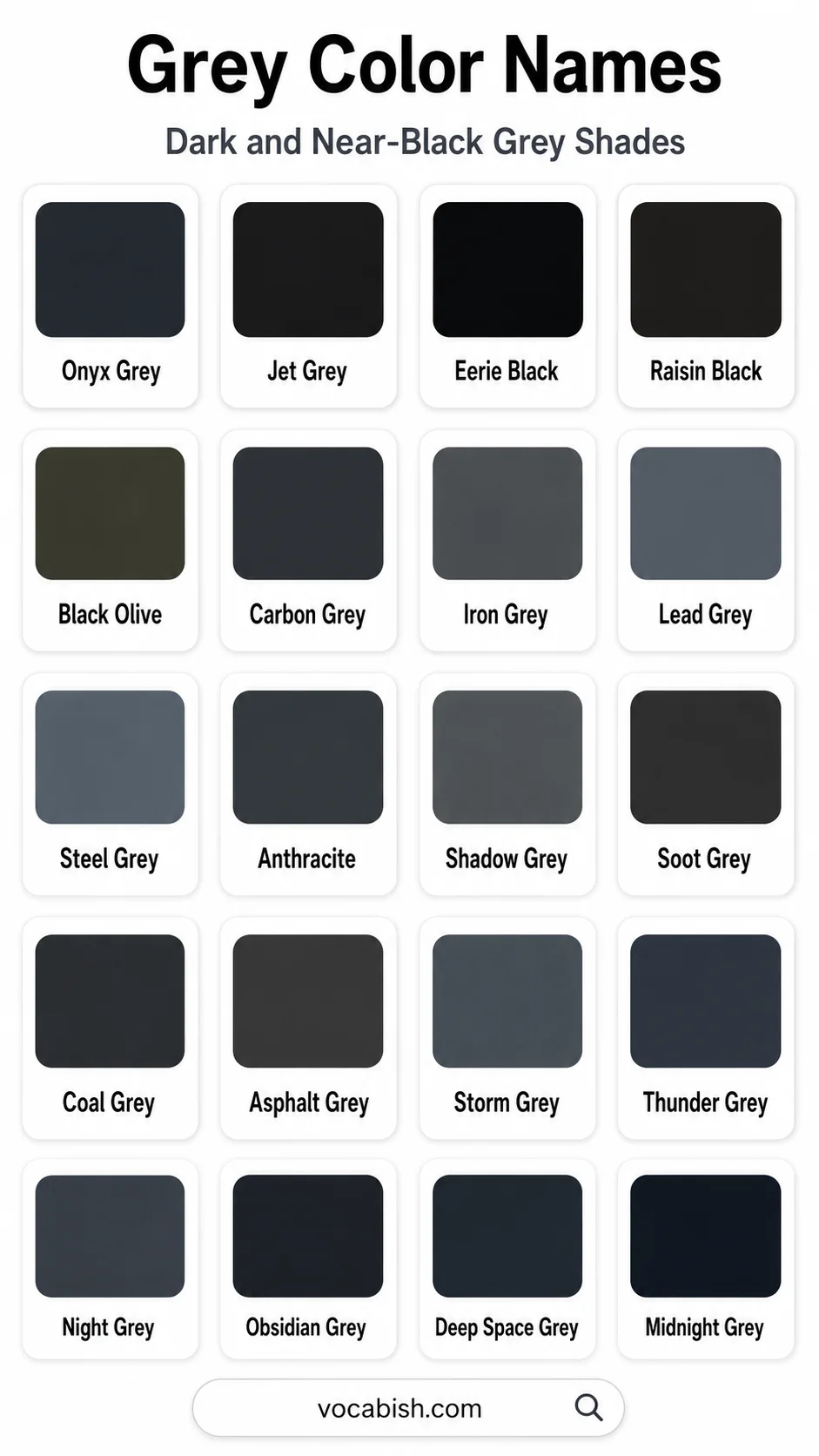
Dark and Near-Black Grey Shades
Dark greys have strength and depth without appearing as absolute black. They are common in modern products, dark interfaces, vehicles, clothing, and industrial design.
Grey colour name | HEX code | RGB code | Meaning or impression |
|---|---|---|---|
Onyx Grey | #353839 | 53, 56, 57 | A dark polished grey inspired by onyx stone. |
Jet Grey | #343434 | 52, 52, 52 | A near-black grey with a smooth, dense appearance. |
Eerie Black | #1B1B1B | 27, 27, 27 | A very deep grey-black with a dramatic mood. |
Raisin Black | #242124 | 36, 33, 36 | A blackened grey with a subtle purple-brown cast. |
Black Olive | #3B3C36 | 59, 60, 54 | A very dark olive-grey with muted green tones. |
Carbon Grey | #4A4A4A | 74, 74, 74 | A dense industrial grey linked with carbon material. |
Iron Grey | #48494B | 72, 73, 75 | A strong dark grey inspired by iron. |
Lead Grey | #575961 | 87, 89, 97 | A heavy-looking cool grey associated with lead metal. |
Steel Grey | #71797E | 113, 121, 126 | A medium-dark blue-grey with an industrial character. |
Anthracite | #383E42 | 56, 62, 66 | A charcoal-like grey named after hard coal. |
Shadow Grey | #4B4E53 | 75, 78, 83 | A dark neutral grey that suggests shaded areas. |
Soot Grey | #3D3D3D | 61, 61, 61 | A deep dusty grey based on soot. |
Coal Grey | #2B2B2B | 43, 43, 43 | A near-black grey inspired by coal. |
Asphalt Grey | #3B3B3B | 59, 59, 59 | A dark grey resembling a road surface. |
Storm Grey | #4F5B66 | 79, 91, 102 | A dark blue-grey associated with storm clouds. |
Thunder Grey | #474A51 | 71, 74, 81 | A deep cool grey with a forceful appearance. |
Night Grey | #2E3033 | 46, 48, 51 | A near-black cool grey suited to dark designs. |
Obsidian Grey | #303033 | 48, 48, 51 | A deep grey inspired by volcanic glass. |
Deep Space Grey | #3A3D42 | 58, 61, 66 | A dark modern grey associated with space and technology. |
Midnight Grey | #262A2E | 38, 42, 46 | A very dark blue-black grey. |
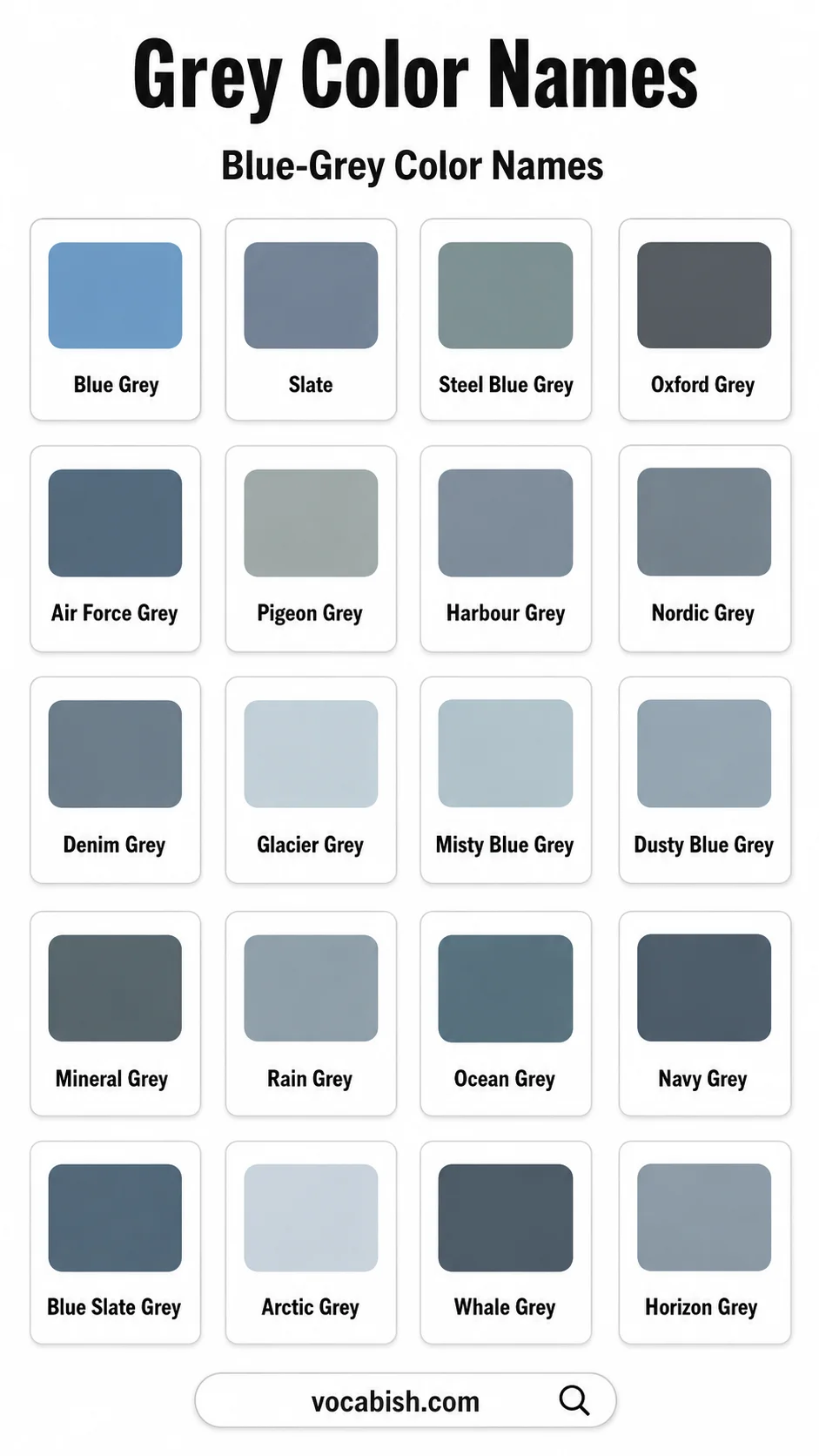
Blue-Grey Color Names
Blue-grey shades combine the calm appearance of blue with the neutrality of grey. They can look formal, cool, cloudy, marine, or metallic.
Grey colour name | HEX code | RGB code | Meaning or impression |
|---|---|---|---|
Blue Grey | #6699CC | 102, 153, 204 | A clear grey-blue combining calmness and neutrality. |
Slate | #708090 | 112, 128, 144 | A muted blue-grey named after slate rock. |
Steel Blue Grey | #6E7F80 | 110, 127, 128 | A subdued blue-grey with a metallic feel. |
Oxford Grey | #5A5D63 | 90, 93, 99 | A restrained dark cool grey with an academic mood. |
Air Force Grey | #5D6D7E | 93, 109, 126 | A disciplined blue-grey associated with aviation. |
Pigeon Grey | #9DA7A8 | 157, 167, 168 | A medium pale grey inspired by pigeon feathers. |
Harbour Grey | #7E8A97 | 126, 138, 151 | A cool grey recalling water, docks, and cloudy skies. |
Nordic Grey | #7C8792 | 124, 135, 146 | A clean cool grey linked with Scandinavian interiors. |
Denim Grey | #6F7C85 | 111, 124, 133 | A muted blue-grey similar to faded denim. |
Glacier Grey | #B4C4CF | 180, 196, 207 | A pale and icy blue-grey. |
Misty Blue Grey | #AABBC4 | 170, 187, 196 | A softened blue-grey with a hazy appearance. |
Dusty Blue Grey | #8797A5 | 135, 151, 165 | A muted blue-grey with reduced saturation. |
Mineral Grey | #5C6B73 | 92, 107, 115 | A cool stone-like grey with blue-green notes. |
Rain Grey | #8A9AA6 | 138, 154, 166 | A soft blue-grey inspired by rainy weather. |
Ocean Grey | #667A85 | 102, 122, 133 | A deep muted grey-blue associated with the sea. |
Navy Grey | #53616C | 83, 97, 108 | A dark and restrained blue-grey. |
Blue Slate Grey | #5B6D7A | 91, 109, 122 | A cool dark grey combining slate and blue. |
Arctic Grey | #C4CDD4 | 196, 205, 212 | A pale cold grey inspired by polar light. |
Whale Grey | #59666F | 89, 102, 111 | A dark marine blue-grey. |
Horizon Grey | #8D9AA5 | 141, 154, 165 | A grey-blue recalling a distant cloudy horizon. |
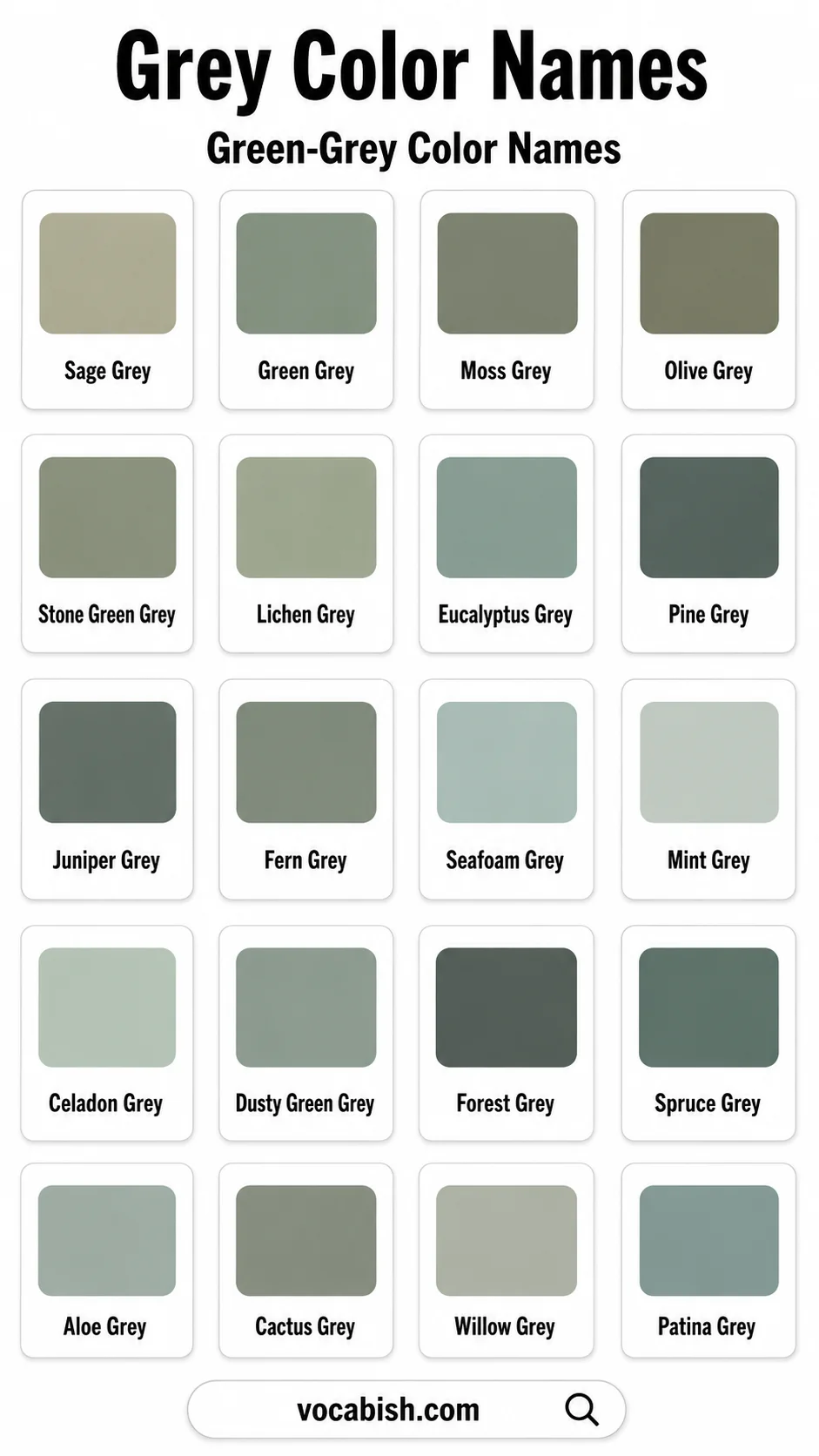
Green-Grey Color Names
Green-grey shades feel more natural and earthy than plain neutral grey. Their undertones may resemble herbs, leaves, moss, aged metal, or forest plants.
Grey colour name | HEX code | RGB code | Meaning or impression |
|---|---|---|---|
Sage Grey | #B2AC88 | 178, 172, 136 | A soft grey-green inspired by dried sage leaves. |
Green Grey | #8A9A8B | 138, 154, 139 | A neutral grey with visible green undertones. |
Moss Grey | #7A806B | 122, 128, 107 | An earthy grey-green similar to shaded moss. |
Olive Grey | #7D8061 | 125, 128, 97 | A muted grey mixed with olive green. |
Stone Green Grey | #8A9278 | 138, 146, 120 | A natural grey-green associated with weathered stone. |
Lichen Grey | #9AA58C | 154, 165, 140 | A muted green-grey inspired by lichen. |
Eucalyptus Grey | #8FA39A | 143, 163, 154 | A fresh, soft green-grey based on eucalyptus leaves. |
Pine Grey | #5F6B64 | 95, 107, 100 | A dark forest-influenced grey-green. |
Juniper Grey | #6B7770 | 107, 119, 112 | A cool botanical grey-green. |
Fern Grey | #7F8B7A | 127, 139, 122 | A muted leafy grey-green. |
Seafoam Grey | #A9BBB4 | 169, 187, 180 | A pale and watery green-grey. |
Mint Grey | #B7C1B7 | 183, 193, 183 | A very soft green-grey with a fresh appearance. |
Celadon Grey | #AEBFB0 | 174, 191, 176 | A pale grey-green inspired by celadon ceramics. |
Dusty Green Grey | #87978D | 135, 151, 141 | A desaturated green-grey with an aged look. |
Forest Grey | #59665D | 89, 102, 93 | A dark natural grey-green. |
Spruce Grey | #65736B | 101, 115, 107 | A cool evergreen grey. |
Aloe Grey | #9AA99F | 154, 169, 159 | A mild plant-like grey-green. |
Cactus Grey | #868D7C | 134, 141, 124 | A dry and muted green-grey. |
Willow Grey | #A1A89A | 161, 168, 154 | A soft grey-green inspired by willow leaves. |
Patina Grey | #7E918C | 126, 145, 140 | A blue-green grey recalling aged metal. |
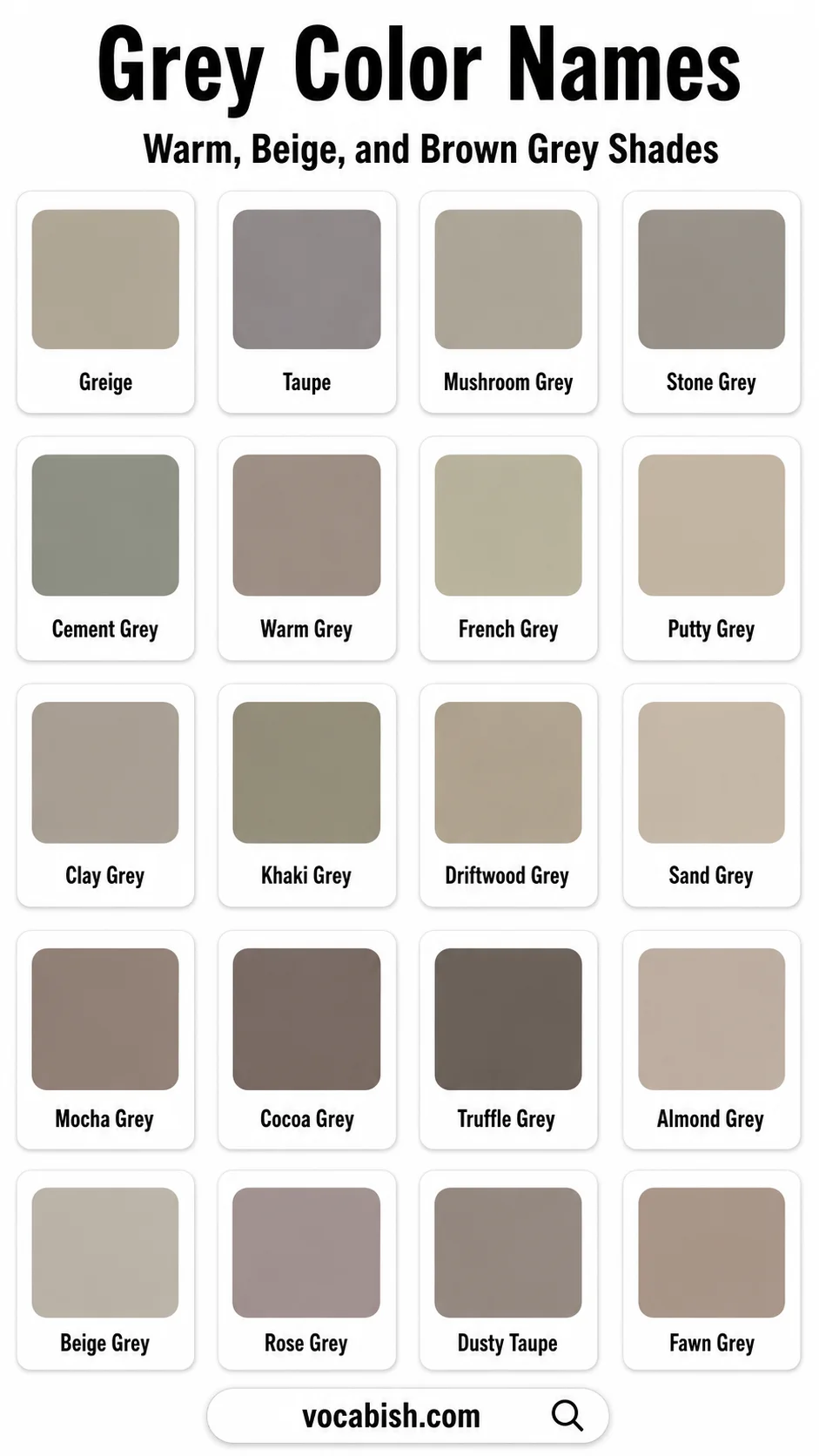
Warm, Beige, and Brown-Grey Shades
Warm greys contain beige, brown, yellow, red, or pink undertones. They often appear softer and earthier than blue-grey or silver-grey shades.
Grey colour name | HEX code | RGB code | Meaning or impression |
|---|---|---|---|
Greige | #B0A999 | 176, 169, 153 | A blend of grey and beige used in interiors. |
Taupe | #8B8589 | 139, 133, 137 | A muted grey-brown with soft violet notes. |
Mushroom Grey | #A89F91 | 168, 159, 145 | A warm earthy grey inspired by mushrooms. |
Stone Grey | #928E85 | 146, 142, 133 | A balanced warm grey based on natural stone. |
Cement Grey | #858A7E | 133, 138, 126 | A practical grey with slight green-brown undertones. |
Warm Grey | #978A84 | 151, 138, 132 | A grey softened by red, brown, or yellow undertones. |
French Grey | #B4B19A | 180, 177, 154 | A refined warm grey with green-beige notes. |
Putty Grey | #C1B6A4 | 193, 182, 164 | A light beige-grey resembling glazing putty. |
Clay Grey | #A49A8F | 164, 154, 143 | An earthy grey with soft brown undertones. |
Khaki Grey | #8D8976 | 141, 137, 118 | A muted grey-beige related to khaki fabric. |
Driftwood Grey | #A99D8C | 169, 157, 140 | A weathered warm grey inspired by old wood. |
Sand Grey | #B8B0A1 | 184, 176, 161 | A light warm grey mixed with sandy beige. |
Mocha Grey | #8B7D77 | 139, 125, 119 | A medium grey-brown with coffee-like warmth. |
Cocoa Grey | #766A64 | 118, 106, 100 | A darker brown-grey with a soft natural feel. |
Truffle Grey | #6B625C | 107, 98, 92 | A rich and dark grey-brown. |
Almond Grey | #B7ADA3 | 183, 173, 163 | A light warm grey with almond-beige notes. |
Beige Grey | #B7B3A8 | 183, 179, 168 | A pale neutral positioned between beige and grey. |
Rose Grey | #9E8E8E | 158, 142, 142 | A warm grey with a faded pink undertone. |
Dusty Taupe | #948B84 | 148, 139, 132 | A muted taupe-grey with an aged finish. |
Fawn Grey | #A89A8E | 168, 154, 142 | A warm soft grey influenced by light brown. |
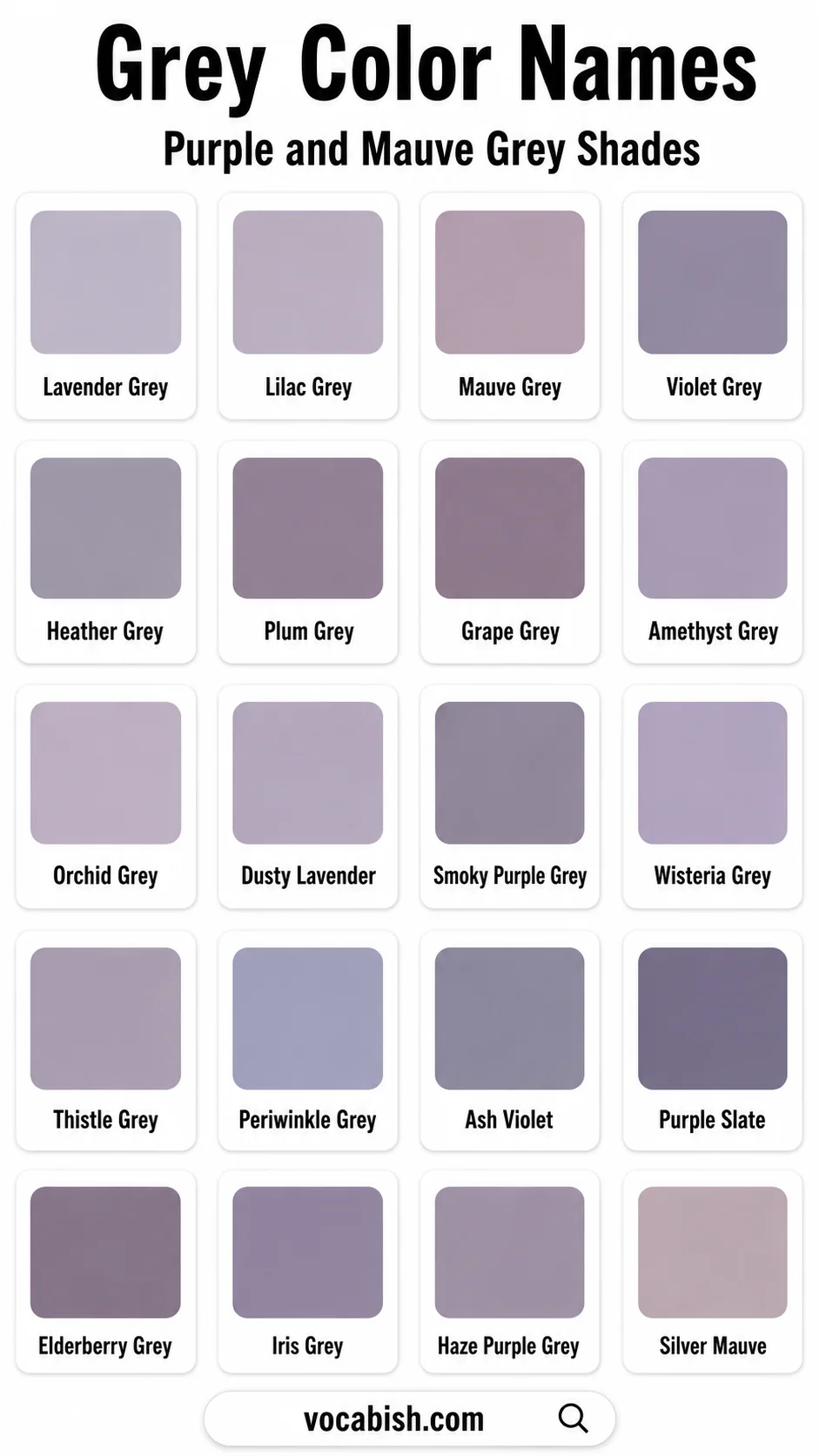
Purple and Mauve Grey Shades
Purple-grey shades contain lavender, mauve, plum, violet, or berry undertones. They can appear soft and delicate or deep and dramatic.
Grey colour name | HEX code | RGB code | Meaning or impression |
|---|---|---|---|
Lavender Grey | #C4C3D0 | 196, 195, 208 | A pale grey with a gentle lavender tint. |
Lilac Grey | #B6B1C0 | 182, 177, 192 | A light purple-grey with a soft floral feel. |
Mauve Grey | #9A8F9C | 154, 143, 156 | A muted grey-purple with dusty pink notes. |
Violet Grey | #7A7180 | 122, 113, 128 | A medium-dark grey with violet undertones. |
Heather Grey | #9AA0A6 | 154, 160, 166 | A soft mixed grey often seen in heathered fabric. |
Plum Grey | #6E5D6E | 110, 93, 110 | A dark grey-purple with plum undertones. |
Grape Grey | #665C68 | 102, 92, 104 | A subdued dark purple-grey. |
Amethyst Grey | #8B8195 | 139, 129, 149 | A muted gem-inspired purple-grey. |
Orchid Grey | #9A8C98 | 154, 140, 152 | A dusty floral grey-purple. |
Dusty Lavender | #A79AA8 | 167, 154, 168 | A low-saturation lavender-grey. |
Smoky Purple Grey | #766B76 | 118, 107, 118 | A dark and muted purple-grey. |
Wisteria Grey | #948A9C | 148, 138, 156 | A soft cool grey-purple inspired by wisteria. |
Thistle Grey | #B5AAB8 | 181, 170, 184 | A pale pink-purple grey. |
Periwinkle Grey | #9EA4B8 | 158, 164, 184 | A cool grey with soft periwinkle-blue notes. |
Ash Violet | #7D7480 | 125, 116, 128 | A dusty grey-violet. |
Purple Slate | #655E6C | 101, 94, 108 | A dark slate grey with purple undertones. |
Elderberry Grey | #5E5362 | 94, 83, 98 | A deep berry-influenced grey-purple. |
Iris Grey | #858092 | 133, 128, 146 | A muted grey-violet inspired by iris petals. |
Haze Purple Grey | #AAA2B2 | 170, 162, 178 | A light and misty purple-grey. |
Silver Mauve | #A7A0A8 | 167, 160, 168 | A silvery grey with a faint mauve cast. |
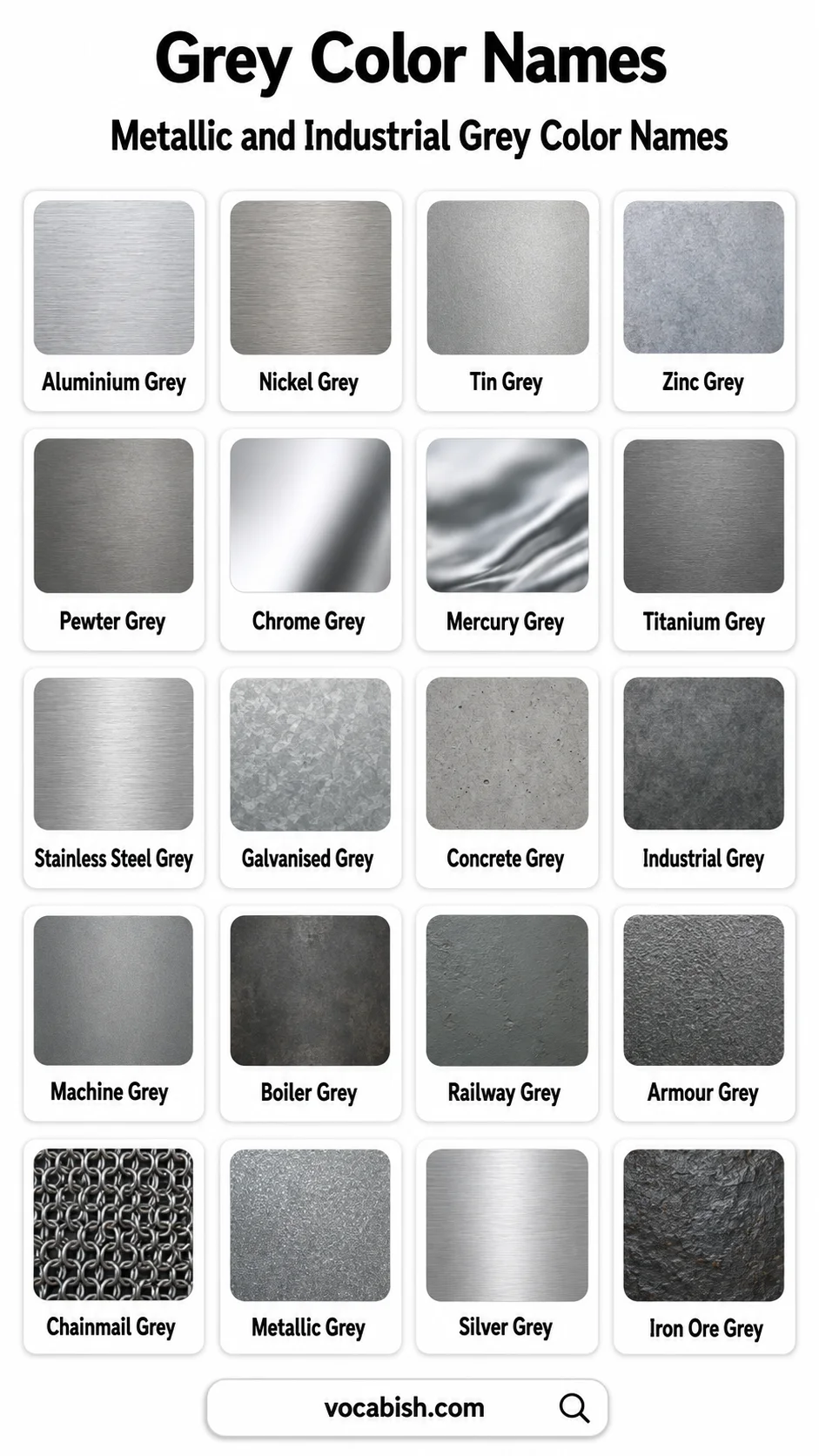
Metallic and Industrial Grey Color Names
These greys are named after metals, machinery, building materials, and industrial surfaces. A flat digital color cannot reproduce true metallic reflection, but it can suggest a similar base shade.
Grey colour name | HEX code | RGB code | Meaning or impression |
|---|---|---|---|
Aluminium Grey | #A8A9AD | 168, 169, 173 | A medium-light metallic grey inspired by aluminium. |
Nickel Grey | #727472 | 114, 116, 114 | A muted medium metallic grey. |
Tin Grey | #A4A9AD | 164, 169, 173 | A pale cool grey based on tin metal. |
Zinc Grey | #7A7F80 | 122, 127, 128 | A cool industrial grey inspired by zinc. |
Pewter Grey | #8E9190 | 142, 145, 144 | A soft medium grey associated with pewter. |
Chrome Grey | #D8D9DA | 216, 217, 218 | A bright grey suggesting reflective chrome. |
Mercury Grey | #E7E8E8 | 231, 232, 232 | A very pale liquid-metal-like grey. |
Titanium Grey | #878681 | 135, 134, 129 | A durable-looking warm metallic grey. |
Stainless Steel Grey | #C6C8C9 | 198, 200, 201 | A clean light grey resembling brushed steel. |
Galvanised Grey | #A8AFB3 | 168, 175, 179 | A cool light industrial grey. |
Concrete Grey | #9E9E98 | 158, 158, 152 | A neutral grey based on construction concrete. |
Industrial Grey | #6F7376 | 111, 115, 118 | A practical medium-dark grey for machinery and interiors. |
Machine Grey | #7A7B78 | 122, 123, 120 | A functional grey associated with equipment. |
Boiler Grey | #6D7072 | 109, 112, 114 | A dark industrial grey used for heavy surfaces. |
Railway Grey | #5B5F62 | 91, 95, 98 | A strong dark grey associated with transport equipment. |
Armour Grey | #6A6D70 | 106, 109, 112 | A solid medium-dark grey with a protective feel. |
Chainmail Grey | #84878A | 132, 135, 138 | A cool metallic grey inspired by linked armour. |
Metallic Grey | #8C8D8F | 140, 141, 143 | A general grey with a metal-like appearance. |
Silver Grey | #BFC1C2 | 191, 193, 194 | A light polished grey close to silver. |
Iron Ore Grey | #43464B | 67, 70, 75 | A deep mineral grey inspired by iron-rich rock. |
Warm Grey vs Cool Grey
Two shades can have similar brightness but look very different because of their undertones. The easiest way to compare them is to place each grey beside pure white.
Feature | Warm grey | Cool grey |
|---|---|---|
Main undertones | Brown, beige, yellow, red, or pink | Blue, green, or violet |
Common appearance | Soft, earthy, inviting | Crisp, calm, modern |
Examples | Greige, taupe, mushroom grey | Slate grey, steel grey, rain grey |
Often paired with | Cream, brown, tan, warm wood | White, navy, blue, cool metals |
Natural associations | Sand, clay, stone, mushrooms | Rain, clouds, steel, ocean water |
How to Identify a Warm Grey
Place the grey next to white or cool blue. A warm grey may begin to look slightly beige, brown, pink, or yellow.
Examples include:
- Greige
- Putty grey
- Sand grey
- Mushroom grey
- Rose grey
How to Identify a Cool Grey
Place the grey beside cream, beige, or warm brown. A cool grey may begin to show blue, green, or violet undertones.
Examples include:
- Slate grey
- Steel grey
- Arctic grey
- Patina grey
- Lavender grey
Light, Medium, and Dark Grey
Brightness changes both the appearance and use of a grey. A light grey contains more white, while a dark grey contains more black or lower RGB values.
Level | Approximate appearance | Example colors |
|---|---|---|
Very light grey | Almost white | White smoke, paper grey, porcelain grey |
Light grey | Soft and pale | Dove grey, pearl grey, cloud grey |
Medium grey | Clearly grey | Grey, pewter grey, neutral grey |
Dark grey | Deep but distinguishable from black | Charcoal, iron grey, storm grey |
Near-black grey | Almost black | Coal grey, midnight grey, eerie black |
A colour’s HEX code can help you estimate its brightness, but visible results also depend on screen settings, lighting, and surrounding colors.
What Do Grey Shades Represent?
Grey commonly suggests neutrality, balance, maturity, restraint, practicality, or calmness. However, the impression changes with the shade and context.
Light Grey Meanings
Light greys may suggest:
- Cleanliness
- Calmness
- Openness
- Softness
- Modern minimalism
Medium Grey Meanings
Medium greys may suggest:
- Balance
- Neutrality
- Reliability
- Practicality
- Formality
Dark Grey Meanings
Dark greys may suggest:
- Strength
- Seriousness
- Authority
- Modern technology
- Quiet sophistication
Warm Grey Meanings
Warm greys often appear:
- Comfortable
- Natural
- Relaxed
- Earthy
- Welcoming
Cool Grey Meanings
Cool greys often appear:
- Controlled
- Calm
- Professional
- Technical
- Contemporary
These associations are flexible rather than universal. The same charcoal grey may feel sophisticated in clothing but heavy when used across an entire room.
How to Choose the Right Grey
The best grey depends on where it will appear, what surrounds it, and what impression you want to create.
For Websites and Digital Designs
Choose a grey with enough contrast against its background. Very pale grey text may be difficult to read on white, while near-black grey can provide a softer alternative to pure black.
Web accessibility depends on measurable contrast between foreground and background colors, not only on whether a color looks attractive. WCAG calculates relative luminance from sRGB values when assessing contrast.
Useful choices include:
- Paper grey for page backgrounds
- Charcoal for headings
- Neutral grey for borders
- Slate grey for secondary interface elements
- White smoke for cards and panels
For Interior Spaces
Always test grey paint in the actual room. Sunlight, lamps, flooring, furniture, and nearby walls can reveal hidden undertones.
- Use warm grey with cream, beige, and natural wood.
- Use blue-grey with white, navy, and cool metal.
- Use green-grey with plants and earthy materials.
- Use pale grey to keep a room feeling open.
- Use dark grey as an accent rather than covering every surface.
For Clothing
Grey is versatile because it works with both bright and muted colors.
- Charcoal looks formal and strong.
- Heather grey appears casual and soft.
- Silver grey feels light and polished.
- Greige creates a warmer neutral outfit.
- Blue-grey pairs naturally with navy and white.
For Logos and Branding
Grey can support other colors without competing for attention.
- Dark grey may replace black for a softer appearance.
- Silver-grey can suggest modern technology.
- Warm grey can make a brand feel more natural.
- Blue-grey can support a professional or calm identity.
- A bright accent color can prevent an all-grey palette from feeling flat.
For Printing
Printed colours may not look exactly like screen colours. HEX and RGB values are designed for digital displays, while many printers use CMYK inks.
For important printed work, request a printed proof instead of judging the final result only from a monitor.
Useful English Words for Describing Grey
English learners can use more precise adjectives instead of repeatedly saying only “light grey” or “dark grey.”
Descriptive word | Meaning | Example |
|---|---|---|
Pale | Very light in colour | The walls are pale grey. |
Deep | Dark and visually rich | He chose a deep grey suit. |
Muted | Soft and not bright | The room uses muted grey tones. |
Dusty | Softened with a faded appearance | She wore a dusty grey scarf. |
Smoky | Dark, soft, and slightly hazy | The glass has a smoky grey tint. |
Silvery | Light and similar to silver | The fish has silvery-grey scales. |
Bluish | Containing a small amount of blue | The clouds look bluish grey. |
Greenish | Containing a small amount of green | The stone is greenish grey. |
Brownish | Containing a small amount of brown | The fabric is brownish grey. |
Metallic | Resembling metal | The car has a metallic grey finish. |
Charcoal | Very dark grey | He wrote with a charcoal-grey pencil. |
Ashen | Pale grey, often describing a face or material | The old wood had an ashen colour. |
Useful Sentence Patterns
- The wall is a pale shade of grey.
- Her coat is charcoal grey.
- The stone has a greenish-grey tone.
- This fabric is grey with blue undertones.
- The car has a metallic silver-grey finish.
- The room uses warm grey and beige.
- The sky turned a deep storm grey.
- The tiles are slightly darker than dove grey.
Tint, Shade, Tone, and Undertone
These words have related but different meanings.
- Tint: A colour made lighter by adding white.
- Shade: A colour made darker by adding black.
- Tone: A colour softened by adding grey or reducing intensity.
- Undertone: A subtle colour visible beneath the main colour.
For example, a grey may look neutral at first but have a blue undertone when placed beside white.
Common Mistakes and Confusions
A few grey-related terms can cause confusion, especially when using color names for websites, paint, or design.
- Grey and gray are not different colors. They are regional spellings of the same word.
- Dark Grey is lighter than basic Grey in CSS. The standardized names come from older web and X11 naming systems, so the labels do not form a perfect brightness order.
- Silver is not truly metallic on a flat screen. Real metallic effects require highlights, shadows, gradients, or reflective materials.
- A color name may have different codes across brands. Check the exact HEX, RGB, paint reference, or manufacturer sample.
- Light grey text is not always readable. Test its contrast against the chosen background before publishing.
FAQs About Grey Color Names
Common names include grey, light grey, dark grey, silver, charcoal, slate grey, ash grey, graphite, dove grey, and steel grey.
The standard CSS grey code is #808080, which equals RGB(128, 128, 128) with equal red, green, and blue values.
No. Grey is common in British English, while gray is preferred in American English. Both spellings describe the same colour.
Near-black shades include eerie black, coal grey, midnight grey, jet grey, and charcoal. Their exact darkness depends on the assigned code.
Warm grey contains beige, brown, yellow, red, or pink undertones. Greige, mushroom grey, taupe, putty grey, and rose grey are examples.
Cool grey contains blue, green, or violet undertones. Slate grey, steel grey, rain grey, patina grey, and lavender grey are examples.
Pale shades such as white smoke, paper grey, porcelain grey, or soft grey work well, provided text has sufficient contrast.
Screens vary in brightness, calibration, colour settings, technology, and surrounding light, so the same digital code may not appear completely identical.
Conclusion
Grey is not one plain or boring colour. It includes pale, dark, warm, cool, earthy, metallic, blue, green, and purple variations.
This collection of 150+ grey color names provides useful HEX codes, RGB values, meanings, and shade families for learners, designers, writers, students, and anyone exploring colour vocabulary. Use the chart as a starting point, but always check a shade in its final setting because lighting, materials, and nearby colors can change its appearance.
Explore More Color Names and Shades
- Blue Color Names with Uses and Chart
- All Skin Color Names With Their Uses and Chart
- Black Color Names in English
- Yellow Color Names
- 150 Funny Color Names
- 30 Color Chart with Names