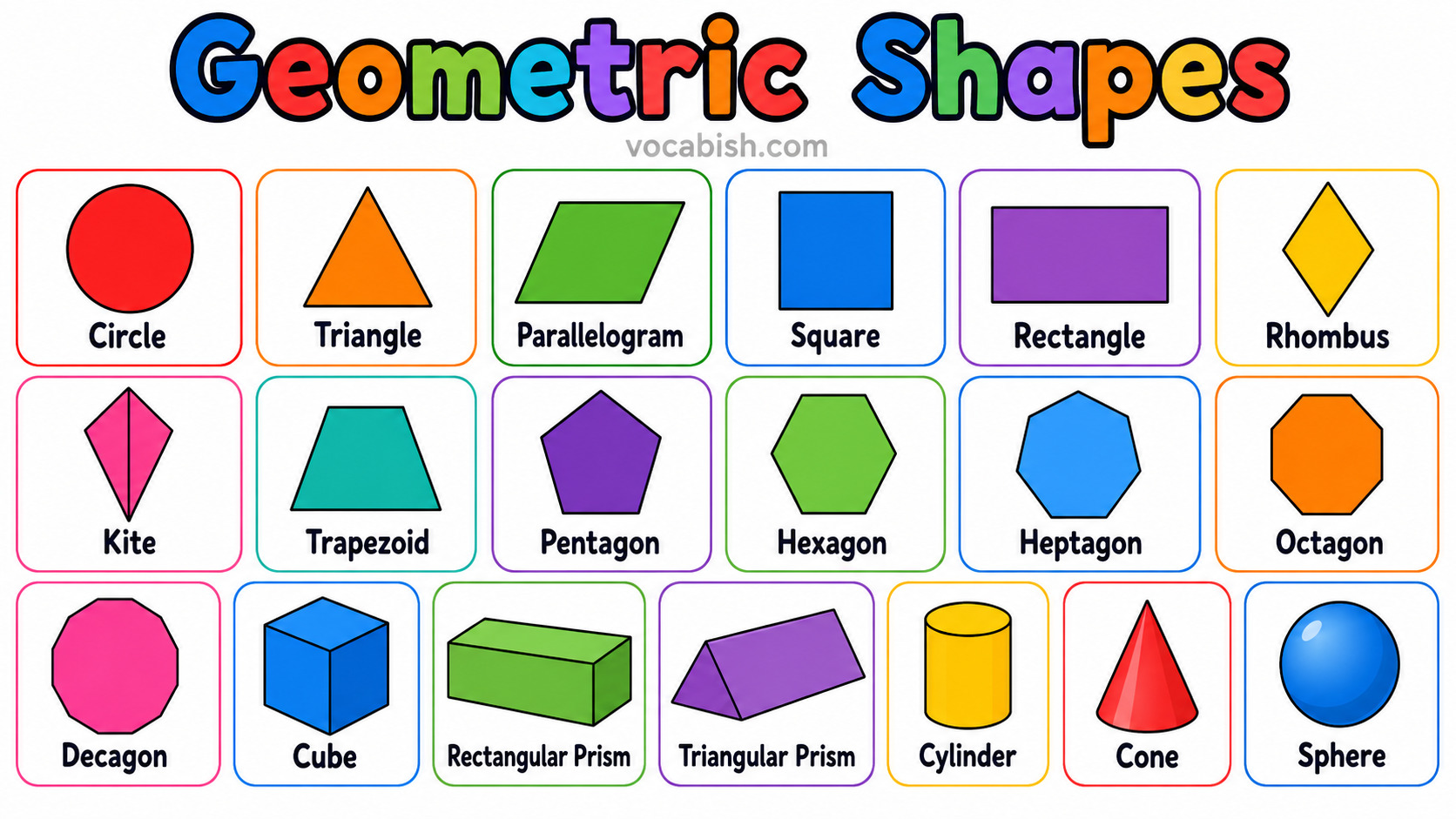

Geometric shapes are the building blocks of geometry. Students see them in math lessons, classroom activities, buildings, road signs, toys, sports equipment, and everyday objects. Learning the names and features of geometric shapes helps students describe the world more clearly and solve math problems with confidence.
This guide explains the meaning of geometric shapes, the main types of 2D and 3D shapes, their properties, and examples. It also includes useful tables and a printable-style worksheet for students from Grade 1 to Grade 7.
To read more about the shapes and their names, check it out: 100+ Shapes Name
What are Geometric Shapes?
Geometric shapes are figures that have a clear form, boundary, and structure. They can be flat, like a square or triangle, or solid, like a cube or sphere.
In simple words, a geometric shape is a shape that can be described using points, lines, curves, surfaces, angles, sides, or faces.
Examples of geometric shapes include:
- Circle
- Triangle
- Square
- Rectangle
- Pentagon
- Cube
- Cone
- Cylinder
- Sphere
Geometric shapes are used in math to study size, position, space, patterns, and measurement.
Definition
A geometric shape is a figure made from points, lines, curves, or surfaces. It has a specific form and can usually be measured, drawn, compared, or classified.
For example:
- A triangle has 3 sides and 3 vertices.
- A square has 4 equal sides and 4 vertices.
- A cube has 6 square faces, 8 vertices, and 12 edges.
Types of Geometric Shapes
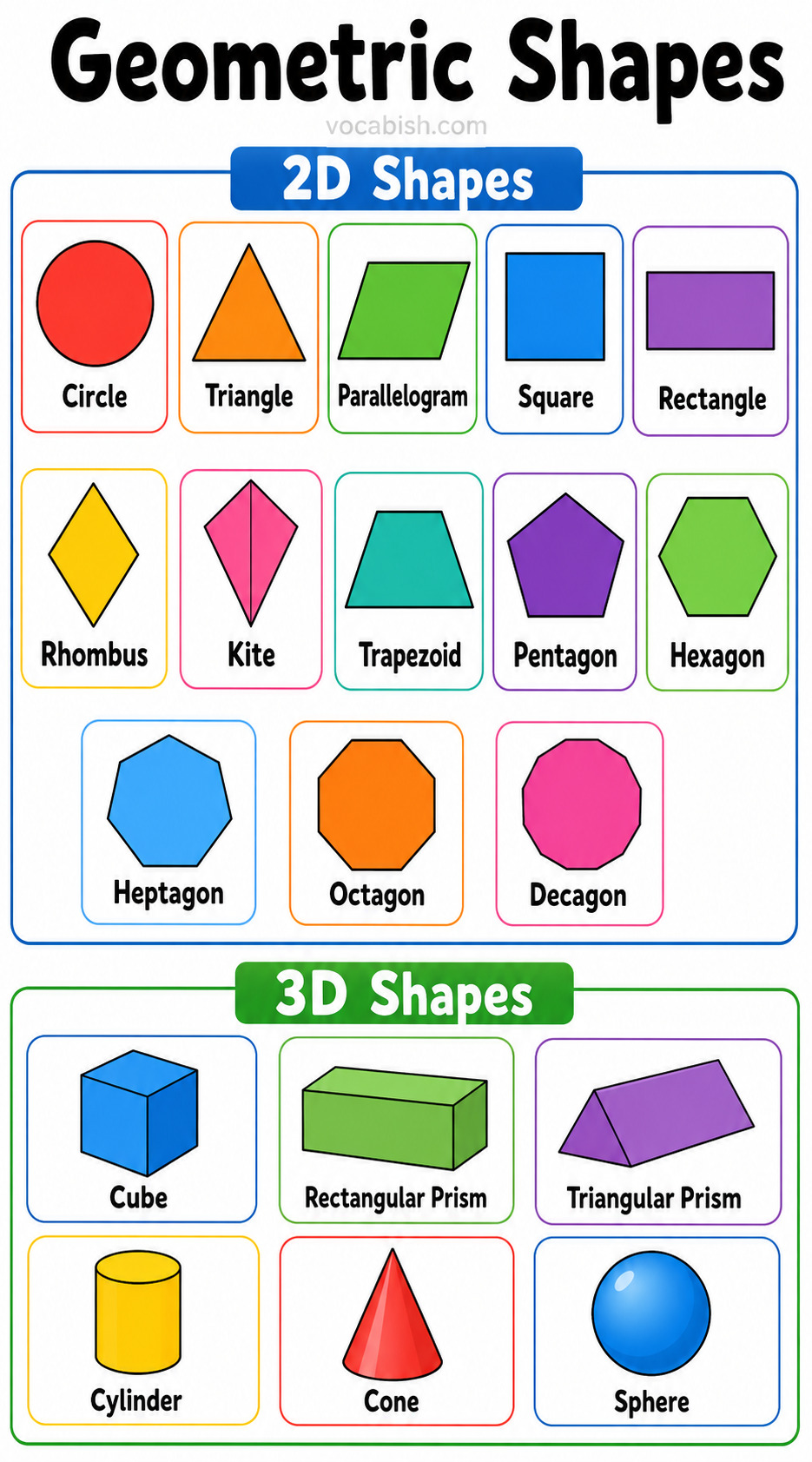
Geometric shapes are usually divided into two main types:
- Two-dimensional shapes
- Three-dimensional shapes
Two-dimensional shapes are flat. Three-dimensional shapes are solid and take up space.
Read More about: The Difference between 2D and 3D Shapes
Two-Dimensional Shapes (2D Shapes)
Two-dimensional shapes, also called 2D shapes, are flat shapes. They have length and width, but no height or depth.
Examples of 2D geometric shapes include circles, triangles, squares, rectangles, pentagons, and hexagons.
A 2D shape may have:
- Sides or curved edges
- Vertices, also called corners
- Angles
- A flat surface
Circle
A circle is a round 2D shape. Every point on the circle is the same distance from its center.
A circle has:
- 0 vertices
- 0 straight sides
- 1 curved boundary
Examples of circles in real life include coins, wheels, clocks, buttons, and plates.
A circle is not a polygon because it does not have straight sides.
Polygons

A polygon is a closed 2D shape made only of straight sides.
To be a polygon, a shape must:
- Be flat
- Be closed
- Have only straight sides
- Have at least 3 sides
Examples of polygons include triangles, squares, rectangles, pentagons, hexagons, and octagons.
A circle is not a polygon because it has a curved boundary.
Triangle
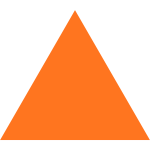
A triangle is a polygon with 3 sides, 3 vertices, and 3 angles.
Common types of triangles include:
- Equilateral triangle: all 3 sides are equal
- Isosceles triangle: 2 sides are equal
- Scalene triangle: no sides are equal
- Right triangle: one angle is 90 degrees
- Acute triangle: all angles are less than 90 degrees
- Obtuse triangle: one angle is greater than 90 degrees
Triangles are used in bridges, roofs, warning signs, and many strong structures.
Related Resources: Six Basic Types of Triangle with Pictures
Quadrilaterals
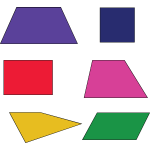
A quadrilateral is any polygon with 4 sides, 4 vertices, and 4 angles.
Examples of quadrilaterals include:
- Square
- Rectangle
- Parallelogram
- Rhombus
- Kite
- Trapezoid
All squares and rectangles are quadrilaterals, but not all quadrilaterals are squares or rectangles.
Parallelogram

A parallelogram is a quadrilateral with two pairs of opposite sides that are parallel.
A parallelogram has:
- 4 sides
- 4 vertices
- Opposite sides equal
- Opposite angles equal
Examples of parallelogram-like shapes can be seen in tiles, patterns, and slanted design layouts.
Square

A square is a quadrilateral with 4 equal sides and 4 right angles.
A square has:
- 4 equal sides
- 4 vertices
- 4 right angles
- 2 pairs of parallel sides
Examples of squares include chessboard spaces, floor tiles, sticky notes, and some windows.
Rectangle

A rectangle is a quadrilateral with 4 right angles. Opposite sides are equal and parallel.
A rectangle has:
- 4 sides
- 4 vertices
- 4 right angles
- Opposite sides equal
Examples of rectangles include books, doors, mobile phones, screens, and paper sheets.
Rhombus

A rhombus is a quadrilateral with 4 equal sides. Its angles do not have to be right angles.
A rhombus has:
- 4 equal sides
- 4 vertices
- Opposite sides parallel
- Opposite angles equal
A diamond shape is often used as a simple real-life example of a rhombus.
Kite
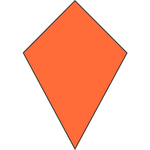
A kite is a quadrilateral with two pairs of equal adjacent sides.
A kite has:
- 4 sides
- 4 vertices
- 2 pairs of equal neighboring sides
It looks like the shape of a traditional flying kite.
Trapezoid
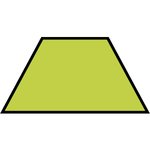
A trapezoid is a quadrilateral with at least one pair of parallel sides.
A trapezoid has:
- 4 sides
- 4 vertices
- At least 1 pair of parallel sides
Examples of trapezoid shapes can appear in bags, lampshades, tables, bridges, and some signs.
Note: In some countries, especially in British English, the word trapezium may be used differently. Students should follow the definition used in their school curriculum.
Polygons with More Than Four Sides
Some polygons have more than four sides. These shapes are named according to the number of sides they have.
Pentagon

A pentagon is a polygon with 5 sides and 5 vertices.
A regular pentagon has all sides and angles equal. A common example is the shape used in some badges, tiles, and designs.
Hexagon

A hexagon is a polygon with 6 sides and 6 vertices.
A honeycomb cell is a common real-life example of a hexagon. Hexagons are also seen in tiles, nuts, bolts, and patterns.
Heptagon

A heptagon is a polygon with 7 sides and 7 vertices.
Heptagons are less common in daily objects, but they are useful in geometry lessons and design patterns.
Octagon

An octagon is a polygon with 8 sides and 8 vertices.
A stop sign is one of the most common real-life examples of an octagon.
Decagon
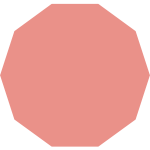
A decagon is a polygon with 10 sides and 10 vertices.
Decagons can be found in decorative patterns, coins, tiles, and geometry exercises.
Three-Dimensional Shapes (3D Shapes)
Three-dimensional shapes, also called 3D shapes, are solid shapes. They have length, width, and height or depth.
A 3D geometric shape may have:
- Faces
- Edges
- Vertices
- Flat surfaces
- Curved surfaces
Examples of 3D geometric shapes include cubes, rectangular prisms, cylinders, cones, spheres, and triangular prisms.
Cube
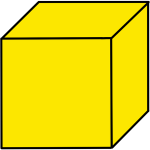
A cube is a 3D shape with 6 equal square faces.
A cube has:
- 6 faces
- 12 edges
- 8 vertices
Examples of cubes include dice, ice cubes, blocks, and some boxes.
Rectangular Prism
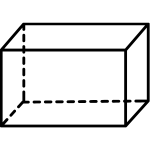
A rectangular prism is a 3D shape with 6 rectangular faces.
A rectangular prism has:
- 6 faces
- 12 edges
- 8 vertices
Examples include books, bricks, cereal boxes, shoeboxes, and rooms.
Triangular Prism
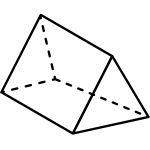
A triangular prism is a 3D shape with two triangular faces and three rectangular faces.
A triangular prism has:
- 5 faces
- 9 edges
- 6 vertices
Examples include camping tents, roof shapes, and some chocolate bars.
Cylinder
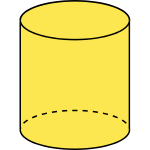
A cylinder is a 3D shape with two circular flat faces and one curved surface.
A cylinder has:
- 2 flat circular faces
- 1 curved surface
- 2 curved edges
- 0 vertices
Examples include cans, jars, pipes, candles, and drums.
Cone
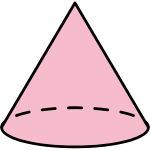
A cone is a 3D shape with one circular base and one curved surface that meets at a point.
A cone has:
- 1 flat circular face
- 1 curved surface
- 1 curved edge
- 1 vertex
Examples include ice cream cones, party hats, traffic cones, and funnels.
Sphere
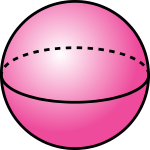
A sphere is a perfectly round 3D shape. Every point on its surface is the same distance from its center.
A sphere has:
- 0 vertices
- 0 edges
- 1 curved surface
Examples include balls, globes, marbles, oranges, and planets.
List of Geometric Shapes
Below are helpful tables showing a complete list of 2D and 3D geometric shapes with their basic properties.
Lists of Two-Dimensional Geometric Shapes
Two-dimensional geometric shapes are flat shapes. They have length and width, but they do not have height or depth. Some 2D shapes have straight sides, while others have curved boundaries.
Name | Type | Vertices | Edges / Sides |
|---|---|---|---|
Circle | Curved 2D shape | 0 | 1 curved edge |
Oval / Ellipse | Curved 2D shape | 0 | 1 curved edge |
Semicircle | Curved 2D shape | 2 | 1 straight side + 1 curved edge |
Triangle | Polygon | 3 | 3 |
Equilateral Triangle | Triangle | 3 | 3 |
Isosceles Triangle | Triangle | 3 | 3 |
Scalene Triangle | Triangle | 3 | 3 |
Right Triangle | Triangle | 3 | 3 |
Acute Triangle | Triangle | 3 | 3 |
Obtuse Triangle | Triangle | 3 | 3 |
Quadrilateral | Polygon | 4 | 4 |
Square | Quadrilateral | 4 | 4 |
Rectangle | Quadrilateral | 4 | 4 |
Parallelogram | Quadrilateral | 4 | 4 |
Rhombus | Quadrilateral | 4 | 4 |
Kite | Quadrilateral | 4 | 4 |
Trapezoid | Quadrilateral | 4 | 4 |
Pentagon | Polygon | 5 | 5 |
Hexagon | Polygon | 6 | 6 |
Heptagon | Polygon | 7 | 7 |
Octagon | Polygon | 8 | 8 |
Nonagon | Polygon | 9 | 9 |
Decagon | Polygon | 10 | 10 |
Hendecagon / Undecagon | Polygon | 11 | 11 |
Dodecagon | Polygon | 12 | 12 |
Regular Polygon | Polygon with equal sides and angles | Depends on shape | Depends on shape |
Irregular Polygon | Polygon with unequal sides or angles | Depends on shape | Depends on shape |
Star | 2D geometric figure | Usually 10 | Usually 10 |
List of Three-Dimensional Geometric Shapes
Three-dimensional geometric shapes are solid shapes. They have length, width, and height or depth. These shapes may have flat faces, curved surfaces, edges, and vertices.
Name | Type | Vertices | Edges | Faces / Surfaces |
|---|---|---|---|---|
Cube | 3D solid | 8 | 12 | 6 flat faces |
Rectangular Prism | Prism | 8 | 12 | 6 flat faces |
Cuboid | Prism | 8 | 12 | 6 flat faces |
Triangular Prism | Prism | 6 | 9 | 5 flat faces |
Pentagonal Prism | Prism | 10 | 15 | 7 flat faces |
Hexagonal Prism | Prism | 12 | 18 | 8 flat faces |
Cylinder | 3D solid with curved surface | 0 | 2 curved edges | 2 flat faces + 1 curved surface |
Cone | 3D solid with curved surface | 1 | 1 curved edge | 1 flat face + 1 curved surface |
Sphere | Curved 3D solid | 0 | 0 | 1 curved surface |
Hemisphere | Half sphere | 0 | 1 curved edge | 1 flat face + 1 curved surface |
Ellipsoid | Curved 3D solid | 0 | 0 | 1 curved surface |
Ovoid | Egg-shaped 3D solid | 0 | 0 | 1 curved surface |
Triangular Pyramid | Pyramid | 4 | 6 | 4 flat faces |
Tetrahedron | Pyramid | 4 | 6 | 4 flat faces |
Square Pyramid | Pyramid | 5 | 8 | 5 flat faces |
Pentagonal Pyramid | Pyramid | 6 | 10 | 6 flat faces |
Hexagonal Pyramid | Pyramid | 7 | 12 | 7 flat faces |
Torus | Curved 3D solid | 0 | 0 | 1 curved surface |
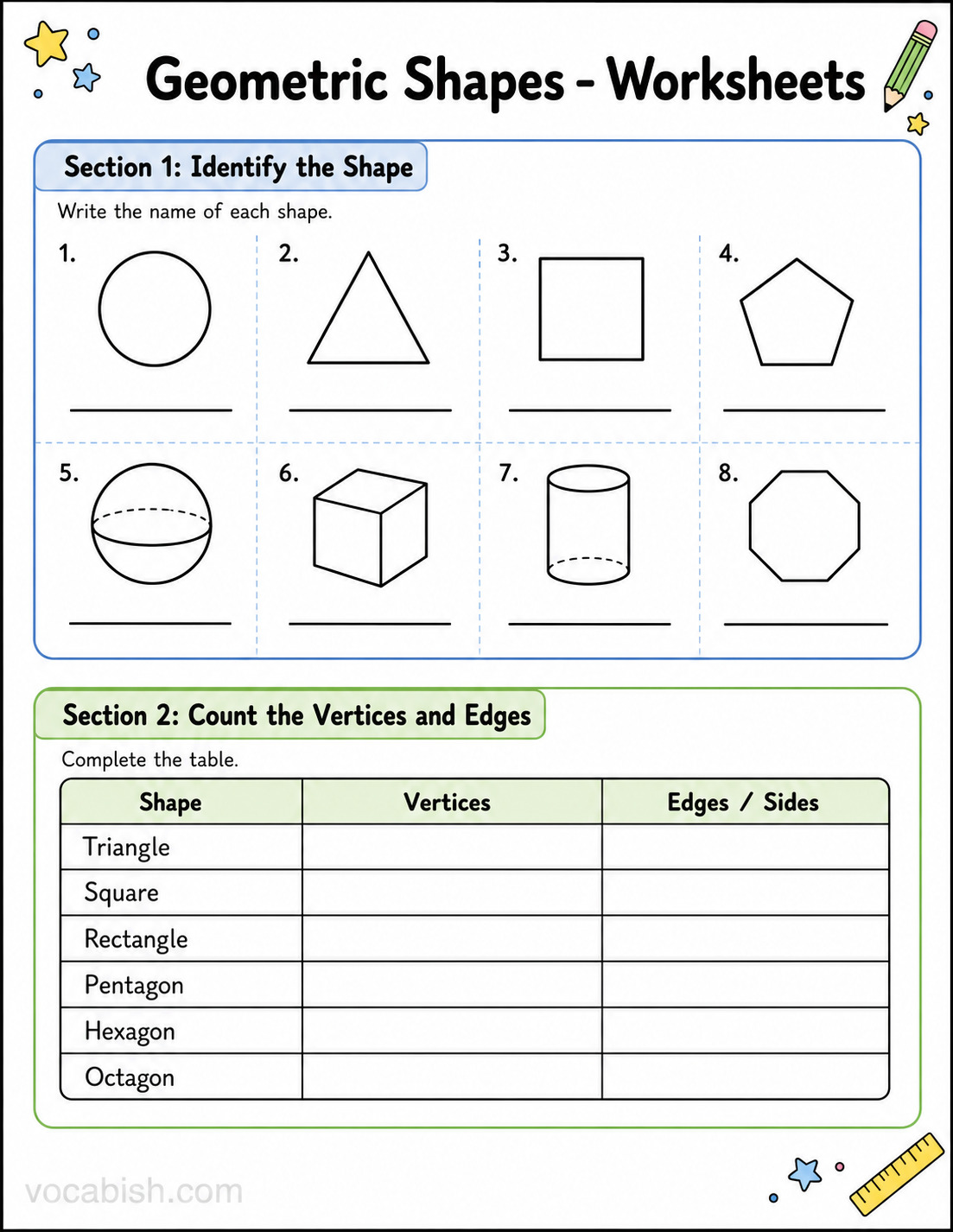
Geometric Shapes Worksheet
This worksheet is suitable for students from Grade 1 to Grade 7. Teachers and parents can adjust the difficulty by asking younger students to name shapes and older students to explain properties.
Related Resources: Shapes Worksheet for Kindergarten
Section 1: Identify the Shape
Write the name of each shape.
- A round flat shape with no corners: __________
- A polygon with 3 sides: __________
- A quadrilateral with 4 equal sides and 4 right angles: __________
- A polygon with 5 sides: __________
- A solid shape like a ball: __________
- A solid shape with 6 equal square faces: __________
- A shape like a can: __________
- A polygon with 8 sides: __________
Section 2: Count the Vertices and Edges
Complete the table.
Shape | Vertices | Edges / Sides |
|---|---|---|
Triangle | ___ | ___ |
Square | ___ | ___ |
Rectangle | ___ | ___ |
Pentagon | ___ | ___ |
Hexagon | ___ | ___ |
Octagon | ___ | ___ |
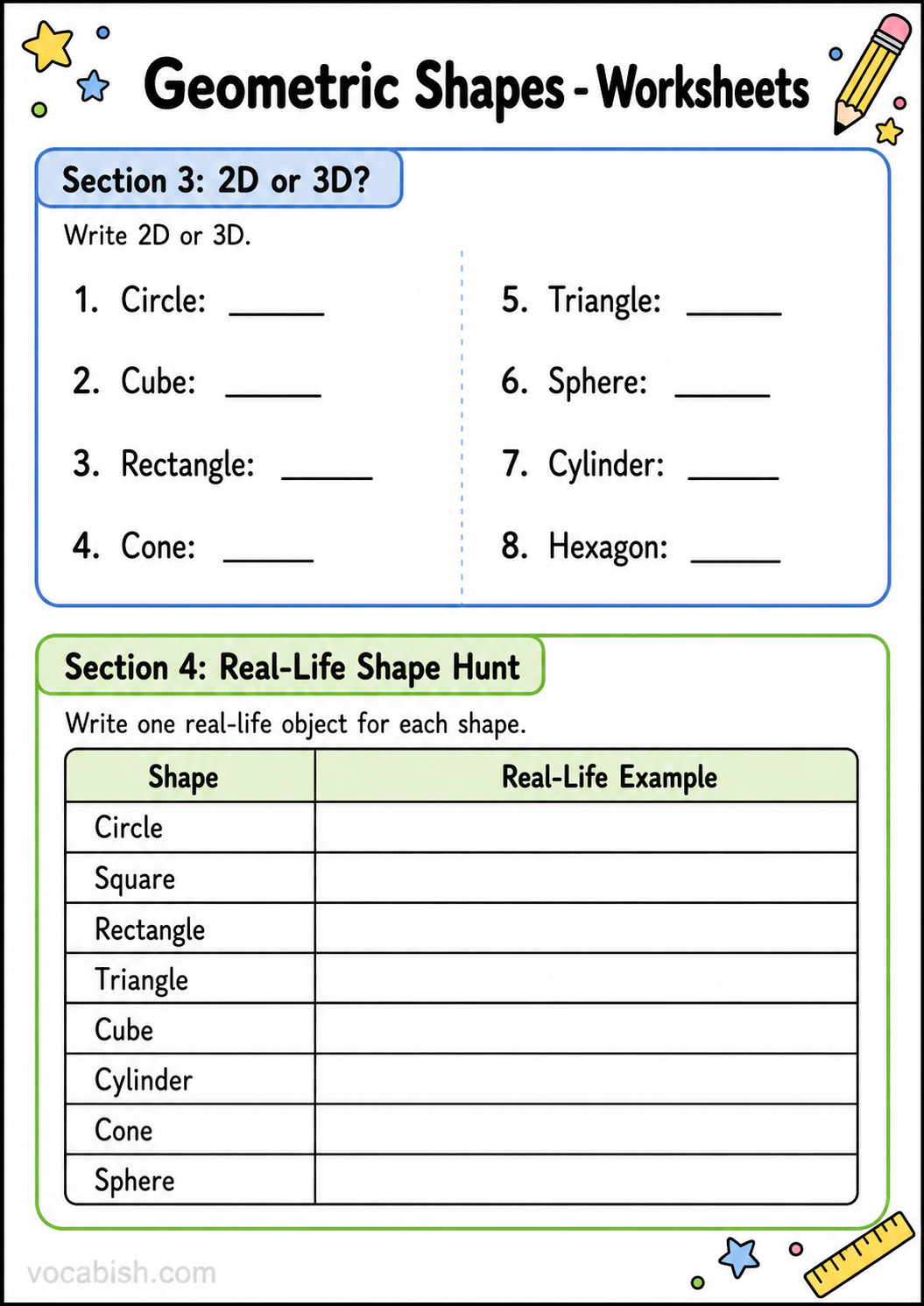
Section 3: 2D or 3D?
Write 2D or 3D.
- Circle: _____
- Cube: _____
- Rectangle: _____
- Cone: _____
- Triangle: _____
- Sphere: _____
- Cylinder: _____
- Hexagon: _____
Section 4: Real-Life Shape Hunt
Write one real-life object for each shape.
Shape | Real-Life Example |
|---|---|
Circle | __________ |
Square | __________ |
Rectangle | __________ |
Triangle | __________ |
Cube | __________ |
Cylinder | __________ |
Cone | __________ |
Sphere | __________ |
Worksheet Answer Key
1
- Circle
- Triangle
- Square
- Pentagon
- Sphere
- Cube
- Cylinder
- Octagon
2
Shape | Vertices | Edges / Sides |
|---|---|---|
Triangle | 3 | 3 |
Square | 4 | 4 |
Rectangle | 4 | 4 |
Pentagon | 5 | 5 |
Hexagon | 6 | 6 |
Octagon | 8 | 8 |
3
- 2D
- 3D
- 2D
- 3D
- 2D
- 3D
- 3D
- 2D
4
Answers may vary. Example answers:
Shape | Real-Life Example |
|---|---|
Circle | Coin |
Square | Tile |
Rectangle | Book |
Triangle | Road sign |
Cube | Dice |
Cylinder | Can |
Cone | Party hat |
Sphere | Ball |
Summary
Geometric shapes are important in math because they help students understand space, size, patterns, and structure. The two main types are 2D shapes and 3D shapes.
2D shapes are flat and include circles, triangles, quadrilaterals, pentagons, hexagons, and other polygons. 3D shapes are solid and include cubes, rectangular prisms, triangular prisms, cylinders, cones, and spheres.
Learning the names, sides, vertices, edges, faces, and real-life examples of geometric shapes helps students build a strong foundation in geometry.
Geometric Shapes PDF
FAQs on List of Geometric Shapes
2D shapes are flat and have only length and width. Examples include circles, triangles, and rectangles. 3D shapes are solid and have length, width, and height or depth. Examples include cubes, cones, cylinders, and spheres.
A regular shape has equal sides and equal angles. For example, a regular pentagon has 5 equal sides and 5 equal angles. An irregular shape does not have all sides or all angles equal.
Examples of geometric shapes in math include circle, triangle, square, rectangle, pentagon, hexagon, cube, cone, cylinder, sphere, rectangular prism, and triangular prism.
The basic polygons include triangle, quadrilateral, pentagon, hexagon, heptagon, octagon, nonagon, and decagon. A polygon must be a closed flat shape made of straight sides.
No, a circle is not a polygon. A polygon must have straight sides, but a circle has a curved boundary and no vertices.
Common types of triangles include equilateral, isosceles, scalene, right, acute, and obtuse triangles. Triangles can be classified by their sides or by their angles.
Examples of curved shapes include circle, oval, sphere, cylinder, and cone. A circle is a flat curved shape, while a sphere, cylinder, and cone are 3D shapes with curved surfaces.
Common types of quadrilaterals include square, rectangle, parallelogram, rhombus, kite, and trapezoid. All quadrilaterals have 4 sides and 4 vertices.
Real-life examples of geometric shapes include wheels as circles, books as rectangles, dice as cubes, cans as cylinders, balls as spheres, traffic cones as cones, and stop signs as octagons.
You May Also Like: