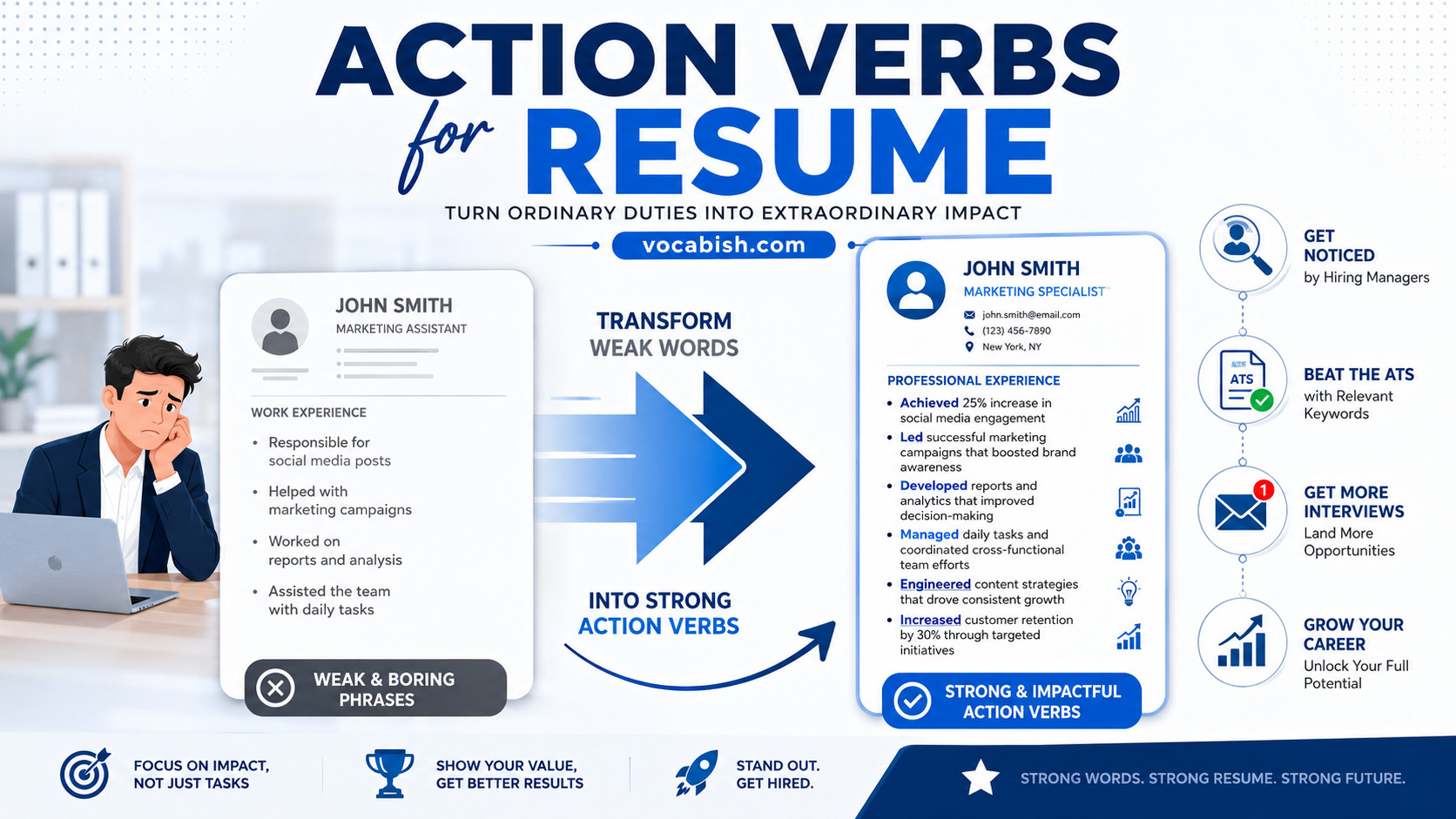

When a hiring manager looks at your job application, you have just a few seconds to make a great impression. If your sentences start with weak phrases like “responsible for” or “helped with,” your true skills might get lost. This is where action verbs for resume writing become your best tool.
Action words show exactly what you did, how you did it, and the results you achieved. They replace passive language with strong, energetic vocabulary. Whether you are building your first application or updating an old one, using the right resume action words will make your English sound more professional, confident, and clear.
This guide provides a massive list of resume action verbs divided by skill sets, complete with simple meanings, to help you stand out to employers worldwide.
What are Action Verbs for a Resume?
Action verbs for a resume are strong, dynamic words used to highlight your professional achievements, skills, and daily responsibilities.
Instead of relying on weak, passive phrases like “was responsible for” or “duties included,” action verbs jump straight to the point. Words like engineered, orchestrated, maximized, or developed show exactly what you accomplished and the direct impact you had on a business.
Placed at the very beginning of your bullet points, these words immediately grab a hiring manager’s attention and make your professional history sound confident, proactive, and strictly focused on results.
Why You Need Strong Action Verbs for Your Resume
Using good action verbs for resume writing changes the entire tone of your professional history. Instead of just listing your daily duties, you are telling a story of success and impact.
- They save space: Action verbs let you say more with fewer words.
- They show leadership: Words like “directed” sound much stronger than “was the boss of.”
- They pass resume scanners: Many companies use Applicant Tracking Systems (ATS) that search for specific, professional action words for resume screening.
- They keep the reader awake: Active voice makes your writing punchy and easy to read.
What Are “Harvard Action Verbs for Resume”?
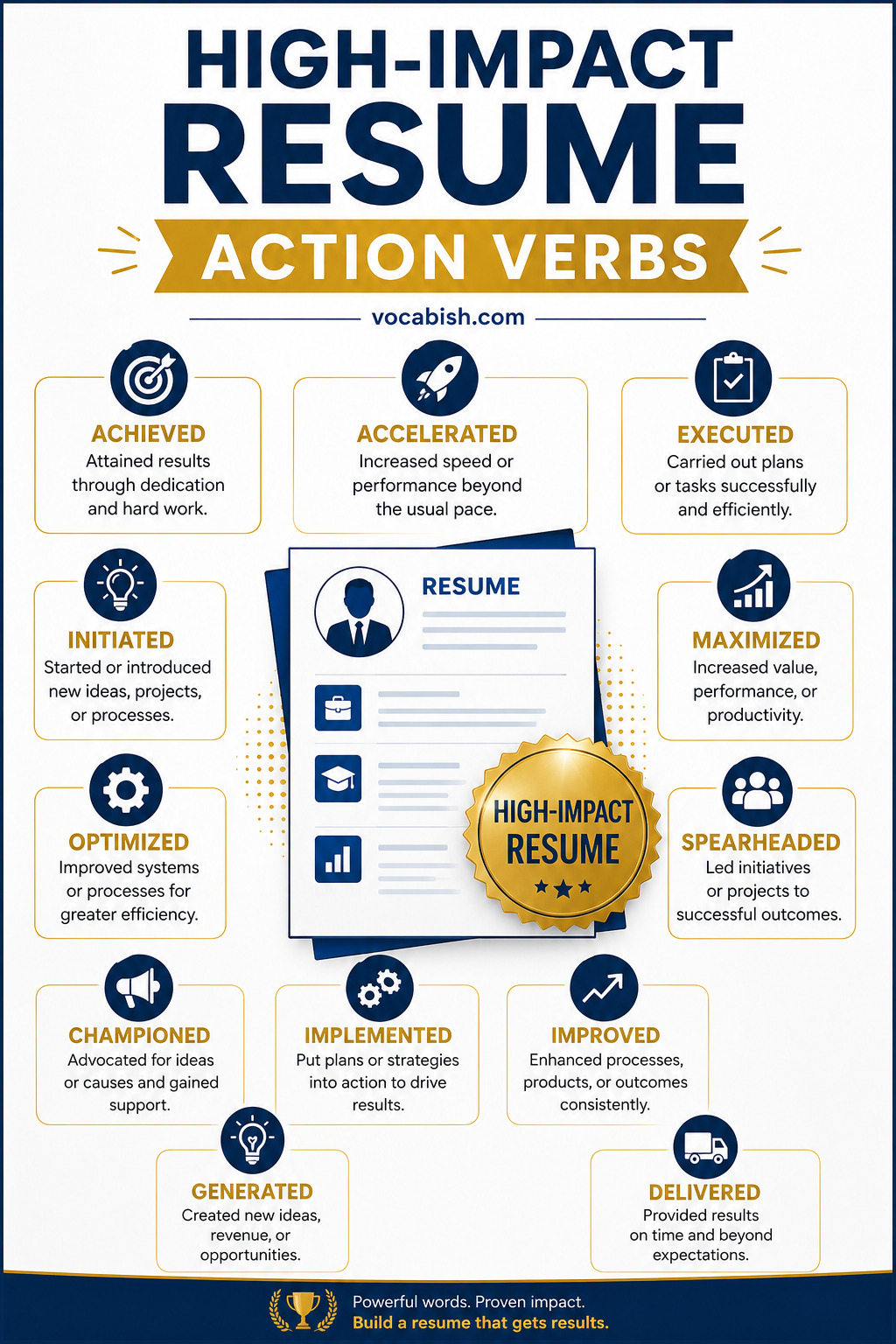
You might have heard the phrase Harvard action verbs for resume writing. This does not mean these words are only for Harvard students. It refers to the high-impact, precise vocabulary that top universities recommend their students use to land competitive jobs. These are simply the best action verbs for resume creation because they are specific, professional, and results-oriented. We have included many of these top-tier words in the lists below.
Complete List of Resume Action Verbs by Skill
To make finding the right word easy, this list is divided by professional skill categories. Review these strong action verbs for resume building and pick the ones that best match your experience.
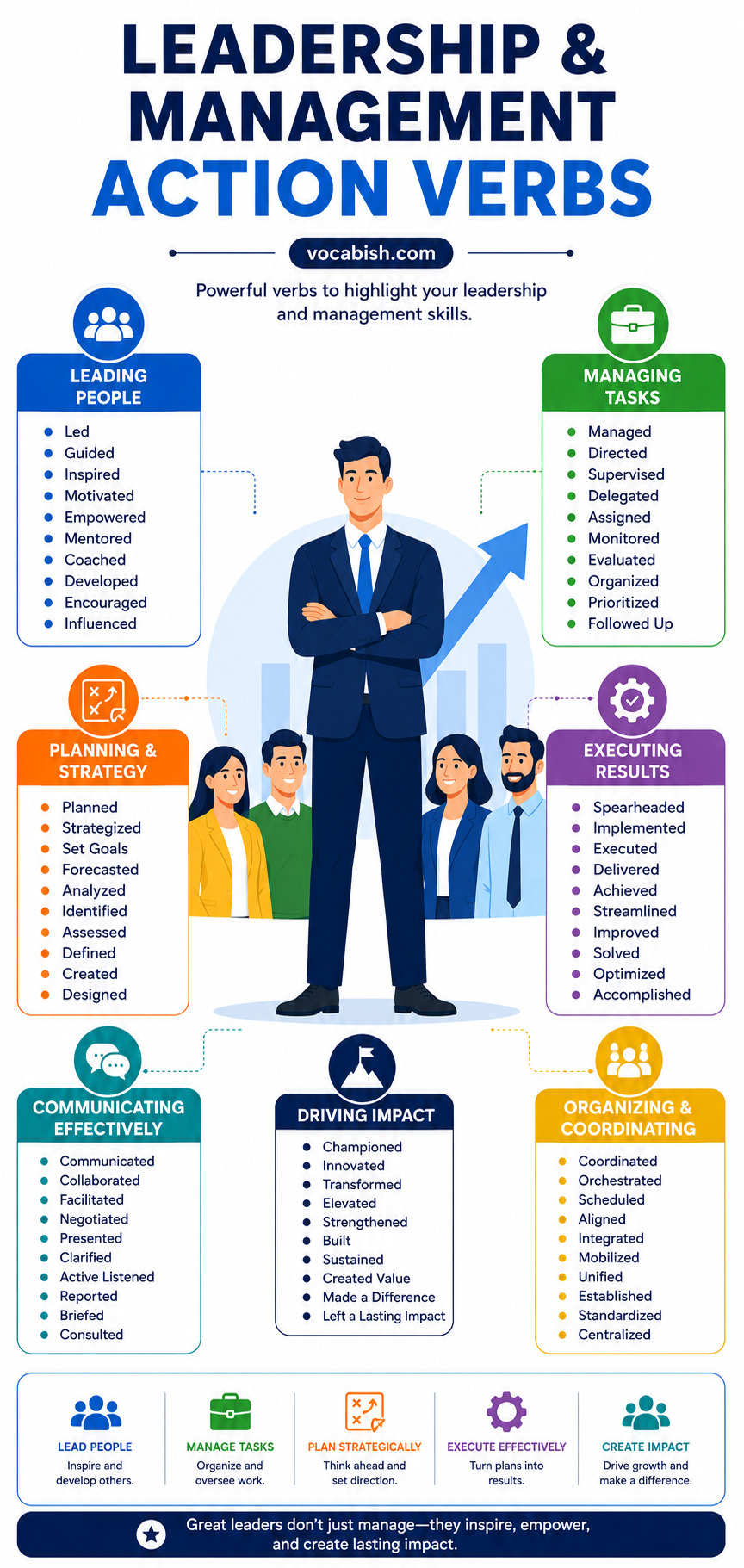
Leadership and Management Action Verbs
Use these words when you are in charge of a team, a project, or a new idea.
- Accelerated: Made a process happen much faster.
- Achieved: Reached a specific goal successfully.
- Advised: Gave expert guidance to others.
- Aligned: Brought different teams together for one goal.
- Authorized: Gave official permission for a project.
- Championed: Supported and defended a new initiative.
- Chaired: Led a committee or a formal meeting.
- Cultivated: Grew and developed a relationship or team.
- Delegated: Assigned specific tasks to team members.
- Directed: Guided the operations of a department.
- Enforced: Made sure rules or standards were followed.
- Executed: Carried out a plan from start to finish.
- Facilitated: Made a process easier for a group.
- Fostered: Encouraged the growth of a positive environment.
- Founded: Started a brand new company or group.
- Guided: Led a team through a difficult process.
- Headed: Acted as the top leader of a project.
- Inspired: Motivated others to do their best work.
- Instituted: Created and started a new policy.
- Managed: Handled the daily operations of a team.
- Mentored: Taught and guided junior staff members.
- Mobilized: Brought people together to take quick action.
- Motivated: Encouraged staff to reach their targets.
- Orchestrated: Carefully planned a complex event or project.
- Overhauled: Completely rebuilt a broken system.
- Prioritized: Decided which tasks were the most important.
- Spearheaded: Led an important initiative from the very beginning.
- Steered: Guided a project in the right direction.
- Supervised: Watched over employees to ensure good work.
- Streamlined: Made a complicated process much simpler.
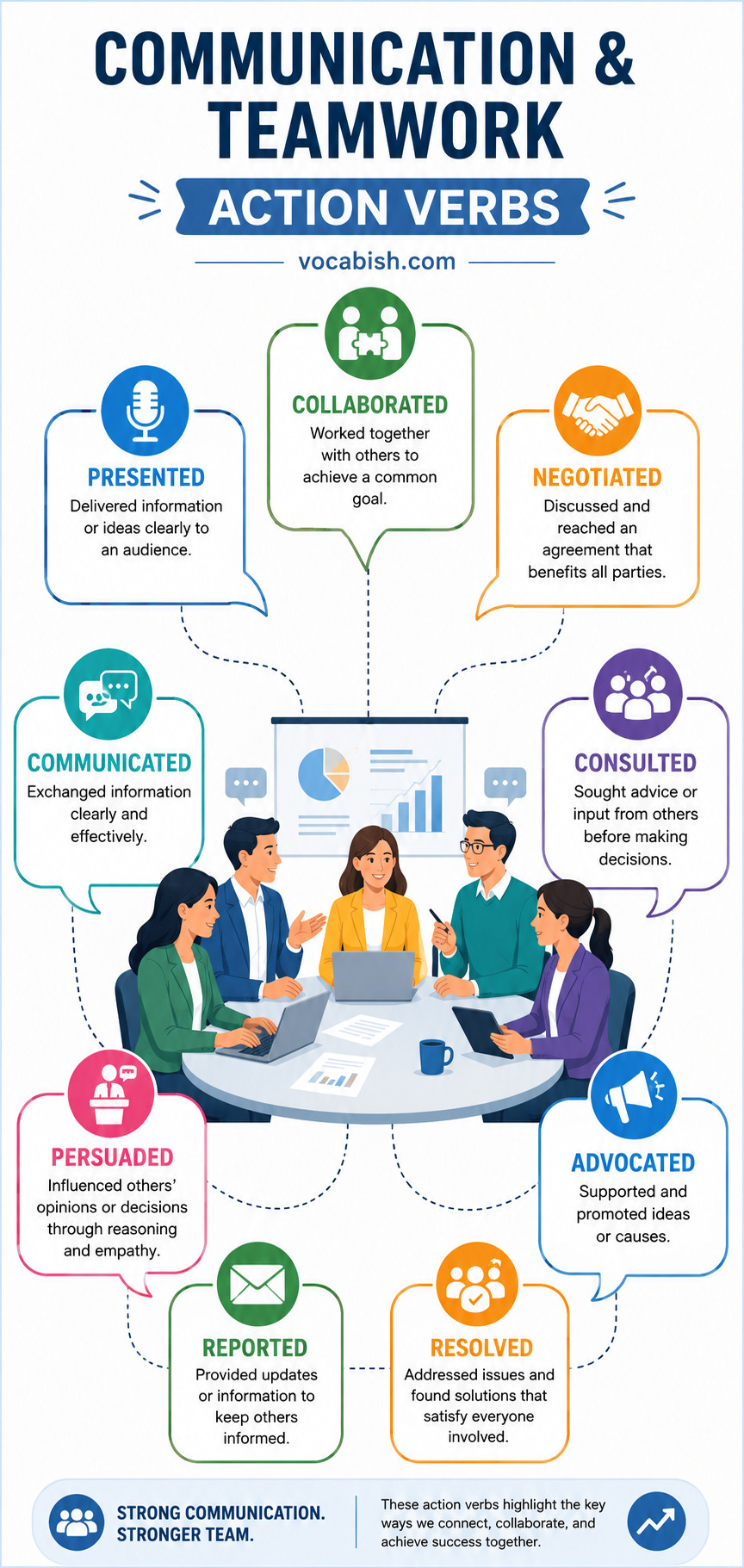
Communication and Teamwork Action Verbs
Use these words when your job requires talking, writing, or working closely with others.
- Addressed: Spoke publicly about a specific topic.
- Advocated: Spoke up in favor of a person or idea.
- Articulated: Expressed a complex idea very clearly.
- Authored: Wrote a complete document or book.
- Clarified: Made a confusing situation easy to understand.
- Coauthored: Wrote a document alongside another person.
- Collaborated: Worked happily and effectively with a team.
- Communicated: Shared important information clearly.
- Composed: Wrote professional emails, letters, or music.
- Consulted: Gave professional advice to a client.
- Conveyed: Passed a message from one person to another.
- Convinced: Made someone agree with your idea.
- Corresponded: Exchanged written messages with someone.
- Defined: Explained the exact meaning of a project scope.
- Documented: Kept a written record of important events.
- Drafted: Created the first version of a written plan.
- Edited: Corrected and improved written materials.
- Illustrated: Showed an idea using pictures or clear examples.
- Influenced: Changed someone’s mind or behavior positively.
- Interpreted: Translated information into a simpler format.
- Lectured: Gave a formal educational talk to a group.
- Marketed: Promoted a product or service to the public.
- Mediated: Helped two arguing sides reach an agreement.
- Moderated: Led a discussion and kept it on topic.
- Negotiated: Discussed terms to reach a fair business deal.
- Persuaded: Convinced a client to take a specific action.
- Presented: Showed a new idea or product to an audience.
- Promoted: Shared positive information to build awareness.
- Publicized: Made something known to the general public.
- Reported: Gave a formal update on a project’s status.
- Resolved: Fixed a conflict between team members.
- Spoke: Delivered a speech to an audience.
- Summarized: Gave a short version of a long report.
- Synthesized: Combined different ideas into one clear message.
- Translated: Changed text from one language to another.
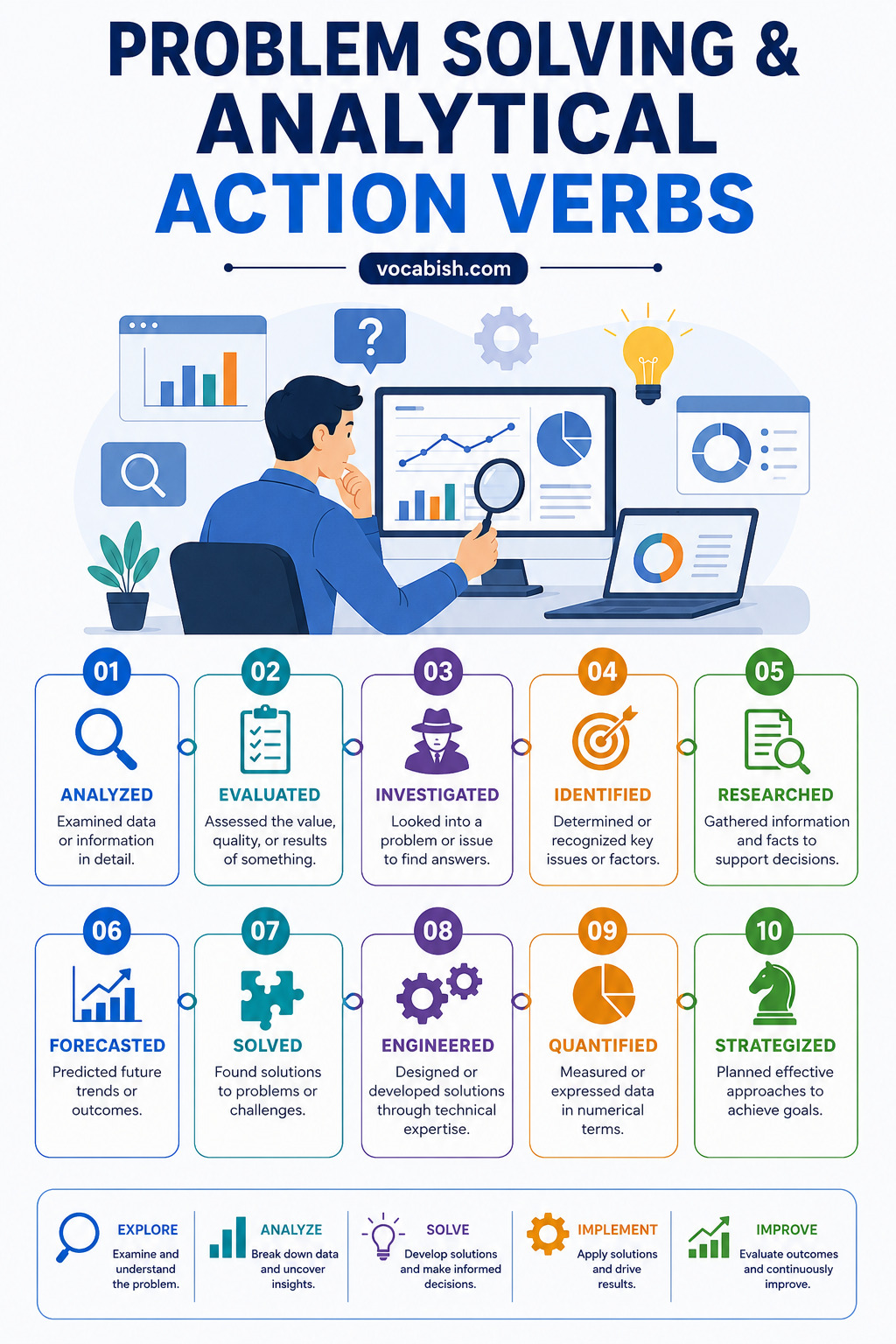
Problem Solving and Analytical Action Verbs
Use these words when you had to fix broken systems, understand data, or think critically.
- Analyzed: Looked closely at data to find patterns.
- Assessed: Judged the quality or value of something.
- Audited: Checked financial or operational records carefully.
- Calculated: Used math to find a specific number.
- Conceptualized: Formed a brand new idea in your mind.
- Deduced: Found the truth by looking at clues.
- Diagnosed: Found the root cause of a specific problem.
- Discovered: Found something new or hidden.
- Engineered: Designed a technical solution to a problem.
- Evaluated: Tested a system to see if it worked well.
- Examined: Looked at a project very closely for errors.
- Extracted: Pulled specific data out of a large system.
- Forecasted: Predicted future trends using current data.
- Identified: Pointed out a specific issue or opportunity.
- Investigated: Searched for the hidden facts of a situation.
- Measured: Tracked the exact size or success of a project.
- Modeled: Created a test version of a system.
- Quantified: Measured a result using exact numbers.
- Reconciled: Made two different sets of data match.
- Researched: Studied a topic deeply to find facts.
- Reviewed: Looked over a document to ensure quality.
- Scrutinized: Examined something with extreme focus.
- Solved: Found the perfect answer to a difficult issue.
- Strategized: Made a long-term plan for success.
- Tested: Tried a product to ensure it worked safely.
- Tracked: Monitored the progress of a long-term goal.
- Troubleshot: Found and fixed technical software problems.
- Uncovered: Revealed important information that was hidden.
- Validated: Proved that a system or fact was correct.
- Verified: Double-checked information for perfect accuracy.
Creative and Design Action Verbs
Use these words when your work involved making something new, visually appealing, or artistic.
- Adapted: Changed an old design to fit a modern style.
- Brainstormed: Generated many creative ideas quickly.
- Built: Constructed a physical or digital product.
- Crafted: Made something carefully by hand or skill.
- Created: Brought a completely new idea to life.
- Customized: Changed a product to fit one specific user.
- Designed: Planned the visual look of a product.
- Developed: Grew a small idea into a complete project.
- Devised: Invented a clever new method or tool.
- Established: Set up the creative rules for a brand.
- Fashioned: Shaped raw materials into a finished piece.
- Generated: Produced new content, leads, or designs.
- Initiated: Took the first step in a creative process.
- Introduced: Brought a new creative concept to the team.
- Invented: Made a tool or process that did not exist before.
- Launched: Released a new creative project to the world.
- Originated: Was the very first person to suggest an idea.
- Photographed: Took professional pictures for a project.
- Pioneered: Led the way in a brand new creative field.
- Planned: Mapped out the steps for a creative campaign.
- Published: Shared creative writing or art publicly.
- Redesigned: Changed an old layout to make it better.
- Revamped: Gave a fresh, modern look to an old project.
- Shaped: Molded an abstract idea into a real product.
- Storyboarded: Drew the scene-by-scene plan for a video.
- Visualized: Created a mental picture of a final design.
- Wrote: Created original text for articles or scripts.
Financial and Data Action Verbs
Use these words when handling money, budgets, sales data, or business growth.
- Administered: Managed the daily distribution of funds.
- Allocated: Divided money or resources appropriately.
- Appraised: Estimated the financial value of an asset.
- Balanced: Ensured financial accounts were perfectly equal.
- Budgeted: Planned how money would be spent over time.
- Conserved: Saved money or resources from being wasted.
- Decreased: Lowered costs, expenses, or financial waste.
- Earned: Brought in new revenue for the company.
- Estimated: Made a smart guess about future costs.
- Financed: Found the money to pay for a large project.
- Grossed: Earned a total amount of money before taxes.
- Halted: Stopped a process that was losing money.
- Increased: Raised the total amount of sales or profits.
- Maximized: Got the absolute highest value out of a budget.
- Minimized: Kept financial losses as low as possible.
- Multiplied: Grew sales or leads significantly.
- Netted: Earned a specific amount of profit after taxes.
- Projected: Guessed future earnings based on math.
- Purchased: Bought supplies or software for the business.
- Reduced: Cut down the amount of money being spent.
- Secured: Safely locked in funding or an investment.
- Yielded: Produced a positive financial return on investment.
Customer Service and Sales Action Verbs
Use these words when your job was focused on helping clients, closing deals, or teaching users.
- Assisted: Helped a customer find what they needed.
- Arbitrated: Settled a dispute fairly for a customer.
- Coached: Guided a client through a learning process.
- Delivered: Gave the customer their promised service.
- Educated: Taught clients how to use a new product.
- Expedited: Rushed an important order for a VIP client.
- Fielded: Answered a large volume of phone calls or emails.
- Informed: Gave customers the latest updates on a service.
- Instructed: Gave step-by-step guidance to a user.
- Provided: Gave clients the resources they asked for.
- Responded: Answered customer complaints quickly.
- Retained: Kept a customer from leaving for a competitor.
- Satisfied: Ensured the customer was totally happy.
- Sold: Closed deals and brought in new buyers.
- Supported: Helped users fix problems with their accounts.
- Taught: Ran training sessions for new customers.
- Trained: Showed junior staff how to handle clients.
- Tutored: Gave one-on-one educational help.
- Welcomed: Greeted clients warmly as they entered.
Organizational and Administrative Action Verbs
Use these words for daily operations, office management, paperwork, and scheduling.
- Approved: Signed off on documents or time-off requests.
- Arranged: Put physical files or meeting times in order.
- Cataloged: Created a detailed list of items in a system.
- Categorized: Grouped similar files or emails together.
- Charted: Mapped out daily schedules or office data.
- Classified: Sorted private documents by security level.
- Coded: Assigned specific numbers to administrative files.
- Collected: Gathered paperwork from different departments.
- Compiled: Put together information into one big report.
- Corrected: Fixed spelling or data errors in paperwork.
- Distributed: Handed out important memos to the office.
- Filed: Stored documents safely in physical or digital folders.
- Incorporated: Added new rules into the daily office routine.
- Inspected: Looked closely at office supplies for damage.
- Logged: Recorded daily activities in a tracking system.
- Maintained: Kept the office running smoothly every day.
- Monitored: Watched inventory levels to order more supplies.
- Obtained: Got the necessary signatures for a project.
- Operated: Ran daily office machinery like printers.
- Ordered: Bought necessary supplies before they ran out.
- Organized: Cleaned up messy digital or physical workspaces.
- Prepared: Got meeting rooms and documents ready for the day.
- Processed: Handled daily paperwork like payroll or invoices.
- Recorded: Wrote down the exact minutes of a meeting.
- Registered: Signed up new guests or clients in the system.
- Reserved: Booked travel, hotels, or meeting rooms.
- Routed: Sent phone calls or emails to the correct person.
- Scheduled: Set up times for interviews and meetings.
- Screened: Checked visitors or callers before letting them through.
- Standardized: Made everyone use the same forms or processes.
- Supplied: Gave the team the tools they needed to work.
- Systematized: Created a strict daily routine for office tasks.
- Updated: Added the newest information to an old file.
Action Verbs for Different Skills and Job Resumes
When writing your resume, do not just pick words randomly. Action verbs for different skills and job resumes must match the industry you are applying for.
- Applying for IT or Tech? Focus on words like Engineered, Configured, Deployed, Troubleshot, and Programmed.
- Applying for Business Management? Lean heavily on Spearheaded, Maximized, Optimized, Directed, and Executed.
- Applying for Creative Roles? Use Conceptualized, Storyboarded, Revamped, Pioneered, and Crafted.
Matching your verbs to the job description proves to the hiring manager that you speak the language of their specific industry.
How to Use Action Words for Resume Successfully
Having a great list of vocabulary is only the first step. To make these verbs truly work for you, follow these simple rules:
- Always start your bullet points with an action verb: Never start a bullet point with “I” or “My job was.” Jump straight into the action. (e.g., Maximized daily sales by 15%.)
- Use the correct tense: For a job you currently have, use the present tense (Manage, Design, Train). For past jobs, always use the past tense (Managed, Designed, Trained).
- Add numbers and metrics: An action verb is powerful, but an action verb paired with a number is unbeatable. Instead of “Improved sales,” write “Improved sales by 20% in three months.“
By combining these strong action verbs for resume writing with real data, you will create an application that employers simply cannot ignore.
FAQs About Resume Action Verbs
Action verbs replace passive duties with energetic achievements, making your professional skills stand out clearly and professionally to hiring managers.
Applicant Tracking Systems scan for specific industry keywords, and using strong action verbs increases your chances of passing these automated filters.
Use present tense verbs for responsibilities at your current job, but use past tense verbs for all previous employment history.
They are top-tier, highly impactful words recommended by Ivy League universities to turn boring task descriptions into powerful success stories.
Place action verbs at the absolute beginning of your bullet points under work experience to instantly showcase your direct professional impact.
Yes, even without professional experience, action words like organized, researched, created, or volunteered highlight your initiative in academic or extracurricular projects.
Generally, use one strong action verb at the start of the bullet, though a second can work if describing a multi-step achievement.
Excellent verbs for customer support include resolved, assisted, educated, expedited, and mediated, as they directly demonstrate your ability to help clients.
You May Also Like: