
Idioms are fun English expressions. They do not always mean exactly what the words say. For example, “piece of cake” does not mean a real cake. It means something is very easy.
Kids can use idioms to make their English more natural and interesting. These idioms are simple, common, and easy to use in everyday speaking.
Idiom Definition for Kids
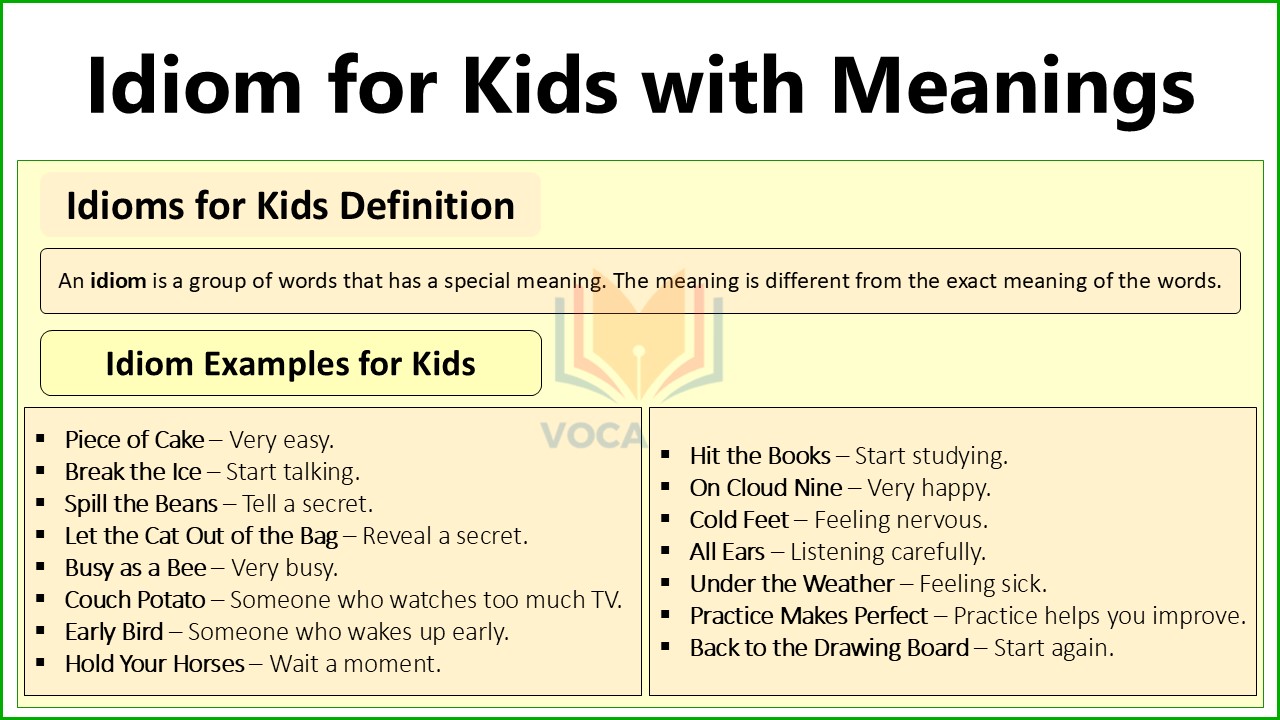
An idiom is a group of words that has a special meaning. The meaning is different from the exact meaning of the words.
For example:
- “Piece of cake” does not mean cake.
- It means something very easy to do.
Daily Use Idioms for Kids
# | Idiom | Meaning | Example |
|---|---|---|---|
1 | A piece of cake | Very easy | This quiz is a piece of cake. |
2 | Break the ice | Start talking | Let’s play a game to break the ice. |
3 | Hit the books | Start studying | I will hit the books after lunch. |
4 | Under the weather | Feeling sick | Ali is under the weather today. |
5 | Once in a blue moon | Very rarely | I eat candy once in a blue moon. |
6 | Spill the beans | Tell a secret | Don’t spill the beans yet. |
7 | Hold your horses | Wait | Hold your horses, please. |
8 | The ball is in your court | It is your turn | The ball is in your court now. |
9 | Let the cat out of the bag | Tell a secret | She let the cat out of the bag. |
10 | Cost an arm and a leg | Very expensive | This bike costs an arm and a leg. |
11 | Bite your tongue | Stay quiet | I had to bite my tongue. |
12 | On cloud nine | Very happy | I was on cloud nine. |
13 | Better late than never | Late is better than never | You came late, but better late than never. |
14 | Call it a day | Stop working | Let’s call it a day. |
15 | In hot water | In trouble | Tom is in hot water. |
16 | Keep an eye on | Watch carefully | Keep an eye on the baby. |
17 | Get cold feet | Feel nervous | I got cold feet on stage. |
18 | Go the extra mile | Try harder | Sara went the extra mile. |
19 | A blessing in disguise | A hidden good thing | The rain was a blessing in disguise. |
20 | Don’t judge a book by its cover | Do not judge by looks | Don’t judge a book by its cover. |
21 | Easy as pie | Very easy | This game is easy as pie. |
22 | In the same boat | In the same situation | We are in the same boat. |
23 | Out of the blue | Suddenly | He called me out of the blue. |
24 | The early bird catches the worm | Start early to win | Wake up early. The early bird catches the worm. |
25 | When pigs fly | Never | I will clean your room when pigs fly. |
Part 2: Idioms 26 to 50
Part 3: Idioms 51 to 75
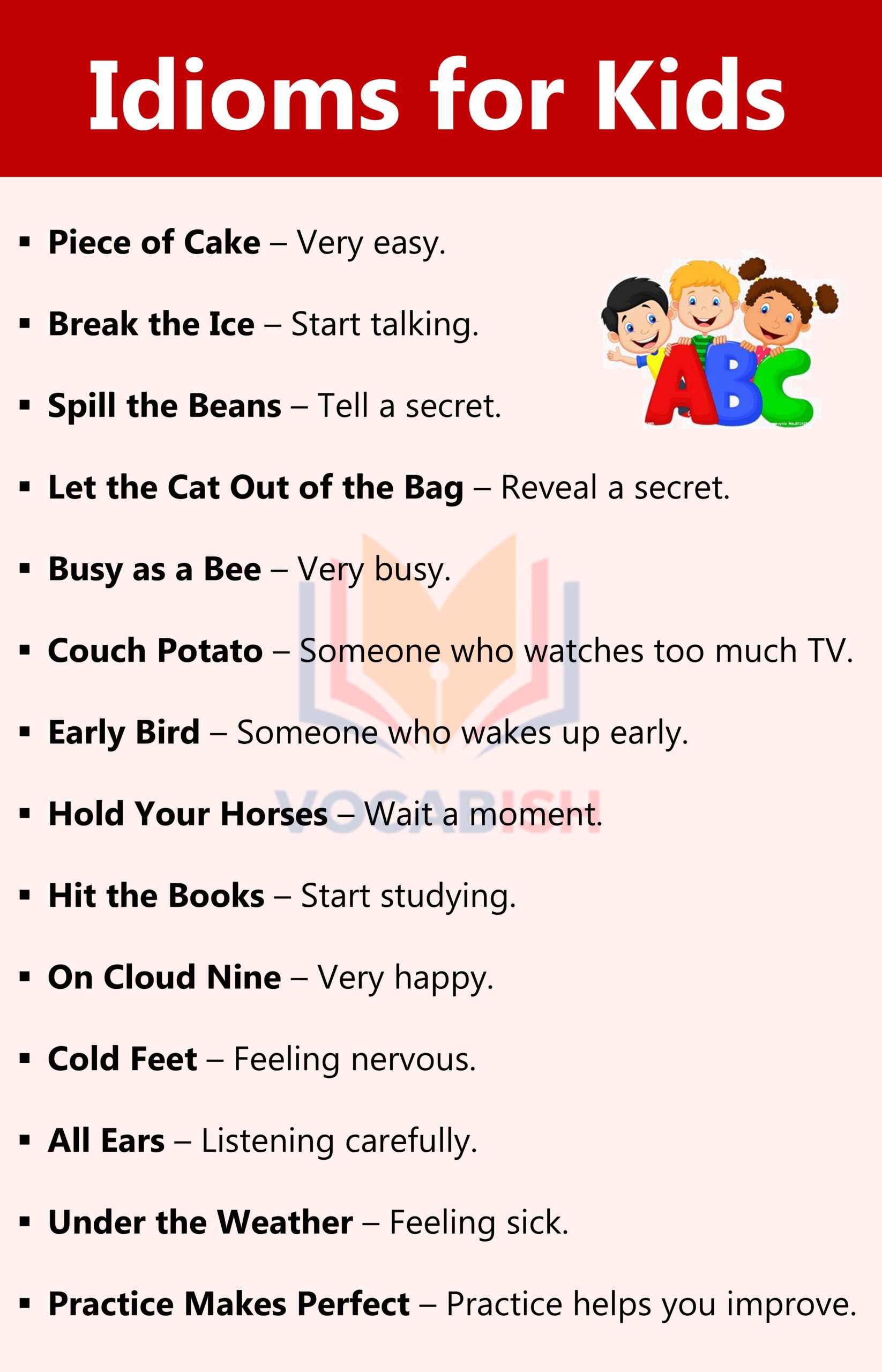
English Idioms for Kids with Meanings
# | Idiom | Meaning | Example |
|---|---|---|---|
26 | Hit the nail on the head | Say the right thing | You hit the nail on the head. |
27 | Pull someone’s leg | Joke with someone | I am just pulling your leg. |
28 | Zip your lip | Stop talking | Zip your lip and listen. |
29 | All ears | Listening carefully | Tell me. I’m all ears. |
30 | Big cheese | Important person | Dad is the big cheese at home. |
31 | Butterflies in my stomach | Feeling nervous | I have butterflies in my stomach. |
32 | Catch some rays | Enjoy sunshine | Let’s catch some rays outside. |
33 | Couch potato | Lazy person | Don’t be a couch potato. |
34 | Cry over spilled milk | Worry about the past | Don’t cry over spilled milk. |
35 | Down to earth | Simple and kind | My teacher is down to earth. |
36 | Fish out of water | Feeling uncomfortable | I felt like a fish out of water. |
37 | Full of beans | Full of energy | The kids are full of beans. |
38 | Give it a shot | Try it | Give it a shot. |
39 | Hang in there | Keep trying | Hang in there, buddy. |
40 | Have a blast | Have fun | We had a blast today. |
41 | Keep your chin up | Stay happy | Keep your chin up. |
42 | Learn the ropes | Learn how it works | I am learning the ropes. |
43 | Make a long story short | Say it briefly | To make a long story short, we won. |
44 | Miss the boat | Miss a chance | I missed the boat. |
45 | On the right track | Doing well | You are on the right track. |
46 | Practice makes perfect | Practice helps you improve | Practice makes perfect. |
47 | Put on your thinking cap | Think carefully | Put on your thinking cap. |
48 | Raining cats and dogs | Raining heavily | It is raining cats and dogs. |
49 | See eye to eye | Agree | We see eye to eye. |
50 | Sit tight | Wait patiently | Sit tight for a minute. |
Idioms for Kids with Examples
# | Idiom | Meaning | Example |
|---|---|---|---|
51 | Sleep on it | Think later | Sleep on it first. |
52 | Speak your mind | Say your thoughts | Speak your mind kindly. |
53 | Take a rain check | Do it later | I will take a rain check. |
54 | Take it easy | Relax | Take it easy today. |
55 | The best of both worlds | Two good things together | This trip has the best of both worlds. |
56 | Time flies | Time passes fast | Time flies when we play. |
57 | Two heads are better than one | Working together helps | Two heads are better than one. |
58 | Up in the air | Not decided | The plan is up in the air. |
59 | Use your head | Think carefully | Use your head before answering. |
60 | Walk on eggshells | Be very careful | Walk on eggshells near the baby. |
61 | A smart cookie | A clever person | You are a smart cookie. |
62 | As busy as a bee | Very busy | Mom is as busy as a bee. |
63 | As cool as a cucumber | Very calm | He stayed cool as a cucumber. |
64 | Back to square one | Start again | We are back to square one. |
65 | Barking up the wrong tree | Blaming the wrong person | You are barking up the wrong tree. |
66 | Beat around the bush | Avoid the point | Don’t beat around the bush. |
67 | Born yesterday | Easy to fool | I wasn’t born yesterday. |
68 | Bright as a button | Very smart | She is bright as a button. |
69 | By the book | Follow the rules | Play by the book. |
70 | Change your mind | Choose differently | I changed my mind. |
71 | Chew the fat | Chat | We chewed the fat after class. |
72 | Cool your jets | Calm down | Cool your jets, please. |
73 | Cut corners | Do it poorly | Don’t cut corners. |
74 | Draw a blank | Forget | I drew a blank. |
75 | Drop the ball | Make a mistake | I dropped the ball today. |
Idioms in English with Pictures
# | Idiom | Meaning | Example |
|---|---|---|---|
76 | Face the music | Accept the result | I had to face the music. |
77 | Find your feet | Feel comfortable | I found my feet at school. |
78 | Get a head start | Start early | I got a head start. |
79 | Get the hang of it | Learn it | I got the hang of it. |
80 | Give someone a hand | Help someone | Give me a hand, please. |
81 | Go bananas | Get very excited | The kids went bananas. |
82 | Good as gold | Very well-behaved | The puppy was good as gold. |
83 | Have second thoughts | Feel unsure | I had second thoughts. |
84 | In a nutshell | In short | In a nutshell, we won. |
85 | Jump for joy | Be very happy | I jumped for joy. |
86 | Keep your word | Keep a promise | Always keep your word. |
87 | Know something by heart | Remember well | I know this poem by heart. |
88 | Light bulb moment | A sudden idea | I had a light bulb moment. |
89 | Make waves | Cause trouble | Don’t make waves in class. |
90 | No sweat | No problem | No sweat, I can help. |
91 | On thin ice | Close to trouble | You are on thin ice. |
92 | Pass with flying colors | Do very well | She passed with flying colors. |
93 | Pick your brain | Ask for ideas | Can I pick your brain? |
94 | Play it by ear | Decide later | Let’s play it by ear. |
95 | Put your best foot forward | Try your best | Put your best foot forward. |
96 | Read between the lines | Understand hidden meaning | Read between the lines. |
97 | Save the day | Fix the problem | You saved the day. |
98 | Small world | A surprising connection | Wow, small world! |
99 | The icing on the cake | An extra good thing | The medal was the icing on the cake. |
100 | Try your hand at | Try something new | Try your hand at drawing. |
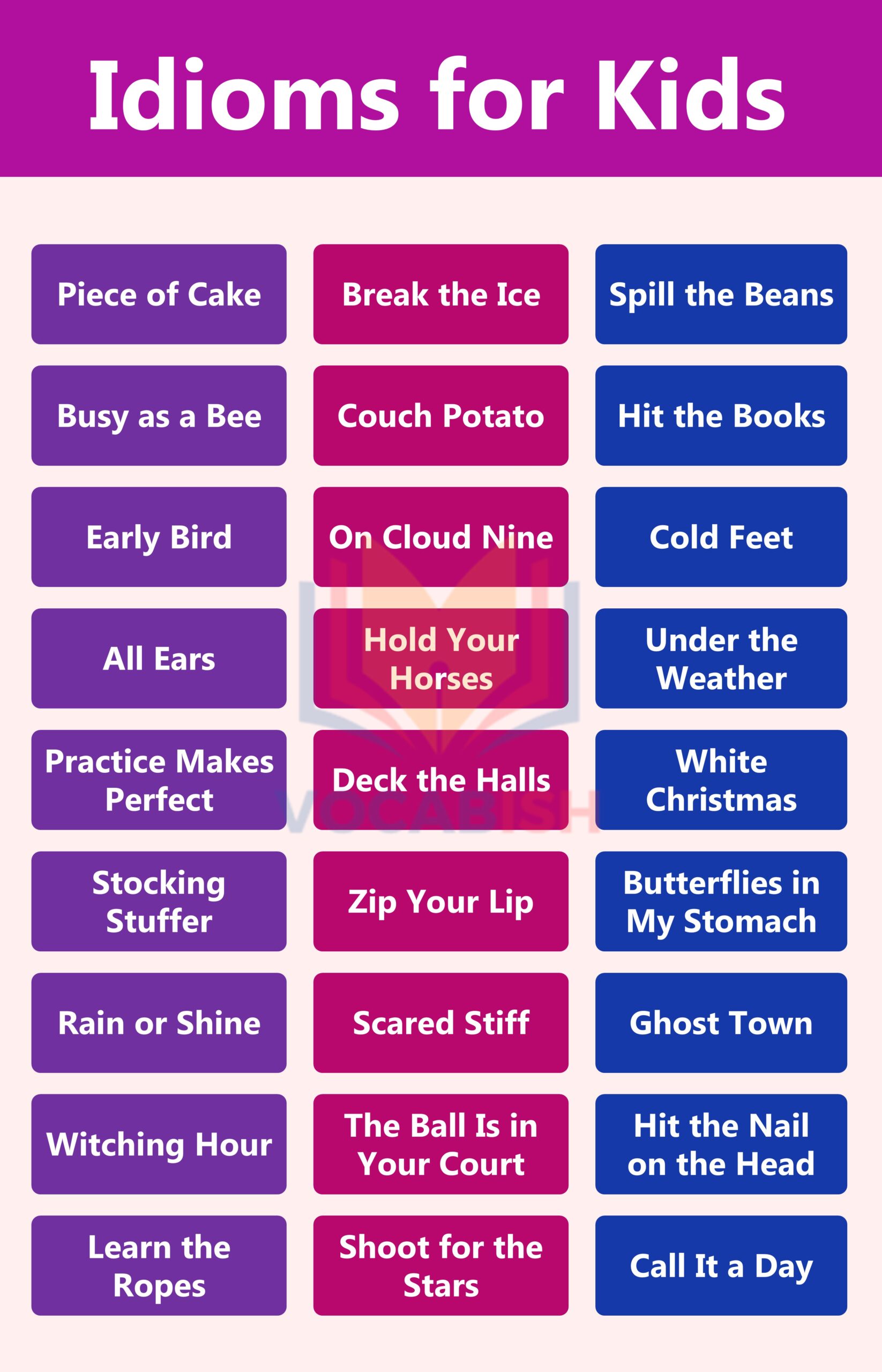
How Kids Can Learn Idioms Easily
Do not try to learn all 100 idioms in one day. Start with five idioms. Read the meaning. Say the example sentence out loud. Then make your own sentence.
Another helpful way is to learn idioms by topic. School idioms are useful for classroom situations. Family idioms can be practiced at home. Friendship idioms are great when talking with friends. Topic-based learning makes idioms easier to remember.
Quick Practice for Kids
Pick any idiom from the list. Read it three times. Say the example sentence. Then write your own sentence.
For example:
Idiom: A piece of cake
Meaning: Very easy
Your sentence: My drawing homework was a piece of cake.
This simple practice helps you remember idioms faster.
Tips for Teaching Idioms to Kids
Learning idioms becomes easier with simple teaching methods.
Helpful strategies include:
- Use pictures to explain idioms
- Show examples in short sentences
- Practice idioms during daily conversations
- Play vocabulary games
- Encourage kids to create their own sentences
FAQs About Idioms for Kids
Idioms for kids are short phrases with meanings different from the literal words. They help children understand everyday English expressions used in conversations, stories, and school communication.
An idiom is a group of words that has a special meaning not understood from the individual words. For example, “piece of cake” means something very easy to do.
Kids can learn idioms by reading stories, practicing sentences, using picture examples, and hearing them in conversations. Regular practice helps children remember idioms and use them correctly in speaking and writing.
Common idioms for kids include “piece of cake,” “break the ice,” “hit the books,” “spill the beans,” and “busy as a bee.” These expressions appear often in daily conversations.
A simple list of idioms for kids includes “piece of cake,” “early bird,” “cold feet,” “all ears,” “busy as a bee,” and “couch potato.” Each idiom expresses an idea in a fun way.
Easy idiom examples for kids include “on cloud nine” (very happy), “hold your horses” (wait), and “under the weather” (feeling sick). These expressions are simple and commonly used.
Related Articles:
Final Words
Idioms make English more fun. They help kids understand stories, cartoons, books, and daily conversations better. Learn slowly. Practice often. Use idioms only when they fit the sentence. With time, these expressions will become easy and natural.