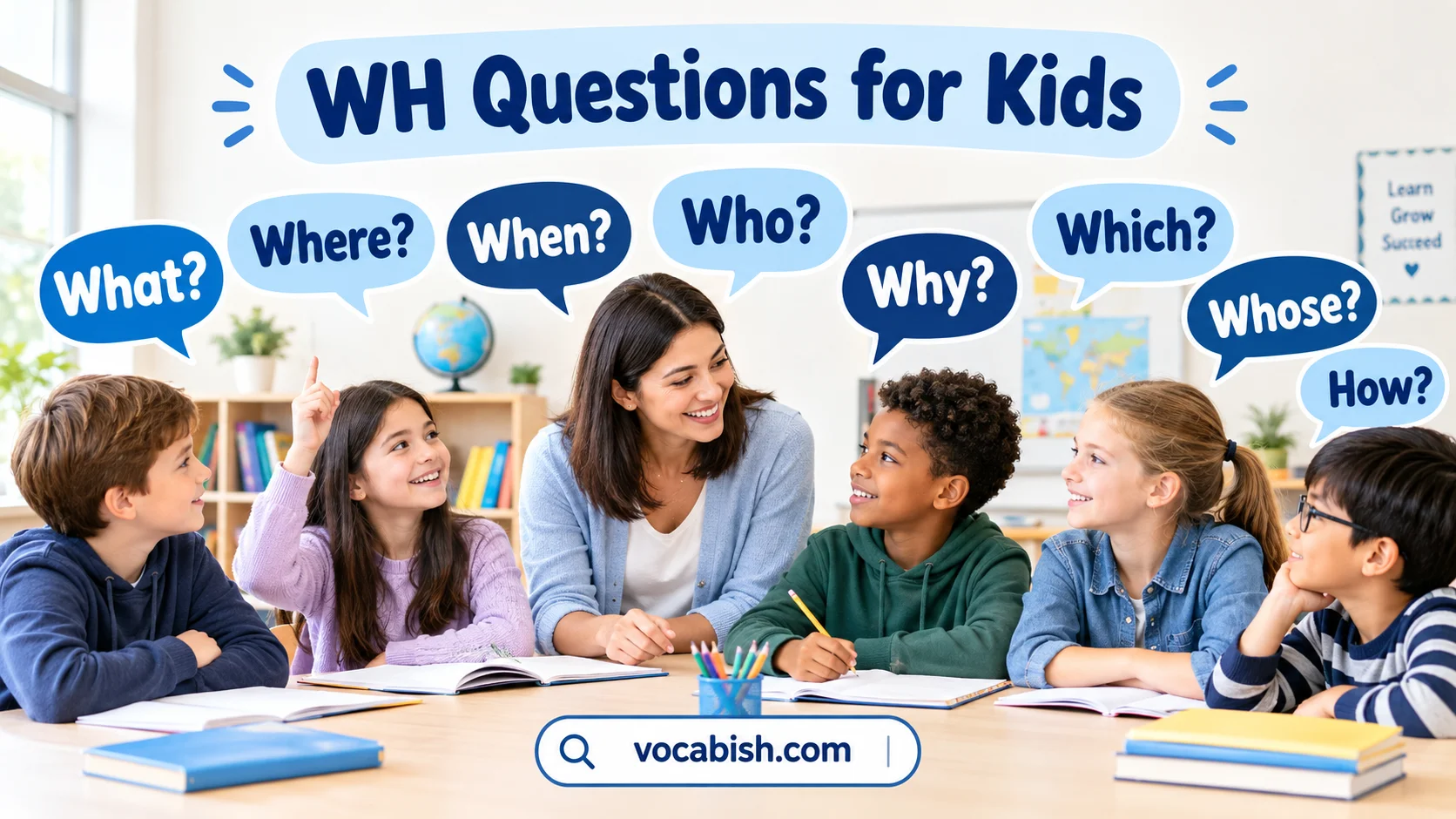

WH questions are questions that ask for specific information. Most of them begin with what, where, when, who, why, which, whose, or how.
They help children learn how to ask about people, places, things, time, choices, reasons, and ways of doing something.
Examples:
- What is your name?
- Where do you live?
- When is your birthday?
- Who is your teacher?
- Why are you happy?
- Which color do you like?
- Whose book is this?
- How are you today?
WH questions usually need more than a yes or no answer.
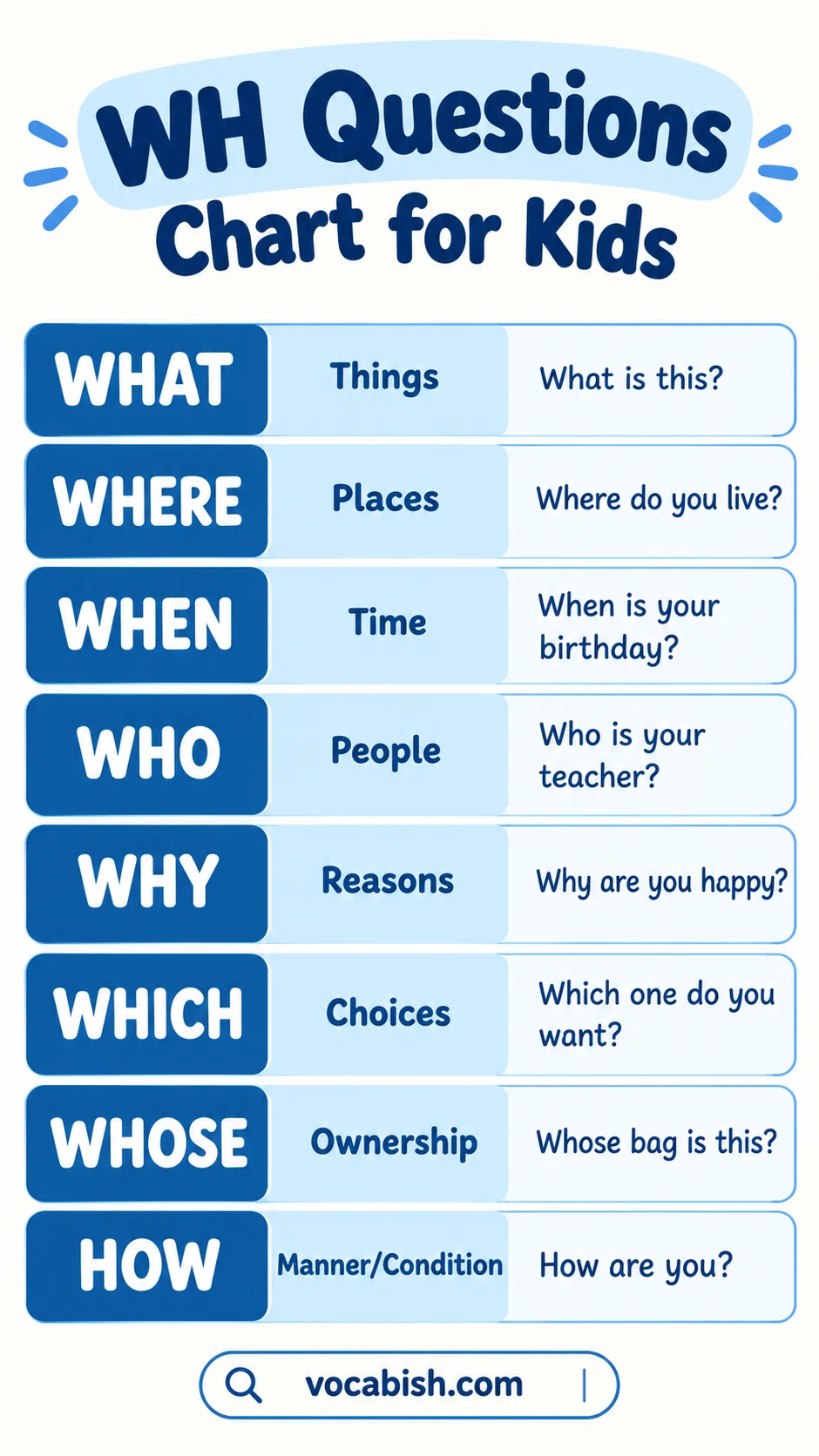
WH Words and Their Uses
WH Word | What It Asks About | Example |
|---|---|---|
What | Things or information | What is this? |
Where | Places | Where is your school? |
When | Time | When do you wake up? |
Who | People | Who is your friend? |
Why | Reasons | Why are you laughing? |
Which | A choice | Which dress do you want? |
Whose | Ownership | Whose pencil is this? |
How | Manner, condition, amount, or degree | How are you? |
What Questions for Kids
What is used to ask about things, actions, names, information, and ideas.
- What is your name?
- What is your favorite food?
- What are you doing?
- What color is your bag?
- What did you eat for breakfast?
- What do you like to play?
- What is your favorite subject?
- What time do you go to school?
For younger children, start with simple questions such as “What is this?” and “What color is it?” Older students can answer questions about activities, opinions, and daily life.
Where Questions for Kids
Where asks about a place or location.
- Where do you live?
- Where is your school?
- Where is my book?
- Where do you play?
- Where did you go yesterday?
- Where are your shoes?
- Where can we buy food?
- Where would you like to go?
A simple answer often starts with in, on, at, near, or under.
Question: Where is the cat?
Answer: The cat is under the table.
When Questions for Kids
When asks about time.
- When is your birthday?
- When do you wake up?
- When does school start?
- When do you eat lunch?
- When did you finish your homework?
- When are you going to the park?
- When is the next holiday?
- When do you usually go to bed?
Children can answer with a time, day, date, month, or part of the day.
Question: When do you go to school?
Answer: I go to school at 8 o’clock.
Who Questions for Kids
Who asks about a person or people.
- Who is your best friend?
- Who is your teacher?
- Who lives with you?
- Who made this cake?
- Who is knocking at the door?
- Who helps you with your homework?
- Who is your favorite singer?
- Who won the game?
Question: Who is your English teacher?
Answer: Mr. Ali is my English teacher.
Why Questions for Kids
Why asks for a reason.
Children often answer why questions with because.
- Why are you happy?
- Why are you crying?
- Why are you late?
- Why do you like English?
- Why is the baby sleeping?
- Why did you open the window?
- Why are you wearing a jacket?
- Why should we study?
Question: Why are you happy?
Answer: Because I got a good grade.
For younger children, simple reasons are enough. Older students can give longer explanations.
Which Questions for Kids
Which is used when choosing between two or more people or things.
- Which color do you like?
- Which book is yours?
- Which fruit do you want?
- Which game should we play?
- Which subject do you like best?
- Which shirt should I wear?
- Which animal do you like?
- Which answer is correct?
Question: Which fruit do you want, an apple or a banana?
Answer: I want a banana.
A useful way to teach which is to give children clear choices.
Whose Questions for Kids
Whose asks who owns something.
- Whose pencil is this?
- Whose bag is on the chair?
- Whose shoes are these?
- Whose book are you reading?
- Whose phone is ringing?
- Whose jacket is this?
- Whose lunch box is on the table?
Question: Whose pencil is this?
Answer: It is Sara’s pencil.
Remember:
Who = a person
Whose = ownership
How Questions for Kids
Although how does not begin with “wh,” it is commonly taught with WH questions because it asks for information in a similar way.
How can ask about condition, manner, amount, distance, age, frequency, and more.
- How are you?
- How do you make a sandwich?
- How old are you?
- How many books do you have?
- How much water do you drink?
- How often do you exercise?
- How far is the school?
- How long is the movie?
How Old:
Use how old to ask about age.
Question: How old are you?
Answer: I am eight years old.
How Many:
Use how many with countable nouns.
Question: How many pencils do you have?
Answer: I have five pencils.
How Much:
Use how much with uncountable nouns or to ask about price.
Question: How much water do you need?
Answer: I need some water.
Question: How much is this book?
Answer: It is five dollars.
How Often:
Use how often to ask about frequency.
Question: How often do you read?
Answer: I read every day.
WH Questions for Kindergarten and Grade 1
Young children should begin with short questions that are easy to understand and answer.
- What is your name?
- What color is this?
- What is that?
- Where is your bag?
- Where is your mom?
- Who is your teacher?
- Who is your friend?
- When do you eat breakfast?
- Why are you happy?
- How are you?
Pictures, classroom objects, toys, and familiar people can make these questions easier for beginners.
WH Questions for Grades 2 and 3
Students at this level can answer questions about school, family, hobbies, food, and daily routines.
- What do you do after school?
- Where do you keep your books?
- When do you do your homework?
- Who do you play with?
- Why do you like your favorite game?
- Which subject do you like?
- Whose notebook is this?
- How many brothers do you have?
Encourage students to answer in complete sentences rather than using only one word.
WH Questions for Grades 4 and 5
Students can start giving more detailed answers.
- What did you do last weekend?
- Where did you go during your vacation?
- When do you usually study?
- Who inspires you?
- Why is exercise important?
- Which book would you recommend?
- Whose idea was better?
- How can you improve your English?
These questions help children practice both grammar and everyday communication.
WH Questions for Grades 6 to 10
Older students can use WH questions to discuss opinions, experiences, plans, and reasons.
- What would you like to learn this year?
- Where would you like to travel?
- When should students start preparing for exams?
- Who has influenced your life the most?
- Why do people need to protect the environment?
- Which skill is most useful for students?
- Whose opinion do you agree with?
- How can students manage their time better?
At this level, students should try to explain their answers instead of giving very short replies.
WH Question Sentence Structure
The structure changes depending on the verb and the kind of question.
1. WH Word + Be Verb + Subject
- Where is your book?
- Who is your teacher?
- What are they doing?
- Why are you tired?
2. WH Word + Do/Does + Subject + Base Verb
- What do you like?
- Where does she live?
- When do they study?
- Why does he run?
3. WH Word + Did + Subject + Base Verb
Use did when asking about a completed action in the past.
- What did you eat?
- Where did you go?
- When did she arrive?
- Why did they leave?
4. WH Word + Modal Verb + Subject + Base Verb
- What can you do?
- Where can we go?
- How should I answer?
- Which book should I read?
Easy WH Questions and Answers for Kids
These short examples are useful for classroom practice and beginner students.
- What is your name? — My name is Ahmed.
- Where do you live? — I live in Lahore.
- When is your birthday? — My birthday is in July.
- Who is your best friend? — Ali is my best friend.
- Why are you smiling? — Because I am happy.
- Which fruit do you like? — I like apples.
- Whose bag is this? — It is Mary’s bag.
- How are you? — I am fine.
- How old are you? — I am ten years old.
- How many books do you have? — I have six books.
WH Questions Practice for Kids
Choose the correct question word.
- ______ is your favorite color?
- ______ do you live?
- ______ is your birthday?
- ______ is your English teacher?
- ______ are you laughing?
- ______ book do you want?
- ______ pencil is this?
- ______ many students are in your class?
Answers:
- What
- Where
- When
- Who
- Why
- Which
- Whose
- How
How Parents and Teachers Can Practice WH Questions
Parents can ask WH questions during normal activities instead of turning every practice session into a grammar lesson.
At breakfast, ask “What do you want to eat?” During the school routine, ask “Where is your bag?” After school, try “What did you learn today?” Before bedtime, ask “What was your favorite part of the day?”
Teachers can use classroom objects, pictures, stories, and daily routines to create quick question-and-answer activities. Younger students can answer orally, while older students can write their answers in complete sentences.
A good progression is:
Ask → Answer → Explain
For example:
Question: Why do you like football?
Answer: I like football because it is exciting.
This gives children practice with both the question and the language needed to explain their ideas.
Common Mistakes With WH Questions
Using “is” with a main verb incorrectly
❌ Where is you live?
✅ Where do you live?
Using “does” with the wrong verb form
❌ What does she likes?
✅ What does she like?
After does, use the base form of the verb.
Using “did” with the past form
❌ What did you ate?
✅ What did you eat?
After did, use the base form of the verb.
Confusing “who” and “whose”
❌ Whose is your teacher?
✅ Who is your teacher?
Who asks about a person.
Whose asks about ownership.
WH Question Sentences for Kids
- What is your favorite food?
- Where do you live?
- When do you wake up?
- Who is your best friend?
- Why do you like school?
- Which animal do you like?
- Whose pencil is this?
- How are you today?
- How old are you?
- How many books do you have?
- How much water do you drink?
- How often do you read?
- How far is your school?
- How long is your class?
FAQs About WH Questions for Kids
WH questions are questions that ask for specific information. Common WH question words include what, where, when, who, why, which, whose, and how.
The commonly taught WH question words are what, where, when, who, why, which, whose, and how. Although how does not begin with “wh,” it is normally included when teaching WH questions.
Some easy examples are:
What is your name?
Where do you live?
Who is your teacher?
When is your birthday?
Why are you happy?
Which color do you like?
Whose book is this?
How are you?
Start with familiar topics such as names, family, school, food, toys, colors, and daily routines. Use short questions first, then move to questions that require longer answers. Pictures and real classroom objects can also help young learners understand the meaning of each question word.
Conclusion
WH questions help kids ask for clear information about people, places, things, time, reasons, choices, and actions. Learning what, where, when, who, why, which, whose, and how gives students a strong foundation for everyday English conversations and grammar. Regular practice with simple questions and complete answers can help children become more confident English speakers.
Explore More Related Lessons