
Why do we say interested in but good at? And why does using the wrong preposition sometimes make a sentence sound strange? Learning Adjectives and Prepositions combinations helps you understand these common English patterns. These word pairs appear in everyday conversations, schoolwork, emails, and exams, so knowing them can make your English sound more natural and accurate.
Many learners know the meaning of adjectives like afraid, proud, and interested, but choosing the correct preposition can be challenging. The good news is that once you learn these combinations in context, they become much easier to remember and use confidently in speaking and writing.
What Are Adjectives and Prepositions Combinations?
Adjective-preposition combinations are fixed word pairs where a specific adjective is usually followed by a particular preposition. These combinations often cannot be translated word-for-word from another language.
For example:
- interested in
- afraid of
- good at
- proud of
- famous for
Using the wrong preposition may make a sentence sound unnatural, even if people still understand your meaning.
Adjective | Correct Preposition | Example |
|---|---|---|
afraid | of | She is afraid of spiders. |
good | at | He is good at math. |
interested | in | We are interested in science. |
proud | of | They are proud of their team. |
Why do we need to learn these combinations?
These combinations appear everywhere in English. Native speakers use them automatically, so learning them helps you sound more fluent.
Benefits of learning adjective-preposition pairs:
- Improve speaking accuracy
- Write more naturally
- Understand conversations better
- Avoid common grammar mistakes
- Build stronger vocabulary knowledge
Instead of learning adjectives alone, learn the whole phrase.
For example:
❌ interested
✅ interested in
Common Adjectives and Prepositions Combinations
Many adjective-preposition pairs are used daily. The table below shows some of the most common ones.
Adjective | Preposition | Example Sentence |
|---|---|---|
afraid | of | I’m afraid of dogs. |
angry | with | She is angry with her brother. |
excited | about | We are excited about the trip. |
famous | for | The city is famous for its food. |
good | at | He is good at football. |
interested | in | They are interested in music. |
proud | of | She is proud of her achievement. |
responsible | for | He is responsible for the project. |
similar | to | Your bag is similar to mine. |
worried | about | I’m worried about the exam. |
Adjectives Followed by “Of”
Many adjectives are commonly followed by of. These combinations often describe feelings, abilities, or opinions.
- afraid of
Sarah is afraid of spiders. - proud of
We are proud of our achievements. - aware of
The manager is aware of the problem. - capable of
He is capable of solving difficult tasks. - tired of
I’m tired of waiting. - jealous of
She is jealous of her friend’s success. - ashamed of
He was ashamed of his behavior. - fond of
My grandmother is fond of gardening.
Adjectives Followed by “At”
The preposition at is often used with adjectives related to skills and abilities.
- clever at
Tom is clever at finding solutions. - good at
Emma is good at mathematics. - bad at
I’m bad at remembering names. - excellent at
She is excellent at public speaking. - skilled at
He is skilled at repairing bicycles. - quick at
My brother is quick at solving puzzles. - slow at
She’s slow at typing. - surprised at
We were surprised at the results.
Adjectives Followed by “In”
Several adjectives are followed by in when talking about interests, experience, or involvement.
- interested in
I’m interested in learning French. - experienced in
She is experienced in teaching children. - involved in
He is involved in community projects. - successful in
They were successful in business. - rich in
Oranges are rich in vitamin C. - active in
She is active in local events. - specialized in
The company is specialized in software development. - weak in
He is weak in grammar.
Adjectives Followed by “With”
The preposition with is common with adjectives describing feelings, relationships, and satisfaction.
- angry with
She is angry with her brother. - pleased with
We are pleased with the results. - satisfied with
He is satisfied with his work. - patient with
Good teachers are patient with students. - familiar with
Are you familiar with this app? - happy with
I’m happy with my new laptop. - disappointed with
They were disappointed with the service. - busy with
She’s busy with her homework.
Adjectives Followed by “For”
Many adjectives take for when giving reasons or describing purposes.
- famous for
Italy is famous for its food. - known for
The city is known for its beaches. - responsible for
She is responsible for the project. - ready for
Are you ready for the exam? - suitable for
This book is suitable for young learners. - necessary for
Water is necessary for life. - perfect for
This bag is perfect for travel. - sorry for
I feel sorry for the injured animal.
Adjectives Followed by “About”
The preposition about is often used when expressing feelings or opinions regarding something.
- excited about
The children are excited about the trip. - worried about
She is worried about her test. - happy about
We’re happy about the news. - nervous about
I’m nervous about the interview. - upset about
They were upset about the delay. - concerned about
Parents are concerned about online safety. - serious about
He’s serious about his studies. - enthusiastic about
She is enthusiastic about photography.
Adjectives Followed by “To”
The preposition to is often used with adjectives that describe relationships, behavior, or comparisons.
- similar to
Your answer is similar to mine. - kind to
She is kind to everyone. - friendly to
The staff were friendly to visitors. - rude to
It’s rude to interrupt people. - married to
She is married to a doctor. - polite to
Always be polite to others. - useful to
This information is useful to students. - important to
Education is important to young people.
How to Use Adjectives with Prepositions in Sentence
Start with the subject
The subject is the person or thing being described.
Example: He
Use the adjective
The adjective describes the subject’s quality.
Example: He is afraid
Add the preposition
The preposition links the adjective to the object.
Example: He is afraid of
End with the object
The object is the thing or person affected by the adjective.
Example: He is afraid of dogs.
100+ Examples of Adjectives and Prepositions
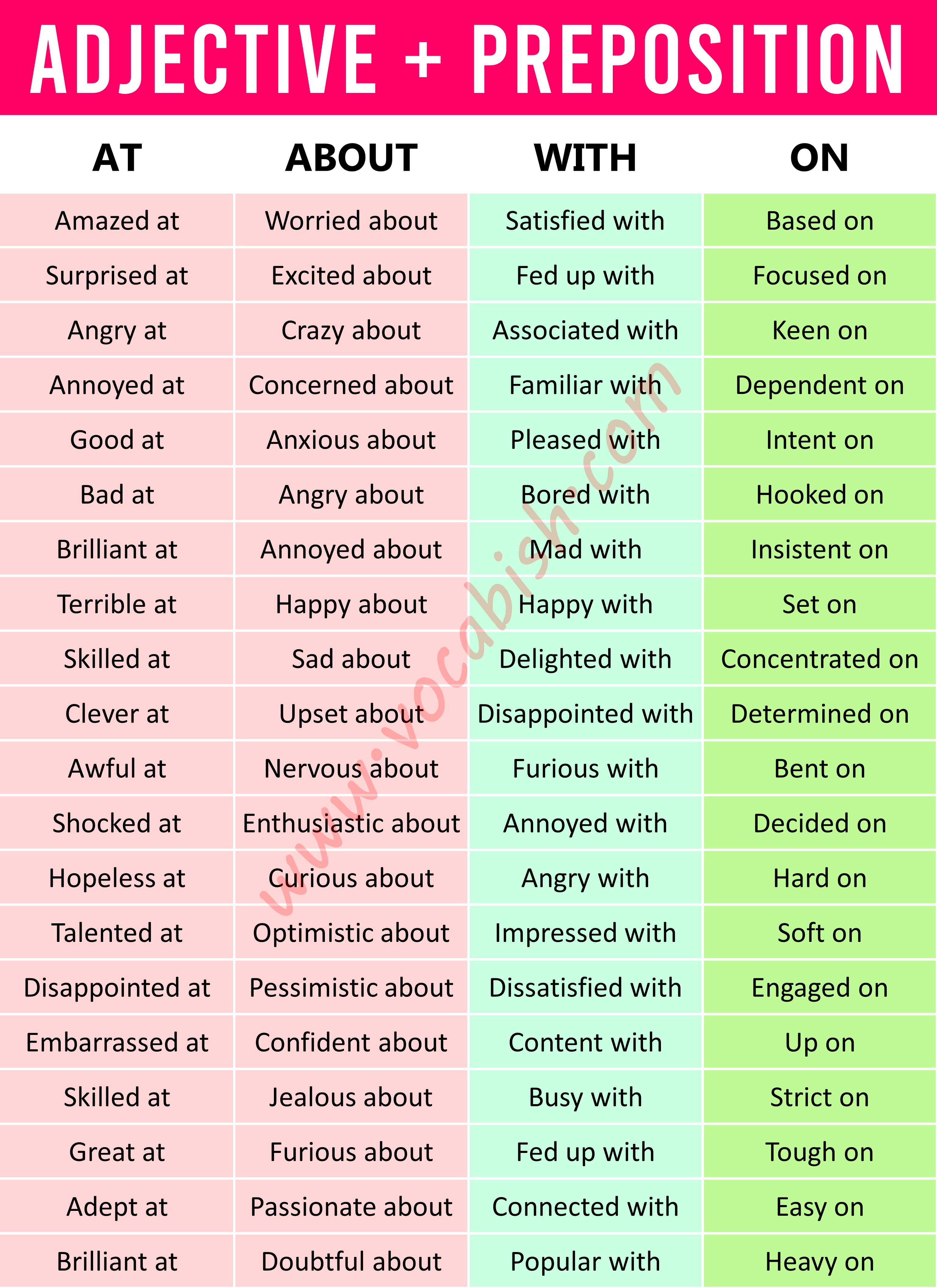
Here’s the list of adjectives and prepositions organized in a table format that shows the combination between adjectives and prepositions:
Adjectives + At | Adjectives + About | Adjectives + With |
|---|---|---|
Amazed at | Worried about | Satisfied with |
Surprised at | Excited about | Fed up with |
Annoyed at | Concerned about | Familiar with |
Good at | Anxious about | Pleased with |
Bad at | Angry about | Bored with |
Brilliant at | Annoyed about | Mad with |
Terrible at | Happy about | Happy with |
Skilled at | Sad about | Delighted with |
Clever at | Upset about | Disappointed with |
Awful at | Nervous about | Furious with |
Shocked at | Enthusiastic about | Annoyed with |
Hopeless at | Curious about | Angry with |
Talented at | Optimistic about | Impressed with |
Disappointed at | Pessimistic about | Dissatisfied with |
Embarrassed at | Confident about | Content with |
Skilled at | Jealous about | Busy with |
Great at | Furious about | Fed up with |
Adept at | Passionate about | Connected with |
Brilliant at | Doubtful about | Popular with |
Adjectives + Prepositions List
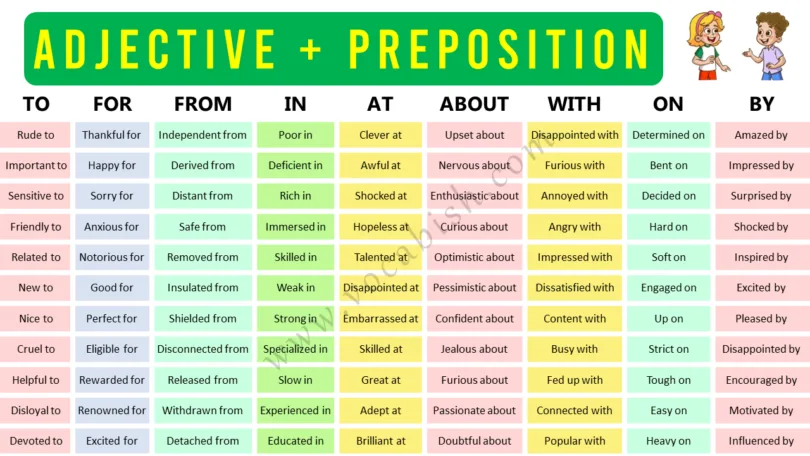
Adjectives + In | Adjectives + To | Adjectives + From | Adjectives + For |
|---|---|---|---|
Interested in | Grateful to | Different from | Famous for |
Engaged in | Addicted to | Free from | Suitable for |
Involved in | Married to | Opposed to | Responsible for |
Skilled in | Similar to | Absent from | Eager for |
Successful in | Attached to | Exempt from | Ready for |
Confident in | Kind to | Protected from | Known for |
Absorbed in | Polite to | Separate from | Prepared for |
Talented in | Opposed to | Distinct from | Qualified for |
Proficient in | Loyal to | Excluded from | Grateful for |
Poor in | Rude to | Independent from | Thankful for |
Deficient in | Important to | Derived from | Happy for |
Rich in | Sensitive to | Distant from | Sorry for |
Immersed in | Friendly to | Safe from | Anxious for |
Skilled in | Related to | Removed from | Notorious for |
Weak in | New to | Insulated from | Good for |
Strong in | Nice to | Shielded from | Perfect for |
Specialized in | Cruel to | Disconnected from | Eligible for |
Slow in | Helpful to | Released from | Rewarded for |
Experienced in | Disloyal to | Withdrawn from | Renowned for |
Educated in | Devoted to | Detached from | Excited for |
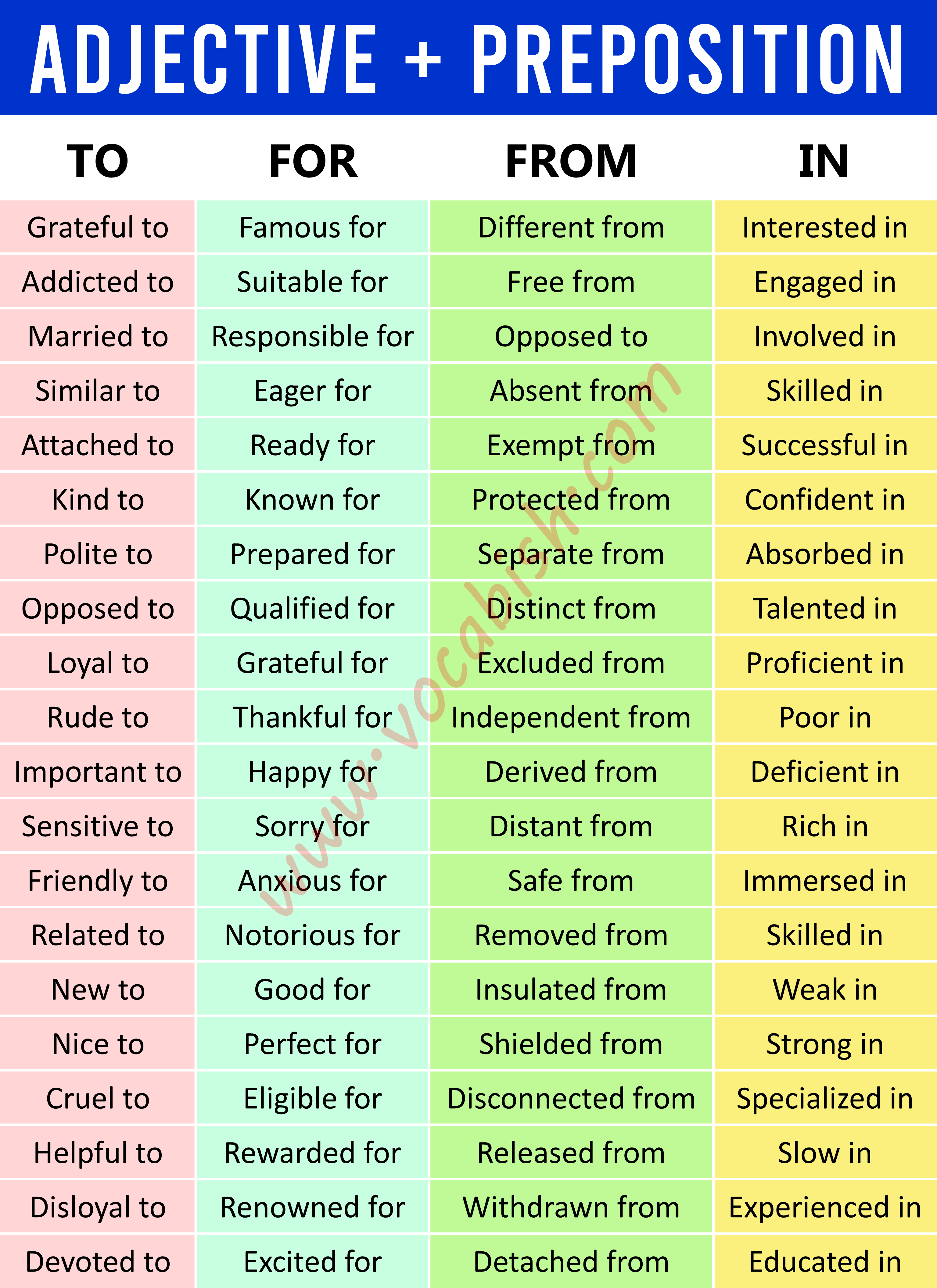 Adjectives and Prepositions
Adjectives + Prepositions with Meaning
Adjectives + about
- anxious about: feeling worried or nervous.
- excited about: feeling enthusiastic and eager.
- serious about: having a sincere intention or thought.
- passionate about: having strong feelings or a strong belief.
- happy about: feeling pleased or content.
- upset about: feeling distressed or troubled.
- optimistic about: hopeful and confident about the future.
- pessimistic about: expecting the worst possible outcome.
- confused about: unable to understand or think clearly.
- indifferent about: having no particular interest or sympathy.
Adjectives + at
- good at: having the ability to do something well.
- terrible at: very bad at doing something.
- skilled at: having a special ability in a task.
- amazed at: greatly surprised or impressed.
- angry at: feeling strong annoyance or displeasure.
- efficient at: achieving maximum productivity with minimum wasted effort.
- surprised at: feeling mild shock or astonishment.
- talented at: having a natural aptitude or skill.
- useless at: not able to do something well.
- proficient at: competent or skilled in doing something.
Adjectives + by
- amazed by: greatly surprised or impressed by someone or something.
- fascinated by: extremely interested in.
- inspired by: given the urge or ability to do or feel something.
- surprised by: unexpectedly impressed by something.
- shocked by: caused to feel surprised and upset.
- impressed by: admiring someone or something deeply.
- disturbed by: upset or worried by something.
- appalled by: greatly dismayed or horrified.
- excited by: very enthusiastic and eager about something.
- disgusted by: feeling strong disapproval or revulsion.
Adjectives + for
- ready for: fully prepared.
- famous for: known about by many people.
- grateful for: feeling or showing thanks.
- sorry for: feeling regret or penitence.
- responsible for: being the cause of something.
- necessary for: needed to be done, achieved, or present.
- prepared for: made ready or fit.
- important for: of great significance or value.
- eligible for: qualified or entitled to something.
- late for: not arriving until after the expected time.
Adjectives + in
- interested in: showing curiosity or concern about something.
- successful in: achieving desired aims or attaining prosperity.
- rich in: containing a large amount of.
- poor in: lacking in.
- confident in: feeling or showing confidence.
- skilled in: having the skills in a specific field.
- proficient in: competent or skilled in doing or using something.
- experienced in: having knowledge or skill in a particular area.
- involved in: participating in an activity or event.
- interested in: having an interest in doing or learning something.
Tips to Remember Adjective-Preposition Combinations
Learning these combinations becomes easier when you study them as complete phrases.
- Write adjective-preposition pairs in a notebook.
- Read English articles and notice common patterns.
- Create your own example sentences.
- Practice speaking with the combinations.
- Review them regularly.
- Learn them in groups by preposition.
Frequently Asked Questions
They are fixed phrases where an adjective is usually followed by a specific preposition, such as interested in, afraid of, and good at.
They help you speak and write more naturally, avoid grammar mistakes, and understand common English expressions used by native speakers.
Good at is used for skills and abilities. Good in is less common and usually refers to situations or environments.
There is no single rule. Most adjective-preposition pairs must be learned together through reading, listening, and regular practice.
Some common examples are interested in, afraid of, good at, worried about, famous for, proud of, and similar to.
Yes. Some adjectives can take different prepositions depending on meaning, though one combination is often more common than others.
Yes. They often appear in grammar, vocabulary, speaking, and writing sections of English proficiency and school examinations.
You May Also Like:
- Verbs and Prepositions Examples
- 150+ A to Z List of Conjunction Words
- 500+ A to Z List of Nouns in English
Conclusion
Learning Adjectives and Prepositions combinations is an important step toward using English more naturally and accurately. While there are no fixed rules for every combination, many of these phrases appear repeatedly in everyday conversations, books, emails, and exams.
Instead of memorizing adjectives and prepositions separately, try learning them together as complete expressions, such as afraid of, good at, interested in, and worried about. This approach helps you remember them more easily and use them correctly when speaking and writing.
The more you read, listen, and practice these common combinations, the more natural they will feel. Start using a few new adjective-preposition pairs each day, and you’ll soon notice a clear improvement in your English communication skills.