

Did you know that almost every sentence you speak contains a noun? From the people you meet and the places you visit to the things you use every day, nouns are everywhere in English. Learning a wide range of nouns can help you improve your vocabulary, understand conversations more easily, and express your ideas with greater confidence.
In this article, you’ll find an extensive A to Z List of Nouns in English along with examples in sentences. Whether you’re a student, ESL learner, or building your everyday vocabulary, these noun lists will help you recognize and use common English words more naturally.
What Are Nouns in English?
Nouns are words that name people, places, animals, things, or ideas. They are one of the most important parts of English grammar and appear in almost every sentence.
Examples:
- teacher
- school
- dog
- book
- happiness
Sentence Example:
The teacher placed the book on the desk.
Read more about: Nouns and Their Types
Why Is It Important to Learn Nouns?
Nouns help you identify and talk about the world around you. The more nouns you know, the easier it becomes to understand English and communicate clearly.
Learning nouns helps you:
- Build vocabulary faster
- Improve speaking skills
- Write more clearly
- Understand conversations
- Read English more confidently
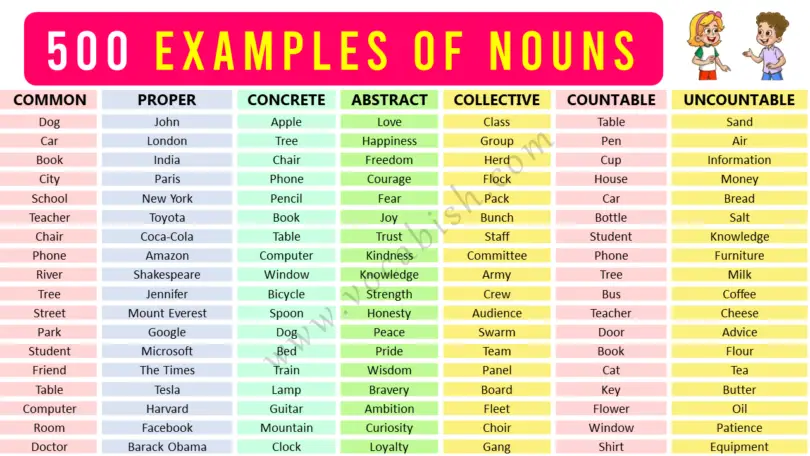
Types of Nouns in English
Before exploring the A to Z list, it’s helpful to understand the main types of nouns.
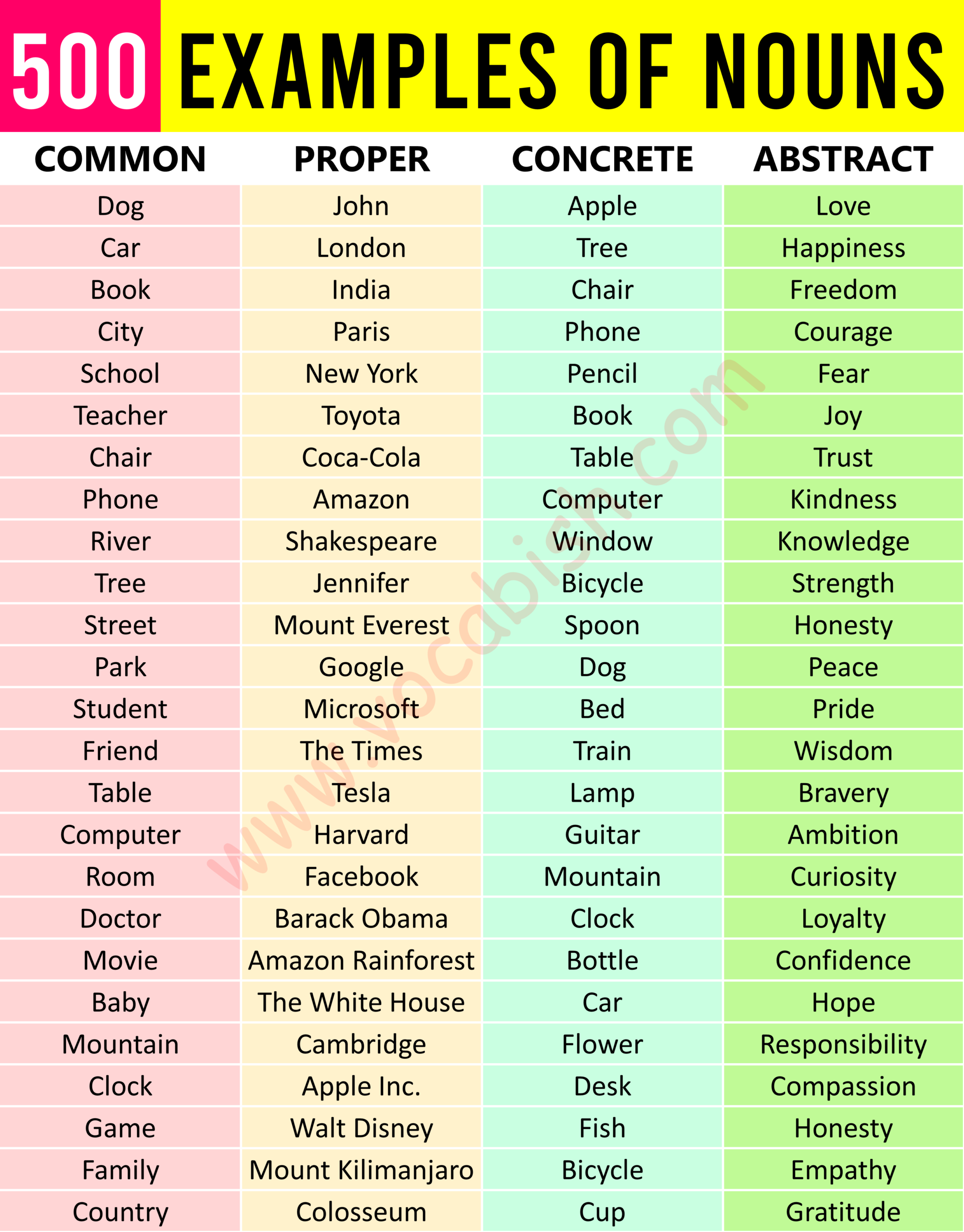
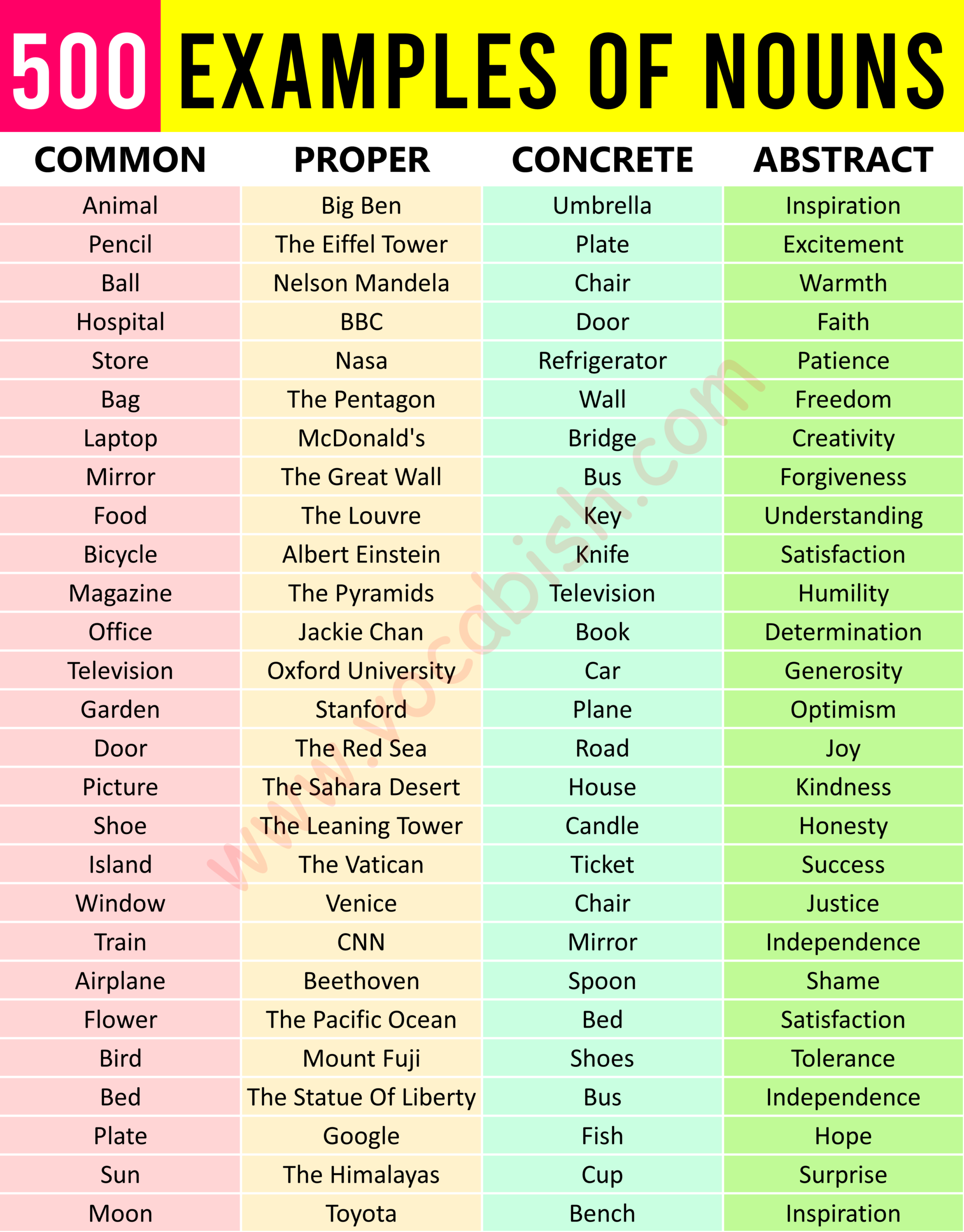
- Common Nouns: General names for people, places, animals, things, or ideas.
- Proper Nouns: Specific names of particular people, places, organizations, days, months, or other unique entities.
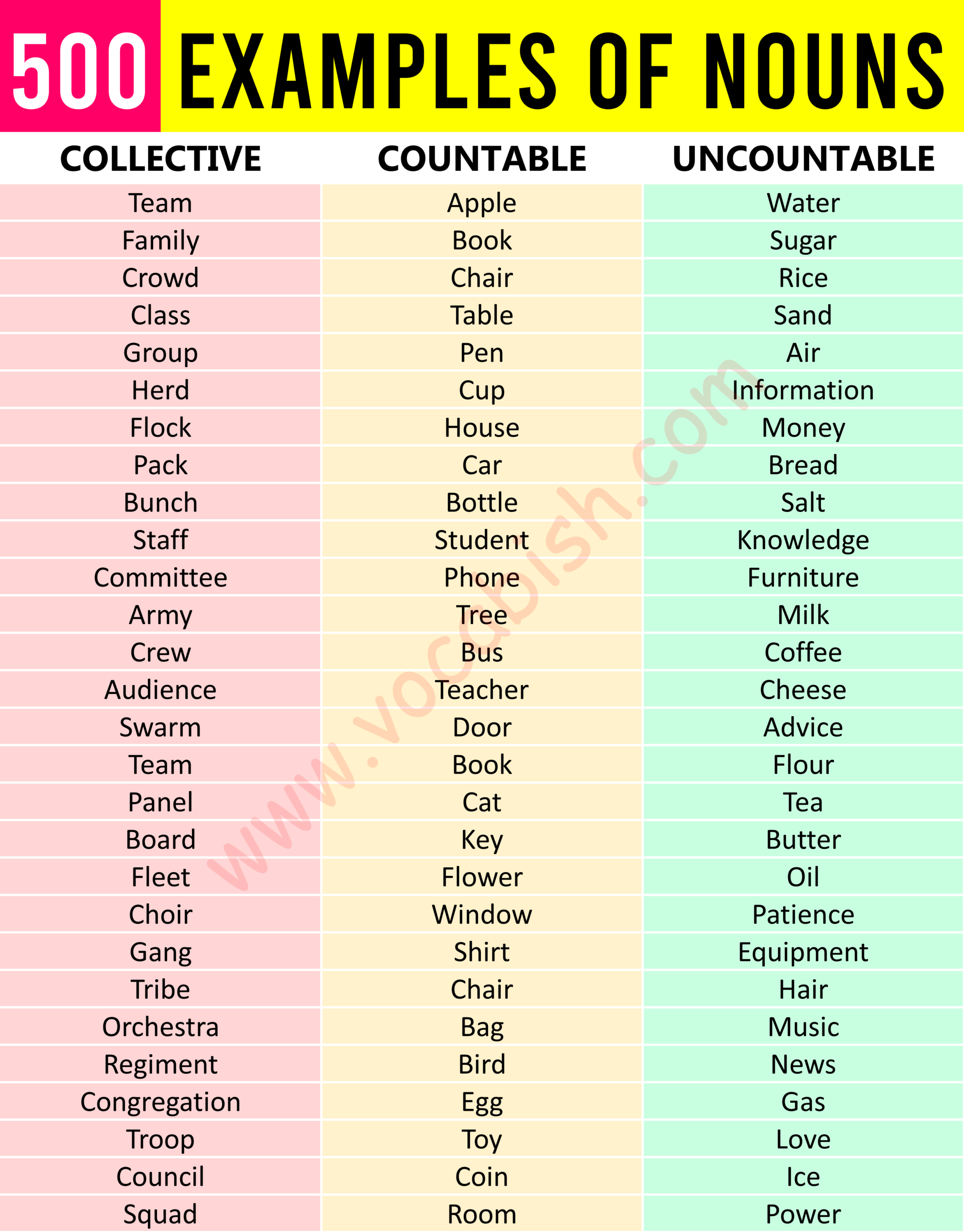
- Collective Nouns: Names for groups of people, animals, or things considered as a single unit.
- Abstract Nouns: Names of feelings, qualities, ideas, states, or concepts that cannot be physically touched or seen.
- Concrete Nouns: Names of people, places, animals, or things that can be seen, touched, heard, smelled, or tasted.
- Countable Nouns: Names of things that can be counted and have singular and plural forms.
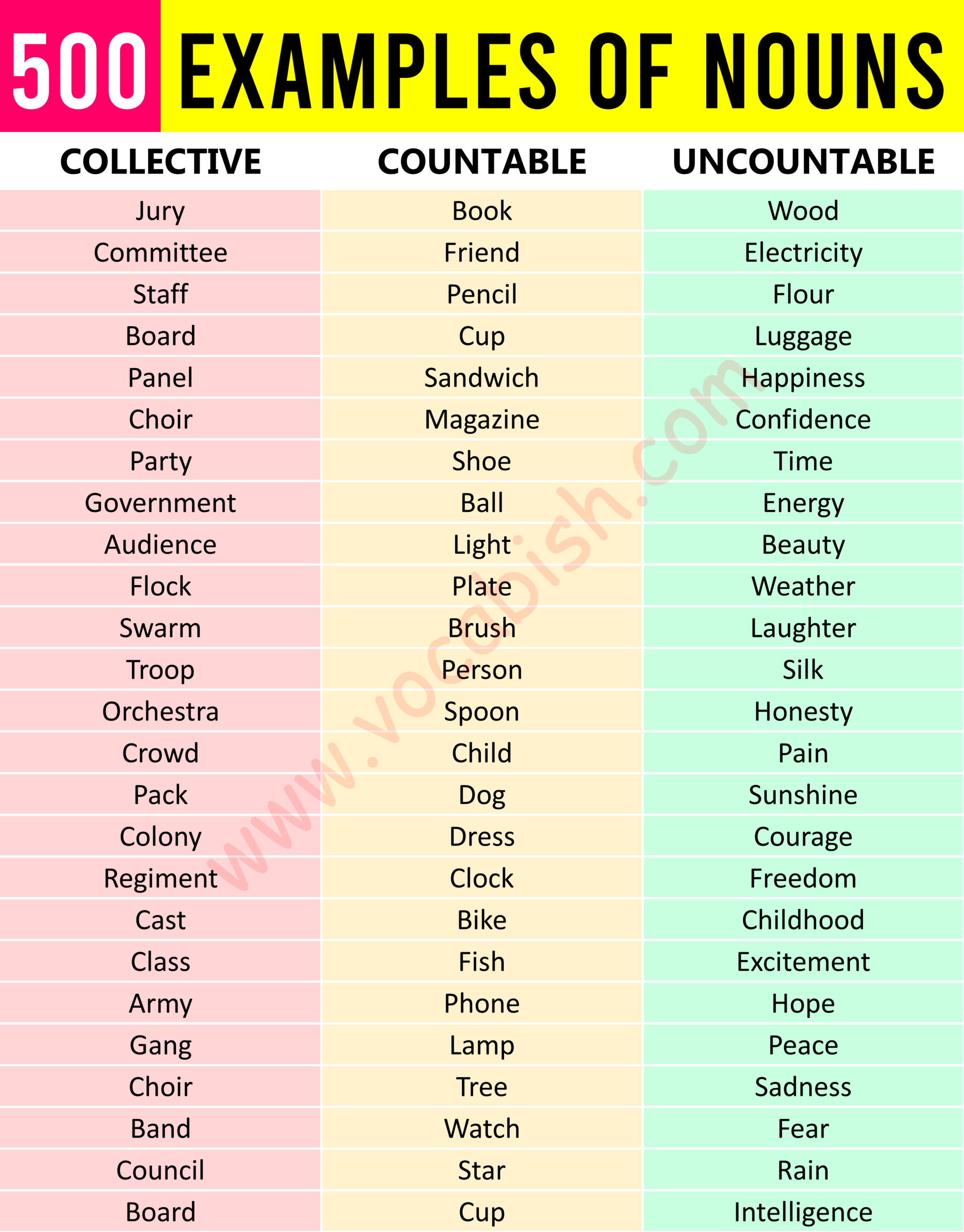
- Uncountable Nouns: Names of substances, concepts, or things that cannot normally be counted individually.
- Compound Nouns: Nouns formed by combining two or more words to create a single noun with a specific meaning.
- Possessive Nouns: Nouns that show ownership, possession, or a relationship between people, animals, places, or things.
To read more about nouns and their types, visit our complete noun guide.
A to Z List of Nouns in English
The A to Z list below includes common English nouns arranged alphabetically for easy learning. These words are used in everyday conversations and can help you build a stronger vocabulary.
- A: apple, animal, actor, airport, aunt, artist
- B: baby, bag, ball, book, bus, bird
- C: cake, camera, car, cat, chair, computer
- D: desk, doctor, dog, door, dress, driver
- E: ear, egg, elephant, engine, envelope, eye
- F: family, farmer, feather, fish, flower, friend
- G: garden, girl, glass, goat, gold, guitar
- H: hair, hammer, hand, hat, hospital, house
- I: ice, idea, island, insect, invitation, iron
- J: jacket, jar, jeep, jewel, job, journal
- K: kangaroo, key, keyboard, kitchen, kite, knife
- L: lake, lamp, leaf, library, lion, lunch
- M: machine, magazine, map, market, monkey, mountain
- N: nail, name, necklace, nest, newspaper, nurse
- O: ocean, office, onion, orange, oven, owl
- P: painter, park, pen, pencil, phone, pizza
- Q: queen, question, quilt, quiz, quotation, queue
- R: rabbit, radio, rain, river, road, robot
- S: school, shirt, ship, shoe, sister, student
- T: table, teacher, telephone, tiger, train, tree
- U: umbrella, uncle, uniform, university, utensil, user
- V: valley, van, vase, vegetable, village, violin
- W: wallet, watch, water, whale, window, woman
- X: xylophone, x-ray, xerox, x-axis, xylophonist, xenolith
- Y: yard, year, yogurt, yacht, youth, yarn
- Z: zebra, zoo, zipper, zone, zucchini
Here are the detailed guides on the A to Z List of Nouns.
Common Nouns Examples in Sentences
Common nouns are general names for people, places, animals, or things. They do not begin with a capital letter unless they start a sentence.
Noun | Example Sentence |
|---|---|
book | I picked up a book to read before going to bed. |
chair | Could you move that chair closer to the table? |
window | Please open the window; the room feels a little warm. |
phone | My phone rang while I was having dinner. |
market | We usually buy fresh vegetables from the local market. |
teacher | Our teacher explained the lesson with a simple example. |
friend | I met an old friend at the coffee shop yesterday. |
house | Their house is only a few minutes away from mine. |
car | She left her car outside the office this morning. |
dog | The dog followed its owner all the way home. |
school | My brother walks to school every morning. |
restaurant | Let’s try that new restaurant downtown tonight. |
bag | I forgot my bag on the bus. |
computer | He uses a computer to finish his work from home. |
coffee | Would you like some coffee before we start? |
street | A small bakery recently opened on our street. |
family | My family gets together every Sunday for lunch. |
garden | She grows fresh herbs in her garden. |
table | We placed the birthday cake on the table. |
office | I’ll meet you outside the office at noon. |
child | The child smiled when she received the gift. |
doctor | You should see a doctor if the pain continues. |
shop | I stopped by the shop to buy some bread. |
water | Don’t forget to drink enough water during the day. |
food | The food at this café is surprisingly good. |
movie | We watched a funny movie after dinner. |
bus | I caught the bus just before it left the station. |
door | Someone knocked on the door while I was cooking. |
kitchen | Mom is preparing dinner in the kitchen. |
phone | She keeps her phone beside her while working. |
neighbor | Our neighbor helped us carry the heavy boxes upstairs. |
job | He recently found a new job near his home. |
student | Every student needs to bring a notebook to class. |
city | This city becomes especially busy during the holiday season. |
park | We often take a walk in the park after sunset. |
bed | I was so tired that I went straight to bed. |
shirt | He wore a clean shirt for the interview. |
store | The store closes at nine o’clock tonight. |
carpet | We replaced the old carpet in the living room. |
window | Rain started hitting the window during the afternoon. |
Proper Nouns Examples in Sentences
Proper nouns are specific names of people, places, organizations, or things. They always begin with a capital letter.
Noun | Example Sentence |
|---|---|
London | I hope to visit London during my next vacation. |
Sarah | Sarah called me after she finished work. |
Pakistan | My cousin moved to Pakistan last year. |
Amazon | I ordered a new notebook from Amazon yesterday. |
Monday | We have an important meeting on Monday morning. |
January | The weather is usually quite cold in January. |
Google | I used Google to find the address of the restaurant. |
New York | His brother works in New York. |
Christmas | Our family usually has dinner together on Christmas. |
Ali | Ali forgot his keys at home this morning. |
Canada | She dreams of studying in Canada someday. |
Facebook | I shared the photos on Facebook last night. |
Sunday | We usually visit our grandparents on Sunday. |
Paris | They spent three wonderful days exploring Paris. |
Toyota | My father drives a Toyota to work every day. |
August | The school year begins in August in some countries. |
Microsoft | Microsoft develops software used by millions of people. |
Asia | Asia is home to many different cultures and languages. |
Emma | Emma brought homemade cookies for everyone. |
Eid | We bought new clothes before Eid. |
Dubai | My uncle is currently working in Dubai. |
Apple | Apple introduced a new product at its annual event. |
Friday | Let’s finish the project by Friday. |
India | India is famous for its diverse food and traditions. |
YouTube | I watched a helpful English lesson on YouTube. |
December | Many families travel during December holidays. |
James | James usually arrives at the office early. |
Europe | She wants to travel around Europe next summer. |
Nike | He bought a pair of running shoes from Nike. |
Tuesday | Our English class takes place every Tuesday. |
Karachi | My sister lives in Karachi with her family. |
Netflix | We watched a documentary on Netflix last night. |
Ramadan | During Ramadan, many families gather for iftar. |
Australia | His goal is to visit Australia one day. |
William | William sent me the documents by email. |
March | The flowers usually begin to bloom in March. |
Instagram | She posted a beautiful travel photo on Instagram. |
Tokyo | Tokyo is known for its busy streets and modern technology. |
Coca-Cola | He ordered a bottle of Coca-Cola with his meal. |
Saturday | We are planning a picnic this Saturday. |
Collective Nouns Examples in Sentences
Collective nouns refer to a group of people, animals, or things acting as one unit.
Noun | Example Sentence |
|---|---|
team | Our team celebrated the victory after the final match. |
family | Her family gathers at her grandparents’ house every weekend. |
class | The class became quiet when the teacher entered the room. |
audience | The audience applauded loudly at the end of the performance. |
crowd | A large crowd gathered outside the stadium. |
committee | The committee will review the proposal tomorrow morning. |
group | Our group decided to meet at the library. |
staff | The hotel staff made us feel welcome during our stay. |
choir | The choir practiced the new song before the concert. |
band | The band played several popular songs at the wedding. |
army | The army moved toward the border after receiving new orders. |
jury | The jury listened carefully to both sides of the case. |
flock | We watched a flock of birds flying across the lake. |
herd | A herd of cows was grazing in the field. |
pack | A pack of dogs was running through the neighborhood. |
swarm | A swarm of bees appeared near the garden. |
colony | A colony of ants had built a nest under the tree. |
fleet | The company operates a fleet of delivery trucks. |
bunch | She bought a bunch of bananas from the market. |
bouquet | He gave her a beautiful bouquet of roses. |
litter | The cat gave birth to a litter of kittens. |
brood | The mother hen watched over her brood of chicks. |
swarm | A swarm of butterflies covered the flowering plants. |
school | A school of fish moved together beneath the boat. |
pride | We saw a pride of lions resting under a tree. |
gaggle | A gaggle of geese crossed the road in front of us. |
panel | A panel of experts answered questions from the audience. |
board | The board approved the company’s new business plan. |
orchestra | The orchestra performed beautifully during the evening concert. |
congregation | The congregation gathered quietly before the service began. |
delegation | A delegation from the company visited our office yesterday. |
crew | The flight crew helped passengers find their seats. |
staff | The restaurant staff quickly prepared our table. |
faculty | The university faculty held a meeting on Monday. |
generation | A new generation of students is growing up with advanced technology. |
partnership | The partnership worked together to launch the new project. |
company | A company of actors arrived for the evening performance. |
lineup | The coach announced the starting lineup before the game. |
cluster | We noticed a cluster of stars in the clear night sky. |
bundle | He carried a bundle of newspapers to the recycling bin. |
Abstract Nouns Examples in Sentences
Abstract nouns name ideas, feelings, qualities, or concepts that cannot be seen or touched.
Noun | Example Sentence |
|---|---|
happiness | Spending time with my family brings me genuine happiness. |
freedom | Everyone deserves the freedom to express their opinions respectfully. |
honesty | Honesty is important when you are building trust with others. |
courage | It took a lot of courage to admit that he had made a mistake. |
kindness | A little kindness can make someone’s difficult day much better. |
love | Her love for her children is clear in everything she does. |
patience | Learning a new language requires patience and regular practice. |
confidence | She gained more confidence after giving several successful presentations. |
success | Hard work played a major role in his success. |
knowledge | Reading regularly can expand your knowledge of the world. |
wisdom | My grandfather shared his wisdom with me during our conversation. |
friendship | Their friendship has remained strong since childhood. |
respect | We should show respect to people even when we disagree. |
trust | It takes time to build trust in a new relationship. |
justice | The community continues to demand justice for everyone. |
peace | The two neighbors finally reached an agreement and restored peace. |
anger | He struggled to control his anger during the argument. |
fear | Her fear of heights made the mountain trip challenging. |
hope | There is still hope that the missing documents will be found. |
beauty | The beauty of the sunset attracted everyone’s attention. |
truth | Sometimes the truth is difficult to accept. |
responsibility | Taking responsibility for your actions shows maturity. |
loyalty | His loyalty to the company earned him the manager’s trust. |
generosity | Her generosity helped several families during the difficult winter. |
creativity | The project gave students an opportunity to express their creativity. |
education | Good education can create better opportunities for young people. |
imagination | Children use their imagination when they create stories and games. |
determination | With enough determination, she completed the challenging course. |
motivation | A clear goal can provide the motivation you need to keep going. |
success | His success came after years of consistent effort. |
failure | Don’t let failure stop you from trying again. |
experience | Working abroad gave her valuable experience in dealing with different cultures. |
confidence | Speaking English every day helped him develop greater confidence. |
health | Regular exercise can improve your overall health. |
wealth | Wealth does not always guarantee a peaceful or satisfying life. |
knowledge | Practical knowledge is often gained through real-world experience. |
justice | Everyone has the right to seek justice when treated unfairly. |
curiosity | Her curiosity encouraged her to learn more about the subject. |
discipline | Discipline helps you stay focused when motivation disappears. |
gratitude | Practicing gratitude can help you appreciate the good things in life. |
Concrete Nouns Examples in Sentences
Concrete nouns refer to things that can be seen, touched, heard, smelled, or tasted.
Noun | Example Sentence |
|---|---|
apple | I packed an apple in my lunch before leaving for work. |
bottle | Please put the empty bottle in the recycling bin. |
backpack | My backpack is too heavy because I brought several books. |
umbrella | Take an umbrella because it looks like rain outside. |
keyboard | She cleaned the keyboard with a soft cloth. |
bicycle | He rides his bicycle to the park every evening. |
blanket | I grabbed a warm blanket when the temperature dropped. |
cup | Could you pass me that cup of tea? |
lamp | The lamp beside my bed provides enough light for reading. |
wallet | I found my wallet underneath the sofa. |
key | Don’t forget to take your key before you leave. |
mirror | She looked in the mirror before heading out. |
sandwich | I made a quick sandwich for lunch. |
camera | He carried his camera during the entire trip. |
pencil | The student sharpened her pencil before starting the test. |
backpack | His backpack was left beside the classroom door. |
bottle | She filled her bottle with cold water. |
shoes | My new shoes feel comfortable even after hours of walking. |
watch | He checked his watch while waiting for the train. |
door | Please close the door quietly because the baby is sleeping. |
banana | She sliced a banana into her morning cereal. |
table | We placed all the dishes on the table. |
refrigerator | The milk is inside the refrigerator. |
towel | I hung the wet towel outside to dry. |
toothbrush | I replaced my old toothbrush this morning. |
notebook | Write the new vocabulary words in your notebook. |
pillow | This pillow is much softer than the one I used before. |
window | The children were looking through the window at the rain. |
television | We turned on the television after dinner. |
fork | She picked up the fork and started eating. |
plate | He accidentally dropped a plate on the kitchen floor. |
computer | My computer stopped working during the online meeting. |
flower | A bright yellow flower was growing beside the fence. |
tree | An old tree stands in front of our house. |
bus | The bus arrived ten minutes late this morning. |
shoe | I found one missing shoe under the bed. |
bicycle | Her bicycle needs a new tire. |
cookie | The child reached for another cookie from the jar. |
doorbell | Someone pressed the doorbell just as we sat down for dinner. |
suitcase | I packed my suitcase the night before the flight. |
Countable Nouns Examples in Sentences
Countable nouns can be counted individually and have singular and plural forms.
Noun | Example Sentence |
|---|---|
book | I borrowed three books from the library yesterday. |
apple | She bought five apples for the family. |
chair | We need two more chairs for the guests. |
student | Every student received a certificate after the course. |
bottle | There are six bottles of water in the refrigerator. |
car | My neighbor owns two cars. |
dog | The park was full of dogs this afternoon. |
pen | I keep several pens in my desk drawer. |
table | The restaurant has twenty tables inside. |
friend | I invited four friends to my birthday dinner. |
phone | She has two phones for work and personal use. |
house | Several houses were built in this neighborhood last year. |
egg | We need six eggs to make the cake. |
teacher | Five teachers attended the training session. |
shirt | He packed three clean shirts for the weekend trip. |
child | The playground was filled with children after school. |
bag | I carried two heavy bags home from the store. |
window | The apartment has large windows facing the garden. |
computer | Our office recently purchased ten new computers. |
banana | The recipe requires three bananas. |
ticket | We bought four tickets for the concert. |
room | This hotel has more than fifty rooms. |
key | I found two old keys in the kitchen drawer. |
carrot | Add a few carrots to the soup for extra flavor. |
student | The students completed their assignments before lunch. |
flower | She planted several flowers around the entrance. |
shoe | I need a new pair of shoes for work. |
restaurant | There are several restaurants near the hotel. |
question | The interviewer asked me five difficult questions. |
camera | He owns three professional cameras. |
cookie | The children ate all the cookies from the jar. |
bus | Two buses stopped outside the school. |
letter | I received three letters from my old friend. |
computer | The company replaced all the old computers last month. |
orange | Would you like one or two oranges with your breakfast? |
doctor | Several doctors attended the medical conference. |
lesson | We have four English lessons this week. |
bicycle | There are two bicycles outside the garage. |
customer | The shop had many customers during the holiday sale. |
cup | Please put three clean cups on the table. |
Uncountable Nouns Examples in Sentences
Uncountable nouns refer to things that cannot usually be counted individually.
Noun | Example Sentence |
|---|---|
water | Please drink plenty of water throughout the day. |
advice | My father gave me useful advice before the interview. |
information | You can find more information on the company’s website. |
rice | We usually serve rice with grilled vegetables. |
money | I don’t have enough money to buy a new laptop right now. |
knowledge | Her knowledge of English has improved significantly. |
furniture | We bought new furniture for the living room. |
traffic | There was heavy traffic on the highway this morning. |
music | I like listening to relaxing music while I work. |
milk | There isn’t much milk left in the refrigerator. |
sugar | Try not to add too much sugar to your coffee. |
bread | We need some fresh bread for breakfast. |
homework | I have a lot of homework to finish tonight. |
equipment | The gym has modern equipment for different workouts. |
weather | The weather has been pleasant all week. |
news | Did you hear the latest news about the company? |
luggage | Your luggage can be checked in at the counter. |
research | The scientist spent years doing research on the subject. |
education | Good education can open doors to better opportunities. |
health | Regular exercise is important for maintaining good health. |
coffee | Would you like some coffee before we leave? |
salt | The soup needs a little more salt. |
flour | We need some flour to bake the cake. |
cheese | There is some cheese in the refrigerator. |
air | Open the window and let some fresh air into the room. |
energy | I don’t have much energy after such a busy day. |
patience | Teaching young children requires a lot of patience. |
experience | She has extensive experience in customer service. |
work | I still have some work to finish before dinner. |
time | We don’t have enough time to stop for lunch. |
love | Their love for animals inspired them to open a shelter. |
peace | Everyone deserves to live in peace and security. |
progress | The project is making good progress this month. |
equipment | The technicians checked the equipment before the event began. |
bread | Could you pick up some bread on your way home? |
water | There was very little water in the tank after the drought. |
English | She speaks English confidently in professional situations. |
knowledge | Practical knowledge often comes from real-life experience. |
software | This software makes it easier to organize large amounts of data. |
research | More research is needed before scientists can confirm the results. |
Compound Nouns Examples in Sentences
Compound nouns are formed by combining two or more words into one noun.
Noun | Example Sentence |
|---|---|
toothbrush | I keep my toothbrush in the bathroom cabinet. |
sunlight | The plants need plenty of sunlight to grow well. |
football | My brother plays football with his friends every weekend. |
bedroom | I cleaned my bedroom before the guests arrived. |
raincoat | Take your raincoat because it may rain this afternoon. |
bus stop | I’ll wait for you at the bus stop near the supermarket. |
notebook | She wrote the new vocabulary in her notebook. |
airport | We arrived at the airport two hours before our flight. |
classroom | The classroom was quiet during the examination. |
haircut | I need a haircut before the wedding next week. |
keyboard | He spilled coffee on his keyboard this morning. |
sunflower | A tall sunflower was growing beside the garden fence. |
newspaper | My grandfather reads the newspaper every morning. |
rainbow | We saw a beautiful rainbow after the storm. |
teapot | She poured hot tea from the teapot into our cups. |
footballer | The young footballer scored the winning goal. |
classmate | I ran into an old classmate at the shopping mall. |
seaside | We spent the afternoon walking along the seaside. |
blackboard | The teacher wrote the homework on the blackboard. |
birthday | We’re planning a small party for her birthday. |
bookshelf | I placed the new novels on the bookshelf. |
firefighter | The firefighter quickly helped everyone leave the building safely. |
policeman | A policeman directed traffic near the busy intersection. |
headache | I stayed home because I had a terrible headache. |
laptop | My laptop needs to be charged before the meeting. |
weekend | We usually visit our relatives on the weekend. |
waterfall | The hikers stopped to photograph the impressive waterfall. |
dishwasher | Please put the dirty plates in the dishwasher. |
classroom | The students decorated their classroom for the school event. |
football | They watched a football match together last night. |
grandmother | My grandmother makes delicious homemade bread. |
sunrise | We woke up early to watch the sunrise. |
doorbell | The doorbell rang while I was taking a shower. |
shopping mall | We spent the afternoon at the shopping mall. |
coffee shop | Let’s meet at the coffee shop after work. |
post office | I need to visit the post office to send this package. |
washing machine | Our washing machine stopped working yesterday. |
swimming pool | The hotel has a large swimming pool for its guests. |
traffic light | We stopped when the traffic light turned red. |
parking lot | I left my car in the parking lot behind the store. |
Read more: 1000 Examples of Compound Nouns
Possessive Nouns Examples in Sentences
Possessive nouns show ownership or belonging.
Noun | Example Sentence |
|---|---|
Sarah’s | Sarah’s phone is charging on the kitchen counter. |
John’s | I borrowed John’s umbrella because it was raining. |
mother’s | My mother’s recipe is always a favorite at family dinners. |
father’s | Father’s car needs to be serviced this weekend. |
brother’s | I found my brother’s wallet under the sofa. |
sister’s | My sister’s room is next to mine. |
teacher’s | The teacher’s desk is covered with books and papers. |
doctor’s | We waited outside the doctor’s office for a few minutes. |
friend’s | We’re having dinner at my friend’s house tonight. |
child’s | The child’s toy was lying near the front door. |
dog’s | The dog’s bowl is beside the refrigerator. |
cat’s | I couldn’t find the cat’s favorite toy anywhere. |
girl’s | The girl’s bicycle was parked outside the school. |
boy’s | The boy’s backpack was left in the classroom. |
student’s | The student’s notebook contains all the important notes. |
manager’s | I left the report on the manager’s desk. |
company’s | The company’s new office opened last month. |
restaurant’s | The restaurant’s menu includes several vegetarian options. |
city’s | The city’s public transportation system has improved recently. |
country’s | The country’s economy has grown steadily this year. |
children’s | We visited the children’s section of the library. |
men’s | The men’s changing room is on the second floor. |
women’s | She bought a jacket from the women’s clothing department. |
teachers’ | The teachers’ meeting starts at three o’clock. |
students’ | The students’ projects were displayed in the main hall. |
parents’ | We stayed at my parents’ house during the holiday. |
players’ | The players’ uniforms were ready before the match. |
workers’ | The workers’ safety equipment was checked before the shift. |
customers’ | The store carefully listened to its customers’ suggestions. |
neighbors’ | We attended our neighbors’ wedding last Saturday. |
babies’ | The babies’ clothes were neatly arranged in the drawer. |
birds’ | We could hear the birds’ songs from the garden. |
dogs’ | The dogs’ toys were scattered across the floor. |
families’ | The community center provides activities for local families’ children. |
companies’ | Several companies’ representatives attended the business conference. |
countries’ | The agreement protects the countries’ shared interests. |
James’s | James’s bicycle is parked outside the house. |
Alex’s | I left the documents on Alex’s desk. |
boss’s | My boss’s office is at the end of the hallway. |
school’s | The school’s annual event will take place next Friday. |
You May Also Like:
Tips for Learning English Nouns
Learning nouns becomes easier when you connect words with images and daily experiences.
Try these methods:
- Learn nouns by category.
- Use picture vocabulary cards.
- Read short English stories.
- Label objects around your home.
- Practice writing sentences with new nouns.
- Review vocabulary regularly.
FAQs about List of Nouns
A noun is a word that names a person, place, thing, animal, or idea, such as teacher, city, dog, or happiness.
Nouns help identify people, objects, places, and concepts, making communication clear and meaningful.
Common nouns are general names for people, places, and things, such as teacher, school, and bicycle.
Proper nouns are specific names and begin with capital letters, such as London, Ahmed, and Monday.
Reading regularly, using picture vocabulary lists, and practicing with example sentences can help you remember nouns faster.
Yes. Compound nouns such as bus stop, swimming pool, and police officer contain more than one word.
Learning the most common 500 nouns provides a strong foundation for everyday English communication.
Yes. Nouns appear in nearly every sentence and help you express ideas clearly when speaking or writing.
Conclusion
Nouns are the building blocks of English vocabulary. They help us name people, places, animals, objects, and ideas, making communication possible in both spoken and written English. By learning nouns from A to Z, you’ll expand your vocabulary, improve comprehension, and feel more confident using English in everyday situations.
Start with the most common nouns, practice them in sentences, and connect them with pictures whenever possible. Over time, these words will become a natural part of your English vocabulary and help you communicate more effectively.
Explore Nouns by Letter
Find more noun words from A to Z.
