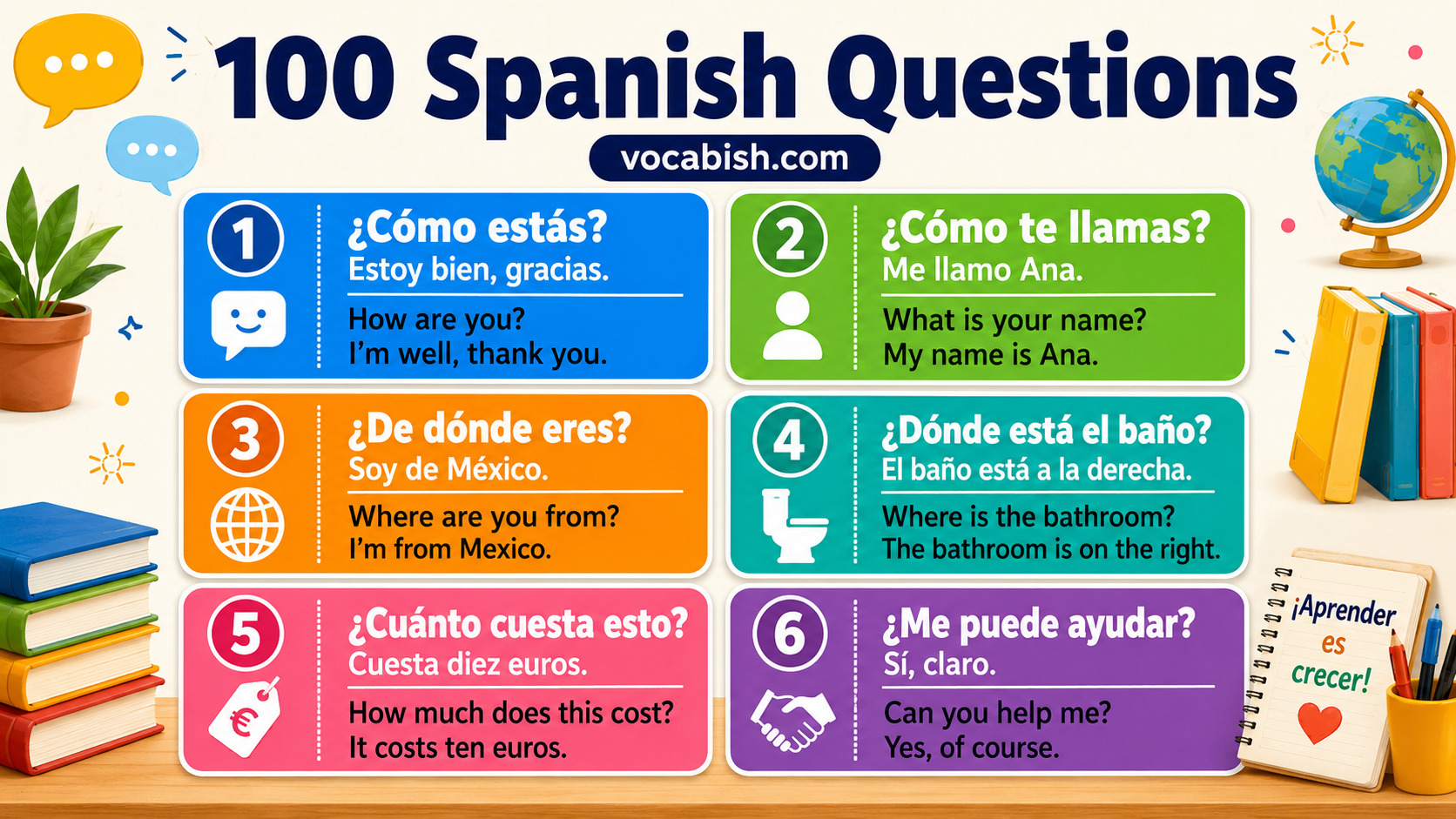
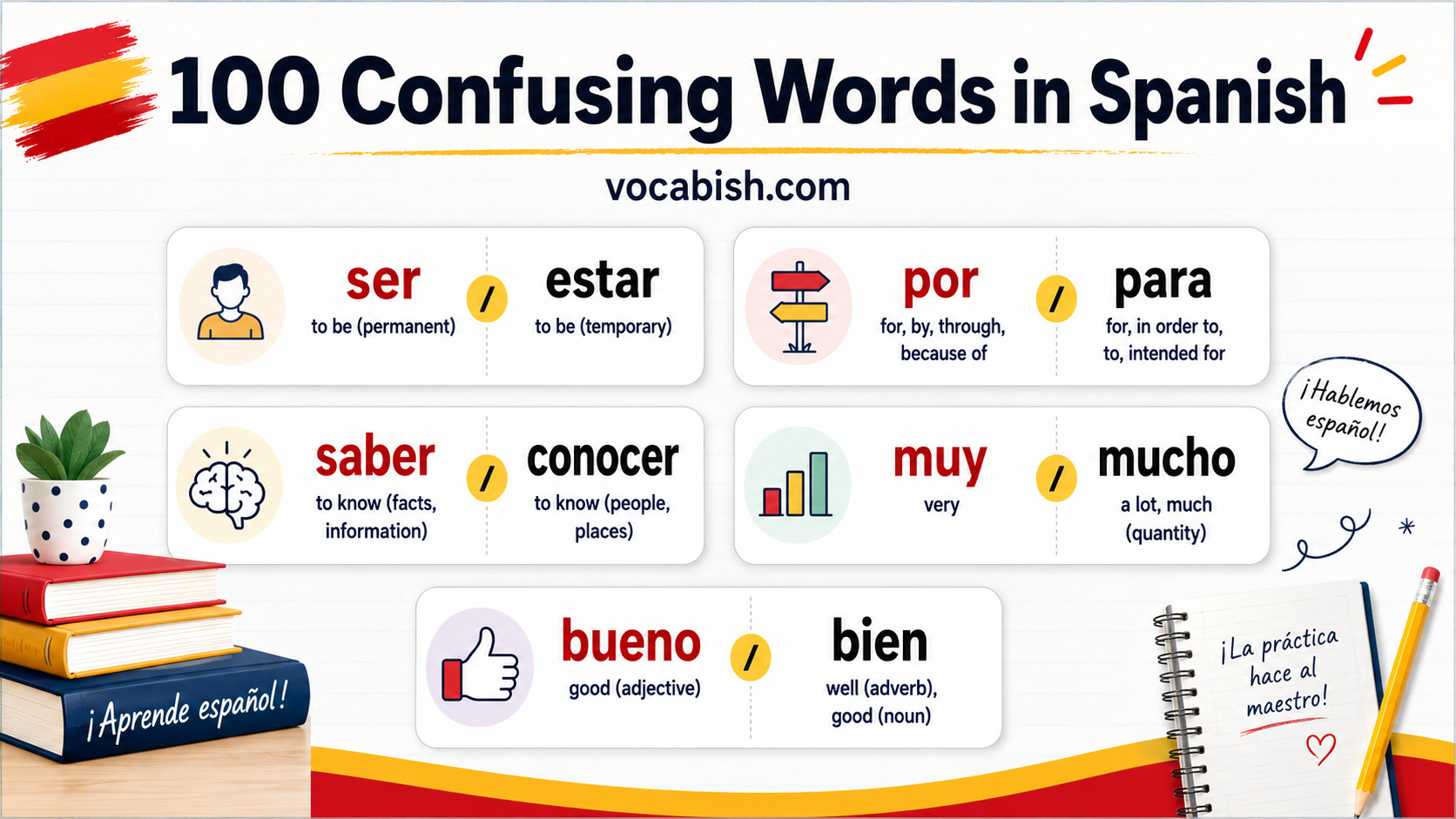

Spanish has many words that look similar, sound similar, or translate into English in almost the same way. That is why learners often ask: Should I use ser or estar? Is it por or para? What is the difference between saber and conocer?
This article makes those tricky words easier to understand. You will learn 50 confusing Spanish word pairs, which gives you 100 commonly confused Spanish words in context.
Each row includes the Spanish words, the meaning difference, and a short example with English translation.
How to Use This List
Do not try to memorize all 100 words in one sitting. Read one pair at a time and focus on the difference between the two words.
A good method is:
- Read the pair.
- Notice the meaning difference.
- Say the example out loud.
- Make your own sentence using the same pattern.
The goal is not only to know the English meaning. The goal is to know when to use each word naturally.
Common Confusing Spanish Words
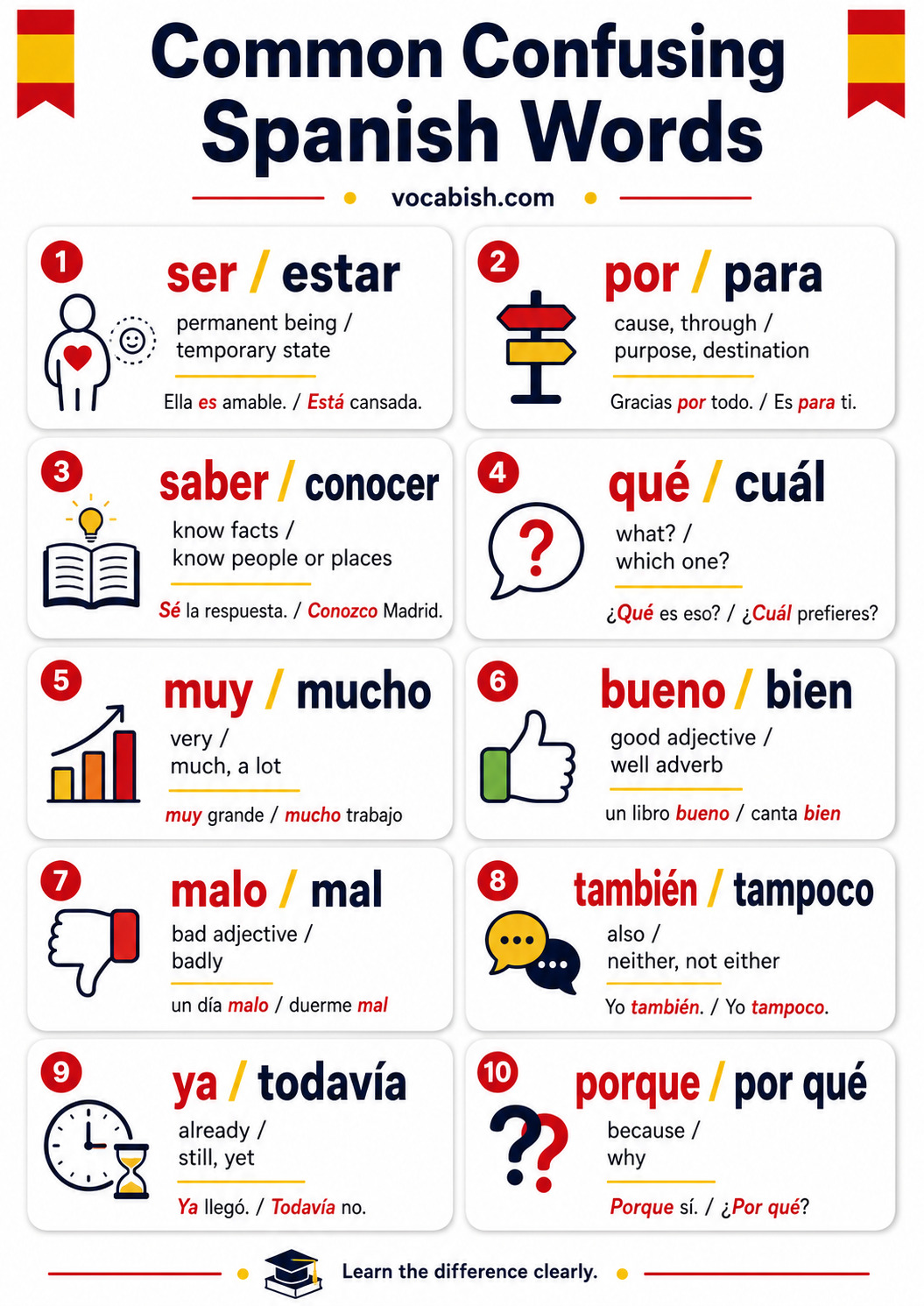
- ser / estar
- Ser is used for identity, origin, profession, and lasting traits.
- Estar is used for feelings, location, and temporary states.
- Soy estudiante. — I am a student.
- Estoy cansado. — I am tired.
- por / para
- Por often shows reason, cause, exchange, or movement through a place.
- Para shows purpose, destination, deadline, or who something is for.
- Gracias por tu ayuda. — Thanks for your help.
- Este regalo es para ti. — This gift is for you.
- saber / conocer
- Saber means to know facts, information, or how to do something.
- Conocer means to know a person, place, or thing.
- Sé la respuesta. — I know the answer.
- Conozco a María. — I know María.
- qué / cuál
- Qué asks “what” when asking for meaning, information, or definition.
- Cuál asks “which” or “what one” when choosing from options.
- ¿Qué significa esto? — What does this mean?
- ¿Cuál prefieres? — Which one do you prefer?
- muy / mucho
- Muy means “very” and goes before adjectives or adverbs.
- Mucho means “much,” “many,” or “a lot.”
- Es muy caro. — It is very expensive.
- Tengo mucho trabajo. — I have a lot of work.
- bueno / bien
- Bueno means “good” and describes a noun.
- Bien means “well” and describes how something is or happens.
- Es un buen libro. — It is a good book.
- Estoy bien. — I am well.
- malo / mal
- Malo means “bad” and describes a noun.
- Mal means “badly” or “not well.”
- Es una mala idea. — It is a bad idea.
- Me siento mal. — I feel bad.
- también / tampoco
- También means “also” or “too.”
- Tampoco means “not either.”
- Yo también quiero ir. — I want to go too.
- Yo tampoco quiero ir. — I do not want to go either.
- ya / todavía
- Ya means “already” or “now.”
- Todavía means “still” or “yet.”
- Ya terminé. — I already finished.
- Todavía estudio español. — I still study Spanish.
- porque / por qué
- Porque means “because.”
- Por qué means “why.”
- Estudio porque quiero aprender. — I study because I want to learn.
- ¿Por qué estudias español? — Why do you study Spanish?
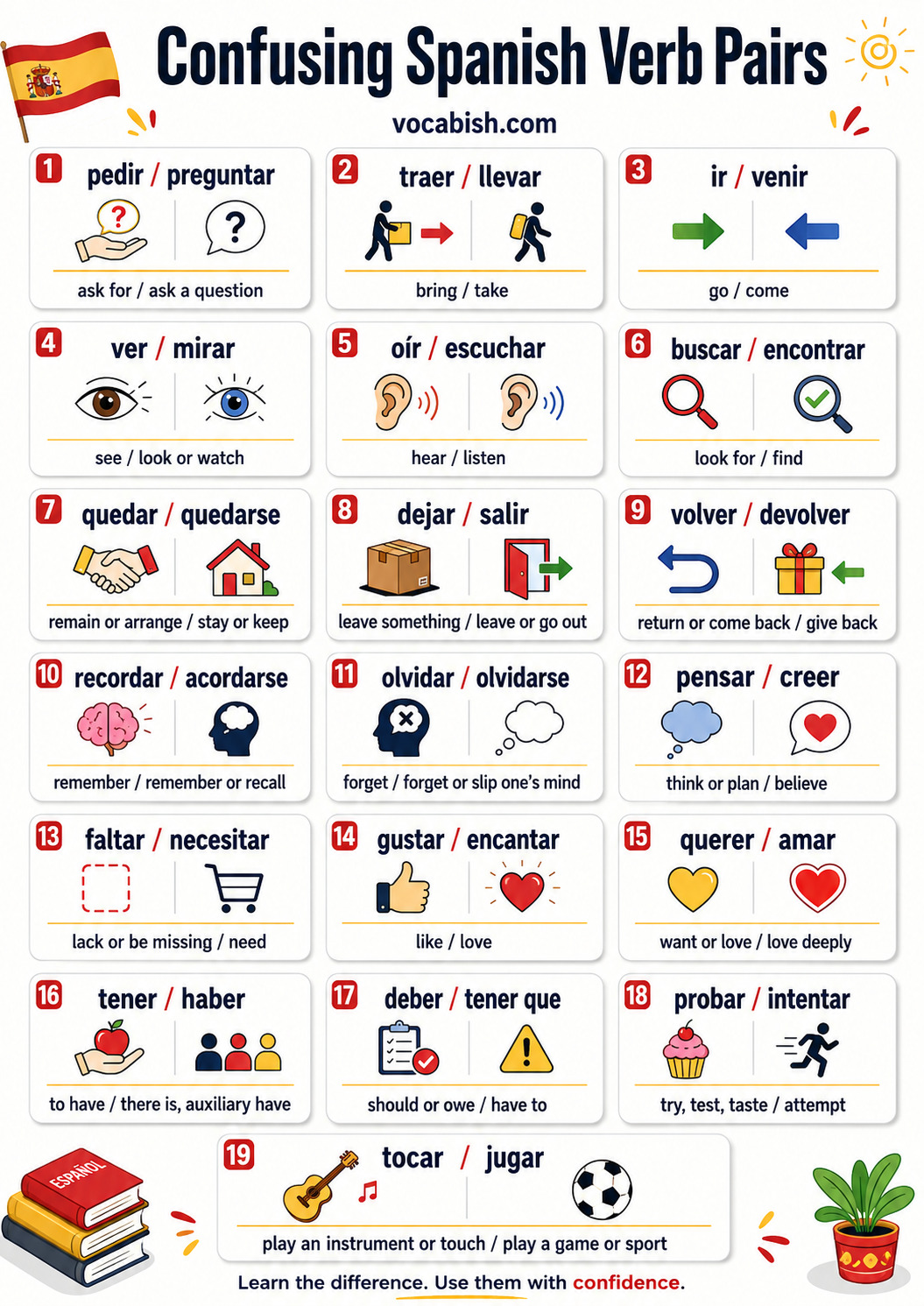
List of Confusing Spanish Verb Pairs
Spanish verbs can be confusing because English often uses one verb where Spanish uses two different verbs. These pairs are very useful in daily conversation.
- pedir / preguntar
- Pedir means to ask for something.
- Preguntar means to ask a question.
- Pido agua. — I ask for water.
- Pregunto la hora. — I ask the time.
- traer / llevar
- Traer means to bring something here.
- Llevar means to take something there.
- Trae el libro aquí. — Bring the book here.
- Lleva el libro a clase. — Take the book to class.
- ir / venir
- Ir means to go away from the speaker.
- Venir means to come toward the speaker.
- Voy al mercado. — I am going to the market.
- Ven a mi casa. — Come to my house.
- ver / mirar
- Ver means to see.
- Mirar means to look at something on purpose.
- Veo un perro. — I see a dog.
- Miro la foto. — I look at the photo.
- oír / escuchar
- Oír means to hear a sound.
- Escuchar means to listen with attention.
- Oigo música. — I hear music.
- Escucho la canción. — I listen to the song.
- buscar / encontrar
- Buscar means to look for something.
- Encontrar means to find something.
- Busco mis llaves. — I am looking for my keys.
- Encuentro mis llaves. — I find my keys.
- quedar / quedarse
- Quedar can mean to remain, be located, or arrange to meet.
- Quedarse means to stay.
- El banco queda cerca. — The bank is nearby.
- Me quedo en casa. — I stay at home.
- dejar / salir
- Dejar means to leave something behind or allow.
- Salir means to go out or leave a place.
- Dejo mi mochila aquí. — I leave my backpack here.
- Salgo a las ocho. — I leave at eight.
- volver / devolver
- Volver means to return or come back.
- Devolver means to give something back.
- Vuelvo mañana. — I come back tomorrow.
- Devuelvo el dinero. — I return the money.
- recordar / acordarse
- Recordar means to remember.
- Acordarse also means to remember, but it is reflexive and often uses de.
- Recuerdo tu nombre. — I remember your name.
- Me acuerdo de ti. — I remember you.
- olvidar / olvidarse
- Olvidar means to forget.
- Olvidarse also means to forget, but it is reflexive and often uses de.
- Olvidé mi teléfono. — I forgot my phone.
- Me olvidé de la cita. — I forgot about the appointment.
- pensar / creer
- Pensar means to think.
- Creer means to believe.
- Pienso en mi familia. — I think about my family.
- Creo que tienes razón. — I believe you are right.
- faltar / necesitar
- Faltar means to be missing or lacking.
- Necesitar means to need.
- Falta una silla. — One chair is missing.
- Necesito una silla. — I need a chair.
- gustar / encantar
- Gustar means to like.
- Encantar means to love something strongly.
- Me gusta el café. — I like coffee.
- Me encanta el café. — I love coffee.
- querer / amar
- Querer means to want or love.
- Amar means to love deeply.
- Quiero agua. — I want water.
- Amo a mi familia. — I love my family.
- tener / haber
- Tener means to have or possess.
- Haber is commonly used as hay, meaning “there is” or “there are.”
- Tengo dos hermanos. — I have two brothers.
- Hay dos sillas. — There are two chairs.
- deber / tener que
- Deber means should or must.
- Tener que means to have to do something.
- Debes estudiar. — You should study.
- Tengo que estudiar. — I have to study.
- probar / intentar
- Probar means to taste, test, or try something.
- Intentar means to attempt or try to do something.
- Pruebo la sopa. — I taste the soup.
- Intento hablar español. — I try to speak Spanish.
- tocar / jugar
- Tocar is used for playing instruments or touching something.
- Jugar is used for sports and games.
- Toco la guitarra. — I play the guitar.
- Juego al fútbol. — I play soccer.
Confusing Everyday Words and Descriptions
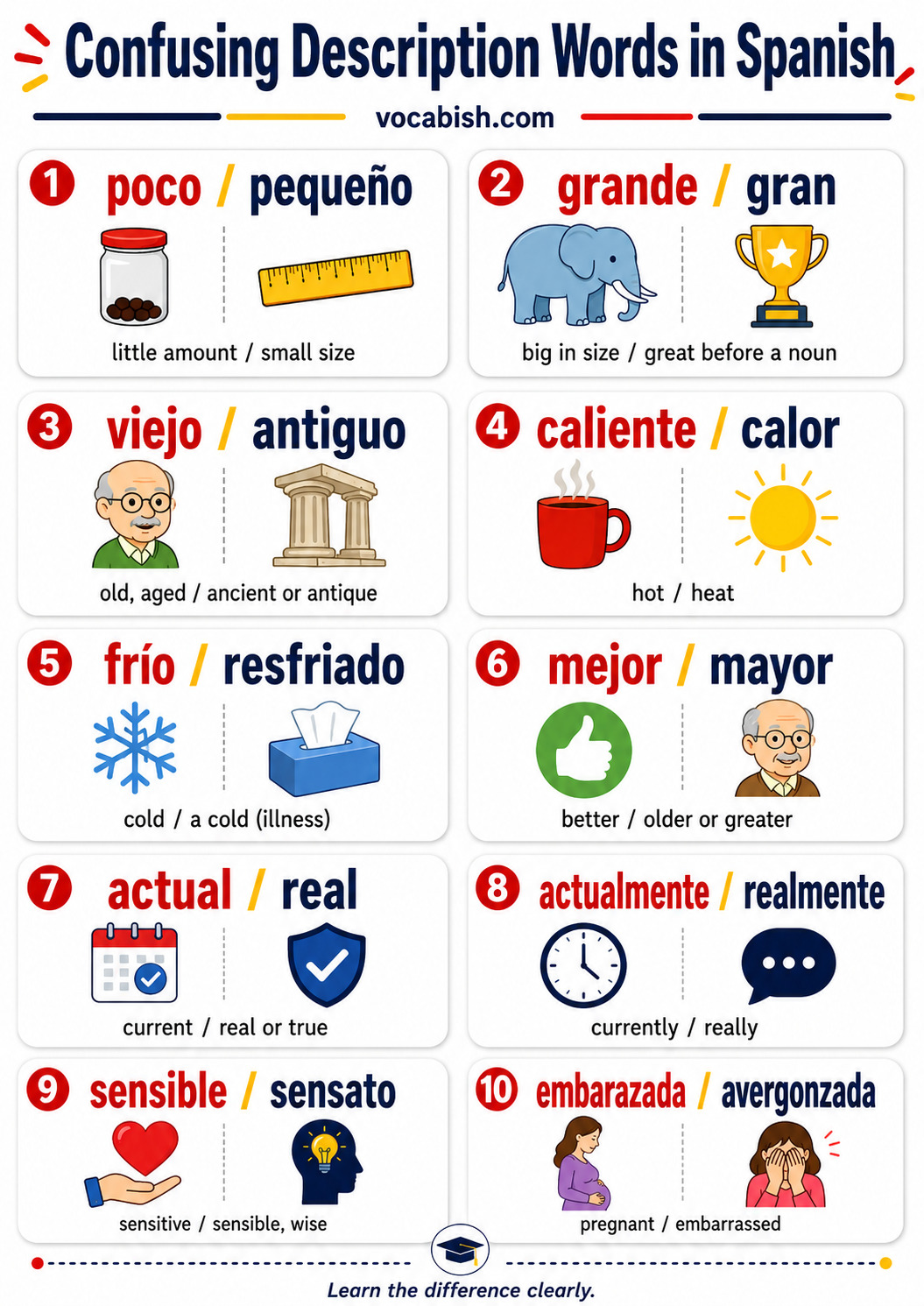
These words appear often in daily Spanish. Many learners know the English translation but still use the wrong word in sentences.
- poco / pequeño
- Poco means little, not much, or few.
- Pequeño means small in size.
- Tengo poco tiempo. — I have little time.
- Es una casa pequeña. — It is a small house.
- grande / gran
- Grande means big or large.
- Gran comes before a singular noun and often means great.
- La casa es grande. — The house is big.
- Es un gran amigo. — He is a great friend.
- viejo / antiguo
- Viejo usually means old in age.
- Antiguo means ancient, old, or former.
- Mi coche es viejo. — My car is old.
- Es una ciudad antigua. — It is an ancient city.
- caliente / calor
- Caliente means hot.
- Calor means heat. In Spanish, you say tengo calor for “I am hot.”
- El café está caliente. — The coffee is hot.
- Tengo calor. — I am hot.
- frío / resfriado
- Frío means cold.
- Resfriado means having a cold or being sick with a cold.
- El agua está fría. — The water is cold.
- Estoy resfriado. — I have a cold.
- mejor / mayor
- Mejor means better.
- Mayor means older, bigger, or greater.
- Este libro es mejor. — This book is better.
- Mi hermano es mayor. — My brother is older.
- actual / real
- Actual means current.
- Real means real or true.
- Mi trabajo actual es bueno. — My current job is good.
- Es una historia real. — It is a true story.
- actualmente / realmente
- Actualmente means currently.
- Realmente means really or truly.
- Actualmente vivo en Lima. — I currently live in Lima.
- Realmente me gusta. — I really like it.
- sensible / sensato
- Sensible means sensitive.
- Sensato means sensible, wise, or reasonable.
- Mi piel es sensible. — My skin is sensitive.
- Es una decisión sensata. — It is a sensible decision.
- embarazada / avergonzada
- Embarazada means pregnant.
- Avergonzada means embarrassed.
- Ella está embarazada. — She is pregnant.
- Estoy avergonzada. — I am embarrassed.
Question, Place, and Connector Words
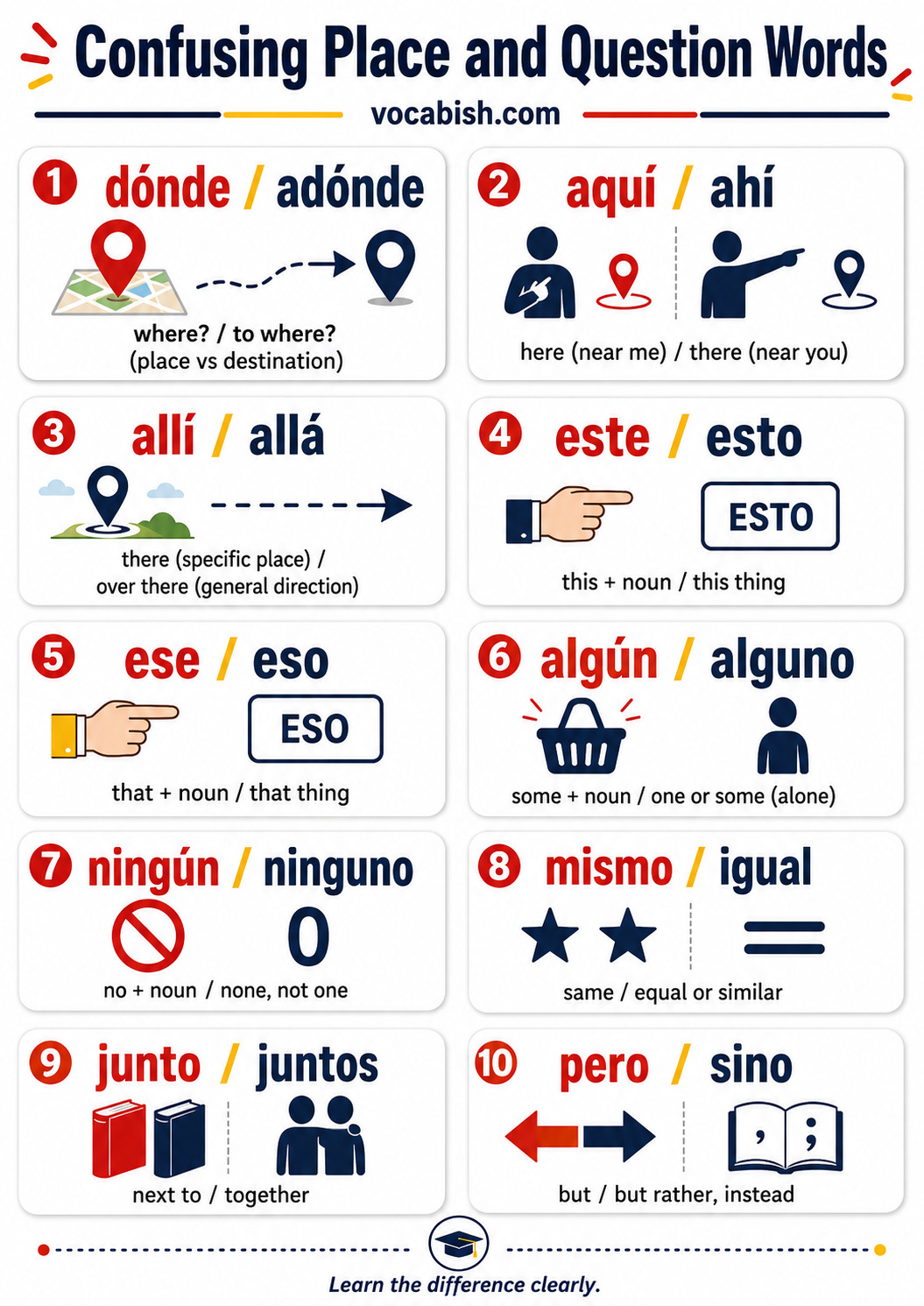
Small words can cause big confusion. These are especially important because they help you ask questions, connect ideas, and describe location.
- dónde / adónde
- Dónde asks where something is.
- Adónde asks where someone is going.
- ¿Dónde vives? — Where do you live?
- ¿Adónde vas? — Where are you going?
- aquí / ahí
- Aquí means here, near the speaker.
- Ahí means there, near the listener or nearby.
- Estoy aquí. — I am here.
- El libro está ahí. — The book is there.
- allí / allá
- Allí means there in a more specific place.
- Allá means over there, often less exact.
- La tienda está allí. — The store is there.
- Vamos allá. — Let’s go over there.
- este / esto
- Este means this and goes with a masculine noun.
- Esto means this thing or this idea.
- Este libro es mío. — This book is mine.
- Esto es importante. — This is important.
- ese / eso
- Ese means that and goes with a masculine noun.
- Eso means that thing or that idea.
- Ese coche es rojo. — That car is red.
- Eso no es verdad. — That is not true.
- algún / alguno
- Algún comes before a masculine singular noun.
- Alguno usually stands alone.
- ¿Tienes algún problema? — Do you have any problem?
- ¿Tienes alguno? — Do you have one?
- ningún / ninguno
- Ningún comes before a masculine singular noun.
- Ninguno usually stands alone.
- No tengo ningún problema. — I do not have any problem.
- No tengo ninguno. — I do not have any.
- mismo / igual
- Mismo means same or self.
- Igual means equal, same, or alike.
- Tengo el mismo libro. — I have the same book.
- Los dos son iguales. — The two are the same.
- junto / juntos
- Junto means next to or near.
- Juntos means together.
- El banco está junto al hotel. — The bank is next to the hotel.
- Vamos juntos. — We are going together.
- pero / sino
- Pero means but.
- Sino means but rather and is used after a negative correction.
- Quiero ir, pero no puedo. — I want to go, but I cannot.
- No es té, sino café. — It is not tea, but coffee.
Common Spanish False Friends
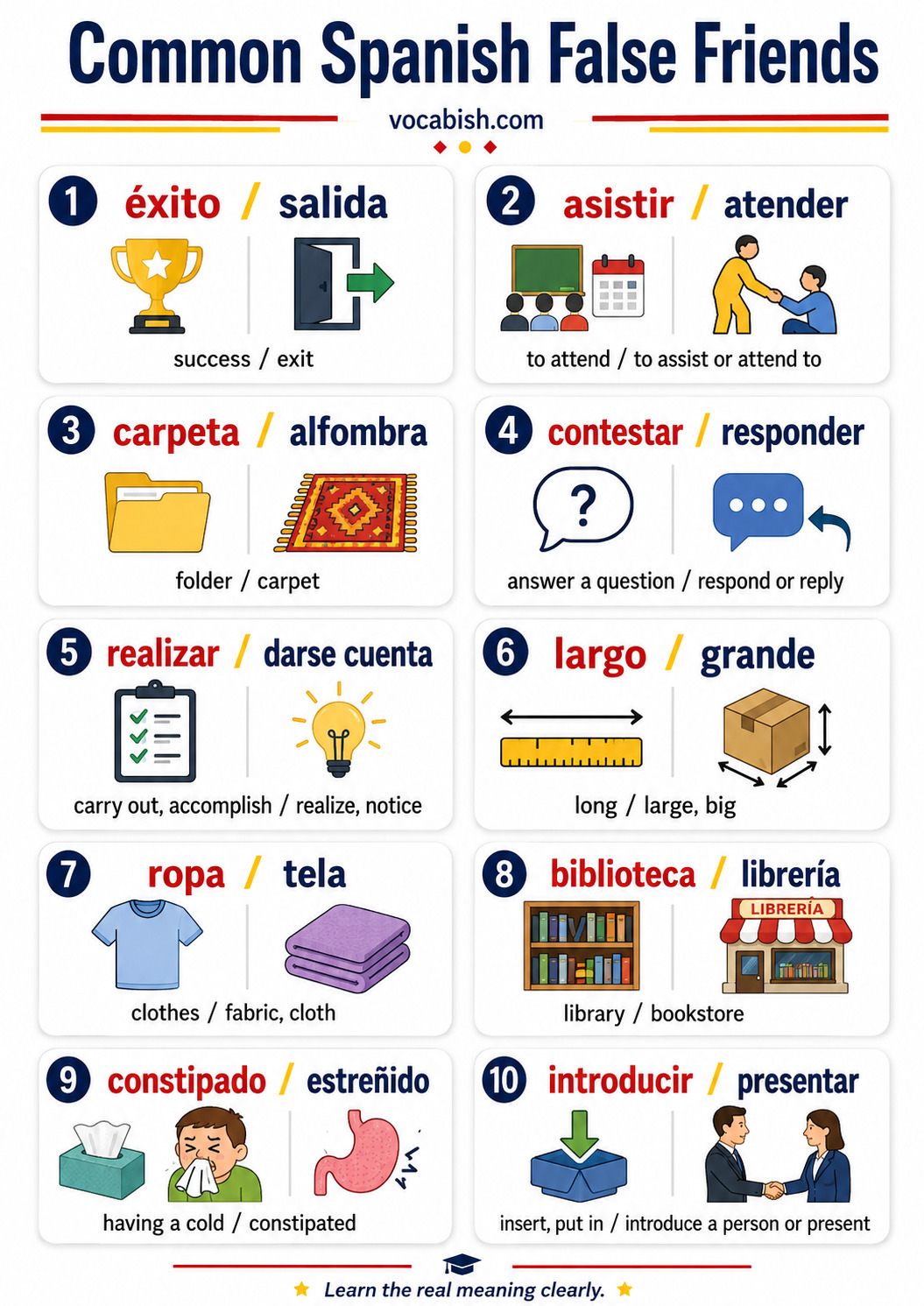
False friends are Spanish words that look like English words but have a different meaning. These can confuse learners because they look familiar.
- éxito / salida
- Éxito means success.
- Salida means exit.
- La película fue un éxito. — The movie was a success.
- La salida está allí. — The exit is there.
- asistir / atender
- Asistir means to attend.
- Atender means to assist, serve, or take care of someone.
- Asisto a la clase. — I attend the class.
- El doctor atiende al paciente. — The doctor treats the patient.
- carpeta / alfombra
- Carpeta means folder.
- Alfombra means carpet.
- La carpeta está en la mesa. — The folder is on the table.
- La alfombra es roja. — The carpet is red.
- contestar / responder
- Contestar means to answer.
- Responder also means to answer or respond.
- Contesto el teléfono. — I answer the phone.
- Respondo a tu pregunta. — I answer your question.
- realizar / darse cuenta
- Realizar means to carry out, do, or complete.
- Darse cuenta means to realize or notice.
- Realizo el proyecto. — I carry out the project.
- Me doy cuenta del error. — I realize the mistake.
- largo / grande
- Largo means long.
- Grande means big.
- El camino es largo. — The road is long.
- La casa es grande. — The house is big.
- ropa / tela
- Ropa means clothes.
- Tela means fabric.
- Compro ropa nueva. — I buy new clothes.
- La tela es suave. — The fabric is soft.
- biblioteca / librería
- Biblioteca means library.
- Librería means bookstore.
- Estudio en la biblioteca. — I study at the library.
- Compro libros en la librería. — I buy books at the bookstore.
- constipado / estreñido
- Constipado can mean having a cold in some countries.
- Estreñido means constipated.
- Estoy constipado. — I have a cold.
- Estoy estreñido. — I am constipated.
- introducir / presentar
- Introducir means to insert or introduce into something.
- Presentar means to introduce a person or present something.
- Introduzco la tarjeta. — I insert the card.
- Te presento a mi amiga. — I introduce you to my friend.
Quick Review for Learners
If you are new to Spanish, start with these pairs first:
- ser / estar
- Use ser for who or what someone is.
- Use estar for feelings, location, or temporary states.
- por / para
- Use por for reason or cause.
- Use para for purpose or destination.
- saber / conocer
- Use saber for facts or skills.
- Use conocer for people and places.
- pedir / preguntar
- Use pedir when asking for something.
- Use preguntar when asking a question.
- muy / mucho
- Use muy before adjectives.
- Use mucho for “a lot” or “many.”
- bueno / bien
- Use bueno to describe a thing.
- Use bien to describe how someone is or how something happens.
Download Confusing Words in Spanish PDF
FAQs about Confusing Words in Spanish
Learn confusing Spanish words in pairs, read short examples aloud, and make your own sentences to remember the difference naturally.
Common confusing words include ser / estar, por / para, saber / conocer, pedir / preguntar, muy / mucho, and bueno / bien.
Learners confuse them because both mean “to be” in English, but Spanish separates identity, condition, location, and temporary states.
Beginners should start with ser / estar, por / para, saber / conocer, ir / venir, and pedir / preguntar because they appear often.
Use por for reason, cause, exchange, movement through a place, or duration. Use para for purpose, destination, deadline, or recipient.
Yes, false friends can completely change meaning. For example, éxito means success, while salida means exit, not success.
Learners often use mucho before adjectives, but Spanish uses muy there. Say muy bueno, not mucho bueno.
Yes, accent marks can change meaning. Sí means yes, while si means if, so spelling affects understanding.
Final Thoughts
The easiest way to master the 100 Most Common Confusing Words in Spanish is to learn them in pairs. When you compare two similar words side by side, the difference becomes much clearer.
Start with the pairs you hear most often: ser / estar, por / para, saber / conocer, pedir / preguntar, bueno / bien, and muy / mucho.
Practice a few examples each day. Over time, these tricky Spanish words will feel much more natural in speaking, listening, reading, and writing.
You May Also Like: