
Learning how to ask and give directions in Spanish is very useful, especially when you are traveling, living in a Spanish-speaking place, or speaking with Spanish speakers in daily life.
You may need to ask where the bathroom is, how to get to a hotel, where the bus stop is, or which way to go. The good news is that many direction phrases in Spanish are short and easy to remember.
In this article, you’ll learn common Spanish phrases for asking and giving directions, along with practical examples you can use in real conversations.
Directions in Spanish with Answers
Asking for Directions | Giving Directions |
|---|---|
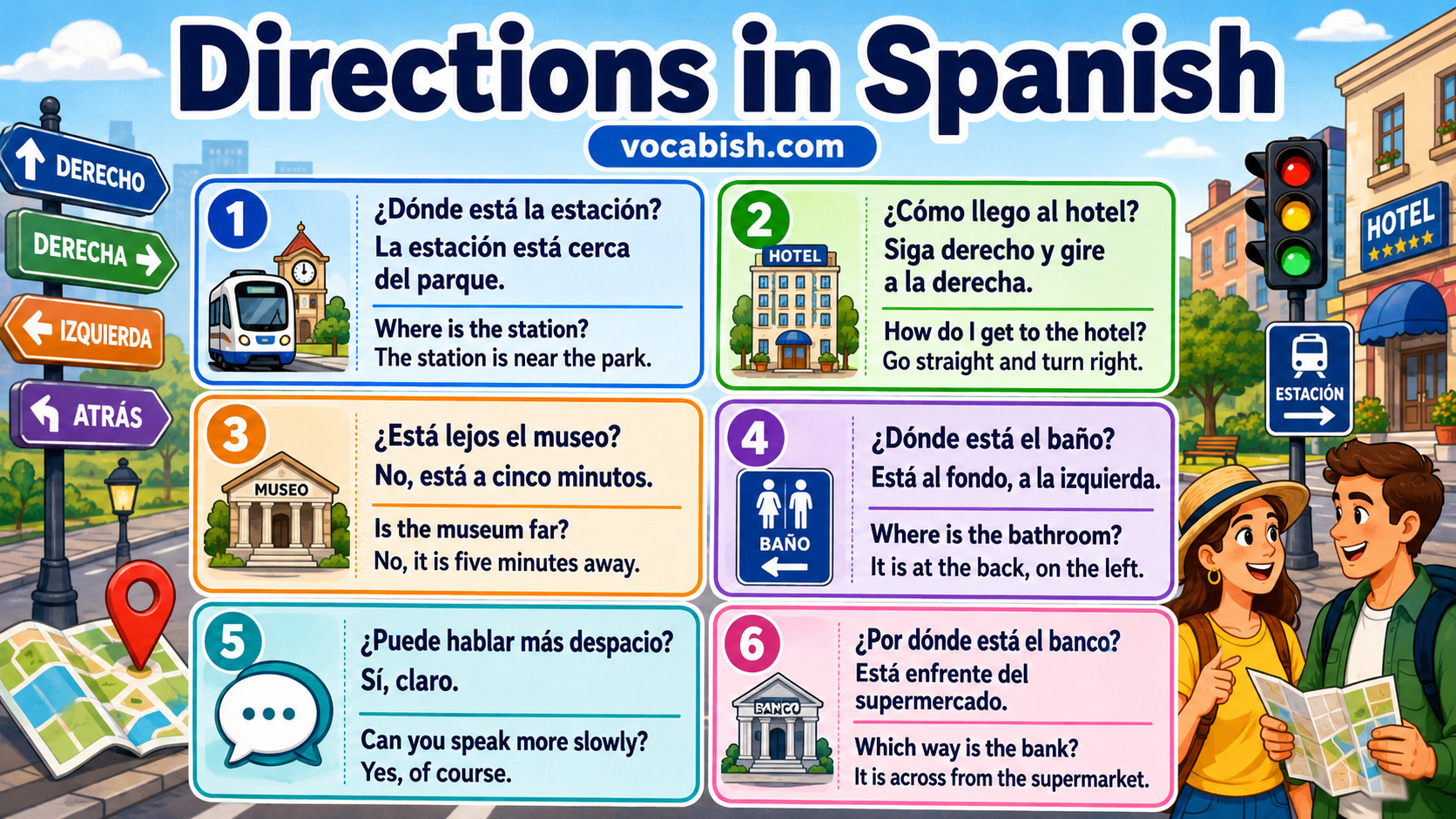
Disculpe, ¿dónde está el baño? Excuse me, where is the bathroom? | Está al fondo, a la derecha. It is at the back, on the right. |
¿Dónde está la estación? Where is the station? | Está cerca del parque. It is near the park. |
¿Cómo llego al hotel? How do I get to the hotel? | Siga derecho y gire a la izquierda.Go straight ahead and turn left. |
¿Dónde está la farmacia? Where is the pharmacy? | Está al lado del supermercado. It is next to the supermarket. |
¿Cómo llego al aeropuerto? How do I get to the airport? | Tome un taxi o vaya en autobús. Take a taxi or go by bus. |
¿Está cerca el banco? Is the bank nearby? | Sí, está en la esquina. Yes, it is on the corner. |
¿Dónde está la parada de autobús? Where is the bus stop? | Está enfrente de la tienda. It is in front of the store. |
¿Cómo llego al museo? How do I get to the museum? | Camine dos cuadras y doble a la derecha. Walk two blocks and turn right. |
¿Dónde está la salida? Where is the exit? | La salida está por allí. The exit is over there. |
¿Está lejos el restaurante? Is the restaurant far? | No, está a cinco minutos caminando. No, it is five minutes away on foot. |
¿Me puede decir dónde está el hotel? Can you tell me where the hotel is? | Está enfrente del banco. It is across from the bank. |
¿Por dónde está el centro? Which way is the city center? | Siga esta calle hasta el semáforo. Follow this street until the traffic light. |
Asking for Directions in Spanish
When you need help finding a place, start with a polite question. Spanish speakers often appreciate polite words like por favor and disculpe, especially when you are speaking to someone you do not know.
Spanish | English |
|---|---|
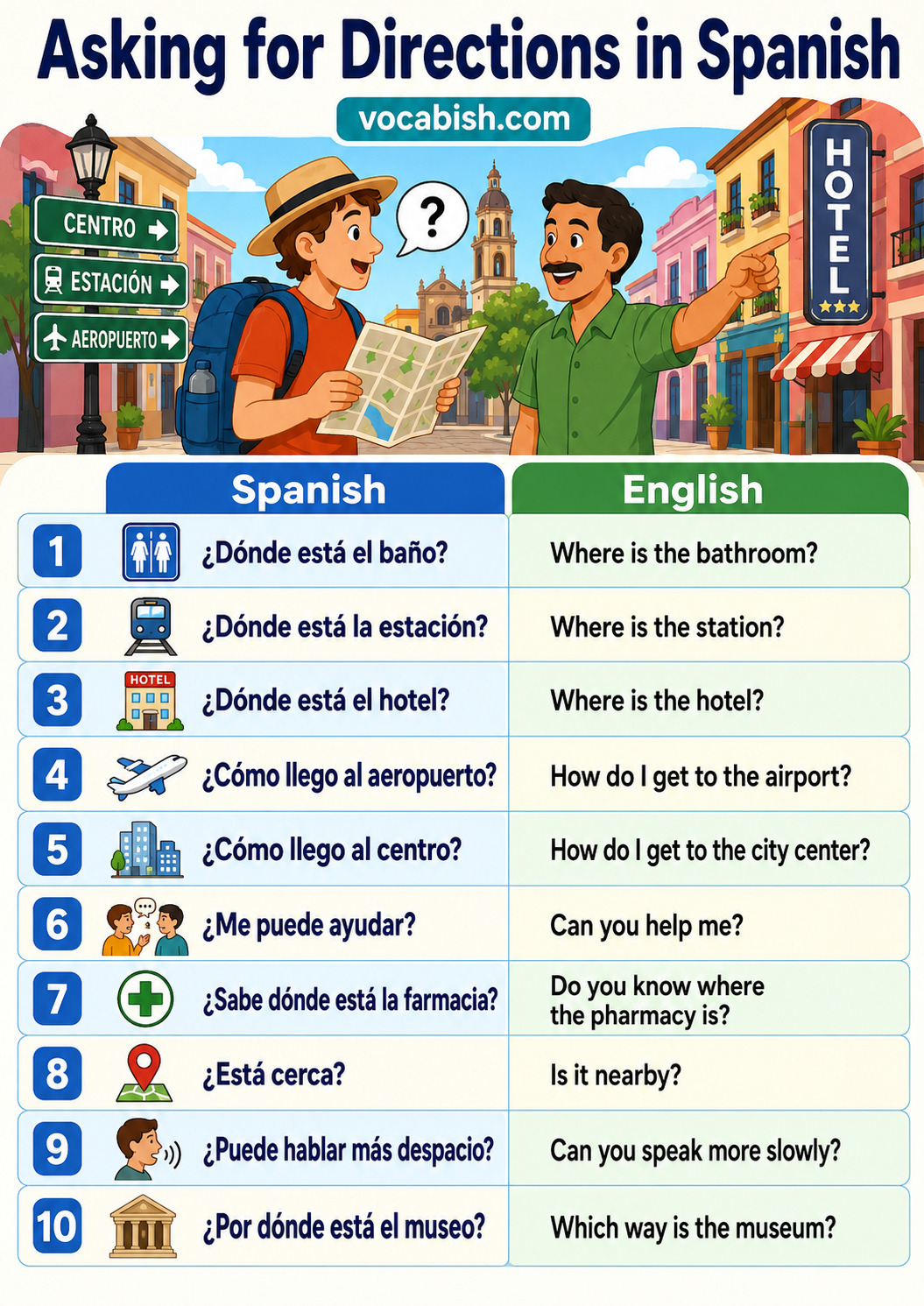
Disculpe, ¿dónde está el baño? | Excuse me, where is the bathroom? |
¿Dónde está la estación de tren? | Where is the train station? |
¿Dónde está el hotel? | Where is the hotel? |
¿Dónde está el restaurante? | Where is the restaurant? |
¿Dónde está la farmacia? | Where is the pharmacy? |
¿Dónde está el banco? | Where is the bank? |
¿Dónde está la parada de autobús? | Where is the bus stop? |
¿Dónde está el aeropuerto? | Where is the airport? |
¿Dónde está la tienda? | Where is the store? |
¿Dónde está la calle principal? | Where is the main street? |
The phrase ¿Dónde está…? means Where is…? This is one of the most helpful Spanish question patterns for directions.
You can use it with almost any place:
Spanish | English |
|---|---|
¿Dónde está el museo? | Where is the museum? |
¿Dónde está el supermercado? | Where is the supermarket? |
¿Dónde está la oficina? | Where is the office? |
¿Dónde está la escuela? | Where is the school? |
¿Dónde está la playa? | Where is the beach? |
If you only learn one direction question in Spanish, start with ¿Dónde está…?
Polite Ways to Ask for Help
In real conversations, it is better to sound polite and natural. You can begin with Disculpe for “Excuse me” or use ¿Me puede ayudar? for “Can you help me?”
Spanish | English |
|---|---|
Disculpe. | Excuse me. |
Perdón. | Sorry. / Excuse me. |
¿Me puede ayudar? | Can you help me? |
¿Puede ayudarme, por favor? | Can you help me, please? |
¿Me puede decir dónde está el banco? | Can you tell me where the bank is? |
¿Sabe dónde está la estación? | Do you know where the station is? |
¿Sabe cómo llegar al hotel? | Do you know how to get to the hotel? |
¿Puede repetir, por favor? | Can you repeat, please? |
¿Puede hablar más despacio? | Can you speak more slowly? |
Muchas gracias por su ayuda. | Thank you very much for your help. |
A very useful pattern is:
¿Me puede decir dónde está…?
It means Can you tell me where… is?
Spanish | English |
|---|---|
¿Me puede decir dónde está el baño? | Can you tell me where the bathroom is? |
¿Me puede decir dónde está la salida? | Can you tell me where the exit is? |
¿Me puede decir dónde está el metro? | Can you tell me where the subway is? |
¿Me puede decir dónde está la recepción? | Can you tell me where reception is? |
This sounds more polite than only saying ¿Dónde está…?, so it is great for hotels, airports, stations, shops, and restaurants.
Asking How to Get Somewhere
Sometimes you do not only want to know where a place is. You want to know how to get there. In that case, use ¿Cómo llego a…?
Spanish | English |
|---|---|
¿Cómo llego al hotel? | How do I get to the hotel? |
¿Cómo llego al centro? | How do I get to the city center? |
¿Cómo llego a la estación? | How do I get to the station? |
¿Cómo llego al aeropuerto? | How do I get to the airport? |
¿Cómo llego a la playa? | How do I get to the beach? |
¿Cómo llego al museo? | How do I get to the museum? |
¿Cómo llego al supermercado? | How do I get to the supermarket? |
¿Cómo llego a esta dirección? | How do I get to this address? |
Note the Difference Between A and AL.
Use al before masculine places:
Spanish | English |
|---|---|
al hotel | to the hotel |
al banco | to the bank |
al museo | to the museum |
al aeropuerto | to the airport |
al restaurante | to the restaurant |
Use a la before feminine places:
Spanish | English |
|---|---|
a la estación | to the station |
a la farmacia | to the pharmacy |
a la playa | to the beach |
a la tienda | to the store |
a la escuela | to the school |
You do not need to master grammar perfectly before speaking. Just practice common chunks like al hotel, a la estación, and al centro.
Useful Place Words for Directions in Spanish
Before asking for directions, it helps to know the names of common places. These words appear often in travel, shopping, and city conversations.
Spanish | English |
|---|---|
el baño | the bathroom |
el hotel | the hotel |
el banco | the bank |
el restaurante | the restaurant |
el aeropuerto | the airport |
el museo | the museum |
el supermercado | the supermarket |
el hospital | the hospital |
el parque | the park |
el centro | the city center |
la estación | the station |
la farmacia | the pharmacy |
la tienda | the store |
la playa | the beach |
la calle | the street |
la avenida | the avenue |
la parada de autobús | the bus stop |
la salida | the exit |
la entrada | the entrance |
la recepción | reception |
Try replacing the place in a question:
Spanish | English |
|---|---|
¿Dónde está el baño? | Where is the bathroom? |
¿Dónde está la salida? | Where is the exit? |
¿Dónde está el hospital? | Where is the hospital? |
¿Dónde está la farmacia? | Where is the pharmacy? |
This makes your Spanish more flexible because you are not memorizing only one sentence. You are learning a pattern.
Understanding Direction Words in Spanish
When someone gives you directions, they may use words like right, left, straight, near, or far. These are important because they tell you where to go.
Spanish | English |
|---|---|
a la derecha | to the right |
a la izquierda | to the left |
derecho | straight ahead |
todo recto | straight ahead |
cerca | near |
lejos | far |
aquí | here |
allí | there |
allá | over there |
enfrente de | in front of |
detrás de | behind |
al lado de | next to |
entre | between |
en la esquina | on the corner |
al final de la calle | at the end of the street |
en frente | across / in front |
arriba | upstairs / up |
abajo | downstairs / down |
Some phrases are very common:
Spanish | English |
|---|---|
Está a la derecha. | It is on the right. |
Está a la izquierda. | It is on the left. |
Está cerca. | It is near. |
Está lejos. | It is far. |
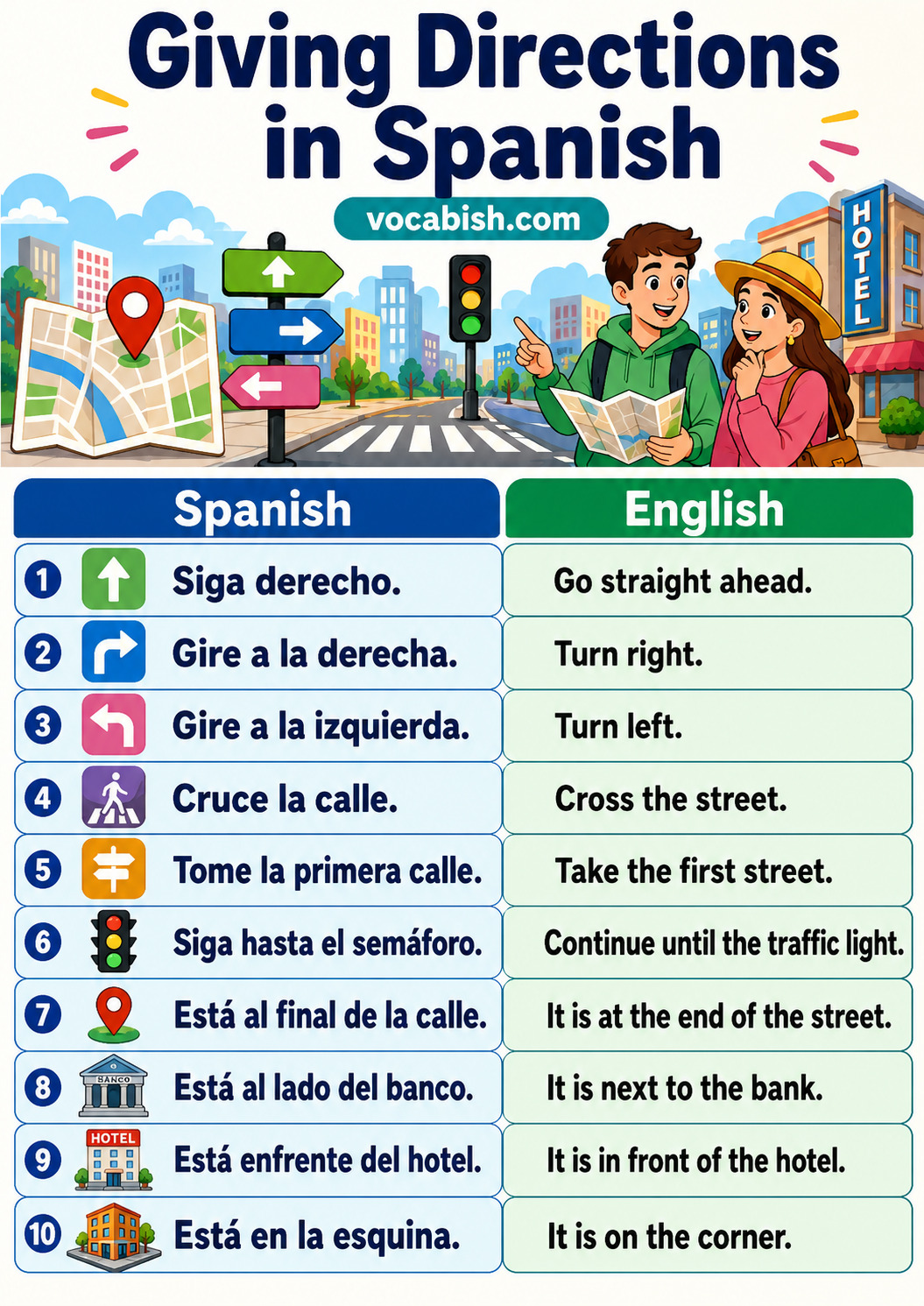
Está en la esquina. | It is on the corner. |
Está al lado del banco. | It is next to the bank. |
Está enfrente del hotel. | It is in front of the hotel. |
Está detrás del restaurante. | It is behind the restaurant. |
If someone says Está cerca, that means the place is nearby. If they say Está lejos, you may need a taxi, bus, or more detailed directions.
Giving Directions in Spanish
Now let’s look at phrases you can use when you are giving directions to someone else. These are practical and easy to use.
Spanish | English |
|---|---|
Siga derecho. | Go straight ahead. |
Sigue derecho. | Go straight ahead. |
Gire a la derecha. | Turn right. |
Gire a la izquierda. | Turn left. |
Dobla a la derecha. | Turn right. |
Dobla a la izquierda. | Turn left. |
Cruce la calle. | Cross the street. |
Cruza la calle. | Cross the street. |
Camine dos cuadras. | Walk two blocks. |
Camina dos cuadras. | Walk two blocks. |
Tome la primera calle. | Take the first street. |
Tome la segunda calle. | Take the second street. |
Pase el banco. | Pass the bank. |
Siga hasta el semáforo. | Continue until the traffic light. |
Está al final de la calle. | It is at the end of the street. |
You may notice two versions of some commands:
Spanish | English |
|---|---|
Siga derecho. | Go straight ahead. |
Sigue derecho. | Go straight ahead. |
Gire a la derecha. | Turn right. |
Dobla a la derecha. | Turn right. |
Camine dos cuadras. | Walk two blocks. |
Camina dos cuadras. | Walk two blocks. |
Both can be useful. Siga, gire, and camine sound more formal or polite. Sigue, dobla, and camina sound more casual.
When speaking to strangers, the polite version is a safe choice.
Common Direction Sentences in Spanish
Here are complete sentences you may hear when asking for directions in Spanish.
Spanish | English |
|---|---|
El baño está a la derecha. | The bathroom is on the right. |
La estación está cerca del parque. | The station is near the park. |
El hotel está enfrente del banco. | The hotel is across from the bank. |
La farmacia está al lado del supermercado. | The pharmacy is next to the supermarket. |
El restaurante está en la esquina. | The restaurant is on the corner. |
El museo está al final de la calle. | The museum is at the end of the street. |
El banco está detrás del hotel. | The bank is behind the hotel. |
La parada de autobús está aquí cerca. | The bus stop is nearby. |
La tienda está entre el banco y la farmacia. | The store is between the bank and the pharmacy. |
La salida está por allí. | The exit is over there. |
The phrase está means is located in this kind of sentence.
For example:
Spanish | English |
|---|---|
El hotel está cerca. | The hotel is nearby. |
La farmacia está lejos. | The pharmacy is far away. |
El baño está allí. | The bathroom is there. |
Asking About Distance in Spanish
Sometimes you need to know if a place is close or far. These short questions are very helpful.
Spanish | English |
|---|---|
¿Está cerca? | Is it nearby? |
¿Está lejos? | Is it far? |
¿Está muy lejos? | Is it very far? |
¿Está cerca de aquí? | Is it near here? |
¿Puedo ir caminando? | Can I walk there? |
¿Cuánto tiempo se tarda? | How long does it take? |
¿Cuánto tiempo se tarda caminando? | How long does it take on foot? |
¿Cuánto tiempo se tarda en taxi? | How long does it take by taxi? |
¿Hay un autobús para ir allí? | Is there a bus to go there? |
¿Necesito tomar un taxi? | Do I need to take a taxi? |
Useful answers may sound like this:
Spanish | English |
|---|---|
Sí, está cerca. | Yes, it is nearby. |
No, está lejos. | No, it is far. |
Está a cinco minutos. | It is five minutes away. |
Está a diez minutos caminando. | It is ten minutes away on foot. |
Puede ir caminando. | You can walk there. |
Es mejor tomar un taxi. | It is better to take a taxi. |
Hay un autobús cerca. | There is a bus nearby. |
A very natural travel question is ¿Puedo ir caminando? It helps you know whether the place is close enough to walk to.
Asking for Directions in a Taxi, Hotel, or Station in Spanish
Different places need slightly different phrases. Here are useful examples for common travel situations.
Spanish | English |
|---|---|
¿Me puede llevar al hotel? | Can you take me to the hotel? |
¿Cuánto cuesta ir al aeropuerto? | How much does it cost to go to the airport? |
¿Cuánto tarda en llegar? | How long does it take to arrive? |
¿Puede dejarme aquí? | Can you drop me off here? |
¿Dónde está la recepción? | Where is reception? |
¿Dónde está mi habitación? | Where is my room? |
¿Dónde está el ascensor? | Where is the elevator? |
¿Dónde puedo comprar un boleto? | Where can I buy a ticket? |
¿A qué hora sale el tren? | What time does the train leave? |
¿Dónde está la puerta de salida? | Where is the departure gate? |
At a hotel, ¿Dónde está la recepción? and ¿Dónde está el ascensor? are very useful. At a station or airport, learn boleto, tren, puerta, and salida.
Mini Conversations for Practice
Short conversations help you see how phrases work together. Read them aloud and replace places with your own examples.
Conversation 1
Spanish | English |
|---|---|
Disculpe, ¿dónde está el baño? | Excuse me, where is the bathroom? |
Está al fondo, a la derecha. | It is at the back, on the right. |
Muchas gracias. | Thank you very much. |
De nada. | You’re welcome. |
Conversation 2
Spanish | English |
|---|---|
¿Cómo llego al hotel? | How do I get to the hotel? |
Siga derecho y gire a la izquierda. | Go straight ahead and turn left. |
¿Está cerca? | Is it nearby? |
Sí, está a cinco minutos. | Yes, it is five minutes away. |
Conversation 3
Spanish | English |
|---|---|
¿Dónde está la farmacia? | Where is the pharmacy? |
Está al lado del supermercado. | It is next to the supermarket. |
¿Puedo ir caminando? | Can I walk there? |
Sí, está muy cerca. | Yes, it is very close. |
Conversation 4
Spanish | English |
|---|---|
Disculpe, ¿sabe dónde está la estación? | Excuse me, do you know where the station is? |
Sí, está cerca del parque. | Yes, it is near the park. |
¿Por dónde voy? | Which way do I go? |
Tome la segunda calle a la derecha. | Take the second street on the right. |
Helpful Tips for Learners
You do not need to memorize every phrase at once. Start with the ones you are most likely to use.
A good first set would be:
Spanish | English |
|---|---|
¿Dónde está…? | Where is…? |
¿Cómo llego a…? | How do I get to…? |
¿Está cerca? | Is it nearby? |
Siga derecho. | Go straight ahead. |
Gire a la derecha. | Turn right. |
Gire a la izquierda. | Turn left. |
Muchas gracias. | Thank you very much. |
Also, do not worry if you do not understand every word someone says. Listen for the main direction words:
Spanish | English |
|---|---|
derecha | right |
izquierda | left |
derecho | straight |
cerca | near |
lejos | far |
esquina | corner |
calle | street |
semáforo | traffic light |
These words often give you the main idea, even if the full sentence feels fast.
FAQs About Asking and Giving Direction in Spanish
Use Disculpe or Perdón before your question, then ask ¿Dónde está…? or ¿Cómo llego a…? to sound polite and clear.
Learn derecha, izquierda, derecho, cerca, lejos, esquina, calle, and semáforo because these words appear in many direction instructions you hear daily.
Yes, listen for key words like right, left, straight, near, and far to understand the main direction quickly in conversations.
Use ¿Dónde está…? when asking where a place is, such as the bathroom, station, hotel, pharmacy, exit, or nearby restaurant.
Use ¿Cómo llego a…? when you need route instructions, not just the location of a place on a map.
Use Estoy perdido, ¿Me puede ayudar?, ¿Dónde estoy?, and ¿Cómo llego al centro? when you need quick help.
Adding por favor makes your request sound respectful, friendly, and natural, especially when speaking to strangers, workers, or older people.
Say ¿Puede hablar más despacio, por favor? It politely asks the person to speak slower so you can understand the directions.
Final Thoughts
Asking and giving directions in Spanish becomes much easier when you learn common phrase patterns. Start with ¿Dónde está…?, ¿Cómo llego a…?, a la derecha, a la izquierda, and siga derecho.
These phrases will help you in hotels, airports, restaurants, streets, stations, shops, and many everyday situations. Practice them out loud, use them in short conversations, and slowly add more place words as your vocabulary grows.
You May Also Like: