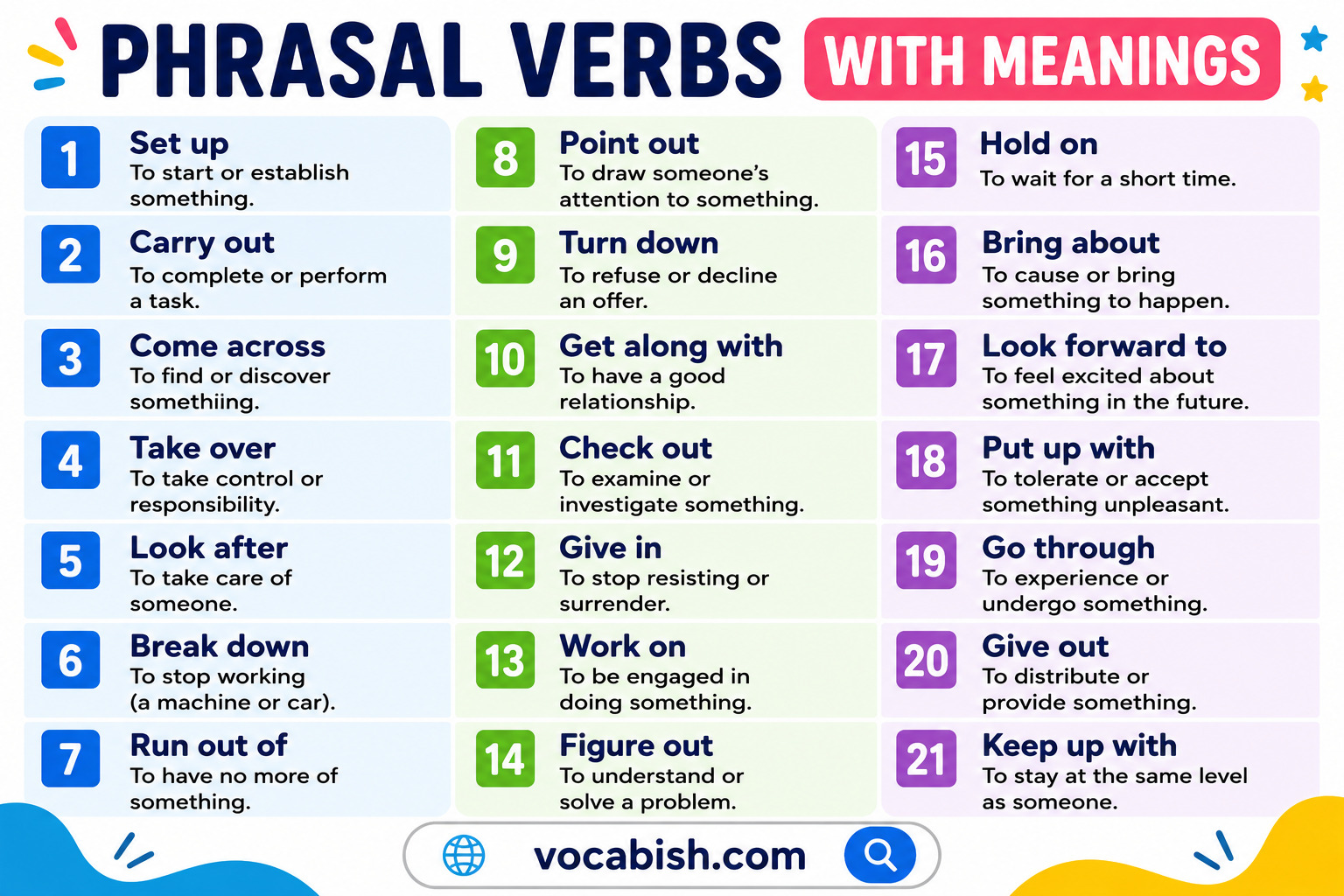

Many English learners reach a point where grammar feels manageable, but everyday expressions still cause confusion. Phrasal Verbs are often the reason. Common phrases like find out, carry on, and run into appear everywhere, yet their meanings can’t always be guessed from the words themselves. Once you understand how they work, everyday conversations become much easier to follow. In this article, you’ll learn the Phrasal Verbs Definition, discover common examples, and practice using them through worksheets and exercises designed for everyday English.
What Are Phrasal Verbs?
Phrasal verbs are one of the most common features of everyday English. Native speakers use them naturally in both spoken and written communication.
A phrasal verb combines a verb with a preposition, an adverb, or both. Together, they create a new meaning that is often different from the original verb.
Examples:
Phrasal Verb | Meaning |
|---|---|
Give up | Stop trying |
Look after | Take care of |
Find out | Discover |
Turn on | Start a machine |
Run into | Meet unexpectedly |
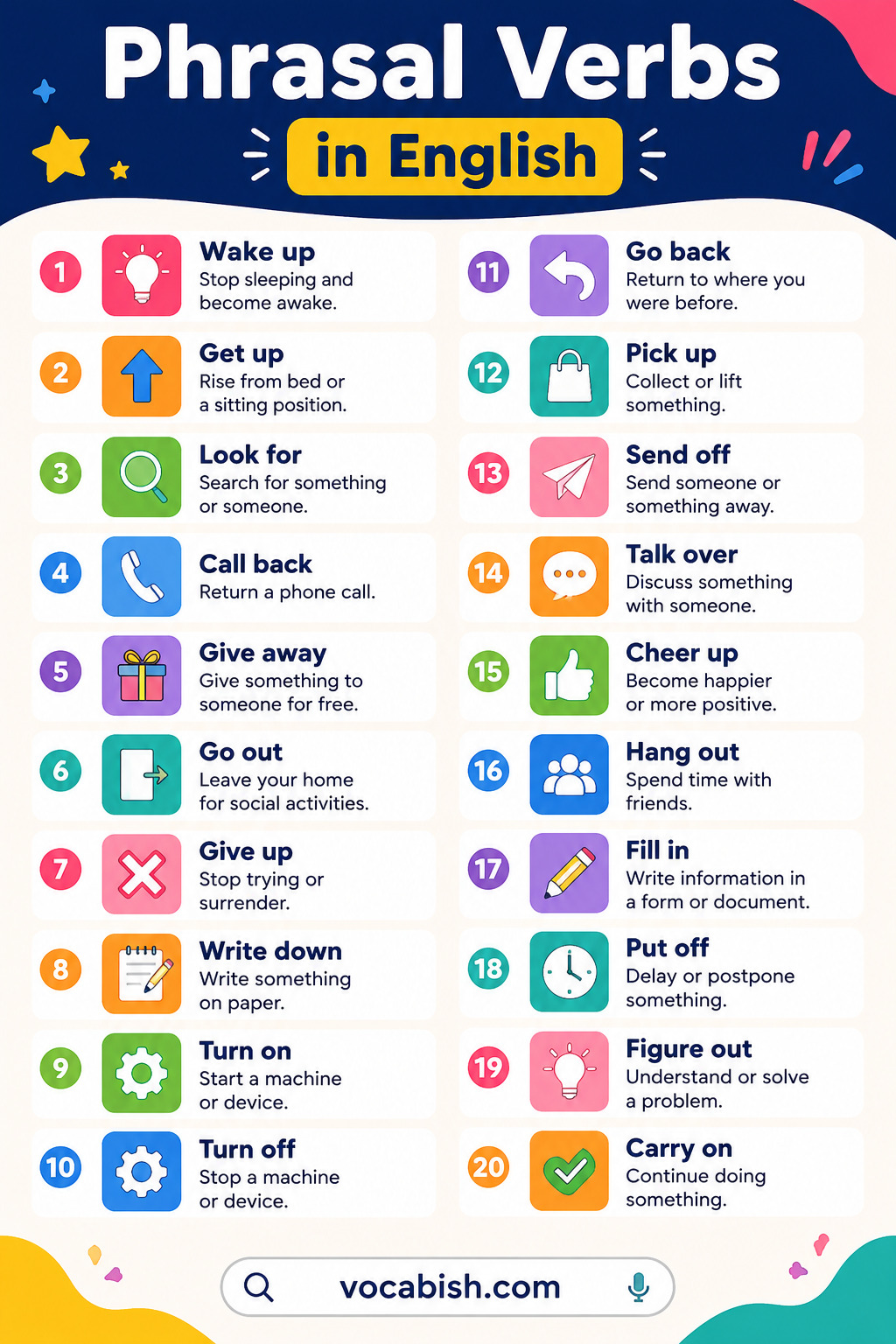
Phrasal Verbs Definition and How They Work in English
A phrasal verb is a combination of a main verb and one or more particles that function as a single unit of meaning.
The meaning may be easy to understand:
- Sit down
- Stand up
- Wake up
Or it may be idiomatic:
- Give up = stop trying
- Put off = postpone
- Bring up = mention
Structure of Phrasal Verbs:
Structure | Example |
|---|---|
Verb + Adverb | Give up |
Verb + Preposition | Look after |
Verb + Adverb + Preposition | Get away with |
Why Phrasal Verbs Are Important for Fluent English
Phrasal verbs appear constantly in daily communication. Learning them helps you understand native speakers and express yourself more naturally.
You will hear phrasal verbs in:
- Conversations
- Movies
- TV shows
- Business meetings
- Emails
- Academic settings
- English proficiency exams
Compare These Examples:
Formal Verb | Phrasal Verb |
|---|---|
Continue | Carry on |
Discover | Find out |
Postpone | Put off |
Return | Come back |
Remove | Take off |
In everyday situations, people often choose the phrasal verb version.
Types of Phrasal Verbs with Examples
Phrasal verbs can be grouped into different categories based on how they work in a sentence.
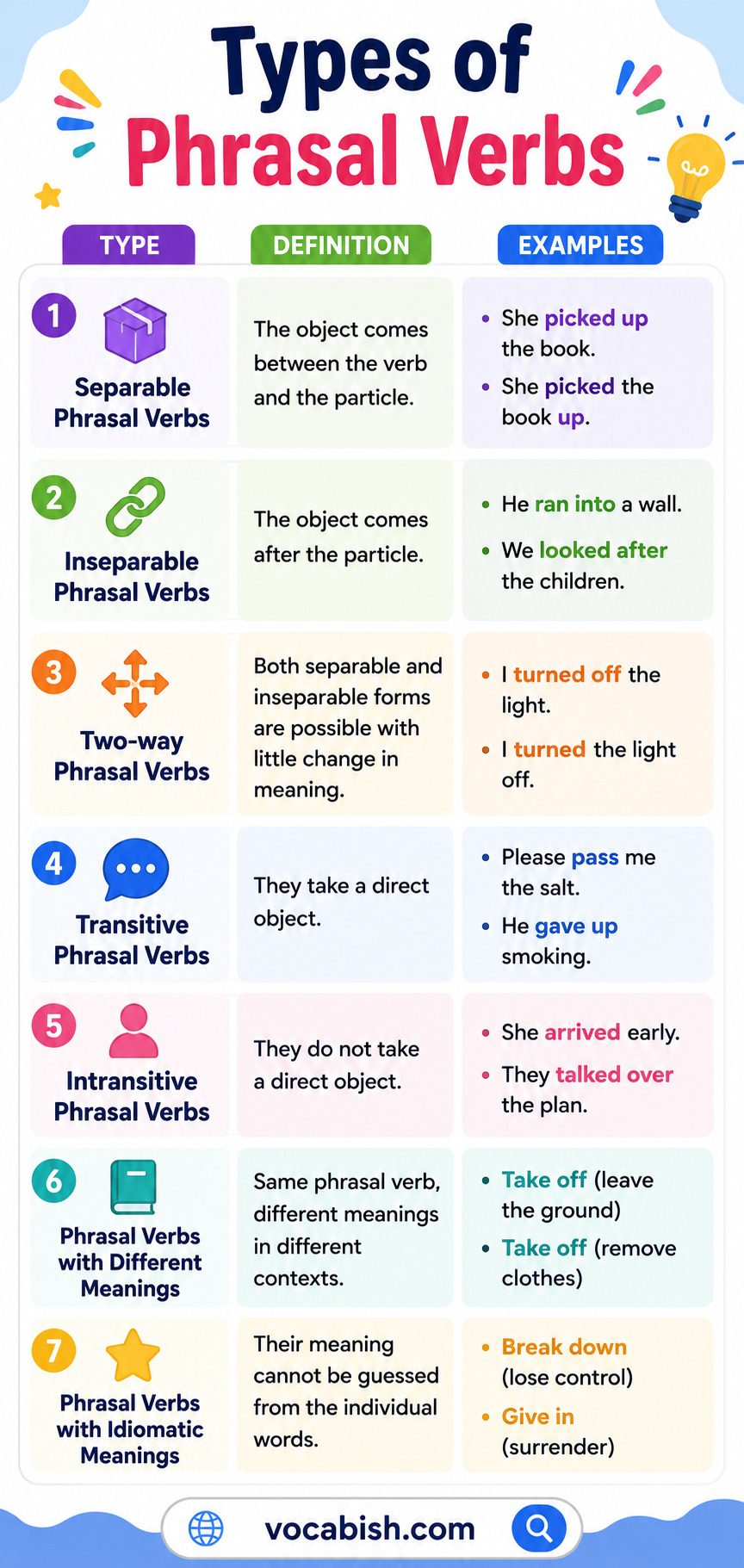
Separable Phrasal Verbs
Separable phrasal verbs allow the object to come either after the phrasal verb or between the verb and the particle. This flexibility makes them different from other types of phrasal verbs.
Examples:
- Turn off the light.
- Turn the light off.
- Pick up the phone.
- Pick the phone up.
Inseparable Phrasal Verbs
These phrasal verbs do not allow the object to come between the verb and the particle. The object must always follow the complete phrasal verb.
Examples:
- Look after the children.
- Run into an old friend.
Incorrect:
- Look the children after.
- Run an old friend into.
Transitive Phrasal Verbs
Transitive phrasal verbs need an object to complete their meaning. Without an object, the sentence sounds incomplete or incorrect.
Structure: Verb + Particle
Examples:
- Hand in your homework.
- Put off the meeting.
Intransitive Phrasal Verbs
Intransitive phrasal verbs do not need an object. They can stand alone and still make complete sense in a sentence.
Structure: Verb + Particle + Object
Examples:
- Wake up.
- Grow up.
- Show up.
Type | Structure | Object Needed? | Example |
|---|---|---|---|
Intransitive | Verb + Particle | No | The plane took off. |
Separable | Verb + Particle + Object | Yes | Turn the light off. |
Inseparable | Verb + Particle + Object | Yes | Look after the child. |
Three-Word | Verb + Adverb + Preposition | Usually Yes | Look forward to the trip. |
Common Phrasal Verbs List with Meanings
The following phrasal verb list includes some of the most useful expressions you should know about.
Phrasal Verb | Meaning |
|---|---|
Add up | Equal |
Ask around | Ask many people |
Ask out | Invite on a date |
Back up | Support |
Blow up | Explode |
Break down | Stop functioning |
Break in | Enter forcibly |
Break up | End a relationship |
Bring up | Mention |
Call back | Return a call |
Call off | Cancel |
Calm down | Relax |
Catch up | Reach the same point |
Check in | Register |
Check out | Leave a hotel |
Cheer up | Become happier |
Clean up | Tidy |
Come across | Find unexpectedly |
Count on | Rely on |
Cut back on | Reduce |
Cut off | Stop providing |
Dress up | Wear formal clothes |
Drop off | Deliver |
Drop out | Quit |
Eat out | Eat at a restaurant |
End up | Finally arrive at |
Figure out | Understand |
Fill out | Complete a form |
Find out | Discover |
Get along | Have a good relationship |
Get away | Go on vacation |
Get back | Return |
Get over | Recover |
Get together | Meet socially |
Get up | Leave bed |
Give away | Reveal or donate |
Give in | Surrender |
Give up | Quit |
Go ahead | Proceed |
Go back | Return |
Go out | Leave for social activity |
Grow up | Become an adult |
Hand in | Submit |
Hand out | Distribute |
Hang on | Wait |
Hang out | Spend time together |
Hold on | Wait briefly |
Keep on | Continue |
Let down | Disappoint |
Look after | Take care of |
Look for | Search |
Look into | Investigate |
Look up | Search for information |
Make up | Invent |
Pass away | Die |
Pick out | Choose |
Put off | Postpone |
Put up with | Tolerate |
Run into | Meet unexpectedly |
Set up | Arrange |
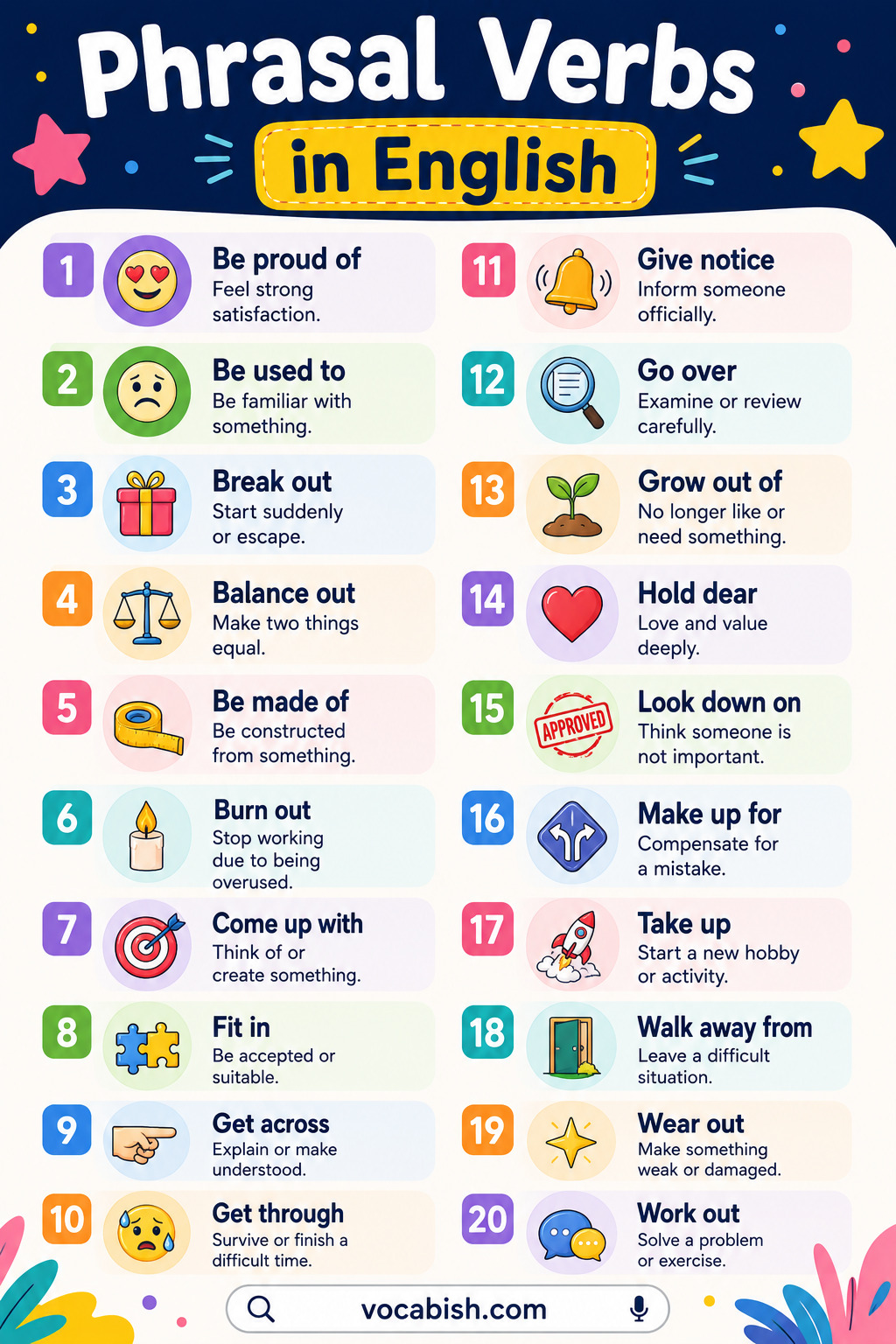
Phrasal Verbs Examples Used in Daily Conversations
Learning phrasal verbs through context makes them easier to remember.
Everyday Conversation Examples:
- I ran into an old friend at the mall.
- Can you pick up some milk on your way home?
- We need to figure out this problem.
- Please turn off the lights before leaving.
- I am looking forward to the weekend.
At Home:
- Clean up your room.
- Take off your shoes.
- Put on your jacket.
- Wake up early tomorrow.
- Hang on for a minute.
Examples of Phrasal Verbs for Work, School, and Travel
Different situations often use different phrasal verbs.
Work:
- The manager called off the meeting.
- We need to follow up with the client.
- Please look over this report.
School:
- Hand in your assignment by Friday.
- I need to look up this word.
- We carried out a science project.
Travel:
- We checked in at the airport.
- The plane took off on time.
- We set off early in the morning.
Frequently Confused Phrasal Verbs and Their Meanings
Some phrasal verbs look similar but have different meanings.
Phrasal Verb | Meaning | Example |
|---|---|---|
Come back | Return | She came back from Paris yesterday. |
Come down with | Become sick | I came down with a cold last week. |
Come forward | Volunteer information | A witness came forward after the accident. |
Come apart | Separate into pieces | The toy came apart in my hands. |
Fall apart | Break into pieces | The old chair fell apart. |
Fall down | Fall to the ground | He fell down while running. |
Fall out | Stop being friends | They fell out over money. |
Fall back on | Depend on as a backup | She has savings to fall back on. |
Hold back | Restrain or hide | He held back his anger. |
Hold onto | Keep firmly | Hold onto the railing. |
Hold up | Delay | Traffic held us up for an hour. |
Hold out | Last for a period | Our supplies won’t hold out long. |
Pass out | Faint | The runner passed out from exhaustion. |
Pass up | Reject an opportunity | She passed up a great job offer. |
Pass through | Move across | We passed through several towns. |
Pass by | Go past | I passed by your house yesterday. |
Take back | Return something | I took the jacket back to the store. |
Take out | Remove | Please take out the trash. |
Wear off | Gradually disappear | The pain medicine wore off. |
Work out | Be successful | Everything worked out well. |
Work on | Spend time improving | She is working on her presentation. |
Try out | Test something new | We tried out the new software. |
Think back | Remember the past | I often think back to my school days. |
Throw away | Dispose of | Don’t throw away those documents. |
Tear up | Rip into pieces | He tore up the letter after reading it. |
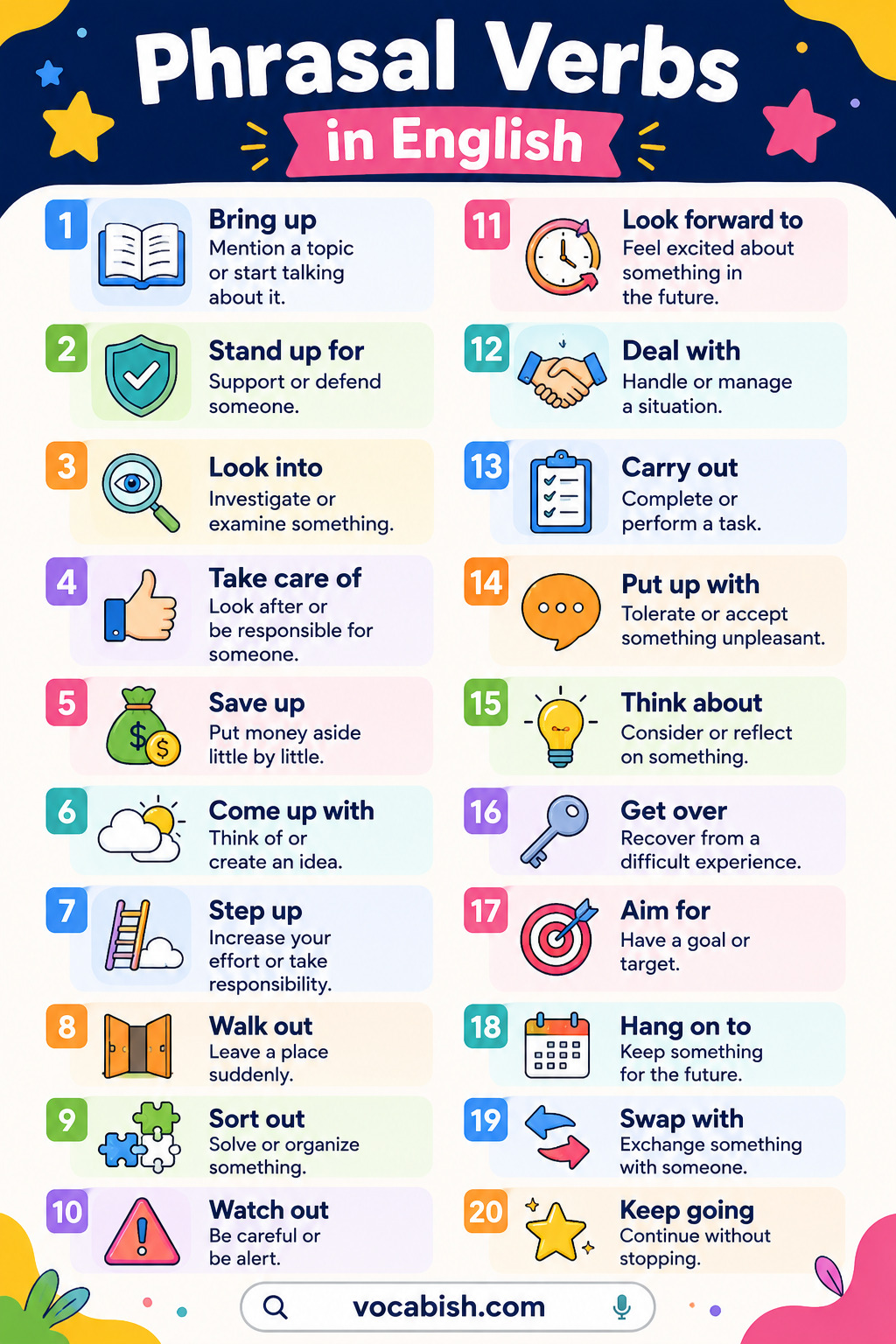
Common Mistakes When Using Phrasal Verbs
1. Translating Word by Word:
Incorrect:
- I put off my jacket.
Correct:
- I took off my jacket.
2. Wrong Word Order:
Incorrect:
- Turn off it.
Correct:
- Turn it off.
3. Choosing the Wrong Phrasal Verb:
Incorrect:
- I looked my friend.
Correct:
- I looked for my friend.
Tips for Remembering Phrasal Verbs Faster
Instead of memorizing long lists, focus on usage and context.
- Learn phrasal verbs in sentences.
- Read English articles regularly.
- Watch English videos with subtitles.
- Group phrasal verbs by topic.
- Review them weekly.
- Create your own examples.
- Practice speaking with them.
Example:
Instead of learning:
- Give up = stop trying
Learn:
- She didn’t give up even after several failures.
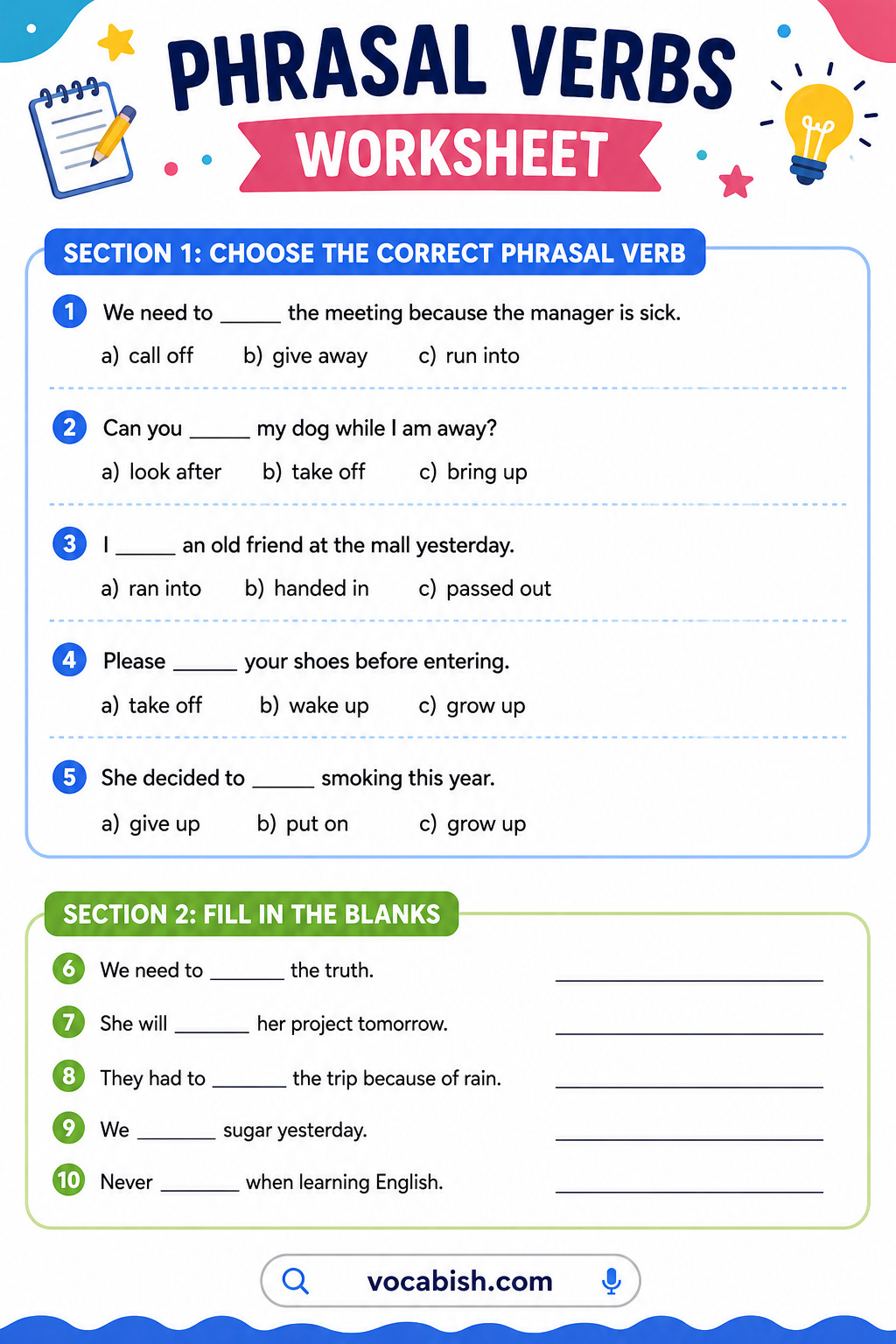
Phrasal Verbs Worksheet
Practice common phrasal verbs. Choose or type the correct answer, then check your score.
Section 1: Choose the Correct Phrasal Verb
1. We need to _____ the meeting because the manager is sick.
2. Can you _____ my dog while I am away?
3. I _____ an old friend at the mall yesterday.
4. Please _____ your shoes before entering.
5. She decided to _____ smoking this year.
Section 2: Fill in the Blanks
6. We need to ______ the truth.
7. She will ______ her project tomorrow.
8. They had to ______ the trip because of rain.
9. We ______ sugar yesterday.
10. Never ______ when learning English.
Answer Key
- call off
- look after
- ran into
- take off
- give up
- find out
- hand in
- put off
- ran out of
- give up
Phrasal Verbs Practice Exercise
Complete each sentence with the correct phrasal verb. Then check your answers instantly.
1. We ______ the meeting because everyone was busy.
2. She ______ the answer after reading the article.
3. Please ______ my cat while I am away.
4. The plane ______ at noon.
5. He ______ from London last night.
6. I ______ my grandfather because he is kind and hardworking.
7. They ______ the concert because of heavy rain.
8. We ______ the report before sending it.
9. She ______ her homework before lunch.
10. The children ______ in a small village.
- put off
- found out
- look after
- took off
- got back
- look up to
- called off
- went over
- handed in
- grew up
Download PDF
FAQs About Phrasal Verbs
Phrasal verbs combine a verb with a preposition or adverb to create a new meaning that often differs from the original verb.
They appear frequently in conversations, media, business communication, and exams, making them an important part of natural English.
Study them in sentences, practice regularly, group them by topic, and use them in speaking and writing activities.
Separable phrasal verbs allow an object between the verb and particle, while inseparable ones keep the object after the complete phrase.
Some are common in formal writing, but many appear more often in conversations, emails, and everyday communication.
Start with the 50–100 most common phrasal verbs. These cover a large portion of everyday English usage.
Yes. Many phrasal verbs have multiple meanings depending on context, so learning them through examples is helpful.