
Reading comprehension passages for kids help children improve their reading skills, understand written information, and develop better vocabulary. From short, easy stories for kindergarten to longer passages for middle and high school students, reading activities introduce different topics, sentence structures, and ideas according to each grade level. Answering questions after reading also encourages children to remember details, identify the main idea, understand new words, and think critically about what they read.
In this article, we will explore 20+ reading comprehension passages for kindergarten through Grade 10, with age-appropriate texts and questions to test understanding. I have organized the passages by grade level, making it easier for parents, teachers, and students to find suitable reading practice. These exercises will help us build reading confidence, improve comprehension, and develop stronger English language skills.
Why Reading Comprehension for Kids Matters
Reading comprehension is an important skill that helps children understand what they read, learn new information, and communicate their thoughts. It goes beyond recognizing words or reading sentences. Children need to understand the meaning of a passage, identify important details, make connections, and answer questions based on the information.
These reading comprehension passages are designed to help children from Kindergarten to Grade 10 develop stronger reading habits and improve their understanding through age-appropriate exercises. Each passage gives children an opportunity to practice reading, think about what they have learned, and answer questions independently.
Regular reading comprehension practice helps children:
- Improve Reading Skills: Children learn to read carefully, understand sentences, and follow the meaning of a passage.
- Develop Writing Skills: Answering questions in complete sentences helps children organize their thoughts and express ideas in writing.
- Build Vocabulary: Reading different passages introduces children to new words, expressions, and sentence structures.
- Improve Understanding: Children practice identifying the main idea, recognizing important details, and understanding what happens in a story or passage.
- Develop Critical Thinking: Questions encourage children to make predictions, understand reasons, draw conclusions, and think beyond individual sentences.
- Strengthen Memory: Remembering characters, events, facts, and important information helps children improve their ability to recall what they read.
- Build Reading Confidence: Completing exercises at the right level helps children become more comfortable with reading and answering questions.
- Support School Learning: Reading comprehension is useful across subjects because children need to understand written instructions, textbooks, questions, and other learning materials.
The 21 reading comprehension passages in this collection provide practice for different learning stages, from simple passages for young readers to more detailed topics for older students. Parents and teachers can use these exercises to support classroom learning, homework, and independent reading practice.
Most importantly, regular practice helps children become more confident readers who can understand information, think clearly, and communicate their ideas more effectively.
Reading Comprehension for Kids: Kindergarten–Grade 1
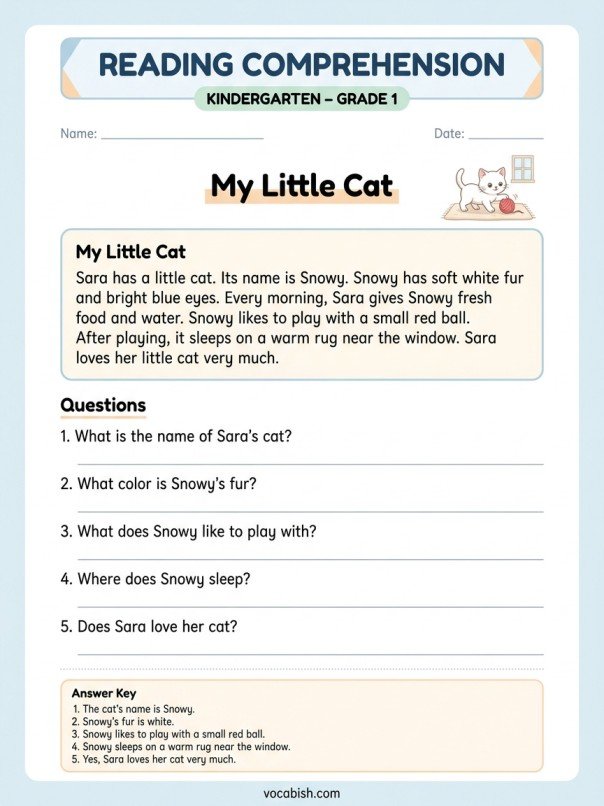
1. My Little Cat
Sara has a little cat. Its name is Snowy. Snowy has soft white fur and bright blue eyes. Every morning, Sara gives Snowy fresh food and water. Snowy likes to play with a small red ball. After playing, it sleeps on a warm rug near the window. Sara loves her little cat very much.
Questions
- What is the name of Sara’s cat?
- What color is Snowy’s fur?
- What does Snowy like to play with?
- Where does Snowy sleep?
- Does Sara love her cat?
Answers
- The cat’s name is Snowy.
- Snowy’s fur is white.
- Snowy likes to play with a small red ball.
- Snowy sleeps on a warm rug near the window.
- Yes, Sara loves her cat very much.
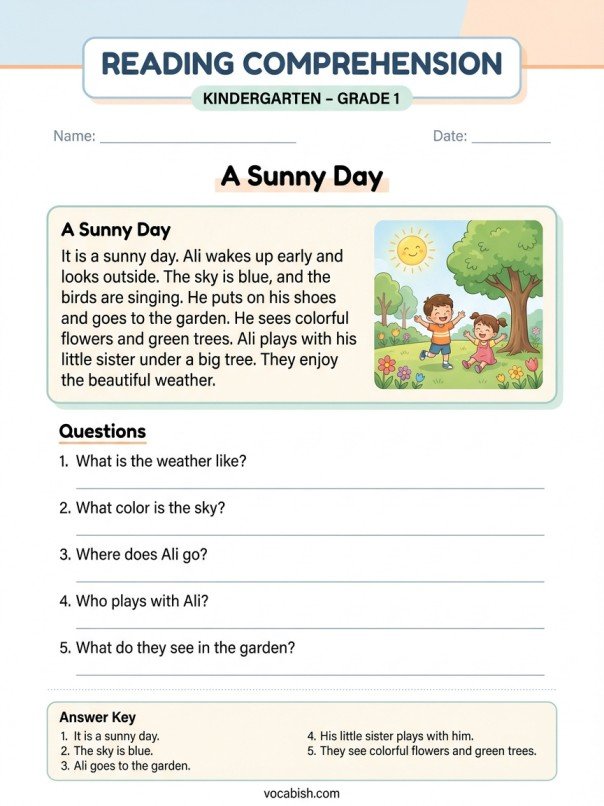
2. A Sunny Day
It is a sunny day. Ali wakes up early and looks outside. The sky is blue, and the birds are singing. He puts on his shoes and goes to the garden. He sees colorful flowers and green trees. Ali plays with his little sister under a big tree. They enjoy the beautiful weather.
Questions
- What is the weather like?
- What color is the sky?
- Where does Ali go?
- Who plays with Ali?
- What do they see in the garden?
Answers
- It is a sunny day.
- The sky is blue.
- Ali goes to the garden.
- His little sister plays with him.
- They see colorful flowers and green trees.
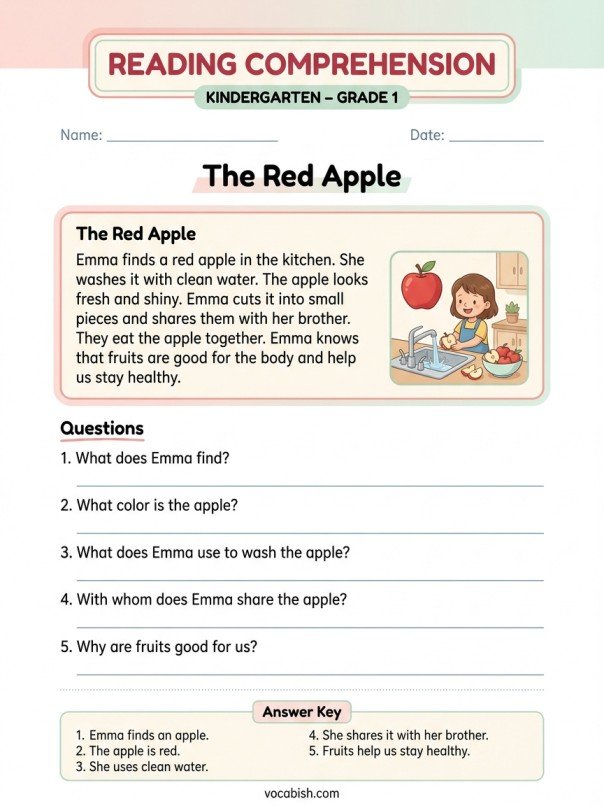
3. The Red Apple
Emma finds a red apple in the kitchen. She washes it with clean water. The apple looks fresh and shiny. Emma cuts it into small pieces and shares them with her brother. They eat the apple together. Emma knows that fruits are good for the body and help us stay healthy.
Questions
- What does Emma find?
- What color is the apple?
- What does Emma use to wash the apple?
- With whom does Emma share the apple?
- Why are fruits good for us?
Answers
- Emma finds an apple.
- The apple is red.
- She uses clean water.
- She shares it with her brother.
- Fruits help us stay healthy.
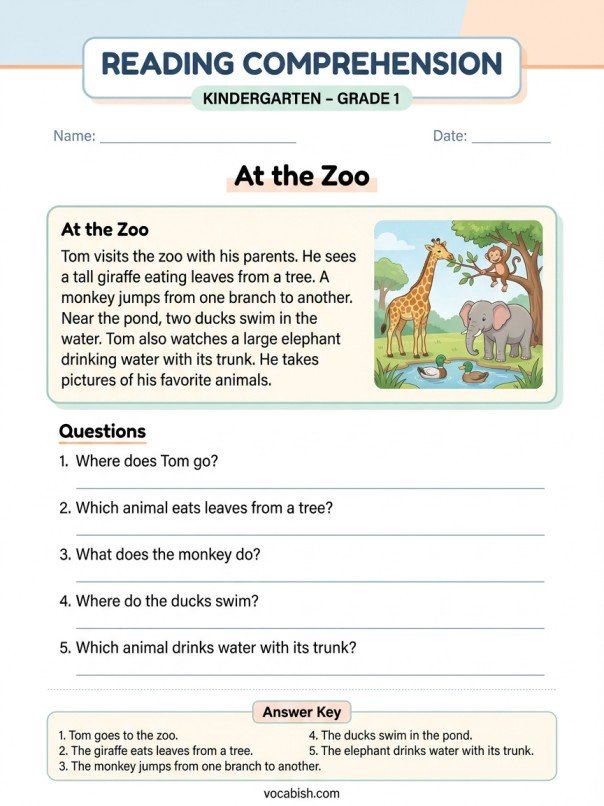
4. At the Zoo
Tom visits the zoo with his parents. He sees a tall giraffe eating leaves from a tree. A monkey jumps from one branch to another. Near the pond, two ducks swim in the water. Tom also watches a large elephant drinking water with its trunk. He takes pictures of his favorite animals.
Questions
- Where does Tom go?
- Which animal eats leaves from a tree?
- What does the monkey do?
- Where do the ducks swim?
- Which animal drinks water with its trunk?
Answers
- Tom goes to the zoo.
- The giraffe eats leaves from a tree.
- The monkey jumps from one branch to another.
- The ducks swim in the pond.
- The elephant drinks water with its trunk.
Reading Comprehension for Kids: Grades 2–3
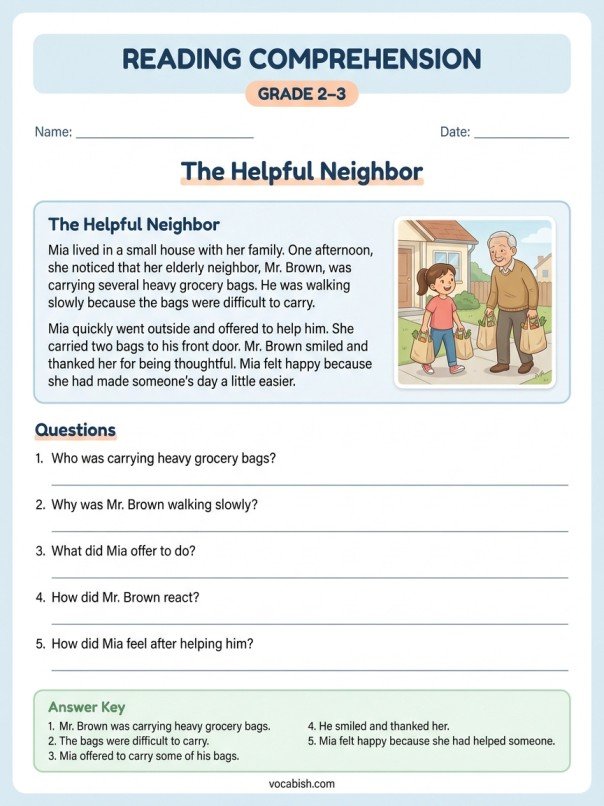
5. The Helpful Neighbor
Mia lived in a small house with her family. One afternoon, she noticed that her elderly neighbor, Mr. Brown, was carrying several heavy grocery bags. He was walking slowly because the bags were difficult to carry.
Mia quickly went outside and offered to help him. She carried two bags to his front door. Mr. Brown smiled and thanked her for being thoughtful. Mia felt happy because she had made someone’s day a little easier.
Questions
- Who was carrying heavy grocery bags?
- Why was Mr. Brown walking slowly?
- What did Mia offer to do?
- How did Mr. Brown react?
- How did Mia feel after helping him?
Answers
- Mr. Brown was carrying heavy grocery bags.
- The bags were difficult to carry.
- Mia offered to carry some of his bags.
- He smiled and thanked her.
- Mia felt happy because she had helped someone.
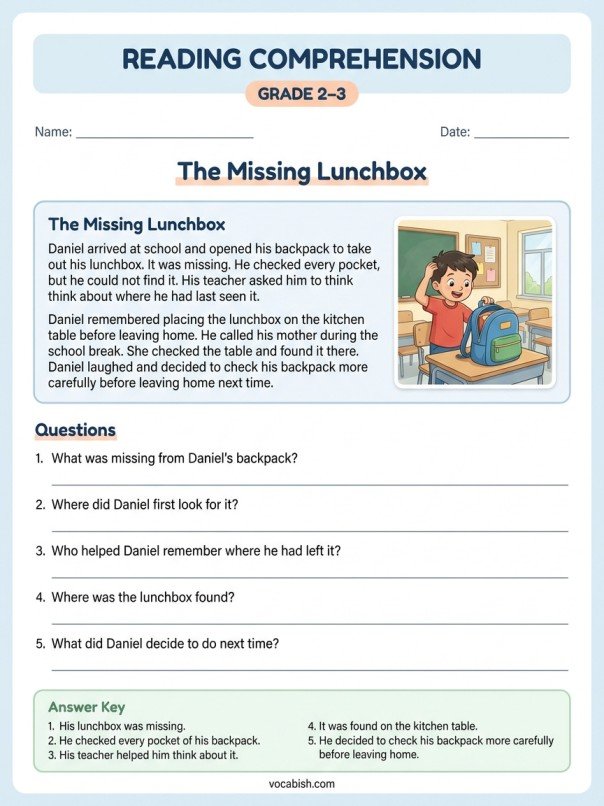
6. The Missing Lunchbox
Daniel arrived at school and opened his backpack to take out his lunchbox. It was missing. He checked every pocket, but he could not find it. His teacher asked him to think about where he had last seen it.
Daniel remembered placing the lunchbox on the kitchen table before leaving home. He called his mother during the school break. She checked the table and found it there. Daniel laughed and decided to check his backpack more carefully before leaving home next time.
Questions
- What was missing from Daniel’s backpack?
- Where did Daniel first look for it?
- Who helped Daniel remember where he had left it?
- Where was the lunchbox found?
- What did Daniel decide to do next time?
Answers
- His lunchbox was missing.
- He checked every pocket of his backpack.
- His teacher helped him think about it.
- It was found on the kitchen table.
- He decided to check his backpack more carefully before leaving home.
7. A Visit to the Farm
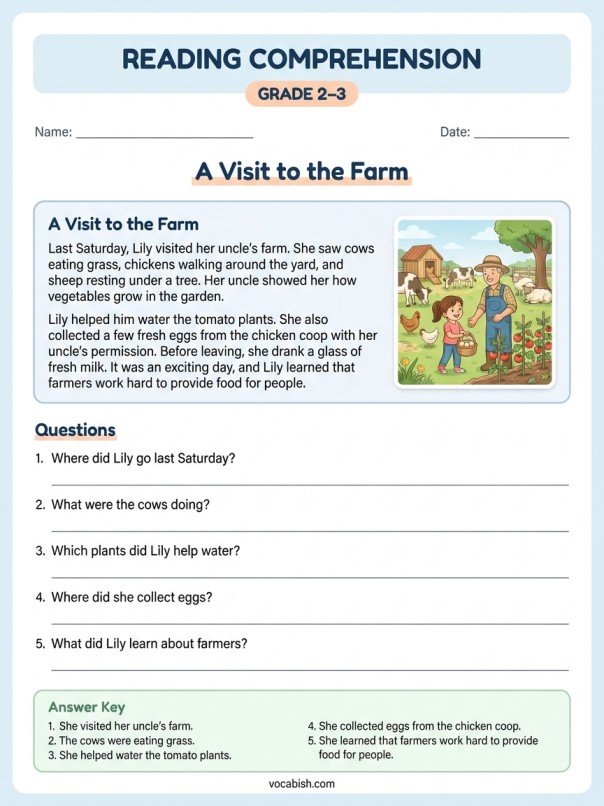
Last Saturday, Lily visited her uncle’s farm. She saw cows eating grass, chickens walking around the yard, and sheep resting under a tree. Her uncle showed her how vegetables grow in the garden.
Lily helped him water the tomato plants. She also collected a few fresh eggs from the chicken coop with her uncle’s permission. Before leaving, she drank a glass of fresh milk. It was an exciting day, and Lily learned that farmers work hard to provide food for people.
Questions
- Where did Lily go last Saturday?
- What were the cows doing?
- Which plants did Lily help water?
- Where did she collect eggs?
- What did Lily learn about farmers?
Answers
- She visited her uncle’s farm.
- The cows were eating grass.
- She helped water the tomato plants.
- She collected eggs from the chicken coop.
- She learned that farmers work hard to provide food for people.
8. The Little Seed
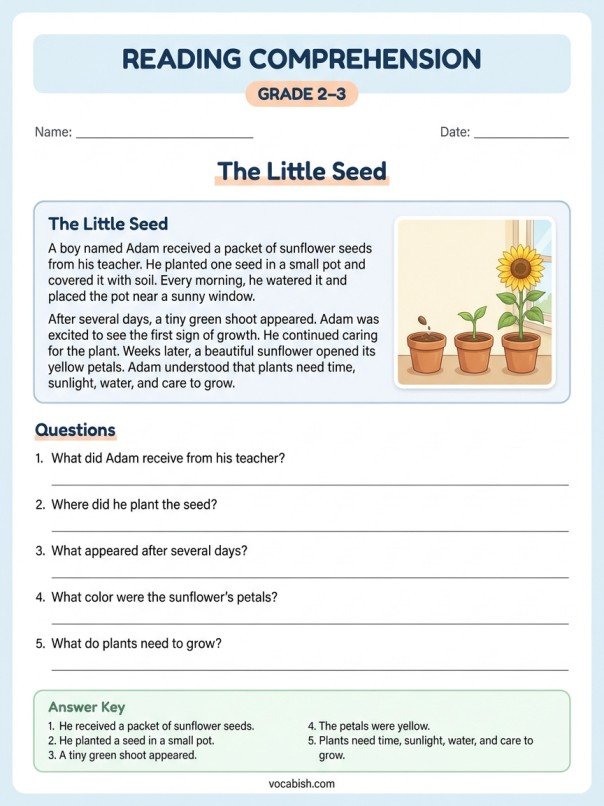
A boy named Adam received a packet of sunflower seeds from his teacher. He planted one seed in a small pot and covered it with soil. Every morning, he watered it and placed the pot near a sunny window.
After several days, a tiny green shoot appeared. Adam was excited to see the first sign of growth. He continued caring for the plant. Weeks later, a beautiful sunflower opened its yellow petals. Adam understood that plants need time, sunlight, water, and care to grow.
Questions
- What did Adam receive from his teacher?
- Where did he plant the seed?
- What appeared after several days?
- What color were the sunflower’s petals?
- What do plants need to grow?
Answers
- He received a packet of sunflower seeds.
- He planted a seed in a small pot.
- A tiny green shoot appeared.
- The petals were yellow.
- Plants need time, sunlight, water, and care to grow.
Reading Comprehension for Kids: Grades 4–5
9. The Library Adventure
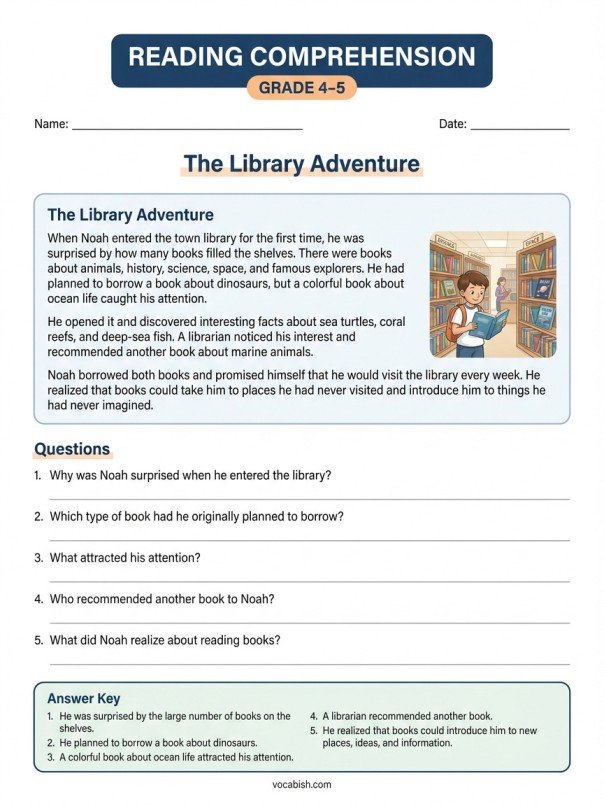
When Noah entered the town library for the first time, he was surprised by how many books filled the shelves. There were books about animals, history, science, space, and famous explorers. He had planned to borrow a book about dinosaurs, but a colorful book about ocean life caught his attention.
He opened it and discovered interesting facts about sea turtles, coral reefs, and deep-sea fish. A librarian noticed his interest and recommended another book about marine animals.
Noah borrowed both books and promised himself that he would visit the library every week. He realized that books could take him to places he had never visited and introduce him to things he had never imagined.
Questions
- Why was Noah surprised when he entered the library?
- Which type of book had he originally planned to borrow?
- What attracted his attention?
- Who recommended another book to Noah?
- What did Noah realize about reading books?
Answers
- He was surprised by the large number of books on the shelves.
- He planned to borrow a book about dinosaurs.
- A colorful book about ocean life attracted his attention.
- A librarian recommended another book.
- He realized that books could introduce him to new places, ideas, and information.
10. The Power of Teamwork
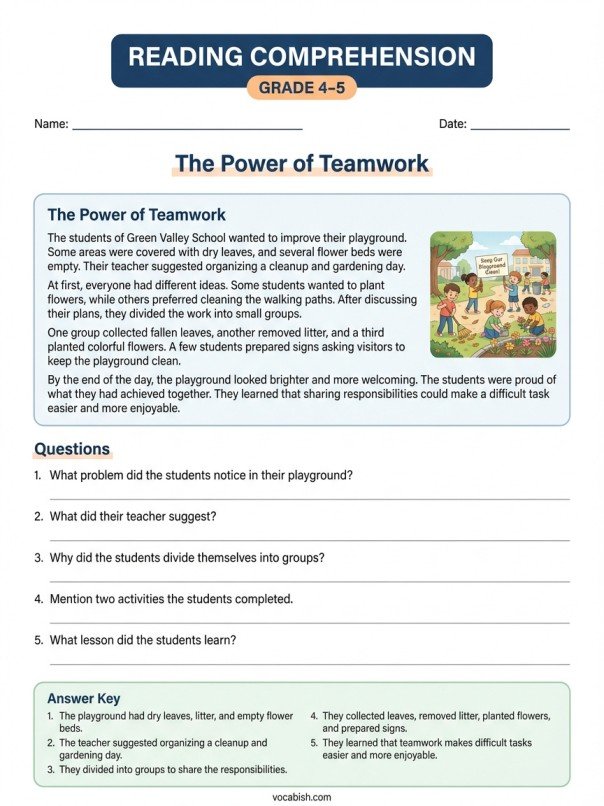
The students of Green Valley School wanted to improve their playground. Some areas were covered with dry leaves, and several flower beds were empty. Their teacher suggested organizing a cleanup and gardening day.
At first, everyone had different ideas. Some students wanted to plant flowers, while others preferred cleaning the walking paths. After discussing their plans, they divided the work into small groups.
One group collected fallen leaves, another removed litter, and a third planted colorful flowers. A few students prepared signs asking visitors to keep the playground clean.
By the end of the day, the playground looked brighter and more welcoming. The students were proud of what they had achieved together. They learned that sharing responsibilities could make a difficult task easier and more enjoyable.
Questions
- What problem did the students notice in their playground?
- What did their teacher suggest?
- Why did the students divide themselves into groups?
- Mention two activities the students completed.
- What lesson did the students learn?
Answers
- The playground had dry leaves, litter, and empty flower beds.
- The teacher suggested organizing a cleanup and gardening day.
- They divided into groups to share the responsibilities.
- They collected leaves, removed litter, planted flowers, and prepared signs.
- They learned that teamwork makes difficult tasks easier and more enjoyable.
11. Why Bees Matter
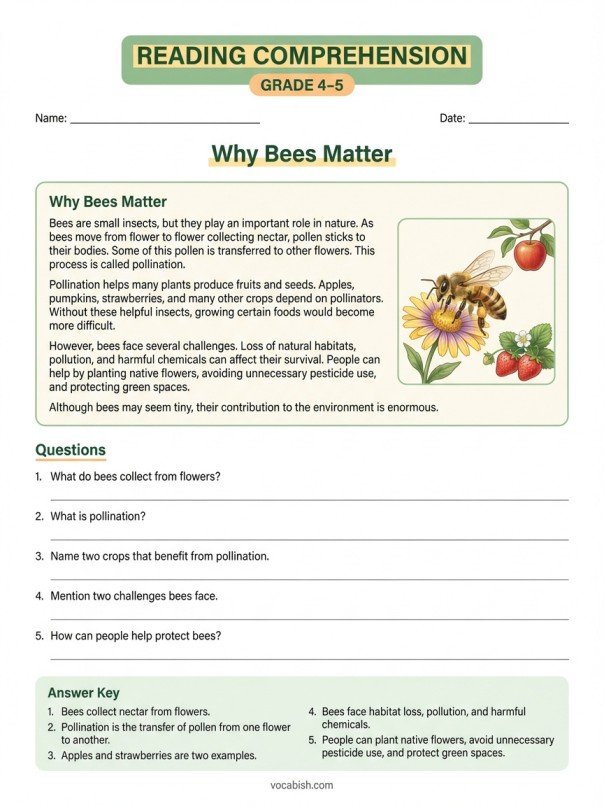
Bees are small insects, but they play an important role in nature. As bees move from flower to flower collecting nectar, pollen sticks to their bodies. Some of this pollen is transferred to other flowers. This process is called pollination.
Pollination helps many plants produce fruits and seeds. Apples, pumpkins, strawberries, and many other crops depend on pollinators. Without these helpful insects, growing certain foods would become more difficult.
However, bees face several challenges. Loss of natural habitats, pollution, and harmful chemicals can affect their survival. People can help by planting native flowers, avoiding unnecessary pesticide use, and protecting green spaces.
Although bees may seem tiny, their contribution to the environment is enormous.
Questions
- What do bees collect from flowers?
- What is pollination?
- Name two crops that benefit from pollination.
- Mention two challenges bees face.
- How can people help protect bees?
Answers
- Bees collect nectar from flowers.
- Pollination is the transfer of pollen from one flower to another.
- Apples and strawberries are two examples.
- Bees face habitat loss, pollution, and harmful chemicals.
- People can plant native flowers, avoid unnecessary pesticide use, and protect green spaces.
12. A Lesson from the Rain
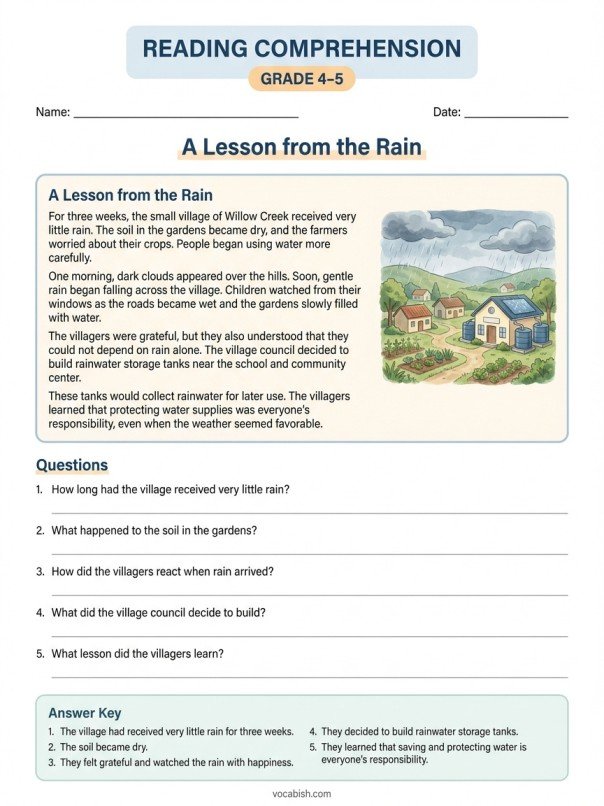
For three weeks, the small village of Willow Creek received very little rain. The soil in the gardens became dry, and the farmers worried about their crops. People began using water more carefully.
One morning, dark clouds appeared over the hills. Soon, gentle rain began falling across the village. Children watched from their windows as the roads became wet and the gardens slowly filled with water.
The villagers were grateful, but they also understood that they could not depend on rain alone. The village council decided to build rainwater storage tanks near the school and community center.
These tanks would collect rainwater for later use. The villagers learned that protecting water supplies was everyone’s responsibility, even when the weather seemed favorable.
Questions
- How long had the village received very little rain?
- What happened to the soil in the gardens?
- How did the villagers react when rain arrived?
- What did the village council decide to build?
- What lesson did the villagers learn?
Answers
- The village had received very little rain for three weeks.
- The soil became dry.
- They felt grateful and watched the rain with happiness.
- They decided to build rainwater storage tanks.
- They learned that saving and protecting water is everyone’s responsibility.
Reading Comprehension for Kids: Grades 6–7
13. The Young Inventor
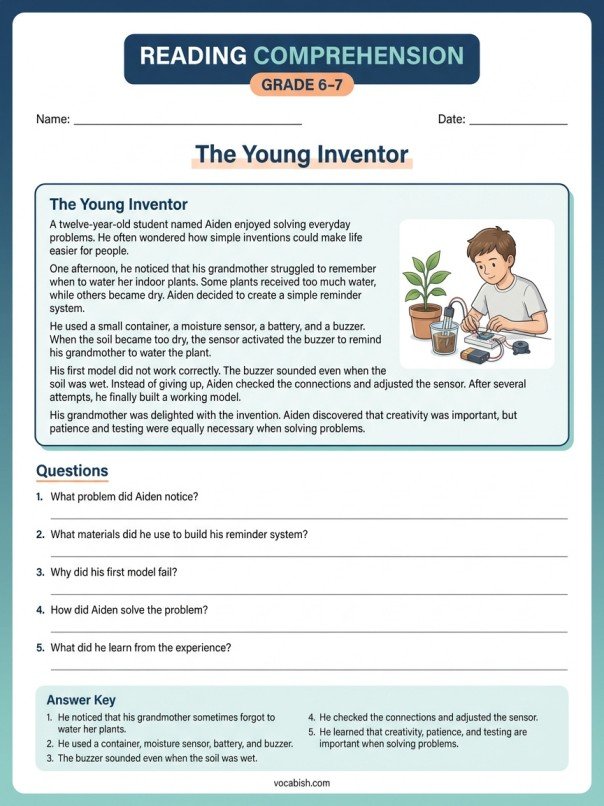
A twelve-year-old student named Aiden enjoyed solving everyday problems. He often wondered how simple inventions could make life easier for people.
One afternoon, he noticed that his grandmother struggled to remember when to water her indoor plants. Some plants received too much water, while others became dry. Aiden decided to create a simple reminder system.
He used a small container, a moisture sensor, a battery, and a buzzer. When the soil became too dry, the sensor activated the buzzer to remind his grandmother to water the plant.
His first model did not work correctly. The buzzer sounded even when the soil was wet. Instead of giving up, Aiden checked the connections and adjusted the sensor. After several attempts, he finally built a working model.
His grandmother was delighted with the invention. Aiden discovered that creativity was important, but patience and testing were equally necessary when solving problems.
Questions
- What problem did Aiden notice?
- What materials did he use to build his reminder system?
- Why did his first model fail?
- How did Aiden solve the problem?
- What did he learn from the experience?
Answers
- He noticed that his grandmother sometimes forgot to water her plants.
- He used a container, moisture sensor, battery, and buzzer.
- The buzzer sounded even when the soil was wet.
- He checked the connections and adjusted the sensor.
- He learned that creativity, patience, and testing are important when solving problems.
14. The Importance of Digital Balance
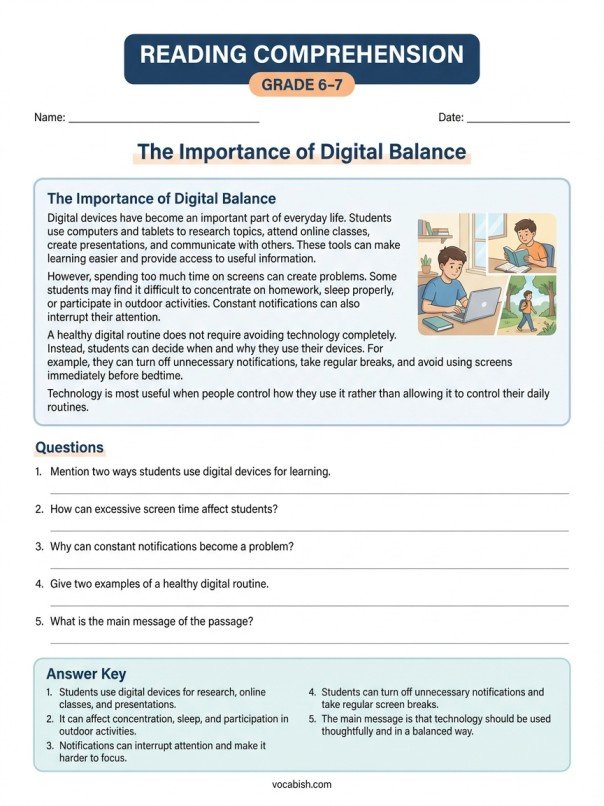
Digital devices have become an important part of everyday life. Students use computers and tablets to research topics, attend online classes, create presentations, and communicate with others. These tools can make learning easier and provide access to useful information.
However, spending too much time on screens can create problems. Some students may find it difficult to concentrate on homework, sleep properly, or participate in outdoor activities. Constant notifications can also interrupt their attention.
A healthy digital routine does not require avoiding technology completely. Instead, students can decide when and why they use their devices. For example, they can turn off unnecessary notifications, take regular breaks, and avoid using screens immediately before bedtime.
Technology is most useful when people control how they use it rather than allowing it to control their daily routines.
Questions
- Mention two ways students use digital devices for learning.
- How can excessive screen time affect students?
- Why can constant notifications become a problem?
- Give two examples of a healthy digital routine.
- What is the main message of the passage?
Answers
- Students use digital devices for research, online classes, and presentations.
- It can affect concentration, sleep, and participation in outdoor activities.
- Notifications can interrupt attention and make it harder to focus.
- Students can turn off unnecessary notifications and take regular screen breaks.
- The main message is that technology should be used thoughtfully and in a balanced way.
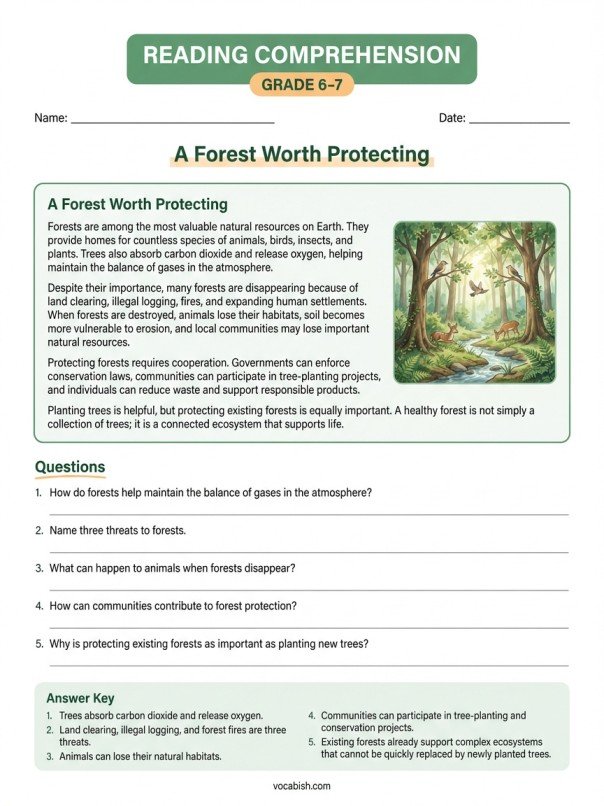
15. A Forest Worth Protecting
Forests are among the most valuable natural resources on Earth. They provide homes for countless species of animals, birds, insects, and plants. Trees also absorb carbon dioxide and release oxygen, helping maintain the balance of gases in the atmosphere.
Despite their importance, many forests are disappearing because of land clearing, illegal logging, fires, and expanding human settlements. When forests are destroyed, animals lose their habitats, soil becomes more vulnerable to erosion, and local communities may lose important natural resources.
Protecting forests requires cooperation. Governments can enforce conservation laws, communities can participate in tree-planting projects, and individuals can reduce waste and support responsible products.
Planting trees is helpful, but protecting existing forests is equally important. A healthy forest is not simply a collection of trees; it is a connected ecosystem that supports life.
Questions
- How do forests help maintain the balance of gases in the atmosphere?
- Name three threats to forests.
- What can happen to animals when forests disappear?
- How can communities contribute to forest protection?
- Why is protecting existing forests as important as planting new trees?
Answers
- Trees absorb carbon dioxide and release oxygen.
- Land clearing, illegal logging, and forest fires are three threats.
- Animals can lose their natural habitats.
- Communities can participate in tree-planting and conservation projects.
- Existing forests already support complex ecosystems that cannot be quickly replaced by newly planted trees.
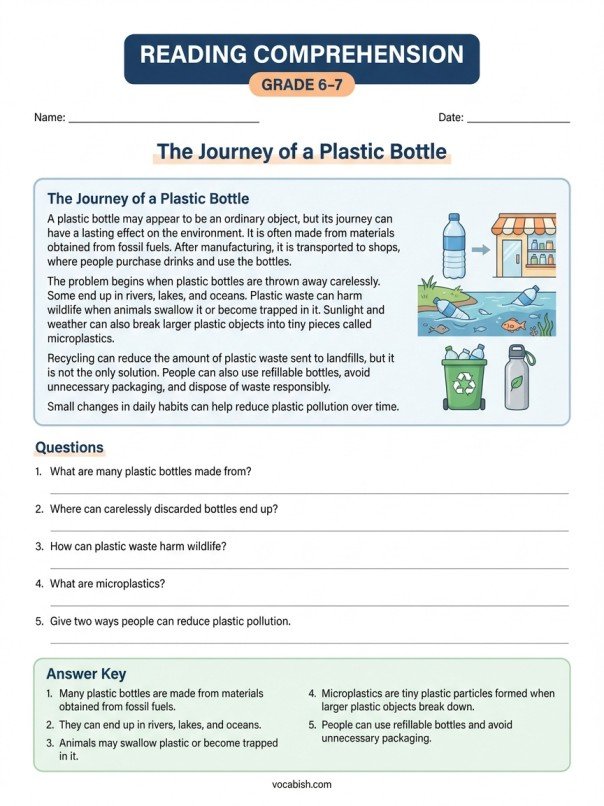
16. The Journey of a Plastic Bottle
A plastic bottle may appear to be an ordinary object, but its journey can have a lasting effect on the environment. It is often made from materials obtained from fossil fuels. After manufacturing, it is transported to shops, where people purchase drinks and use the bottles.
The problem begins when plastic bottles are thrown away carelessly. Some end up in rivers, lakes, and oceans. Plastic waste can harm wildlife when animals swallow it or become trapped in it. Sunlight and weather can also break larger plastic objects into tiny pieces called microplastics.
Recycling can reduce the amount of plastic waste sent to landfills, but it is not the only solution. People can also use refillable bottles, avoid unnecessary packaging, and dispose of waste responsibly.
Small changes in daily habits can help reduce plastic pollution over time.
Questions
- What are many plastic bottles made from?
- Where can carelessly discarded bottles end up?
- How can plastic waste harm wildlife?
- What are microplastics?
- Give two ways people can reduce plastic pollution.
Answers
- Many plastic bottles are made from materials obtained from fossil fuels.
- They can end up in rivers, lakes, and oceans.
- Animals may swallow plastic or become trapped in it.
- Microplastics are tiny plastic particles formed when larger plastic objects break down.
- People can use refillable bottles and avoid unnecessary packaging.
Reading Comprehension for Kids: Grades 8–10
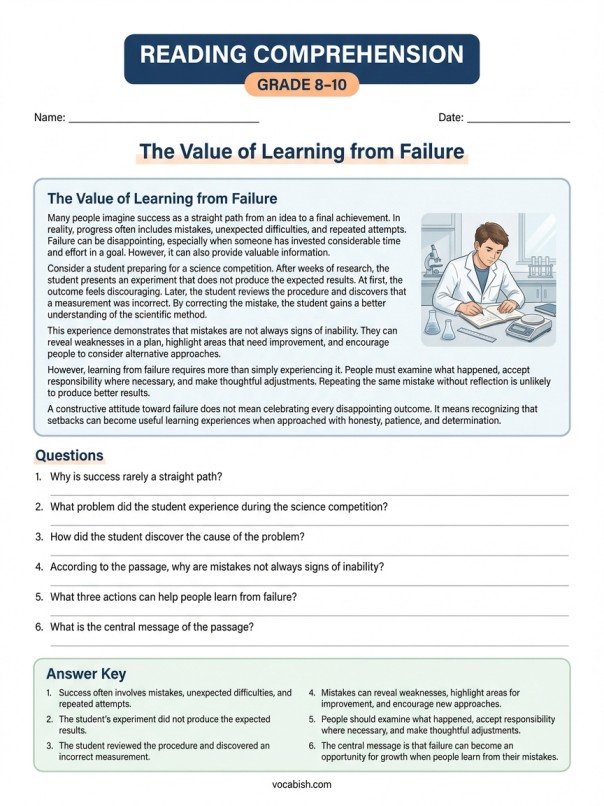
17. The Value of Learning from Failure
Many people imagine success as a straight path from an idea to a final achievement. In reality, progress often includes mistakes, unexpected difficulties, and repeated attempts. Failure can be disappointing, especially when someone has invested considerable time and effort in a goal. However, it can also provide valuable information.
Consider a student preparing for a science competition. After weeks of research, the student presents an experiment that does not produce the expected results. At first, the outcome feels discouraging. Later, the student reviews the procedure and discovers that a measurement was incorrect. By correcting the mistake, the student gains a better understanding of the scientific method.
This experience demonstrates that mistakes are not always signs of inability. They can reveal weaknesses in a plan, highlight areas that need improvement, and encourage people to consider alternative approaches.
However, learning from failure requires more than simply experiencing it. People must examine what happened, accept responsibility where necessary, and make thoughtful adjustments. Repeating the same mistake without reflection is unlikely to produce better results.
A constructive attitude toward failure does not mean celebrating every disappointing outcome. It means recognizing that setbacks can become useful learning experiences when approached with honesty, patience, and determination.
Questions
- Why is success rarely a straight path?
- What problem did the student experience during the science competition?
- How did the student discover the cause of the problem?
- According to the passage, why are mistakes not always signs of inability?
- What three actions can help people learn from failure?
- What is the central message of the passage?
Answers
- Success often involves mistakes, unexpected difficulties, and repeated attempts.
- The student’s experiment did not produce the expected results.
- The student reviewed the procedure and discovered an incorrect measurement.
- Mistakes can reveal weaknesses, highlight areas for improvement, and encourage new approaches.
- People should examine what happened, accept responsibility where necessary, and make thoughtful adjustments.
- The central message is that failure can become an opportunity for growth when people learn from their mistakes.
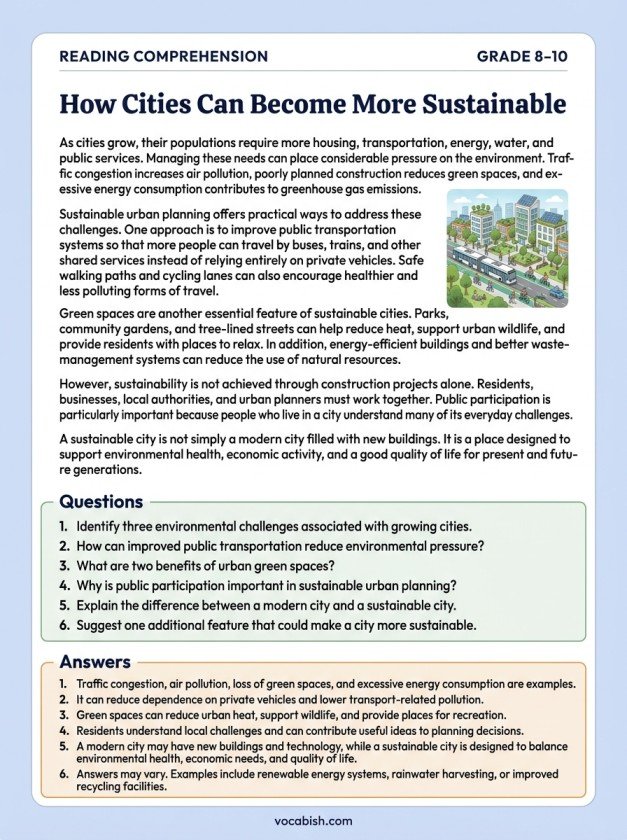
18. How Cities Can Become More Sustainable
As cities grow, their populations require more housing, transportation, energy, water, and public services. Managing these needs can place considerable pressure on the environment. Traffic congestion increases air pollution, poorly planned construction reduces green spaces, and excessive energy consumption contributes to greenhouse gas emissions.
Sustainable urban planning offers practical ways to address these challenges. One approach is to improve public transportation systems so that more people can travel by buses, trains, and other shared services instead of relying entirely on private vehicles. Safe walking paths and cycling lanes can also encourage healthier and less polluting forms of travel.
Green spaces are another essential feature of sustainable cities. Parks, community gardens, and tree-lined streets can help reduce heat, support urban wildlife, and provide residents with places to relax. In addition, energy-efficient buildings and better waste-management systems can reduce the use of natural resources.
However, sustainability is not achieved through construction projects alone. Residents, businesses, local authorities, and urban planners must work together. Public participation is particularly important because people who live in a city understand many of its everyday challenges.
A sustainable city is not simply a modern city filled with new buildings. It is a place designed to support environmental health, economic activity, and a good quality of life for present and future generations.
Questions
- Identify three environmental challenges associated with growing cities.
- How can improved public transportation reduce environmental pressure?
- What are two benefits of urban green spaces?
- Why is public participation important in sustainable urban planning?
- Explain the difference between a modern city and a sustainable city.
- Suggest one additional feature that could make a city more sustainable.
Answers
- Traffic congestion, air pollution, loss of green spaces, and excessive energy consumption are examples.
- It can reduce dependence on private vehicles and lower transport-related pollution.
- Green spaces can reduce urban heat, support wildlife, and provide places for recreation.
- Residents understand local challenges and can contribute useful ideas to planning decisions.
- A modern city may have new buildings and technology, while a sustainable city is designed to balance environmental health, economic needs, and quality of life.
- Answers may vary. Examples include renewable energy systems, rainwater harvesting, or improved recycling facilities.
19. The Science of Sleep and Learning
Sleep is often treated as something that can be sacrificed when students have examinations or important assignments. However, scientific research has shown that sleep plays an essential role in learning, memory, and overall health.
During sleep, the brain processes information gathered throughout the day. Some memories become more stable, making it easier to remember facts and skills later. Sleep also supports attention, problem-solving, and emotional regulation. These functions are particularly important for students who must understand new concepts and apply information in different situations.
A lack of sufficient sleep can affect concentration and make ordinary tasks more difficult. Students who regularly stay awake late may struggle to remain attentive in class or remember information they studied the previous evening. Although studying for additional hours may seem productive, tiredness can reduce the quality of that effort.
Developing healthy sleep habits can improve daily routines. Going to bed at a consistent time, creating a comfortable sleeping environment, and limiting stimulating activities before bedtime are useful steps. The amount of sleep needed varies with age, but children and teenagers generally require more sleep than adults.
Effective learning depends on several factors, including regular practice, a supportive environment, and adequate rest. Sleep is not wasted time; it is an important part of the learning process.
Questions
- What role does sleep play in memory?
- Mention two mental functions supported by adequate sleep.
- Why might studying for additional hours become less effective when a student is tired?
- Identify three healthy sleep habits mentioned in the passage.
- Why do children and teenagers generally need more sleep than adults?
- What does the final paragraph suggest about the relationship between sleep and education?
Answers
- Sleep helps the brain process information and strengthen memories.
- Sleep supports attention, problem-solving, and emotional regulation.
- Tiredness can reduce concentration and the ability to remember information.
- Going to bed consistently, creating a comfortable sleeping environment, and limiting stimulating activities before bedtime.
- Their developing bodies and brains generally require more sleep.
- It suggests that adequate rest is an essential part of effective learning, not a waste of study time.
20. The Importance of Cultural Understanding
Every society has traditions, customs, languages, and beliefs that influence how people live and interact. These differences make the world culturally diverse. They can be seen in clothing, food, celebrations, music, family relationships, and everyday communication.
Cultural understanding involves recognizing and respecting differences without assuming that one way of life is automatically better than another. For example, a greeting that is considered polite in one country may be uncommon in another. Similarly, eating customs, personal space, and communication styles can vary between communities.
Learning about other cultures can help people communicate more effectively and avoid unnecessary misunderstandings. Schools, libraries, travel experiences, and international friendships provide opportunities to explore different perspectives.
However, cultural understanding requires more than memorizing facts about other countries. It involves listening carefully, asking respectful questions, and being willing to reconsider assumptions. People should also remember that individuals within the same culture may have different opinions, experiences, and preferences.
In an increasingly connected world, cultural awareness is an important social skill. It encourages cooperation, reduces prejudice, and helps people build relationships based on mutual respect.
Questions
- What factors contribute to cultural diversity?
- What does cultural understanding involve?
- Give two examples of customs that may differ between societies.
- How can learning about other cultures prevent misunderstandings?
- Why is memorizing cultural facts not enough to develop cultural understanding?
- What does the passage mean by mutual respect?
Answers
- Traditions, customs, languages, and beliefs contribute to cultural diversity.
- It involves recognizing and respecting cultural differences without judging one way of life as automatically superior.
- Greeting styles and eating customs are two examples.
- It helps people understand different behaviors and communicate more effectively.
- True understanding also requires listening, asking respectful questions, and reconsidering assumptions.
- Mutual respect means treating one another with consideration and recognizing the value of different perspectives.
21. Artificial Intelligence and the Future of Education
Artificial intelligence is changing the way people access information and complete tasks. In education, AI-powered tools can help students practice languages, receive feedback on writing, explore difficult concepts, and organize their study schedules. Teachers may also use these technologies to prepare learning materials and identify areas where students need additional support.
One major advantage of educational AI is its ability to provide personalized learning experiences. For example, a student who struggles with fractions may receive additional practice questions, while another student who understands the topic can move on to more challenging activities. This flexibility can make learning more responsive to individual needs.
Nevertheless, AI also creates important challenges. Some tools may provide inaccurate information, misunderstand questions, or produce answers that sound convincing but contain errors. Students who depend entirely on automated answers may miss opportunities to develop independent thinking, research skills, and problem-solving abilities.
Privacy is another concern. Educational platforms may collect personal information, so schools and families should understand how student data is handled. Technology should be selected carefully and used according to appropriate safety guidelines.
The future of education is unlikely to depend on technology alone. Effective learning still requires human guidance, curiosity, discussion, creativity, and meaningful relationships between teachers and students. AI can support these activities, but it cannot replace the value of responsible teaching and active participation.
The most useful approach is to treat artificial intelligence as a learning assistant rather than an unquestionable source of truth. Students should use it to explore ideas, verify information, and strengthen their understanding while continuing to think independently.
Questions
- Mention three ways AI can support students or teachers.
- How can AI provide personalized learning experiences?
- What risks may arise when students depend entirely on automated answers?
- Why is student data privacy an important issue?
- According to the passage, can AI replace teachers completely? Explain your answer.
- What does the writer mean by treating AI as a learning assistant?
- What is the main argument of the passage?
Answers
- AI can help students practice languages, receive writing feedback, explore difficult concepts, and organize study schedules. It can also help teachers prepare materials.
- It can adjust practice activities and difficulty levels according to each student’s learning needs.
- Students may receive incorrect information and lose opportunities to develop independent thinking, research, and problem-solving skills.
- Educational platforms may collect personal information, which must be handled responsibly and safely.
- No. The passage explains that human guidance, discussion, creativity, and teacher-student relationships remain important.
- It means using AI to support learning and explore ideas while checking information and thinking independently.
- The main argument is that AI can improve education when used responsibly, but it should support rather than replace human teaching and independent learning.
How to Improve Reading Comprehension Skills
Children can improve their reading comprehension through regular practice and simple reading activities. These habits help them understand stories, remember important details, and express their ideas clearly.
- Read Every Day: Encourage children to read short stories, passages, and books regularly.
- Understand Before Answering: Teach children to understand the passage instead of guessing the answers.
- Learn New Words: Discuss unfamiliar words and their meanings while reading.
- Find Important Details: Help children identify the main idea, characters, setting, and important events.
- Practice Asking Questions: Encourage children to ask who, what, when, where, why, and how questions.
- Retell the Story: Ask children to explain what happened in a passage using their own words.
- Make Predictions: Encourage them to guess what might happen next based on the information they read.
- Write Short Answers: Give children opportunities to answer questions in complete sentences.
Tips for Parents and Teachers
Parents and teachers play an important role in developing children’s reading comprehension skills.
- Choose reading passages that match the child’s grade and reading level.
- Start with short and simple passages before moving to longer texts.
- Allow children enough time to read and understand each passage.
- Ask questions that test understanding, not just memory.
- Discuss the story and encourage children to share their opinions.
- Praise their effort and help them learn from incorrect answers.
- Make reading practice a regular and enjoyable activity.
Why Is Reading Comprehension Important?
Reading comprehension helps children understand written information and use it effectively. It is an important skill for learning in every school subject and communicating ideas clearly.
Strong reading comprehension skills help children:
- Understand stories, instructions, and information.
- Develop stronger reading and writing skills.
- Build vocabulary and learn new expressions.
- Improve critical thinking and problem-solving.
- Remember important information.
- Express thoughts and ideas more clearly.
- Become more confident and independent learners.
Frequently Asked Questions
Reading comprehension for kids is the ability to read a passage, understand its meaning, identify important details, and answer questions about what they have read.
Encourage daily reading, discuss stories, explain new vocabulary, ask questions, and let your child retell passages in their own words. Regular practice can help develop stronger comprehension skills.
Reading comprehension activities include reading short passages, answering questions, identifying the main idea, finding details, matching words, making predictions, and retelling stories.
Children can begin simple listening and reading comprehension activities in Kindergarten. As they grow, passages and questions can become more challenging according to their reading level.
Reading comprehension practice helps children understand information, improve reading and writing skills, develop vocabulary, and become more confident learners.
Start Practicing Reading Comprehension
Regular practice is one of the best ways for children to become better readers. Start with simple passages and gradually introduce more challenging reading activities as their skills improve.
Explore the 21 reading comprehension passages in this article, choose an appropriate grade level, read each passage carefully, and answer the questions. Children can use these exercises at home or in the classroom to strengthen their reading and writing skills.
Explore More Related Topics
- 20 Easy Essay Writing Topics for Kids in English
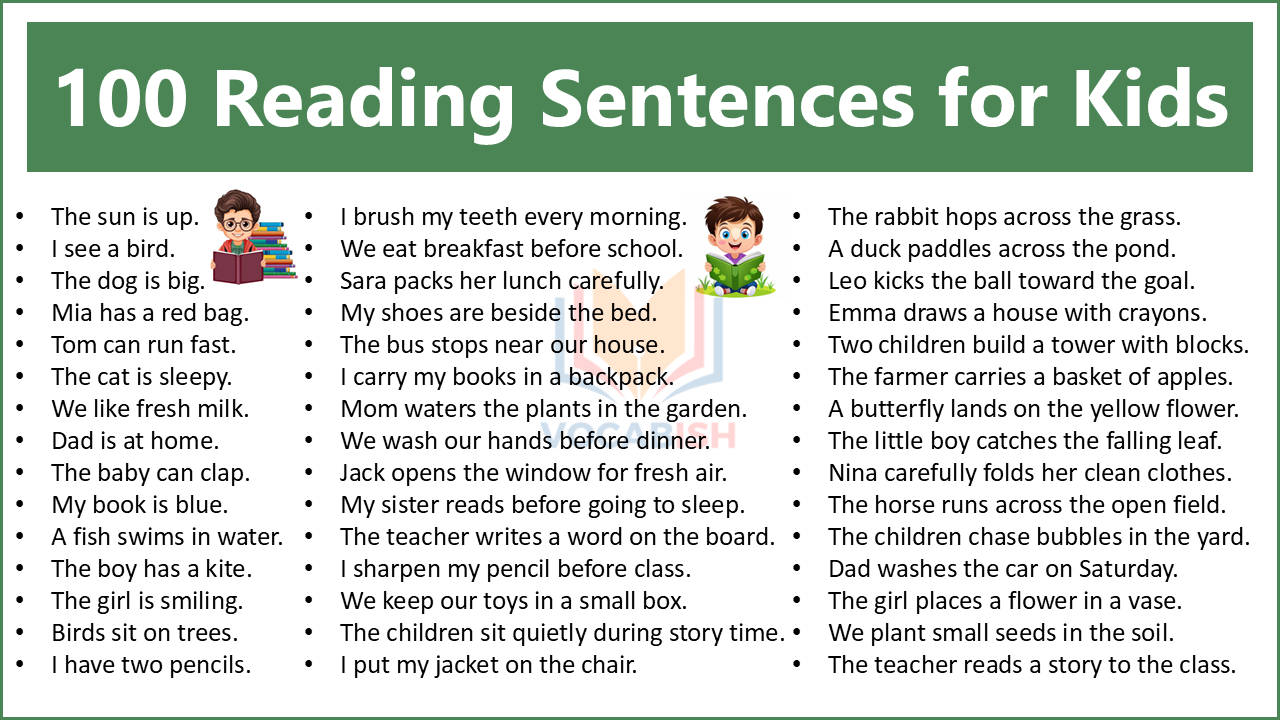
- 100 Reading Sentences for Kids in English
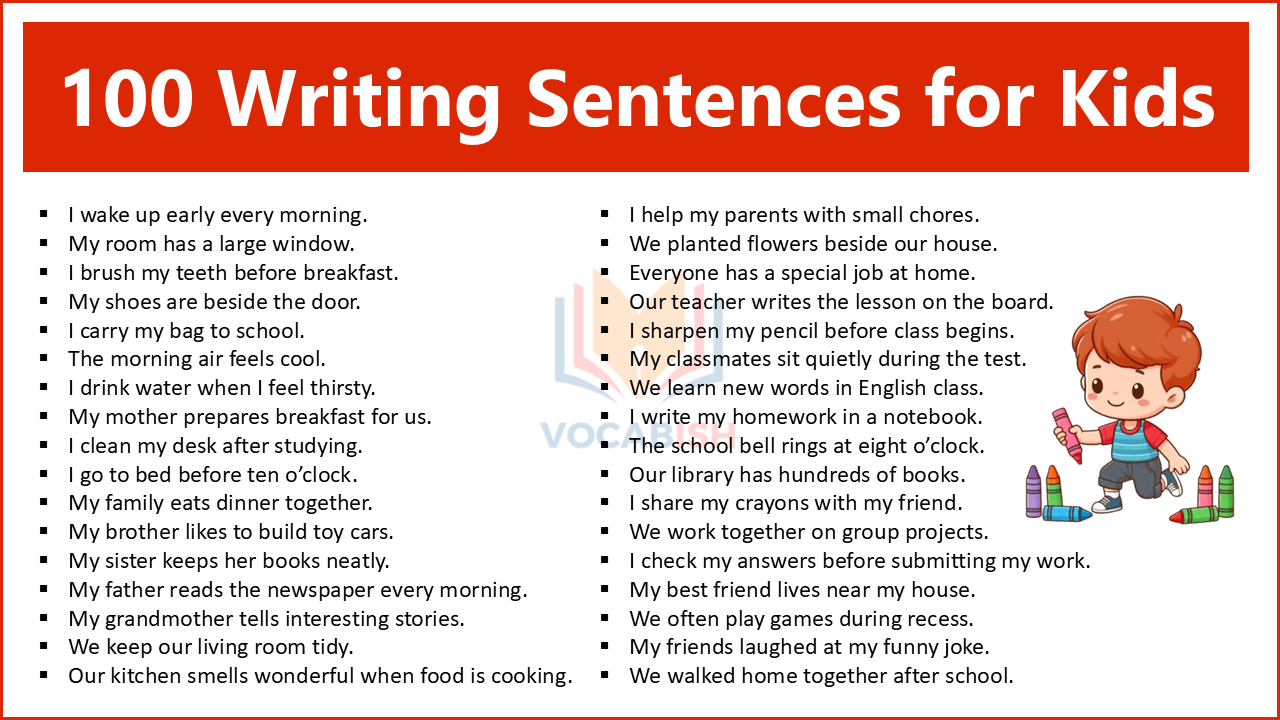
- 100 Writing Sentences for Kids in English
- 200+ This or That Questions for Kids
- 80+ Best Sister’s Day Questions for Kids