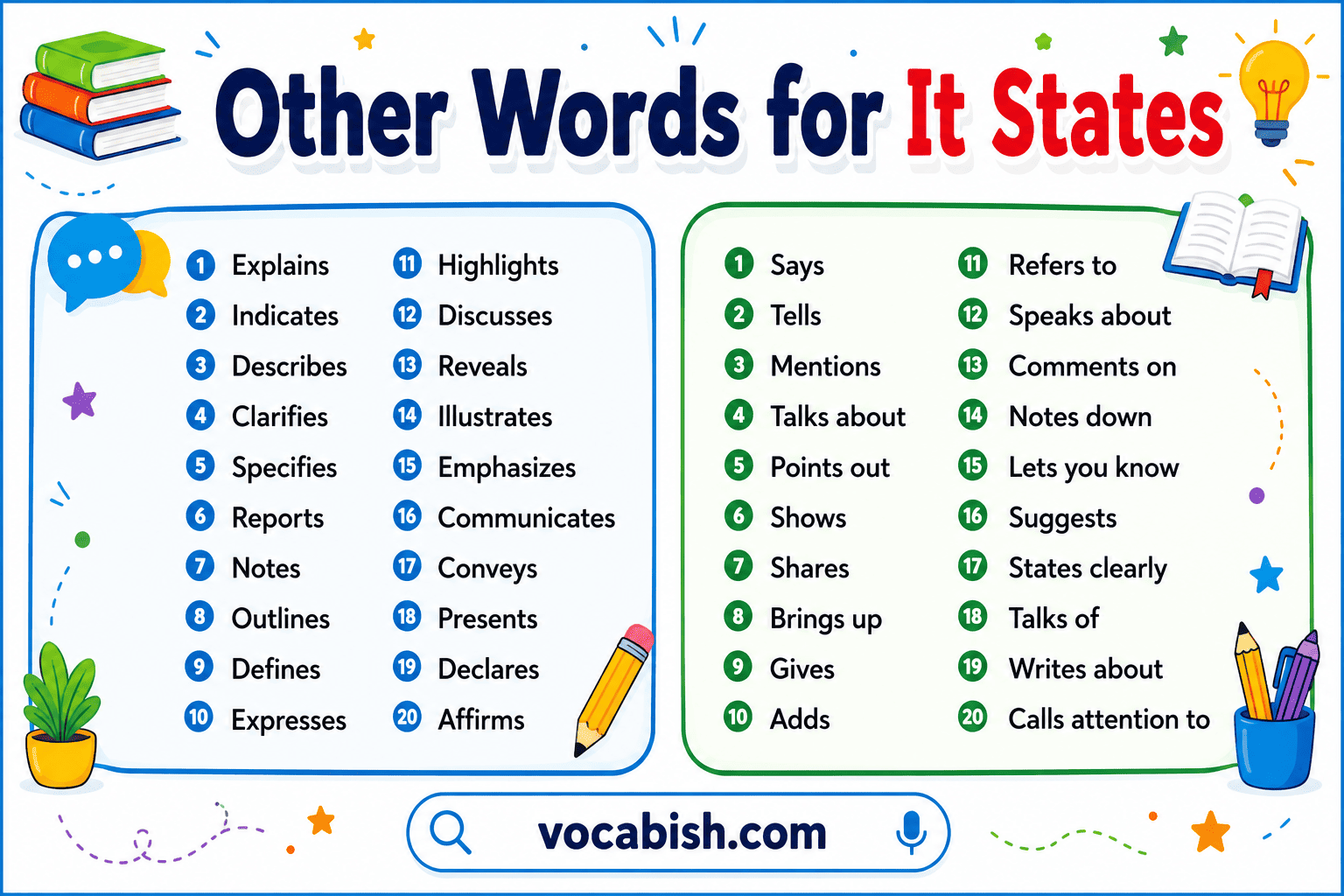

Many English learners use the word explain again and again in writing, school assignments, emails, and conversations. While the word works in many situations, repeating it too often can make communication sound flat or repetitive.
Learning different Synonyms for Explain helps you speak more naturally, write with better flow, and choose words that match the situation. Some alternatives sound formal, some feel conversational, and others work better when teaching, describing, or giving instructions.
Explain Synonyms
People often search for an explain synonym when they want to sound clearer, more professional, or less repetitive. The best alternative depends on what you are trying to communicate.
For example, a teacher may clarify a lesson, while a scientist may illustrate a process or demonstrate a method. These words are related, but they are not always interchangeable.
What Is “Explain”?
The word explain means to make something easier to understand. It often involves giving reasons, details, steps, or examples.
People use explain in many situations:
- teaching a topic
- answering questions
- giving instructions
- describing causes
- helping someone understand information
Examples:
- Can you explain this math problem?
- The manager explained the new policy clearly.
- She explained why the meeting was canceled.
In communication, explain usually focuses on understanding rather than just describing facts.
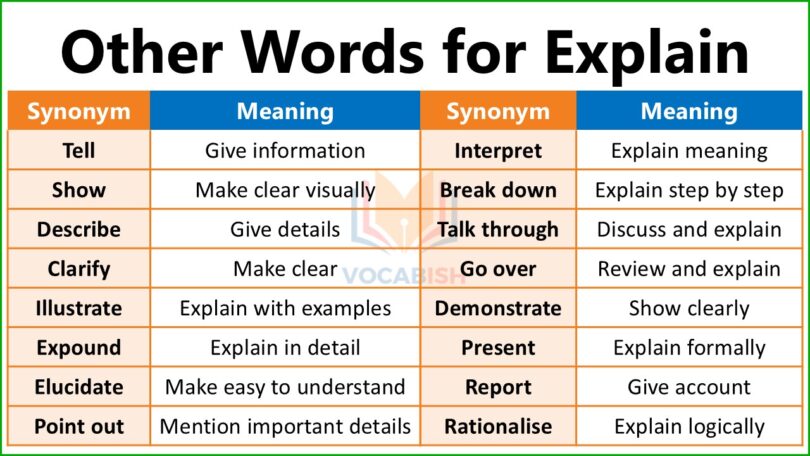
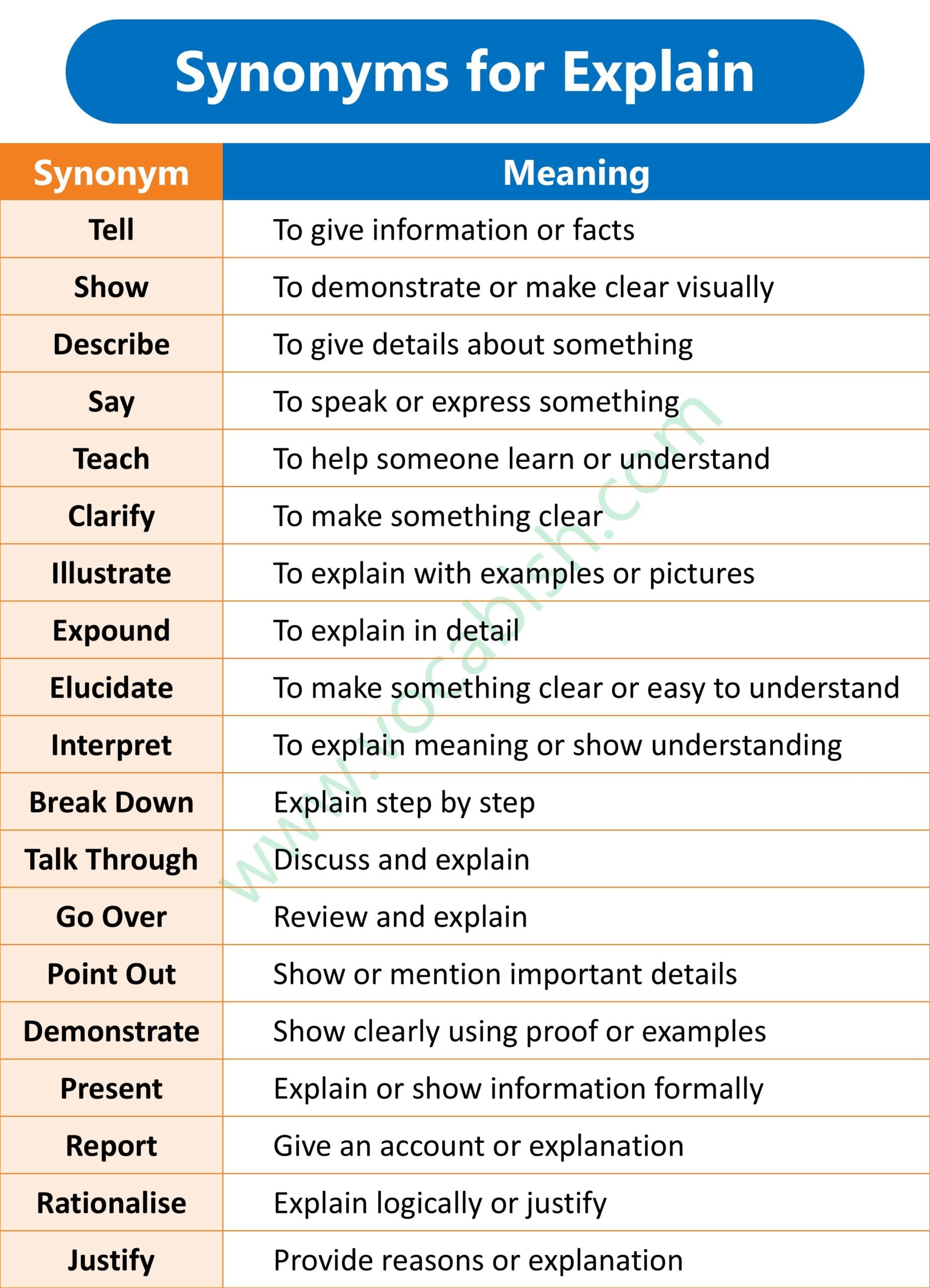
List of Synonyms for Explain
Here are some widely used alternatives grouped by communication purpose.
Synonym | Common Usage | Tone |
|---|---|---|
Clarify | Removing confusion | Neutral/Formal |
Describe | Giving details | Neutral |
Illustrate | Using examples or visuals | Academic/Formal |
Demonstrate | Showing how something works | Practical/Formal |
Define | Giving exact meaning | Academic |
Interpret | Explaining meaning | Analytical |
Elaborate on | Adding more detail | Conversational |
Expound | Explaining deeply | Formal |
Simplify | Making easier to understand | Friendly |
Outline | Giving a general explanation | Professional |
Analyze | Breaking down information | Academic |
Decode | Making something understandable | Informal/Technical |
Types of Synonyms for Explain
Different synonyms work better in different communication situations. Some focus on reducing confusion, while others focus on showing evidence, giving examples, or analyzing information.
Clarifying or Simplifying Information
These words help when the listener feels confused or overwhelmed.
Word | Best Use |
|---|---|
Clarify | Clearing up confusion |
Simplify | Making difficult ideas easier |
Define | Giving exact meaning |
Decode | Making hidden meaning understandable |
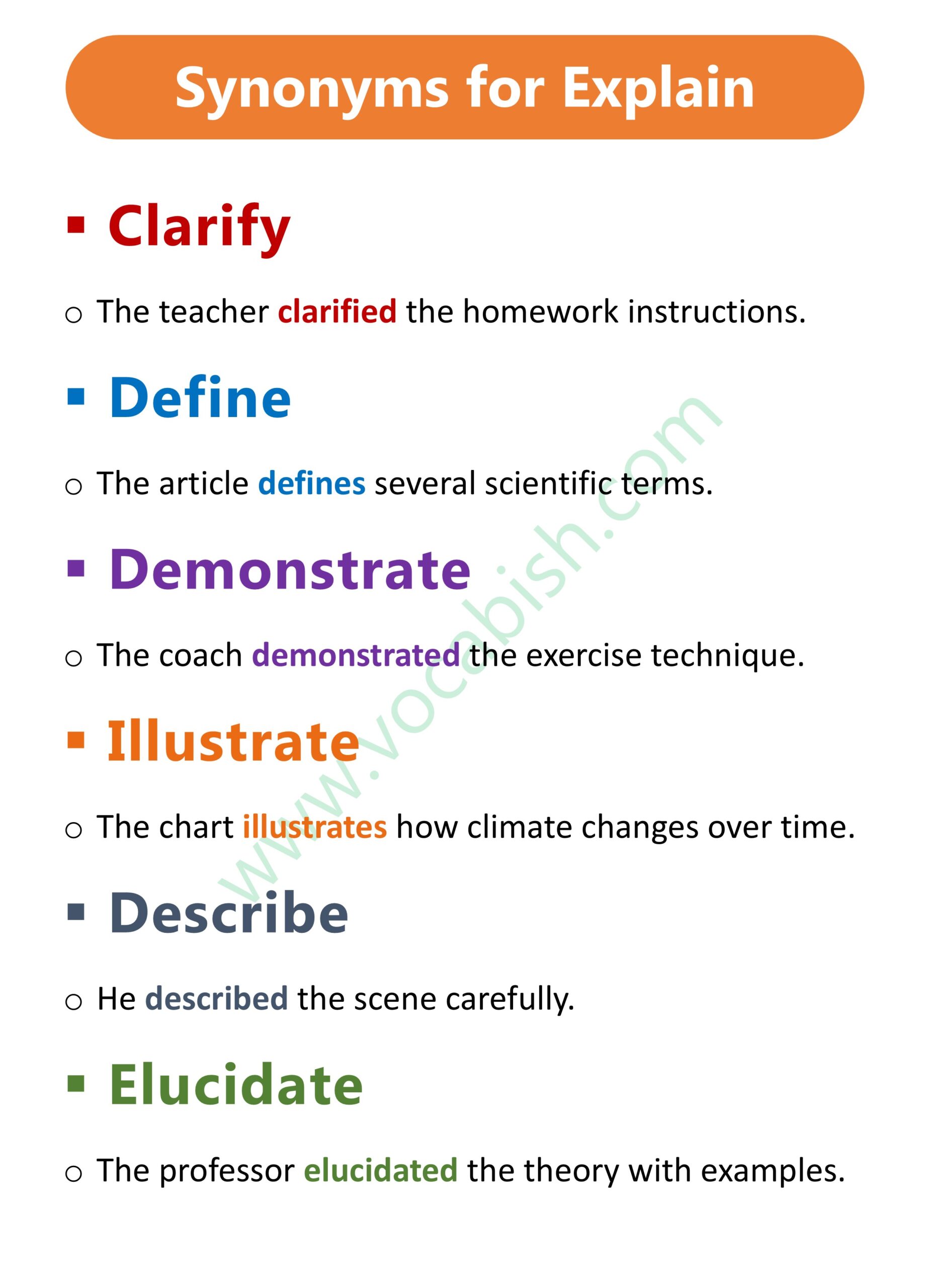
Example Sentences:
- The teacher clarified the homework instructions.
- Can you simplify this paragraph for younger students?
- The article defines several scientific terms.
Demonstrating or Showing
Some alternatives focus less on verbal explanation and more on showing actions, proof, or process.
Word | Best Use |
|---|---|
Demonstrate | Showing steps or proof |
Illustrate | Using examples or visuals |
Present | Explaining information formally |
Example Sentences:
- The coach demonstrated the exercise technique.
- The chart illustrates how climate changes over time.
- She presented the findings during the meeting.
Describing with Detail or Examples
These synonyms work when adding context, description, or supporting information.
Word | Best Use |
|---|---|
Describe | Giving details |
Elaborate on | Expanding an idea |
Outline | Giving a structured summary |
Example Sentences:
- He described the scene carefully.
- Could you elaborate on your opinion?
- The speaker outlined the project goals.
Elucidating or Shedding Light
Some words sound more formal and are common in academic or analytical writing.
Word | Best Use |
|---|---|
Elucidate | Making meaning clearer |
Interpret | Explaining meaning |
Expound | Explaining deeply and formally |
Example Sentences:
- The professor elucidated the theory with examples.
- Critics interpreted the poem differently.
- The author expounded on social issues in the lecture.
Analyzing or Going Deeper
Certain synonyms focus on examining ideas carefully rather than only making them understandable.
Word | Best Use |
|---|---|
Analyze | Breaking down information |
Examine | Studying closely |
Explore | Looking at ideas in detail |
Example Sentences:
- The report analyzes consumer behavior.
- Let’s examine the causes of the problem.
- The documentary explores cultural traditions.
Common Synonyms for Explain
Some alternatives appear more often than others in daily English. Knowing the small differences between them helps you choose words more naturally.
Explain vs. Describe
Although both words provide information, they serve different purposes.
Explain | Describe |
|---|---|
Focuses on understanding | Focuses on details |
Often answers “why” or “how” | Often answers “what” |
Common in teaching and instruction | Common in storytelling and observation |
Explain vs. Clarify
These words are closely connected, but clarify usually appears when confusion already exists.
Explain | Clarify |
|---|---|
Gives understanding | Removes confusion |
Broader usage | More specific purpose |
Explain vs. Illustrate
Illustrate often relies on examples, visuals, or comparisons.
Explain | Illustrate |
|---|---|
General understanding | Understanding through examples |
Verbal focus | Visual or example-based focus |
Explain vs. Demonstrate
Demonstrate usually involves showing actions physically or visually.
Explain | Demonstrate |
|---|---|
Tells how something works | Shows how something works |
Spoken or written | Often action-based |
Synonyms for Explain in Different Contexts
The best synonym often depends on the setting. A classroom discussion sounds different from a workplace presentation or casual conversation.
Clarifying Complex Topics
When discussing difficult subjects, speakers often use words that reduce confusion.
Best choices include:
- Clarify
- Simplify
- Break down
- Interpret
In Academic and Educational Settings
Academic English often uses more formal alternatives.
Common choices:
- Illustrate
- Analyze
- Define
- Expound
- Elucidate
Technical Instructions
Technical communication focuses on precision and process.
Useful alternatives include:
- Demonstrate
- Outline
- Walk through
- Specify
Day-to-Day Explanations
Casual conversations usually prefer direct and natural wording.
Common options:
- Explain
- Tell
- Go over
- Break down
Absolute and Near Synonyms of Explain
Absolute Synonyms | Near Synonyms |
|---|---|
Clarify | Describe |
Elucidate | Demonstrate |
Interpret | Illustrate |
Expound | Analyze |
Frequently Asked Questions
Clarify is one of the closest synonyms because both words focus on helping someone understand information clearly.
No. Describe gives details about something, while explain focuses on meaning, reasons, or process.
Words like elucidate, expound, and illustrate sound more formal and are common in academic writing.
Phrases like go over and break down sound natural in everyday speech.
Sometimes. Demonstrate works best when showing actions, procedures, or proof rather than only speaking about them.
Academic writing often uses:
Illustrate
Analyze
Elucidate
Interpret
Expound
Using varied vocabulary improves writing flow, makes speech sound more natural, and helps match the right tone for different situations.
Conclusion
Using different synonyms for explain can make your English sound clearer, more natural, and more precise. Words like clarify, illustrate, demonstrate, and describe each carry a slightly different tone and purpose, so choosing the right one depends on the situation and the message you want to communicate.
As you build your vocabulary, focus less on memorizing long lists and more on understanding how words work in context. That approach improves both confidence and communication in writing, speaking, and everyday conversation.
Related Articles: