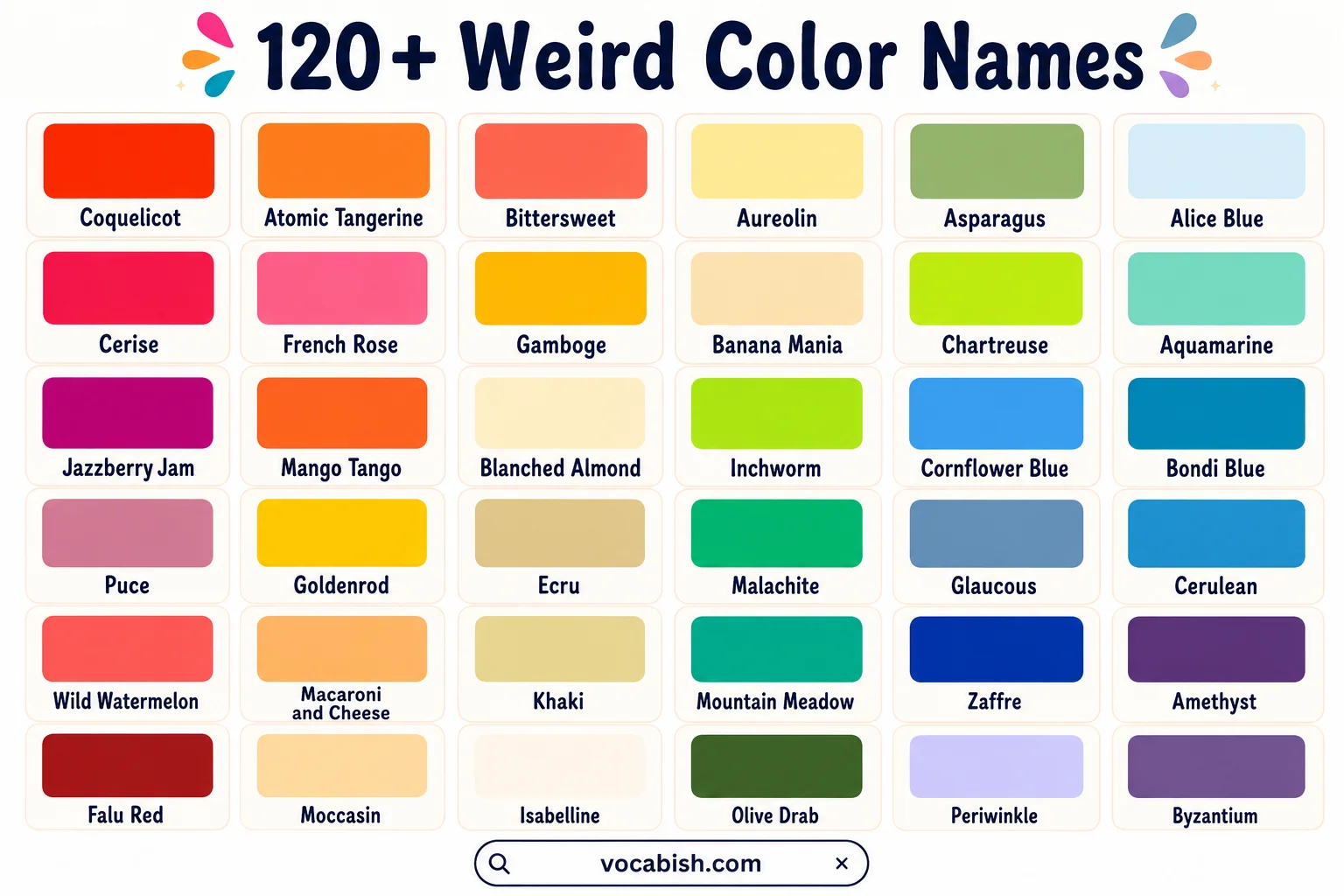

Have you ever heard of a color called Coquelicot, Glaucous, Inchworm, or Macaroni and Cheese? These weird color names describe genuine shades found in digital design, art, nature, history, and crayon collections.
Some unusual colors take their names from flowers, minerals, foods, animals, and places. Others have playful names created to make a shade easier to remember. This article introduces more than 120 unique colors with hex codes and familiar picture clues.
What Are Weird Color Names?
Weird color names are uncommon, surprising, old-fashioned, or playful names given to particular hues. They often sound unrelated to color until you learn their origin.
Examples include:
- Puce, a dusty pink-purple
- Glaucous, a soft blue-gray
- Gamboge, a rich golden yellow
- Zaffre, a deep cobalt blue
- Isabelline, a pale cream-gray
There is no official master list containing every weird color name. Color names come from many systems, including traditional art vocabulary, CSS web colors, dictionaries, paint collections, fashion, science, and crayon palettes.
CSS named colors have fixed digital values, while many historical or artistic names may represent a small range of similar shades. Hex codes provide a useful digital reference, but colors can appear slightly different on separate screens.
Weird Color Names Chart: 120+ Shades, Codes, and Picture Clues
The charts below arrange unusual colors by their main color family. The picture clue connects each shade with a familiar object, material, plant, or scene.
Some values are browser-standard CSS colors. Others are common digital representations of traditional shades or published crayon colors.
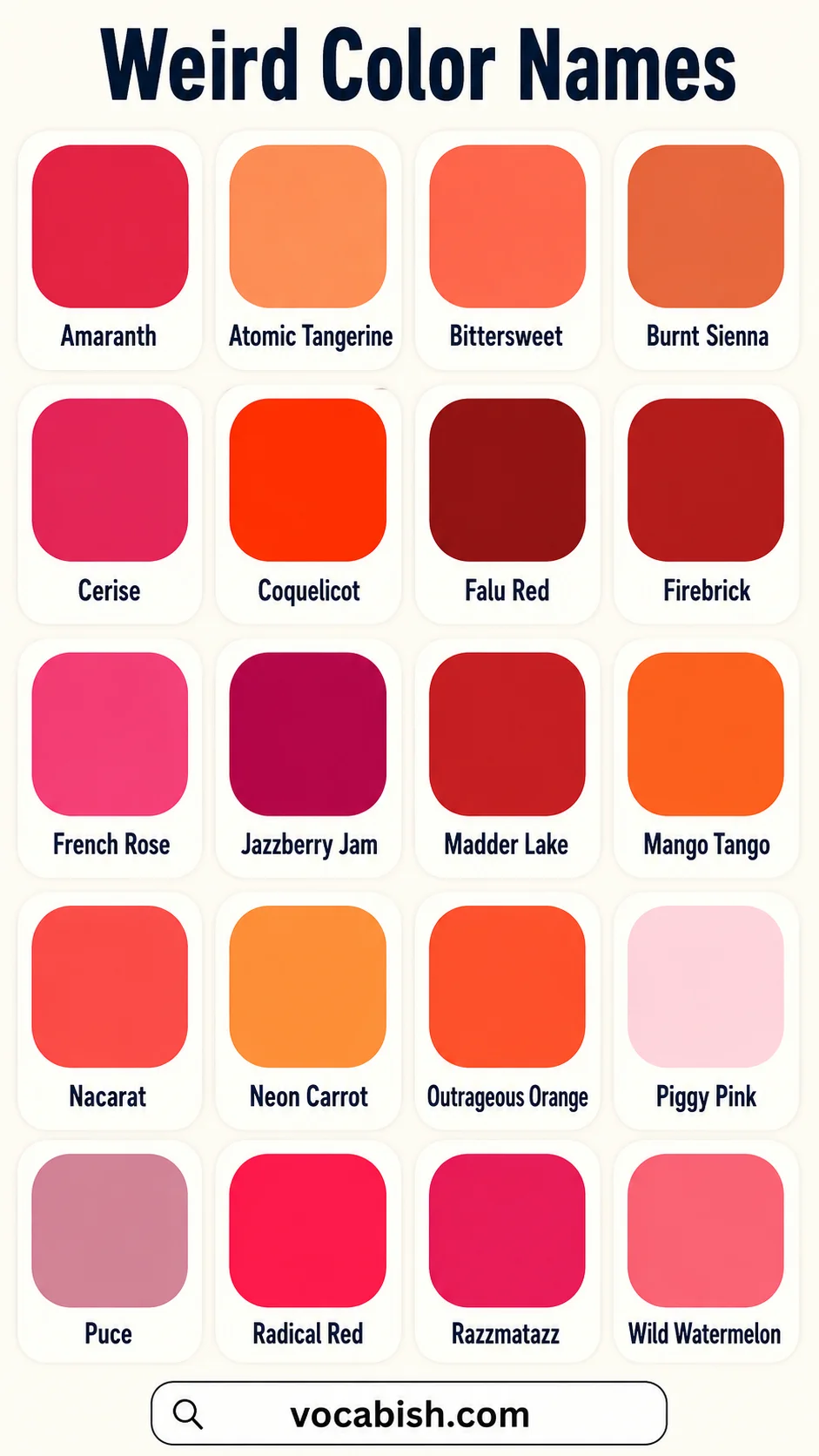
Weird Red, Pink, and Orange Color Names
These shades range from pale pink to vivid orange and dark historical reds. Many names come from flowers, fruits, pigments, foods, and imaginative crayon collections.
Color Name | Hex Code | Shade | Picture Clue |
|---|---|---|---|
Amaranth | #E52B50 | Deep rose-red | Amaranth flower petals |
Atomic Tangerine | #FF9966 | Bright orange | Glowing orange candy |
Bittersweet | #FE6F5E | Warm coral-orange | Bittersweet berries |
Burnt Sienna | #E97451 | Earthy red-orange | Fired clay |
Cerise | #DE3163 | Strong cherry pink | Ripe red cherries |
Coquelicot | #FF3800 | Fiery red-orange | Wild poppy petals |
Falu Red | #801818 | Dark rustic red | Swedish wooden cottage |
Firebrick | #B22222 | Deep brick red | Fired red brick |
French Rose | #F64A8A | Bright rosy pink | Fresh pink rose |
Jazzberry Jam | #A50B5E | Dark berry-magenta | Blackberry jam |
Madder Lake | #CC3336 | Rich pigment red | Traditional red dye |
Mango Tango | #FF8243 | Tropical orange | Ripe mango flesh |
Nacarat | #FC5D5D | Warm orange-red | Red-orange silk |
Neon Carrot | #FFA343 | Bright yellow-orange | Glowing carrot |
Outrageous Orange | #FF6E4A | Vivid coral-orange | Fluorescent marker |
Piggy Pink | #FDDDE6 | Very pale pink | Pink piglet |
Puce | #CC8899 | Dusty pink-purple | Faded rose fabric |
Radical Red | #FF355E | Electric pink-red | Neon red sign |
Razzmatazz | #E3256B | Raspberry pink | Crushed raspberries |
Wild Watermelon | #FC6C85 | Juicy red-pink | Watermelon flesh |
Coquelicot comes from the French word for a wild poppy and commonly represents a brilliant red-orange shade.
Weird Yellow, Gold, and Beige Color Names
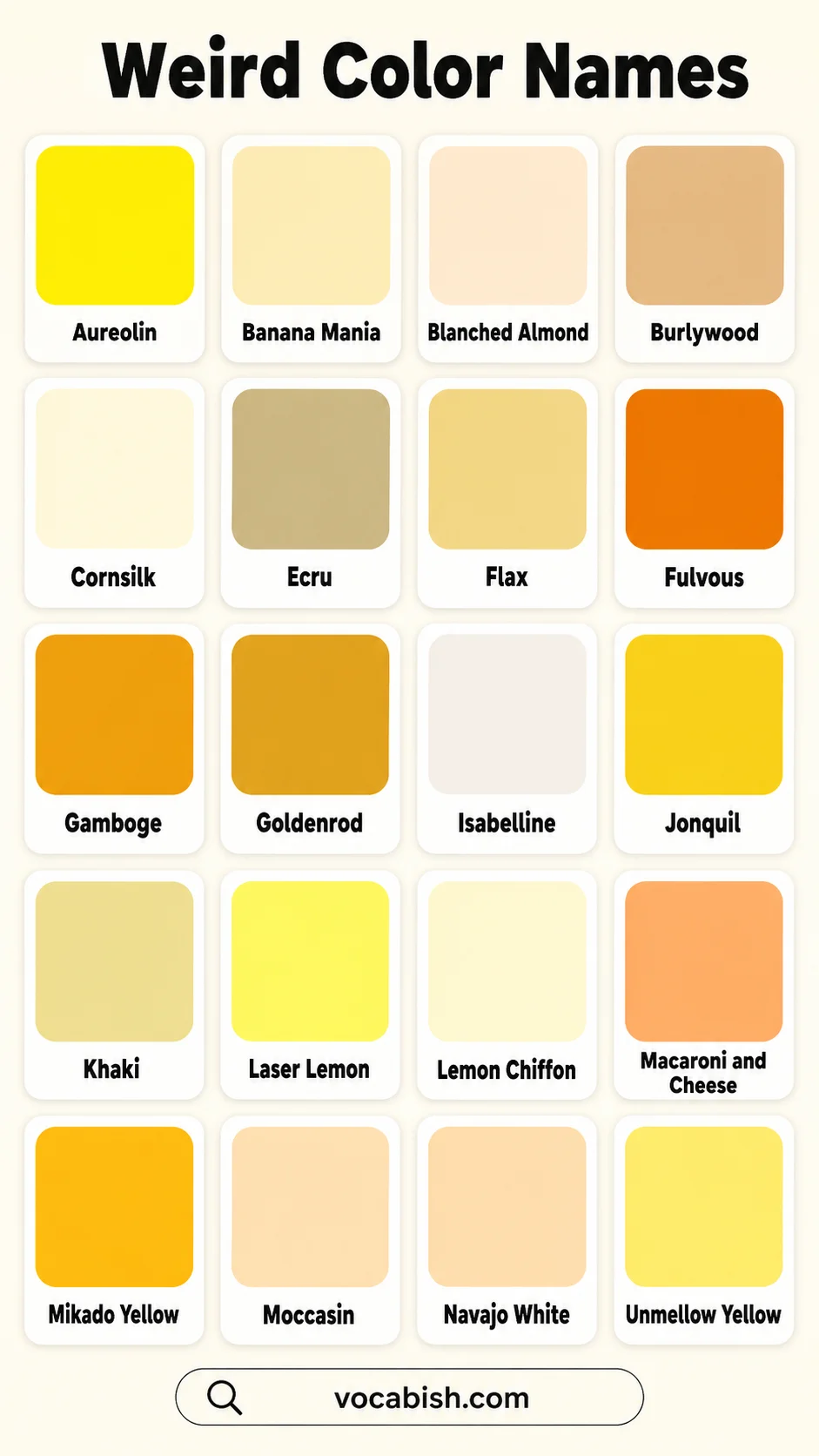
These unusual colors include glowing yellows, creamy neutrals, brownish golds, and shades named after food or natural pigments.
Color Name | Hex Code | Shade | Picture Clue |
|---|---|---|---|
Aureolin | #FDEE00 | Brilliant yellow | Bright artist’s pigment |
Banana Mania | #FAE7B5 | Pale banana cream | Banana milkshake |
Blanched Almond | #FFEBCD | Warm creamy beige | Peeled almond |
Burlywood | #DEB887 | Light sandy brown | Cut wooden board |
Cornsilk | #FFF8DC | Soft yellow-white | Corn silk threads |
Ecru | #C2B280 | Grayish beige | Unbleached linen |
Flax | #EEDC82 | Muted golden yellow | Dried flax fibres |
Fulvous | #E48400 | Tawny orange-yellow | Golden-brown feathers |
Gamboge | #E49B0F | Deep mustard gold | Golden tree resin |
Goldenrod | #DAA520 | Warm golden yellow | Goldenrod flowers |
Isabelline | #F4F0EC | Pale cream-gray | Light animal fur |
Jonquil | #F4CA16 | Strong flower yellow | Jonquil petals |
Khaki | #F0E68C | Dusty yellow-tan | Khaki fabric |
Laser Lemon | #FFFF66 | Fluorescent lemon | Neon yellow marker |
Lemon Chiffon | #FFFACD | Very pale yellow | Lemon cream dessert |
Macaroni and Cheese | #FFB97B | Soft cheese-orange | Creamy macaroni |
Mikado Yellow | #FFC40C | Rich golden yellow | Golden stage costume |
Moccasin | #FFE4B5 | Peachy cream | Soft leather shoe |
Navajo White | #FFDEAD | Warm peach-beige | Sunlit sandstone |
Unmellow Yellow | #FFEE66 | Loud bright yellow | Fluorescent crayon |
Names such as Macaroni and Cheese, Unmellow Yellow, Atomic Tangerine, and Inchworm appear in published Crayola color collections.
Weird Green Color Names
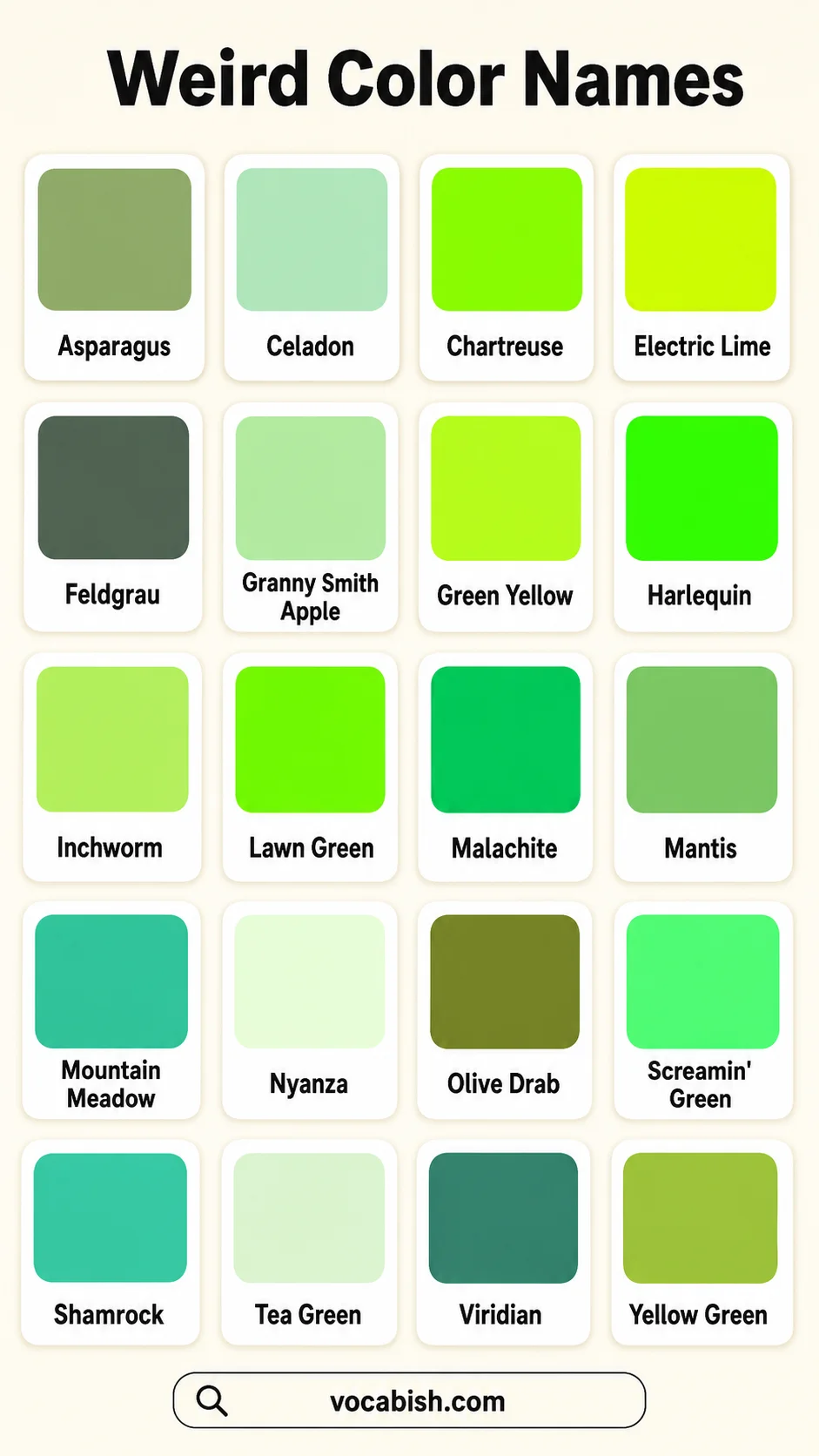
Green has many unusual names because it appears widely in plants, minerals, military clothing, food, and animal life.
Color Name | Hex Code | Shade | Picture Clue |
|---|---|---|---|
Asparagus | #87A96B | Muted vegetable green | Asparagus stalk |
Celadon | #ACE1AF | Pale gray-green | Celadon pottery |
Chartreuse | #7FFF00 | Yellow-green | Glowing lime |
Electric Lime | #CCFF00 | Neon yellow-green | Electric sign |
Feldgrau | #4D5D53 | Dark gray-green | Historical field uniform |
Granny Smith Apple | #A8E4A0 | Light apple green | Green apple skin |
Green Yellow | #ADFF2F | Bright lime green | Young spring leaves |
Harlequin | #3FFF00 | Intense green | Harlequin costume |
Inchworm | #B2EC5D | Fresh yellow-green | Small green caterpillar |
Lawn Green | #7CFC00 | Vivid grass green | Sunlit lawn |
Malachite | #0BDA51 | Brilliant mineral green | Polished malachite |
Mantis | #74C365 | Medium leaf green | Praying mantis |
Mountain Meadow | #30BA8F | Fresh blue-green | Green alpine meadow |
Nyanza | #E9FFDB | Very pale green | Mint-tinted paper |
Olive Drab | #6B8E23 | Dark yellow-green | Military canvas |
Screamin’ Green | #66FF66 | Fluorescent green | Neon glow stick |
Shamrock | #45CEA2 | Fresh green-teal | Shamrock leaves |
Tea Green | #D0F0C0 | Pale leafy green | Light green tea |
Viridian | #40826D | Deep blue-green | Artist’s green pigment |
Yellow Green | #9ACD32 | Earthy lime | Green pear skin |
The boundaries between green, blue-green, teal, and turquoise are not fixed in everyday language. A single color may receive different names in art, fashion, printing, or web design.
Weird Blue and Teal Color Names
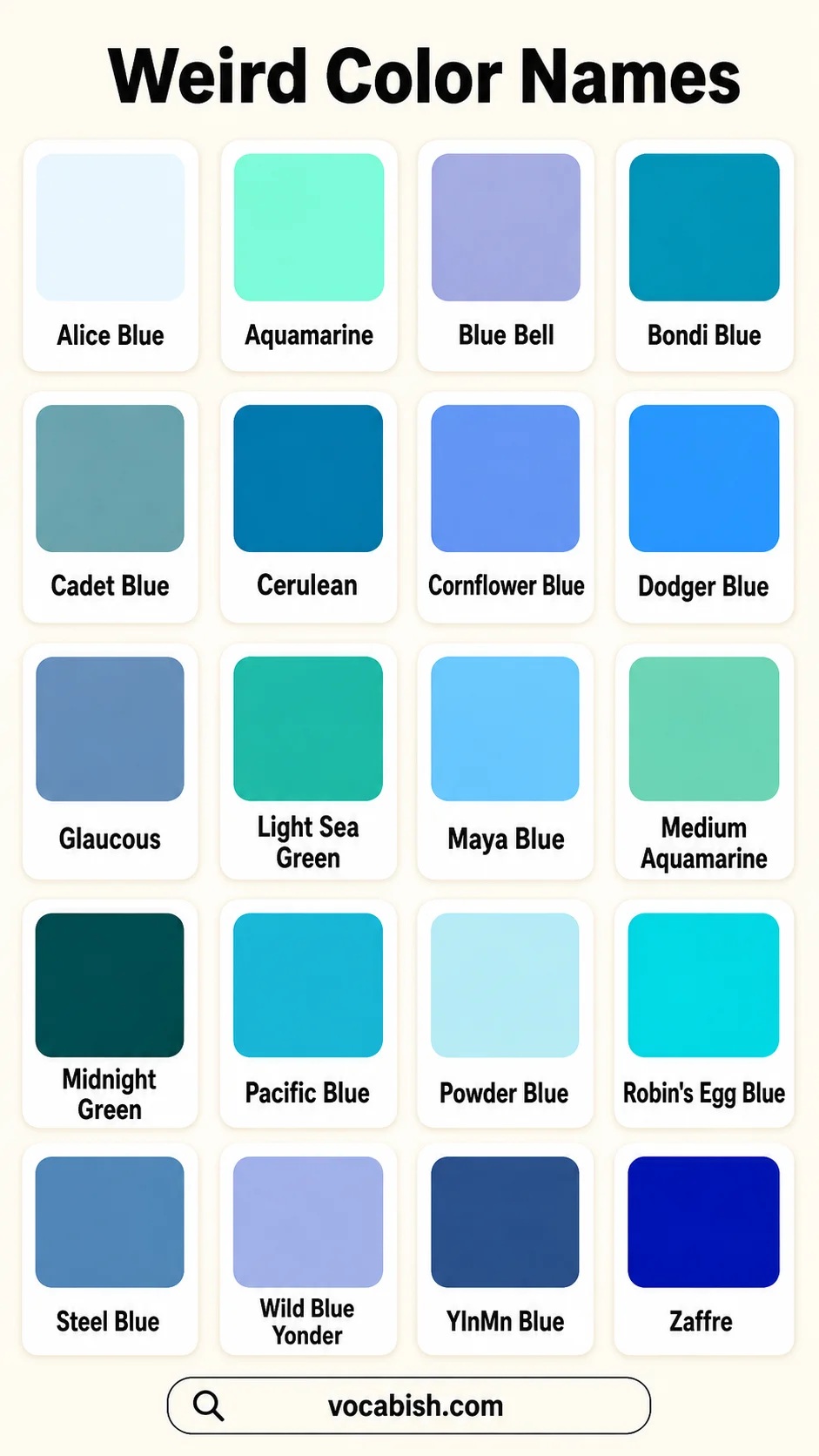
Some blue names describe the sky or sea. Others come from flowers, birds, minerals, scientific discoveries, and old pigments.
Color Name | Hex Code | Shade | Picture Clue |
|---|---|---|---|
Alice Blue | #F0F8FF | Nearly white blue | Icy morning sky |
Aquamarine | #7FFFD4 | Pale green-blue | Aquamarine gemstone |
Blue Bell | #A2A2D0 | Soft blue-violet | Bluebell flowers |
Bondi Blue | #0095B6 | Strong ocean blue | Coastal seawater |
Cadet Blue | #5F9EA0 | Muted blue-green | Faded uniform |
Cerulean | #007BA7 | Clear sky blue | Deep summer sky |
Cornflower Blue | #6495ED | Medium floral blue | Cornflower petals |
Dodger Blue | #1E90FF | Bright clear blue | Sports uniform |
Glaucous | #6082B6 | Dusty blue-gray | Waxy blue-green leaf |
Light Sea Green | #20B2AA | Medium turquoise | Shallow tropical water |
Maya Blue | #73C2FB | Bright pale blue | Painted blue mural |
Medium Aquamarine | #66CDAA | Soft green-teal | Clear lagoon water |
Midnight Green | #004953 | Very dark teal | Sea at night |
Pacific Blue | #1CA9C9 | Strong cyan-blue | Pacific Ocean |
Powder Blue | #B0E0E6 | Pale cloudy blue | Powdered blue chalk |
Robin’s Egg Blue | #00CCCC | Bright blue-green | Robin’s egg shell |
Steel Blue | #4682B4 | Cool gray-blue | Blue-tinted steel |
Wild Blue Yonder | #A2ADD0 | Soft cloudy blue | Distant hazy sky |
YInMn Blue | #2E5090 | Rich mineral blue | Modern blue pigment |
Zaffre | #0014A8 | Deep cobalt blue | Cobalt-stained glass |
Glaucous describes a blue-gray or gray-green appearance seen on some plants, fruits, and animals. Zaffre is the name of a deep blue pigment connected with cobalt.
Weird Purple and Violet Color Names
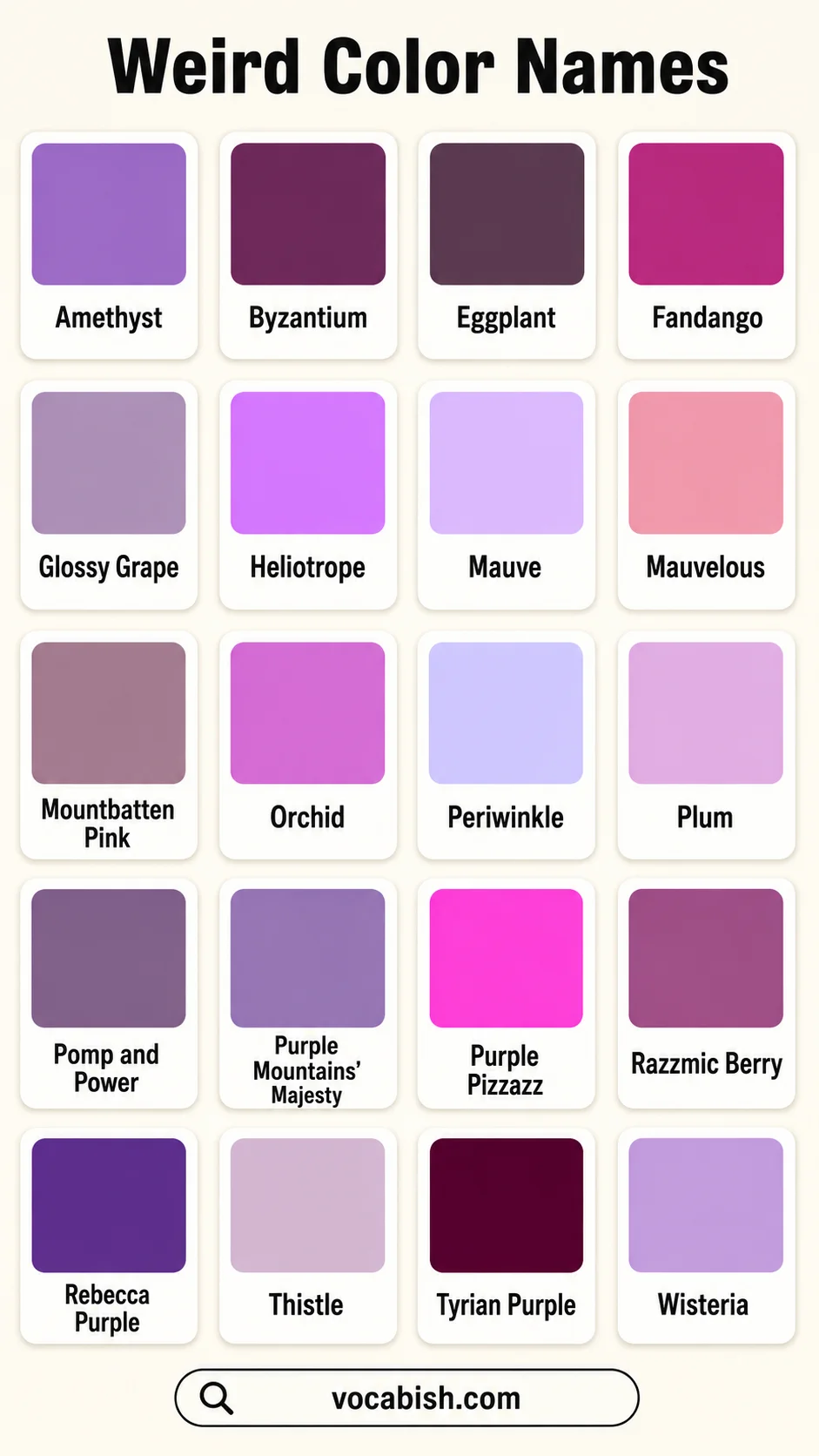
Purple shades often receive dramatic names because they are linked with flowers, royalty, berries, clothing, and precious stones.
Color Name | Hex Code | Shade | Picture Clue |
|---|---|---|---|
Amethyst | #9966CC | Medium gemstone purple | Amethyst crystal |
Byzantium | #702963 | Dark reddish purple | Royal velvet |
Eggplant | #614051 | Dark muted purple | Eggplant skin |
Fandango | #B53389 | Strong purple-pink | Bright dance costume |
Glossy Grape | #AB92B3 | Soft gray-purple | Pale grape skin |
Heliotrope | #DF73FF | Bright pink-violet | Heliotrope flower |
Mauve | #E0B0FF | Pale purple | Light purple ribbon |
Mauvelous | #EF98AA | Dusty pink-mauve | Vintage pink fabric |
Mountbatten Pink | #997A8D | Muted gray-pink | Dusty naval paint |
Orchid | #DA70D6 | Floral purple-pink | Orchid petals |
Periwinkle | #CCCCFF | Pale blue-purple | Periwinkle flower |
Plum | #DDA0DD | Soft reddish purple | Light plum flesh |
Pomp and Power | #86608E | Muted royal purple | Ceremonial cloth |
Purple Mountains’ Majesty | #9678B6 | Dusty lavender | Mountains at sunset |
Purple Pizzazz | #FE4EDA | Electric magenta | Neon purple light |
Razzmic Berry | #8D4E85 | Deep berry-purple | Dark berry juice |
Rebecca Purple | #663399 | Medium dark purple | Rich purple fabric |
Thistle | #D8BFD8 | Pale gray-lilac | Thistle flower |
Tyrian Purple | #630330 | Dark red-purple | Ancient royal dye |
Wisteria | #C9A0DC | Soft lavender | Hanging wisteria blooms |
Rebecca Purple is an official CSS named color with the hex value #663399. It was added to the CSS color system as a memorial tribute.
Weird Brown, Gray, and White Color Names
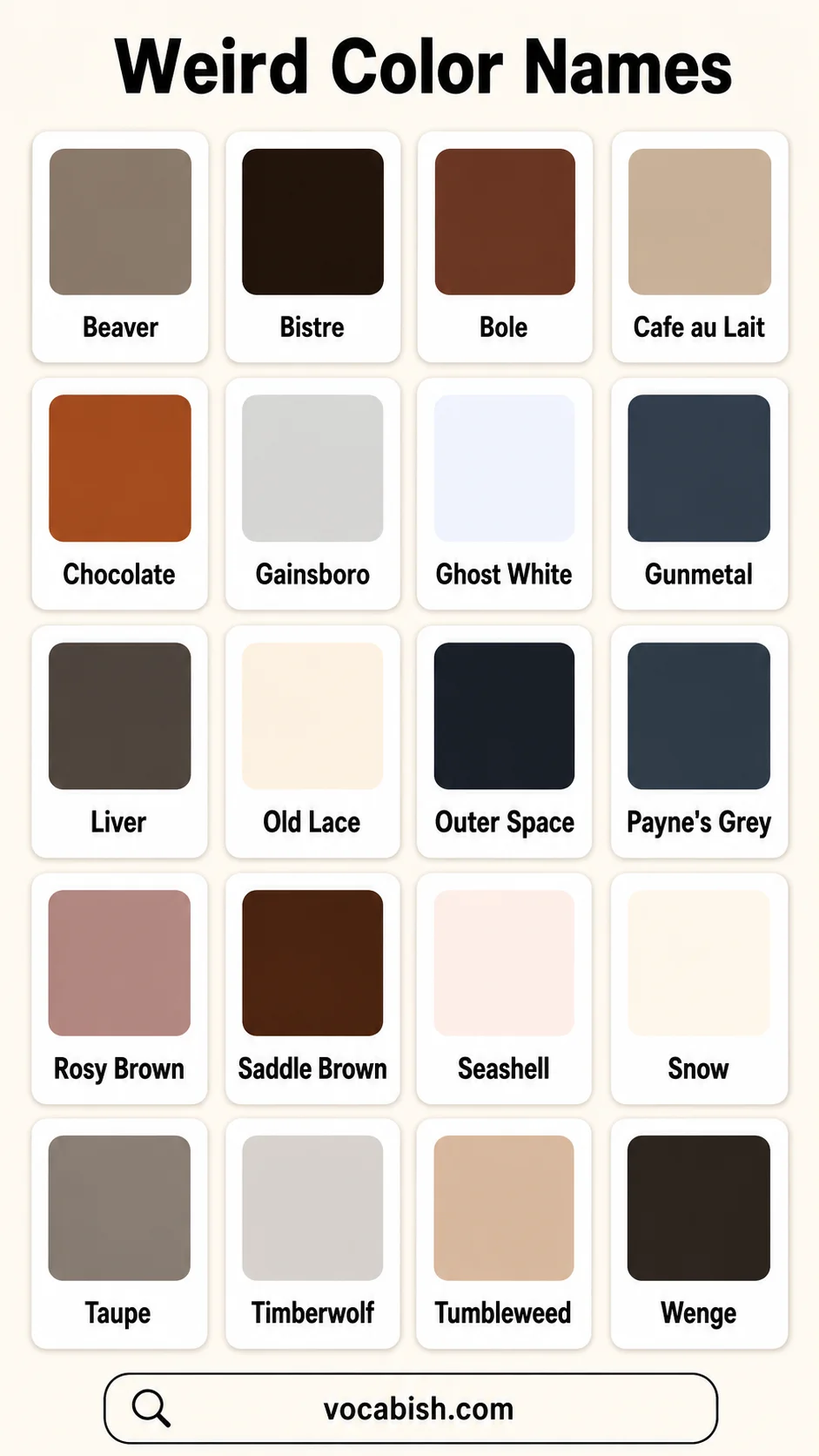
Neutral colors can also have unexpected names. These shades often come from wood, stone, smoke, food, cloth, animal fur, and natural earth.
Color Name | Hex Code | Shade | Picture Clue |
|---|---|---|---|
Beaver | #9F8170 | Soft gray-brown | Beaver fur |
Bistre | #3D2B1F | Very dark brown | Sooty brown ink |
Bole | #79443B | Earthy reddish brown | Damp clay soil |
Café au Lait | #A67B5B | Coffee-beige | Coffee with milk |
Chocolate | #D2691E | Warm orange-brown | Milk chocolate |
Gainsboro | #DCDCDC | Light neutral gray | Pale gray cloth |
Ghost White | #F8F8FF | Blue-tinted white | Misty white light |
Gunmetal | #2A3439 | Dark blue-gray | Dark metal surface |
Liver | #674C47 | Deep gray-brown | Dark brown leather |
Old Lace | #FDF5E6 | Warm creamy white | Antique lace |
Outer Space | #414A4C | Dark charcoal blue | Night sky |
Payne’s Grey | #536878 | Cool dark blue-gray | Storm clouds |
Rosy Brown | #BC8F8F | Muted rose-brown | Dried rose petals |
Saddle Brown | #8B4513 | Rich dark brown | Leather saddle |
Seashell | #FFF5EE | Pink-tinted white | Pale seashell |
Snow | #FFFAFA | Soft warm white | Fresh snow |
Taupe | #483C32 | Dark gray-brown | Mole-colored fabric |
Timberwolf | #DBD7D2 | Pale warm gray | Wolf fur |
Tumbleweed | #DEAA88 | Sandy peach-brown | Dry desert plant |
Wenge | #645452 | Dark grayish brown | Wenge wood |
Where Do Unusual Color Names Come From?
Color names develop through language, trade, science, fashion, art, and everyday observation. A name may describe the object that inspired the color or tell a story about where it was first used.
Plants and Flowers
Many shades borrow their names from petals, fruit, leaves, or plant materials.
Examples include:
- Amaranth
- Cerise
- Coquelicot
- Cornflower Blue
- Goldenrod
- Heliotrope
- Jonquil
- Wisteria
Food and Drinks
Food names help people imagine a shade quickly because the object is already familiar.
Examples include:
- Banana Mania
- Café au Lait
- Chocolate
- Lemon Chiffon
- Macaroni and Cheese
- Mango Tango
- Papaya Whip
- Peach Puff
Minerals and Pigments
Some uncommon hues come from stones, metals, chemical pigments, or traditional painting materials.
Examples include:
- Amethyst
- Aureolin
- Cerulean
- Gamboge
- Malachite
- Viridian
- YInMn Blue
- Zaffre
Places and Cultures
A color may be named after a location, cultural object, historical period, or traditional material.
Examples include:
- Bondi Blue
- Byzantium
- Falu Red
- Maya Blue
- Mikado Yellow
- Navajo White
- Tyrian Purple
Playful Imagination
Crayon and product makers often choose memorable names instead of technical labels.
Examples include:
- Atomic Tangerine
- Jazzberry Jam
- Purple Pizzazz
- Screamin’ Green
- Unmellow Yellow
- Wild Blue Yonder
- Wild Watermelon
Pronunciation of Difficult Weird Color Names
Some color words are difficult for English learners because their spelling does not clearly show their pronunciation.
Color Name | Easy Pronunciation | Meaning |
|---|---|---|
Aureolin | aw-REE-uh-lin | A brilliant yellow |
Cerise | suh-REEZ | A strong cherry pink |
Coquelicot | KOK-lee-koh | A vivid poppy red |
Ecru | AY-kroo | A pale beige |
Fulvous | FUL-vus | A tawny orange-brown |
Gamboge | gam-BOHZH | A deep golden yellow |
Glaucous | GLAW-kus | A dusty blue-gray |
Heliotrope | HEE-lee-uh-trohp | A bright violet |
Isabelline | iz-uh-BEL-een | A pale cream-gray |
Nacarat | NAK-uh-rat | A warm orange-red |
Puce | PYOOS | A dusty pink-purple |
Viridian | vuh-RID-ee-un | A deep blue-green |
Zaffre | ZAF-er | A strong cobalt blue |
Pronunciation can vary slightly between English accents. The forms above are practical approximations for everyday speaking.
How to Read and Use Hex Color Codes
A hex code is a six-character digital code used to represent color. It begins with a hash symbol, such as #663399.
The six characters appear in three pairs:
- The first pair controls red
- The second pair controls green
- The third pair controls blue
The code #FF0000 produces bright red because the red value is at its highest level, while green and blue are at zero.
Hexadecimal color notation uses numbers from 0 to 9 and letters from A to F. A three-character code may also be expanded into a six-character form. For example, #FB0 becomes #FFBB00.
Where Can Hex Codes Be Used?
You can use hex values in:
- Website design
- Digital illustrations
- Social media graphics
- Presentation slides
- Logos and brand palettes
- Mobile applications
- Photo-editing programs
- Online color pickers
For example, the following CSS changes a heading to Rebecca Purple:
h2 {
  color: #663399;
}
Warm, Cool, and Neutral Weird Colors
Grouping shades by temperature can make them easier to compare and use.
Color Group | Examples | Common Feeling |
|---|---|---|
Warm weird colors | Coquelicot, Gamboge, Nacarat, Fulvous | Energetic, cheerful, bold |
Cool weird colors | Glaucous, Zaffre, Viridian, Cerulean | Calm, distant, fresh |
Soft pastel colors | Isabelline, Nyanza, Piggy Pink, Thistle | Gentle, light, peaceful |
Dark dramatic colors | Byzantium, Bistre, Tyrian Purple, Gunmetal | Serious, rich, mysterious |
Bright playful colors | Inchworm, Purple Pizzazz, Atomic Tangerine | Fun, youthful, energetic |
Earthy colors | Feldgrau, Ecru, Bole, Tumbleweed | Natural, warm, grounded |
A color can feel warmer or cooler depending on the shades placed beside it. Lighting, brightness, and screen settings also influence its appearance.
How to Choose a Weird Color for Your Project
An unusual color name can make a project more memorable, but the shade should still match its purpose.
For Websites
Use pale colors such as Alice Blue, Nyanza, or Old Lace for backgrounds. Darker shades such as Gunmetal or Tyrian Purple work better for headings and accents.
For Logos
Choose one memorable main color and support it with one or two quieter shades. Malachite, Cerulean, Jazzberry Jam, and Mikado Yellow can create strong visual identities.
For Children’s Designs
Bright playful colors can attract attention. Suitable choices include Inchworm, Atomic Tangerine, Piggy Pink, and Wild Blue Yonder.
For Vintage Designs
Muted shades often create an aged or historical feeling. Try Isabelline, Ecru, Mountbatten Pink, Taupe, or Falu Red.
For Nature Themes
Plant, mineral, and earth-inspired shades work naturally together. Celadon, Viridian, Malachite, Feldgrau, and Bistre form an organic palette.
For Readable Text
Check the contrast between the text and background. Pale yellow text on white or dark blue text on black can be difficult to read.
A dark text color usually works well on a pale background, while white or cream text is often clearer on a deep color.
Common Confusions About Weird Colors
Unusual color names are not always used consistently. Keep these points in mind:
- A historical color may have several accepted digital versions.
- A physical crayon or paint can look different from its screen swatch.
- Puce is usually dusty pink-purple, not bright green.
- Glaucous may describe blue-gray, gray-green, or a waxy pale coating.
- Similar names, such as aquamarine and medium aquamarine, have separate hex values.
FAQs About Weird Color Names
Weird color names are unusual, historical, imaginative, or surprising labels for shades, such as Puce, Glaucous, Coquelicot, Inchworm, and Zaffre.
The answer is subjective, but Macaroni and Cheese, Unmellow Yellow, Puce, Coquelicot, and Screamin’ Green are often considered especially unusual.
No single official list exists. Unusual color names come from web standards, art, fashion, dictionaries, pigments, paint brands, and crayon collections.
Puce is usually a muted pink-purple or brownish rose. A widely used digital representation of the shade is hex code #CC8899.
Glaucous is a dusty blue-gray shade, sometimes with a slight green tone. It resembles waxy plant leaves, grapes, or certain bird feathers.
Food provides familiar visual references. Names such as Peach Puff, Lemon Chiffon, Chocolate, and Macaroni and Cheese help people imagine shades quickly.
The numerical code remains the same, but brightness, display quality, color settings, and lighting may make the shade appear slightly different.
Only recognized CSS color keywords work directly as names. Other unusual colors should be entered through their hex, RGB, HSL, or similar values.
Conclusion
Weird color names make the world of color more memorable and expressive. Shades such as Coquelicot, Glaucous, Isabelline, Puce, and Zaffre connect language with flowers, minerals, food, history, and imagination.
This list of weird color names provides more than 120 unique shades with hex codes and picture clues. Use it to build color palettes, improve vocabulary, create designs, or discover uncommon hues beyond basic red, blue, green, and yellow.
Explore Color Names with Codes
- 60 Unique Color Names and Their Codes
- List of All Pink Color Names
- 150+ Purple Color Names with HEX Codes
- List of All Green Color Names and PDF
- All MTG Color Combinations and Pictures