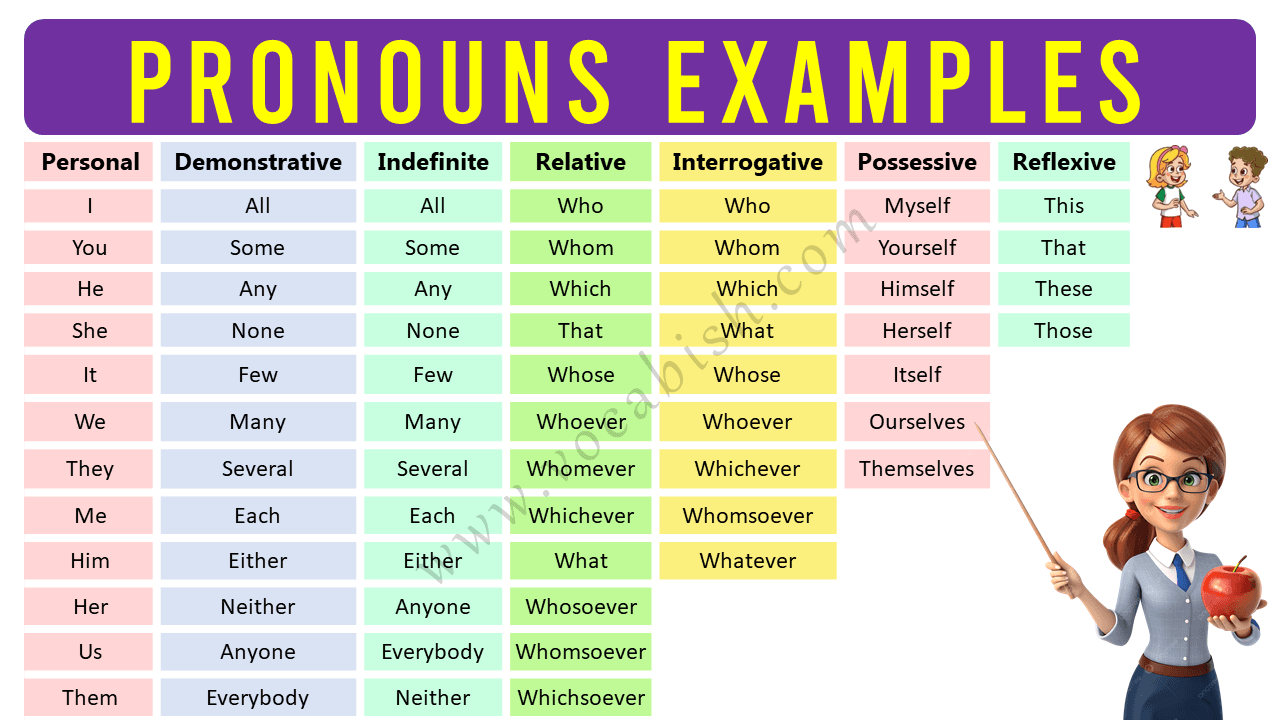

Have you noticed how often words like he, she, they, and it appear in English? These words are called pronouns, and they help us avoid repeating nouns again and again. Without pronouns, conversations and writing would sound repetitive and unnatural.
Learning pronouns is an important part of building strong English grammar skills. In this article, you’ll find an A to Z list of pronouns, examples in sentences, and different types of pronouns commonly used in everyday English.
What Are Pronouns in English?
Pronouns are words that replace nouns in a sentence. They help avoid repetition and make communication smoother and easier to understand.
Examples:
- he
- she
- it
- they
- we
- someone
- this
Sentence Example:
Ahmed is my friend. He lives next door.
To read more about the pronouns and their types, visit our Pronoun Guide.
Why do we need to learn pronouns?
Pronouns help make sentences shorter, clearer, and more natural. They are used in everyday conversations, writing, reading, and listening.
Learning pronouns helps you:
- Avoid repeating nouns
- Improve sentence structure
- Speak more naturally
- Write clearly
- Understand English better
A to Z List of Pronouns in English
The A to Z list below includes common pronouns and pronoun-related words used in English. Learning them alphabetically can help you recognize and remember them more easily.
- A: all, another, anybody, anyone, anything
- B: both
- C: certain, each other (contains C in phrase usage)
- D: each, either, everybody, everyone
- E: each, either, everybody, everyone, everything
- F: few
- G: (No common English pronouns begin with G)
- H: he, her, hers, herself, him, himself
- I: I, it, its, itself
- J: (No common English pronouns begin with J)
- K: (No common English pronouns begin with K)
- L: little
- M: many, me, mine, more, most, myself
- N: neither, nobody, none, no one, nothing
- O: one, oneself, other, others
- P: (No common English pronouns begin with P)
- Q: (No common English pronouns begin with Q)
- R: relative pronouns such as who, whom, whose
- S: several, she, some, somebody, someone, something
- T: that, their, theirs, them, themselves, these, they, this, those
- U: us
- V: (No common English pronouns begin with V)
- W: we, what, whatever, which, whichever, who, whoever, whom, whomever, whose
- X: (No common English pronouns begin with X)
- Y: you, yours, yourself, yourselves
- Z: (No common English pronouns begin with Z)
Personal Pronouns Examples in Sentences
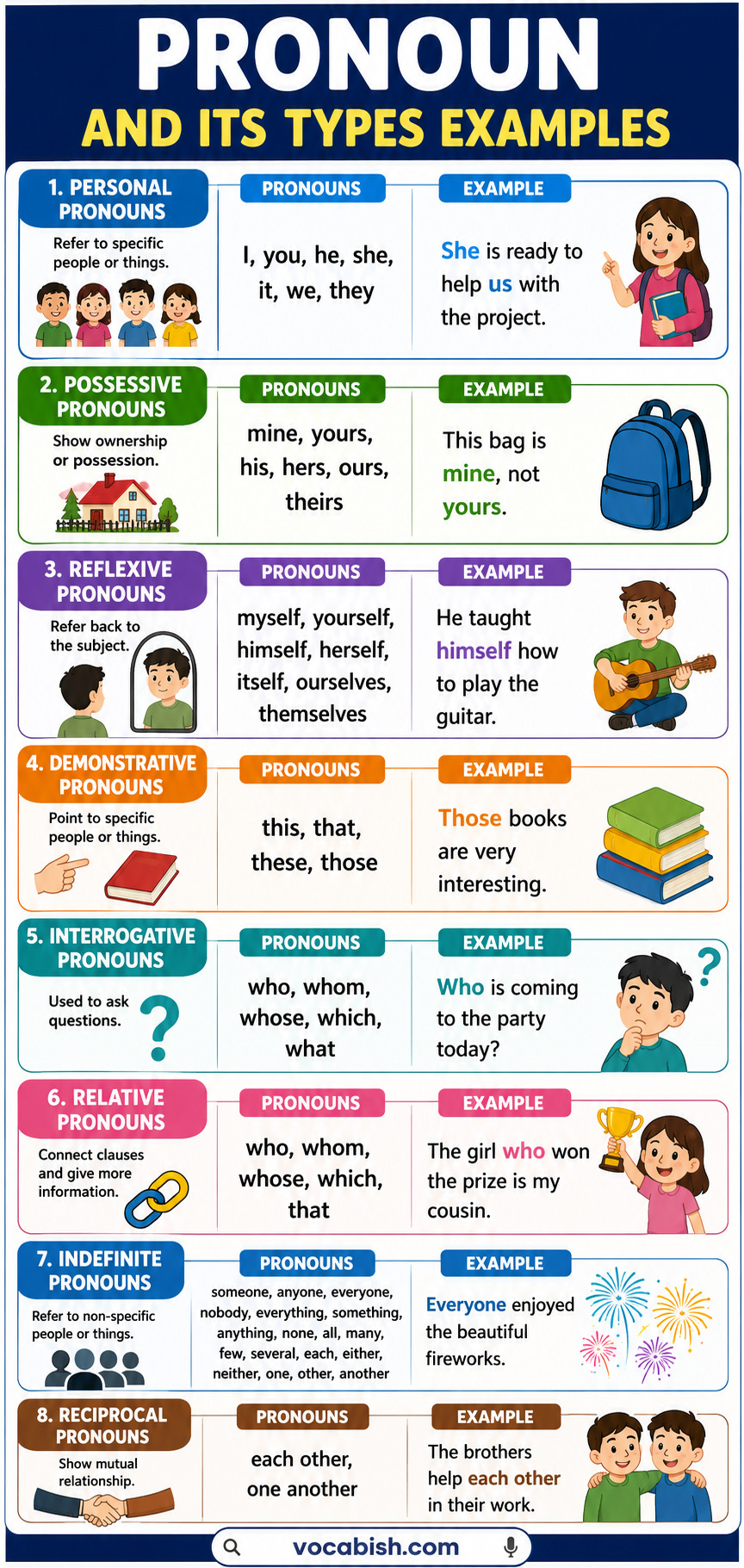
Personal pronouns refer to specific people, animals, or things.
- I
I enjoy reading books. - you
You are my best friend. - he
He plays football every weekend. - she
She is studying for her exam. - it
It is raining outside. - we
We visited the museum yesterday. - they
They live in another city.
Possessive Pronouns Examples in Sentences
Possessive pronouns show ownership or possession.
- mine
This notebook is mine. - yours
Is this bag yours? - his
The blue bicycle is his. - hers
The red jacket is hers. - ours
The victory was ours. - theirs
The house at the corner is theirs.
Reflexive Pronouns Examples in Sentences
Reflexive pronouns refer back to the subject of the sentence.
- myself
I completed the project myself. - yourself
You should trust yourself. - himself
He fixed the bicycle himself. - herself
She taught herself how to paint. - itself
The cat cleaned itself. - ourselves
We prepared the meal ourselves. - themselves
They organized the event themselves.
Demonstrative Pronouns Examples in Sentences
Demonstrative pronouns point to specific people or things.
- this
This is my favorite book. - that
That belongs to my brother. - these
These are delicious cookies. - those
Those are beautiful flowers.

Interrogative Pronouns Examples in Sentences
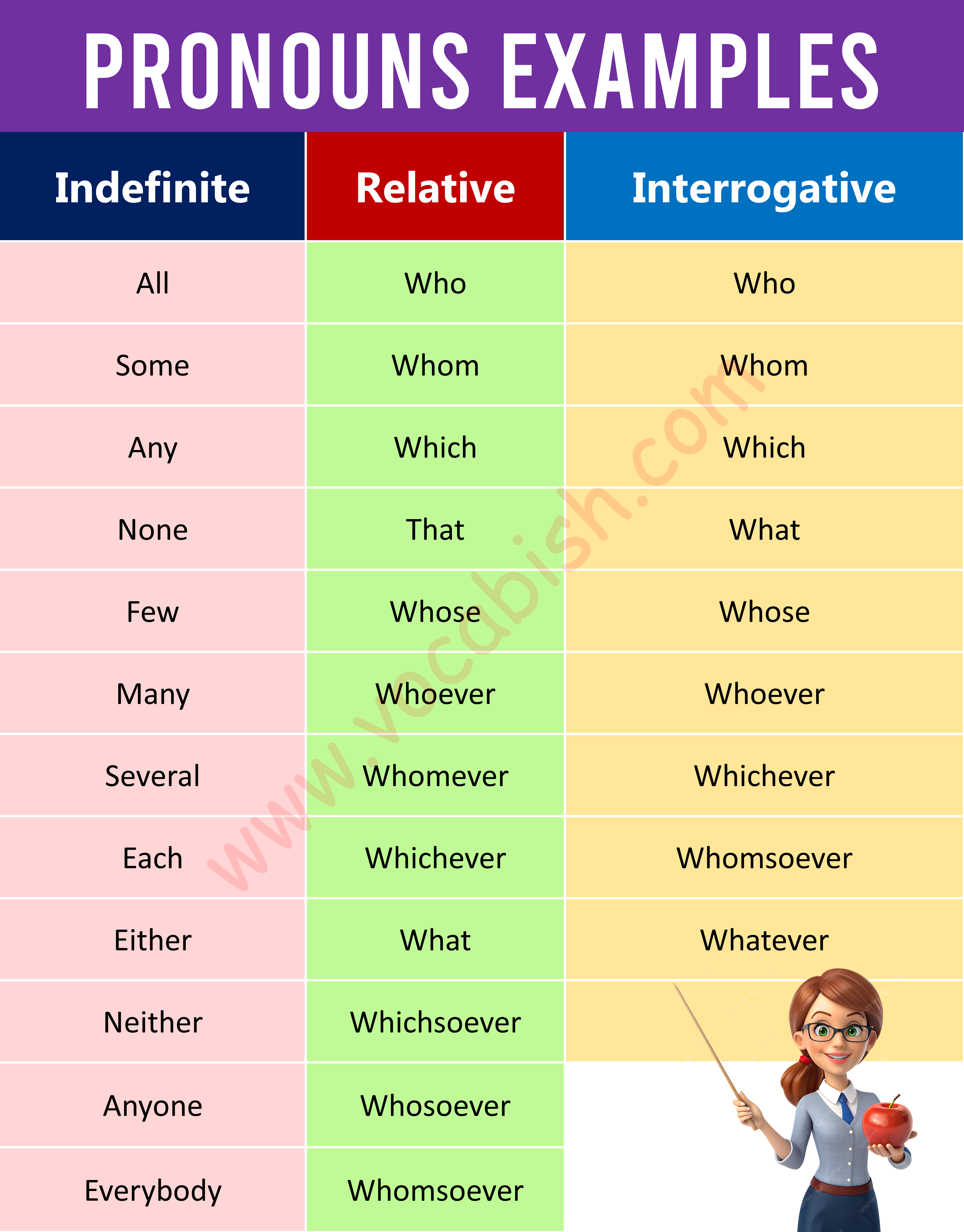
Interrogative pronouns are used to ask questions.
- who
Who is knocking at the door? - whom
Whom did you invite? - whose
Whose phone is ringing? - which
Which do you prefer? - what
What happened yesterday?
Relative Pronouns Examples in Sentences
Relative pronouns connect clauses and provide more information about a noun.
- who
The teacher who helped me was very kind. - whom
The person whom we met was friendly. - whose
I know a girl whose father is a doctor. - which
The book which I borrowed is excellent. - that
The car that he bought is new.
Indefinite Pronouns Examples in Sentences
Indefinite pronouns refer to non-specific people or things.
- someone
Someone left a message for you. - anyone
Anyone can join the competition. - everyone
Everyone enjoyed the party. - nobody
Nobody answered the phone. - something
I heard something outside. - everything
Everything is ready for the event. - nothing
Nothing can stop her determination.
Reciprocal Pronouns Examples in Sentences
Reciprocal pronouns show a mutual relationship between two or more people.
- each other
The twins help each other with homework. - one another
The team members respect one another.
Easy Tips to Remember Pronouns
Learning pronouns becomes easier when you connect them to the nouns they replace. Here are a few practical ways to remember them:
- Replace a person’s name with a pronoun.
Ahmed is my friend. → He is my friend. - Learn pronouns in small groups.
I, you, he, she, it, we, they - Practice with everyday sentences.
She likes reading.
They play football. - Use pictures and identify people or objects with pronouns.
The girl is happy. → She is happy. - Read short stories and highlight pronouns.
This helps you see how they are used naturally. - Make simple conversations using pronouns.
Are they your friends?
Yes, they are. - Focus on one type at a time.
Learn personal pronouns first, then move to possessive, reflexive, and other types.
You May Also Like:
- A to Z List of Nouns with Sentences
- 300 Daily Used Adverbs with Examples
- Adjectives + Preposition Words Examples
FAQs about List of Pronouns
A pronoun is a word that replaces a noun in a sentence. It helps avoid repetition and makes communication clearer and more natural.
The main types include personal, possessive, reflexive, demonstrative, interrogative, relative, indefinite, and reciprocal pronouns used in different situations.
A noun names a person, place, thing, or idea, while a pronoun replaces that noun to avoid repeating it.
Commonly used pronouns include I, you, he, she, it, we, they, this, that, someone, and everyone.
She is my friend.
They are playing football.
I like this book.
We went to the market.
It is raining outside.
Pronouns help connect ideas smoothly, reduce repeated nouns, and make sentences easier to read, write, understand, and speak correctly.
Conclusion
Pronouns make English communication smoother by replacing nouns and reducing repetition. From personal pronouns like he and she to indefinite pronouns like someone and everything, these words appear in almost every conversation and piece of writing.
By learning the different types of pronouns and practicing them in sentences, you’ll improve your grammar, writing, and speaking skills. The more you use pronouns in context, the more natural your English will become.