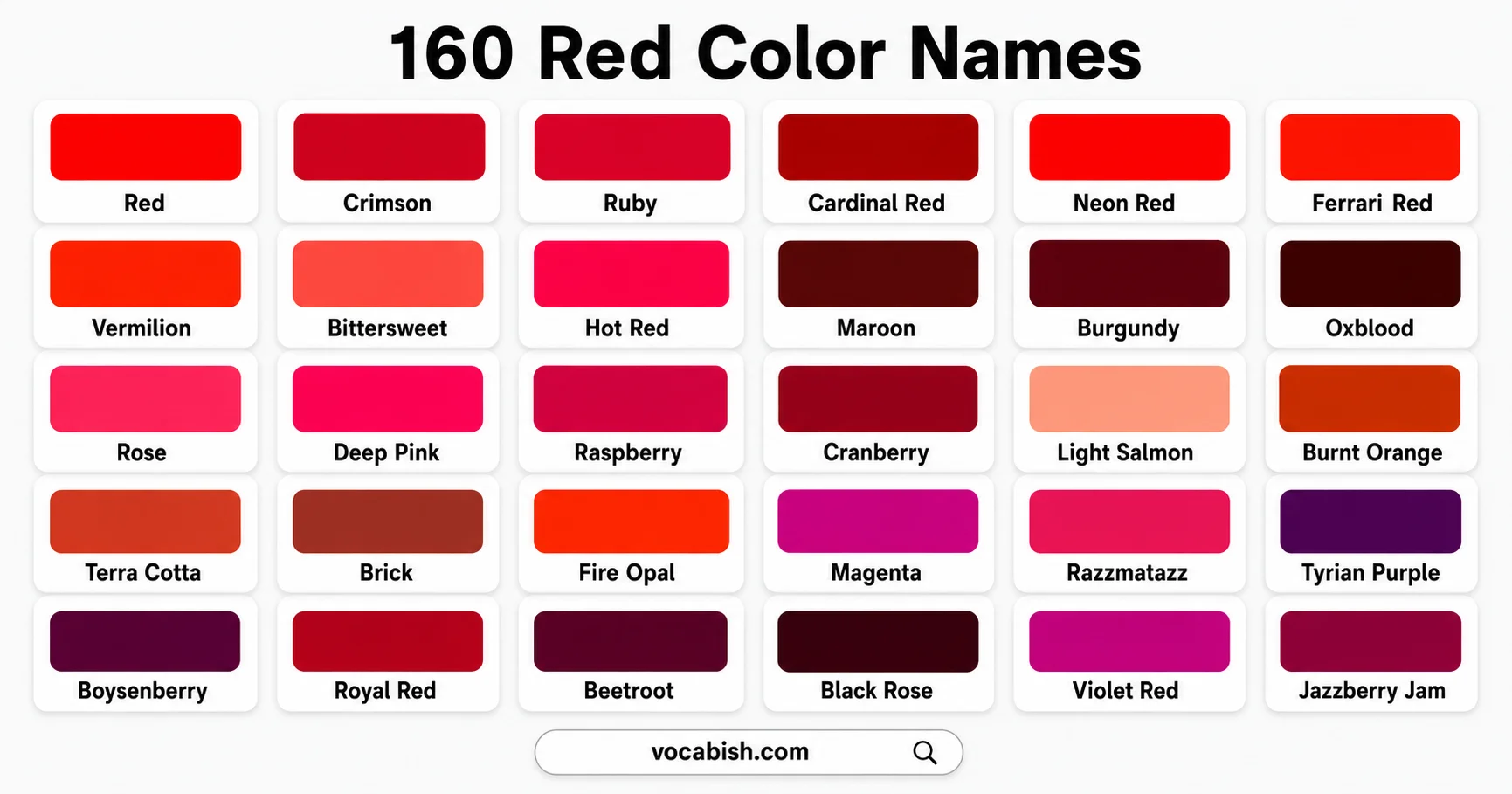

Red color names cover a wide range of warm, cool, bright, dark, earthy, pinkish, and purple-toned shades. Familiar examples include scarlet, crimson, ruby, cherry red, burgundy, and maroon. Many red shades take their names from fruits, flowers, gemstones, wines, places, natural pigments, and historical traditions. This article presents 160 names of red colors with hex codes, RGB values, shade groups, meanings, and practical examples to help learners, writers, artists, and designers understand and use each color more accurately.
Important: A few web color names have officially defined values. Many artistic, fashion, paint, and commercial color names do not have one universal code. Their hex values may vary slightly between brands and color systems.
What Are Red Color Names?
Red color names are words used to identify different variations within and around the red color family. These variations may differ in brightness, darkness, warmth, coolness, or saturation.
Common examples include:
- Scarlet
- Crimson
- Ruby
- Cherry red
- Burgundy
- Maroon
- Coral red
- Rose red
- Brick red
- Oxblood
The boundaries of the red family are not always exact. A shade may move toward orange, pink, purple, or brown while still containing a strong red component.
Quick Definition
Red is a primary color of light in the RGB system. Pure digital red has the hex code #FF0000 and the RGB value 255, 0, 0.
Red Color Families at a Glance
Red shades can be organised into smaller families according to their undertones and visual qualities.
Red family | Main characteristics | Examples |
|---|---|---|
Classic reds | Balanced and clearly recognisable as red | Red, crimson, scarlet |
Bright reds | Highly saturated and attention-grabbing | Neon red, vivid red, torch red |
Dark reds | Mixed with black, brown, or deep purple | Maroon, burgundy, oxblood |
Rose and berry reds | Red mixed with pink or cool purple | Rose red, raspberry, cranberry |
Orange-reds | Red with warm yellow or orange undertones | Vermilion, cinnabar, tomato |
Purple-reds | Red mixed with blue or violet | Claret, beetroot, mulberry red |
Earthy reds | Muted with brown, grey, or orange | Brick, rust, red ochre |
Pastel reds | Lightened or softened red shades | Pastel red, light coral, misty rose |
This grouping makes a long red colors chart easier to study, compare, and use.
Here’s a detailed guide to learn about the 16 color families and their examples.
How to Read Red Color Codes
Color codes help computers, websites, editing programs, and design tools display a particular color. Hex and RGB are two of the most widely used digital formats.
Code type | Example | What it means |
|---|---|---|
Hex | #FF0000 | A six-character digital color code |
RGB | 255, 0, 0 | Amounts of red, green, and blue light |
HSL | 0°, 100%, 50% | Hue, saturation, and lightness |
CMYK | 0, 100, 100, 0 | Cyan, magenta, yellow, and black ink |
Understanding Hex Codes
A hex code begins with a number sign followed by six characters:
#RRGGBB
- The first two characters represent red.
- The middle two represent green.
- The last two represent blue.
- Values range from
00toFF.
For example:
#FF0000means full red, no green, and no blue.#800000produces a much darker red.#FF6961creates a soft pastel red.
Understanding RGB Values
RGB stands for red, green, and blue. Each channel uses a value between 0 and 255.
For pure red:
- Red: 255
- Green: 0
- Blue: 0
The result is written as:
RGB(255, 0, 0)
160 Red Color Names with Hex Codes, RGB Values, and Meanings
The following red color names chart is divided into eight families. The meanings describe common visual or design associations rather than fixed rules.
Cultural background, personal experience, lighting, and surrounding colors can all affect how a red shade is understood.
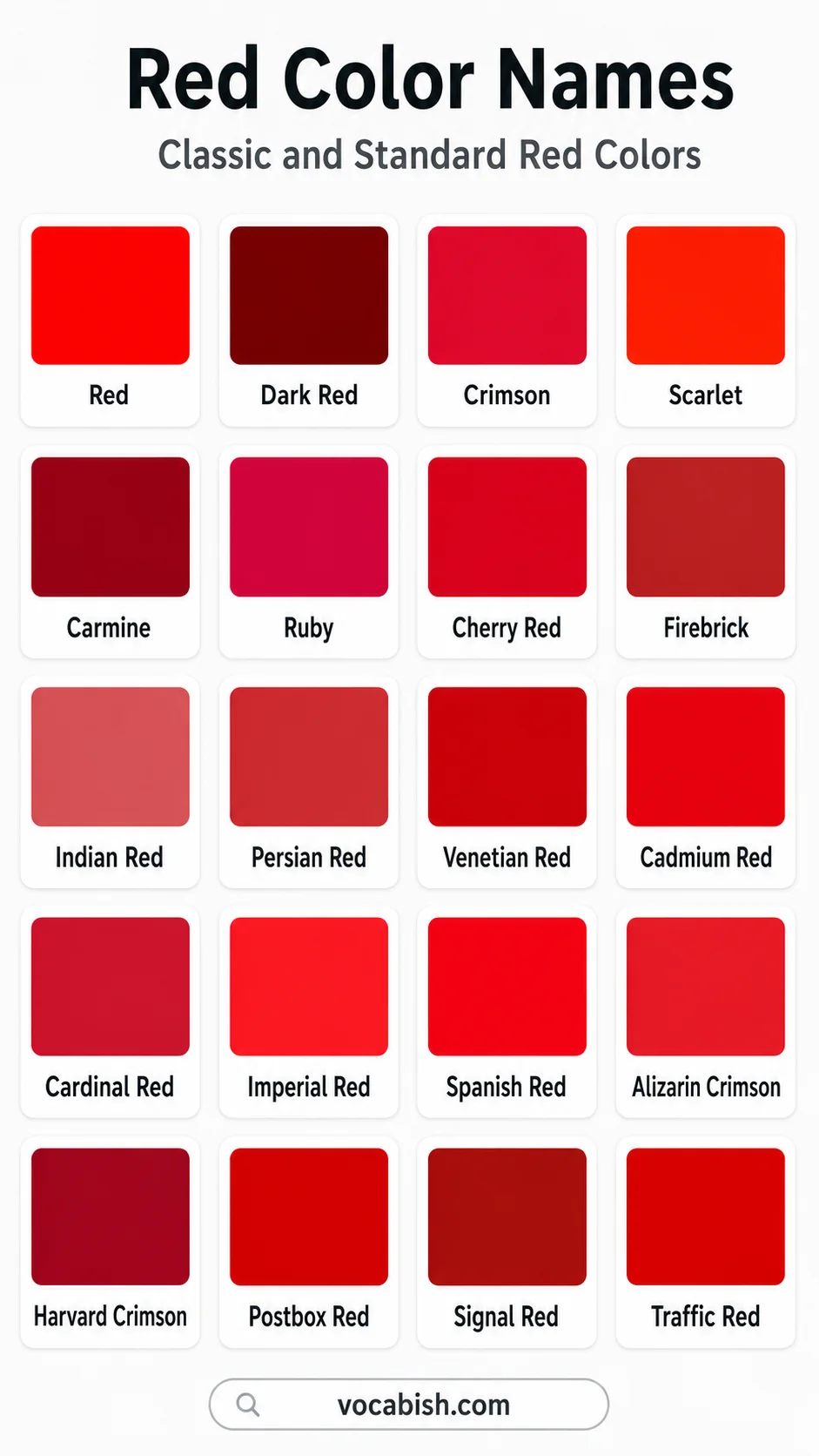
Classic and Standard Red Colors
These shades sit close to the central red family. They are useful for learning the basic differences between clear, warm, cool, muted, and historical reds.
Red color name | Hex code | RGB value | Description |
|---|---|---|---|
Red | #FF0000 | 255, 0, 0 | Pure, bold red used for urgency, love, and attention. |
Dark Red | #8B0000 | 139, 0, 0 | A serious, mature red linked with strength and depth. |
Crimson | #DC143C | 220, 20, 60 | A rich blue-based red associated with ceremony and passion. |
Scarlet | #FF2400 | 255, 36, 0 | A brilliant warm red that feels energetic and dramatic. |
Carmine | #960018 | 150, 0, 24 | A deep, refined red often used in art and cosmetics. |
Ruby | #E0115F | 224, 17, 95 | A jewel-like red suggesting luxury, romance, and value. |
Cherry Red | #D2042D | 210, 4, 45 | A lively fruit red with a cheerful, youthful feel. |
Firebrick | #B22222 | 178, 34, 34 | A dark brick red suited to traditional and industrial designs. |
Indian Red | #CD5C5C | 205, 92, 92 | A muted earthy red with a calm, natural character. |
Persian Red | #CC3333 | 204, 51, 51 | A warm, balanced red common in decorative palettes. |
Venetian Red | #C80815 | 200, 8, 21 | An earthy historical pigment red with an artistic feel. |
Cadmium Red | #E30022 | 227, 0, 34 | A strong opaque artist’s red with high visual impact. |
Cardinal Red | #C41E3A | 196, 30, 58 | A dignified deep red associated with confidence and ceremony. |
Imperial Red | #ED2939 | 237, 41, 57 | A polished bright red that suggests power and importance. |
Spanish Red | #E60026 | 230, 0, 38 | A vivid warm red with a festive, expressive mood. |
Alizarin Crimson | #E32636 | 227, 38, 54 | A cool deep crimson used widely in painting. |
Harvard Crimson | #A51C30 | 165, 28, 48 | A dark academic crimson associated with tradition and prestige. |
Postbox Red | #D50000 | 213, 0, 0 | A highly visible public-service red used for recognition. |
Signal Red | #A52019 | 165, 32, 25 | A clear warning red designed to attract attention quickly. |
Traffic Red | #CC0605 | 204, 6, 5 | A safety-related red linked with stopping and danger. |
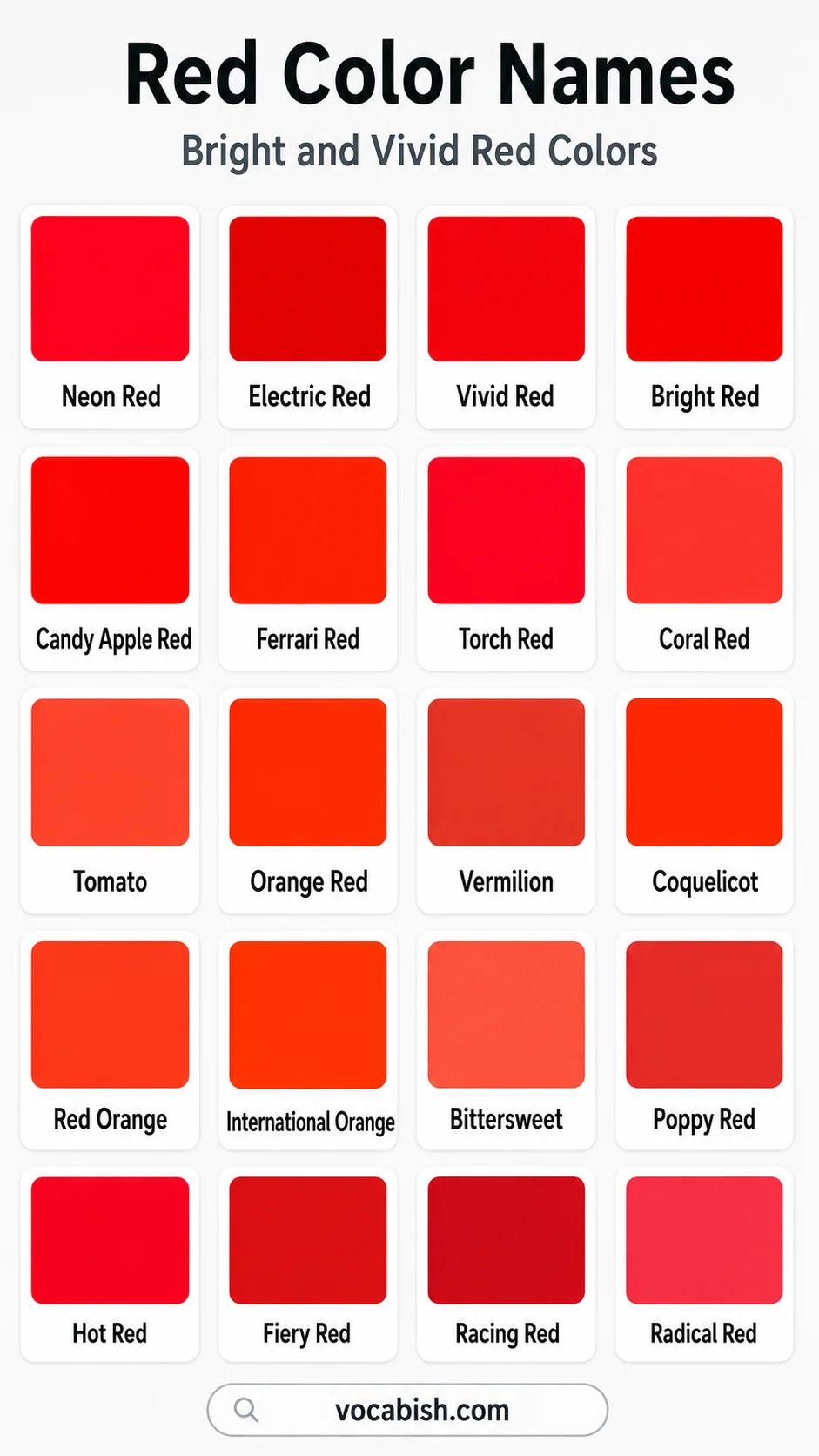
Bright and Vivid Red Colors
Bright reds contain strong saturation and very little grey. They are often chosen for signs, sports graphics, calls to action, packaging, and energetic visual content.
Red color name | Hex code | RGB value | Description |
|---|---|---|---|
Neon Red | #FF073A | 255, 7, 58 | An intense glowing red used for nightlife and digital emphasis. |
Electric Red | #E60000 | 230, 0, 0 | A sharp high-energy red suited to modern graphics. |
Vivid Red | #F70D1A | 247, 13, 26 | A saturated red that appears strong, fresh, and direct. |
Bright Red | #FF000D | 255, 0, 13 | A clean, eye-catching red for alerts, buttons, and highlights. |
Candy Apple Red | #FF0800 | 255, 8, 0 | A glossy warm red associated with cars and sweets. |
Ferrari Red | #FF2800 | 255, 40, 0 | A racing-inspired red suggesting speed and performance. |
Torch Red | #FD0E35 | 253, 14, 53 | A blazing pink-red often used for energetic branding. |
Coral Red | #FF4040 | 255, 64, 64 | A friendly red softened by orange and pink undertones. |
Tomato | #FF6347 | 255, 99, 71 | A warm orange-red that feels fresh and casual. |
Orange Red | #FF4500 | 255, 69, 0 | A fiery red-orange used for action and high visibility. |
Vermilion | #E34234 | 227, 66, 52 | A historic orange-red pigment with a bold artistic presence. |
Coquelicot | #FF3800 | 255, 56, 0 | A poppy-like orange-red that feels bright and lively. |
Red Orange | #FF5349 | 255, 83, 73 | A balanced mix of red and orange with youthful energy. |
International Orange | #FF4F00 | 255, 79, 0 | A safety-focused orange-red made for strong visibility. |
Bittersweet | #FE6F5E | 254, 111, 94 | A soft reddish orange with a warm, nostalgic character. |
Poppy Red | #DC343B | 220, 52, 59 | A floral red-orange associated with brightness and remembrance. |
Hot Red | #F0002F | 240, 0, 47 | A forceful pink-red used for excitement and emphasis. |
Fiery Red | #D01C1F | 208, 28, 31 | A heated red suggesting flame, action, and intensity. |
Racing Red | #BD162C | 189, 22, 44 | A sporty dark red associated with movement and competition. |
Radical Red | #FF355E | 255, 53, 94 | A playful vivid pink-red used in youthful designs. |
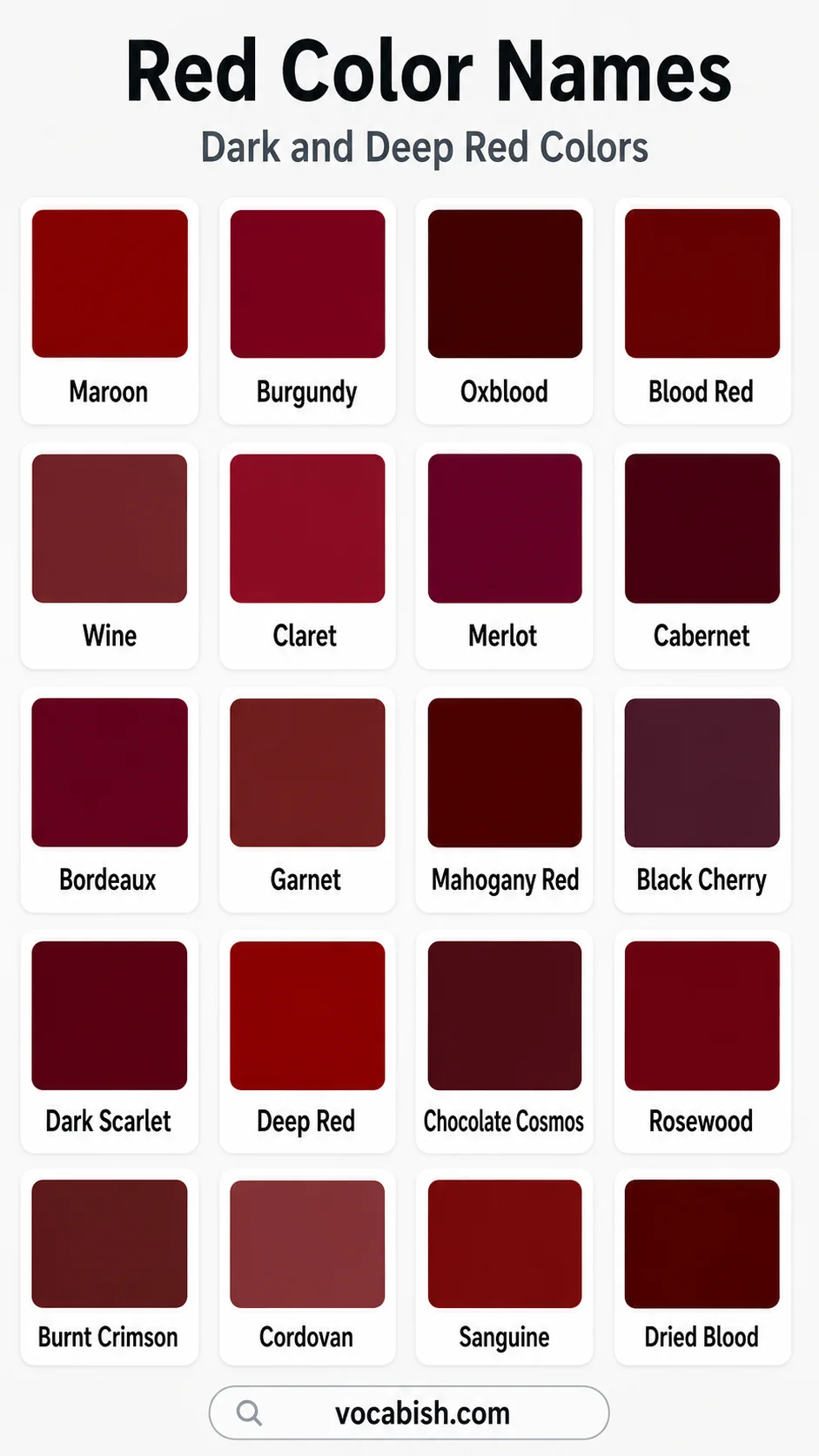
Dark and Deep Red Colors
Dark reds are created by lowering the lightness of red or mixing it with black, brown, blue, or purple. They often appear richer and more formal than bright reds.
Red color name | Hex code | RGB value | Description |
|---|---|---|---|
Maroon | #800000 | 128, 0, 0 | A dark brown-red that suggests stability and tradition. |
Burgundy | #800020 | 128, 0, 32 | A wine-inspired red linked with luxury and sophistication. |
Oxblood | #4A0000 | 74, 0, 0 | An almost-black red used for leather and dramatic interiors. |
Blood Red | #660000 | 102, 0, 0 | A very dark pure red associated with intensity and danger. |
Wine | #722F37 | 114, 47, 55 | A muted dark red with an elegant, mature mood. |
Claret | #7F1734 | 127, 23, 52 | A deep purplish red named after dark red wine. |
Merlot | #730039 | 115, 0, 57 | A smooth wine red often used in refined palettes. |
Cabernet | #4C0013 | 76, 0, 19 | A nearly black wine red with a formal character. |
Bordeaux | #5C0120 | 92, 1, 32 | A dark French-wine red suited to premium branding. |
Garnet | #733635 | 115, 54, 53 | A brownish jewel red suggesting depth and durability. |
Mahogany Red | #4E0606 | 78, 6, 6 | A blackened wood red with a rich traditional appearance. |
Black Cherry | #52253A | 82, 37, 58 | A dark purple-red with a sweet, luxurious feel. |
Dark Scarlet | #560319 | 86, 3, 25 | A shadowed scarlet that remains bold but more serious. |
Deep Red | #850101 | 133, 1, 1 | A concentrated dark red used for drama and emphasis. |
Chocolate Cosmos | #58111A | 88, 17, 26 | A brown-black red inspired by the dark flower. |
Rosewood | #65000B | 101, 0, 11 | A dark red-brown associated with polished wood and heritage. |
Burnt Crimson | #582124 | 88, 33, 36 | A smoky dark crimson with an aged artistic look. |
Cordovan | #893F45 | 137, 63, 69 | A leather-like red-brown used in classic fashion. |
Sanguine | #6C110E | 108, 17, 14 | A historic blood-red tone associated with drawing pigments. |
Dried Blood | #4B0101 | 75, 1, 1 | A very dark brown-red used for sombre dramatic palettes. |
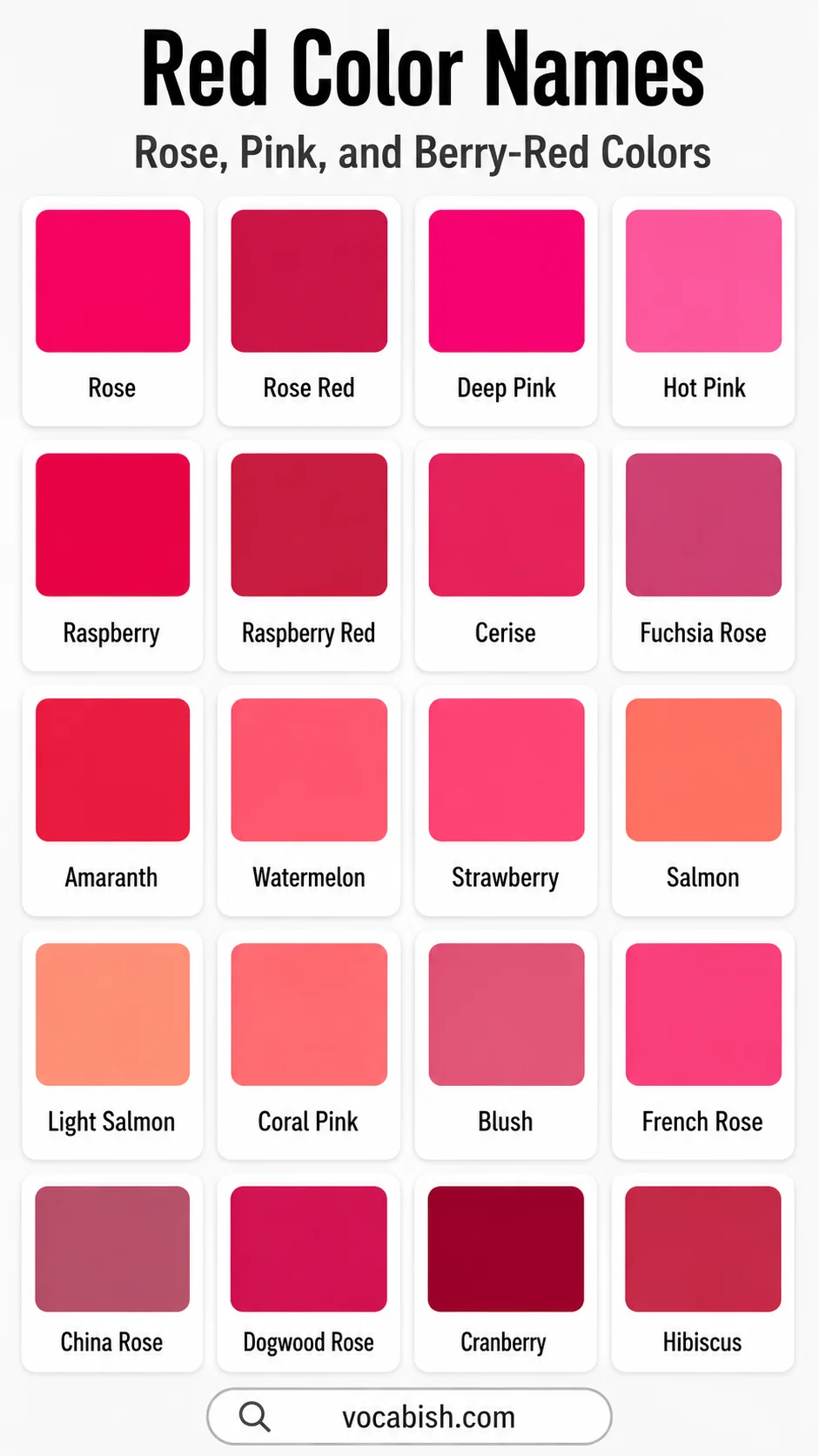
Rose, Pink, and Berry-Red Colors
These red colors move toward pink, magenta, or cool purple. Many are named after flowers, fruits, and berries.
Red color name | Hex code | RGB value | Description |
|---|---|---|---|
Rose | #FF007F | 255, 0, 127 | A strong pink-red associated with affection and flowers. |
Rose Red | #C21E56 | 194, 30, 86 | A balanced floral red between crimson and pink. |
Deep Pink | #FF1493 | 255, 20, 147 | A saturated pink-red with a lively, playful effect. |
Hot Pink | #FF69B4 | 255, 105, 180 | A bright pink-red used for bold, youthful statements. |
Raspberry | #E30B5C | 227, 11, 92 | A cool fruit red with a fresh, fashionable feel. |
Raspberry Red | #C72C48 | 199, 44, 72 | A darker berry red suited to beauty and food branding. |
Cerise | #DE3163 | 222, 49, 99 | A vivid cherry-pink red whose name comes from French. |
Fuchsia Rose | #C74375 | 199, 67, 117 | A cool floral red with noticeable purple undertones. |
Amaranth | #E52B50 | 229, 43, 80 | A bright rosy red named after the amaranth flower. |
Watermelon | #FC6C85 | 252, 108, 133 | A juicy light red-pink associated with summer and freshness. |
Strawberry | #FC5A8D | 252, 90, 141 | A sweet pinkish red used in playful food imagery. |
Salmon | #FA8072 | 250, 128, 114 | A soft warm pink-red with an approachable feel. |
Light Salmon | #FFA07A | 255, 160, 122 | A paler salmon shade suited to gentle backgrounds. |
Coral Pink | #F88379 | 248, 131, 121 | A warm pink-red inspired by coral reefs. |
Blush | #DE5D83 | 222, 93, 131 | A muted rosy red associated with softness and warmth. |
French Rose | #F64A8A | 246, 74, 138 | A polished bright rose used in fashion and cosmetics. |
China Rose | #A8516E | 168, 81, 110 | A dusty purple-red with a vintage floral character. |
Dogwood Rose | #D71868 | 215, 24, 104 | A strong botanical pink-red with excellent contrast. |
Cranberry | #9E003A | 158, 0, 58 | A cool dark berry red associated with autumn and food. |
Hibiscus | #B43757 | 180, 55, 87 | A tropical floral red with rich pink undertones. |
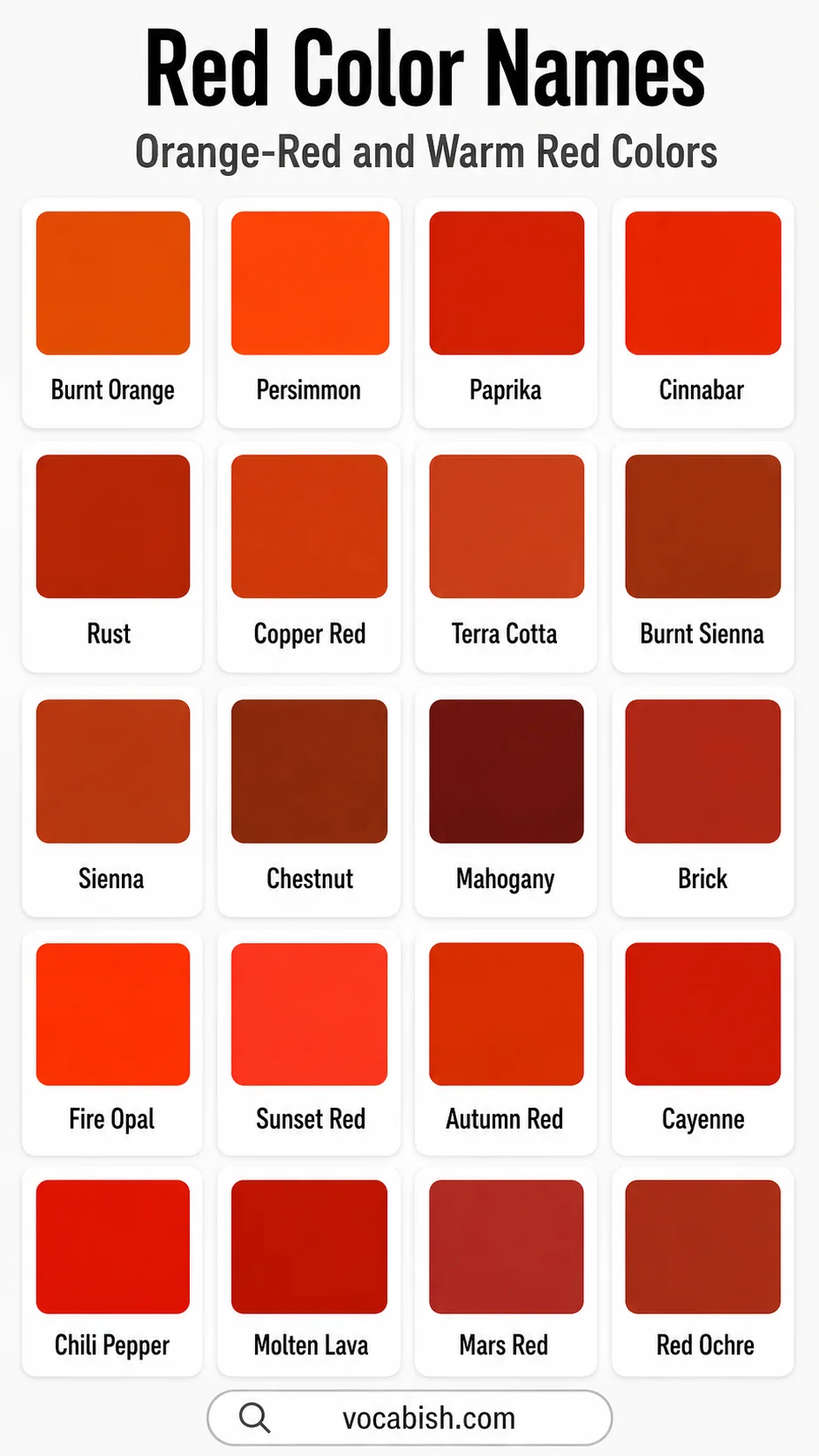
Orange-Red and Warm Red Colors
Warm reds contain yellow, orange, or brown undertones. They often resemble flames, spices, clay, autumn leaves, or sun-warmed earth.
Red color name | Hex code | RGB value | Appearance or common meaning |
|---|---|---|---|
Burnt Orange | #CC5500 | 204, 85, 0 | A dark orange-red linked with autumn and warmth. |
Persimmon | #EC5800 | 236, 88, 0 | A vivid fruit orange-red that feels lively and natural. |
Paprika | #A63A2B | 166, 58, 43 | A spicy muted red with warm brown undertones. |
Cinnabar | #E44D2E | 228, 77, 46 | A bright mineral orange-red known from historic pigments. |
Rust | #B7410E | 183, 65, 14 | An oxidised brown-red suggesting age, earth, and industry. |
Copper Red | #CB6D51 | 203, 109, 81 | A metallic-looking warm red with soft orange tones. |
Terra Cotta | #E2725B | 226, 114, 91 | A clay-based red-orange used in pottery and architecture. |
Burnt Sienna | #E97451 | 233, 116, 81 | An earth pigment between orange, red, and brown. |
Sienna | #A0522D | 160, 82, 45 | A natural brown-red named after an Italian earth pigment. |
Chestnut | #954535 | 149, 69, 53 | A medium reddish brown associated with wood and hair. |
Mahogany | #C04000 | 192, 64, 0 | A strong red-brown inspired by polished hardwood. |
Brick | #CB4154 | 203, 65, 84 | A muted construction red with familiar earthy warmth. |
Fire Opal | #E95C4B | 233, 92, 75 | A glowing coral-red inspired by the colourful gemstone. |
Sunset Red | #C23B22 | 194, 59, 34 | A warm dark orange-red associated with evening skies. |
Autumn Red | #B73524 | 183, 53, 36 | A leaf-like red-brown used in seasonal palettes. |
Cayenne | #C04F3D | 192, 79, 61 | A spicy warm red named after cayenne pepper. |
Chili Pepper | #9B1B30 | 155, 27, 48 | A dark pepper red suggesting heat and bold flavour. |
Molten Lava | #B5332E | 181, 51, 46 | A smoky glowing red associated with heat and movement. |
Mars Red | #BC2731 | 188, 39, 49 | An iron-rich earthy red inspired by the planet. |
Red Ochre | #913831 | 145, 56, 49 | A natural mineral red used since ancient times. |
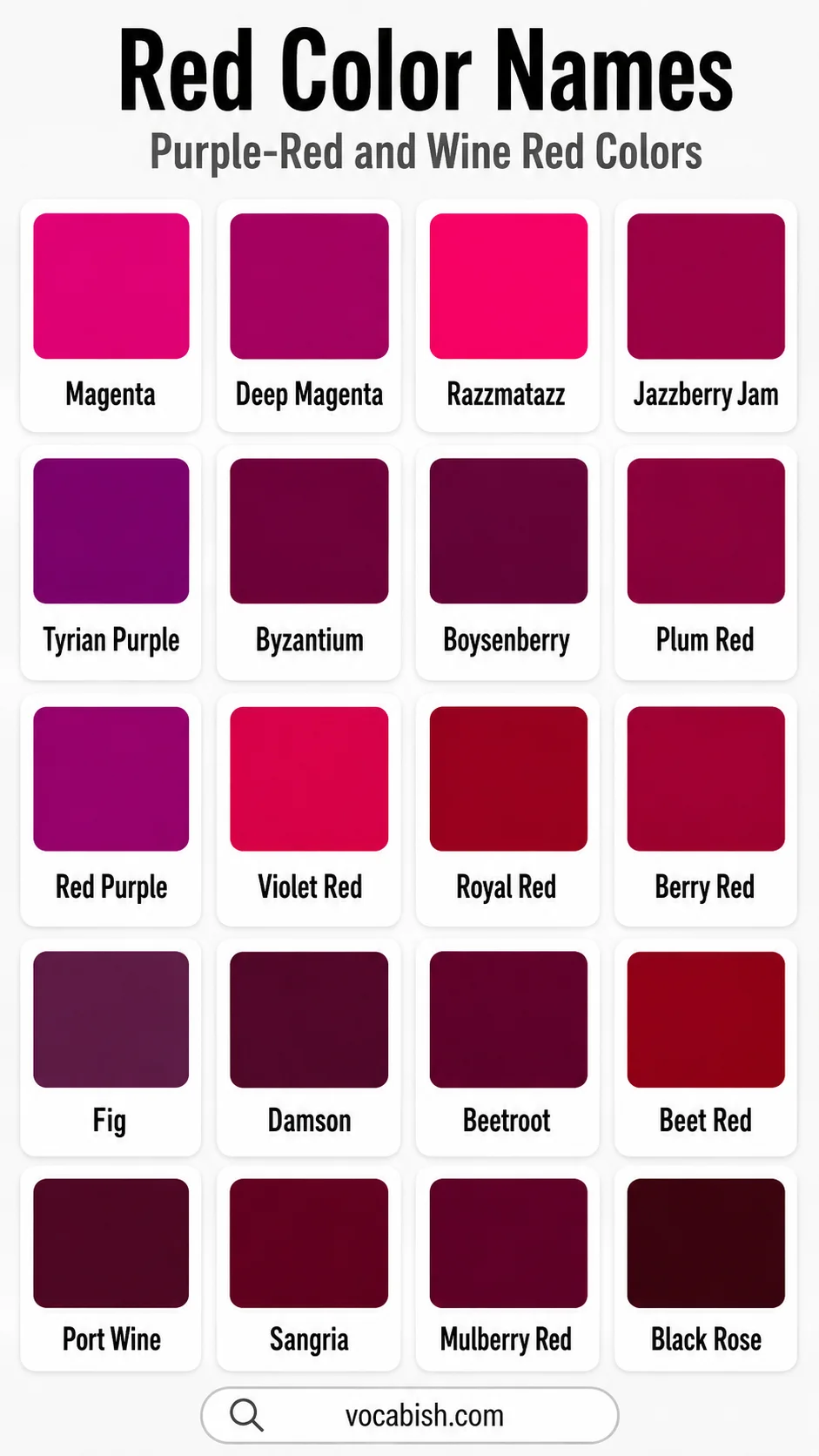
Purple-Red and Wine Red Colors
Purple-red colors contain a noticeable blue or violet influence. They range from vivid magenta to nearly black wine shades.
Red color name | Hex code | RGB value | Description |
|---|---|---|---|
Magenta | #FF00FF | 255, 0, 255 | A vivid red-purple used in printing and digital color systems. |
Deep Magenta | #CC00CC | 204, 0, 204 | A darker red-purple with strong theatrical impact. |
Razzmatazz | #E3256B | 227, 37, 107 | A bright raspberry red with playful energy. |
Jazzberry Jam | #A50B5E | 165, 11, 94 | A dark berry-magenta used for creative designs. |
Tyrian Purple | #630330 | 99, 3, 48 | A historic dark purple-red associated with royalty. |
Byzantium | #702963 | 112, 41, 99 | A muted deep purple-red with an antique feel. |
Boysenberry | #873260 | 135, 50, 96 | A dark berry red-purple inspired by the fruit. |
Plum Red | #8F1D4D | 143, 29, 77 | A deep fruit red with noticeable violet undertones. |
Red Purple | #E40078 | 228, 0, 120 | A direct mixture of red and purple with strong saturation. |
Violet Red | #F75394 | 247, 83, 148 | A lighter red-violet used in cosmetics and fashion. |
Royal Red | #9B1C31 | 155, 28, 49 | A dark formal red suggesting authority and richness. |
Berry Red | #8A1538 | 138, 21, 56 | A cool deep red suited to food and beauty palettes. |
Fig | #7A3E48 | 122, 62, 72 | A muted dusky red-purple inspired by fig skin. |
Damson | #5E2A40 | 94, 42, 64 | A dark plum-red named after the damson fruit. |
Beetroot | #8E0038 | 142, 0, 56 | An earthy purple-red associated with the root vegetable. |
Beet Red | #7A1F3D | 122, 31, 61 | A muted beet-like red used for natural palettes. |
Port Wine | #5A0A1E | 90, 10, 30 | A near-black purple-red inspired by fortified wine. |
Sangria | #92000A | 146, 0, 10 | A strong dark red named after the fruit-and-wine drink. |
Mulberry Red | #A93C64 | 169, 60, 100 | A medium berry red with soft purple undertones. |
Black Rose | #532934 | 83, 41, 52 | A shadowy red-purple used for dramatic themes. |
Earthy, Brown, and Rustic Red Colors
Earthy reds contain brown, orange, grey, or muted mineral tones. They are widely used in architecture, traditional art, leather, furniture, and autumn-inspired designs.
Red color name | Hex code | RGB value | Description |
|---|---|---|---|
Auburn | #A52A2A | 165, 42, 42 | A medium red-brown commonly used to describe hair. |
Red Brown | #8B2E22 | 139, 46, 34 | A straightforward earthy blend of red and brown. |
Russet | #80461B | 128, 70, 27 | A dark orange-brown red associated with leaves and leather. |
Copper | #B87333 | 184, 115, 51 | A metallic orange-brown with a warm reddish cast. |
Burnt Umber | #8A3324 | 138, 51, 36 | A deep brown pigment with a noticeable red undertone. |
Sepia Red | #704214 | 112, 66, 20 | A vintage brown-red suited to aged visual effects. |
Cedar Chest | #C95A49 | 201, 90, 73 | A warm wood red inspired by cedar furniture. |
Redwood | #A45A52 | 164, 90, 82 | A muted timber red associated with natural materials. |
Rose Taupe | #905D5D | 144, 93, 93 | A greyed red-brown with a calm interior-design feel. |
Dusty Red | #B9484E | 185, 72, 78 | A muted red softened with grey for understated designs. |
Clay Red | #B66A50 | 182, 106, 80 | A warm earthen red inspired by natural clay. |
Earth Red | #8E3A2D | 142, 58, 45 | A grounded brown-red used in rustic color schemes. |
Canyon Red | #AF5F45 | 175, 95, 69 | A sun-baked stone red with orange-brown undertones. |
Rooibos Red | #A23B3C | 162, 59, 60 | A tea-inspired earthy red with natural warmth. |
Henna | #7C2D12 | 124, 45, 18 | A dark orange-brown red associated with henna dye. |
Cinnamon Red | #9E3B2E | 158, 59, 46 | A spicy brown-red inspired by cinnamon bark. |
Tuscan Red | #7C4848 | 124, 72, 72 | A muted historic red used in architecture and interiors. |
Antique Ruby | #841B2D | 132, 27, 45 | An aged jewel red with brown and wine undertones. |
Falu Red | #801818 | 128, 24, 24 | A traditional deep red used on Scandinavian wooden buildings. |
Barn Red | #7C0A02 | 124, 10, 2 | A dark practical red associated with rural buildings. |
Soft, Muted, and Pastel Red Colors
These shades are lightened with white or softened with grey. They work well when pure red would appear too strong or demanding.
Red color name | Hex code | RGB value | Description |
|---|---|---|---|
Pastel Red | #FF6961 | 255, 105, 97 | A softened warm red that remains cheerful but less intense. |
Light Coral | #F08080 | 240, 128, 128 | A pale coral-red suited to friendly backgrounds and accents. |
Salmon Pink | #FF91A4 | 255, 145, 164 | A light pink-red with warm orange undertones. |
Melon | #FDBCB4 | 253, 188, 180 | A delicate peach-red inspired by ripe melon flesh. |
Misty Rose | #FFE4E1 | 255, 228, 225 | An extremely pale pink-red often used as a background. |
Tea Rose | #F4C2C2 | 244, 194, 194 | A gentle dusty pink-red with a classic floral feel. |
Rose Dust | #9E5E6F | 158, 94, 111 | A greyed mauve-red suited to understated fashion palettes. |
Old Rose | #C08081 | 192, 128, 129 | A muted historic rose with a vintage appearance. |
Antique Rose | #D19592 | 209, 149, 146 | A warm faded rose associated with aged fabrics. |
Rosy Brown | #BC8F8F | 188, 143, 143 | A soft brownish rose included among standard web colors. |
New York Pink | #D7837F | 215, 131, 127 | A muted salmon-red with a modern soft look. |
Muted Red | #B55A5A | 181, 90, 90 | A low-saturation red for calm, restrained designs. |
Soft Red | #E97471 | 233, 116, 113 | A gentle medium red that feels warm rather than urgent. |
Faded Red | #D3494E | 211, 73, 78 | A washed red suggesting weathering or vintage print. |
Pastel Rose | #DEA5A4 | 222, 165, 164 | A pale greyed rose suitable for soft decorative themes. |
Rose Beige | #CB8E8E | 203, 142, 142 | A neutral reddish beige used in interiors and fashion. |
Apricot Red | #E8917D | 232, 145, 125 | A light orange-red with a warm fruit-like quality. |
Salmon Rose | #E7968B | 231, 150, 139 | A muted coral-rose balancing warmth and softness. |
Pinkish Red | #F03A47 | 240, 58, 71 | A bright red shifted toward pink for lively accents. |
Pale Chestnut | #DDADAF | 221, 173, 175 | A light dusty red-brown with a delicate vintage feel. |
How Are Different Shades of Red Created?
A red shade changes when another color, white, black, or grey is added. The amount added determines whether the result becomes lighter, darker, warmer, cooler, brighter, or more muted.
Color term | How it is created | Red example |
|---|---|---|
Hue | The basic color family | Red |
Tint | Red mixed with white | Pastel red |
Shade | Red mixed with black | Dark red |
Tone | Red mixed with grey | Dusty red |
Warm red | Red leaning toward yellow or orange | Scarlet |
Cool red | Red leaning toward blue or purple | Crimson |
Saturated red | Strong red with little grey | Vivid red |
Muted red | Red softened with grey or brown | Tuscan red |
Red Tints
A tint is produced by adding white to red.
Examples include:
- Misty rose
- Tea rose
- Pastel red
- Light coral
- Melon
- Pale chestnut
Red tints usually appear softer, calmer, and less urgent than pure red.
Red Shades
A shade is produced by adding black to red.
Examples include:
- Dark red
- Oxblood
- Cabernet
- Deep red
- Rosewood
- Black rose
These darker colors often create a serious, dramatic, or formal appearance.
Red Tones
A tone is made by adding grey to red. Brown may also produce a muted, natural-looking result.
Examples include:
- Dusty red
- Rose taupe
- Muted red
- Old rose
- Tuscan red
- Rose beige
Warm Red and Cool Red Shades
The undertone of a red color changes how it works with other colors. Looking at whether red leans toward orange or blue can make matching colors much easier.
Warm Reds
Warm reds contain yellow, orange, or brown undertones.
Examples include:
- Scarlet
- Vermilion
- Tomato
- Cinnabar
- Burnt sienna
- Persimmon
- Cayenne
- Red ochre
Warm reds often pair well with cream, beige, gold, warm white, olive, and dark brown.
Cool Reds
Cool reds contain blue, pink, violet, or purple undertones.
Examples include:
- Crimson
- Carmine
- Ruby
- Raspberry
- Cranberry
- Claret
- Burgundy
- Beetroot
Cool reds often work well with navy, cool grey, silver, pale pink, violet, and crisp white.
Quick Comparison
Warm red | Cool red |
|---|---|
Leans toward orange | Leans toward blue or purple |
Often feels fiery or sunny | Often feels rich or jewel-like |
Scarlet is a common example | Crimson is a common example |
Works well with earthy palettes | Works well with cool or formal palettes |
What Does the Color Red Mean?
Red is one of the most visually powerful colors. Its meaning depends on context, shade, culture, and the other colors surrounding it.
Common associations include:
- Love and romance
- Energy and movement
- Courage and confidence
- Heat and fire
- Danger and warning
- Anger or intensity
- Celebration and good fortune
- Strength and leadership
A bright red button may signal an urgent action. A ruby-red dress may suggest elegance, while a dark burgundy room may feel formal and comfortable.
Red does not communicate the same message everywhere. Cultural meanings should be considered when creating international designs, products, or learning materials.
How to Choose the Right Red Color
The best red depends on the purpose, audience, background, and amount of space it will cover.
For Websites and Digital Designs
Bright red attracts attention quickly, making it useful for:
- Alerts
- Sale labels
- Notification icons
- Important buttons
- Error messages
- Small visual highlights
Avoid covering a large screen with highly saturated red unless the strong effect is intentional.
For readability, check the contrast between red text and its background. Do not use red alone to communicate an error because some users may not distinguish it easily. Add an icon, label, or explanatory message.
For Clothing and Fashion
Different undertones suit different combinations:
- Scarlet creates a bright statement.
- Ruby feels polished and luxurious.
- Burgundy works well for formal clothing.
- Coral red feels lighter and more relaxed.
- Oxblood gives leather and footwear a classic appearance.
- Dusty red produces a softer, understated look.
Lighting and fabric texture can make the same red appear different.
For Interior Design
Red can make a room feel warm and active, but large amounts may become visually heavy.
Common choices include:
- Brick red for rustic rooms
- Burgundy for formal spaces
- Terra cotta for warm natural interiors
- Dusty red for softer rooms
- Barn red for traditional or farmhouse styles
- Rose beige for neutral decorative schemes
For Educational Color Charts
A useful red colors name chart should include:
- A visible color sample
- The color name
- A hex code
- An RGB value
- A short description
- Clear grouping by shade family
Grouping similar shades helps learners compare subtle differences without feeling overwhelmed.
Pronunciation of Unusual Red Color Names
Some names of red colors come from French, historical pigments, gemstones, foods, and places. Their pronunciation may not be clear from their spelling.
Color name | Pronunciation | Helpful note |
|---|---|---|
Alizarin | uh-LIZ-uh-rin | A historic dye and pigment name |
Burgundy | BUR-guhn-dee | Named after the Burgundy region |
Carmine | KAR-mine | A deep crimson-red |
Cerise | suh-REEZ | French for cherry |
Cinnabar | SIN-uh-bar | A red mineral and pigment |
Claret | KLAR-it | A name connected with red wine |
Coquelicot | KOH-klee-koh | French name for a poppy-red shade |
Cordovan | KOR-duh-vuhn | Connected with fine leather |
Oxblood | OKS-blud | A very dark brownish red |
Sanguine | SANG-gwin | A historical reddish drawing color |
Vermilion | ver-MIL-yuhn | A bright orange-red pigment |
Venetian | vuh-NEE-shuhn | Connected with Venice |
Red Color Vocabulary for English Learners
Learning red color names also introduces useful vocabulary for describing objects accurately.
Describing Brightness
- Bright red: strong and easy to notice
- Light red: red mixed with white
- Dark red: red with low lightness
- Pale red: very light and soft
- Deep red: dark, rich, and concentrated
For Describing Intensity
- Vivid red: highly saturated and strong
- Muted red: softened with grey or brown
- Bold red: visually powerful and confident
- Soft red: gentle and less intense
- Dull red: low in saturation or brightness
Describing Undertones
- Orange-red: red leaning toward orange
- Pink-red: red leaning toward pink
- Purple-red: red leaning toward violet
- Brown-red: red mixed with earthy brown
- Blue-red: a cool red with a blue undertone
Example Sentences
- She wore a crimson scarf with a black coat.
- The old building had a brick-red exterior.
- We selected burgundy chairs for the formal dining room.
- The flowers were a bright vermilion color.
- His hair appeared auburn in the sunlight.
- The designer used coral red for the main button.
- The leather shoes had a deep oxblood finish.
- The sunset changed from orange to scarlet.
Common Red Color Confusions
- Not every name has one fixed code. Paint, fashion, printing, and digital brands may define the same name differently.
- Pink, orange, and purple boundaries can overlap. Coral, rose, magenta, and vermilion may belong to more than one color family.
- Screen colors may not match printed colors. RGB and hex values describe light, while printing usually uses CMYK inks.
- Brightness depends on surroundings. A red may look darker beside white and brighter beside black.
- Some names are historical or legacy terms. Their modern use may be wider than their original pigment or material meaning.
FAQs About Red Color Names
Pure digital red uses #FF0000 and RGB 255, 0, 0. It contains maximum red light with no green or blue.
There is no fixed total because red can be adjusted continuously. Color systems, paint companies, designers, and cultures use thousands of variations.
Common names include red, scarlet, crimson, ruby, cherry red, maroon, burgundy, coral red, brick red, vermilion, and rose red.
Scarlet is generally a warm red leaning toward orange, while crimson is usually a cooler, deeper red with a slight blue undertone.
Burgundy is a dark red with purple or brown undertones. It remains part of the red family but appears cooler than maroon.
Oxblood, cabernet, dried blood, black rose, rosewood, mahogany red, and port wine are among the darkest shades in this red colors list.
Scarlet, vermilion, tomato, cinnabar, persimmon, burnt sienna, cayenne, and orange red are warm because they contain yellow or orange undertones.
Many color names are descriptive rather than officially standardised. Different sources may therefore assign slightly different digital values to the same shade name.
Conclusion
These red color names show how one color family can move from vivid scarlet and fiery vermilion to dark burgundy, earthy brick, cool raspberry, and pale misty rose.
Use the names, hex codes, RGB values, and meanings in this red colors chart to build vocabulary, compare shades, plan designs, and describe colors more accurately. Remember that many artistic and commercial red names have approximate rather than universal digital codes.
Explore More Colors and Their Shades
- 120+ Weird Color Names
- All MTG Color Combo Names
- 150+ Green Color Names
- 150+ Purple Color Names
- Pink Color Names in English
- 60 Brown Color Names in English