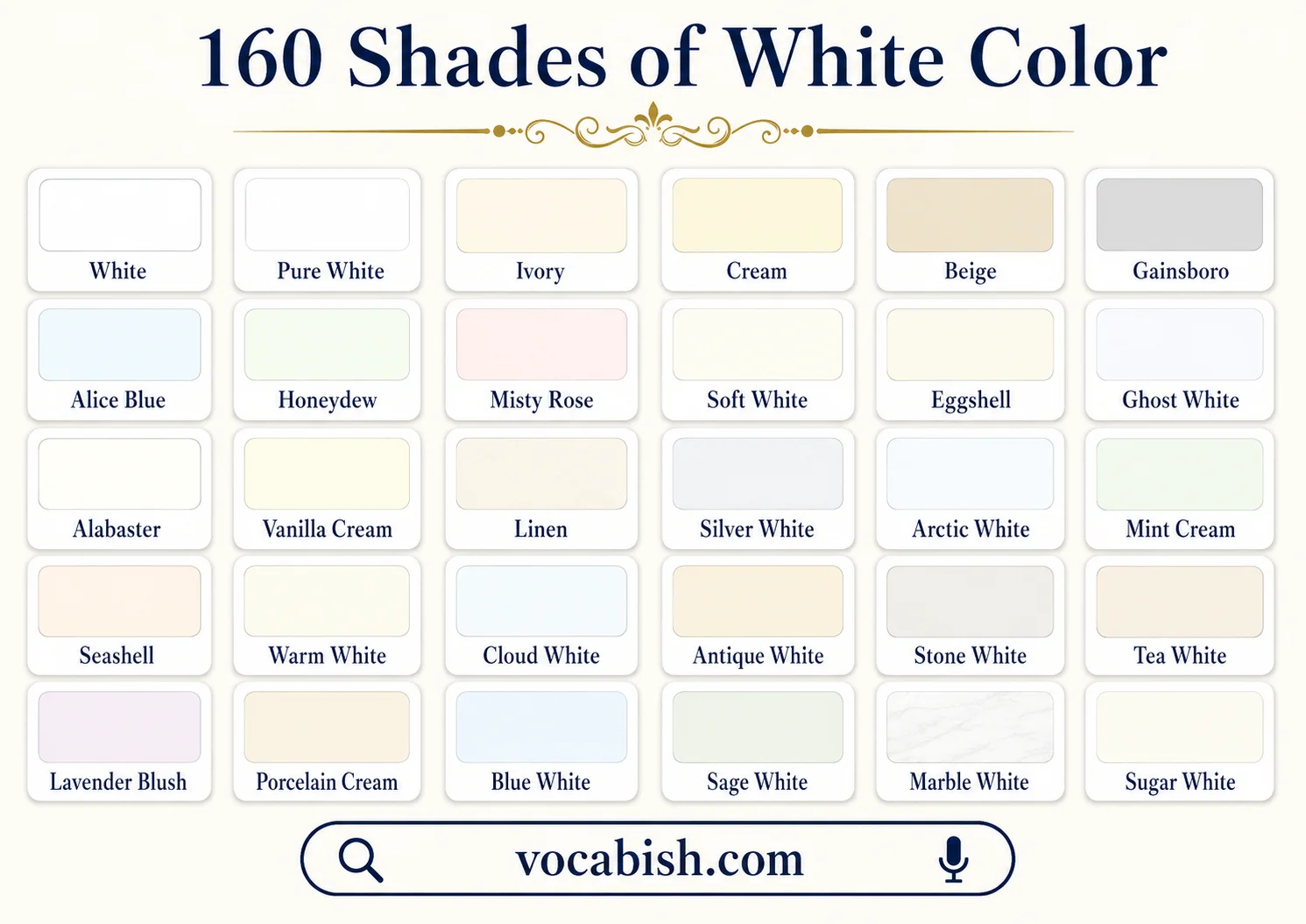

White may look like one simple color, but it comes in many beautiful shades. White color names include pure white, ivory, cream, snow, pearl, alabaster, linen, and many more. Each shade can have a warm, cool, gray, beige, pink, or blue undertone. These small differences can change how a white color looks on screens, clothes, walls, paper, or designs. In this article, you will find 150+ names of white colors with hex codes, meanings, undertones, and easy explanations.
What Makes One White Different From Another?
Pure digital white has no visible undertone, but most off-whites contain a small amount of another color. That hidden color changes how the white looks beside furniture, clothing, lighting, or other shades.
For example, ivory contains a soft yellow tone, while ghost white has a faint blue-violet appearance. Both may look white alone, but their differences become clearer when placed side by side.
What Is an Undertone?
An undertone is the subtle color underneath the main color. White may have one of these common undertones:
- Yellow: warm, sunny, and creamy
- Beige: natural, soft, and earthy
- Pink: gentle, romantic, and welcoming
- Peach: warm, light, and friendly
- Blue: cool, clean, and crisp
- Green: fresh, calm, and botanical
- Gray: balanced, modern, and muted
- Violet: cool, delicate, and slightly floral
Is Off-White Still White?
Yes. Off-white is a broad term for a shade that is close to white but contains a visible hint of another color.
Cream, ivory, eggshell, pearl, linen, bone, and alabaster are all commonly treated as off-white colors.
White Color Names Chart: 160 Shades and Hex Codes
The following white colors chart contains 160 names arranged by undertone and visual family. Each hex code represents the shade on a digital screen.
Some names, such as white, snow, ivory, and ghost white, have established web-color values. Decorative, fashion, interior, and paint-style names may vary between brands, so their codes below are representative reference values.
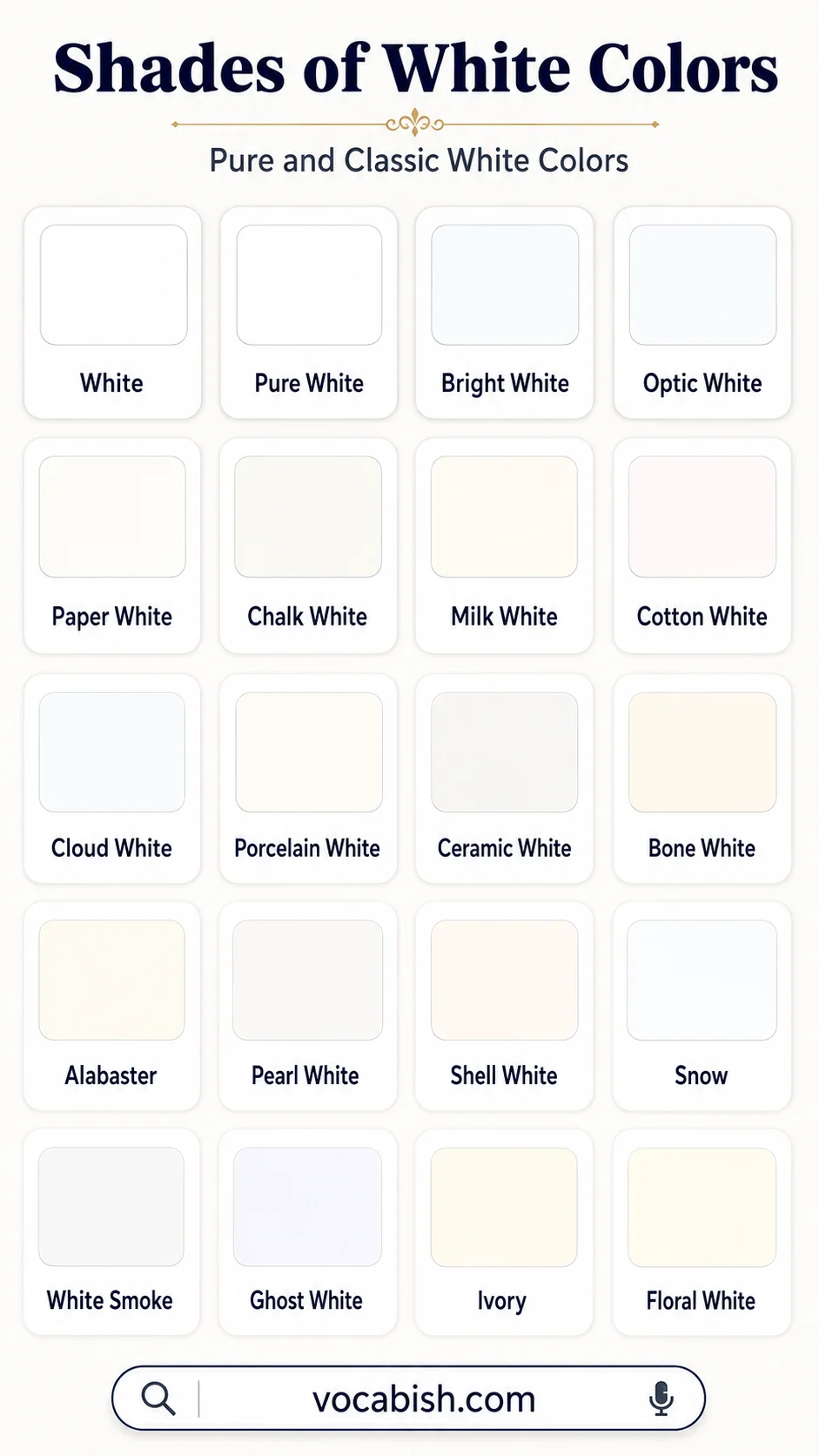
Pure and Classic White Colors
These are the cleanest and most familiar names of white colors. Some are nearly neutral, while others contain only a slight warm, cool, or gray undertone.
White color name | Hex code | Undertone | Meaning or appearance |
|---|---|---|---|
White | #FFFFFF | Neutral | The cleanest digital white |
Pure White | #FEFEFE | Neutral | Almost identical to full white |
Bright White | #FDFDFD | Neutral | A crisp, high-brightness white |
Optic White | #FCFCFF | Cool | A sharp white with faint blue |
Paper White | #F8F8F4 | Neutral | A soft white like clean paper |
Chalk White | #FBFBF7 | Neutral | A dry, powdery-looking white |
Milk White | #FDFFF5 | Warm | A gentle white with creamy warmth |
Cotton White | #FBFAF2 | Warm | A soft natural-fabric white |
Cloud White | #F7F9F9 | Cool | A light and airy gray-white |
Porcelain White | #F8F6F0 | Warm | A smooth, refined ceramic white |
Ceramic White | #F7F7F2 | Neutral | A clean white with muted depth |
Bone White | #F9F6EE | Warm | An off-white with beige warmth |
Alabaster | #F2F0E6 | Warm | A pale mineral-inspired white |
Pearl White | #F6F1EB | Warm | A softly glowing, elegant white |
Shell White | #F8F4ED | Warm | A natural white inspired by shells |
Snow | #FFFAFA | Pink | A nearly pure white with rosy warmth |
White Smoke | #F5F5F5 | Gray | A very pale screen-friendly gray-white |
Ghost White | #F8F8FF | Cool | A light blue-violet white |
Ivory | #FFFFF0 | Yellow | A warm white with pale yellow |
Floral White | #FFFAF0 | Warm | A delicate cream-white |
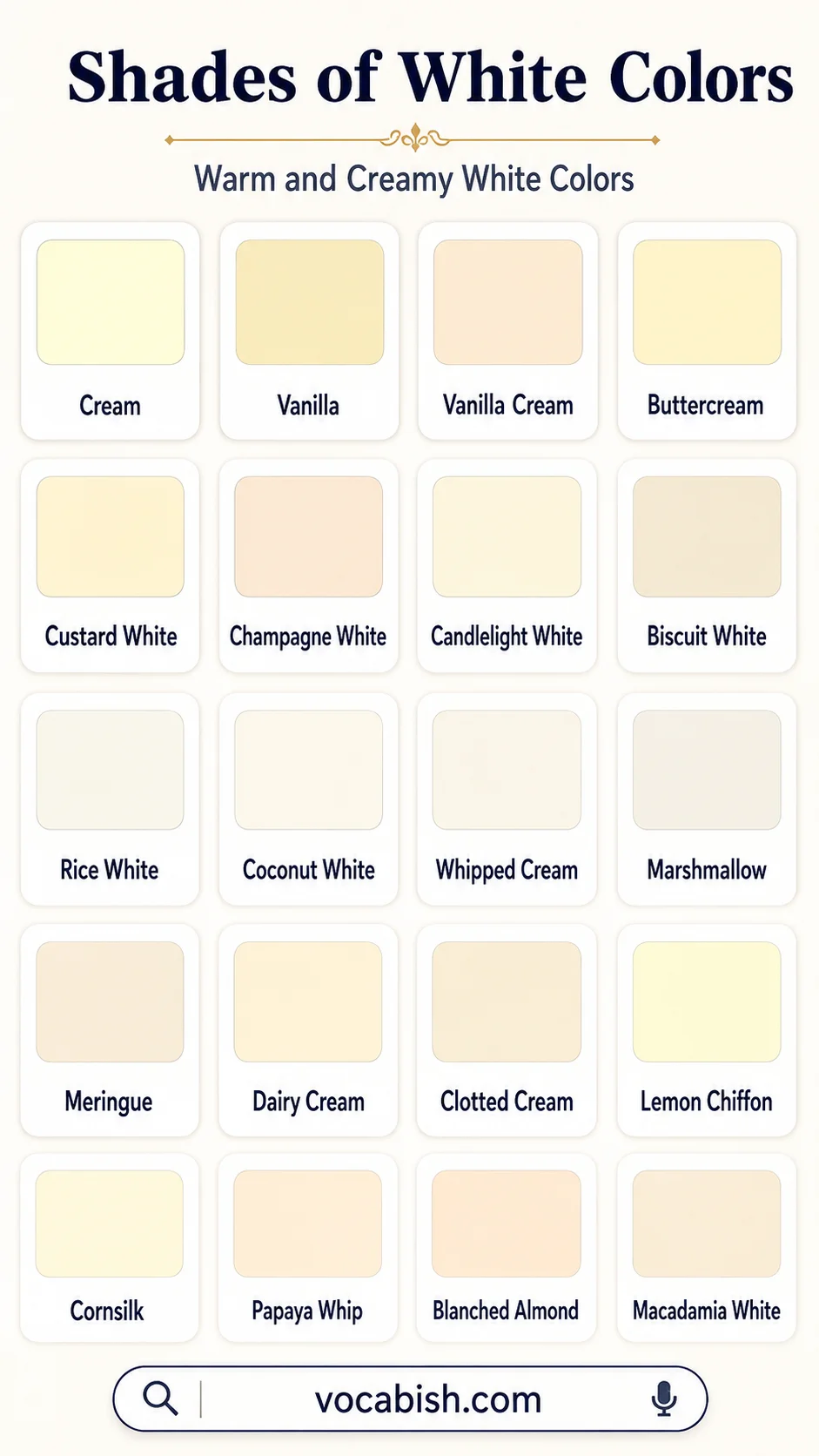
Warm and Creamy White Colors
Creamy whites contain yellow, gold, peach, or light beige. They often feel softer than pure white and work well with warm browns, natural fabrics, and wooden surfaces.
White color name | Hex code | Undertone | Meaning or appearance |
|---|---|---|---|
Cream | #FFFDD0 | Yellow | A pale yellow-white with softness |
Vanilla | #F3E5AB | Yellow | A sweet, warm creamy shade |
Vanilla Cream | #F7E7CE | Peach | A lighter vanilla with peach warmth |
Buttercream | #FFF4C2 | Yellow | A rich bakery-inspired white |
Custard White | #FFF3D0 | Yellow | A gentle creamy yellow-white |
Champagne White | #F7E6D2 | Peach | An elegant beige-pink white |
Candlelight White | #F8EFD4 | Yellow | A warm white like candlelight |
Biscuit White | #F1E6D2 | Beige | A baked, lightly tan white |
Rice White | #F4F0E6 | Warm | A calm white like uncooked rice |
Coconut White | #F6F1E7 | Warm | A natural creamy-white tone |
Whipped Cream | #F5F1E8 | Warm | A fluffy and soft off-white |
Marshmallow | #F3EDE4 | Warm | A sweet, muted cream-white |
Meringue | #F3E4C7 | Yellow | A pale baked-cream shade |
Dairy Cream | #F9EFD8 | Yellow | A milky white with golden warmth |
Clotted Cream | #F3E8D0 | Yellow | A dense and rich cream-white |
Lemon Chiffon | #FFFACD | Yellow | A very pale lemon-white |
Cornsilk | #FFF8DC | Yellow | A light golden-white shade |
Papaya Whip | #FFEFD5 | Peach | A soft peachy cream |
Blanched Almond | #FFEBCD | Peach | A warm almond-colored off-white |
Macadamia White | #F7EAD6 | Beige | A nutty cream-white |
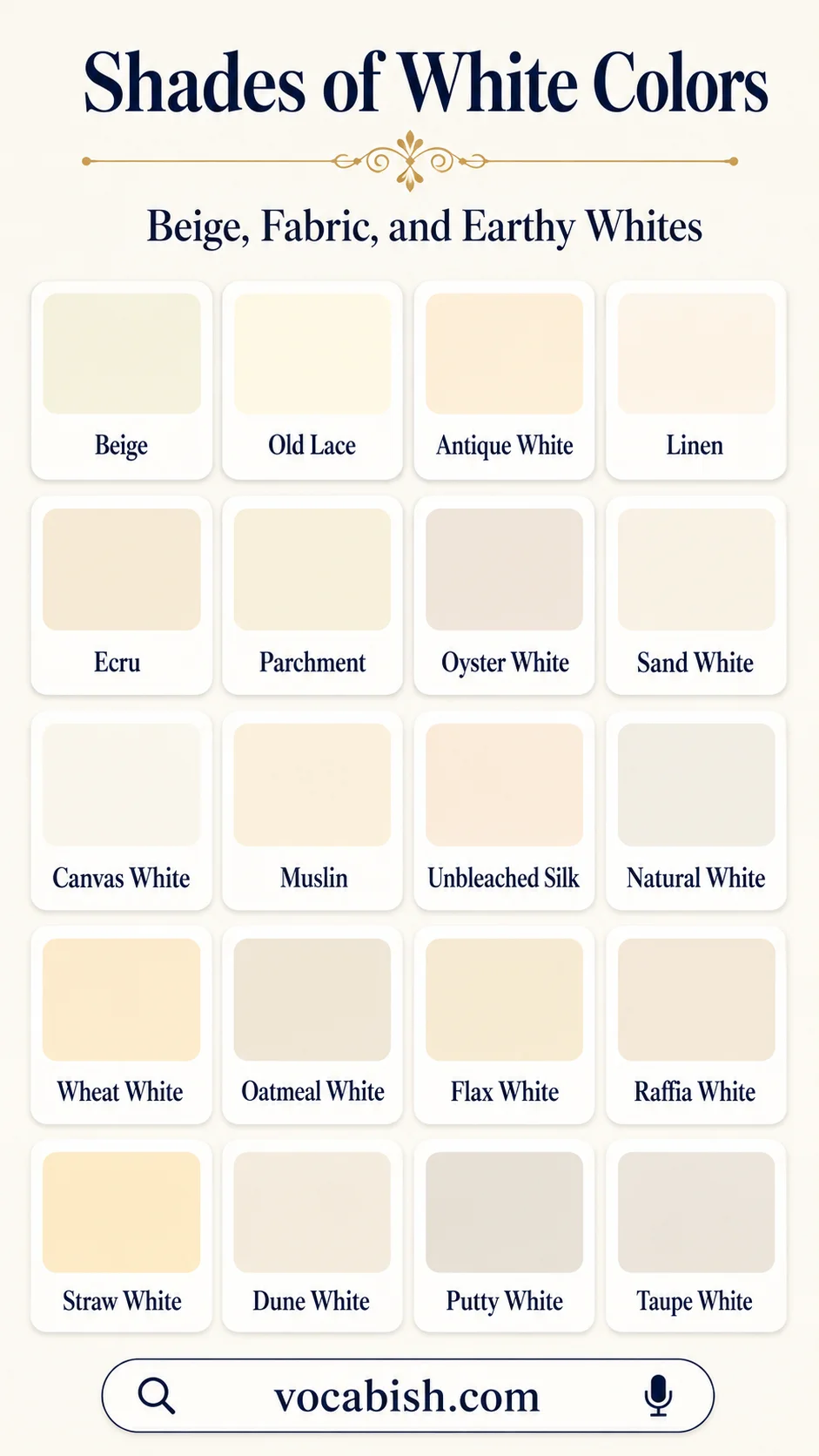
Beige, Fabric, and Earthy Whites
These shades resemble natural fibres, sand, grain, paper, stone, and unbleached fabric. Their muted appearance often feels calm and grounded.
White color name | Hex code | Undertone | Meaning or appearance |
|---|---|---|---|
Beige | #F5F5DC | Beige | A pale neutral between white and tan |
Old Lace | #FDF5E6 | Warm | A vintage creamy-white |
Antique White | #FAEBD7 | Warm | An aged white with golden warmth |
Linen | #FAF0E6 | Peach | A pale fabric-inspired off-white |
Ecru | #F3E8D3 | Beige | An unbleached natural-cloth white |
Parchment | #F1E9D2 | Yellow | A paper-like aged cream |
Oyster White | #EAE0D5 | Gray-beige | A muted shell-inspired neutral |
Sand White | #F4EEE1 | Beige | A soft beach-sand off-white |
Canvas White | #F5F2E8 | Neutral | A sturdy natural-fabric white |
Muslin | #F4EAD5 | Beige | An unbleached cotton-like shade |
Unbleached Silk | #F5E6D3 | Peach | A soft natural-silk white |
Natural White | #EEECE1 | Beige | A restrained, earthy white |
Wheat White | #F7E7C6 | Yellow | A pale grain-colored cream |
Oatmeal White | #EDE3D0 | Beige | A cozy grain-inspired neutral |
Flax White | #F2E8CE | Yellow | A plant-fibre-inspired cream |
Raffia White | #E9DFCB | Beige | A dry woven-fibre off-white |
Straw White | #F7E9CF | Yellow | A light golden rural white |
Dune White | #EDE5D8 | Beige | A muted sandy off-white |
Putty White | #E4DDD3 | Gray-beige | A soft gray-beige white |
Taupe White | #E8E1D8 | Taupe | A pale brown-gray white |
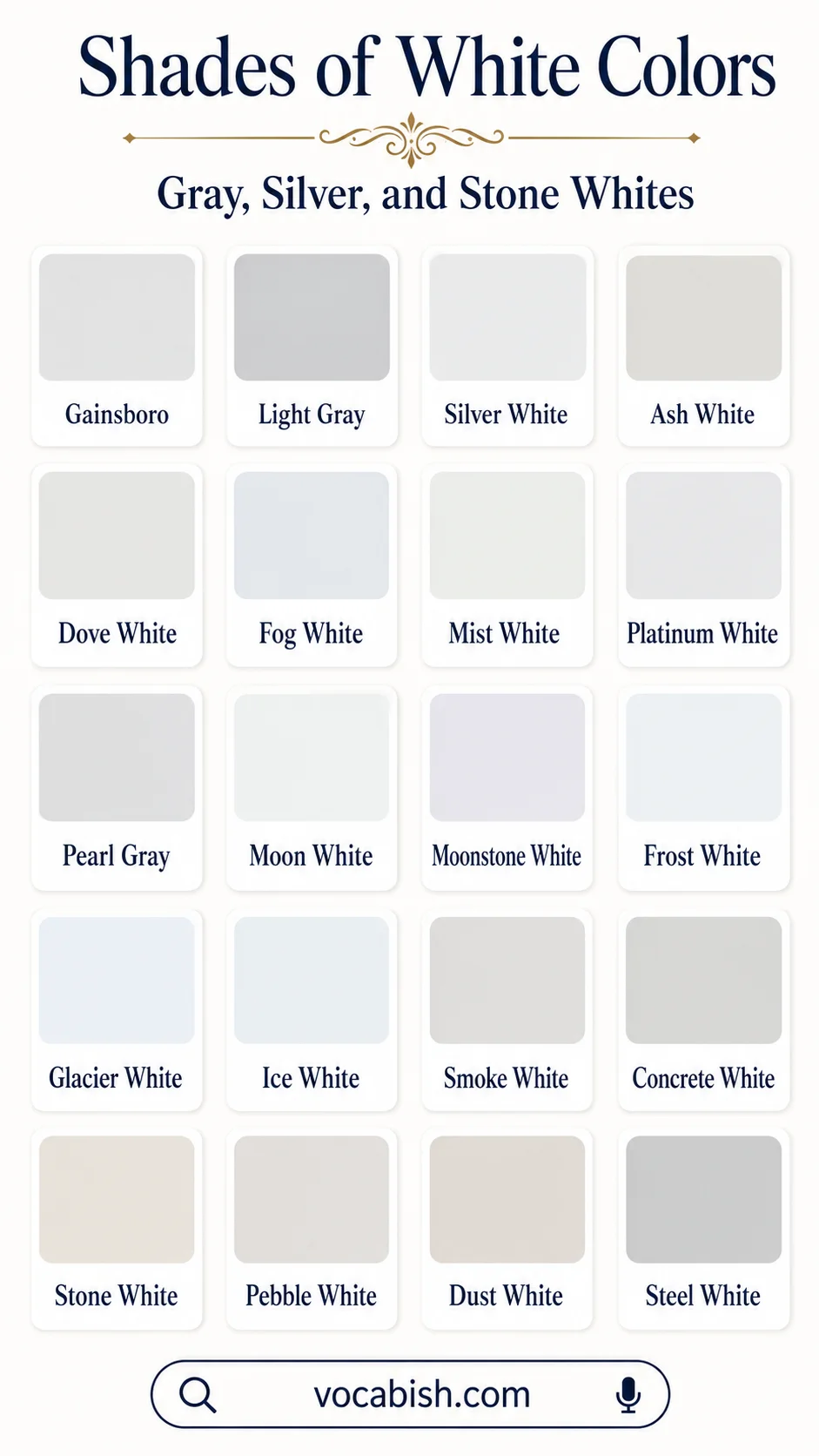
Gray, Silver, and Stone Whites
Gray-white colors have a quiet, modern appearance. They are less bright than pure white and may reduce strong contrast in digital layouts and interior spaces.
White color name | Hex code | Undertone | Meaning or appearance |
|---|---|---|---|
Gainsboro | #DCDCDC | Gray | A named light gray near white |
Light Gray | #D3D3D3 | Gray | A clear pale gray |
Silver White | #E6E8E9 | Cool gray | A bright metallic-looking neutral |
Ash White | #E7E5E4 | Gray | A dusty gray-white |
Dove White | #EDEBE8 | Warm gray | A calm feather-like white |
Fog White | #F1F2F1 | Gray | A hazy, low-contrast white |
Mist White | #EEF0F2 | Cool gray | A cool and airy white |
Platinum White | #E5E4E2 | Gray | A pale precious-metal neutral |
Pearl Gray | #EAE7E2 | Warm gray | A softly reflective gray-white |
Moon White | #F4F4F0 | Neutral | A pale, luminous white |
Moonstone White | #E9EEF0 | Cool gray | A mineral white with blue-gray depth |
Frost White | #EEF1F3 | Cool gray | A chilly gray-white |
Glacier White | #EAF2F8 | Blue-gray | A cool, icy white |
Ice White | #F1F7F7 | Blue | A crisp blue-leaning white |
Smoke White | #ECEAE7 | Warm gray | A muted, smoky neutral |
Concrete White | #E8E6E1 | Gray-beige | A pale architectural gray |
Stone White | #E6E2DA | Beige-gray | A grounded mineral off-white |
Pebble White | #E8E3DB | Beige-gray | A soft rounded-stone white |
Dust White | #E5E2DD | Gray-beige | A powdery and muted white |
Steel White | #E3E7E9 | Cool gray | A clean industrial gray-white |
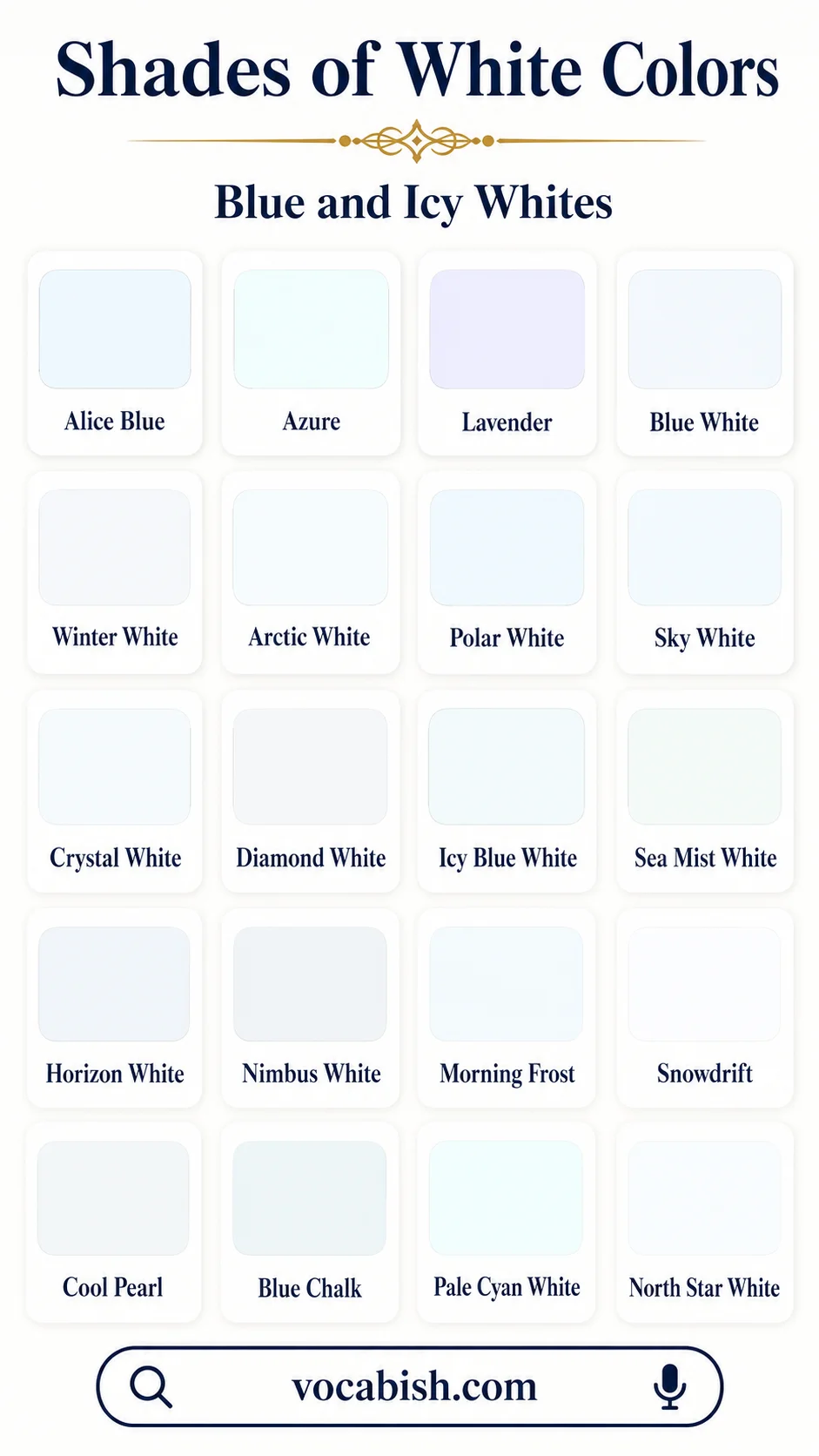
Blue and Icy Whites
Blue-white colors appear bright, fresh, and cool. They are common in winter themes, technology designs, clean packaging, and modern interiors.
White color name | Hex code | Undertone | Meaning or appearance |
|---|---|---|---|
Alice Blue | #F0F8FF | Blue | A very pale blue-white |
Azure | #F0FFFF | Cyan | A near-white with cyan freshness |
Lavender | #E6E6FA | Violet | A pale violet-white |
Blue White | #F3F7FA | Blue | A subtle blue-leaning white |
Winter White | #F5F7F8 | Cool | A clean cold-season white |
Arctic White | #F6FBFF | Blue | A bright polar blue-white |
Polar White | #F2F8FC | Blue | A cool snowfield white |
Sky White | #F4FAFF | Blue | A white touched by sky blue |
Crystal White | #F6FAFC | Cool | A clear, glass-like white |
Diamond White | #F4F7F8 | Cool gray | A bright polished white |
Icy Blue White | #EEF7FA | Blue | A faint frozen-blue white |
Sea Mist White | #F0F8F7 | Cyan | A coastal blue-green white |
Horizon White | #EFF5F7 | Blue-gray | A distant and airy blue-white |
Nimbus White | #EEF1F4 | Blue-gray | A cloud-inspired cool neutral |
Morning Frost | #F2F7FA | Blue | A soft dawn-frost white |
Snowdrift | #F7FAFC | Cool | A clean piled-snow white |
Cool Pearl | #EEF2F3 | Cool gray | A silvery white with cool depth |
Blue Chalk | #EAF1F3 | Blue-gray | A powdery blue-white |
Pale Cyan White | #F2FFFF | Cyan | A nearly white cyan tint |
North Star White | #F6FAFD | Blue | A bright celestial white |
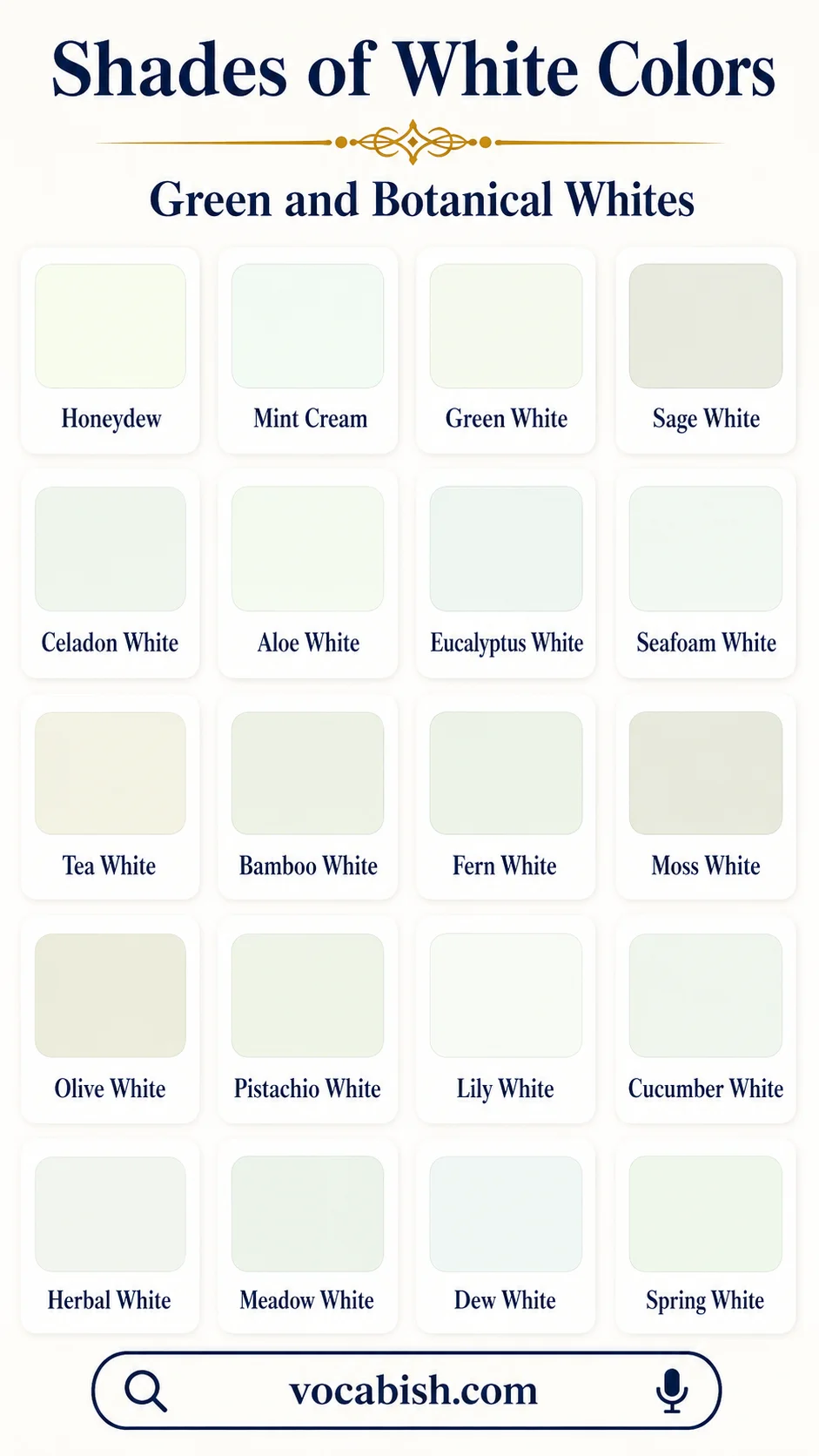
Green and Botanical Whites
Green-leaning whites connect naturally with leaves, herbs, mist, water, and plant life. They can feel fresh without looking strongly green.
White color name | Hex code | Undertone | Meaning or appearance |
|---|---|---|---|
Honeydew | #F0FFF0 | Green | A pale fresh green-white |
Mint Cream | #F5FFFA | Green | A clean mint-tinted white |
Green White | #F3F7F2 | Green | A subtle green-leaning neutral |
Sage White | #EDF1E7 | Green-gray | A muted herbal white |
Celadon White | #F0F5EB | Green | A pale ceramic green-white |
Aloe White | #EFF5EA | Green | A gentle plant-inspired white |
Eucalyptus White | #EDF2EC | Green-gray | A calm silvery green-white |
Seafoam White | #EFF8F3 | Green-blue | A coastal green-white |
Tea White | #F4F5EA | Yellow-green | A light tea-leaf neutral |
Bamboo White | #F1F0E5 | Yellow-green | A soft natural-stalk white |
Fern White | #EEF3EB | Green | A quiet leafy white |
Moss White | #ECEFE6 | Green-gray | A muted earthy green-white |
Olive White | #F1F0E2 | Olive | A pale yellow-green white |
Pistachio White | #F3F4E5 | Green-yellow | A creamy nut-green white |
Lily White | #F0F4ED | Green | A floral white with green depth |
Cucumber White | #F2F6EC | Green | A watery fresh green-white |
Herbal White | #EFF2E7 | Green-yellow | A soft botanical neutral |
Meadow White | #F3F5EB | Green | A sunny field-inspired white |
Dew White | #F4FAF4 | Green | A fresh moisture-tinted white |
Spring White | #F5FAF0 | Green-yellow | A lively seasonal white |
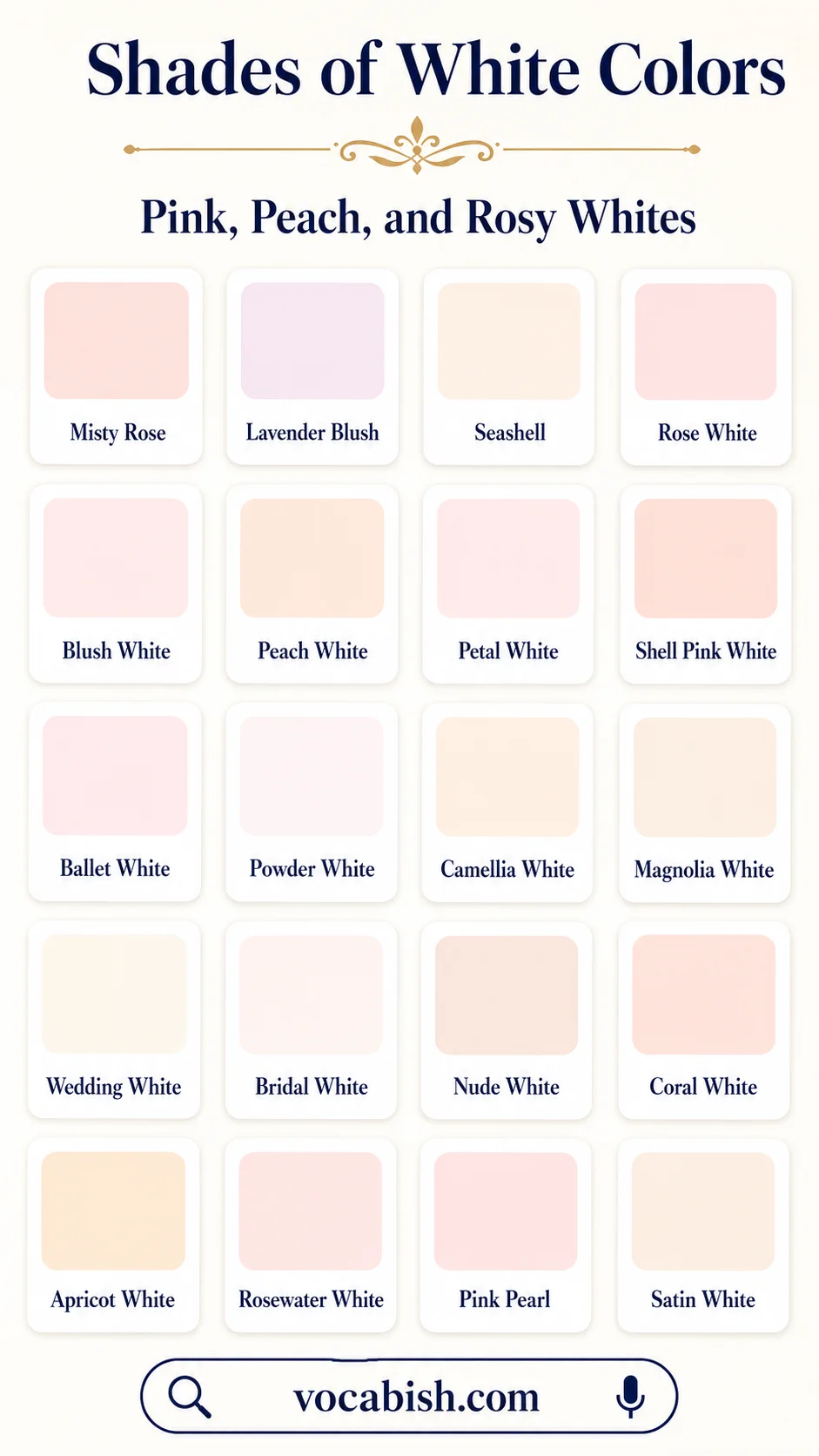
Pink, Peach, and Rosy Whites
Pink and peach whites feel softer and warmer than neutral white. They are often connected with flowers, shells, cosmetics, weddings, fabrics, and gentle decorative themes.
White color name | Hex code | Undertone | Meaning or appearance |
|---|---|---|---|
Misty Rose | #FFE4E1 | Pink | A very pale rosy shade |
Lavender Blush | #FFF0F5 | Pink-violet | A delicate pink-lavender white |
Seashell | #FFF5EE | Peach | A pale shell-like pink-white |
Rose White | #FFF6F5 | Pink | A white with gentle rose warmth |
Blush White | #FDF2F2 | Pink | A soft facial-blush white |
Peach White | #FFF3EB | Peach | A white with light peach warmth |
Petal White | #FAF0EF | Pink | A tender flower-petal white |
Shell Pink White | #FCEEEA | Peach-pink | A muted pink shell neutral |
Ballet White | #F5ECEA | Pink-beige | A graceful powder-pink white |
Powder White | #F8F1F0 | Pink-gray | A soft cosmetic-style white |
Camellia White | #FBF3F2 | Pink | A refined floral white |
Magnolia White | #F8F4E9 | Warm | A creamy flower-inspired white |
Wedding White | #F8F2ED | Peach | A soft formal-event white |
Bridal White | #F7F0EC | Pink-beige | A romantic warm off-white |
Nude White | #F3E9E4 | Beige-pink | A skin-toned pale neutral |
Coral White | #FFF1EC | Coral | A very light coral-white |
Apricot White | #FFF2E4 | Orange | A pale apricot cream |
Rosewater White | #F9EEEE | Pink | A diluted rose-tinted white |
Pink Pearl | #F8ECEC | Pink | A soft pearly blush-white |
Satin White | #F7F0EB | Peach | A smooth warm textile white |
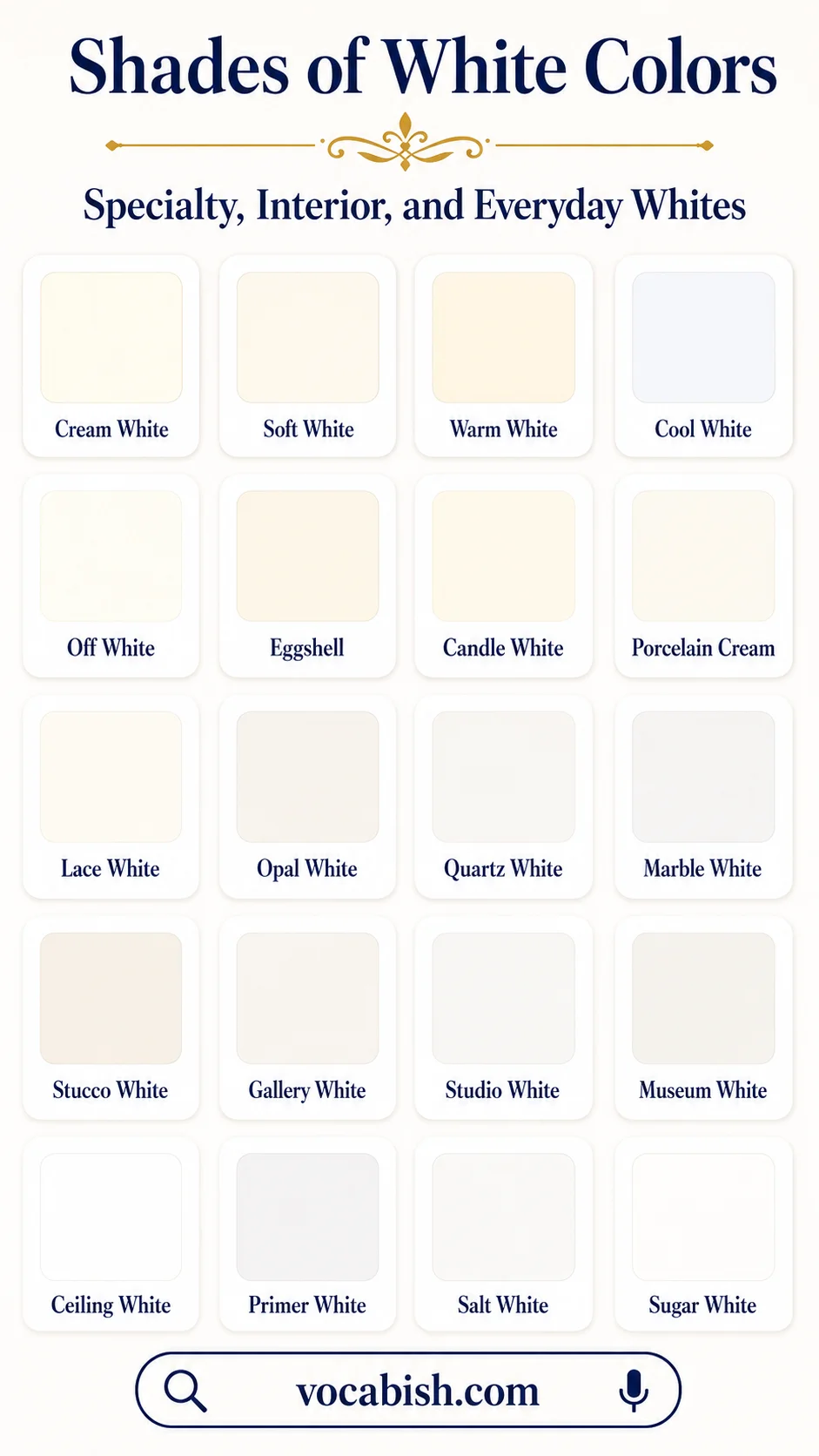
Specialty, Interior, and Everyday Whites
Many white color names come from paint, architecture, art materials, minerals, and common objects. These shades are useful when describing surfaces and interior finishes.
White color name | Hex code | Undertone | Meaning or appearance |
|---|---|---|---|
Cream White | #FFFDF2 | Yellow | A barely creamy white |
Soft White | #FAF9F6 | Warm | A gentle low-glare white |
Warm White | #FDF4E3 | Yellow | A cozy yellow-leaning white |
Cool White | #F8FAFC | Blue-gray | A crisp blue-leaning white |
Off White | #F7F5F0 | Warm | White softened by another tint |
Eggshell | #F0EAD6 | Yellow-beige | A classic warm paint-like white |
Candle White | #FFF9E8 | Yellow | A soft glowing white |
Porcelain Cream | #F6F0E4 | Warm | A creamy ceramic shade |
Lace White | #FBF7EF | Warm | A delicate textile-inspired white |
Opal White | #F4F1EC | Warm gray | A milky gemstone white |
Quartz White | #F4F4F2 | Neutral | A clean stone-like white |
Marble White | #F2F3F1 | Gray | A pale veined-stone white |
Stucco White | #F2EFE7 | Beige | A matte architectural off-white |
Gallery White | #F7F6F2 | Neutral | A quiet white for display spaces |
Studio White | #F4F3EF | Neutral | A balanced workroom white |
Museum White | #F6F5F0 | Warm gray | A calm exhibition-wall white |
Ceiling White | #FAFAF7 | Neutral | A bright practical interior white |
Primer White | #F3F3F0 | Gray | A flat preparatory-paint white |
Salt White | #F8F8F5 | Neutral | A dry crystalline white |
Sugar White | #FFFDF8 | Warm | A bright, slightly warm white |
Warm, Cool, and Neutral White at a Glance
The easiest way to compare shades of white colors is to group them by temperature. Color temperature describes whether a shade appears visually warm, cool, or balanced.
Warm whites lean toward yellow, orange, pink, or beige. Cool whites contain blue, green, violet, or cool gray.
White type | Common undertones | Examples | Overall feeling |
|---|---|---|---|
Neutral white | Very little visible color | White, Pure White, Quartz White | Clear, balanced, direct |
Warm white | Yellow, beige, peach, pink | Ivory, Cream, Linen, Eggshell | Soft, cozy, welcoming |
Cool white | Blue, cyan, violet, cool gray | Ghost White, Alice Blue, Arctic White | Crisp, fresh, modern |
Earthy white | Tan, taupe, grain, warm gray | Ecru, Oatmeal White, Dune White | Natural, quiet, grounded |
Botanical white | Green, sage, olive | Honeydew, Sage White, Mint Cream | Fresh, calm, organic |
Rosy white | Pink, peach, coral | Misty Rose, Blush White, Seashell | Gentle, romantic, warm |
Warm White Versus Cool White
A warm white may look creamy beside a blue-gray wall. A cool white may look slightly blue beside wood or beige fabric.
Neither type is automatically better. The right choice depends on the surrounding colors, light source, material, and desired mood.
Why Lighting Changes White
White reflects nearby light more clearly than many darker colors. As a result, the same white surface can appear different during the day.
- Warm indoor bulbs may make white look yellow or creamy.
- Cool LED lighting may make white look blue or gray.
- Morning daylight often appears cooler.
- Late-afternoon light usually adds golden warmth.
- Nearby walls, curtains, flooring, or furniture may reflect color onto white surfaces.
Popular White Shades and Their Meanings
White is often linked with cleanliness, openness, peace, freshness, and new beginnings. However, color meanings can change between cultures, settings, and personal experiences.
The undertone also affects the message. A sharp white may feel modern, while an aged cream may suggest tradition or comfort.
Shade | Common meaning or impression |
|---|---|
Pure White | Cleanliness, clarity, and brightness |
Ivory | Elegance, tradition, and gentle warmth |
Cream | Comfort, softness, and friendliness |
Snow | Freshness, winter, and natural purity |
Pearl White | Grace, value, and quiet luxury |
Alabaster | Calmness, refinement, and classical beauty |
Eggshell | Comfort, balance, and understated warmth |
Antique White | Age, history, and traditional style |
Linen | Natural fabric, relaxation, and simplicity |
Ghost White | Lightness, technology, and cool freshness |
Alice Blue | Airiness, imagination, and softness |
Mint Cream | Freshness, cleanliness, and nature |
Misty Rose | Tenderness, affection, and gentleness |
Cloud White | Openness, softness, and peaceful space |
Dove White | Quietness, balance, and calm |
White in Different Contexts
The meaning of white depends on where and how it appears.
- Clothing: White may suggest freshness, formality, celebration, or cleanliness.
- Interior design: It can make a room appear open, bright, or calm.
- Web design: White space can improve visual separation and reading comfort.
- Packaging: White often supports a clean, modern, or minimal appearance.
- Nature: Snow, clouds, shells, flowers, and minerals inspire many white names.
- Ceremonies: White may represent celebration in one culture and mourning in another.
How to Read White Color Codes
A color name can vary, but a digital code identifies a more exact screen color. The white colors and codes in the main chart use hexadecimal values, usually called hex codes.
A hex code begins with a hash sign followed by six characters, such as #FFFFFF.
Understanding a Hex Code
The six characters are divided into three pairs:
- The first pair controls red.
- The second pair controls green.
- The third pair controls blue.
Each pair ranges from 00, which means none of that color, to FF, which means the maximum amount.
For example:
#FFFFFFmeans full red, full green, and full blue.#FFFDD0contains slightly less green and much less blue, producing cream.#F0F8FFcontains a little less red and green than blue, producing Alice blue.
Popular Whites in Hex and RGB
RGB codes describe the same colors by listing red, green, and blue values from 0 to 255.
Color | Hex | RGB |
|---|---|---|
White | #FFFFFF | rgb(255, 255, 255) |
Snow | #FFFAFA | rgb(255, 250, 250) |
White Smoke | #F5F5F5 | rgb(245, 245, 245) |
Ghost White | #F8F8FF | rgb(248, 248, 255) |
Ivory | #FFFFF0 | rgb(255, 255, 240) |
Floral White | #FFFAF0 | rgb(255, 250, 240) |
Cream | #FFFDD0 | rgb(255, 253, 208) |
Beige | #F5F5DC | rgb(245, 245, 220) |
Old Lace | #FDF5E6 | rgb(253, 245, 230) |
Antique White | #FAEBD7 | rgb(250, 235, 215) |
Alice Blue | #F0F8FF | rgb(240, 248, 255) |
Mint Cream | #F5FFFA | rgb(245, 255, 250) |
Honeydew | #F0FFF0 | rgb(240, 255, 240) |
Seashell | #FFF5EE | rgb(255, 245, 238) |
Lavender Blush | #FFF0F5 | rgb(255, 240, 245) |
Why Screen and Printed White Look Different
Screens create white by combining red, green, and blue light. Printed materials usually show white through the paper or another physical surface rather than white ink.
A shade displayed on a phone or monitor may therefore look different when printed. Screen brightness, printer settings, paper type, and surrounding light can all affect the result.
Pronunciation and Spelling of White Color Names
Several names in a white colours name list come from French, minerals, plants, fabrics, or natural materials. Learning their pronunciation can help English learners use them confidently.
Word | Easy pronunciation | Meaning |
|---|---|---|
Alabaster | AL-uh-bas-ter | A pale mineral or stone |
Beige | bayzh | A light brown or sandy color |
Ecru | AY-kroo | The color of unbleached fabric |
Ivory | EYE-vuh-ree | A creamy yellow-white |
Linen | LIN-in | Fabric made from flax |
Porcelain | POR-suh-lin | A fine type of ceramic |
Taupe | tohp | A gray-brown neutral |
Celadon | SEL-uh-don | A pale gray-green color |
Muslin | MUZ-lin | A light cotton fabric |
Parchment | PARCH-ment | Prepared writing material or aged paper |
How to Choose the Right Shade of White
Choosing white is easier when you compare it with the colors that will appear beside it. A shade that looks neutral alone may reveal a clear undertone next to another white.
Use physical samples for paint, fabric, flooring, or printed material whenever possible.
For Interior Walls
Consider the room’s light, flooring, furniture, and fixed surfaces.
- Choose warm white with brown wood, beige stone, or golden lighting.
- Choose cool white with blue-gray furnishings or modern metal finishes.
- Choose a muted white when pure white feels too bright.
- Test samples on more than one wall.
- Check the color in morning, afternoon, and artificial light.
For Websites and Digital Design
Pure white creates strong brightness, but it is not always necessary for every background.
#FFFFFFcreates a clean, high-contrast background.- Soft white can reduce visual harshness.
- Gray-white helps separate sections without using dark borders.
- Warm white can make editorial or lifestyle pages feel inviting.
- Cool white may suit technology, science, or winter-related designs.
Always maintain readable contrast between text and its background. Very pale gray text on white can be difficult to read.
For Clothing
Warm and cool whites may interact differently with skin tone, accessories, and nearby fabrics.
- Optic white has a bright, blue-leaning appearance.
- Ivory looks softer and more golden.
- Cream feels warmer and less formal.
- Ecru and linen create a natural, relaxed effect.
- Pearl or satin white may appear different because of light reflection.
For Branding and Packaging
White can support many visual identities, but the undertone changes the impression.
- Bright white can look direct and modern.
- Cream may feel handmade or traditional.
- Blue-white can suggest freshness or precision.
- Green-white may support natural or botanical themes.
- Gray-white creates a quieter, more restrained background.
Common Mistakes and Confusions
White shade names are descriptive, but they are not always universal. Keep these points in mind when using a white color name chart:
- Do not assume that every company uses the same code for names such as pearl, cream, or alabaster.
- Do not judge an undertone without comparing the shade beside another white.
- Do not expect a screen color to match printed paper or wall paint exactly.
- Do not treat every pale beige, gray, or pastel as pure white.
- Do not choose white without checking it under the light where it will be used.
FAQs About White Color Names
Common names include pure white, ivory, cream, snow, pearl, alabaster, eggshell, linen, bone, antique white, floral white, and ghost white.
There is no fixed total because paint, fashion, printing, digital design, and manufacturing systems create and name thousands of slightly different whites.
The standard hex code for pure digital white is #FFFFFF, which combines the maximum red, green, and blue values on an RGB screen.
White is visually neutral and very bright. Off-white contains a slight yellow, beige, gray, pink, blue, green, or other colored undertone.
Yes. Ivory is a warm off-white with a pale yellow or creamy undertone, making it softer and less sharp than pure white.
Ghost white, Alice blue, ice white, arctic white, glacier white, blue white, cool pearl, frost white, and azure have cool undertones.
Ivory, cream, antique white, linen, eggshell, floral white, buttercream, vanilla cream, parchment, and bone white contain warm undertones.
Each white may contain a different undertone. Lighting, nearby objects, texture, screen settings, and material can make those differences more visible.
Conclusion
White color names help us describe shades that might otherwise appear identical. Pure white, ivory, cream, pearl, snow, linen, alabaster, and hundreds of other whites differ through subtle warm, cool, neutral, or earthy undertones.
This list of white colors provides 160 names, representative hex codes, plain meanings, and useful comparisons. When selecting a shade, use the code as a digital reference, check the undertone, and compare it under the light in which it will actually appear.
Explore More Colors and Their Shades
- Grey Color Names and Shades with Codes
- Red Color Names and Shades with Meanings
- Names of Unusual Color Names and Charts
- List of Shades of Green Colors and Charts
- Shades of Purple Colors with PDF
- Brown Colors and Shades with Pictures