
Aquatic animals live in oceans, seas, rivers, lakes, ponds, wetlands, and other water habitats. Aquatic animal names include familiar animals such as fish, dolphins, whales, sharks, turtles, crabs, octopuses, frogs, and many others. Some spend their entire lives underwater, while others divide their time between water and land. This list covers 100+ freshwater and saltwater animals with pictures to help you recognize each animal, learn its English name, and understand the wide variety of life found in aquatic environments.
What Are Aquatic Animals?
Aquatic animals are animals that live in water for most or all of their lives. Some live in oceans, while others live in rivers, lakes, ponds, and wetlands.
They can breathe through gills, lungs, or even through their skin, depending on the species.
Examples:
- Fish
- Dolphin
- Whale
- Octopus
- Crab
- Sea Turtle
Why Learn Aquatic Animal Names in English?
Learning aquatic animal vocabulary helps you understand:
- School science lessons
- Nature documentaries
- English reading materials
- Travel conversations
- Wildlife discussions
Major Types of Aquatic Animals
Type | Information | Examples |
|---|---|---|
Live in rivers, lakes, and ponds. | Catfish, Trout, Frog | |
Live in seas and oceans. | Shark, Octopus, Jellyfish | |
Live both in water and on land. | Frog, Salamander | |
Warm-blooded and breathe air. | Whale, Dolphin, Seal |
1. Freshwater Animals
Trout
Trout are freshwater fish that live in cold rivers and lakes.
They are strong swimmers and are often caught for food and sport.
Catfish
Catfish have smooth, scale-less skin and whisker-like feelers.
They live at the bottom of rivers and eat insects, plants, and small fish.
Carp
Carp are hardy freshwater fish that can survive in dirty water.
They are popular for fishing and also kept in ponds.
Frog
Frogs live both in water and on land.
They have strong legs for jumping and lay eggs in ponds and lakes.
Goldfish
Goldfish are small freshwater fish often kept as pets.
They live in aquariums and need clean water and oxygen to survive.
2. Saltwater Animals
Shark
Sharks are large saltwater fish with sharp teeth.
They are top predators of the ocean and help keep marine life in balance.
Octopus
The octopus has eight flexible arms and high intelligence.
It can change colour and shape to hide from predators under the sea.
Jellyfish
Jellyfish are soft, umbrella-shaped sea animals.
They float with ocean currents and use stinging tentacles to catch food and protect themselves.
Tuna
Tuna are fast-swimming saltwater fish found in warm seas.
They are an important food source and travel long distances while migrating.
Crab
Crabs have hard shells and walk sideways.
They live on the sea floor and use claws to eat plants and small sea creatures.
3. Amphibians
Toad
Toads are land-living amphibians with dry, bumpy skin.
They return to water only to lay eggs and eat insects at night.
Salamander
Salamanders have long bodies and tails.
They live in moist places and can regrow lost limbs, which helps them survive injuries.
Axolotl
Axolotls are unique amphibians that live fully underwater.
They are famous for their ability to regrow organs and body parts.
Newt
Newts look like small lizards but live in both water and on land.
They eat insects, worms, and tiny aquatic animals.
Frog
Frogs breathe through their skin and lungs.
They are found worldwide and are an important part of the natural food chain.
4. Marine Mammals
Blue Whale
The blue whale is the largest animal on Earth.
It lives in oceans and feeds mainly on krill, a tiny shrimp-like sea creature.
Dolphin
Dolphins are intelligent, playful mammals that live in groups.
They communicate through sounds and help protect humans and other sea life.
Seal
Seals have smooth bodies and flippers for swimming.
They spend time on ice or beaches and eat fish and squid.
Walrus
Walruses are large sea mammals with long tusks.
They live in cold Arctic waters and use tusks to climb ice and defend themselves.
Orca (Killer Whale)
Orcas are strong, black-and-white marine mammals.
They hunt in groups and are known as the top predators of the ocean.
Aquatic and Semi-Aquatic Animals
Animals that live completely or mostly in water are called aquatic animals. They depend on oceans, rivers, lakes, ponds, or other water bodies for survival. Examples include fish, whales, dolphins, octopuses, and jellyfish.
Semi-aquatic animals spend part of their lives in water and part on land. They are adapted to both environments and can move, hunt, or rest in either place. Examples include otters, beavers, frogs, crocodiles, alligators, and platypuses.
Difference Between Aquatic and Semi-Aquatic Animals
Feature | Aquatic Animals | Semi-Aquatic Animals |
|---|---|---|
Habitat | Live mainly in water | Live in both water and on land |
Movement | Mostly swim | Swim and move on land |
Dependence on Water | Fully or mostly dependent on water | Depend on both environments |
Examples | Dolphin, Whale, Shark, Octopus | Otter, Beaver, Frog, Crocodile |
Examples of Aquatic and Semi-Aquatic Animals
Aquatic Animals | Semi-Aquatic Animals |
|---|---|
Shark | Frog |
Tuna | Crocodile |
Salmon | Alligator |
Dolphin | Hippopotamus |
Whale | Otter |
Octopus | Beaver |
Jellyfish | Seal |
Starfish | Penguin |
Crab | Duck |
Lobster | Turtle |
Squid | Sea lion |
Eel | Marine iguana |
Seahorse | Muskrat |
Clownfish | Water snake |
Swordfish | Salamander |
Ray fish | Newt |
Cod | Capybara |
Mackerel | Nutria |
Sardine | Kingfisher |
Trout | Heron |
Understanding the difference between aquatic and semi-aquatic animals helps you classify animals more accurately and expand your English vocabulary related to wildlife and nature.
Popular Aquatic Animals Names with Pictures
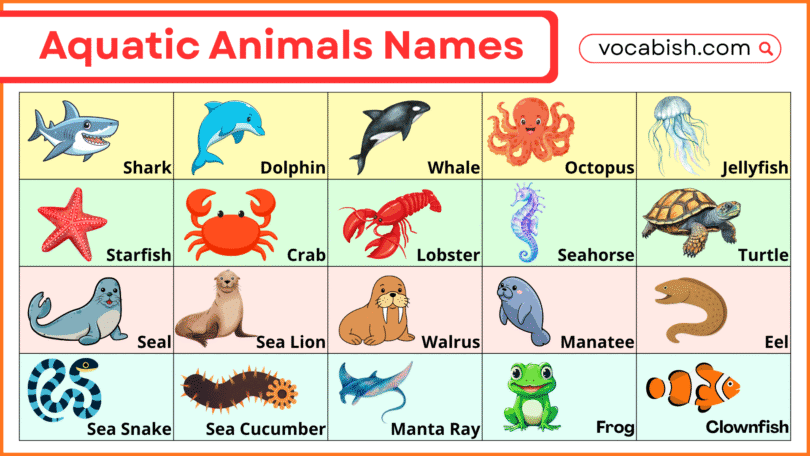
Here’s a list of the 30 most popular aquatic animal names and their pictures:
- Fish
- Shark
- Dolphin
- Whale
- Octopus
- Crab
- Lobster
- Jellyfish
- Turtle
- Starfish
- Seahorse
- Seal
- Walrus
- Penguin
- Stingray
- Squid
- Clownfish
- Blue Whale
- Pufferfish
- Sea Lion
- Sea Otter
- Manatee
- Coral
- Eel
- Sea Urchin
- Sea Snake
- Sea Cucumber
- Manta Ray
- Frog
- Catfish

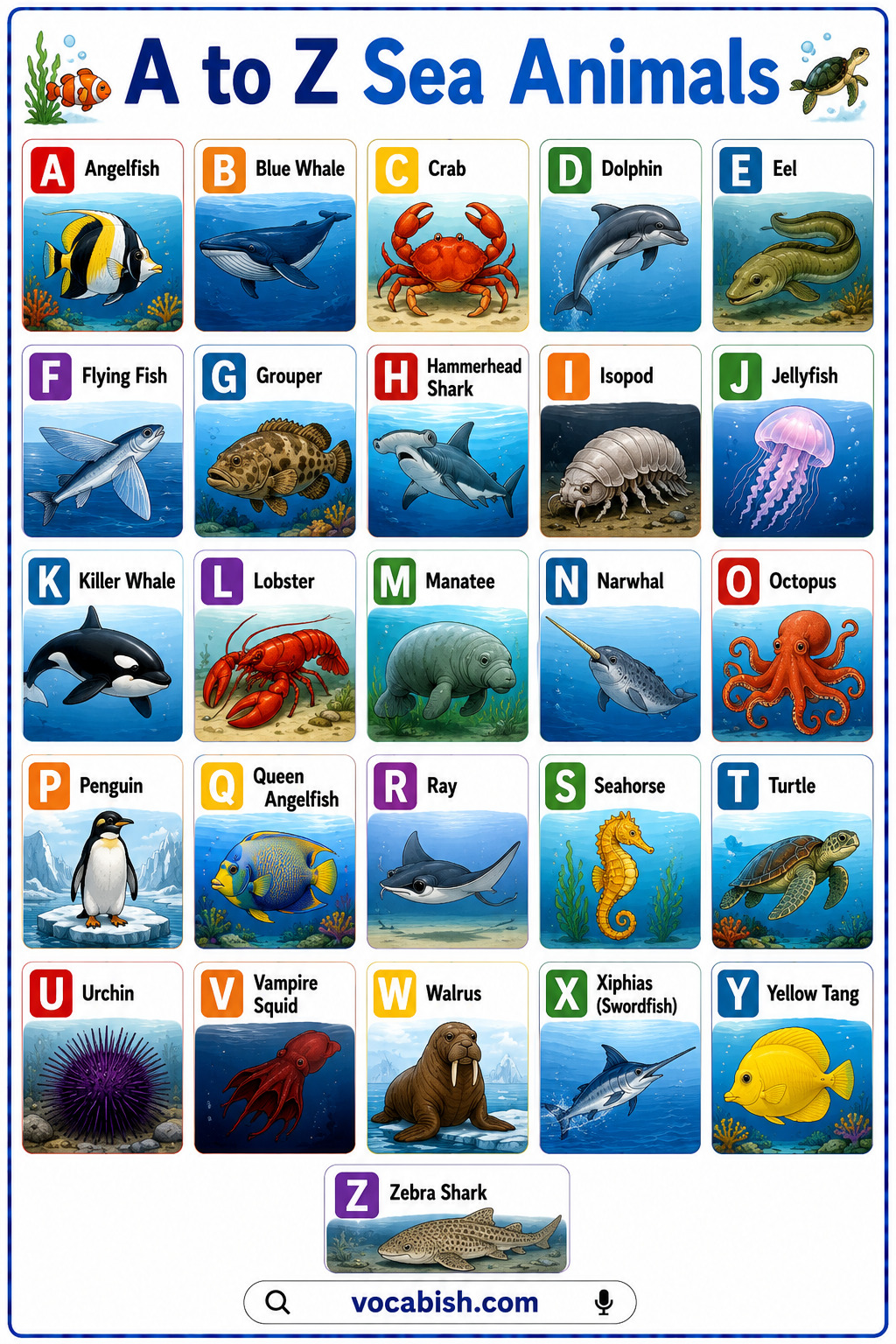
A to Z Aquatic Animals List
A Animals | B Animals | C Animals |
|---|---|---|
Angelfish | Blue Whale | Crab |
Anchovy | Barracuda | Clownfish |
Anemone | Beluga Whale | Catfish |
Abalone | Bass | Clam |
Archerfish | Boxfish | Coral |
Axolotl | Blue Tang | Crocodile |
D Animals | E Animals | F Animals |
Dolphin | Eel | Frog |
Dugong | Electric Ray | Flounder |
Damselfish | Emperor Angelfish | Fish |
Dogfish | Elephant Seal | Flatfish |
Dragonet | Emerald Crab | Firefish |
Dory | Estuarine Crocodile | Flying Fish |
G Animals | H Animals | I Animals |
Goldfish | Hammerhead Shark | Irukandji Jellyfish |
Grouper | Humpback Whale | Icefish |
Garfish | Haddock | Isopod |
Giant Clam | Hermit Crab | Indian Mackerel |
Green Turtle | Horse Mackerel | Ivory Coral |
Goby | Halibut | Inchworm Fish |
J Animals | K Animals | L Animals |
Jellyfish | Killer Whale (Orca) | Lobster |
Jackfish | King Crab | Lionfish |
Jack Mackerel | Krill | Lamprey |
Japanese Spider Crab | Koi Fish | Leafy Sea Dragon |
Jellynose Fish | Knife Fish | Limpet |
Jawfish | Kingfish | Lingcod |
M Animals | N Animals | O Animals |
Manta Ray | Narwhal | Octopus |
Manatee | Nautilus | Oyster |
Mackerel | Needlefish | Otter |
Mollusk | Nurse Shark | Ocean Sunfish |
Moray Eel | Nudibranch | Oarfish |
Mussel | Noodlefish | Olive Sea Snake |
P Animals | Q Animals | R Animals |
Penguin | Queen Angelfish | Ray |
Pufferfish | Quahog | Red Snapper |
Parrotfish | Queen Triggerfish | Remora |
Pike | Quokka (marine type) | Rockfish |
Plankton | Quillfish | Ribbon Eel |
Prawn | Quaker Fish | Rudd |
S Animals | T Animals | U Animals |
Shark | Turtle | Urchin |
Seahorse | Tuna | Umbrella Squid |
Squid | Trout | Unicornfish |
Starfish | Tang | Upside-down Catfish |
Stingray | Tarpon | Uaru Fish |
Seal | Tilapia | Undulate Ray |
V Animals | W Animals | X Animals |
Viperfish | Whale | Xiphias (Swordfish) |
Velvet Crab | Walrus | X-ray Tetra |
Vampire Squid | Wahoo | Xantus’s Goby |
Velella | Wrasse | Xenocouste Fish |
Vermilion Snapper | Wobbegong Shark | Xenopterus |
Viper Moray | Weedy Sea Dragon | Xingu River Ray |
Y Animals | Z Animals | |
Yellow Tang | Zebra Shark | |
Yellowfin Tuna | Zooplankton | |
Yellowtail Snapper | Zander | |
Yabby | Zebrafish | |
Yeti Crab | Zebra Moray | |
Yellowtail Clownfish | Zebra Mussel |
List of 100+ Animals that Live in Water
Fish
Fish are the largest group of aquatic animals. They breathe through gills and live in both freshwater and saltwater.
- Salmon
- Tuna
- Trout
- Carp
- Goldfish
- Shark
- Swordfish
- Mackerel
- Sardine
- Herring
- Cod
- Haddock
- Tilapia
- Catfish
- Eel
- Angelfish
- Clownfish
- Guppy
- Betta fish
- Pike
- Barracuda
- Halibut
- Flounder
- Anchovy
- Perch
- Bream
- Sturgeon
- Ray fish
- Mahi Mahi
- Grouper
- Snapper
- Wrasse
- Lionfish
- Mudfish
- Snakehead
- Goby
- Flying fish
- Opah
- Tarpon
- Lamprey
- Sawfish
- Goblin shark
- Hammerhead shark
- Great white shark
- Tiger shark
- Whale shark
- Nurse shark
- Electric eel
- Moray eel
- Rainbow fish
- Koi fish
- Discus fish
- Oscar fish
- Neon tetra
- Swordtail
- Molly fish
- Zander
Marine Mammals
Marine mammals breathe air but live in water most of the time.
- Dolphin
- Whale
- Blue whale
- Orca
- Sperm whale
- Humpback whale
- Seal
- Sea lion
- Walrus
- Manatee
- Dugong
- Porpoise
Aquatic Reptiles
These reptiles live in or near water and depend on it for survival.
- Sea turtle
- Green sea turtle
- Loggerhead turtle
- Leatherback turtle
- Saltwater crocodile
- Marine iguana
Invertebrates
Invertebrates do not have a backbone and form a large part of aquatic life.
- Octopus
- Squid
- Cuttlefish
- Jellyfish
- Starfish
- Sea cucumber
- Sea urchin
- Coral
- Sponge
- Anemone
- Crab
- Lobster
- Shrimp
- Prawn
- Barnacle
- Mussel
- Oyster
- Clam
- Scallop
- Nautilus
- Sea slug
- Nudibranch
- Krill
- Copepod
- Amphipod
- Isopod
- Brittle star
- Feather star
Example Sentences Using Aquatic Animal Names
Seeing vocabulary in context makes it easier to remember.
- The dolphin jumped above the water.
- A shark was swimming near the reef.
- The octopus hid between the rocks.
- We saw a sea turtle while snorkeling.
- The goldfish lives in a small aquarium.
- A whale can travel long distances in the ocean.
- The crab moved sideways across the beach.
- The seahorse wrapped its tail around a plant.
- A jellyfish floated near the shore.
- The otter played in the river.
Facts about Aquatic Animals
- Most aquatic animals breathe through gills or skin.
- They are an important part of the food chain.
- Some aquatic animals can glow in the dark (like jellyfish).
- Aquatic mammals such as whales and dolphins nurse their young.
Tips to Remember Aquatic Animals Vocabulary
Learning animal names becomes easier when you connect words with images and examples.
Try these methods:
- Group animals by category.
- Use picture flashcards.
- Watch wildlife documentaries in English.
- Practice with quizzes.
- Create your own vocabulary notebook.
- Use new words in short sentences.
- Label pictures of sea creatures.
- Review vocabulary weekly.
You May Also Like:
FAQs about Aquatic Animals
Aquatic animals are animals that live mainly in water, including oceans, rivers, lakes, ponds, and wetlands throughout their lives.
Marine animals live in saltwater environments, while freshwater animals live in rivers, lakes, ponds, and other low-salt water habitats.
No. A dolphin is a mammal because it breathes air, gives birth to live young, and feeds milk to its babies.
The blue whale is the largest aquatic animal and the largest known animal to have lived on Earth.
Common aquatic mammals include dolphins, whales, seals, sea lions, walruses, manatees, dugongs, otters, and platypuses.
Yes. Sea turtles spend most of their lives in water, although female turtles come onto land to lay eggs.
Learning aquatic animal vocabulary improves reading, speaking, listening, and science-related English while expanding knowledge of nature and wildlife.
Children can learn faster through pictures, flashcards, videos, games, and repeated practice using animal names in everyday sentences.
Conclusion
Aquatic animals make up one of the most diverse groups of living creatures on Earth, from tiny shrimp and colorful clownfish to massive whales and intelligent dolphins. Learning 100+ aquatic animals names in English helps students, ESL learners, and children expand their vocabulary while gaining a better understanding of marine life, freshwater species, and underwater ecosystems.
In this article, you explored different types of aquatic animals, including fish, marine mammals, sharks, rays, crustaceans, mollusks, reptiles, and amphibians. You also learned useful vocabulary, practical examples, and easy ways to remember animal names. By practicing these words regularly and connecting them with pictures and everyday contexts, you can build stronger English skills and talk about nature and wildlife with greater confidence.