
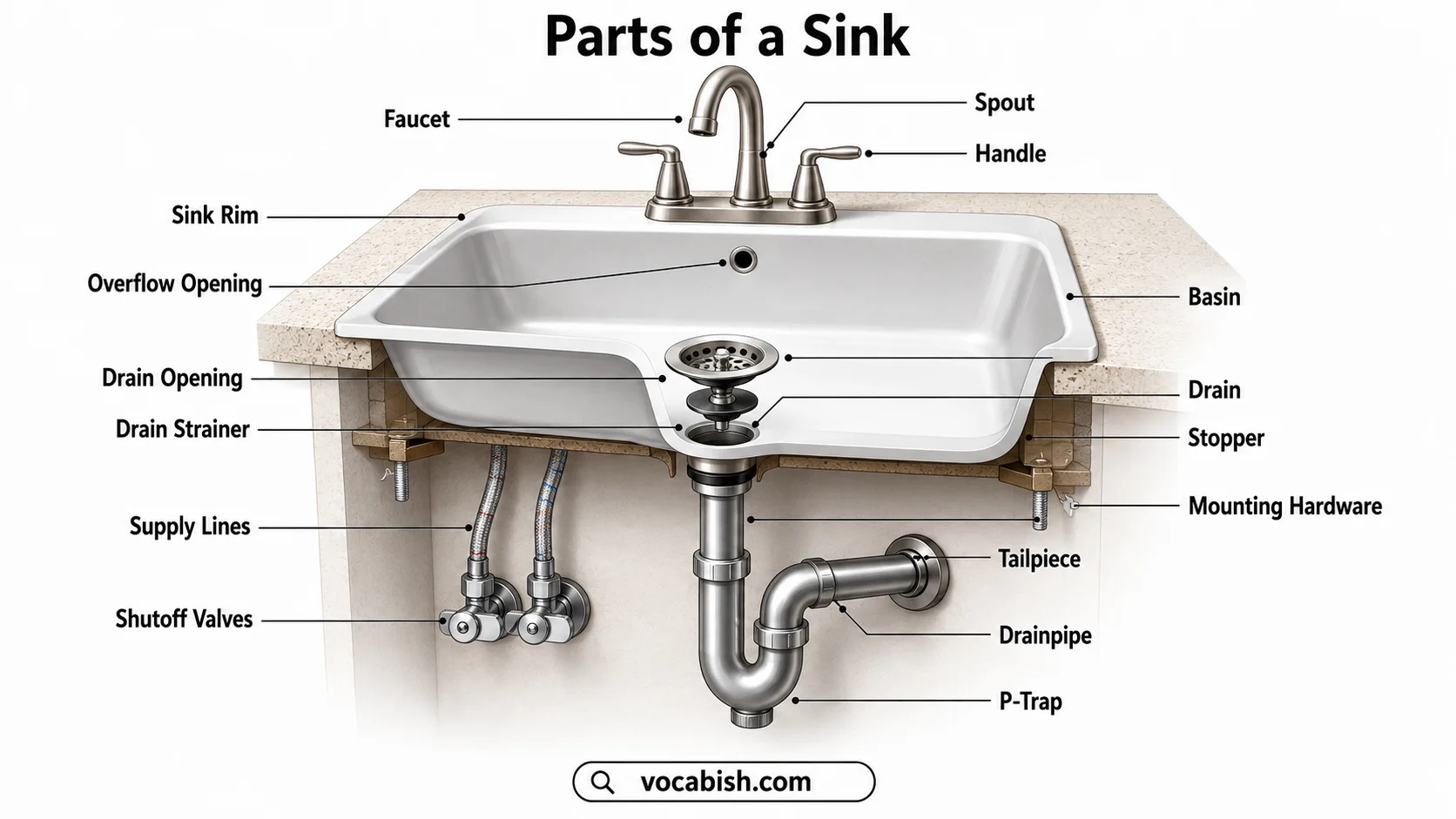
Have you ever looked at a sink and wondered what the different parts are called? Parts of a Sink include the basin, faucet, drain, stopper, overflow opening, supply lines, and several other components that work together to deliver and remove water.
Whether you are learning English, studying household vocabulary, choosing a new sink, or trying to understand basic plumbing, knowing these sink parts makes everyday conversations much easier. In this article, you will learn the parts of the sink, their functions, common sink types, and the names used for each component.
What Is a Sink?
A sink is a bowl-shaped plumbing fixture used for washing, cleaning, rinsing, or collecting water. It usually has a basin, faucet, drain, and connected plumbing.
Sinks are commonly found in kitchens, bathrooms, utility rooms, laboratories, and other places where water is needed.
The basic water system is easy to understand:
Water supply → Faucet → Basin → Drain → Drainpipe
The exact parts vary according to the sink’s design, location, and installation method.
Parts of a Sink with Functions
The table below gives the most common parts of a sink and their functions in one place.
Sink Part | Function |
|---|---|
Basin | Holds water and provides the main area for washing or rinsing. |
Faucet | Controls and directs water into the basin. |
Spout | The outlet through which water flows from the faucet. |
Handle | Turns the water on or off and may control temperature. |
Drain | Allows used water to leave the basin. |
Drain Opening | The opening through which water enters the drain assembly. |
Drain Strainer | Catches larger debris before it enters the drainpipe. |
Stopper | Closes the drain when the basin needs to hold water. |
Overflow Opening | Helps prevent water from overflowing when the basin becomes too full. |
Overflow Channel | Carries excess water toward the drain system. |
Supply Lines | Carry hot and cold water from the plumbing system to the faucet. |
Shutoff Valves | Stop the water supply to the faucet for repairs or replacement. |
Drainpipe | Carries wastewater away from the sink. |
P-Trap | Holds water in a curved section to help block sewer gases from entering the room. |
Tailpiece | Connects the sink drain assembly to the trap. |
Mounting Hardware | Secures the sink to the countertop, cabinet, or wall. |
Sink Rim | Forms the outer edge of the basin and may support the sink on the countertop. |
Countertop | Supports a countertop-mounted sink and surrounds the fixture. |
Cabinet | Provides support and storage beneath many kitchen and bathroom sinks. |
Main Parts of a Sink Explained
Understanding the names is easier when each component is connected to its job. Here are the main parts of a sink you are most likely to see.
1. Basin
The basin is the large bowl-shaped section of the sink. It holds water temporarily and provides the space where you wash dishes, hands, vegetables, or other items.
A sink may have one basin or several basins.
2. Faucet
The faucet supplies water to the sink. It is connected to the home’s water supply through pipes or flexible supply lines.
Depending on the design, a faucet can have one handle, two handles, or a separate control system.
3. Spout
The spout is the part of the faucet where water comes out.
Its shape and length determine where the water lands in the basin. Kitchen faucets often have taller or longer spouts to provide more working space.
4. Handle
The handle controls the water flow.
A single-handle faucet usually uses one lever to control both flow and temperature. A two-handle faucet normally has separate controls for hot and cold water.
5. Drain
The drain removes used water from the basin.
It connects to the drain assembly underneath the sink and eventually carries wastewater into the building’s drainage system.
6. Drain Opening
The drain opening is the hole at the bottom of the basin where water leaves the sink.
It is usually fitted with a drain assembly that may include a strainer, stopper, flange, or other components.
7. Drain Strainer
A drain strainer is a perforated or screened piece placed over the drain opening.
Its job is to catch larger pieces of food, hair, or other debris before they travel farther into the drainpipe.
8. Stopper
A stopper closes the drain so the basin can hold water.
Bathroom sinks may use a lift rod or pop-up mechanism, while some kitchen sinks use removable stoppers.
9. Overflow Opening
The overflow opening is a small opening near the upper part of some sink basins.
If the water level rises too high, the opening provides another path for excess water to enter the drainage system.
10. Supply Lines
Supply lines connect the faucet to the hot and cold water supply.
They are usually located underneath the sink and may be flexible tubes or other approved plumbing connections.
11. Shutoff Valves
Shutoff valves control the water supply going to the faucet.
They allow you to turn off the water without shutting off the water supply to the entire building.
12. Drainpipe
The drainpipe carries wastewater away from the sink.
It connects the drain assembly to the trap and then to the building’s larger drainage system.
13. P-Trap
The P-trap is the curved section of drain plumbing beneath the sink.
It holds a small amount of water in the pipe, creating a barrier that helps prevent sewer gases from coming back through the drain.
14. Tailpiece
The tailpiece is the short pipe connected directly below the sink drain assembly.
It carries water downward from the drain toward the trap.
15. Sink Rim
The sink rim is the outer edge around the basin.
On certain sink designs, the rim rests on the countertop and supports the fixture.
16. Mounting Hardware
Mounting hardware consists of clips, brackets, screws, or other components used to hold the sink securely in place.
The exact hardware depends on the sink’s installation style.
Parts of a Sink Diagram
Types of Sinks and Their Functions
There is no single sink design for every room. Different types of sinks are made for different spaces, uses, and installation methods.
Sink Type | Main Function |
|---|---|
Kitchen Sink | Washing dishes, food, cookware, and hands. |
Bathroom Sink | Washing hands, face, and small personal items. |
Utility Sink | Handling cleaning, laundry, tools, and messy tasks. |
Bar Sink | Washing glasses, utensils, and small items. |
Laundry Sink | Washing clothes, shoes, tools, and household items. |
Vessel Sink | Provides a raised basin for bathroom washing. |
Undermount Sink | Provides a clean countertop edge around the basin. |
Drop-In Sink | Fits into a countertop opening with its rim resting above the surface. |
Wall-Mount Sink | Saves floor and cabinet space by attaching to the wall. |
Pedestal Sink | Supports a bathroom basin on a pedestal base. |
Farmhouse Sink | Provides a deep basin suited to kitchen washing tasks. |
Corner Sink | Uses corner space where a standard sink may not fit well. |
Sink Types by Installation
Sink types can also be grouped according to how they are installed.
Drop-In Sink
A drop-in sink is placed into a prepared opening in the countertop. Its rim remains visible above the counter.
Undermount Sink
An undermount sink is installed below the countertop surface. The countertop extends over the sink’s edge, creating a continuous surface around the basin.
Vessel Sink
A vessel sink sits above the countertop rather than being installed completely inside it. The basin is clearly visible.
Wall-Mount Sink
A wall-mount sink is attached directly to the wall. It can leave open space underneath and is often used where floor space matters.
Pedestal Sink
A pedestal sink has a basin supported by a pedestal. The pedestal helps support the fixture and conceals some of the plumbing.
Farmhouse Sink
A farmhouse sink, also called an apron-front sink, has a front panel that remains visible beyond the countertop edge.
Kitchen Sink Parts
Kitchen sinks often have larger basins and features designed for food preparation and dishwashing.
Common kitchen sink components include:
Part | Purpose |
|---|---|
Main Basin | Provides space for washing dishes and food. |
Secondary Basin | Separates washing, rinsing, or other tasks. |
Faucet | Supplies water for kitchen tasks. |
Pull-Down Sprayer | Provides a flexible spray of water for rinsing. |
Drain | Removes used water from the basin. |
Strainer | Helps keep larger food particles out of the drain. |
Sink Grid | Protects the bottom of some sinks and allows water to flow underneath dishes. |
Some kitchen sinks also include a soap dispenser, air gap, side sprayer, or accessories designed to fit into additional countertop openings.
Bathroom Sink Parts
Bathroom sinks are generally designed for handwashing and personal care.
Part | Purpose |
|---|---|
Basin | Holds water during washing. |
Faucet | Provides water for hand and face washing. |
Spout | Directs water into the basin. |
Handle | Controls water flow and temperature. |
Drain | Removes wastewater. |
Stopper | Closes the drain when the basin needs to hold water. |
Overflow Opening | Helps manage excess water in sinks designed with an overflow. |
P-Trap | Provides a water seal in the drain plumbing. |
Sink Parts Vocabulary for English Learners
Learning sink vocabulary is easier when the words are grouped by location and purpose.
English Word | Plain-English Meaning | Example Sentence |
|---|---|---|
Basin | The bowl-shaped part of a sink. | The basin is full of water. |
Faucet | The fixture that supplies water. | Turn off the faucet. |
Spout | The part where water comes out. | Water is flowing from the spout. |
Handle | The part used to control water. | Move the handle to increase the flow. |
Drain | The opening or system that removes water. | The drain is blocked. |
Stopper | A piece that closes the drain. | Put the stopper in the drain. |
Rim | The outer edge of the sink. | Wipe the sink rim. |
Strainer | A piece that catches larger debris. | Clean the drain strainer. |
P-Trap | A curved drainpipe that holds water. | The plumber replaced the P-trap. |
Supply Line | A pipe or tube carrying water to the faucet. | The supply line is leaking. |
Shutoff Valve | A valve that stops water flow. | Close the shutoff valve before repairs. |
Drainpipe | A pipe that carries wastewater away. | The drainpipe connects to the trap. |
Useful Sink Verbs
Verb | Meaning | Example |
|---|---|---|
Wash | Clean with water | Wash your hands in the sink. |
Rinse | Wash lightly with clean water | Rinse the plate in the sink. |
Fill | Make something full | Fill the basin with water. |
Drain | Remove water | Drain the sink after washing. |
Plug | Close an opening | Plug the drain with the stopper. |
Unclog | Remove a blockage | We need to unclog the sink. |
Pronunciation of Common Sink Words
Some sink-related words can be difficult for English learners because their spelling does not always make pronunciation obvious.
Word | Pronunciation Guide | Meaning |
|---|---|---|
Sink | sink | A fixture used for washing |
Faucet | FAW-sit | A device that supplies water |
Basin | BAY-sin | The bowl-shaped part of a sink |
Drain | drayn | An opening or pipe for removing water |
Strainer | STRAY-ner | A device that catches debris |
Valve | valv | A device that controls liquid flow |
Plumbing | PLUM-ing | The system of pipes and water fixtures |
In American English, faucet is very common. In British English, tap is often used for the same fixture.
Common Sink Part Confusions
A few sink terms are easy to mix up, especially when learning household vocabulary.
- Faucet vs. spout: The faucet is the complete water-control fixture; the spout is the section where water exits.
- Drain vs. drainpipe: The drain is the opening or assembly at the sink; the drainpipe carries wastewater away underneath.
- Basin vs. sink: The basin is the bowl-shaped section, while the sink usually refers to the complete fixture.
- Stopper vs. strainer: A stopper closes the drain; a strainer helps catch larger debris.
- Tap vs. faucet: These usually refer to the same type of water fixture, with usage varying by region.
FAQs About Parts of a Sink
The main parts include the basin, faucet, spout, handle, drain, stopper, overflow opening, supply lines, P-trap, and drainpipe.
The bowl-shaped section of a sink is called the basin. It is the main area used for holding water and washing items.
The hole at the bottom of a sink is called the drain opening. It allows used water to enter the drain assembly.
The curved pipe under a sink is called a P-trap. It holds water and helps prevent sewer gases from entering through the drain.
The faucet controls and delivers water. Its handle or handles regulate water flow and, depending on design, temperature.
A basin is the bowl-shaped section that holds water, while a sink generally refers to the complete plumbing fixture.
Common sink types include kitchen, bathroom, utility, vessel, drop-in, undermount, wall-mount, pedestal, and farmhouse sinks.
A sink overflow provides an additional water path when the basin’s water level becomes too high, helping reduce the risk of overflow.
Conclusion
Knowing the Parts of a Sink helps you understand household English, basic plumbing, and everyday conversations about kitchens and bathrooms. The main components include the basin, faucet, spout, drain, stopper, overflow opening, supply lines, shutoff valves, P-trap, and drainpipe.
Sink designs vary, but their basic purpose remains the same: supply water, provide a place for washing, and safely remove wastewater. Learning the names and functions of these sink parts makes it easier to identify a fixture, understand a diagram, and communicate clearly about common household plumbing.
Explore More Parts of Things