
Have you ever wondered what is inside or underneath a toilet when you flush it? Parts of a Toilet work together to bring in clean water, remove waste, and refill the bowl for the next use.
From the toilet bowl and seat to the flush valve, flapper, fill valve, and trapway, each component has a specific job. Knowing toilet parts and their names can help you understand a toilet diagram, describe bathroom fixtures in English, and identify common problems.
This article explains the main parts of a toilet, their functions, common toilet types, and the vocabulary you need to talk about them clearly.
What Is a Toilet?
A toilet is a bathroom fixture designed to collect human waste and carry it into a drainage system. It uses water to flush waste from the bowl through a trapway and drainpipe.
A modern toilet normally has a bowl, seat, flush mechanism, water tank or cistern, and drain connection. Some designs use a concealed tank or connect directly to a flushing valve.
The word toilet can refer to the complete fixture, while individual components have their own names.
Main Toilet Parts and Their Functions
Understanding the parts of the toilet with functions is easier when each component is connected to its location and purpose.
1. Toilet Bowl
The toilet bowl is the large ceramic or porcelain section that holds water and receives waste.
It is shaped to direct wastewater toward the trapway when the toilet is flushed.
2. Toilet Seat
The toilet seat is the hinged ring attached to the top of the bowl. It provides a comfortable surface for sitting during toilet use.
Most toilet seats can be lifted for cleaning.
3. Toilet Lid
The toilet lid is the cover that sits over the toilet seat and bowl.
It helps cover the bowl when the toilet is not being used and can also protect the seat from dust.
4. Toilet Tank
The toilet tank is the upper container found behind the bowl on many traditional toilets.
It stores water that is released during flushing. In some countries, the word cistern is commonly used instead of tank.
5. Flush Handle
The flush handle is the lever on the outside of the tank.
When you press or lift it, it activates the internal flushing mechanism and starts the flow of water into the bowl.
6. Flush Button
A flush button performs the same basic job as a flush handle but is usually pressed from the top of the tank.
Dual-flush toilets often have two buttons. One uses less water for liquid waste, while the other provides a stronger flush.
7. Fill Valve
The fill valve controls the flow of fresh water into the toilet tank after flushing.
It closes when the water reaches the required level.
8. Flapper
The flapper is a rubber or plastic seal located inside the tank.
It normally keeps water inside the tank. During a flush, it lifts and allows water to flow into the bowl.
9. Flush Valve
The flush valve is the opening at the bottom of the tank that allows stored water to enter the toilet bowl.
The flapper usually sits over this opening in a conventional gravity-flush toilet.
10. Overflow Tube
The overflow tube is a vertical tube inside the tank.
If the water level rises too high, excess water can flow through this tube and into the bowl instead of spilling over the tank.
11. Float
The float helps control the water level inside the tank.
Depending on the toilet design, it may be a floating ball or a compact float attached to the fill valve.
When the water reaches the correct level, the fill valve stops supplying water.
12. Flush Chain
A flush chain is a small chain found in some traditional toilet tanks.
It connects the flush handle mechanism to the flapper. Pulling the handle lifts the flapper and starts the flush.
Modern toilets may use a plastic rod or another linkage instead of a chain.
13. Rim
The rim is the upper edge of the toilet bowl.
Water enters the bowl through openings around or beneath this area in many toilet designs, helping wash the inside of the bowl during flushing.
14. Rim Holes
Rim holes are small openings located around the underside of the bowl rim.
They allow flushing water to enter the bowl and create a washing action.
Some newer toilet designs use different water-flow arrangements.
15. Siphon Jet
A siphon jet is a small opening in the lower part of some toilet bowls.
It directs water into the bowl to help create a strong flushing action and move waste through the trapway.
16. Trapway
The trapway is the curved internal passage that carries waste and water from the bowl toward the drain.
Its shape also helps maintain a water seal that limits sewer gases from entering the bathroom.
17. Water Line
The water supply line carries fresh water from the household plumbing system to the toilet.
It connects the toilet to the shut-off valve.
18. Shut-Off Valve
The shut-off valve controls the water supply to the toilet.
Turning it off stops fresh water from entering the toilet, which is useful during repairs or when dealing with a leak.
19. Toilet Flange
The toilet flange is a fitting attached to the floor and connected to the drainpipe.
It provides the connection between the toilet and the drainage system and helps secure the toilet in position.
20. Wax Ring or Toilet Seal
A wax ring or another approved toilet seal sits between the toilet base and the flange.
Its job is to create a watertight and odor-resistant seal around the drain connection.
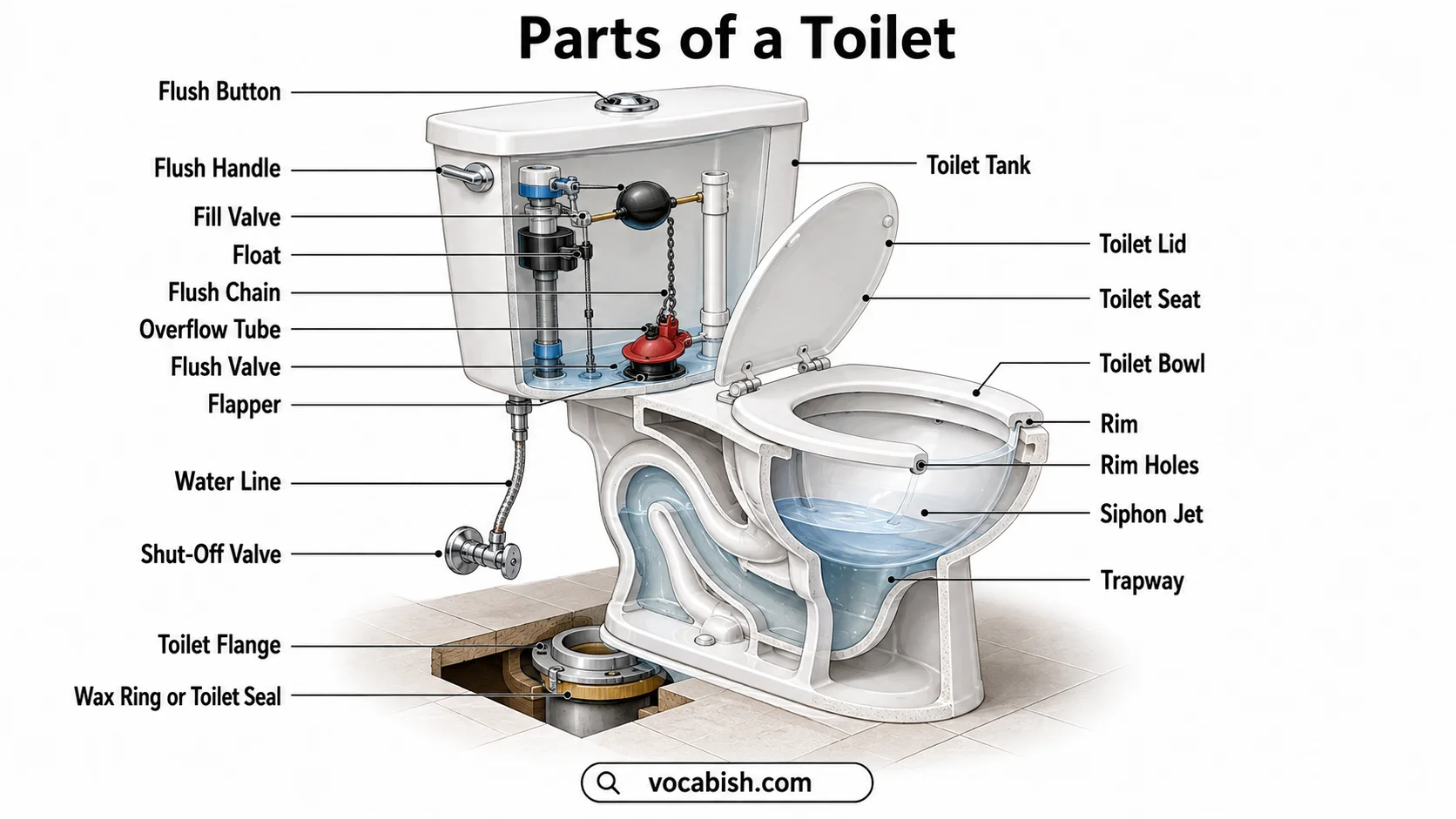
Parts of a Toilet Diagram
Parts Inside a Toilet Tank
The tank contains several components that control filling and flushing. Their exact design varies between toilet models.
Tank Part | Function | Common Alternative |
|---|---|---|
Fill valve | Adds fresh water after flushing | Inlet valve |
Flapper | Opens and closes the tank outlet | Flush seal |
Float | Detects the tank water level | Float cup |
Flush valve | Releases water from the tank | Tank outlet valve |
Overflow tube | Provides an overflow route | Overflow pipe |
Flush chain | Connects handle to flapper | Lift rod |
Flush handle | Activates the flushing mechanism | Tank lever |
Tank cover | Covers the top of the tank | Cistern lid |
How the Toilet Tank Refills
After a flush, the water level inside the tank drops.
The fill valve opens and allows fresh water to enter. As the tank fills, the float rises. When the correct water level is reached, the fill valve closes.
This process prepares the toilet for the next flush.
Parts Under and Around the Toilet
Some important toilet components are not visible during normal use.
The parts beneath and around the toilet connect the fixture to the home’s water and drainage systems.
Part | Location | Purpose |
|---|---|---|
Toilet flange | Floor beneath toilet | Connects toilet to drain |
Toilet seal | Between toilet and flange | Prevents leakage and sewer odors |
Drainpipe | Beneath the toilet | Carries wastewater away |
Supply line | Beside or behind toilet | Brings fresh water |
Shut-off valve | On supply pipe | Stops water flow |
Mounting bolts | At toilet base | Secure toilet to flange |
Bolt caps | Over mounting bolts | Cover and protect bolt heads |
How a Toilet Works
A toilet performs several steps during a normal flush.
- The flush is activated.
Pressing the handle or button starts the flushing mechanism. - The tank outlet opens.
The flapper or another seal lifts, allowing stored water to leave the tank. - Water enters the bowl.
Water flows through the bowl’s flushing passages and helps move waste. - Waste moves through the trapway.
The water and waste travel through the toilet’s internal passage into the drain. - The bowl retains clean water.
After the flush, a measured amount of water remains in the bowl. - The tank refills.
The fill valve opens and supplies fresh water until the tank reaches its normal level. - The fill valve closes.
Once the water reaches the set level, the valve stops the incoming flow.
This process happens quickly, but every stage depends on several toilet parts working together.
Types of Toilets
Toilets come in different designs based on installation, flushing method, shape, and water-saving features.
Toilet Type | Main Feature | Common Use |
|---|---|---|
One-piece toilet | Bowl and tank form one unit | Modern bathrooms |
Two-piece toilet | Bowl and tank are separate | Common household bathrooms |
Wall-hung toilet | Bowl is mounted on the wall | Modern and compact bathrooms |
Close-coupled toilet | Tank sits directly above the bowl | Residential bathrooms |
Back-to-wall toilet | Cistern and plumbing are concealed or positioned behind | Contemporary bathrooms |
Dual-flush toilet | Offers two flushing volumes | Water-conscious bathrooms |
Pressure-assisted toilet | Uses pressure to support flushing | Strong-flush applications |
Gravity-flush toilet | Uses gravity and stored water | Common residential toilets |
Composting toilet | Treats waste without a conventional sewer flush | Off-grid locations |
Portable toilet | Designed to be moved or temporarily installed | Events and outdoor use |
One-Piece Toilet
A one-piece toilet has the tank and bowl manufactured as a single unit.
It has fewer exposed joints and a continuous appearance.
Two-Piece Toilet
A two-piece toilet has a separate tank and bowl that are joined during installation.
This design is widely used because individual components can be replaced when needed.
Wall-Hung Toilet
A wall-hung toilet is mounted to the wall rather than standing directly on the floor.
Its tank is often concealed inside the wall, leaving more visible floor space underneath the bowl.
Dual-Flush Toilet
A dual-flush toilet provides two flushing options.
A smaller flush is generally intended for liquid waste, while a larger flush is used for solid waste.
Gravity-Flush Toilet
A gravity-flush toilet uses the force of water falling from the tank into the bowl.
It is one of the most common flushing systems in homes.
Pressure-Assisted Toilet
A pressure-assisted toilet uses compressed air or pressure within the tank system to create a forceful flush.
It differs from a standard gravity-flush design.
Composting Toilet
A composting toilet treats human waste through controlled biological decomposition rather than sending it through a conventional water-based sewer system.
It is often used where standard plumbing is unavailable.
Toilet Parts Vocabulary
If you are learning English, these words are useful when describing a toilet or discussing bathroom plumbing.
Word | Meaning | Example |
|---|---|---|
Bowl | The lower section that holds water and waste | The bowl is full of water. |
Seat | The ring used for sitting | The toilet seat is loose. |
Lid | The cover over the seat | Please close the lid. |
Tank | The container that stores flushing water | The tank is not filling. |
Flush | To send water through the toilet | Please flush the toilet. |
Flapper | The seal that controls tank water release | The flapper is leaking. |
Fill valve | The valve that refills the tank | The fill valve needs adjustment. |
Trapway | The internal passage for waste and water | The trapway can become blocked. |
Flange | The floor fitting connecting the toilet to the drain | The flange is under the toilet. |
Cistern | British English word for a toilet tank | The cistern is behind the bowl. |
Toilet, Restroom, Bathroom, and Lavatory
These words are related but are not always interchangeable.
- Toilet can mean the fixture or the room containing it.
- Bathroom usually means a room with a toilet and often a sink or shower.
- Restroom is commonly used in American English for a public toilet room.
- Lavatory is a more formal term that can refer to a toilet or bathroom, especially in travel and aviation contexts.
- Cistern is commonly used in British English for the water tank of a toilet.
Toilet vs. Urinal
A toilet is designed for sitting or, depending on the design and use, squatting to urinate or have a bowel movement.
A urinal is a separate plumbing fixture mainly designed for urination and is commonly found in public men’s restrooms.
Common Toilet Parts Confusions
Some toilet terms are easy to mix up, especially for English learners.
- Tank vs. bowl: The tank stores flushing water; the bowl receives water and waste.
- Flapper vs. fill valve: The flapper releases tank water; the fill valve adds fresh water.
- Seat vs. lid: The seat is used for sitting; the lid covers the bowl.
- Flush valve vs. fill valve: The flush valve releases water for flushing; the fill valve refills the tank.
- Trapway vs. drainpipe: The trapway is part of the toilet; the drainpipe carries wastewater away from it.
FAQs About Parts of a Toilet
The main parts include the bowl, seat, lid, tank, flush mechanism, fill valve, flapper, trapway, water supply line, and drain connection.
The toilet tank stores water used for flushing, while the bowl also holds a smaller amount of water after flushing.
Common internal parts include the fill valve, flapper, float, flush valve, overflow tube, and flush linkage.
A toilet flapper seals the tank outlet and lifts during flushing so stored water can flow into the toilet bowl.
They refer to the same basic component. “Tank” is common in American English, while “cistern” is common in British English.
The toilet flange connects the toilet base to the drain opening and helps secure the fixture to the floor.
The curved internal passage is called the trapway. It carries water and waste toward the drain while helping maintain a water seal.
Common types include one-piece, two-piece, wall-hung, close-coupled, dual-flush, gravity-flush, pressure-assisted, and composting toilets.
Conclusion
The Parts of a Toilet work as one system to supply water, flush waste, refill the tank, and maintain a water seal against sewer gases. The most familiar components include the bowl, seat, lid, tank, flush handle, fill valve, flapper, overflow tube, trapway, flange, and water supply connection.
Knowing these toilet parts and their functions makes toilet diagrams easier to understand and gives English learners useful vocabulary for everyday bathroom and plumbing situations. Different toilet types may use different mechanisms, but the basic purpose remains the same: collect waste, move it safely into the drainage system, and prepare the fixture for its next use.
Explore More Parts of Things