
Have you ever wondered what the longest words in English are, especially those starting with A, B, C, and every letter through Z? Long English words can look intimidating, but they also reveal interesting patterns in spelling, word formation, science, medicine, and vocabulary.
This A–Z collection presents notable long English words with their letter counts, meanings, pronunciation help, and examples. It also explains why there is no single permanent “longest word” for every letter.
What Counts as a Long Word in English?
A long word is generally judged by its number of letters, but there is no universal A–Z record book that gives one permanent winner for every letter.
Dictionaries also differ. Some include scientific and medical terms, while others exclude rare, invented, or highly specialized formations. Merriam-Webster notes that many English words longer than about 15–20 letters are scientific or highly specialized.
That is why the list below focuses on well-established or widely cited long words, rather than pretending every letter has one uncontested champion.
Longest Words From A to Z
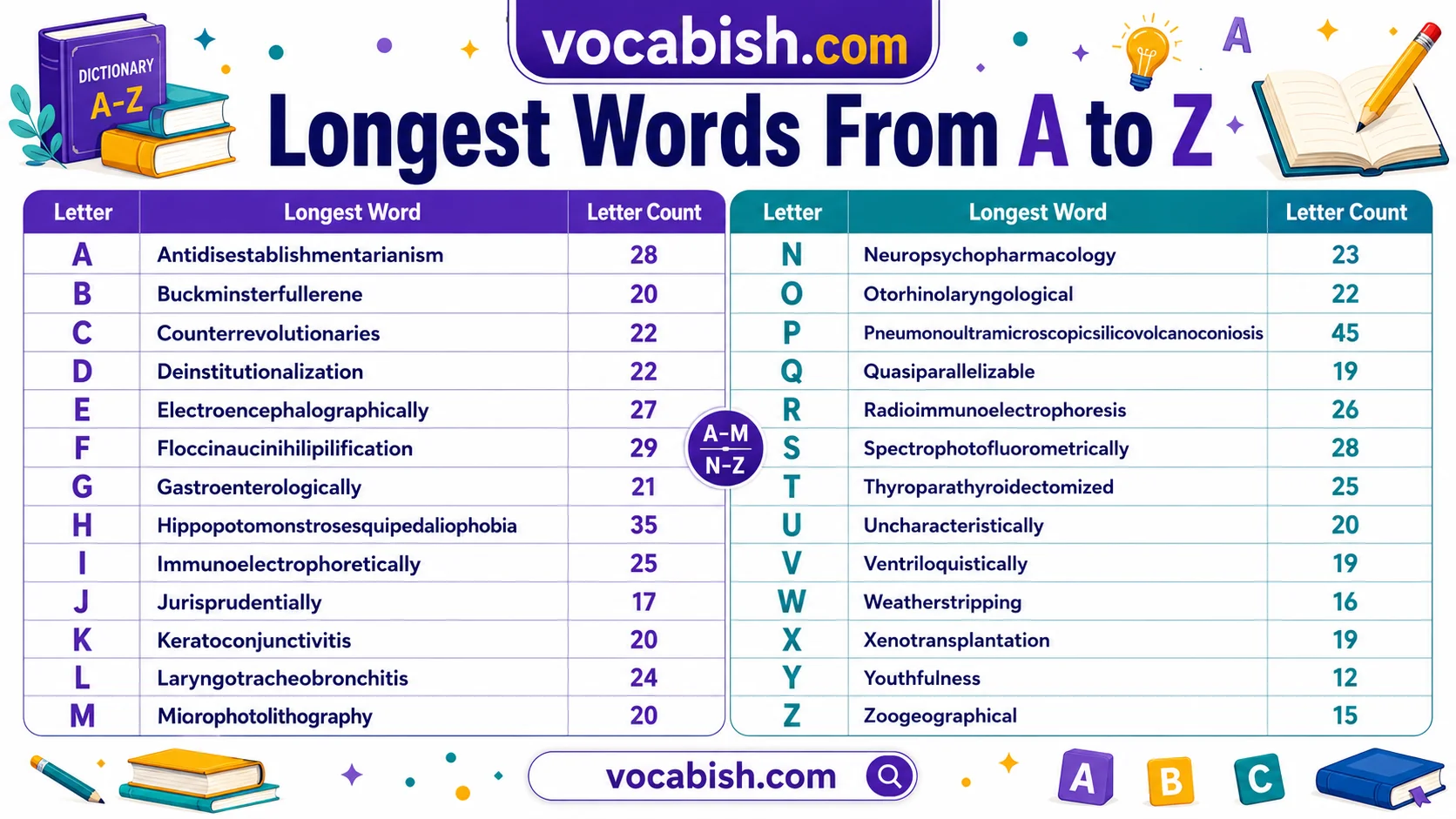
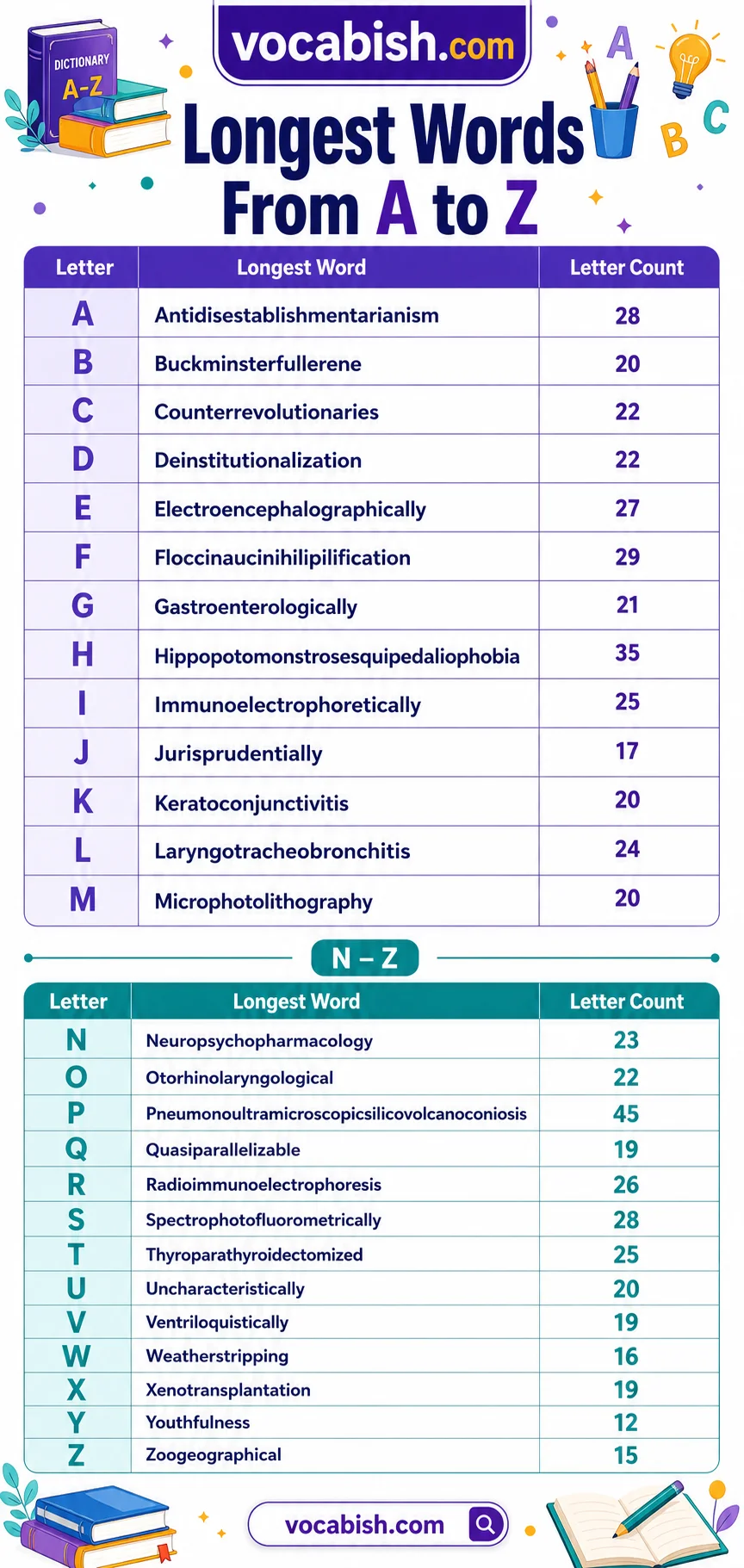
The table gives one notable long English word for each letter. Letter counts ignore spaces, hyphens, and punctuation.
Letter | Long word |
|---|---|
A | Antidisestablishmentarianism — 28 letters |
B | Buckminsterfullerene — 20 letters |
C | Counterrevolutionaries — 22 letters |
D | Deinstitutionalization — 22 letters |
E | Electroencephalographically — 27 letters |
F | Floccinaucinihilipilification — 29 letters |
G | Gastroenterologically — 21 letters |
H | Hippopotomonstrosesquipedaliophobia — 35 letters |
I | Immunoelectrophoretically — 25 letters |
J | Jurisprudentially — 17 letters |
K | Keratoconjunctivitis — 20 letters |
L | Laryngotracheobronchitis — 24 letters |
M | Microphotolithography — 20 letters |
N | Neuropsychopharmacology — 23 letters |
O | Otorhinolaryngological — 22 letters |
P | Pneumonoultramicroscopicsilicovolcanoconiosis — 45 letters |
Q | Quasiparallelizable — 19 letters |
R | Radioimmunoelectrophoresis — 26 letters |
S | Spectrophotofluorometrically — 28 letters |
T | Thyroparathyroidectomized — 25 letters |
U | Uncharacteristically — 20 letters |
V | Ventriloquistically — 19 letters |
W | Weatherstripping — 16 letters |
X | Xenotransplantation — 19 letters |
Y | Youthfulness — 12 letters |
Z | Zoogeographical — 15 letters |
The letter-by-letter comparison is necessarily flexible because specialist dictionaries and word lists use different inclusion rules. The best-known dictionary-record example remains pneumonoultramicroscopicsilicovolcanoconiosis, at 45 letters, while other famous long words such as antidisestablishmentarianism and floccinaucinihilipilification have different dictionary statuses.
Long Words Starting With A to E
These early letters contain several famous examples, including political vocabulary, chemistry, medicine, and brain science.
Starting With A
Antidisestablishmentarianism is perhaps the most famous long word beginning with A. It refers to opposition to the disestablishment of a state church. Its famous reputation is partly historical rather than a reflection of everyday use.
Starting With B
Buckminsterfullerene is a scientific term for a carbon molecule. It is also called a buckyball because of its rounded molecular structure.
Beginning With C
Counterrevolutionaries is a plural noun referring to people who oppose a revolution. Its length comes largely from several meaningful word parts joined together.
Beginning With D
Deinstitutionalization describes the shift from institutional care toward community-based care. It is particularly common in discussions of healthcare, social services, and mental health.
Beginning With E
Electroencephalographically is especially long because it is built around electroencephalography, the recording of electrical activity in the brain. It is a strongly technical medical term.
Long Words Beginning With F to J
The F–J group includes one of the most famous non-technical long words as well as specialized scientific and legal vocabulary.
Starting With F
Floccinaucinihilipilification means judging something as worthless or insignificant. Cambridge describes it as a word mainly used as an example of a very long word and identifies it as the longest non-technical word in that context.
Starting With G
Gastroenterologically comes from gastroenterology, the medical field dealing with the digestive system. The word is an adverb, so it describes how something is done.
Beginning With H
Hippopotomonstrosesquipedaliophobia is a humorous formation associated with fear of long words. It is famous largely because the word itself is extremely long.
Beginning With I
Immunoelectrophoretically belongs to laboratory and medical vocabulary. Its structure combines terms related to immune reactions and electrophoresis.
Starting With J
Jurisprudentially relates to jurisprudence, the study or theory of law. It is more likely to appear in legal writing than everyday conversation.
Long Words Beginning With K to O
Many of the longest K–O words belong to medicine, biology, chemistry, or other specialized fields.
Starting With K
Keratoconjunctivitis describes inflammation involving the cornea and conjunctiva. The term combines medical roots associated with the eye.
Beginning With L
Laryngotracheobronchitis describes inflammation affecting the larynx, trachea, and bronchi. Breaking it into those familiar anatomical parts can make the spelling easier to understand.
Beginning With M
Microphotolithography refers to a highly specialized manufacturing process used to create tiny patterns, especially in semiconductor technology.
Beginning With N
Neuropsychopharmacology combines ideas from neuroscience, psychology, and pharmacology. It focuses on how drugs influence the brain, behavior, and mental processes.
Starting With O
Otorhinolaryngological relates to otorhinolaryngology, the medical specialty commonly associated with the ear, nose, and throat, or ENT.
Long Words Starting With P to T
This group contains the most recognizable entry on the entire list: a 45-letter medical term.
Starting With P
Pneumonoultramicroscopicsilicovolcanoconiosis has 45 letters and is listed by Merriam-Webster as the longest word entered in most standard English dictionaries. It refers to a pneumoconiosis associated with inhaling very fine silicate or quartz dust.
The word is also interesting for learners because its parts suggest its meaning:
- pneumono- — related to the lungs
- ultramicroscopic — extremely small
- silico- — related to silica
- volcano- — associated with volcanic dust
- -coniosis — a condition caused by inhaled dust
Beginning With Q
Quasiparallelizable is a specialized technical term. Words beginning with Q are less common in English, so many long Q words belong to scientific or academic vocabulary.
Beginning With R
Radioimmunoelectrophoresis is a laboratory term formed from several scientific elements. It illustrates how English can build long technical words by combining roots.
Beginning With S
Spectrophotofluorometrically relates to spectrophotofluorometric measurement. It is highly specialized and is more likely to occur in scientific literature than ordinary speech.
Beginning With T
Thyroparathyroidectomized is a medical adjective describing a subject that has undergone surgical removal involving the thyroid and parathyroid glands.
Long Words Beginning With U to Z
The final part of the alphabet contains fewer familiar long words, but several are useful for learning advanced vocabulary.
Starting With U
Uncharacteristically means in a way that is unusual for someone or something.
This is one of the more useful long words on the list because learners may actually encounter it in ordinary writing.
Beginning With V
Ventriloquistically relates to the manner of a ventriloquist. The root word ventriloquist refers to a performer who creates the impression that a voice comes from somewhere other than the speaker.
Beginning With W
Weatherstripping is practical household vocabulary. It means material placed around windows or doors to reduce drafts, air leakage, and sometimes noise.
Beginning With X
Xenotransplantation is an important biomedical term. It refers to transplantation between different species and is used in discussions of transplantation science and medicine.
Beginning With Y
Youthfulness is much shorter than the famous scientific words in this list, but it is highly understandable and useful in normal English.
It means the quality associated with being young, energetic, or youthful.
Starting With Z
Zoogeographical relates to zoogeography, the study of how animals are distributed across different geographical regions.
The Longest English Word
The answer depends on what counts as a word.
The most widely cited 45-letter dictionary word is:
Pneumonoultramicroscopicsilicovolcanoconiosis
Merriam-Webster describes it as a lung disease caused by inhalation of extremely fine silicate or quartz dust.
There are even longer scientific names. Merriam-Webster notes that a chemical name associated with the protein titin can reach 189,819 letters, but that gigantic chemical name is not normally treated as an ordinary dictionary word.
Another famous example is floccinaucinihilipilification, which has 29 letters and means treating something as worthless. Cambridge specifically notes its use as an example of an extremely long word.
So the safest answer is:
Pneumonoultramicroscopicsilicovolcanoconiosis is the famous 45-letter dictionary word commonly cited as the longest English word.
Hardest Long Words to Pronounce
Length is not the only challenge. A word can be difficult because of unfamiliar letter combinations, many syllables, or specialized roots.
Word | Pronunciation guide |
|---|---|
Antidisestablishmentarianism | an-ti-dis-es-tab-lish-men-TAIR-ee-an-iz-um |
Floccinaucinihilipilification | flok-si-naw-si-nih-il-ip-il-i-fi-KAY-shun |
Hippopotomonstrosesquipedaliophobia | hip-oh-pot-oh-mon-stroh-ses-kwip-eh-dal-ee-oh-FOH-bee-uh |
Electroencephalographically | e-lek-troh-en-sef-al-oh-GRAF-ik-lee |
Pneumonoultramicroscopicsilicovolcanoconiosis | noo-moh-no-ul-tra-my-kroh-SKOP-ik-sil-i-koh-vol-KAY-noh-koh-nee-OH-sis |
Keratoconjunctivitis | ker-uh-toh-kon-junk-tih-VY-tis |
Laryngotracheobronchitis | luh-ring-goh-tray-kee-oh-brong-KY-tis |
Neuropsychopharmacology | noo-roh-sy-koh-far-muh-KOL-uh-jee |
A useful pronunciation strategy is to divide a long word into meaningful parts rather than trying to memorize every letter as one large unit.
Why English Has So Many Long Words
English creates long words in several common ways.
1. Prefixes are added
Words can become longer when prefixes such as anti-, de-, un-, micro-, or neuro- are added.
2. Roots are combined
Scientific and medical vocabulary often joins several Greek or Latin roots into one term.
For example:
neuro + psycho + pharmaco + logy
Each part contributes meaning.
3. Suffixes change the word
Endings such as -ism, -tion, -ology, -ically, and -ness can transform a root into a longer noun, adjective, or adverb.
4. Technical vocabulary needs precision
A specialist may need one word to identify a very specific disease, process, substance, or scientific method.
That is why medicine and science contain many of the longest English terms.
Long Words Worth Learning for ESL Students
Not every long word is useful for everyday conversation. A better study strategy is to separate impressive words from practical vocabulary.
Word | Useful meaning |
|---|---|
Uncharacteristically | In an unusual way |
Weatherstripping | Material that blocks drafts |
Youthfulness | A youthful quality |
Jurisdiction | Legal authority over an area or matter |
Neuropsychopharmacology | Study of drugs affecting the brain and behavior |
Xenotransplantation | Transplantation between species |
Deinstitutionalization | Moving care from institutions to communities |
Antidisestablishmentarianism | Opposition to disestablishing a state church |
Learners do not need to memorize every long word simply because it has many letters. Understanding word parts is usually more valuable.
How to Break Down Long English Words
A long word often becomes easier when you identify its smaller components.
Take otorhinolaryngological:
oto + rhino + laryngo + logical
These parts relate to the ear, nose, larynx, and a related field.
Another example is pneumonoultramicroscopicsilicovolcanoconiosis:
pneumono + ultra + microscopic + silico + volcano + coniosis
The parts give clues about lungs, tiny particles, silica, volcanic material, and a dust-related condition.
This method improves both spelling and vocabulary because you are learning how English words are constructed rather than memorizing random letter strings.
Common Mistakes and Confusions
- “Antidisestablishmentarianism is definitely the longest English word.” Not necessarily. Dictionary rules and word categories change the answer.
- “The longest word must be used in everyday English.” Many extremely long words are scientific, medical, legal, or humorous.
- “Longer means more useful.” A shorter word such as jurisdiction may be far more useful than a 40-letter medical term.
- “Every scientific string is an ordinary word.” Some chemical names can be enormously long without functioning like normal dictionary vocabulary.
- “You should pronounce a long word letter by letter.” It is usually easier to divide it into syllables and meaningful word roots.
FAQs About Longest Words
The famous longest dictionary word is pneumonoultramicroscopicsilicovolcanoconiosis, which contains 45 letters.
Antidisestablishmentarianism is one of the best-known very long A words, with 28 letters and a historical political meaning.
Pneumonoultramicroscopicsilicovolcanoconiosis is the famous 45-letter P word associated with a dust-related lung disease.
Floccinaucinihilipilification is commonly cited as a very long non-technical word and has 29 letters.
Not in the standard dictionary sense. It has 28 letters, while pneumonoultramicroscopicsilicovolcanoconiosis has 45.
Medical terms often combine Greek or Latin roots, prefixes, and suffixes to describe anatomy, diseases, procedures, or biological processes precisely.
Only when useful. Learning common roots, prefixes, suffixes, and practical vocabulary usually provides greater long-term benefit.
Yes. Chemical naming systems can produce extremely long names, including a 189,819-letter protein name, but such names are not ordinary everyday vocabulary.
Conclusion
The world of longest words in English is more varied than a single record suggests. Some long words come from medicine and science, while others come from law, politics, technology, or playful word formation.
The best-known dictionary example is pneumonoultramicroscopicsilicovolcanoconiosis, but words such as antidisestablishmentarianism, floccinaucinihilipilification, and neuropsychopharmacology show how English can combine many meaningful parts into one word.
For English learners, the real value is not simply counting letters. Breaking long words into roots, prefixes, and suffixes can make difficult vocabulary easier to spell, understand, pronounce, and remember.
Explore More Related Articles