
Good manners help children communicate respectfully, build healthy relationships, and feel more confident in everyday situations. They are not limited to saying “please” and “thank you.” Manners also include listening carefully, waiting patiently, respecting personal space, sharing with others, and taking responsibility for mistakes.
Children do not learn polite behavior in a single lesson. They develop it gradually by watching adults, practising social skills, and receiving calm reminders. Parents and teachers play an important role by showing children what kindness, courtesy, and respect look like in real life.
This guide explains the most important good manners for kids and offers practical ways to teach them at home, at school, in public, and online.
What Are Good Manners for Kids?
Good manners for kids are polite and respectful behaviors that help children communicate, cooperate, and treat others kindly. They include greeting people, asking permission, listening without interrupting, sharing, apologizing, and showing gratitude.
Good manners teach children how their words and actions affect the people around them. They also help children handle social situations with greater confidence and self-control.
Why Good Manners Matter in a Child’s Life
Manners are more than social rules. They help children develop emotional awareness, responsibility, empathy, and communication skills.
A child who understands polite behavior is often better prepared to join group activities, solve small disagreements, follow routines, and form positive relationships.
They Build Confidence
Children feel more confident when they know how to behave in different situations. Simple skills such as greeting a teacher, asking for help, or joining a group can reduce uncertainty.
For example, a child who knows how to say, “Excuse me, may I play too?” may find it easier to approach other children at school or in the park.
They Improve Relationships
Listening, sharing, using kind words, and respecting boundaries help children build stronger relationships with siblings, classmates, teachers, and other adults.
Good manners also make it easier to solve disagreements. A child who can apologize sincerely or explain a problem calmly is more likely to repair a friendship.
They Teach Respect and Responsibility
Polite behavior teaches children that other people have feelings, needs, belongings, and boundaries. It encourages them to think before acting.
Cleaning up toys, returning borrowed items, and admitting mistakes also help children become more responsible for their choices.
Related Resources: Bad Habits for Kids
List of Essential Good Manners for Kids
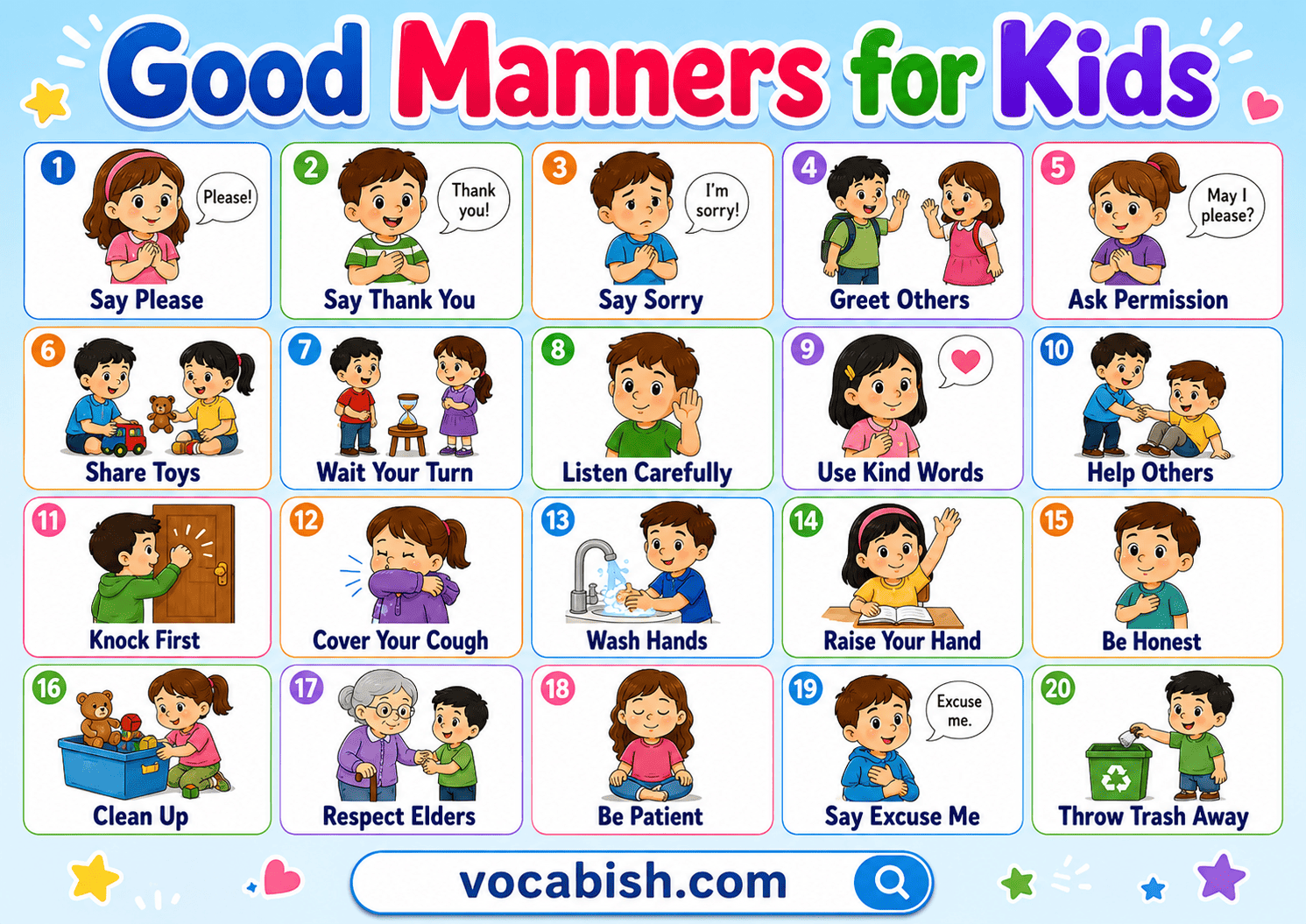
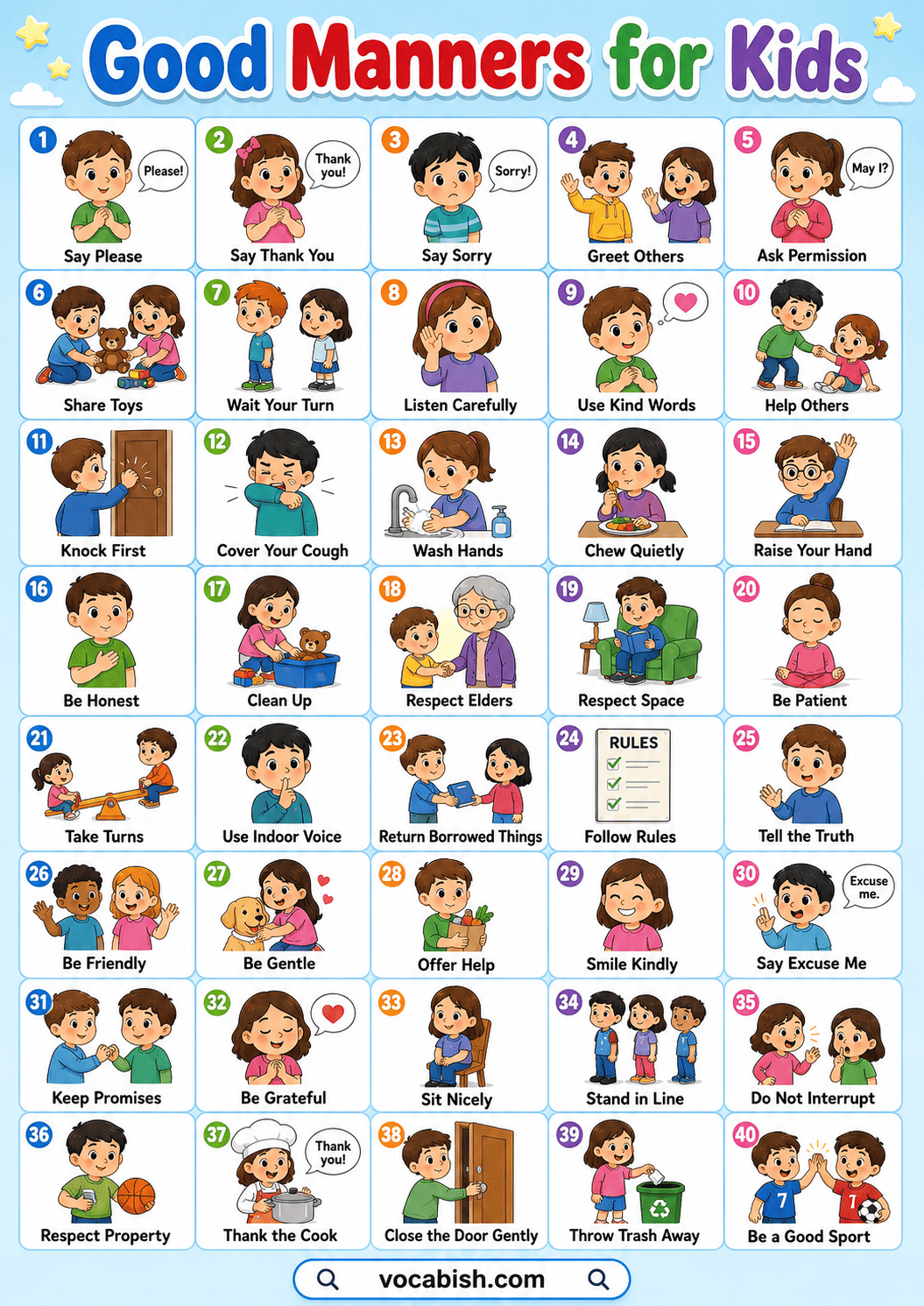
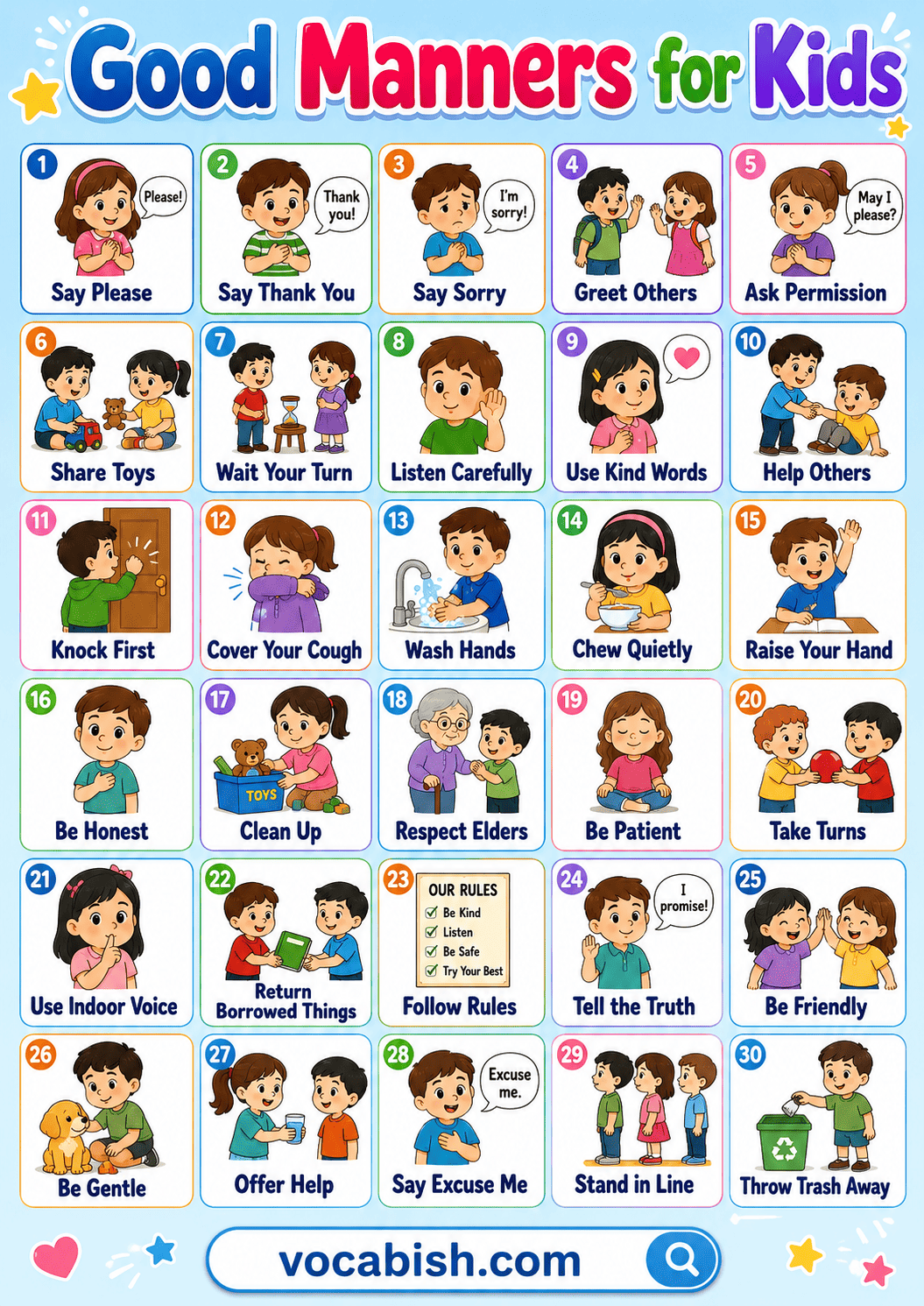
The following basic manners for kids can be practised in daily conversations and routines.
- Saying “Please”
“Please” turns a demand into a respectful request. Encourage children to use it when asking for food, help, permission, or an object.
Example: “Can I please have another piece of fruit?”
- Saying “Thank You”
Saying “thank you” teaches children to notice and appreciate what others do for them.
Example: “Thank you for helping me with my homework.”
- Saying “Sorry”
A meaningful apology shows that a child understands that their behavior affected someone else. Children should also learn how to repair the situation.
Example: “I am sorry I knocked over your blocks. I will help rebuild them.”
- Asking for Permission
Children should ask before using another person’s belongings, leaving an area, opening something, or joining an activity.
Example: “May I use your colored pencils?”
- Greeting People Politely
A simple “hello,” “good morning,” or “nice to meet you” helps children acknowledge others warmly.
Example: “Good morning, Mrs. Brown.”
- Listening Without Interrupting
Listening shows respect and helps children understand what another person is saying. Young children may need gentle reminders to wait.
Example: “I will wait until Dad finishes speaking.”
- Waiting for Their Turn
Turn-taking is important during games, conversations, classroom activities, and public queues.
Example: “It is Ali’s turn now. I will go next.”
- Sharing with Others
Sharing teaches cooperation, but children should also learn that some personal belongings do not have to be shared.
Example: “You can use the blue crayon when I finish.”
- Using Kind Words
Children should avoid insults, teasing, and hurtful comments. Teach them to express disagreement without attacking another person.
Example: “I do not agree, but I want to hear your idea.”
- Respecting Personal Space
Children need to understand that people may not always want to be touched, hugged, or crowded.
Example: “Can I give you a hug?”
- Helping Others
Small helpful actions teach kindness and cooperation.
Example: “I can help you carry those books.”
- Covering the Mouth When Coughing
Children should cough or sneeze into a tissue or the inside of their elbow. They should then wash or clean their hands when needed.
Example: “I covered my cough with my elbow.”
- Knocking Before Entering
Knocking teaches children to respect privacy at home, at school, and in other shared spaces.
Example: “May I come in?”
- Cleaning Up After Themselves
Children can learn to put away toys, clear small dishes, organize school supplies, and throw rubbish in the bin.
Example: “I finished playing, so I will put the blocks away.”
- Respecting Elders
Respecting older people means speaking politely, listening, and offering appropriate help. It does not mean children must ignore their own safety or boundaries.
Example: “Would you like my seat?”
- Accepting “No” Politely
Disappointment is normal, but children can learn to respond without shouting, arguing, or insulting others.
Example: “I feel disappointed, but I understand.”
- Returning Borrowed Things
Borrowed items should be handled carefully and returned on time.
Example: “Thank you for lending me your book. Here it is.”
- Keeping Promises
Children should learn not to make promises they cannot keep. Small commitments build trust.
Example: “I said I would feed the cat, so I will do it now.”
- Speaking in a Calm Voice
A calm voice helps children explain their needs more clearly, especially during frustration or disagreement.
Example: “I am upset because I was still using that toy.”
- Showing Gratitude
Gratitude includes appreciating gifts, help, time, food, and thoughtful actions.
Example: “Thank you for making dinner for us.”
Good Manners at Home
Home is often the first place where children practise respectful behavior. Everyday routines provide many opportunities to teach good habits for kids.
Children can greet family members in the morning, ask before taking someone’s belongings, and listen when another person is speaking. They can also help with age-appropriate tasks such as putting away toys, setting the table, sorting laundry, or feeding a pet.
Polite requests should become part of normal family communication. Instead of saying, “Give me water,” a child can say, “Can I please have some water?”
Adults should use the same respectful language they expect from children. When parents say “please,” “thank you,” and “I’m sorry,” children see that manners apply to everyone.
Classroom Manners Every Child Should Know
Classroom manners help create a safe and comfortable learning environment. They should be presented as positive social skills rather than a long list of strict rules.
Children should listen to instructions, raise their hands when required, wait for their turn, and avoid speaking over classmates. They should also respect school supplies, keep shared areas clean, and take part fairly in group work.
Good school etiquette includes accepting different ideas and abilities. A child should never laugh at a classmate for making a mistake, reading slowly, or giving an incorrect answer.
Teachers can reinforce respectful behavior with clear phrases such as:
- “Let’s give Mia time to finish.”
- “Please return the scissors to the supply box.”
- “You may disagree without being unkind.”
These reminders teach children what appropriate behavior looks and sounds like.
Table Manners for Children
Table manners help children eat safely, respect other diners, and take part in family or school meals comfortably.
Children should wash their hands before eating, chew with their mouths closed, and avoid talking while food is in their mouths. They should ask politely for food instead of reaching across another person’s plate.
They can also learn to take a reasonable amount of food, avoid unnecessary waste, and thank the person who prepared or served the meal.
Do | Don’t |
|---|---|
Say, “Please pass the bread.” | Reach across someone’s plate. |
Chew quietly with your mouth closed. | Speak with food in your mouth. |
Use a napkin when needed. | Wipe your hands on your clothes. |
Ask before leaving the table. | Walk away without saying anything. |
Thank the person who prepared the food. | Complain rudely about the meal. |
Table etiquette should be taught patiently. Young children may need repeated reminders while their coordination and self-control are still developing.
Here’s a complete guide on: Table Manners for Kids
Polite Behavior in Public Places
Public places introduce children to shared rules and spaces. Restaurants, parks, shops, libraries, buses, and family gatherings all require slightly different behavior.
Children can learn to use a quieter voice indoors, wait in queues, keep shared spaces clean, and avoid damaging public property. They should not point at, stare at, or make comments about another person’s appearance or disability.
On public transport, older children can learn to notice when an elderly person, pregnant passenger, or person with a disability may need a seat. However, adults should guide these situations rather than placing the full responsibility on a young child.
The goal is not to make children fearful or silent. It is to help them understand that public spaces belong to everyone.
Digital Manners and Online Etiquette
Digital manners are now an important part of polite behavior for children. The words children use online can affect real people, even when they cannot see their reactions.
Children should avoid rude comments, online bullying, repeated unwanted messages, and sharing embarrassing content. They should ask permission before posting another person’s photograph or video.
Online etiquette for kids also includes:
- Using respectful language in messages
- Replying politely when a response is needed
- Avoiding typing in anger
- Not sharing passwords or private information
- Following family rules about screen use
- Telling a trusted adult about threatening or uncomfortable messages
Good digital etiquette should always be taught alongside internet safety. Children need to know that being polite does not mean responding to strangers or keeping unsafe online conversations secret.
Age-Appropriate Manners for Children
Children learn manners gradually. Expectations should match their age, language ability, emotional development, and level of self-control.
Age Group | Manners to Practise |
|---|---|
Ages 2–4 | Saying hello and goodbye, using please and thank you, helping with cleanup, beginning to share, and following simple routines |
Ages 5–7 | Waiting for a turn, apologizing, listening in class, using table manners, asking permission, and respecting belongings |
Ages 8–12 | Respecting personal space, disagreeing politely, showing empathy, managing online behavior, keeping commitments, and taking responsibility |
Ages 2–4
Toddlers and preschoolers can begin using simple polite words. Adults should model the words and give short reminders without expecting perfect behavior.
Ages 5–7
Children in this age group can understand how their actions affect others. They can practise turn-taking, classroom manners, sincere apologies, and simple responsibilities.
Ages 8–12
Older children can discuss more complex ideas such as privacy, empathy, respectful disagreement, digital etiquette, and peer pressure.
At every age, repetition matters. A child who forgets a manner has not necessarily become disrespectful. They may still need support, practice, and a calm reminder.
How Parents Can Teach Good Manners
Children learn more from what adults repeatedly do than from what adults occasionally say. Parents can make manners part of ordinary family life through a few practical strategies.
- Model the behavior. Speak respectfully to children, relatives, workers, and strangers.
- Use gentle reminders. Say, “Try asking again with please,” instead of giving a long lecture.
- Praise specific actions. “I noticed you waited until your sister finished speaking” is more useful than simply saying, “Good job.”
- Practise through role-play. Act out how to greet a guest, ask for help, return an item, or handle disappointment.
- Keep expectations consistent. Children become confused when rude behavior is ignored one day and strongly punished the next.
- Correct privately when possible. Public embarrassment can make children defensive and distract from the lesson.
- Avoid forcing empty apologies. Help the child understand what happened and how to repair it.
Instead of saying, “You are rude,” say, “Please wait until Grandma finishes speaking.” The second statement corrects the behavior without labelling the child.
How Teachers Can Encourage Polite Behavior
Teachers can build classroom etiquette into regular lessons and routines. A warm greeting at the door, clear turn-taking rules, and respectful language from adults create a strong foundation.
Useful classroom strategies include:
- Morning greeting routines
- Kind-word or gratitude charts
- Role-playing common situations
- Shared classroom responsibilities
- Positive reinforcement
- Stories about empathy and respect
- Calm, consistent expectations
Teachers can also use real situations as brief learning opportunities. After a disagreement, they might ask, “What happened?”, “How did each person feel?” and “What could we do differently next time?”
Good manners activities for kids work best when they teach understanding rather than simple obedience.
Fun Activities for Teaching Good Manners
Children often learn social skills more effectively through games, stories, and practice.
Manners Role-Play
Give children a familiar situation, such as greeting a visitor, asking to join a game, apologizing, or borrowing a pencil. Let them act out both an impolite and a polite response, then discuss the difference.
Polite Words Jar
Place a small token in a jar whenever the child uses a polite phrase naturally. When the jar is full, celebrate with a shared activity such as a family game or extra story time.
The activity should encourage awareness, not make children expect a reward for every kind action.
Good Manners Story Cards
Write short situations on cards:
- A friend drops their books.
- Two children want the same toy.
- A guest arrives at the door.
- Someone is speaking, but you have an urgent question.
Ask, “What could the child say or do?”
Kindness Challenge
Choose one simple action each day, such as thanking a school worker, helping a sibling, including someone in a game, or writing a kind note.
At the end of the day, talk about how the action affected other people.
Good Manners Examples for Kids
Short dialogues help children understand how polite language works in real conversations.
Asking for something
Child: “May I please use your pencil?”
Friend: “Yes, you may.”
Child: “Thank you.”
Interrupting politely
Child: “Excuse me, may I say something?”
Parent: “Yes, go ahead.”
Making a mistake
Child: “I am sorry I broke your toy. I will help fix it.”
Joining a game
Child: “Can I play with you?”
Friend: “Yes. You can be on my team.”
Child: “Great, thank you.”
Disagreeing respectfully
Child 1: “I think we should draw a house.”
Child 2: “I have a different idea. Could we draw a park instead?”
Borrowing an item
Child: “May I borrow your ruler?”
Classmate: “Yes, but I need it back after the lesson.”
Child: “I will return it. Thank you.”
Responding to disappointment
Parent: “You cannot have another sweet today.”
Child: “I am disappointed, but I understand.”
Common Mistakes Adults Should Avoid
Adults can unintentionally make manners harder to learn. One common mistake is correcting children publicly in a way that causes embarrassment. A quiet reminder is often more effective.
Manners should not be taught through fear, threats, or humiliation. Children may follow a rule temporarily, but they may not understand the value behind it.
Adults should also avoid:
- Expecting perfect behavior immediately
- Calling a child rude, selfish, or bad
- Laughing at disrespectful behavior and later punishing it
- Demanding apologies without discussing what happened
- Expecting children to show manners adults do not model
- Treating quietness or shyness as disrespect
- Forcing physical affection as a form of politeness
A child can greet a relative kindly without being forced to hug or kiss them. Respecting children’s boundaries is also part of teaching respect.
Good Manners Checklist for Kids
Children can use this simple checklist at home or in the classroom:
- I say please and thank you.
- I greet people politely.
- I listen when someone is speaking.
- I wait for my turn.
- I ask before using someone’s belongings.
- I use kind and respectful words.
- I respect personal space.
- I clean up after myself.
- I return things I borrow.
- I apologize when my actions hurt someone.
- I help others when I can.
- I follow reasonable rules at home and school.
The checklist can be printed, displayed, or discussed regularly. It should serve as a reminder rather than a test of perfect behavior.
FAQs About Good Manners for Kids
Five basic good manners are saying “please,” saying “thank you,” listening when someone is speaking, waiting for a turn, and apologizing after a mistake. These habits help children communicate respectfully and cooperate with others at home, at school, and in public places.
Children can begin learning simple manners during the toddler years. Parents can model greetings, polite words, sharing, and cleanup from an early age. Expectations should remain age-appropriate because young children are still developing language, patience, memory, and emotional control.
Teach manners through modeling, calm reminders, role-play, specific praise, and consistent routines. Explain why a behavior matters and show the child what to do instead. For example, replace “Stop being rude” with “Please wait until your brother finishes speaking.”
Children may forget manners when they are excited, tired, hungry, stressed, distracted, or emotionally overwhelmed. Self-control develops gradually, so forgetting does not always mean deliberate disrespect. A short reminder and another chance to respond are usually more helpful than anger.
Children should be encouraged to apologize, but forcing the word “sorry” without understanding may produce an empty response. First help the child recognize what happened, how the other person felt, and what they can do to repair the situation.
Manners are respectful social behaviors, such as listening, greeting others, and using polite language. Discipline is the wider process of teaching boundaries, responsibility, and self-control. Positive discipline helps children understand and practise good manners rather than simply obeying through fear.
Final Thoughts
Good manners for kids are not about creating perfect, silent, or unquestioning children. They are about helping children communicate with respect, notice other people’s feelings, and take responsibility for their actions.
These skills develop through patience, repetition, clear expectations, and strong adult examples. Parents and teachers should correct behavior without shaming the child and recognise that mistakes are part of learning. When children regularly see kindness, courtesy, empathy, and gratitude in action, those values gradually become part of their own behavior.
Explore More Kids Learning Resources