
Have you ever looked at a Spanish word and wondered, “How do I even say these letters?” Learning the ABC in Spanish is one of the fastest ways to feel more confident with Spanish pronunciation, spelling, and reading.
The good news is that the Spanish alphabet is not hard to learn. It uses many letters you already know in English, but some letters have different names, sounds, and pronunciation rules. In this lesson, you will learn the Spanish alphabet with pronunciation, example words, English sound clues, and a worksheet you can use for practice.
What Is the ABC in Spanish?
The ABC in Spanish is the Spanish alphabet used to read, write, spell, and pronounce Spanish words. It has 27 letters, including the special letter ñ, which does not appear in the English alphabet.
In Spanish, each letter has a name. Some letter names sound close to English, but others are very different. Once you know them, spelling names, reading new words, and understanding classroom Spanish becomes much easier.
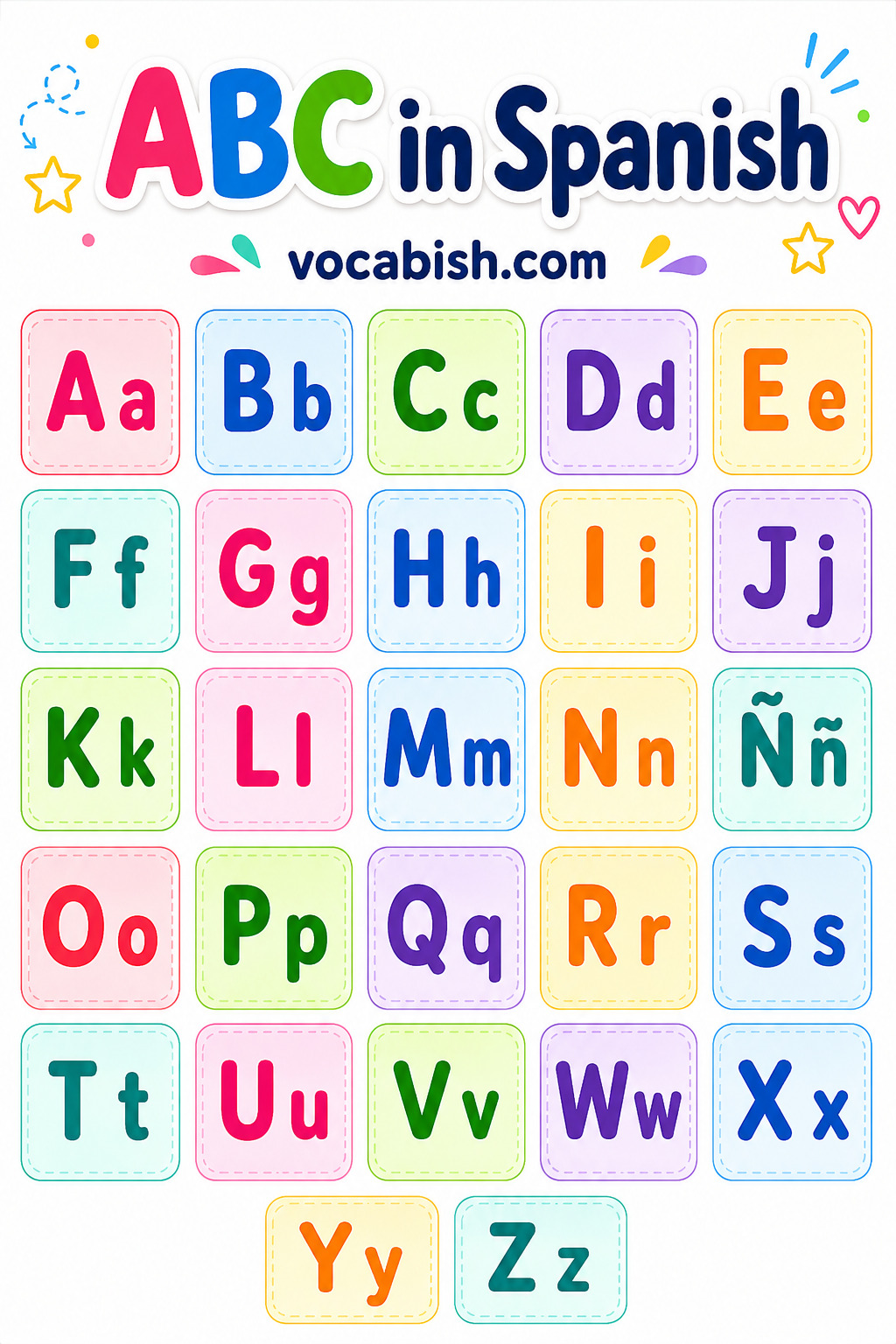
The modern Spanish alphabet includes:
A, B, C, D, E, F, G, H, I, J, K, L, M, N, Ñ, O, P, Q, R, S, T, U, V, W, X, Y, Z
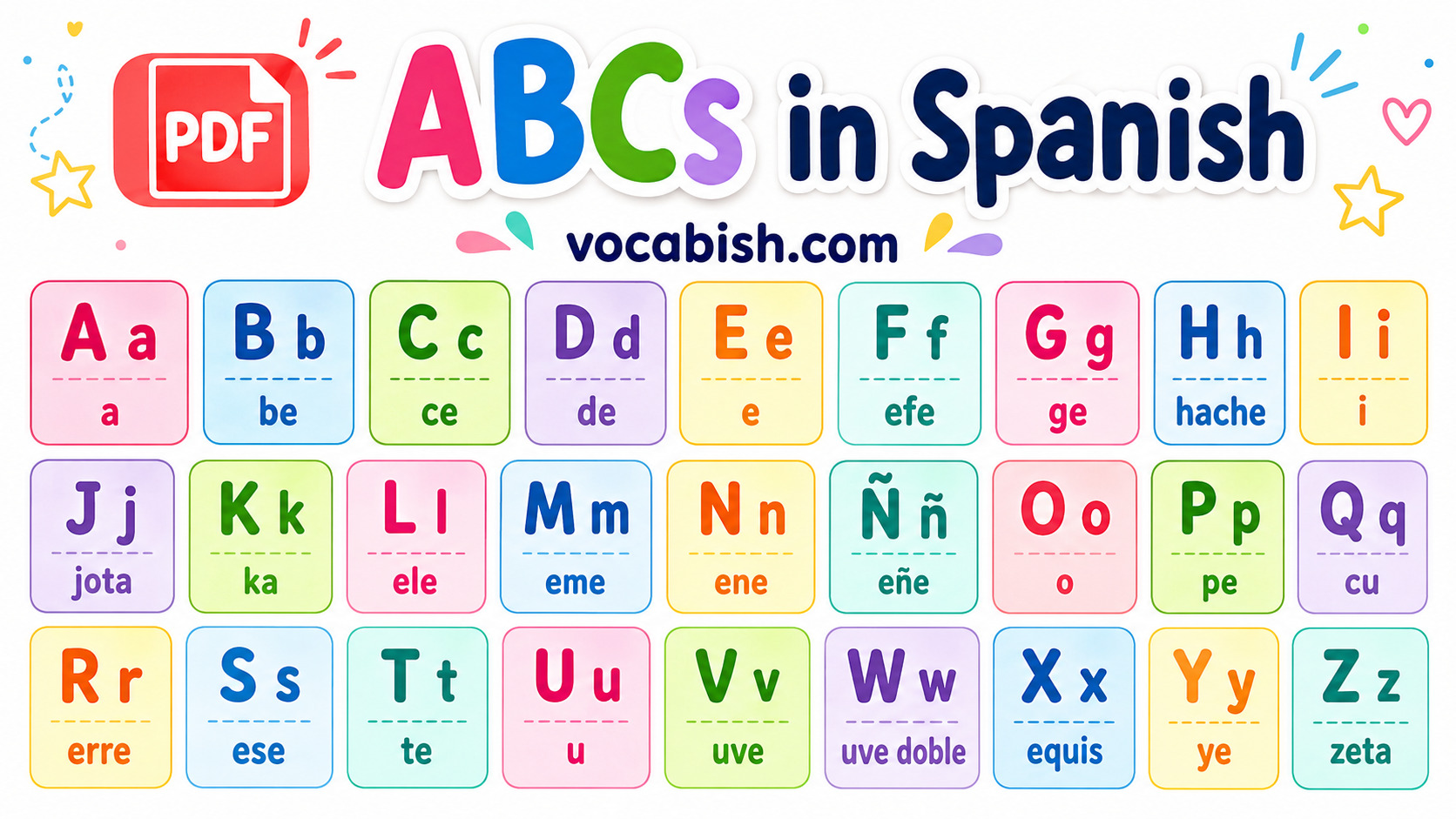
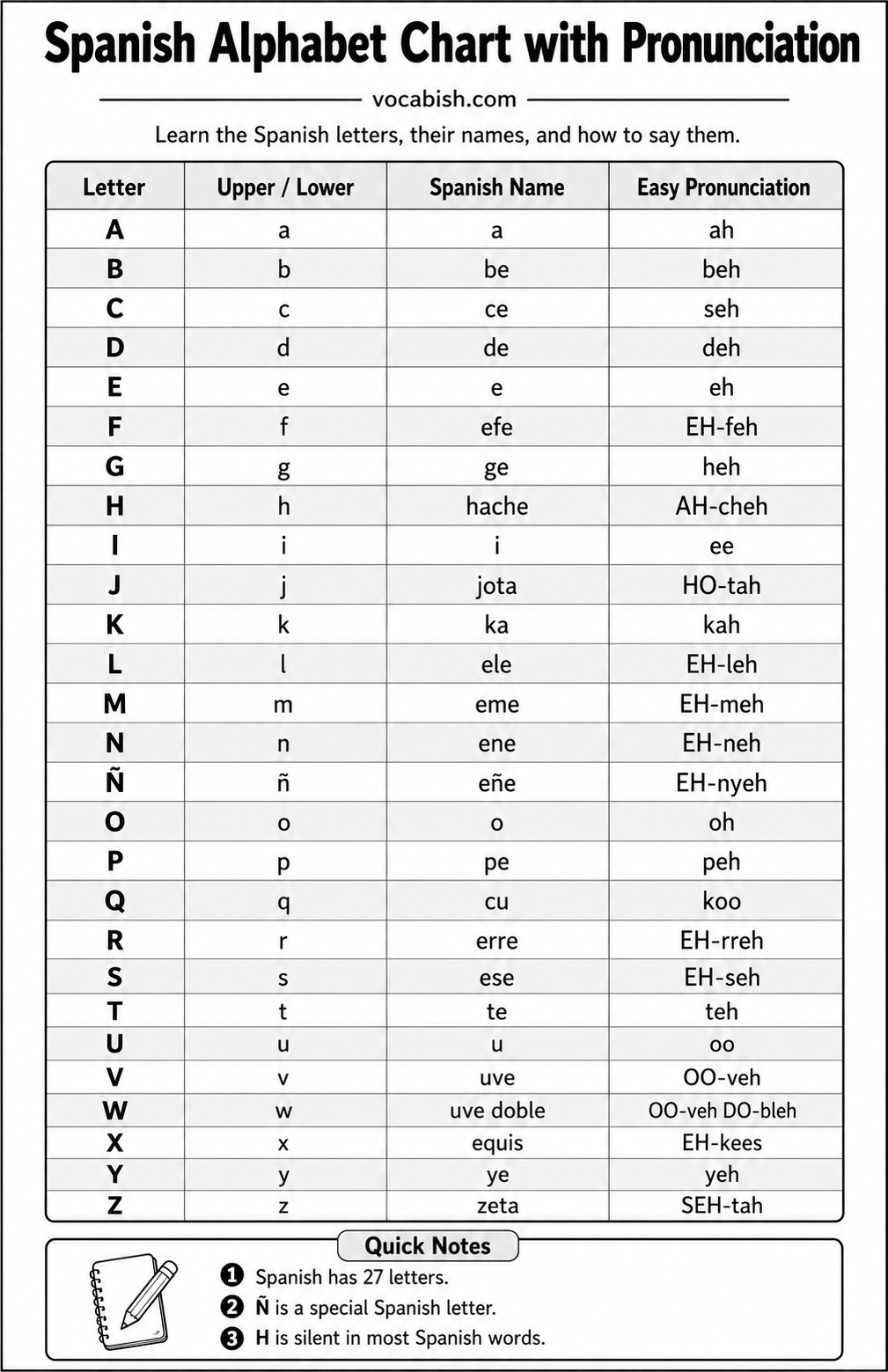
Spanish Alphabet Chart with Pronunciation
This chart shows each Spanish letter, its Spanish name, and a clear pronunciation clue for English speakers. Use it slowly at first, then read it aloud several times.
The goal is not to sound perfect right away. Focus on hearing the rhythm of the letter names and noticing which letters sound different from English.
ABC in Spanish
Quick Pronunciation Note
Spanish vowels stay more consistent than English vowels. For example, a usually sounds like “ah,” and e usually sounds like “eh.” This helps you read Spanish words with more confidence.
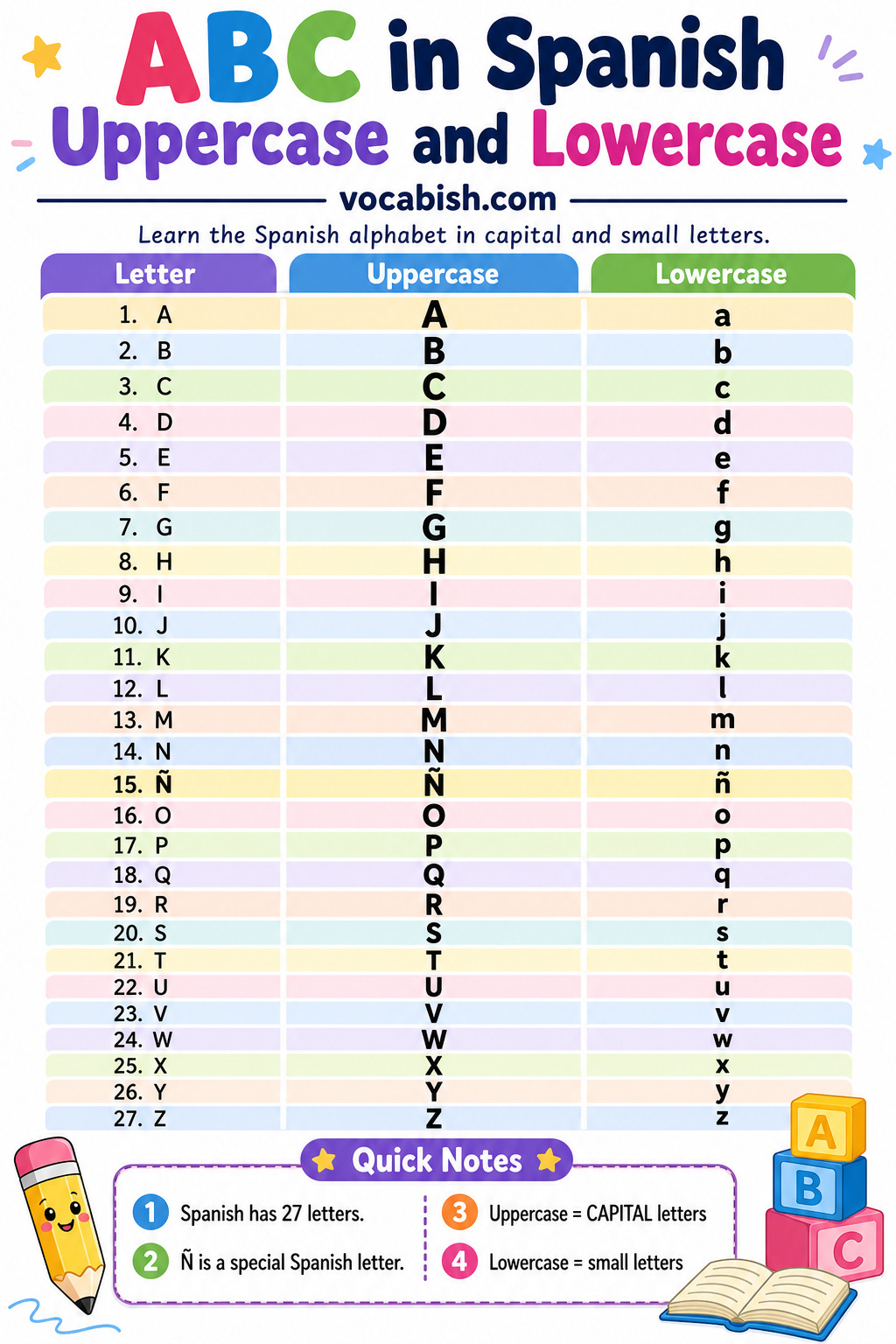
ABC in Spanish Uppercase and Lowercase
Spanish uses uppercase and lowercase letters like English. The letter shapes are mostly the same, but Spanish includes ñ and Ñ.
Learning the ABC in Spanish lowercase helps with reading books, worksheets, signs, and online text.
Learning the ABC in Spanish uppercase helps with titles, names, headings, and forms.
How Spanish Capital Letters Work:
Spanish capital letters are used at the beginning of sentences and for proper names, just like English. One difference is that Spanish does not capitalize languages or nationalities in normal writing.
Examples:
- Hablo español.
I speak Spanish. - María vive en México.
María lives in Mexico. - El libro está en la mesa.
The book is on the table.
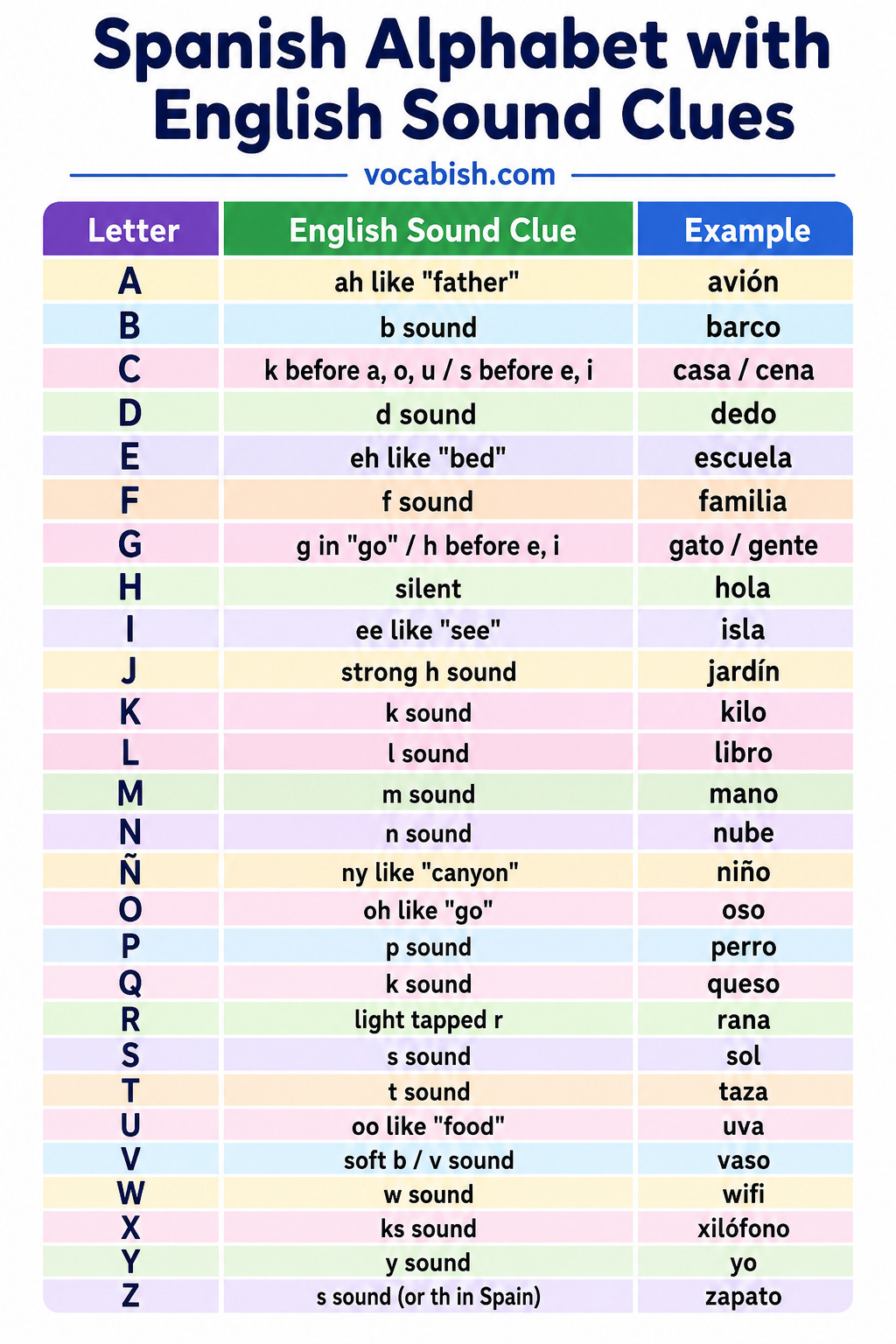
Spanish Alphabet with English Sound Clues
A Spanish alphabet with English clues can help you start quickly, but remember that English sounds are only a close match. Spanish pronunciation is cleaner and more consistent.
Use the English clues as training wheels. Then listen to native pronunciation when you can, especially for j, g, r, rr, and ñ.
Spanish Letter | Often Sounds Like | Example |
|---|---|---|
A | a in “father” | casa |
E | e in “bed” | mesa |
I | ee in “see” | amigo |
O | o in “go” | sol |
U | oo in “food” | luna |
Ñ | ny in “canyon” | niño |
J | strong h sound | jardín |
H | silent | hola |
LL | y sound in many regions | lluvia |
R | tapped r | pero |
RR | rolled r | perro |
Why English sound clues are not exact:
English has many shifting vowel sounds. Spanish vowels are shorter and steadier. That is why me, mi, mo, and mu feel more regular in Spanish than similar letter patterns in English.
Spanish Alphabet with Words
Learning the Spanish alphabet with words makes each letter easier to remember. Instead of memorizing letters alone, connect each one to a useful Spanish word.
Read the word aloud after saying the letter name. This builds spelling, vocabulary, and pronunciation at the same time.
Letter | Spanish Word | English Meaning |
|---|---|---|
A | avión | airplane |
B | barco | boat |
C | casa | house |
D | dedo | finger |
E | escuela | school |
F | familia | family |
G | gato | cat |
H | hola | hello |
I | isla | island |
J | jardín | garden |
K | kilo | kilo |
L | libro | book |
M | mano | hand |
N | nube | cloud |
Ñ | niño | boy |
O | oso | bear |
P | perro | dog |
Q | queso | cheese |
R | rana | frog |
S | sol | sun |
T | taza | cup |
U | uva | grape |
V | vaso | glass |
W | wifi | Wi-Fi |
X | xilófono | xylophone |
Y | yo | I |
Z | zapato | shoe |
Helpful classroom tip:
When students learn one word per letter, they remember the alphabet faster. Teachers can also ask students to draw the word, spell it, and use it in a short sentence.
Letters That Sound Different in Spanish
Some Spanish letters surprise English speakers because their names or sounds do not match English habits. These letters deserve extra attention.
You do not need to master every regional accent at once. Start with the common classroom pronunciation, then notice differences as you listen to Spanish speakers from different countries.
H is silent
The Spanish letter h is called hache, but it is usually silent in words.
Examples:
- hola sounds like “ola”
- hotel sounds like “otel”
- hombre sounds like “ombre”
J sounds like a strong H
The Spanish j has a strong breathy sound. It is close to an English “h,” but often stronger.
Examples:
- jugo
- jardín
- José
Ñ has a “ny” sound
The letter ñ is one of the most important differences between English and Spanish. It sounds like “ny” in “canyon.”
Examples:
- niño
- mañana
- señor
B and V can sound similar
In many Spanish accents, b and v sound very close. This often surprises English speakers because English clearly separates them.
Examples:
- bien
- vaca
- bebé
- vino
R and RR need practice
Spanish has a tapped r and a rolled rr. Many learners need time to feel comfortable with these sounds.
Examples:
- pero means “but”
- perro means “dog”
One small sound change can create a different word, so practice slowly and listen carefully.
How to Practice the ABC in Spanish
The best way to learn the ABC in Spanish is to say it, hear it, write it, and use it in words. Short daily practice works better than long memorizing sessions.
Try to connect the letters to things you already know. Names, food, places, and classroom words are great starting points.
Here are practical ways to practice:
- Say the alphabet aloud once a day.
- Spell your name in Spanish.
- Write uppercase and lowercase letters together.
- Match each letter with one Spanish word.
- Read short Spanish words slowly.
- Listen to Spanish alphabet songs or teacher recordings.
- Practice difficult letters separately: j, ñ, r, rr, v, y.
Spell your name in Spanish:
Spelling names is a useful classroom skill. Here is an example:
Name: Ana
A = a
N = ene
A = a
Ana is spelled: a – ene – a
Now try your own name. Say each letter in Spanish, not English.
How Do You Pronounce the Spanish Alphabet?
The Spanish alphabet is usually easier to pronounce than English because many letters keep a steady sound. Still, some letters change sound when they appear with certain vowels or letter combinations.
These patterns are worth learning early because they appear in many common Spanish words. Once you recognize them, reading and speaking Spanish feels much more natural.
G Before E or I
When g comes before e or i, it sounds like a strong, raspy English h. This sound comes from the throat.
Spanish Word | Meaning | Sound Tip |
|---|---|---|
gente | people | sounds like “hen-teh” |
Gibraltar | Gibraltar | starts with a strong h-like sound |
When g comes before a, o, or u, it sounds like the g in the English word good.
Examples:
- gol — goal
- guapo — handsome
- gato — cat
A helpful way to remember it:
g + e / i = strong h sound
g + a / o / u = hard g sound
C Before H
When c comes before h, the two letters form ch. In Spanish, ch sounds like the ch in the English word cheese.
Examples:
- chícharo — pea
- chicharra — cicada
Even though ch is no longer counted as a separate letter in the modern Spanish alphabet, it is still a very common sound in Spanish words.
Double L: LL
The letter combination ll can sound different depending on the country or region. In many places, it sounds like the y in yellow.
In some Spanish-speaking areas, it may sound closer to the j in judge or the sh in show.
Examples:
- llamar — to call
- valle — valley
For most learners, starting with the y sound is a good choice. As you listen to more Spanish speakers, you will notice regional differences.
Double R: RR
When two r letters appear together, Spanish speakers use a rolled or trilled sound. This is the sound people often think of when they hear “rolling your r.”
Examples:
- carro — car
- burro — donkey
A single r at the beginning of a word is also rolled.
Example:
- rojo — red
Do not worry if the rolled r takes time. Many learners need regular practice before this sound feels comfortable.
X in Spanish Words
The letter x is often pronounced like ks in the English word socks.
Example:
- examen — exam
However, x can change sound in some place names and personal names, especially names from Mexico or Indigenous languages.
X Sound | Example | Meaning |
|---|---|---|
ks sound | examen | exam |
raspy h sound | México | Mexico |
s sound | Xochimilco | a neighborhood in Mexico City |
sh sound | Xicalango | a town in Mexico |
This is why Spanish pronunciation is not only about letters. Names, regions, and word history can also affect how a word sounds.
Quick Pronunciation Review:
Here are the key patterns to remember:
- g + e / i sounds like a strong English h.
- g + a / o / u sounds like the g in good.
- ch sounds like ch in cheese.
- ll often sounds like y in yellow.
- rr is rolled or trilled.
- x can sound like ks, h, s, or sh, depending on the word.
These sound clues help you move beyond memorizing the ABC in Spanish and start reading real Spanish words with better pronunciation.
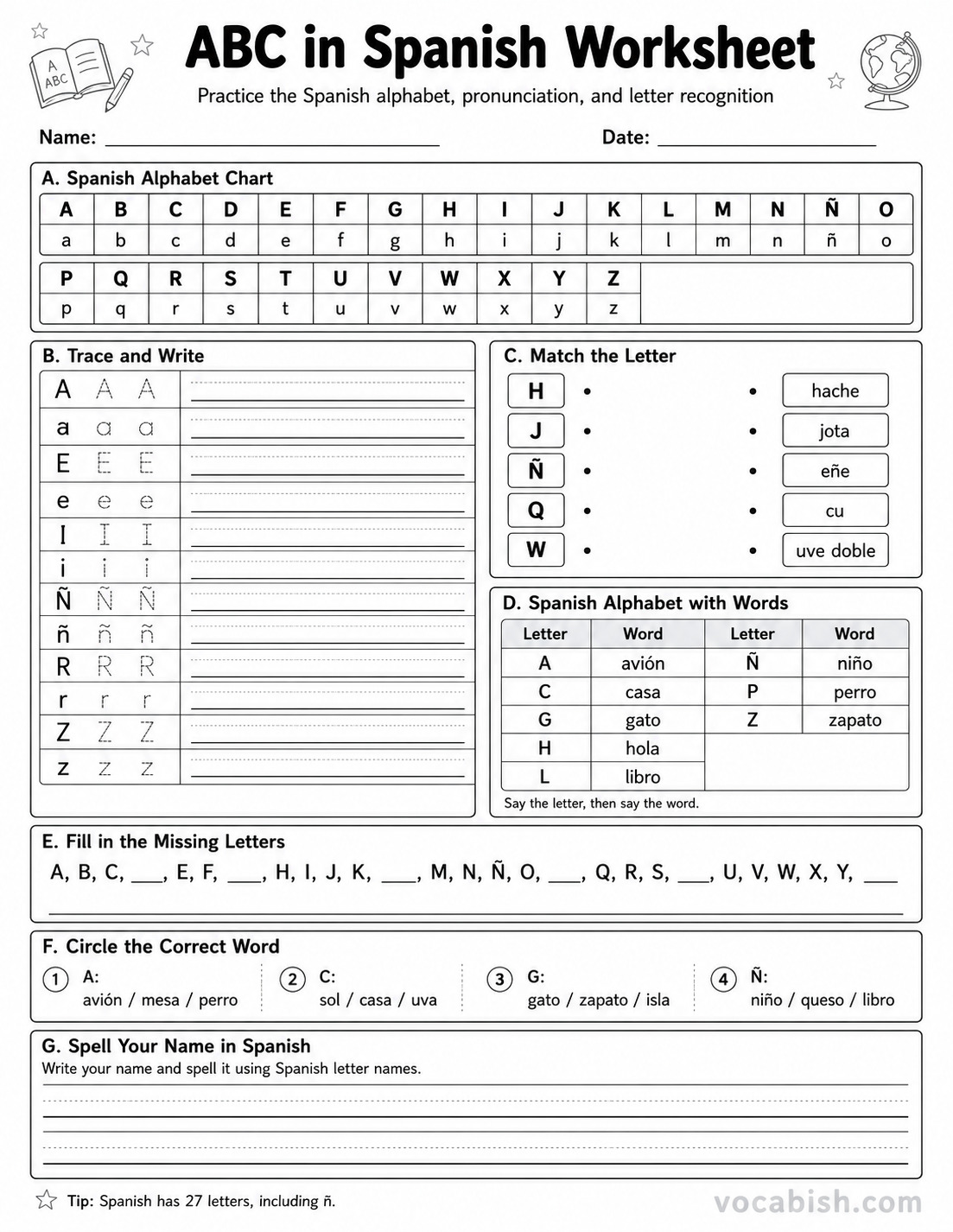
ABC in Spanish: Worksheet
This worksheet helps you review the Spanish alphabet, lowercase letters, uppercase letters, pronunciation, and vocabulary. You can copy it into a notebook or print it for classroom use.
Work slowly and check your answers after each section. The goal is to build accuracy, not speed.
1: Write the lowercase letter
Write the lowercase form of each Spanish uppercase letter.
Uppercase | Lowercase |
|---|---|
A | ____ |
B | ____ |
C | ____ |
D | ____ |
E | ____ |
F | ____ |
G | ____ |
H | ____ |
I | ____ |
J | ____ |
Ñ | ____ |
O | ____ |
Q | ____ |
R | ____ |
Z | ____ |
2: Match the letter to its Spanish name
Match each letter with the correct Spanish name.
Letter | Spanish Name |
|---|---|
H | a. jota |
J | b. eñe |
Ñ | c. hache |
Q | d. cu |
W | e. uve doble |
3: Choose the correct word
Choose the Spanish word that starts with each letter.
- A
a. avión
b. mesa
c. perro - C
a. sol
b. casa
c. uva - G
a. gato
b. zapato
c. isla - Ñ
a. niño
b. queso
c. libro - Z
a. taza
b. zapato
c. mano
4: Fill in the missing letters
Complete the missing Spanish alphabet letters.
A, B, C, ___, E, F, ___, H, I, J, K, ___, M, N, Ñ, O, ___, Q, R, S, ___, U, V, W, X, Y, ___
5: Spell these words aloud
Say each letter name in Spanish.
Word | Spell It in Spanish |
|---|---|
casa | __________________ |
hola | __________________ |
niño | __________________ |
perro | __________________ |
sol | __________________ |
Answer Key:
Answers for Part 1:
- A/a, B/b, C/c, D/d, E/e, F/f, G/g, H/h, I/i, J/j, Ñ/ñ, O/o, Q/q, R/r, Z/z
Part 2:
- H = c. hache
- J = a. jota
- Ñ = b. eñe
- Q = d. cu
- W = e. uve doble
Answers for Part 3:
- avión
- casa
- gato
- niño
- zapato
Part 4:
- D, G, L, P, T, Z
Common Mistakes English Speakers Make
English speakers often bring English pronunciation habits into Spanish. That is normal, but a few small changes can make your Spanish sound much clearer.
Pay attention to vowel sounds, silent letters, and letter names. These are usually the places where learners make the most mistakes.
Common mistakes include:
- Saying Spanish vowels like English vowels.
- Pronouncing h when it should stay silent.
- Saying j like the English letter “j.”
- Forgetting that ñ is a separate letter.
- Treating b and v exactly like English.
- Skipping practice with r and rr.
- Calling Spanish letters by English names during spelling practice.
A better practice habit:
When you learn a new Spanish word, say the word first, then spell it letter by letter in Spanish. This connects pronunciation and spelling in a natural way.
Example:
mesa
Word: mesa
Spelling: eme – e – ese – a
Quick Review: Spanish Alphabet Basics
The Spanish alphabet has 27 letters and includes ñ. Most letters look familiar to English speakers, but the pronunciation can be different.
If you remember only a few key points today, remember these:
- Spanish vowels are steady: a, e, i, o, u.
- H is usually silent.
- J sounds like a strong “h.”
- Ñ sounds like “ny.”
- R and RR need repeated practice.
- Letter names matter when spelling in Spanish.
Download Spanish Alphabet PDF
FAQs About the ABC in Spanish
The Spanish alphabet has 27 letters. It uses the English alphabet plus ñ, which has its own name and sound.
The Spanish alphabet is called “el alfabeto español” or “el abecedario.” Both are common and understood by Spanish speakers.
Yes, ñ is a separate Spanish letter. It sounds like “ny” in “canyon” and appears in words like niño.
Today, ch and ll are not separate alphabet letters. They are letter combinations, though they still create important Spanish sounds.
ABC in Spanish is pronounced “a, be, ce.” The letter names sound like “ah, beh, seh” for English speakers.
Spanish letter sounds are more consistent than English. Vowels stay steady, h is silent, and j has a strong h-like sound.
Children can sing alphabet songs, trace letters, match words to pictures, spell names, and repeat one Spanish word for each letter.
The Spanish alphabet helps you read, spell, pronounce words, understand classroom instructions, and build confidence in everyday Spanish communication.
Conclusion
Learning the ABC in Spanish gives you a strong start with pronunciation, spelling, and reading. Once you know the letter names, vowel sounds, and special letters like ñ, Spanish words feel easier to understand and say. Keep practicing with charts, example words, and short spelling activities until the alphabet feels natural.