
Have you ever written “Can you advice me?” and wondered whether it was correct? The difference between advice vs advise is small in spelling but important in grammar.
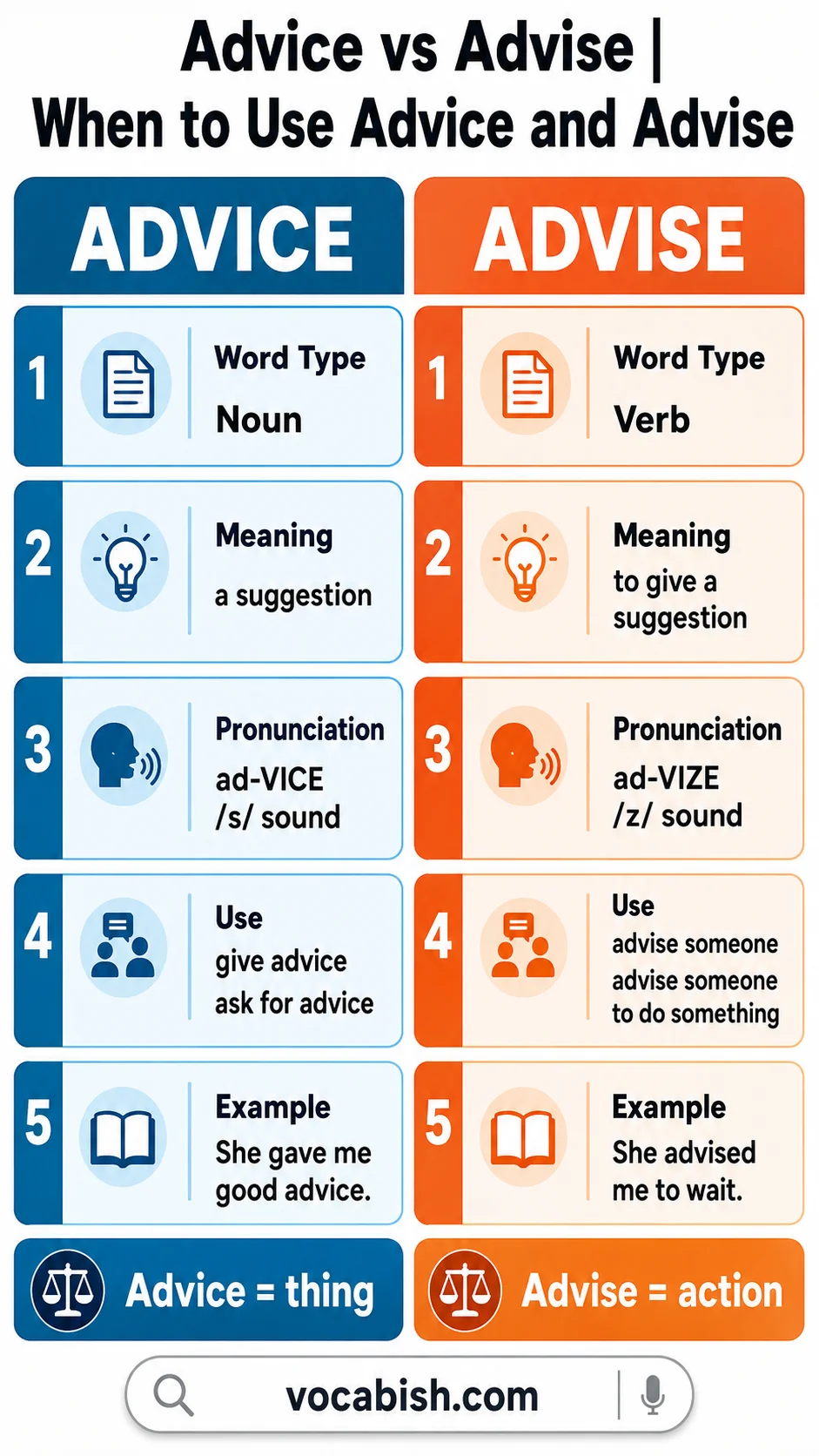
Advice is a noun meaning a suggestion or recommendation. Advise is a verb meaning to give someone a suggestion or recommendation. Their pronunciation is also different: advice ends with an s sound, while advise ends with a z sound.
Advice vs Advise: The Quick Difference
The easiest way to separate these words is to identify their parts of speech. One names a recommendation, while the other describes the action of giving it.
Word | Part of Speech | Meaning | Pronunciation | Example |
|---|---|---|---|---|
Advice | Noun | A suggestion or recommendation | /ədˈvaɪs/ | She gave me useful advice. |
Advise | Verb | To give a suggestion or recommendation | /ədˈvaɪz/ | She advised me to rest. |
Here is the difference in one sentence:
My teacher advised me to follow her advice.
In this example, advised describes the teacher’s action, while advice names the recommendation she gave.
What Does Advice Mean?
Advice is a noun. It refers to an opinion, recommendation, or suggestion intended to help someone decide what to do.
You can receive advice, ask for advice, follow advice, ignore advice, or give advice.
Examples of Advice in Sentences
- My father gave me some helpful advice.
- Can I ask you for advice?
- Her advice helped me make a better decision.
- You should follow your doctor’s advice.
- That was the best advice I had ever received.
- He ignored my advice and made the same mistake again.
Advice Is an Uncountable Noun
In standard English, advice is uncountable. This means we do not normally use it with a, an, or a plural ending.
Incorrect:
- She gave me an advice.
- I received several advices.
- He shared two useful advices.
Correct:
- She gave me some advice.
- I received several pieces of advice.
- He shared two useful pieces of advice.
To count individual recommendations, use expressions such as:
- a piece of advice
- two pieces of advice
- a word of advice
- several suggestions
- a few recommendations
Example:
Let me give you one piece of advice: always check your work before submitting it.
Common Words Used with Advice
Certain verbs and adjectives frequently appear with advice.
Common Expression | Example |
|---|---|
ask for advice | I asked my teacher for advice. |
give advice | She often gives practical advice. |
get advice | You should get professional advice. |
seek advice | He sought advice from an expert. |
follow advice | I followed your advice. |
take someone’s advice | Take my advice and leave early. |
ignore advice | They ignored the safety advice. |
helpful advice | Thank you for the helpful advice. |
sound advice | Her suggestion was sound advice. |
practical advice | The article contains practical advice. |
expert advice | We asked for expert advice. |
legal advice | You may need legal advice. |
Advice About or Advice on?
Both advice about and advice on are correct.
Use them when introducing the subject of the recommendation:
- Can you give me advice about my career?
- She offered advice on saving money.
- I need advice about choosing a course.
- The website provides advice on improving pronunciation.
Advice on often sounds slightly more formal, but the meanings are usually the same.
What Does Advise Mean?
Advise is a verb. It means to recommend an action, suggest what someone should do, or give useful information.
Because it is a verb, its form can change according to tense and subject.
Verb Form | Example |
|---|---|
advise | I advise you to wait. |
advises | She advises new students. |
advised | The teacher advised us to practise. |
advising | He is advising the project team. |
Examples of Advise in Sentences
- I advise you to read the instructions carefully.
- The doctor advised him to get more rest.
- She advises students about university applications.
- They are advising customers to change their passwords.
- We strongly advise booking your tickets early.
- The lawyer advised the company against signing the agreement.
The word does not always involve personal advice. It can also mean to inform someone officially.
- Please advise us of any changes.
- Customers were advised that the office would close early.
How to Pronounce Advice and Advise
The final sound is the main pronunciation difference. Advice ends with an unvoiced s sound, while advise ends with a voiced z sound.
- Advice: /ədˈvaɪs/ — sounds like ad-VICE
- Advise: /ədˈvaɪz/ — sounds like ad-VIZE
Compare these endings:
- ice → advice
- eyes → advise
Try saying this sentence slowly:
I advise you to follow my advice.
Your mouth position is similar for both words, but your voice vibrates on the final sound of advise.
A hand-on-throat test can help. Place your fingers lightly on your throat:
- Say the final s in advice. You should feel little or no vibration.
- Say the final z in advise. You should feel vibration.
Grammar Patterns with Advice
Because advice is a noun, it usually appears after verbs such as give, need, want, ask for, and follow. It can also follow adjectives and possessive words.
Give Someone Advice
Use this structure:
give + person + advice
- She gave me advice.
- The coach gave the players some advice.
- Could you give us advice about the interview?
You can also say:
give advice to + person
- She gave advice to the new employees.
The first pattern usually sounds more natural in everyday conversation.
Ask Someone for Advice
Use:
ask + person + for advice
- I asked my brother for advice.
- You should ask your teacher for advice.
- She asked an expert for financial advice.
Do not say ask advice from someone in ordinary English. Although it may appear in formal usage, ask someone for advice is clearer and more natural.
Take or Follow Advice
Both expressions mean that you act according to someone’s recommendation.
- I took her advice and applied for the job.
- He followed the doctor’s advice.
- Take my advice: do not leave everything until the last minute.
Take my advice is often used before giving a direct recommendation.
A Piece of Advice
Use a piece of advice when referring to one recommendation.
- Can I give you a piece of advice?
- She offered me one valuable piece of advice.
- His first piece of advice was to remain calm.
In conversation, people often use a tip or a suggestion instead:
- Here is a useful tip.
- Can I make a suggestion?
Grammar Patterns with Advise
The verb advise can be followed by a person, an action, a noun phrase, or a clause. Choosing the right structure makes your sentence sound natural.
Advise Someone to Do Something
This is the most common pattern:
advise + person + to + base verb
- I advise you to wait.
- She advised me to speak to the manager.
- The teacher advised the students to revise regularly.
- We strongly advise visitors to keep their belongings safe.
When describing something a person should not do, use:
advise + person + not to + base verb
- They advised us not to travel during the storm.
- I would advise you not to make a rushed decision.
Advise Doing Something
You can use a gerund when the person receiving the recommendation is not mentioned.
advise + verb-ing
- We advise arriving at least thirty minutes early.
- Experts advise checking the details carefully.
- The company advises using a strong password.
Compare:
- We advise customers to book early.
- We advise booking early.
Both are correct. The first identifies the people receiving the recommendation; the second focuses on the recommended action.
Advise Someone About or On Something
Use this structure when naming the subject of the advice:
- She advised me about my career choices.
- A consultant advised the company on its marketing strategy.
- The teacher advised us on how to prepare for the examination.
Advise on is common in professional and formal contexts.
Advise Against Something
Advise against means to recommend not doing something.
- Doctors advise against smoking.
- The guide advised us against walking alone at night.
- I would advise against making that decision without more information.
- They advised him against accepting the offer.
The word after against is usually a noun or an -ing form.
Advise That
In formal English, advise can introduce a clause with that.
- The committee advised that the plan should be revised.
- The doctor advised that she rest for a few days.
- We advise that all applicants read the conditions carefully.
In American English, the base verb is often used after advise that:
The lawyer advised that he remain silent.
In British English, should is also common:
The lawyer advised that he should remain silent.
Advice or Advise in Common Situations
Seeing the words in everyday contexts makes their roles easier to recognise. Focus on whether the sentence needs a thing or an action.
At School
- My teacher gave me useful advice about improving my writing.
- My teacher advised me to read more often.
At Work
- I need your advice before I reply to this email.
- My manager advised me to speak directly with the client.
While Travelling
- The hotel staff gave us advice about local transport.
- They advised us to avoid travelling during rush hour.
In a Formal Email
- Could you please give me some advice on this matter?
- Please advise me on the next steps.
- Please advise whether the documents have been approved.
In business communication, please advise often means “please tell me what I should do” or “please provide the requested information.”
It is correct, but it can sound formal or slightly direct. Friendlier alternatives include:
- Please let me know what you recommend.
- Could you tell me what the next step is?
- Please let me know how I should proceed.
In Health-Related Contexts
- Follow the advice given by a qualified healthcare professional.
- The doctor advised the patient to attend a follow-up appointment.
These examples explain grammar only. They do not replace professional healthcare guidance.
Common Mistakes with Advice and Advise
Most errors happen because learners confuse the noun with the verb or try to make advice plural. Check whether your sentence needs a recommendation or the act of recommending.
- Incorrect: Can you advice me?
Correct: Can you advise me? - Incorrect: She gave me an advice.
Correct: She gave me some advice. - Incorrect: He gave me many advices.
Correct: He gave me several pieces of advice. - Incorrect: They advised to leave early.
Correct: They advised us to leave early.
Also correct: They advised leaving early. - Incorrect: My teacher adviced me to practise.
Correct: My teacher advised me to practise.
How to Remember Advice vs Advise
A quick spelling connection can help you choose correctly. Link the final letters to other familiar noun-and-verb pairs.
The C and S Memory Trick
Advice contains c and is a noun, like choice.
- advice = a thing
- choice = a thing
Advise contains s and is a verb, like suggest.
- advise = an action
- suggest = an action
Replace the Word
Try replacing the word with recommendation or recommend.
Use advice when recommendation fits:
- I need your recommendation.
- I need your advice.
Use advise when recommend fits:
- I recommend that you wait.
- I advise you to wait.
Listen to the Final Sound
Remember:
- advice → /s/ sound
- advise → /z/ sound
The pronunciation can remind you that the words perform different grammatical jobs.
Advice and Advise Compared in Sentence Pairs
These paired examples show how the noun and verb express the same idea in different sentence structures.
Using Advice | Using Advise |
|---|---|
She gave me advice about saving money. | She advised me to save money. |
His advice was helpful. | He advised us carefully. |
I need advice about the interview. | Please advise me about the interview. |
We followed their advice. | They advised us to change our plan. |
The advice was to arrive early. | They advised everyone to arrive early. |
Her advice prevented a mistake. | She advised me against making that mistake. |
Notice that advice can be described with adjectives:
- helpful advice
- useful advice
- practical advice
- valuable advice
- professional advice
The verb advise can be modified with adverbs:
- strongly advise
- carefully advise
- professionally advise
- officially advise
Practice Exercise: Choose Advice or Advise
Complete each sentence with the correct word or form.
- Could you ______ me about choosing a new laptop?
- She gave me excellent ______.
- The guide ______ us to carry enough water.
- I followed your ______ and spoke to my teacher.
- Experts ______ checking the information before sharing it.
- He asked his parents for ______.
- We were ______ not to enter the building.
- Can you give me a piece of ______?
- I would ______ against signing the document immediately.
- The manager will ______ you on the next steps.
Answers
- advise
- advice
- advised
- advice
- advise
- advice
- advised
- advice
- advise
- advise
FAQs About Advice and Advise
Advice is a noun. It names a suggestion, opinion, or recommendation given to help someone make a decision or solve a problem.
Advise is a verb meaning to recommend an action, offer guidance, or officially inform someone about a situation, decision, or change.
No. Advice is uncountable in standard English. Say “some advice,” “a piece of advice,” or “a helpful suggestion” instead.
Advice has no standard plural form. To describe multiple recommendations, use “pieces of advice,” “suggestions,” “tips,” or “recommendations.”
No. The correct expression is “please advise me” because the sentence needs a verb describing the action of giving guidance.
“Please advise” asks someone to provide information, guidance, or recommended next steps. It is correct but may sound formal or direct.
Say “advise me.” The verb takes a direct object, as in “She advised me to wait” or “They advised us.”
Use “advise doing” when no person is named. Use “advise someone to do” when identifying who receives the recommendation.
Conclusion
The difference in advice vs advise depends on grammar. Advice is an uncountable noun meaning a recommendation, while advise is a verb meaning to give that recommendation.
Remember this sentence:
I advise you to follow this advice.
Use advice for the suggestion itself and advise for the action of giving it. Once you identify whether your sentence needs a noun or a verb, choosing the correct word becomes much easier.
You May Also Like
