
Have you ever wanted to describe an awkward feeling but were unsure whether to use discomfit or discomfort? The words look related, yet they differ in meaning, grammar, and everyday use.
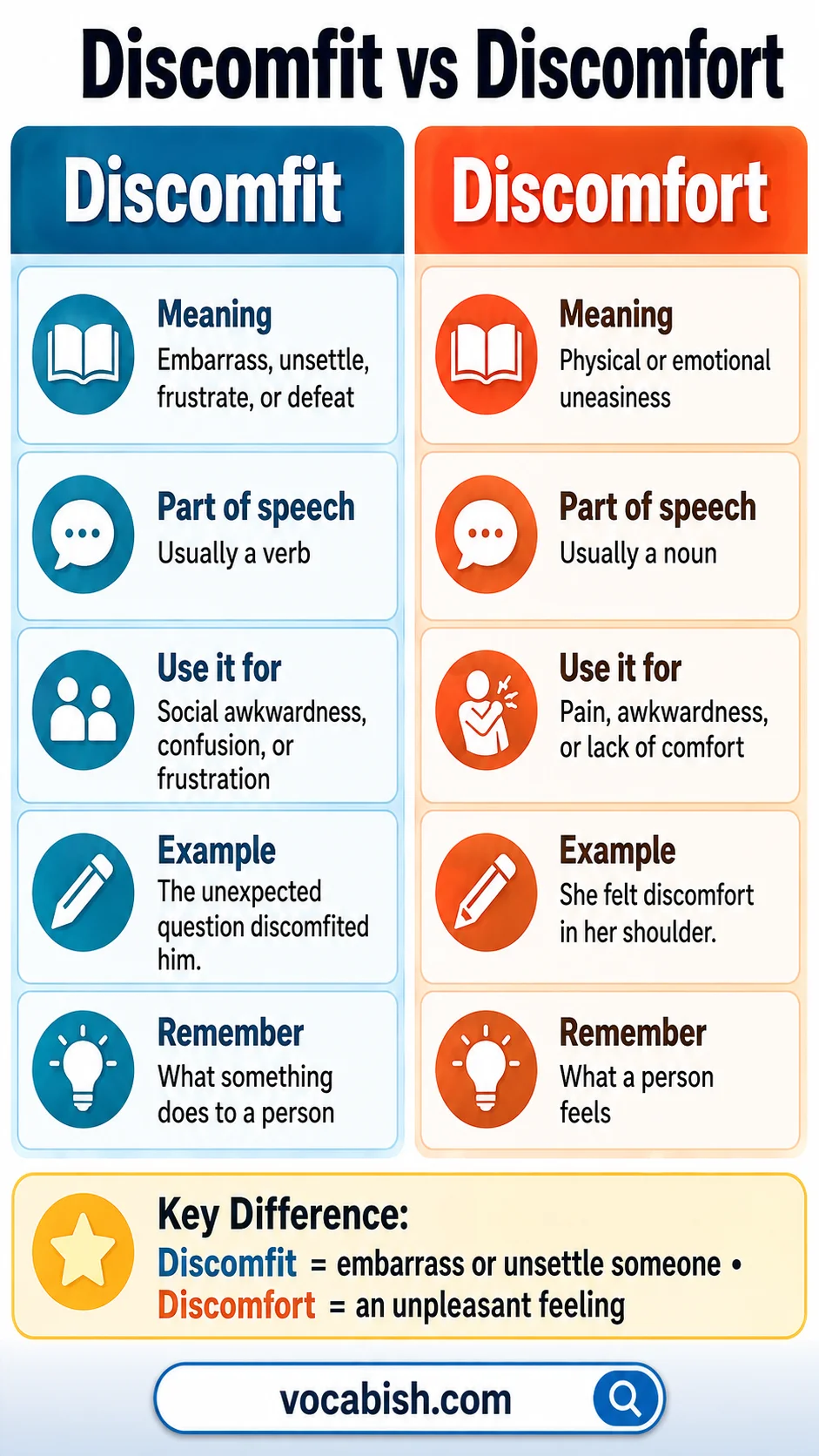
The key difference in discomfit vs discomfort is that discomfit is a verb meaning to embarrass, confuse, frustrate, or defeat someone. Discomfort usually refers to physical or emotional uneasiness, although it can also be used as a verb.
Discomfit vs Discomfort at a Glance
Although these words share several letters, they do not normally perform the same job in a sentence. This quick comparison shows their main meanings and uses.
Word | Part of Speech | Main Meaning | Example |
|---|---|---|---|
Discomfit | Verb | To embarrass, confuse, frustrate, or defeat | The unexpected question discomfited him. |
Discomfort | Noun | Physical pain, uneasiness, or emotional awkwardness | She felt discomfort in her shoulder. |
Discomfort | Verb | To make someone physically or emotionally uncomfortable | His rude remarks discomforted the guests. |
Quick answer
- Use discomfit when someone becomes embarrassed, confused, or frustrated.
- Use discomfort when talking about pain, uneasiness, awkwardness, or a lack of comfort.
What Does “Discomfit” Mean?
Discomfit is a verb. It usually means to make someone feel embarrassed, confused, unsettled, or unable to respond confidently.
Pronunciation: /dɪsˈkʌmfɪt/
It sounds roughly like dis-KUM-fit.
Common Meanings of Discomfit
1. To embarrass or unsettle someone
Use discomfit when an action, question, or situation causes someone to lose confidence or composure.
- The personal question discomfited the speaker.
- Her direct criticism clearly discomfited him.
- The student looked discomfited by the sudden attention.
- His confident reply discomfited his opponent.
In these examples, the person does not necessarily feel physical pain. The feeling is closer to embarrassment, confusion, or social uneasiness.
2. To frustrate or defeat a plan
In more formal English, discomfit can mean to prevent someone from succeeding or to defeat their plans.
- The unexpected evidence discomfited their strategy.
- Heavy rain discomfited the team’s travel plans.
- The defenders discomfited every attempt to enter the building.
- Her careful preparation discomfited her critics.
This meaning is less common in everyday conversation. Words such as frustrate, thwart, foil, and defeat are often more natural.
Forms of Discomfit
Form | Example |
|---|---|
Base form | The question may discomfit him. |
Third-person singular | Public criticism discomfits her. |
Past tense | His reaction discomfited everyone. |
Past participle | She was discomfited by the remark. |
Present participle | The interviewer kept discomfiting the candidate. |
Synonyms for Discomfit
Depending on the context, possible synonyms include:
- embarrass
- unsettle
- confuse
- disturb
- frustrate
- foil
- thwart
- defeat
- fluster
These words are not always interchangeable. For example, embarrass focuses on social awkwardness, while thwart focuses on stopping a plan.
What Does “Discomfort” Mean?
Discomfort is most commonly a noun. It refers to physical pain, emotional uneasiness, inconvenience, or an uncomfortable feeling.
Pronunciation: /dɪsˈkʌmfət/ in British English and /dɪsˈkʌmfərt/ in American English.
Discomfort as a Noun
1. Mild physical pain or bodily uneasiness
Discomfort often describes an unpleasant physical feeling that may be less severe or less specific than pain.
- He felt discomfort in his lower back.
- These shoes caused considerable discomfort.
- She reported mild stomach discomfort.
- Sitting for several hours can cause neck discomfort.
In health-related writing, discomfort may describe soreness, pressure, irritation, aching, or another unpleasant sensation. It does not identify a medical condition by itself.
2. Emotional or social uneasiness
The word can also describe nervousness, embarrassment, worry, or awkwardness.
- She showed discomfort during the discussion.
- His silence created a feeling of discomfort.
- I could sense their discomfort with the topic.
- He laughed to hide his discomfort.
Here, the feeling is emotional rather than physical.
3. Inconvenience or lack of comfort
Discomfort may refer to unpleasant living or travelling conditions.
- The passengers endured hours of discomfort.
- The broken air conditioner caused considerable discomfort.
- They completed the journey despite the heat and discomfort.
- A thin mattress can create unnecessary discomfort.
Discomfort as a Verb
Although less common, discomfort can also be a verb meaning to make someone feel physically or emotionally uncomfortable.
- The bright light discomforted her eyes.
- His questions discomforted the young athlete.
- The tense atmosphere discomforted several guests.
In everyday English, speakers often choose make uncomfortable, bother, trouble, or disturb instead.
Forms of Discomfort as a Verb
Form | Example |
|---|---|
Base form | Loud noises may discomfort some people. |
Third-person singular | The pressure discomforts his knee. |
Past tense | The conversation discomforted her. |
Past participle | He felt discomforted by their behaviour. |
Present participle | The tight strap was discomforting his shoulder. |
The Main Difference in Discomfit vs Discomfort
The clearest difference concerns meaning and grammatical role. Discomfit describes an action, while discomfort usually names an unpleasant feeling or condition.
Point of Comparison | Discomfit | Discomfort |
|---|---|---|
Most common word class | Verb | Noun |
Main idea | Embarrass, unsettle, frustrate, or defeat | Physical or emotional uneasiness |
Common subject | A question, comment, person, event, or obstacle | A person experiencing pain or awkwardness |
Typical object or complement | A person, opponent, plan, or attempt | A body part, situation, feeling, or condition |
Everyday frequency | Relatively uncommon and formal | Very common |
Example | The accusation discomfited him. | The accusation caused him discomfort. |
Compare these sentences:
- The question discomfited Maria.
The question embarrassed or unsettled Maria. - Maria felt discomfort during the interview.
Maria experienced emotional uneasiness. - The tight chair caused Maria discomfort.
Maria experienced physical uneasiness.
The first sentence focuses on what the question did. The second and third focus on the unpleasant feeling Maria experienced.
Grammar and Sentence Patterns
The correct choice often becomes clearer when you examine the sentence structure. Each word follows different patterns in standard English.
Patterns with Discomfit
Something discomfits someone
Subject + discomfit + object
- The reporter’s question discomfited the politician.
- Her unexpected confidence discomfited her rivals.
- The sudden change discomfited the entire group.
Someone is discomfited by something
Subject + be + discomfited + by + cause
- He was discomfited by the accusation.
- They were discomfited by her refusal.
- I was slightly discomfited by his intense stare.
This passive pattern is common because it places attention on the affected person.
Patterns with Discomfort
Someone feels or experiences discomfort
Subject + feel/experience + discomfort
- She experienced discomfort after the long flight.
- He felt some discomfort in his wrist.
- Several guests expressed discomfort with the arrangement.
Something causes discomfort
Subject + cause/create + discomfort
- The hard seat caused discomfort.
- His inappropriate joke created discomfort.
- Poor posture may cause muscular discomfort.
Discomfort in a body part
Discomfort + in + body part
- discomfort in the chest
- discomfort in the knees
- discomfort in the throat
- discomfort in the lower back
Discomfort with or about something
Use with or about when discussing emotional uneasiness.
- She expressed discomfort with the proposal.
- He felt discomfort about sharing personal information.
- Their discomfort with public speaking was obvious.
Physical, Emotional, and Social Contexts
Choosing between discomfit and discomfort depends partly on the type of experience being described. One word focuses on an action, while the other focuses on a feeling.
Physical context
Use discomfort, not discomfit, for physical sensations.
- Correct: The tight collar caused discomfort.
- Incorrect: The tight collar caused discomfit.
- Correct: He felt discomfort in his left shoulder.
- Incorrect: He felt discomfit in his left shoulder.
Discomfit is not normally used as a name for physical pain.
Emotional context
Both words may appear in emotional situations, but they describe different parts of the experience.
- Her question discomfited me.
- I felt discomfort after her question.
- The criticism discomfited the manager.
- The manager’s discomfort was easy to notice.
The verb discomfited identifies the effect of the question or criticism. The noun discomfort identifies the resulting feeling.
Social context
In social situations, discomfit often suggests that someone has lost confidence or composure.
- The child’s honest observation discomfited the adults.
- The interviewer’s follow-up question discomfited the candidate.
- His public praise seemed to discomfit her.
Discomfort describes the awkward atmosphere or personal uneasiness.
- An uncomfortable silence increased everyone’s discomfort.
- She smiled despite her obvious discomfort.
- The discussion caused discomfort among the staff.
Common Collocations
Collocations are words that commonly appear together. Learning them helps English learners produce more natural sentences.
Common Expressions with Discomfort
Collocation | Example |
|---|---|
mild discomfort | She experienced mild discomfort in her ankle. |
severe discomfort | He reported severe discomfort after the journey. |
physical discomfort | The heat caused physical discomfort. |
emotional discomfort | The conversation created emotional discomfort. |
considerable discomfort | The narrow seat caused considerable discomfort. |
temporary discomfort | The treatment may cause temporary discomfort. |
abdominal discomfort | She mentioned abdominal discomfort. |
chest discomfort | He complained of chest discomfort. |
ease discomfort | A softer cushion may ease discomfort. |
relieve discomfort | The change in position relieved her discomfort. |
cause discomfort | The bright light caused discomfort. |
express discomfort | Several students expressed discomfort with the rule. |
Common Expressions with Discomfit
- discomfit an opponent
- discomfit a speaker
- discomfit a critic
- discomfit a rival
- visibly discomfited
- slightly discomfited
- clearly discomfited
- discomfited by a question
- discomfited by criticism
- discomfited by attention
Examples:
- The difficult question visibly discomfited him.
- Her calm reply discomfited her opponent.
- He appeared slightly discomfited by the praise.
- The unexpected evidence discomfited the defence team.
Discomfited vs Uncomfortable
Discomfited and uncomfortable are related, but they are not identical. Discomfited often suggests embarrassment, confusion, or a loss of confidence.
- She was discomfited by the personal question.
- She was uncomfortable in the crowded room.
The first sentence suggests that the question emotionally unsettled her. The second could refer to heat, lack of space, nervousness, or another unpleasant condition.
Word | Main Focus | Example |
|---|---|---|
Discomfited | Embarrassed, confused, frustrated, or unsettled | He looked discomfited by the accusation. |
Uncomfortable | Not physically or emotionally comfortable | He felt uncomfortable in the small chair. |
In casual speech, uncomfortable is much more common. Discomfited sounds more formal and precise.
Common Mistakes with Discomfit and Discomfort
These errors usually happen because the words look and sound similar. Remember that one is mainly an action verb, while the other is usually a feeling or condition.
- Do not use discomfit as a noun: say “I felt discomfort,” not “I felt discomfit.”
- Do not use discomfit for ordinary physical pain.
- Do not assume discomfited always means physically uncomfortable.
- Avoid confusing discomforted with the more common adjective uncomfortable.
- Use discomfit carefully because it sounds formal in everyday conversation.
How to Remember Discomfit or Discomfort
A short memory trick can help you choose the right word quickly.
Discomfit = an action
Think:
Something discomfits a person.
It embarrasses, confuses, frustrates, or unsettles that person.
- The remark discomfited him.
- The defeat discomfited the team.
Discomfort = a feeling
Think:
A person feels discomfort.
It is an unpleasant physical or emotional condition.
- She felt discomfort in her back.
- He showed discomfort during the meeting.
One-sentence memory rule
Discomfit is usually what something does; discomfort is usually what someone feels.
More Examples in Different Contexts
The following examples show how the two words work in natural sentences.
Examples with discomfit
- The interviewer’s unexpected question discomfited the applicant.
- Her calm response discomfited those who had criticised her.
- The sudden applause appeared to discomfit the shy student.
- New evidence discomfited the lawyer’s original argument.
- He was discomfited by the attention he received.
- The opposing team’s strategy discomfited the champions.
- Her honesty discomfited several people in the room.
- The interruption briefly discomfited the presenter.
Examples with discomfort
- The heavy backpack caused discomfort in his shoulders.
- She felt emotional discomfort during the argument.
- The medicine produced mild stomach discomfort.
- His rude comment caused visible discomfort.
- They travelled for hours in considerable discomfort.
- She expressed discomfort with the proposed changes.
- A short break helped relieve his discomfort.
- The room’s high temperature increased everyone’s discomfort.
Examples using both words
- The direct question discomfited him, and his discomfort was obvious.
- Her criticism discomfited the speaker and created discomfort among the audience.
- The attention discomfited the shy child, who showed clear discomfort.
- The accusation discomfited the manager, but he tried to hide his discomfort.
Practice: Choose the Correct Word
Choose discomfit, discomfited, or discomfort for each sentence.
- The hard seat caused considerable ________.
- Her unexpected question ________ the witness.
- He felt mild ________ in his right knee.
- The new evidence may ________ their plans.
- She looked ________ by the personal remark.
- Several employees expressed ________ with the decision.
- The confident newcomer managed to ________ the experienced players.
- His nervous laughter revealed his ________.
Answers
- discomfort
- discomfited
- discomfort
- discomfit
- discomfited
- discomfort
- discomfit
- discomfort
FAQs About Discomfit vs Discomfort
No. Discomfit means to embarrass, unsettle, frustrate, or defeat someone. Discomfort usually means physical pain, emotional uneasiness, or lack of comfort.
Discomfit is a verb. It describes the action of embarrassing, confusing, frustrating, unsettling, or defeating a person, argument, attempt, or plan.
Yes. Discomfort can mean to make someone uncomfortable, but this verb use is less common than phrases such as “cause discomfort.”
Not usually. Discomfit mainly refers to embarrassment, confusion, frustration, or defeat. Use discomfort or uncomfortable for unpleasant physical sensations.
The past tense is discomfited. For example: “The unexpected criticism discomfited him and made him hesitate before answering.”
Use discomfort for mild pain, soreness, irritation, pressure, or bodily uneasiness. Discomfit does not normally describe a physical sensation.
Discomfit is correct but relatively formal. In ordinary conversation, speakers often use embarrass, unsettle, confuse, frustrate, or make uncomfortable.
Yes. A person can be or feel discomfited when embarrassed, unsettled, or confused, especially by attention, criticism, or an unexpected question.
Conclusion
The difference in discomfit vs discomfort becomes clearer when you focus on grammar and meaning. Discomfit is a verb meaning to embarrass, unsettle, frustrate, or defeat. Discomfort is usually a noun referring to physical pain, emotional uneasiness, awkwardness, or inconvenience.
Remember the basic rule: something may discomfit a person, while that person may experience discomfort. This distinction will help you use both words naturally and accurately.
You May Also Like
