
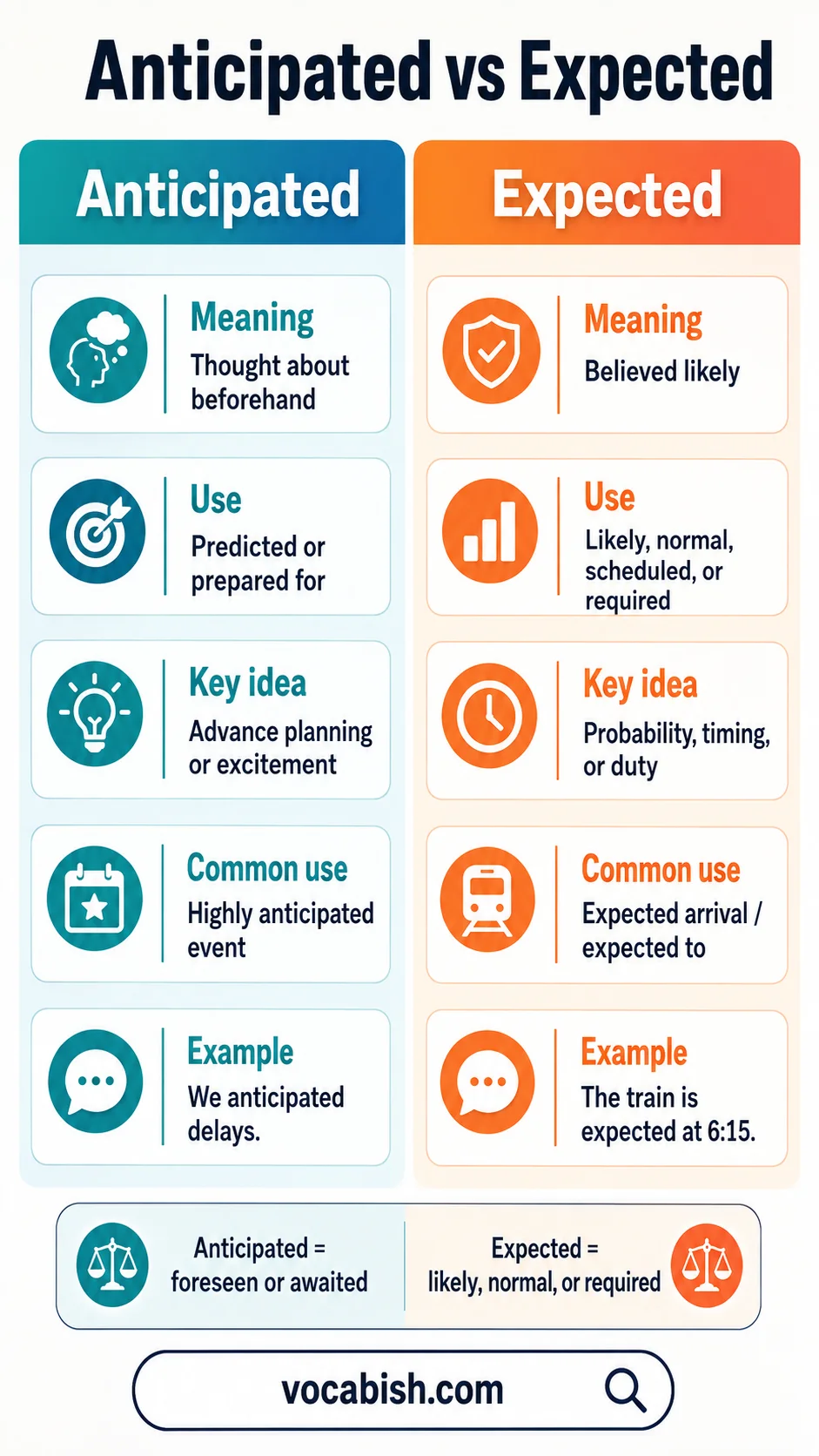
The difference between anticipated vs expected is small but meaningful. Both words describe something believed to happen, but anticipated often suggests advance thought, preparation, or excitement, while expected usually expresses likelihood, a normal standard, or a requirement.
Understanding this distinction will help you make more natural word choices in conversations, academic writing, business communication, and everyday English.
Anticipated vs Expected: Quick Answer
Anticipated means thought about, predicted, or prepared for before it happens. It can also describe something people are eagerly waiting for.
Expected means considered likely, normal, scheduled, or required. It is more common in everyday English and works in a wider range of situations.
Word | Main meaning | Common idea | Example |
|---|---|---|---|
Anticipated | Foreseen or considered beforehand | Prediction, preparation, or excitement | The anticipated demand was higher than usual. |
Expected | Believed likely, normal, or required | Probability, schedule, or duty | The package arrived earlier than expected. |
A useful memory rule is:
Anticipated often looks forward with preparation or interest.
Expected states what is likely, normal, or required.
What Does “Anticipated” Mean?
Anticipated is the past form and past participle of the verb anticipate. It can also function as an adjective before a noun.
It usually means that someone thought about an event before it happened, predicted it, or prepared for it.
Pronunciation: /æn-TIS-uh-pay-tid/
Anticipated as “predicted beforehand”
Use anticipated when an event, problem, result, or need was foreseen in advance.
- The company increased production to meet the anticipated demand.
- The storm caused less damage than anticipated.
- Engineers prepared for the anticipated rise in water levels.
- The anticipated costs were included in the budget.
In these examples, people considered the situation before it happened.
Anticipated as “eagerly awaited”
The word can also describe something people are excited about or strongly interested in.
- The singer released her highly anticipated album.
- The much-anticipated final will take place on Saturday.
- Fans gathered for the anticipated return of the team captain.
- The new game is one of the year’s most anticipated releases.
Words such as highly, eagerly, and much-anticipated often add a feeling of excitement.
Anticipated can suggest preparation
Sometimes, anticipated does more than express a prediction. It suggests that someone took action because of that prediction.
- The school anticipated heavy traffic and opened the gates early.
- We anticipated a large crowd, so we added more seats.
- The hospital anticipated higher demand during the holiday period.
The speakers did not merely believe something would happen. They prepared for it.
What Does “Expected” Mean?
Expected is the past form and past participle of the verb expect. Like anticipated, it can also work as an adjective.
It commonly means believed to happen, considered normal, scheduled to occur, or required from someone.
Pronunciation: /ik-SPEK-tid/
Expected as “likely to happen”
Use expected for predictions based on information, plans, experience, or probability.
- Rain is expected this evening.
- Sales are expected to increase next month.
- The journey took longer than expected.
- Her test results were better than expected.
- The repairs are expected to finish by Friday.
This is the most common meaning of expected.
Expected as “scheduled or due”
Expected can refer to an arrival, delivery, event, or completion time.
- The train is expected at 6:15.
- Your order is expected to arrive tomorrow.
- The baby is expected in October.
- The flight’s expected departure time is 9:30.
In these sentences, expected connects closely with a schedule or estimated time.
Expected as “normal”
Expected can describe something considered usual or unsurprising.
- Some tiredness is expected after a long journey.
- A few mistakes are expected when learning a new skill.
- Prices were higher than expected.
- His reaction was completely expected.
Here, the word means normal, understandable, or not surprising.
Expected as “required”
Use expected when talking about duties, rules, standards, or appropriate behavior.
- Students are expected to complete their homework.
- Employees are expected to arrive on time.
- Guests are expected to follow the hotel rules.
- You are expected to treat others respectfully.
Anticipated cannot replace expected in these sentences because the meaning is obligation, not prediction.
The Main Difference Between Anticipated and Expected
The central difference concerns the speaker’s focus.
Expected focuses on what is likely, normal, scheduled, or required. Anticipated focuses more on advance awareness, forecasting, preparation, or eager interest.
Point of comparison | Anticipated | Expected |
|---|---|---|
Basic meaning | Foreseen beforehand | Believed likely |
Preparation implied | Often | Not necessarily |
Excitement possible | Yes | Usually not |
Rules or duties | No | Yes |
Scheduled events | Possible, but less common | Very common |
Everyday frequency | Less common and more formal | Very common |
Common phrase | Highly anticipated event | Expected arrival time |
Consider these two sentences:
- We expected a large crowd.
- We anticipated a large crowd.
The first sentence means that a large crowd seemed likely.
The second may suggest that the speakers predicted the crowd in advance and possibly prepared for it.
Now compare:
- The film is expected to earn millions.
- It is a highly anticipated film.
The first sentence makes a financial prediction. The second describes strong public interest and excitement.
When Both Words Are Possible
In some sentences, both anticipated and expected are grammatically correct. The best choice depends on the emphasis you want.
Anticipated result vs expected result
- The experiment produced the expected result.
- The experiment produced the anticipated result.
Expected result is more natural when the result matched a prediction.
Anticipated result sounds more formal and may suggest that the result had been considered during planning.
Anticipated increase vs expected increase
- The company is preparing for an expected increase in sales.
- The company is preparing for an anticipated increase in sales.
Both are correct. However, anticipated places slightly more emphasis on advance forecasting and preparation.
Anticipated arrival vs expected arrival
- The guest’s expected arrival is 4:00 p.m.
- The guest’s anticipated arrival is 4:00 p.m.
Expected arrival is the more natural phrase for schedules and estimated times.
Anticipated arrival is possible in formal writing, especially when discussing plans or preparations connected with the arrival.
Anticipated problems vs expected problems
- We experienced fewer problems than expected.
- We experienced fewer problems than anticipated.
Both sentences mean the problems were fewer than predicted. Anticipated sounds slightly more formal and planning-focused.
Grammar Patterns with Anticipate and Expect
The verbs anticipate and expect do not always follow the same grammar patterns. Learning these structures will prevent common errors.
Patterns with Anticipate
Anticipate + noun
- We anticipate delays.
- Experts anticipate further growth.
- The organizers anticipated a large audience.
Anticipate + possessive or object + -ing verb
- We anticipate prices rising soon.
- She anticipated him asking that question.
- They anticipate completing the project in May.
Anticipate + that-clause
- We anticipate that demand will increase.
- Scientists anticipate that temperatures will fall overnight.
- I anticipated that the meeting would be difficult.
Do not normally use anticipate + to-infinitive in an active sentence.
Incorrect:
- We anticipate to finish early.
Correct:
- We anticipate finishing early.
- We expect to finish early.
However, an infinitive can follow anticipated in a passive structure:
- The changes are anticipated to take effect next month.
- Demand is anticipated to increase.
Patterns with Expect
Expect + noun
- We expect rain.
- She expected a reply.
- They expect better results.
Expect + to-infinitive
- We expect to arrive at noon.
- Prices are expected to rise.
- He expected to win.
Expect + person + to-infinitive
- I expect you to be honest.
- The teacher expects students to listen.
- We expected them to arrive earlier.
Expect + that-clause
- I expect that she will agree.
- They expected that the task would be easy.
- We expect that sales will improve.
Be expected to
This structure often expresses a duty or requirement.
- You are expected to wear your identification card.
- All participants are expected to register.
- Staff members are expected to follow safety procedures.
Intended structure | Correct example |
|---|---|
Anticipate + noun | We anticipate delays. |
Anticipate + -ing | We anticipate finishing early. |
Anticipate + that | We anticipate that costs will rise. |
Expect + to-infinitive | We expect to finish early. |
Expect + person + to-infinitive | We expect them to finish early. |
Be expected to | Students are expected to attend. |
Common Situations and Natural Examples
The correct word often becomes clearer when you consider the situation. Here are several common contexts in which English learners may need anticipated or expected.
Travel and transportation
Use expected for arrival times, departures, delays, and schedules.
- The bus is expected in ten minutes.
- The flight arrived later than expected.
- Heavy traffic is expected near the airport.
- The train’s expected arrival time has changed.
Use anticipated when emphasizing advance planning.
- The airline added staff because of anticipated holiday traffic.
- Roads were closed ahead of the anticipated storm.
Work and business
Both words are common in business English, but their emphasis differs.
- The expected profit is $20,000.
- The product performed better than expected.
- The company hired extra workers to meet anticipated demand.
- The anticipated expansion will require additional office space.
Expected often reports a prediction. Anticipated often connects that prediction with strategy or preparation.
Films, books, games, and events
Use anticipated when people are eagerly waiting for something.
- It is one of the most anticipated films of the year.
- Readers welcomed the author’s much-anticipated novel.
- The highly anticipated match attracted millions of viewers.
- The brand announced its anticipated new product.
Using expected would remove much of the feeling of excitement:
- The film is expected to open in June.
This sentence gives scheduling information rather than describing public interest.
Rules and responsibilities
Use expected, not anticipated, for duties and standards.
- Children are expected to follow classroom rules.
- Drivers are expected to stop at a red light.
- Team members are expected to attend the meeting.
- Visitors are expected to keep the area clean.
These sentences describe required or appropriate behavior.
Weather and future conditions
Both words can refer to future conditions, but expected is more common.
- Snow is expected tonight.
- Temperatures are expected to fall.
- The anticipated rainfall may affect the event.
- Farmers prepared their fields for the anticipated dry season.
Use anticipated when the forecast affects planning or preparation.
Word Forms and Related Vocabulary
Looking at each word family can help you understand how anticipated and expected function in different sentences.
The anticipate word family
Word | Part of speech | Meaning | Example |
|---|---|---|---|
Anticipate | Verb | To expect or prepare for something beforehand | We anticipate strong demand. |
Anticipated | Adjective/past participle | Foreseen or eagerly awaited | The anticipated announcement came today. |
Anticipation | Noun | A feeling or act of expecting something | The children waited with anticipation. |
Anticipatory | Adjective | Happening because something is expected | The market showed anticipatory activity. |
Unanticipated | Adjective | Not foreseen or prepared for | We faced unanticipated costs. |
The expect word family
Word | Part of speech | Meaning | Example |
|---|---|---|---|
Expect | Verb | To believe something will happen | We expect good weather. |
Expected | Adjective/past participle | Considered likely, normal, or required | The expected answer was correct. |
Expectation | Noun | A belief about what will happen | The results exceeded expectations. |
Expectedly | Adverb | In a way that is not surprising | The small team, expectedly, struggled. |
Unexpected | Adjective | Surprising or not predicted | We received an unexpected message. |
Expectedly is grammatically correct but uncommon. English speakers often use as expected instead.
- Less natural: Expectedly, the roads were busy.
- More natural: As expected, the roads were busy.
Unexpected vs Unanticipated
These words are related but not always identical.
- Unexpected means surprising or not believed likely.
- Unanticipated means not foreseen, considered, or planned for.
Examples:
- I received an unexpected gift.
- The project faced unanticipated technical problems.
A gift may be unexpected because it surprises you. A technical problem may be unanticipated because the planning team did not foresee it.
Common Mistakes to Avoid
These are the most frequent problems learners face when choosing anticipated or expected.
- Do not use anticipated for obligations: say “Employees are expected to arrive on time.”
- Avoid anticipate to do: say “We anticipate finishing” or “We expect to finish.”
- Use expected for ordinary schedules: “The train is expected at noon.”
- Use highly anticipated for something people are excitedly awaiting.
- Do not assume the words are interchangeable in every sentence; check whether the meaning is prediction, preparation, excitement, or duty.
How to Choose Anticipated or Expected
Ask yourself what you want the sentence to communicate.
Choose anticipated when:
- Someone foresaw a situation in advance.
- A prediction influenced preparation or planning.
- People are eagerly waiting for an event or product.
- You want a slightly more formal, forecasting-focused word.
Examples:
- The store ordered more stock to meet anticipated demand.
- The highly anticipated series begins next week.
Choose expected when:
- Something seems likely to happen.
- You are giving an estimated or scheduled time.
- A result is normal or unsurprising.
- Someone has a duty or responsibility.
- You want the most natural word for everyday conversation.
Examples:
- The delivery is expected tomorrow.
- Students are expected to submit the work online.
Five-second decision test
Use this quick test:
- Likely, normal, scheduled, or required? Choose expected.
- Foreseen, prepared for, or eagerly awaited? Choose anticipated.
When both words seem possible, expected is usually the safer everyday choice.
Practice: Anticipated or Expected?
Choose the best word for each sentence.
- All employees are ______ to attend the training session.
- The hotel hired extra staff for the ______ increase in visitors.
- The singer’s highly ______ album will be released tomorrow.
- The train is ______ to arrive at 7:45.
- The test was easier than I had ______.
- We ______ completing the work before Friday.
- The company prepared for the ______ rise in fuel costs.
- Visitors are ______ to turn off their phones.
Answers
- Expected — It describes a requirement.
- Anticipated — The increase was predicted and prepared for.
- Anticipated — People are eagerly waiting for the album.
- Expected — It refers to a scheduled arrival.
- Expected or anticipated — Both work, but expected is more common.
- Anticipate — It correctly takes an -ing form.
- Anticipated — The company considered the increase during planning.
- Expected — It describes required behavior.
FAQs About Anticipated and Expected
They are close synonyms when discussing future events, but anticipated often suggests advance awareness or preparation, while expected simply means considered likely.
Sometimes, especially for predicted events. However, use expected for duties, normal behavior, scheduled arrivals, and patterns considered likely or standard.
An expected arrival is the likely or scheduled arrival time. An anticipated arrival may emphasize forecasting, advance planning, or eager attention.
Yes. “Highly anticipated” means many people are eagerly waiting for something, such as a film, match, product, or public event.
Not by itself. It means expected beforehand, but phrases such as eagerly anticipated or much-anticipated often carry excitement and positive interest.
Anticipated usually sounds slightly more formal and planning-focused. Expected is more common in everyday speech, instructions, schedules, and ordinary predictions.
Yes, in passive constructions: “The change is anticipated to happen soon.” In active sentences, say, “We anticipate the change happening soon.”
Unexpected is the usual opposite of expected. Unanticipated means not foreseen or planned for and often appears in formal or technical contexts.
Conclusion
The difference between anticipated vs expected depends on the idea you want to express.
Use expected for something likely, normal, scheduled, or required. Use anticipated for something foreseen in advance, prepared for, or eagerly awaited.
Although anticipated and expected can sometimes describe the same future event, they do not always carry the same emphasis. When deciding between anticipated or expected, remember this rule: expected states what will probably happen, while anticipated often shows that someone has already thought about it, prepared for it, or looked forward to it.
You May Also Like
