
A strong ending can make a sentence, paragraph, conversation, or short speech feel complete. These Closing Sentence Examples show how English speakers naturally finish thoughts, summarize ideas, express final opinions, and bring conversations to an end.
Whether you are writing a school paragraph, finishing an email, answering a question, or ending an everyday conversation, the right closing sentence helps your message sound complete and natural.
What Is a Closing Sentence?
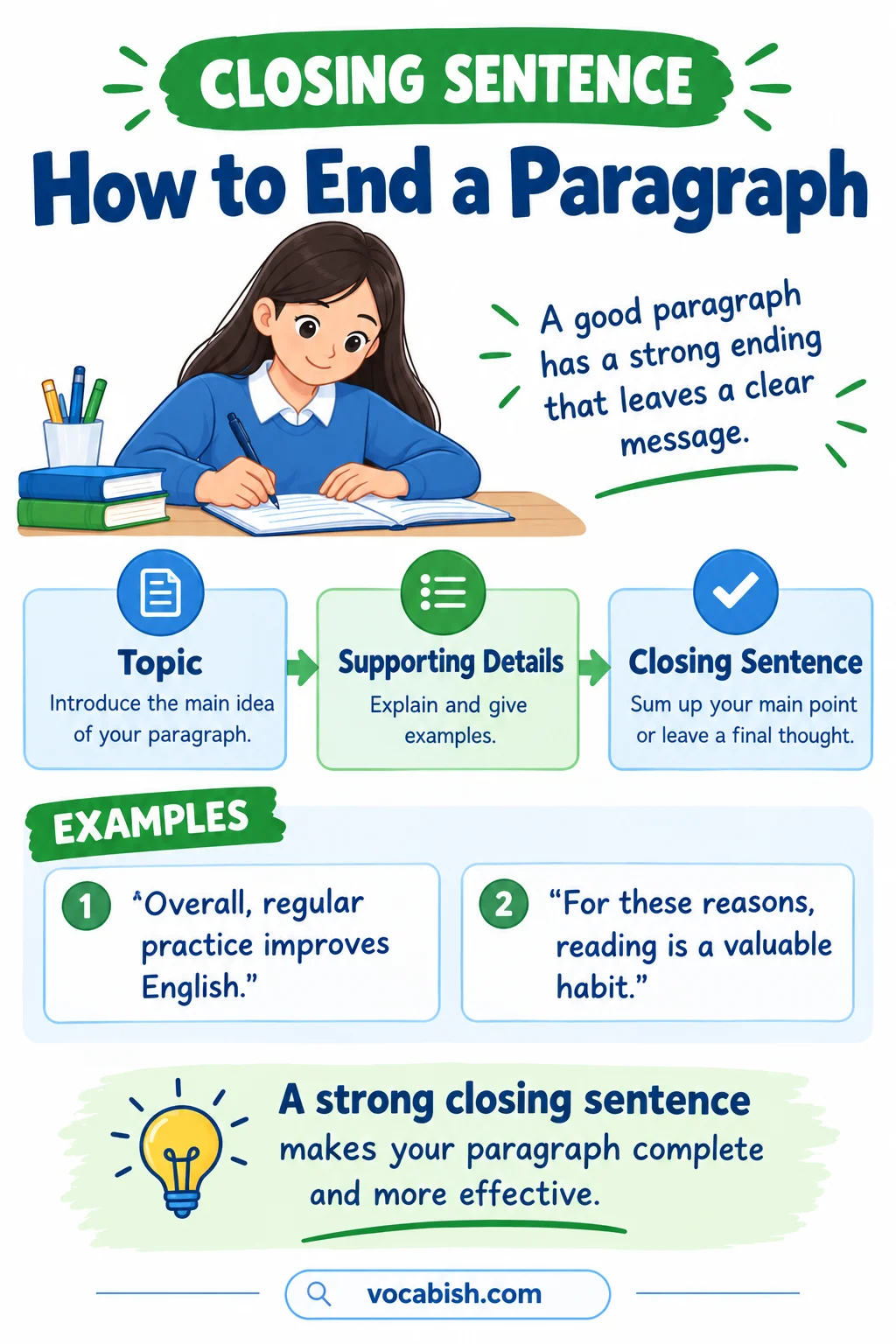
A closing sentence is the final sentence used to finish a paragraph, discussion, message, speech, or conversation. It can summarize the main idea, give a final thought, express a conclusion, or politely end an interaction.
In paragraph writing, a closing sentence usually connects the final idea back to the main topic. In everyday conversation, it can signal that the speaker has finished talking or wants to end the discussion.
Common types include:
- Summary closing sentences
- Opinion-based closing sentences
- Final-thought sentences
- Recommendation sentences
- Result or conclusion sentences
- Thank-you closing sentences
- Polite conversation closings
- Agreement and disagreement closings
- Email and message closings
- Speech and presentation closings
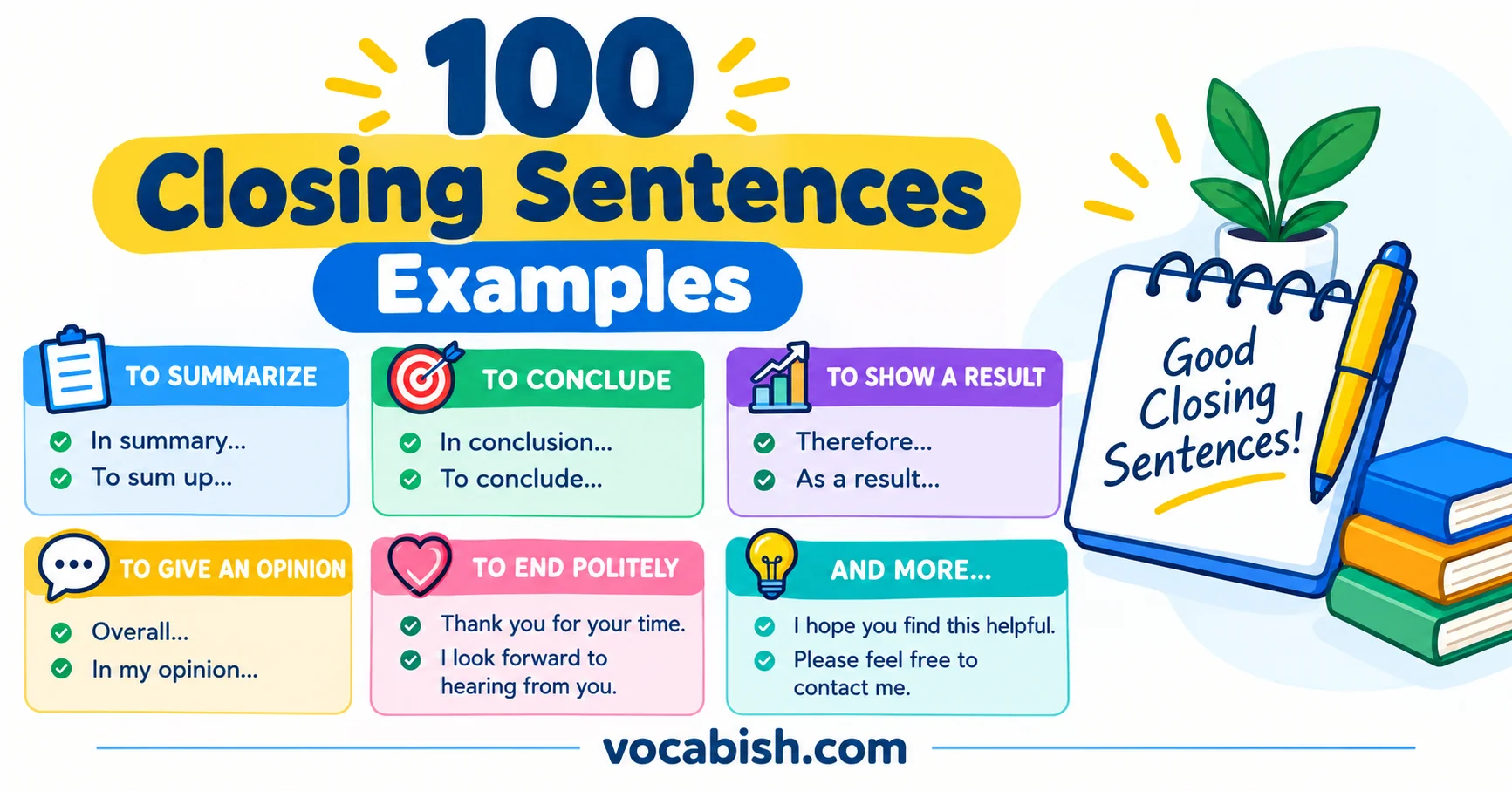
100 Closing Sentence Examples
The following examples of closing sentences cover school writing, communication, conversations, emails, speeches, and everyday situations.
Closing Sentences for Paragraphs
- For these reasons, regular exercise should be part of everyone’s daily routine.
- In conclusion, teamwork helps people achieve better results.
- Overall, learning a new language requires patience and practice.
- These points show why reading is an important habit.
- Therefore, students should make time for reading every day.
- All in all, good preparation leads to better performance.
- For these reasons, protecting the environment is everyone’s responsibility.
- In the end, hard work can make a significant difference.
- This shows that small actions can create positive changes.
- Ultimately, education gives people more opportunities in life.
Closing Sentences for Essays
- In conclusion, technology can be helpful when it is used responsibly.
- For all these reasons, schools should encourage students to develop healthy habits.
- Overall, the advantages of public transportation make it a valuable part of modern life.
- Taking everything into account, careful planning can prevent many problems.
- In short, effective communication is important in both personal and professional life.
- These examples demonstrate why time management matters to students.
- As a result, people should think carefully before making important decisions.
- For these reasons, I believe that every student should have access to quality education.
- Looking at the evidence, it is clear that preparation plays an important role in success.
- In the final analysis, responsible choices can benefit both individuals and society.
Closing Sentences for School Assignments
- Therefore, students can benefit greatly from developing good study habits.
- This discussion shows why cooperation is important in the classroom.
- In conclusion, every student can improve through consistent effort.
- For this reason, learners should not be afraid of making mistakes.
- Overall, practice remains one of the best ways to improve a skill.
- These ideas show that learning can take place both inside and outside the classroom.
- In the end, curiosity can lead students toward greater knowledge.
- Therefore, students should continue working toward their academic goals.
- All things considered, a positive attitude can make learning more enjoyable.
- To conclude, successful learning requires effort, patience, and consistency.
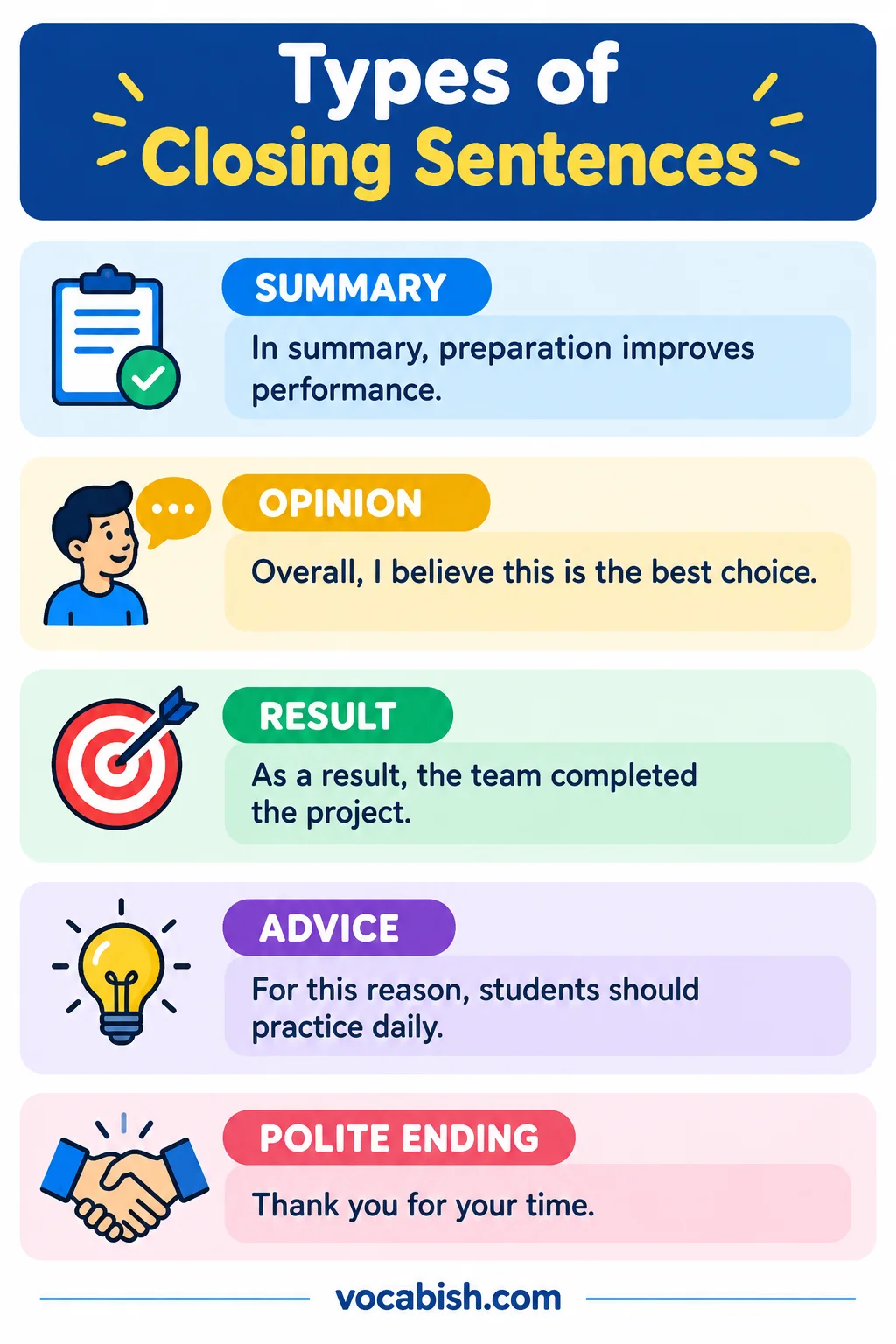
Closing Sentences for Opinions
- That is why I believe this is the best choice.
- For me, this is the most practical solution.
- Overall, I think the plan is worth trying.
- In my opinion, the benefits clearly outweigh the disadvantages.
- After considering everything, I still support the idea.
- Personally, I believe we should give it another chance.
- For these reasons, I agree with your suggestion.
- Taking everything into consideration, I think we made the right decision.
- In the end, I believe everyone deserves an opportunity to succeed.
- That is my final opinion on the matter.
Closing Sentences for Summarizing an Idea
- In short, preparation makes difficult tasks easier.
- To sum up, everyone has a role to play.
- Overall, the project was successful.
- In conclusion, the results support our original idea.
- In brief, good communication can prevent misunderstandings.
- To put it simply, practice leads to improvement.
- All in all, the experience was valuable.
- In the end, we learned an important lesson.
- Taken together, these points support the main argument.
- In summary, the evidence shows a clear pattern.
Closing Sentences for Recommendations
- For this reason, I recommend starting with a small daily goal.
- Therefore, students should review their lessons regularly.
- Based on these points, choosing the safer option would be wise.
- I would recommend making a plan before starting the project.
- For better results, try to practice a little every day.
- Considering the circumstances, I recommend waiting before making a final decision.
- Therefore, we should focus on the most important tasks first.
- For these reasons, this approach deserves serious consideration.
- I strongly recommend discussing the matter with your teacher.
- In light of these points, careful planning is the best approach.
Closing Sentences for Everyday Conversations
- Anyway, I should get going now.
- It was nice talking to you.
- I’ll see you tomorrow.
- I’ll talk to you later.
- Take care and have a great day.
- Thanks for your help; I really appreciate it.
- I think we have covered everything for now.
- Let’s talk again soon.
- I have to leave now, but I’ll call you later.
- Have a safe trip home.
Closing Sentences for Friendly Conversations
- It was great catching up with you.
- I’ll let you get back to your work.
- Let’s meet again next weekend.
- I’m glad we had a chance to talk.
- Thanks for coming over today.
- I’ll message you when I get home.
- Enjoy the rest of your evening.
- See you around.
- Have a wonderful weekend.
- Talk to you soon.
Closing Sentences for Professional Conversations
- Thank you for your time.
- I appreciate your help with this matter.
- I look forward to hearing from you.
- Please let me know if you need anything else.
- I believe we have covered the main points.
- Thank you for meeting with me today.
- I look forward to working with you.
- Please feel free to contact me if you have any questions.
- I appreciate your consideration.
- I believe this brings our discussion to a close.
Closing Sentences for Emails and Messages
- Thank you again for your assistance.
- I look forward to your response.
- Please let me know if you need any additional information.
- I appreciate your time and consideration.
- Thank you for your attention to this matter.
- I look forward to discussing this further.
- Please feel free to contact me with any questions.
- I hope to hear from you soon.
- Thank you for your continued support.
- I look forward to speaking with you soon.
Closing Sentences for Speeches
- Thank you all for listening.
- Thank you for your time and attention.
- I hope you will take these ideas with you today.
- Let us work together to create a better future.
- With that, I would like to bring my speech to an end.
- Thank you for being here today.
- I hope this discussion has given you something to think about.
- Let us remember that every small action matters.
- Together, we can make a meaningful difference.
- Thank you, and have a wonderful day.
Closing Sentences for Presentations
- That brings me to the end of my presentation.
- Thank you for listening.
- I hope this presentation has answered your main questions.
- That concludes my presentation for today.
- Thank you for your attention.
- I would be happy to answer any questions.
- I hope you found these points useful.
- This concludes the main part of our discussion.
- Thank you for joining me today.
- I appreciate your time and participation.
Closing Sentences for Discussions
- I think we can agree on that point.
- We can discuss the remaining details later.
- I believe we have reached a reasonable conclusion.
- Let’s leave that question for another discussion.
- I think we have considered the main arguments.
- We may have different opinions, but I respect your view.
- I believe we have made our position clear.
- Let’s take some time to consider these points.
- We can return to this issue if new information becomes available.
- I think this is a good place to end the discussion.
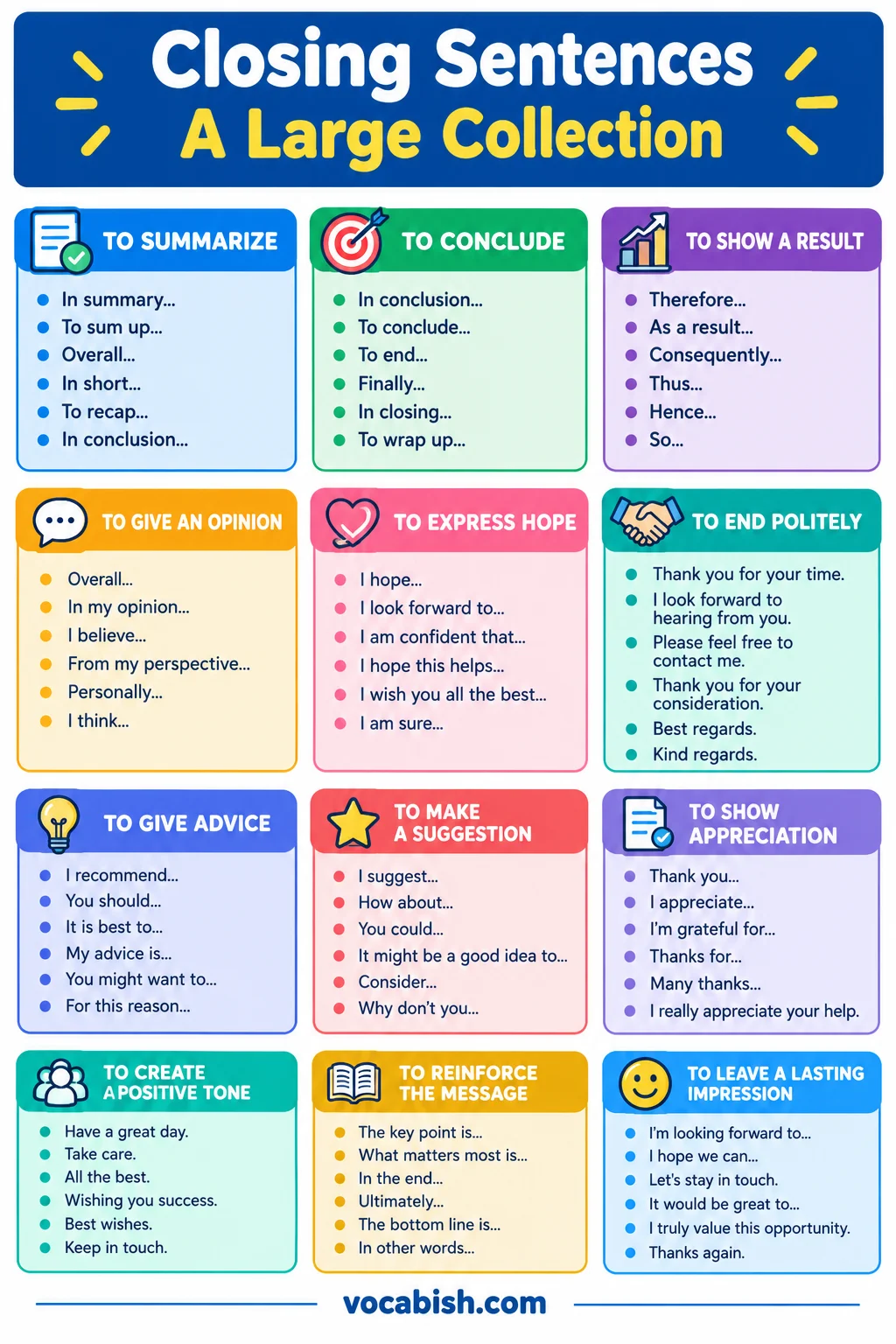
Closing Sentences for Different Writing Purposes
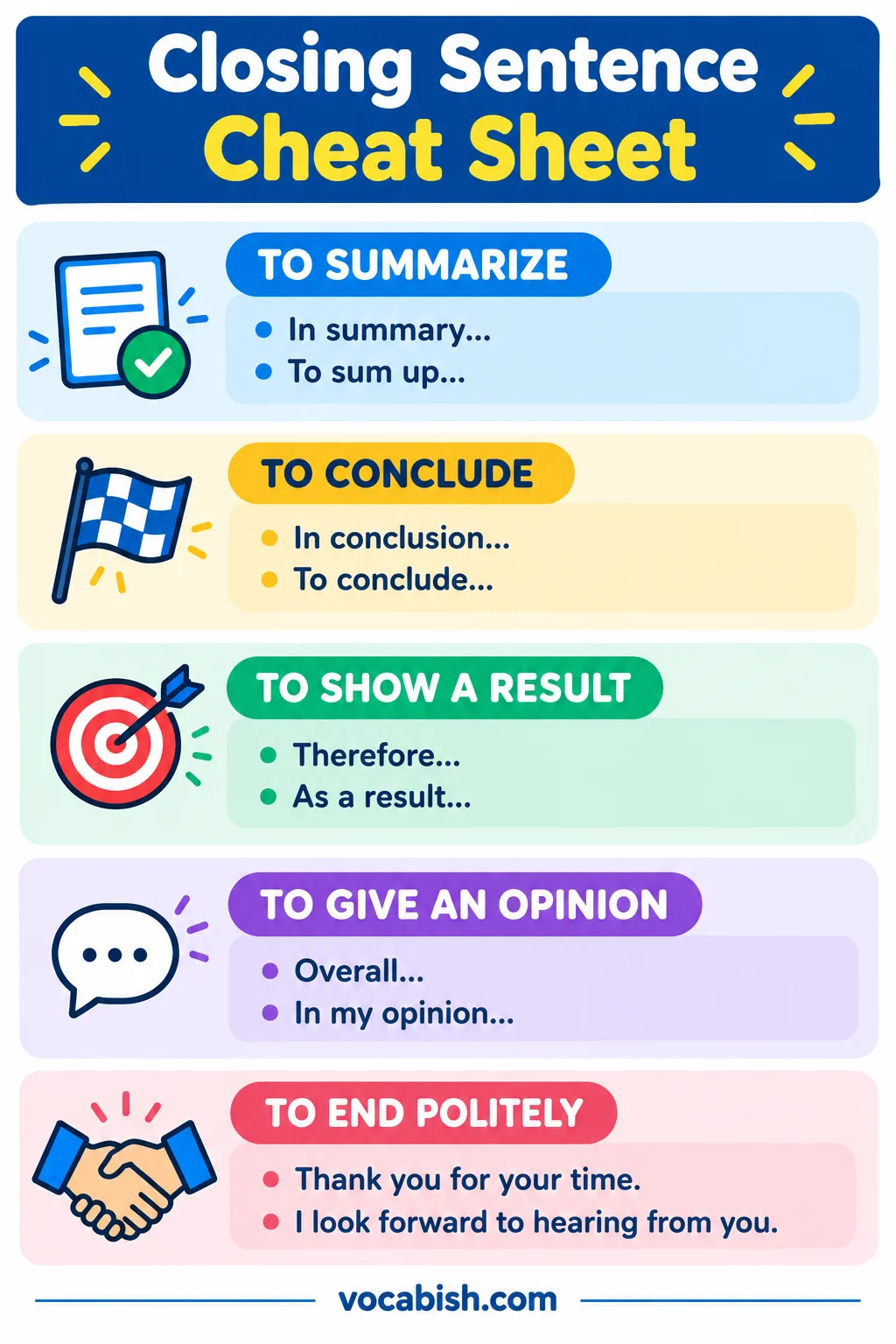
A closing sentence should match the purpose of the writing. A school paragraph may need a concluding thought, while an email may need a polite ending.
To Summarize
- In summary, the project achieved its main goals.
- Overall, the experience was both useful and rewarding.
- To sum up, careful preparation can improve the final result.
To State a Final Opinion
- In my opinion, this remains the best available option.
- After considering all the facts, I support the proposal.
- Overall, I believe this decision will benefit everyone involved.
To Show a Result
- As a result, the team completed the project on time.
- Therefore, the company decided to change its approach.
- Consequently, everyone had more time to prepare.
To Give Final Advice
- For this reason, students should begin preparing early.
- Therefore, it is better to check the information carefully.
- Based on these points, planning ahead is a sensible choice.
To End Politely
- Thank you for your time.
- I hope you have a pleasant evening.
- I look forward to speaking with you again.
Closing Sentence Examples in Everyday Situations
Closing sentences are not limited to essays and paragraphs. English learners also use them when ending phone calls, meetings, chats, visits, and other daily interactions.
Ending a Phone Call
- I need to get back to work now, so I’ll talk to you later.
- Thanks for calling; it was great speaking with you.
- I’ll call you again when I have more information.
- I have to go now, but we’ll talk tomorrow.
- Take care, and I’ll speak to you soon.
Ending a Meeting
- I think we have covered everything for today.
- Thank you everyone for your contributions.
- Let’s meet again next Monday to review our progress.
- I appreciate everyone’s time and effort.
- With that, we can end today’s meeting.
Ending a Chat
- I should get some sleep now, so I’ll talk to you tomorrow.
- It was nice chatting with you.
- I have to go now, but send me a message later.
- I’ll catch up with you soon.
- Have a good night.
Ending a Visit
- Thanks for having me; I really enjoyed my visit.
- I should head home now.
- It was wonderful seeing you again.
- Thank you for everything.
- I hope we can do this again soon.
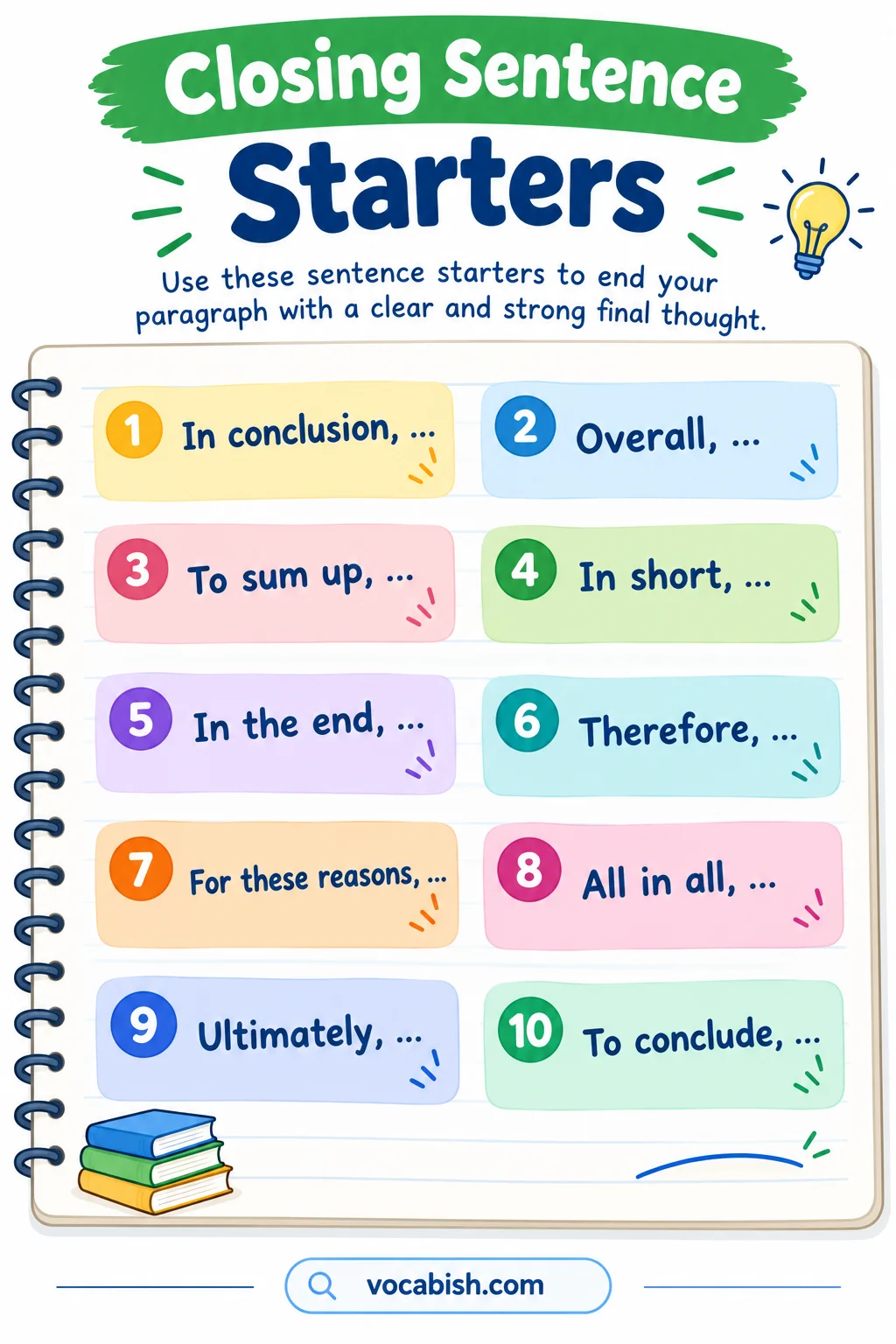
Closing Sentence Starters
These sentence starters can help learners create their own endings without repeating the same expression.
- In conclusion, …
- Overall, …
- In summary, …
- To sum up, …
- In short, …
- For these reasons, …
- Therefore, …
- As a result, …
- All in all, …
- In the end, …
- Ultimately, …
- Taking everything into account, …
- For this reason, …
- To conclude, …
- Finally, …
How to Write a Strong Closing Sentence
A good closing sentence should feel like a natural ending rather than a sudden stop.
When writing one, consider these points:
- Return to the main idea without copying the opening sentence.
- Keep the final thought relevant to the topic.
- Avoid introducing an unrelated idea at the end.
- Use a concluding word or phrase when it improves clarity.
- Keep the sentence appropriate for your audience and purpose.
- Make sure the final sentence gives the reader a sense of completion.
Common Mistakes with Closing Sentences
- Repeating the exact topic sentence instead of giving a final thought.
- Introducing completely new information in the last sentence.
- Using “In conclusion” in every paragraph.
- Ending a formal paragraph with overly casual language.
- Making the final sentence unnecessarily long or complicated.
Closing Sentence vs. Concluding Sentence
The terms closing sentence and concluding sentence are closely related, but their use can depend on context.
A closing sentence can refer broadly to the sentence that finishes a paragraph, conversation, email, speech, or message.
A concluding sentence is especially common in academic and paragraph writing, where it brings the main idea to an appropriate ending.
For everyday English, both expressions can describe a sentence that brings something to a close.
Practice: Complete the Closing Sentences
Try completing these sentences with your own ideas:
- In conclusion, students should __________.
- Overall, I believe that __________.
- For these reasons, people should __________.
- In the end, we learned that __________.
- To sum up, the most important point is __________.
- Therefore, everyone should __________.
- All in all, the experience was __________.
- Taking everything into account, I would __________.
Quick Answers for Practice
Possible answers include:
- In conclusion, students should develop good study habits.
- Overall, I believe that regular practice leads to improvement.
- For these reasons, people should protect the environment.
- In the end, we learned that teamwork matters.
- To sum up, the most important point is effective communication.
- Therefore, everyone should respect other people’s opinions.
- All in all, the experience was extremely valuable.
- Taking everything into account, I would choose the safer option.
FAQs About Closing Sentence
A closing sentence is the final sentence that completes a paragraph, conversation, email, speech, or discussion.
“In conclusion, regular practice can help students improve their English skills.”
You can start with phrases such as “In conclusion,” “Overall,” “To sum up,” “In short,” or “For these reasons.”
A good closing sentence reinforces the paragraph’s main idea and gives the reader a clear sense that the thought is complete.
Yes. Expressions such as “It was nice talking to you” and “I’ll see you tomorrow” naturally close everyday conversations.
A topic sentence introduces the main idea of a paragraph, while a closing sentence brings that idea to a natural conclusion.
No. Using different expressions such as “Overall,” “In short,” “Therefore,” and “All in all” can make writing more natural.
Yes. A closing sentence is normally a single final sentence that completes the paragraph, thought, discussion, or communication.
Conclusion
These Closing Sentence Examples demonstrate how English learners can finish paragraphs, essays, conversations, emails, speeches, and everyday discussions naturally. The best closing sentence depends on the purpose: summarize an idea, give a final opinion, state a result, offer advice, or politely end a conversation.
When you practice different closing sentences, your writing and everyday communication can sound clearer, more complete, and more confident.
Explore More Related Articles