
A conversation can sound abrupt when one idea suddenly jumps to another. Transitional phrases example sentences show learners how words such as however, for example, in addition, therefore, and on the other hand can connect ideas smoothly.
These transitional phrases sentences are useful for everyday English conversations, classroom writing, essays, presentations, emails, and speaking practice. The examples below are grouped by purpose so you can see how different transitions work naturally in context.
Transitional Phrases for Adding Ideas
These examples use transitions to connect one idea with another. They are common in conversations, school assignments, emails, and short explanations.
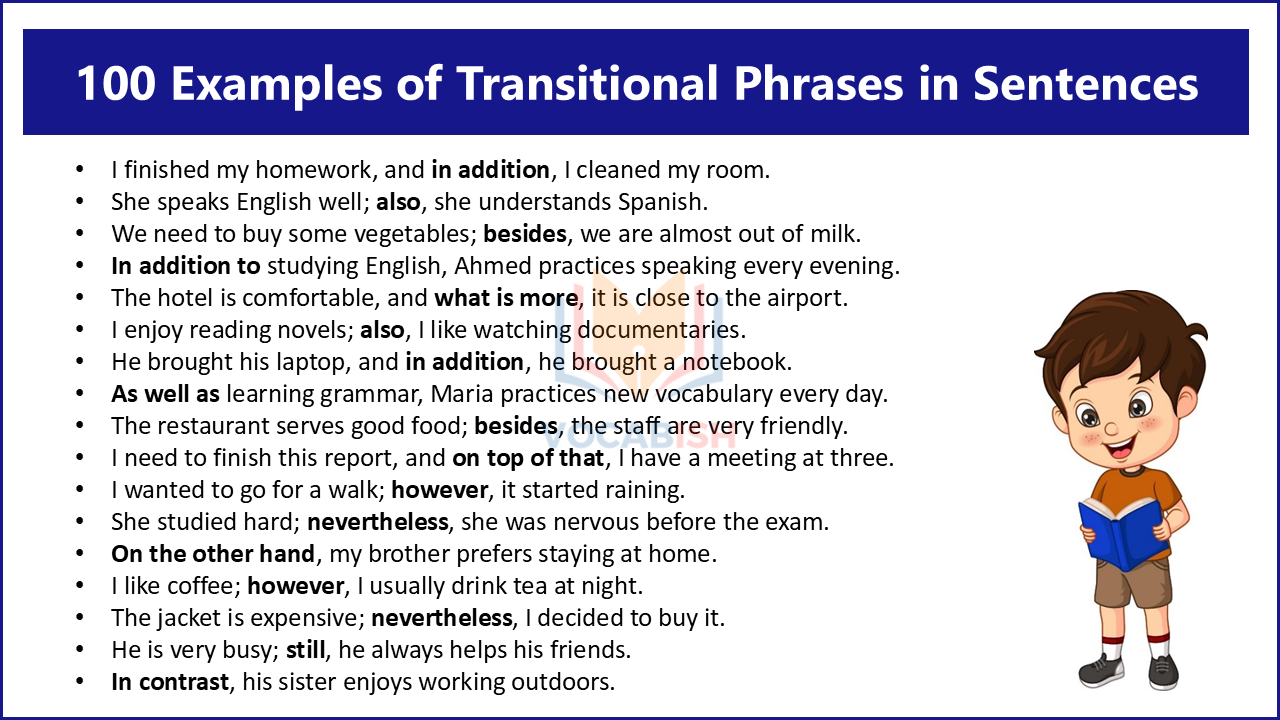
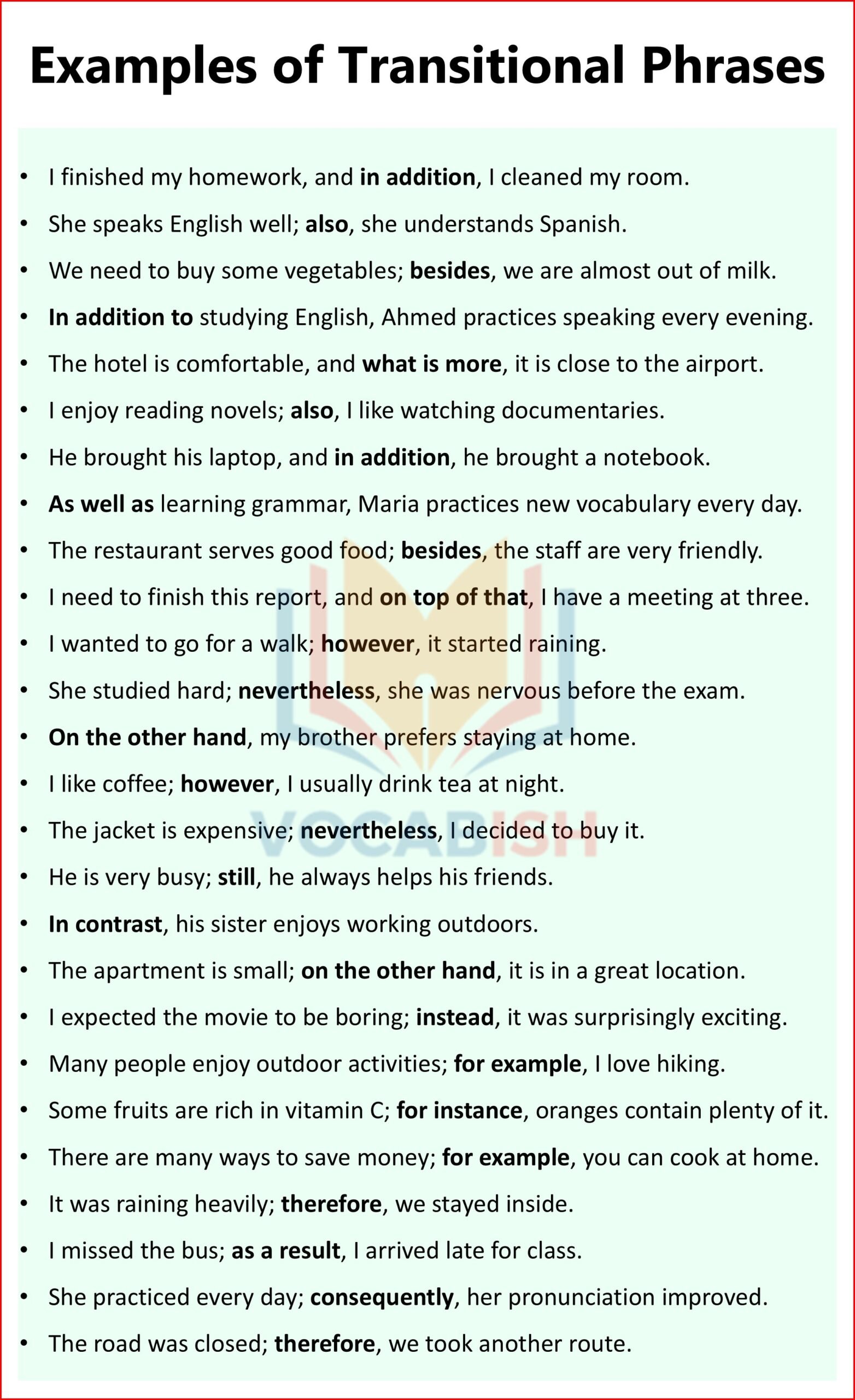
- I finished my homework, and in addition, I cleaned my room.
- She speaks English well; also, she understands Spanish.
- We need to buy some vegetables; besides, we are almost out of milk.
- In addition to studying English, Ahmed practices speaking every evening.
- The hotel is comfortable, and what is more, it is close to the airport.
- I enjoy reading novels; also, I like watching documentaries.
- He brought his laptop, and in addition, he brought a notebook.
- As well as learning grammar, Maria practices new vocabulary every day.
- The restaurant serves good food; besides, the staff are very friendly.
- I need to finish this report, and on top of that, I have a meeting at three.
Transitional Phrases for Showing Contrast
Use these examples of transitional phrases when two ideas are different or when the second idea does not match what someone might expect.
- I wanted to go for a walk; however, it started raining.
- She studied hard; nevertheless, she was nervous before the exam.
- On the other hand, my brother prefers staying at home.
- I like coffee; however, I usually drink tea at night.
- The jacket is expensive; nevertheless, I decided to buy it.
- He is very busy; still, he always helps his friends.
- In contrast, his sister enjoys working outdoors.
- The apartment is small; on the other hand, it is in a great location.
- I expected the movie to be boring; instead, it was surprisingly exciting.
- She does not enjoy cooking; however, she makes dinner for her family every day.
Transitional Phrases for Giving Examples
These transitional phrases help introduce a specific example after a general statement.
- Many people enjoy outdoor activities; for example, I love hiking.
- Some fruits are rich in vitamin C; for instance, oranges contain plenty of it.
- You can improve your English in many ways; for example, you can practice speaking with friends.
- Some students prefer studying alone; for instance, Ali usually studies in his bedroom.
- There are many ways to save money; for example, you can cook at home.
- Several animals can live in cold climates; for instance, polar bears survive in very cold regions.
- You can practice English anywhere; for example, try speaking with a friend while walking.
- Some jobs require strong communication skills; for instance, teachers speak with students every day.
- Many things can affect your sleep; for example, using your phone late at night may keep you awake.
- There are several ways to learn vocabulary; for instance, you can read short stories.
Transitional Phrases for Showing Cause and Effect
These examples connect an action, situation, reason, or result.
- It was raining heavily; therefore, we stayed inside.
- I missed the bus; as a result, I arrived late for class.
- She practiced every day; consequently, her pronunciation improved.
- The road was closed; therefore, we took another route.
- He forgot his umbrella; as a result, he got wet.
- I was feeling tired; because of this, I went to bed early.
- The shop was closed; for this reason, we went somewhere else.
- She saved money every month; as a result, she could afford the trip.
- The team worked together; consequently, they completed the project early.
- My phone battery was dead; therefore, I could not call you.
Transitional Phrases for Showing Sequence
Sequence transitions are useful when telling a story, explaining instructions, or describing steps.
- First, wash your hands before preparing the food.
- Next, add the vegetables to the pan.
- Then, cook everything for about ten minutes.
- After that, serve the meal while it is warm.
- Finally, clean the kitchen.
- First of all, I checked my email.
- Afterward, I went to the library.
- Meanwhile, my sister prepared dinner.
- Eventually, we found the missing keys.
- In the end, everyone agreed with the plan.
Transitional Phrases for Showing Time
These examples help connect events according to when they happen.
- Meanwhile, I will prepare the documents for the meeting.
- Before that, I need to finish my homework.
- Afterward, we can go out for dinner.
- At the same time, my parents were waiting for us at home.
- Soon afterward, the teacher entered the classroom.
- Later, I called my friend to discuss the problem.
- In the meantime, you can start reading the first chapter.
- Previously, I had never visited that city.
- From then on, she started practicing English every morning.
- Eventually, we reached the station.
Transitional Phrases for Comparing Ideas
These transitional phrases sentences show similarities or relationships between two ideas, people, places, or situations.
- Similarly, my sister enjoys reading before bed.
- Likewise, our teacher encourages us to practice speaking every day.
- In the same way, regular practice can improve your writing skills.
- Compared with last year, I feel much more confident speaking English.
- Just as exercise strengthens the body, reading strengthens the mind.
- My father enjoys football; similarly, my brother watches every match.
- Both students worked hard; likewise, both received excellent grades.
- In a similar way, we can improve pronunciation by listening carefully.
- City life is busy; similarly, life in large towns can be fast-paced.
- Compared to my old phone, this one works much faster.
Transitional Phrases for Emphasizing Ideas
These examples use transitions to draw attention to an important point.
- In fact, I have already finished the assignment.
- Indeed, she was one of the best students in the class.
- Above all, remember to be honest with your customers.
- Most importantly, make sure you understand the instructions.
- Especially, try to practice speaking with other learners.
- In particular, I enjoy reading books about history.
- Certainly, we should discuss this problem before making a decision.
- Without a doubt, regular practice can make a difference.
- Above all else, we need to keep everyone safe.
- More importantly, you should focus on understanding the sentence rather than memorizing every word.
Transitional Phrases for Clarifying Ideas
These examples show how transitions can introduce another way of expressing or explaining an idea.
- In other words, you need to practice more often.
- That is to say, we should arrive before the meeting begins.
- To put it simply, the plan will save us time.
- In short, we need a better solution.
- To clarify, the class will begin at nine o’clock.
- Specifically, we need three volunteers for the event.
- More precisely, the meeting will start at 9:30 a.m.
- To be clear, you can submit the assignment tomorrow.
- In other words, we should not give up after one mistake.
- To put it another way, practice is more useful when you do it regularly.
Transitional Phrases for Concluding Ideas
These examples use concluding transitions to bring an explanation, conversation, or argument to an end.
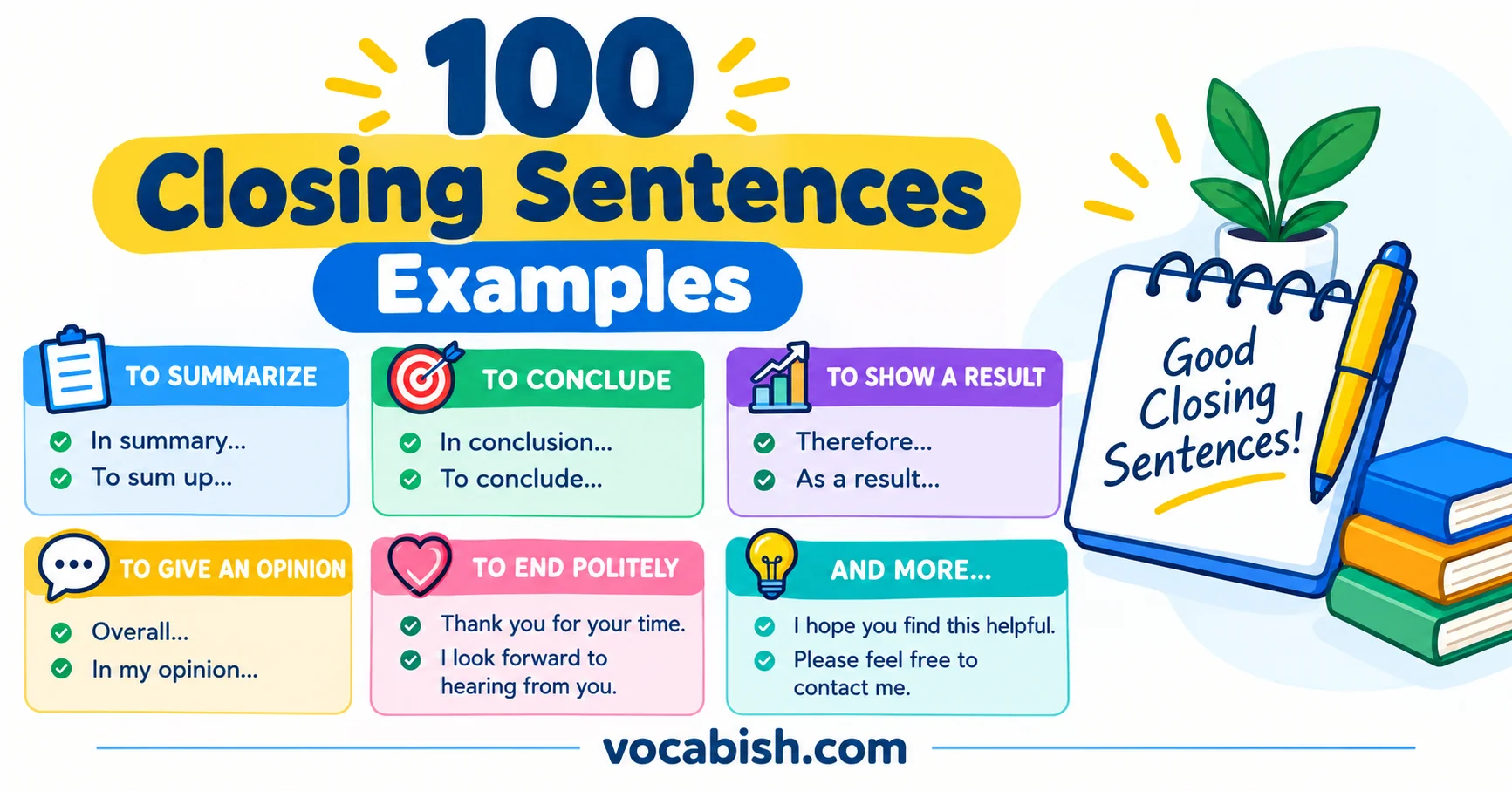
- In conclusion, regular practice can improve your English.
- To sum up, we need to arrive early and bring our documents.
- In summary, the meeting was productive and informative.
- Overall, I had a wonderful experience at the event.
- All in all, the trip was worth the money.
- In the end, we decided to accept the offer.
- To conclude, everyone agreed to follow the new schedule.
- Ultimately, she chose the job that offered more flexibility.
- In brief, the project was completed successfully.
- To wrap things up, let’s review the main points before we finish.
Common Transitional Phrase Mistakes
Learners sometimes choose a transition that does not match the relationship between two ideas. Watch for these common problems:
- Do not use however when you are adding a similar idea; use a transition such as also or in addition.
- Do not use therefore unless the second idea is a result of the first.
- Use for example or for instance when introducing a specific example.
- Use finally for the last point or step, not simply because something happens later.
- Do not add several transitional phrases together when one clear transition is enough.
Practice: Complete the Sentences
Choose a suitable transitional phrase for each sentence.
- I was tired; ________, I finished my homework.
- We missed the train; ________, we had to take a taxi.
- Many people enjoy sports; ________, my brother loves football.
- ________, wash the vegetables before cooking them.
- The hotel was expensive; ________, the service was excellent.
- I finished my work. ________, I went home.
- ________, we need to discuss the most important problem.
- Sarah likes reading. ________, her brother enjoys books about science.
- The road was blocked; ________, we found another route.
- ________, regular English practice can improve your communication skills.
Answers:
- however
- as a result
- for example
- first
- however
- afterward
- most importantly
- similarly
- therefore
- in conclusion
FAQs About Transitional Phrases
Transitional phrases are words or groups of words that connect ideas and show relationships such as contrast, addition, sequence, cause, effect, and conclusion.
Five common examples are however, therefore, for example, in addition, and finally.
Place a suitable transitional phrase between ideas to show their relationship, such as contrast, cause and effect, sequence, or addition.
“I wanted to go outside; however, it started raining.” The word however connects two contrasting ideas.
Common choices include for example, for instance, and such as, depending on how the sentence is structured.
Common contrast transitions include however, nevertheless, on the other hand, in contrast, instead, and still.
Common cause-and-effect transitions include therefore, as a result, consequently, for this reason, and because of this.
They help speakers and writers connect ideas clearly, making conversations, paragraphs, explanations, and essays easier to follow.
Conclusion
These 100 Transitional Phrases Example Sentences show how transitions can connect everyday ideas naturally. Practicing phrases such as however, for example, therefore, next, similarly, in fact, in other words, and in conclusion can make English speaking and writing more organized and fluent.
The best way to learn transitional phrases is to notice how they connect ideas and then use them in your own conversations, school assignments, emails, and short paragraphs.
Explore More Example Sentences