
Should you say “Three hours elapsed” or “Three hours lapsed”? The words elapse and lapse look and sound similar, but they usually describe different situations.
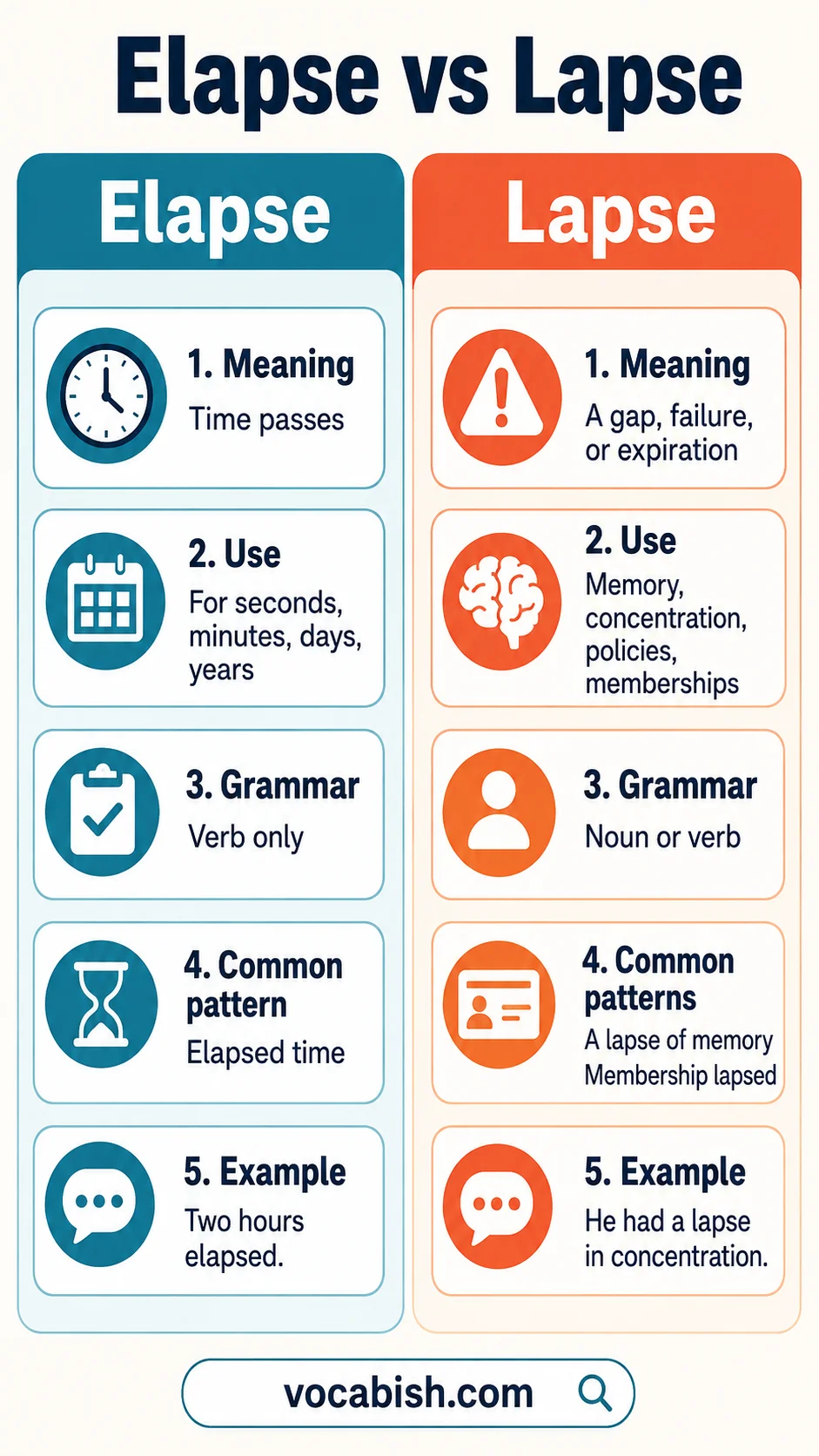
The main difference in elapse vs lapse is straightforward: elapse means that time passes, while lapse usually refers to a temporary mistake, interruption, gap, or expiration. Understanding this distinction will help you discuss time, memory, concentration, insurance, memberships, and many other everyday situations correctly.
Quick Difference Between Elapse and Lapse
Both words can relate to time, but they do not work in the same way. Elapse describes time passing, while lapse usually describes something stopping, failing, expiring, or being forgotten temporarily.
Word | Part of Speech | Main Meaning | Example |
|---|---|---|---|
Elapse | Verb | For time to pass | Two hours elapsed before help arrived. |
Lapse | Noun or verb | A temporary failure, gap, interruption, or expiration | His membership lapsed last month. |
Quick rule:
- Use elapse when a period of time passes.
- Use lapse when something temporarily fails, stops, expires, or is forgotten.
Compare:
- Three weeks elapsed before she received a reply.
- Her gym membership lapsed after she stopped paying.
- He had a brief lapse in concentration.
What Does Elapse Mean?
Elapse is a verb meaning “to pass” when talking about time. It is normally used with a period such as seconds, minutes, hours, days, months, or years.
Elapse Meaning
When time elapses, it passes from one point to another.
Elapse: to pass or go by, especially when referring to time.
Examples:
- Ten minutes elapsed before the bus arrived.
- Several months elapsed between the two meetings.
- A full year had elapsed since their last conversation.
- Only a few seconds elapsed before the alarm sounded.
- How much time elapsed between the accident and the call?
In each sentence, the subject is a period of time. The minutes, months, year, or seconds passed.
Pronunciation of Elapse
Elapse is pronounced:
ih-LAPS
/ɪˈlæps/
The stress falls on the second syllable.
Forms of Elapse
Form | Example |
|---|---|
Base form | Several days may elapse. |
Present simple | Time elapses quickly. |
Past simple | Two hours elapsed. |
Past participle | Three weeks have elapsed. |
-ing form | Time is elapsing. |
The adjective elapsed is also common before the noun time:
- Check the elapsed time on the timer.
- The screen displays the total elapsed time.
- We calculated the elapsed time between departure and arrival.
Elapsed time means the total amount of time that has passed between the beginning and end of an activity.
What Does Lapse Mean?
Lapse can be a noun or a verb. It commonly refers to a temporary failure, a break in attention, a period without activity, or something becoming invalid because it was not renewed.
Unlike elapse, lapse does not normally mean that a number of minutes or hours simply passed.
Lapse as a Noun
As a noun, lapse often means a temporary mistake, failure, interruption, or loss of attention.
Examples:
- She made an error because of a brief lapse in concentration.
- Forgetting his name was a momentary lapse of memory.
- The mistake was a serious lapse in judgment.
- There was a short lapse in communication.
- His rude comment showed a lapse in good manners.
Common expressions include:
- a lapse in concentration
- a lapse of memory
- a lapse in judgment
- a lapse in security
- a lapse in communication
- a momentary lapse
- a temporary lapse
A lapse of memory means a temporary inability to remember something. It does not necessarily indicate a permanent memory problem.
Lapse as a Verb
As a verb, lapse can mean to expire, become invalid, stop being active, or gradually return to a previous condition.
Examples:
- Her insurance policy lapsed because she missed the payment.
- His professional membership has lapsed.
- The offer will lapse at the end of the month.
- Their subscription lapsed last week.
- He lapsed into silence during the conversation.
- After a few months, she lapsed back into her old habits.
In these examples, something ends, becomes inactive, or returns to an earlier state.
Pronunciation of Lapse
Lapse is pronounced:
LAPS
/læps/
It has only one syllable.
Forms of Lapse
Form | Example |
|---|---|
Base form | The agreement may lapse. |
Present simple | The permit lapses tomorrow. |
Past simple | His membership lapsed. |
Past participle | The policy has lapsed. |
-ing form | The agreement is lapsing. |
Elapse vs Lapse: Key Differences
The clearest way to separate these words is to ask what is happening. Is time passing, or is something failing, stopping, expiring, or being forgotten?
Point of Comparison | Elapse | Lapse |
|---|---|---|
Main meaning | Time passes | Something fails, stops, expires, or is interrupted |
Part of speech | Verb | Noun and verb |
Common subject | A period of time | Policy, membership, concentration, memory, judgment |
Common phrase | Elapsed time | Lapse of memory |
Example | Five minutes elapsed. | His insurance lapsed. |
Can describe a mistake? | No | Yes |
Can describe expiration? | No | Yes |
Can directly describe time passing? | Yes | Usually no |
Consider these two sentences:
- Two years elapsed before the building reopened.
- The building remained closed after a two-year lapse in construction.
The first sentence focuses on the passage of two years. The second focuses on a break or interruption in construction.
Elapse or Lapse: How to Choose the Correct Word
To decide between elapse or lapse, identify the main idea in the sentence. The surrounding nouns often tell you which word is needed.
1. Choose Elapse for Passing Time
Use elapse when the sentence answers questions such as:
- How much time passed?
- How long was the delay?
- How many days went by?
- What was the elapsed time?
Examples:
- Thirty minutes elapsed before the doctor called her name.
- Several days had elapsed since the message was sent.
- No more than a minute elapsed between the two events.
2. Choose Lapse for a Temporary Failure
Use lapse for a temporary failure in attention, memory, judgment, behaviour, or performance.
Examples:
- The accident resulted from a lapse in concentration.
- Calling her by the wrong name was a lapse of memory.
- Sharing the password was a serious lapse in security.
3. Choose Lapse for Expiration
Use lapse when an agreement, subscription, policy, licence, membership, or legal right becomes inactive or invalid.
Examples:
- His driving licence lapsed while he was abroad.
- Do not allow your insurance coverage to lapse.
- The contract will lapse unless both parties renew it.
4. Choose Lapse for Returning to an Earlier State
The pattern lapse into means to gradually enter or return to a condition, behaviour, or way of speaking.
Examples:
- The room lapsed into silence.
- He occasionally lapses into his local dialect.
- After the argument, they lapsed into an uncomfortable silence.
- She lapsed back into her old routine.
Common Sentence Patterns with Elapse and Lapse
Learning common patterns makes it easier to use these words naturally. Notice which nouns and prepositions usually appear with each word.
Pattern | Meaning | Example |
|---|---|---|
Time + elapse | A period of time passes | Three hours elapsed. |
Time + have elapsed | Time has passed until now | Several weeks have elapsed. |
Elapsed time | Total time that passed | The elapsed time was 45 minutes. |
A lapse in + noun | Temporary failure or interruption | A lapse in concentration caused the error. |
A lapse of + noun | Temporary loss of something | He had a lapse of memory. |
Something + lapse | Become inactive or expire | Her subscription lapsed. |
Lapse into + state | Gradually enter a condition | The crowd lapsed into silence. |
After a lapse of + time | After a gap or interruption | They met again after a lapse of ten years. |
“After a Lapse of Time”
The expression after a lapse of time is correct because lapse is a noun meaning a gap or interval.
- They returned to the village after a lapse of twenty years.
- The case was reopened after a long lapse of time.
- Communication resumed after a lapse of several months.
This construction differs from using elapse as a verb:
- Several months elapsed before communication resumed.
Both sentences are correct, but their grammatical structures are different.
Common Mistakes to Avoid
Because elapse and lapse have similar spelling and pronunciation, learners sometimes use one in place of the other. These corrections show the standard forms.
1: Using Lapse for Time Passing
Incorrect:
- Three hours lapsed before the train arrived.
Better:
- Three hours elapsed before the train arrived.
Use elapsed because the sentence describes three hours passing.
2: Using Elapse for an Expired Policy
Incorrect:
- My insurance policy elapsed last week.
Correct:
- My insurance policy lapsed last week.
A policy lapses when it expires or becomes inactive.
3: Saying “Elapse of Memory”
Incorrect:
- I had an elapse of memory.
Correct:
- I had a lapse of memory.
A lapse is a temporary failure or loss. Elapse cannot be used as a noun in this expression.
4: Confusing Elapsed Time with Lapsed Time
Standard:
- The app records the elapsed time.
Usually incorrect:
- The app records the lapsed time.
Elapsed time is the standard expression for the amount of time that has passed.
5: Making Elapse Transitive
Incorrect:
- We elapsed three hours at the airport.
Correct:
- We spent three hours at the airport.
- Three hours elapsed while we waited at the airport.
Elapse is normally an intransitive verb, which means it does not take a direct object. Time itself is usually the subject.
An Easy Way to Remember Elapse vs Lapse
A small memory trick can help you separate the two words.
Elapse = Time Goes By
Think:
Elapse = Every minute passes.
When seconds, minutes, days, or years go by, use elapse.
- Five minutes elapsed.
- Many years have elapsed.
Lapse = Loss or Letting Something Expire
Think:
Lapse = a temporary Loss.
A lapse may involve a loss of memory, concentration, judgment, validity, or activity.
- a lapse of memory
- a lapse in judgment
- a lapsed membership
You can also remember this one-line rule:
Time elapses, but attention, memory, policies, and memberships lapse.
Practice: Choose Elapse or Lapse
Complete each sentence with the correct form of elapse or lapse.
- Several minutes __________ before anyone answered the door.
- His gym membership __________ because he forgot to renew it.
- The mistake was caused by a brief __________ in concentration.
- Two years had __________ since their last meeting.
- Do not let your insurance coverage __________.
- She described the forgotten appointment as a temporary __________ of memory.
- The room slowly __________ into silence.
- The clock shows the total __________ time.
- They spoke again after a __________ of several months.
- Only a few seconds __________ between the flash and the sound.
Answers
- elapsed
- lapsed
- lapse
- elapsed
- lapse
- lapse
- lapsed
- elapsed
- lapse
- elapsed
FAQs About Elapse vs Lapse
Elapse means that time passes. Lapse means a temporary failure, interruption, expiration, or return to an earlier condition or behaviour.
“Time elapsed” is the standard expression when describing time passing. “A lapse of time” is correct when lapse functions as a noun.
Say “three hours elapsed” because the sentence describes a period of time passing. Lapsed usually describes expiration, failure, or interruption.
Yes. A lapse can be a temporary mistake or failure, as in “a lapse in judgment” or “a lapse in concentration.”
A lapsed membership is no longer active, usually because it expired or the member failed to renew it or make payment.
Elapse is a verb. The related adjective is elapsed, commonly used in the phrase “elapsed time” for time that has passed.
A lapse of memory is a temporary failure to remember information, such as a name, appointment, password, or recent instruction.
No. Use elapse for time passing and lapse for temporary failures, interruptions, expiration, gaps, or movement into a particular condition.
Conclusion
The difference in elapse vs lapse depends on the meaning of the sentence. Use elapse when seconds, hours, days, or years pass. Use lapse for a temporary failure, gap, interruption, expiration, or return to an earlier condition.
Remember the basic contrast: time elapses, but concentration, memory, policies, subscriptions, and memberships can lapse. This rule will help you choose correctly whenever you are unsure whether to use elapse or lapse.
You May Also Like
